Why Qatar Is the Smart Choice for 2026
Qatar's sweeping business reforms since 2020 have transformed the GCC's wealthiest nation per capita into one of its most accessible markets for foreign entrepreneurs. For founders evaluating where to start a company in Qatar, the timing has never been better.
The government has slashed registration fees by up to 50%, expanded 100% foreign ownership rights across most sectors, and digitized almost the entire company formation process through the Ministry of Commerce and Industry (MOCI) portal, reducing physical office visits to a single appointment in most cases. Anyone starting business in Doha 2026 can now complete much of the paperwork remotely.
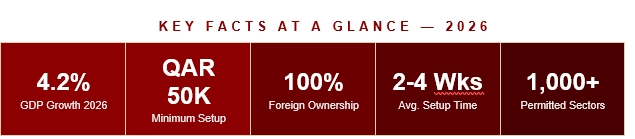
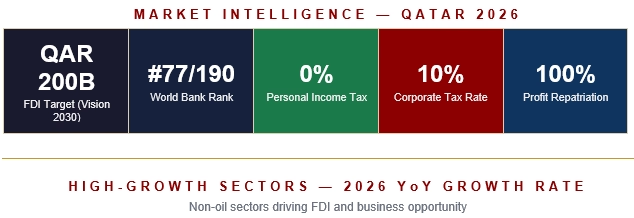
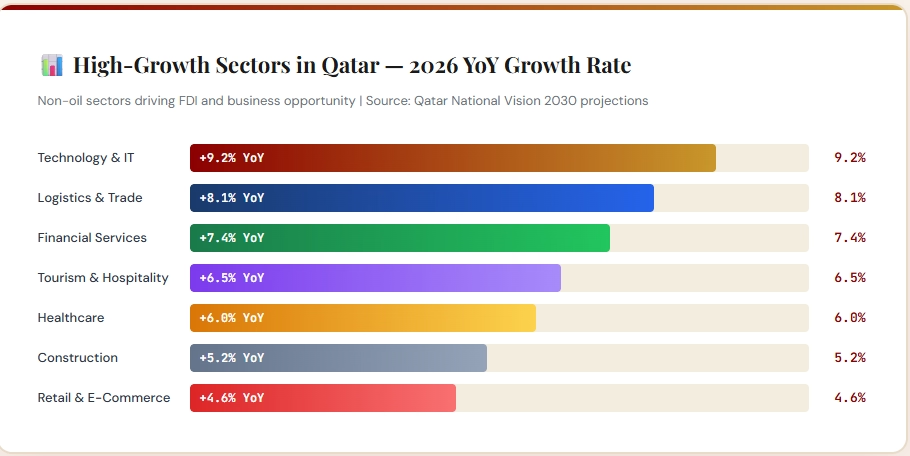
The 2026 landscape is particularly compelling: non-oil sectors are growing at 7% year-over-year; the government's Qatar National Vision 2030 is channeling QAR 200 billion in FDI targets into technology, logistics, and professional services; and the legacy of World Cup 2022 infrastructure continues to attract global firms seeking a regional base. The World Bank ranks Qatar at #77 out of 190 nations for ease of doing business — a significant draw for entrepreneurs considering opening a business in Qatar.
Business Registration Timeline — Step by Step (2026)
Understanding the Qatar company registration process cost requirements 2026 is essential before you file your first document. The roadmap below walks through every stage.
Choose the Right Business Structure
Your choice of legal entity determines your tax liability, capital requirements, operational flexibility, and ability to expand. Qatar offers six principal business structures, each optimized for different investor profiles and activity types. Understanding the distinctions before filing saves weeks of re-application and avoids mismatched licensing.
| Structure | Min. Capital | Ownership | Best For |
|---|---|---|---|
| LLC (W.L.L.) | QAR 200,000 | 100% Foreign | SMEs, trading, retail, services — most popular structure |
| QFC Entity | None required | 100% Foreign | Finance, tech, consulting — 0% tax for 20 years |
| Branch Office | Parent liability | 100% Foreign | Market entry for established foreign parent companies |
| Rep. Office | None required | 100% Foreign | Market research, promotions — no revenue generation |
| Holding Company | QAR 200,000+ | 100% Foreign | Multi-subsidiary management across diverse sectors |
| Joint Venture | By agreement | Shared | Project-based operations and government contracts |
Qatar's MOCI digital portal has compressed what was once a 6-8 week process into just 2-4 weeks for a well-prepared applicant. Understanding each stage's dependencies, required documents, and responsible government body is the key to avoiding the costly delays that affect 40%+ of first-time applicants.
| Timeline | Action Required | Cost (QAR) |
|---|---|---|
| Day 1–2 | Trade Name Reservation via MOCI portal (3 name options) | 1,000–2,000 |
| Day 3–7 | Initial Approval — business plan, SIC code, shareholder details | Free |
| Day 7–10 | Notarize Articles of Association + office lease + capital deposit | 5,000–15,000 |
| Day 10–14 | Commercial Registration (CR) + QCCI Chamber membership | 2,600–8,500 |
| Day 14–18 | Trade License issued (activity-specific, must match SIC code) | 720–15,000 |
| Day 18–21 | Municipality clearance + Tax ID (TIN) from General Tax Authority | 500–2,000 |
| Day 21–28 | Investor + employee visas via MOI portal (medicals + biometrics) | 2,000–10,000/person |
Complete Cost Breakdown — Qatar Business Setup 2026
The 2026 regulatory environment is significantly more cost-efficient than 2022-2024 due to the government's economic diversification incentives. Fees dropped post-2025 reforms; totals below exclude the QAR 200,000 minimum share capital deposit (which is refundable after setup is complete and does not represent a permanent operating expense).
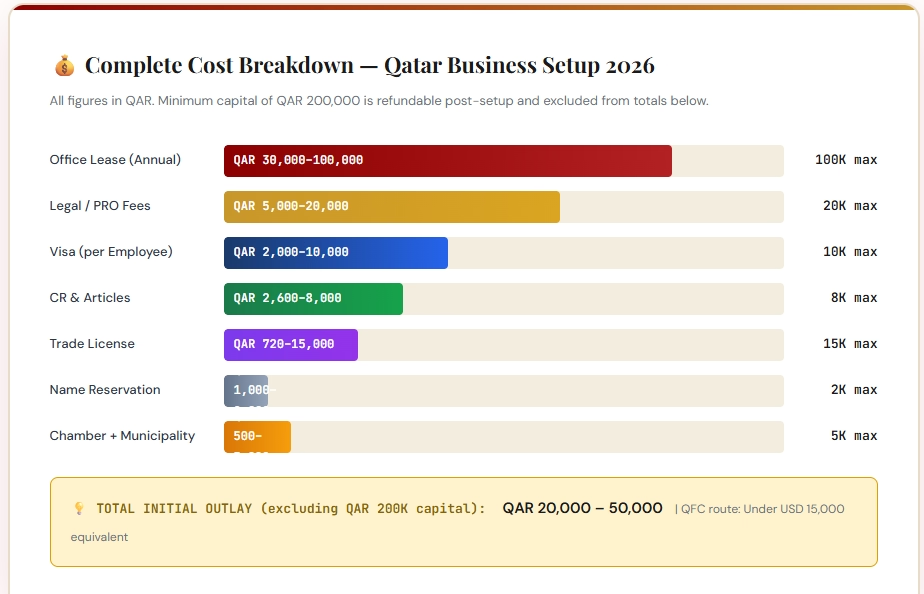
FULL COST REFERENCE TABLE — 2026
| Cost Category | Min (QAR) | Max (QAR) | Frequency | Notes |
|---|---|---|---|---|
| Name Reservation | 1,000 | 2,000 | One-time | MOCI portal; 3 name submissions |
| CR & Articles of Association | 2,600 | 8,000 | One-time | Reduced from prior QAR 10,000+ |
| Trade License | 720 | 15,000 | Annual | Activity-based; commercial is lowest |
| Legal / PRO Fees | 5,000 | 20,000 | One-time | Notary + advisor; QFC adds USD 500 |
| Office Lease | 30,000 | 100,000 | Annual | Doha prime: QAR 100–300/sqm/month |
| Minimum Share Capital (LLC) | 200,000 | 200,000+ | Deposit | Refundable; held in Qatari bank |
| Visa per Employee | 2,000 | 10,000 | Per person | MOI fees + medicals; varies by nationality |
| Chamber of Commerce (QCCI) | 500 | 5,000 | Annual | Renewal ~QAR 3,000–10,000 |
| Municipality Fees | 200 | 2,000 | Annual | Signage, premises clearance |
| Annual Statutory Audit | 8,000 | 30,000 | Annual | Required for all registered entities |
| Corporate Tax | 0 | 10% of profit | Annual | Only on profits exceeding QAR 500,000 |
Mainland vs QFC vs Free Zones
Choosing the right jurisdiction within Qatar dramatically impacts your tax obligations, operational freedom, and access to local markets. This side-by-side comparison is designed for enterprise decision-makers evaluating the optimal market entry route in 2026, while also exploring tools like an AI Instagram post generator to strengthen their digital marketing strategy.
| Feature | Mainland (MOCI) | Qatar Financial Centre (QFC) | Free Zones |
|---|---|---|---|
| Min. Capital | QAR 200,000 | None required | Varies (low) |
| Foreign Ownership | 100% most sectors | 100% always | 100% always |
| Corporate Tax | 10% above QAR 500K | 0% for 20 years | 0% for 10–20 years |
| Qatar Market Access | Full domestic access | Partial access | Export-focused only |
| Governing Law | Qatari Law | English Common Law | Qatari + Zone Rules |
| Setup Timeline | 2–4 weeks | 1–2 weeks | 2–3 weeks |
| Annual Audit | Required | Required | Varies by zone |
| Best For | SME, Trade, Retail | Finance, Tech, Consulting | Logistics, Media, Mfg |
Trade Licences: Types, Fees & Compliance
Qatar's licensing framework is activity-specific. Selecting the wrong licence type or failing to obtain additional sector permits is among the most common and costly mistakes made by foreign investors. Every licence must match the company's SIC code precisely. Mismatches are caught at renewal and trigger financial penalties plus business activity suspension.
TRADE LICENSE TYPES — 2026 FEE SCHEDULE
| Licence Type | Base Fee (QAR) | Renewal (QAR) | Activity Examples | Additional Permits |
|---|---|---|---|---|
| Commercial | 720 | 720–2,000 | Trading, retail, import/export | Customs registration |
| Industrial | 2,000 | 2,000–5,000 | Manufacturing, processing | Environmental clearance |
| Professional Services | 1,500 | 1,500–3,000 | Consulting, legal, IT, accounting | Professional body license |
| Tourism & F&B | 3,000 | 3,000–8,000 | Hotels, restaurants, travel | Qatar Tourism Authority |
| Healthcare | 5,000 | 5,000–15,000 | Clinics, pharma, medical devices | Ministry of Health + MOPH |
| Financial Services | QFC route | USD 500+ | Asset management, insurance, fintech | QFCA authorization |
| Media & Broadcasting | 4,000 | 4,000–10,000 | PR, advertising, production | Ministry of Culture permit |
| Education | 3,500 | 3,500–8,000 | Training centers, schools | Ministry of Education |
Qatar Tax Framework — What You Owe in 2026
Qatar's tax environment is one of the most business-friendly on the planet. There is no personal income tax, no VAT as of 2026, no withholding tax on repatriated profits, and a corporate tax rate that only activates on profits exceeding QAR 500,000. For startups and SMEs in their first 1-2 years, the effective tax rate is often zero — one of the strongest reasons founders are moving to Qatar to start a business 2026.
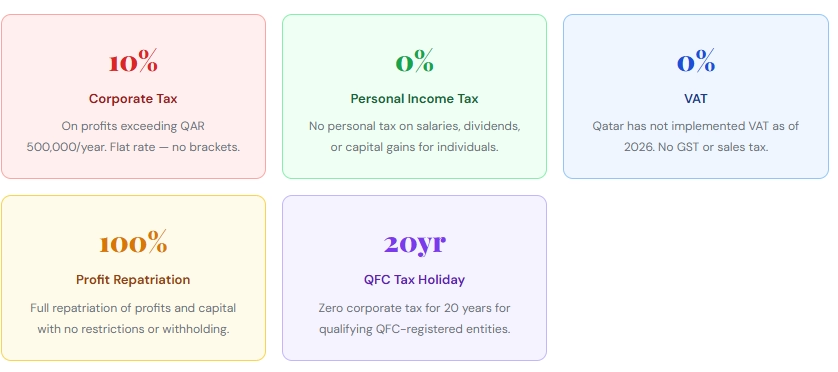 Key rule: Corporate tax at 10% flat rate applies ONLY to annual profits exceeding QAR 500,000. Businesses below this threshold pay zero. All entities must file an annual return with the General Tax Authority by March 31 regardless. QFC-registered companies enjoy full 0% corporate and income tax exemption for 20 years, making QFC one of the world's most favourable free zone regimes for eligible businesses.
4-Week Launch Roadmap: From Idea to Operations
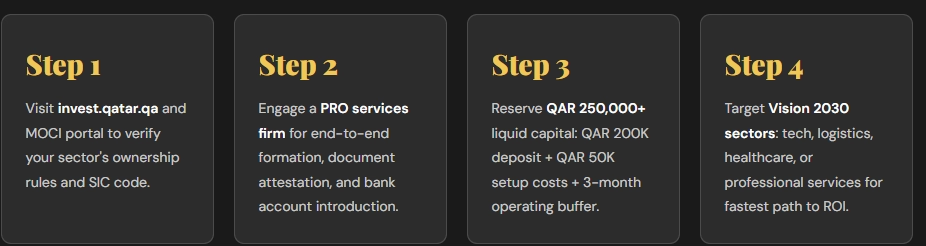
This roadmap represents the fastest compliant route to a fully operational Qatar business in 2026, assuming all documents are prepared in advance and a PRO services partner is engaged from day one. For anyone serious about starting a business in Qatar, budget a QAR 50,000+ buffer beyond the capital deposit, and target your first client engagement for Week 5.
Annual Compliance Essentials
Registering your company is just the beginning. Qatar imposes a structured set of annual obligations on all operating entities. Missing renewal deadlines triggers financial penalties and can result in license suspension. The following is the complete compliance calendar every Qatar business owner must follow.
###Annual Renewal Calendar
- Commercial Registration renewal — QAR 2,600+ annually
- Trade License renewal — QAR 720–15,000 based on activity type
- QCCI membership renewal — QAR 3,000–10,000 per year
- Employee residence permit renewals — QAR 2,000–5,000 per employee annually
- Statutory audited financial statements — mandatory for all entities
- Corporate tax return filing by March 31 each year (even if below threshold)
Qatarization & Labor Compliance
Qatar's Qatarization policy (also called Nationalization) requires businesses in certain sectors to maintain minimum percentages of Qatari nationals in their workforce. Requirements vary by sector — financial services and government-adjacent industries face stricter quotas than technology or consulting firms. Compliance is reported annually to the Ministry of Labor and failure results in license renewal complications.
Banking Requirements
- Local Qatari bank account mandatory for all registered entities
- Capital deposit certificate from bank required before CR issuance
- Account opening typically takes 2–4 additional weeks after CR
- Recommended banks: QNB (Qatar National Bank), Commercial Bank, Doha Bank
- Multi-currency accounts available; SWIFT transfers unrestricted
RISK ASSESSMENT
Opportunities & Challenges
| Key Advantages | Key Challenges |
|---|---|
| ✓ Zero personal income tax on salaries & dividends | ! QAR 200,000 minimum capital for mainland LLCs |
| ✓ 100% profit repatriation, no capital controls | ! Some sectors still require Qatari partner |
| ✓ World-class infrastructure post-World Cup 2022 | ! Office space costs in Doha remain high |
| ✓ Strategic location — 4 hours from 2.6B people | ! Labor quotas (Qatarization) in some sectors |
| ✓ Highly educated, multilingual workforce | ! Arabic documentation requirements |
| ✓ Political stability and strong rule of law | ! Bank account opening: 2–4 additional weeks |
| ✓ Growing non-oil economy with government backing | ! Annual statutory audit required for all entities |
| ✓ QFC: best-in-class financial regulatory environment | ! Employee sponsorship (kafala) adds HR complexity |
Frequently Asked Questions
These are the questions enterprise investors, foreign entrepreneurs, and Indian business owners most commonly ask about how to start a business in Qatar when planning a market entry. Each answer reflects current 2026 regulatory reality.
Q1: What is the minimum capital to form a 100% foreign-owned LLC?
The minimum share capital for a mainland Limited Liability Company (W.L.L.) with 100% foreign ownership is QAR 200,000. This capital must be deposited in a licensed Qatari bank and a certificate obtained before the Commercial Registration can be issued. This capital is refundable once setup is complete. The QFC route bypasses this requirement entirely — no minimum capital applies for qualifying activities.
Q2: How long does business registration realistically take in 2026?
With MOCI's digitized portal, the average end-to-end timeline from name reservation to trade license issuance is 2-4 weeks. Common delays include incomplete documentation at notarization, bank account opening (which adds 2-4 independent weeks), or SIC code mismatches. A PRO services firm typically cuts this to 10-14 calendar days with 95%+ first-submission approval.
Q3: Are employee visas included in the business setup cost?
No — visa costs are separate from company formation fees. After your CR is issued, you can begin sponsoring visas through the MOI portal. Each visa costs QAR 2,000-10,000 depending on nationality, job category, and medical exam requirements. Budget QAR 3,000-5,000 per employee as a conservative estimate, excluding salary and accommodation.
Q4: What are the corporate tax obligations in Qatar?
Qatar imposes a flat 10% corporate income tax on annual profits exceeding QAR 500,000. Businesses below this threshold pay zero corporate tax. No personal income tax, no VAT (as of 2026), and no withholding tax on repatriated dividends. QFC entities enjoy 0% tax for 20 years. All entities must file an annual return with the General Tax Authority by March 31.
Q5: Can Indian entrepreneurs set up a Qatar company remotely?
Yes — most of the formation process can be initiated remotely via MOCI's digital portal and through licensed PRO firms. Documents from India (passports, corporate papers) must be attested and apostilled. Firms like RegisterKaro and Arnifi specialize in Qatar company formation for Indian nationals. Physical presence is typically required only for bank account opening and visa stamping.
Q6: Which sectors still require a Qatari partner or sponsor?
While Law No. 1 of 2019 expanded 100% foreign ownership broadly, restricted sectors requiring a Qatari partner (min. 51%) include: commercial banking, insurance underwriting, legal practice, media broadcasting, distribution of certain regulated goods, and real estate development in non-designated zones for non-GCC nationals. Always verify your specific SIC code with MOCI directly.
Q7: What is the Qatar Financial Centre and who should use it?
The QFC is an onshore financial and business center with its own independent legal framework based on English common law. Key advantages: zero capital, 0% tax for 20 years, 100% foreign ownership, English legal system, fast 1-2 week setup. The QFC restricts permitted activities to approximately 40 categories — it is not suitable for trading, manufacturing, retail, or construction.
Q8: What ongoing annual costs should I budget post-setup?
Annual compliance costs beyond salaries and rent typically include: CR renewal (QAR 2,600+), trade license renewal (QAR 720-15,000), QCCI membership (QAR 3,000-10,000), statutory audit (QAR 8,000-30,000), employee permit renewals (QAR 2,000-5,000 each), and municipality fees (QAR 200-2,000). Budget QAR 40,000-120,000/year for a small-to-medium enterprise with 3-10 employees.
Q9: What is the office space requirement for mainland LLC registration?
All mainland LLCs require a physical Qatarized office of at least 30 square meters within Qatar. A signed lease and landlord NOC must be submitted with the CR application. Central Doha rents range from QAR 100-300/sqm/month — meaning QAR 30,000-100,000+ annually. Co-working arrangements are accepted for QFC entities but must be confirmed with your PRO firm before lease signing.
Q10: What is the expected ROI timeline for a foreign investor in Qatar?
Businesses in high-growth sectors (technology, logistics, professional services) targeting Vision 2030 projects can achieve break-even within 12-18 months and 20%+ ROI in Year 2. Key drivers: zero personal tax, full profit repatriation, gas revenue-backed government spending. F&B and retail businesses typically take 24-36 months to reach sustainable profitability due to higher competition.
Conclusion: Is Qatar Right for You in 2026?
Qatar in 2026 presents a uniquely compelling opportunity for foreign entrepreneurs willing to navigate its structured formation process. The combination of zero personal income tax, 100% profit repatriation, a digitized registration system that delivers licenses in 2-4 weeks, and government-backed FDI targets of QAR 200 billion creates conditions that few GCC jurisdictions can match end-to-end.
For enterprise-scale entrants, the mainland LLC structure offers maximum operational flexibility with access to Qatar's entire domestic market. For financial services, technology, and consulting firms seeking a low-tax, internationally recognized jurisdiction, the QFC represents perhaps the most favorable regulatory environment in the entire Middle East. Budget a realistic QAR 50,000-70,000 for initial setup (excluding the refundable QAR 200,000 capital deposit), partner with an experienced PRO services firm, and target the high-growth sectors — technology, logistics, healthcare — where Qatar's Vision 2030 investment pipeline creates durable demand.