AI app development in Brisbane has moved beyond basic chatbot integrations. Brisbane businesses are increasingly partnering with mobile app development companies in Brisbane to build AI-powered customer and operational solutions. They are adopting AI features that solve specific operational challenges, including tenant automation, fraud detection, and predictive booking. Brisbane-facing AI builds typically run AUD 40,000 to 500,000+ depending on scope, with a straightforward AI feature added to an existing app taking 4 to 8 weeks rather than a full rebuild.
Brisbane's app market has a specific catalyst most other Australian cities don't: the 2032 Olympics. Infrastructure investment, tourism growth, and a compressed timeline to digitize hospitality, logistics, and event services are pulling AI app development forward faster than organic demand alone would. This piece looks at what's actually being commissioned, what it costs, which sectors are moving first, and an honest read on where Brisbane sits relative to Sydney and Melbourne in this market.
Why Brisbane, Why Now
Two forces are compounding in Brisbane's favour right now. First, the 2032 Olympics is functioning as a hard deadline for digital infrastructure investment across tourism, transport, hospitality, and event management, businesses in these sectors are digitizing on a timeline set by the Games, not just competitive pressure. Second, Australia's broader AI adoption curve is accelerating nationally, and Brisbane's small-to-mid business base is positioned to benefit from the same first-mover window seen elsewhere in the country, with AI video generators also gaining traction.
| Metric (National Australia Data) | Figure |
|---|---|
| Australian companies already using AI | 68% |
| Australian SMEs adopting AI | 40% |
| Australia's AI market value, 2024 | AUD 4.80 billion |
| Projected AI market value, 2034 | AUD 295.81 billion (51% CAGR) |
| CSIRO Data61 projected AI economic contribution by 2028 | AUD 315 billion |
Which Brisbane Sectors Are Actually Moving First
Adoption isn't even across Brisbane's economy. Some sectors have a clear, Olympics-linked reason to move now, others are watching and waiting.
| Sector | Why It's Moving Now (or Not) | Typical First AI Feature |
|---|---|---|
| Tourism and hospitality | Direct 2032 Olympics exposure, visitor volume forecasting is a competitive necessity | Predictive booking and dynamic pricing |
| Property and facilities management | Tenant and building inquiry volume makes automation an easy cost case | AI-powered inquiry chatbots pulling from a knowledge base |
| Fintech and lending | Fraud exposure scales with transaction volume, making real-time detection high-value | Real-time fraud and anomaly detection |
| Logistics and transport | Olympics-driven infrastructure and event logistics planning | Route and demand forecasting |
| Mining and resources | Queensland's largest traditional industry, safety and uptime have direct cost impact | Predictive maintenance and safety monitoring |
| Agriculture and agritech | Regional Queensland's core economy, yield and supply chain optimisation have clear ROI | Yield prediction and smart farming analytics |
| Field services (trades, inspections, maintenance) | Scheduling and dispatch overhead is a direct, measurable cost | AI-driven job scheduling and route optimisation |
| Retail and consumer apps | Competitive pressure from personalisation becoming a baseline UX expectation | Behaviour-based recommendations and predictive caching |
A real Brisbane example worth knowing: Coast Smoke Alarms, a Queensland field service business, had a custom offline-first mobile app and backend built from scratch, then added AI-driven scheduling and route optimisation on top. The reported result: roughly 80% of scheduling automated and hundreds of hours saved monthly, replacing manual spreadsheet-based dispatch. It's a useful example precisely because it's a field service business, not a flashy fintech or tourism app, showing the ROI case extends well beyond the obvious sectors.
What's Actually Being Built: Real AI Use Case Categories
Rather than abstract "AI transforms everything" claims, here's what's actually shipping in production for Australian businesses, drawn from real vendor project work rather than marketing copy.
| AI Feature Category | What It Actually Does | Example Sector |
|---|---|---|
| Tenant/customer inquiry automation | Searches a knowledge base, identifies the user's profile, returns a specific answer instantly instead of routing to a human | Property management, facilities |
| Real-time fraud and risk detection | Flags anomalous transaction patterns as they happen rather than in batch review | Fintech, lending |
| Predictive booking and demand forecasting | Anticipates booking volume and adjusts pricing or availability dynamically | Hospitality, tourism |
| Behaviour-based personalisation | Learns which features or services a user engages with most and surfaces them proactively | Retail, co-working, lifestyle apps |
| Predictive caching and performance optimisation | Learns which screens a user is likely to tap next and preloads assets to cut lag | Any high-use consumer app |
The pattern across every real deployment is the same: AI is solving a specific, measurable problem, tenant inquiries that used to take a staff member's time, fraud that used to surface only after the fact, bookings that used to be static. That's the test worth applying before commissioning any AI feature: what specific problem does this solve that a simpler feature couldn't?
What This Actually Costs and How Long It Takes
| Project Type | Typical Timeline | Indicative Cost Range (AUD) |
|---|---|---|
| Focused MVP, no AI | 12 to 16 weeks | 40,000 to 150,000 |
| Adding AI to an existing app | 4 to 8 weeks | Varies by complexity, often the fastest path to a working AI feature |
| Complex app with custom backend and AI integration | 20 to 32 weeks | 150,000 to 500,000+ |
| Agentic AI integration (multi-step autonomous tasks) | Varies by backend complexity | 30,000 to 200,000+ |
The single biggest driver of where a project lands in that range isn't the AI concept, it's whether the existing app was built API-first. Businesses whose apps already expose clean, structured data through APIs can add AI features in weeks. Those with monolithic, tightly coupled apps often need a structural rework before AI integration is even possible, which is where costs and timelines blow out well past initial estimates.
An AI-Readiness Checklist Before You Brief a Developer
- s your existing app's data accessible through APIs, or locked inside a monolithic backend that would need reworking first?
- o you have clean, sufficient historical data for the specific AI feature you want (bookings history for demand forecasting, transaction history for fraud detection)?
- ave you identified the one specific operational problem the AI feature needs to solve, rather than a general "add AI" brief?
- oes your team have the same-timezone availability to run fortnightly review sprints with your development partner?
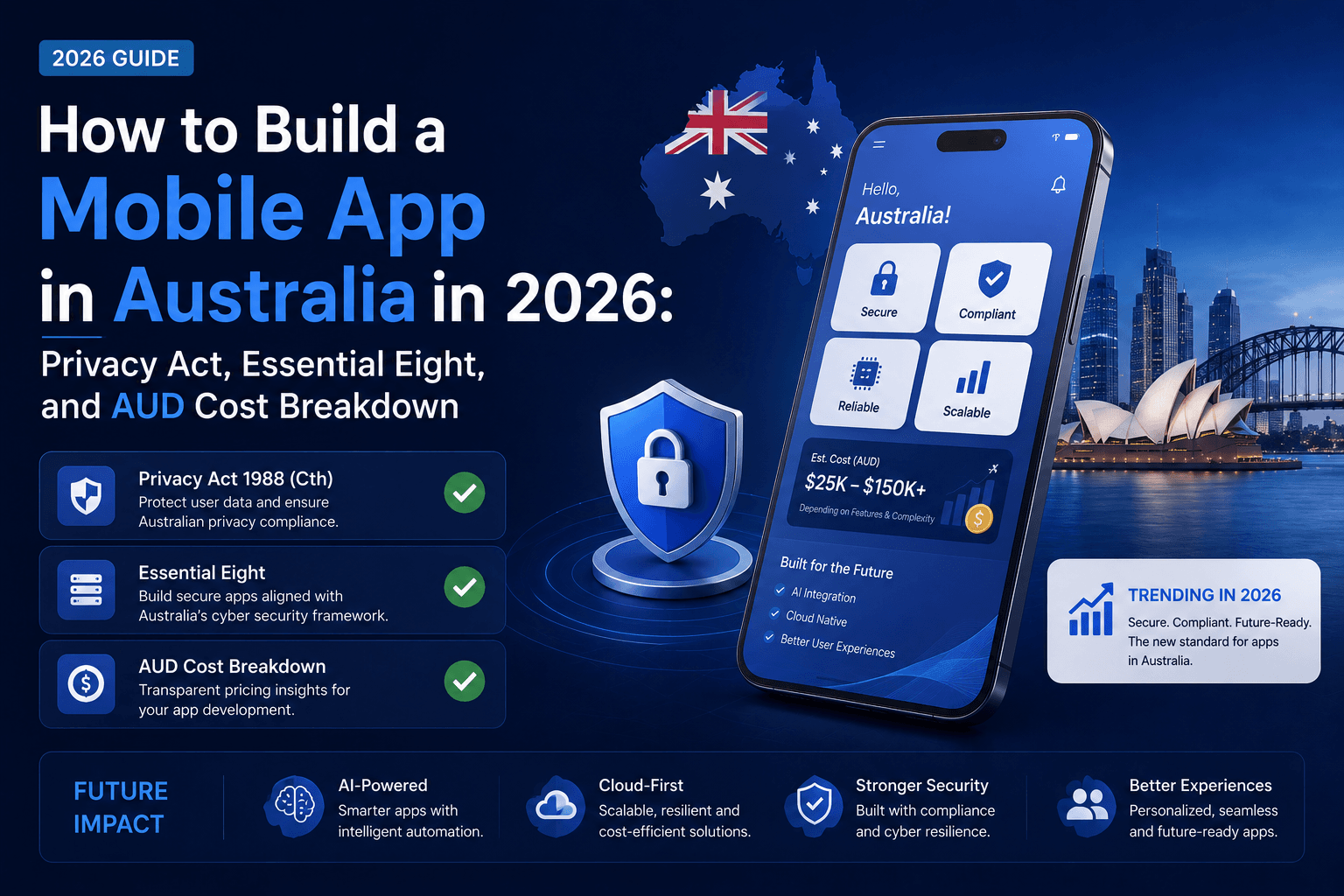
- ave you confirmed IP ownership and Australian Privacy Act compliance terms before sharing any product details?
Security and Compliance: What Actually Applies
Several sectors covered in this piece, fintech, property management, healthcare-adjacent services, handle exactly the kind of personal and financial data that comes with real compliance obligations. The relevant framework is Australia's Privacy Act 1988 and its Notifiable Data Breaches (NDB) scheme, administered by the Office of the Australian Information Commissioner (OAIC), not GDPR, which only applies to businesses processing EU residents' data specifically.
| Requirement | What It Means for a Brisbane AI App |
|---|---|
| Notifiable Data Breach readiness | A documented, tested breach response process is expected, not just preventive controls |
| Data minimisation | AI features should only collect and process the data genuinely needed for the feature to work |
| Encryption in transit and at rest | Increasingly a baseline expectation rather than a premium feature, especially for fintech and property apps |
| AI-specific risk review | Model manipulation and training data poisoning are distinct risks from traditional app security, and need their own review, not just a standard penetration test |
| IP ownership terms | Confirm code, model configurations, and training data pipelines are assigned to you on completion, not licensed back from the vendor |
The practical takeaway: any Brisbane business building AI features into a customer-facing app should treat security and compliance review as part of the same architecture conversation as the AI feature itself, not a separate legal sign-off tacked on before launch. Retrofitting compliance around an AI feature that's already built is consistently more expensive than designing for it from the first sprint.
Local, Interstate, or Offshore: The Honest Market Structure
Here's a structural reality worth knowing before choosing a development partner: a meaningful share of serious mobile and AI work for Queensland businesses is actually delivered by agencies headquartered in Sydney or Melbourne, flying in for kickoffs and milestones, rather than Brisbane-based teams. This isn't necessarily a problem, same-timezone, same-country delivery solves most of the practical concerns that come with offshore outsourcing, IP protection under Australian law, accountable contracts, and overlapping working hours. But it does mean "local Brisbane developer" and "the right developer for a Brisbane business" aren't always the same search.
What actually matters more than a Brisbane postcode: Australian legal jurisdiction for IP and data protection, same-timezone availability for stand-ups and reviews, and a track record with businesses of your specific type (fintech, proptech, hospitality, logistics), not necessarily a CBD office you can walk into.
What Comes Next: The Olympics Timeline Effect
Three things are worth planning around given Brisbane's specific 2032 deadline:
- Tourism and hospitality AI features will compress into a shorter build window than usual. Businesses that wait until 2029 or 2030 to start will be competing for the same limited pool of experienced AI development teams as every other Olympics-adjacent business.
- Agentic AI is moving from experiment to standard offering. Systems that don't just answer a question but complete a multi-step task independently, checking a policy, confirming a user's status, and returning a tailored answer, are increasingly available as a standard service line rather than a bespoke R&D project.
- API-first architecture is becoming a prerequisite, not a nice-to-have. Businesses building or rebuilding an app now should assume AI integration is coming within 12 to 24 months and architect accordingly, retrofitting is consistently more expensive than building API-first from the start.
A Realistic 2026–2032 Timeline for Olympics-Adjacent Businesses
| Window | What Should Be Happening |
|---|---|
| 2026–2027 | API-first architecture decisions, AI readiness audits, early pilot features for tourism and hospitality demand forecasting |
| 2028–2029 | Full AI feature rollouts, agentic AI for customer service and booking systems, infrastructure stress-testing ahead of visitor volume growth |
| 2030–2031 | Peak competition for experienced AI development capacity, businesses starting from scratch here will face longer lead times and higher costs |
| 2032 | Games-time load, systems built and tested well in advance rather than launched close to the event |
Common Mistakes Brisbane Businesses Make With AI Projects
- Briefing "add AI" instead of a specific problem. The businesses getting real ROI have identified one measurable operational cost, tenant inquiry volume, fraud losses, scheduling overhead, rather than asking a developer to "make the app smarter."
- Underestimating data readiness cost. The AI model is rarely the expensive part. Cleaning, structuring, and validating historical data before any model work starts is the most common source of budget and timeline overruns.
- Choosing a vendor on price alone. A cheaper quote that doesn't include a documented breach response process, fixed IP assignment terms, or sector-specific experience often costs more once rework and compliance gaps surface post-launch.
- Treating the 2032 Olympics as a distant deadline. Tourism, hospitality, and logistics businesses waiting until 2029 or 2030 to start will compete for the same shrinking pool of experienced AI development capacity as every other Olympics-adjacent business.
- Skipping the compliance conversation until after launch. Retrofitting Privacy Act and Notifiable Data Breach readiness around an already-built AI feature is consistently more expensive than designing for it from the first sprint.
A Vendor Evaluation Checklist
Before signing with any Brisbane-facing AI development partner, confirm they can answer these directly:
- Is pricing fixed and scoped upfront, or open-ended hourly billing with no ceiling?
- Where does IP assignment sit, do you own the code, models, and data pipelines outright on completion, or is anything licensed back to the vendor?
- Can they show a reference project in your specific sector (fintech, proptech, hospitality, field services), not just a general portfolio?
- What's their actual delivery cadence, fortnightly working demos, or a single reveal at the end of a multi-month build?
- Are they Australian-registered, or does data leave the country during development, and if so, under what terms?
- Do they have a documented approach to Notifiable Data Breach readiness, or is compliance an afterthought bolted on before launch?
Frequently Asked Questions
How is AI actually transforming mobile app development for Brisbane businesses?
The shift is from generic features to specific, measurable automation, tenant inquiry handling, fraud detection, and predictive booking are replacing static app functionality with systems that learn and adapt. The common thread is solving one clear operational problem, not adding AI as a marketing feature.
What does AI app development cost in Brisbane?
A focused MVP typically runs AUD 40,000 to 150,000. Adding AI to an existing app is often the cheapest path to real functionality, typically 4 to 8 weeks. Full custom builds with complex AI integration run AUD 150,000 to 500,000 or more.
How long does it take to add AI to an existing Brisbane business app?
Most AI integrations into an existing app take 4 to 8 weeks, assuming the app was built with a reasonably clean, API-accessible architecture. Apps without that foundation often need structural rework first, which extends the timeline significantly.
Is there a Brisbane-specific AI adoption rate?
Not one that's separately published. Available adoption data is tracked nationally (68% of Australian companies, 40% of SMEs) or by state for larger markets like Victoria, but Brisbane and Queensland-specific figures aren't broken out in the sources reviewed for this piece.
Which Brisbane industries are adopting AI apps fastest?
Tourism, hospitality, property management, and fintech are moving first, tourism and hospitality due to direct 2032 Olympics exposure, property management because tenant inquiry automation has an easy cost case, and fintech because fraud detection value scales directly with transaction volume.
Should I hire a Brisbane-based developer or one from Sydney or Melbourne?
What matters more than the office address is Australian legal jurisdiction, same-timezone availability, and direct experience with your specific industry. A meaningful share of serious Brisbane AI and mobile work is already delivered by interstate Australian teams rather than purely local ones.
What's driving AI app demand specifically in Brisbane right now?
The 2032 Olympics is the clearest local catalyst, compressing the digitization timeline for tourism, hospitality, transport, and event management businesses well ahead of what organic demand alone would produce.
What is agentic AI, and is it relevant for a Brisbane business app?
Agentic AI refers to systems that complete multi-step tasks independently, checking policy documents, confirming a user's account status, and returning a tailored answer, rather than just responding to a single question. It's increasingly available as a standard offering rather than a bespoke research project, with integration costs typically AUD 30,000 to 200,000+ depending on backend complexity.
Do I need to rebuild my entire app to add AI features?
Usually not. Most AI integration work enhances an existing platform rather than starting from scratch, provided the underlying app has a reasonably clean, structured data architecture. Apps built without that foundation are the main exception where a partial rebuild becomes necessary.
What's the biggest reason AI projects go over budget in Brisbane?
Data readiness, not AI model complexity. Businesses with clean, structured historical data move through AI development far faster and cheaper than those where the data itself needs to be collected and structured before any model work can start.
Conclusion
Brisbane's AI app development market is being pulled forward by a hard deadline, the 2032 Olympics, more than by organic demand curves alone, which means the businesses that start now will have first-mover access to experienced local and interstate AI teams before that pool gets stretched thin closer to the Games. The practical priorities are consistent regardless of sector: build (or rebuild) API-first so AI features can be added in weeks rather than months, budget realistically against the AUD 40,000 to 500,000+ range depending on genuine complexity, and choose a delivery partner based on same-timezone availability and sector experience rather than office postcode alone. Tourism, hospitality, and property management businesses have the clearest near-term case to move first, but every sector should treat API-first architecture as a 2026 decision, not a 2030 scramble. The Brisbane businesses ahead of this curve in 2027 will be the ones treating AI readiness as an architecture decision made today, not a feature request made after a competitor already shipped it.
Related Reading
This piece is part of a broader look at how Australian cities are approaching AI app development. See the companion piece on Melbourne mobile app trends for 2026, which covers the same Privacy Act compliance framework alongside Melbourne-specific AI adoption data and named case studies.
Need an AI-powered mobile app for your Brisbane business?
Junkies Coder builds API-first, AI-ready mobile applications for businesses preparing for exactly this kind of growth curve. See our mobile app development services or explore our AI integration work for similar builds.