Discover how cross-platform app development can help your business reach a wider audience and increase user engagement. Learn about the benefits and best practices for creating apps that work seamlessly on multiple devices and platforms. Start building your app today with our expert guidance.

Build Once, Run Everywhere
One Code, Multiple Platforms
Empowering awards and recognition to Drive Innovation and Success with our unparalleled expertise and commitment to excellence.
Years of experience
Countries Served
Average cost P/H
Positive Feedbacks
Happy Success Stories
Experts & Engineers
CORE FEATURES
End-to-end cross-platform engineering using Flutter and React Native, covering architecture, UI design, dual-platform delivery, and post-launch maintenance from a single shared codebase.
Flutter App Development
React Native App Development
Cross-Platform UI/UX Design
Cross-Platform Enterprise App Development
Native App to Cross-Platform Migration
Cross-Platform App Maintenance and Support
Cross-platform apps that feel wrong on one platform are not a cost saving, they are a product failure. The PROOF Standard holds both iOS and Android to equal platform quality standards from the first design review to the final dual-store submission.
Performance, UI behavior, and interaction patterns are benchmarked per platform before development begins. Cross-platform does not mean one standard applied to both, it means the correct standard applied to each.
Flutter versus React Native is evaluated and decided based on your UI complexity, SDK requirements, and team composition with the rationale documented in your project scope. You know why the framework was chosen, not just which one.
You receive full ownership of the shared codebase, all platform-specific modules, and the CI/CD pipeline configuration. The architecture is documented so your team can maintain and extend it independently.
Both platforms are built and distributed to TestFlight and Google Play Internal Testing at every sprint close. No platform falls behind the other at any point during development.
Before handover, the codebase is reviewed against the framework's published upgrade roadmap and a documented upgrade path is provided so your team knows how to handle the next major framework version without a full rewrite.
Every cross-platform application in the Junkies Coder portfolio is live, serving real users across iOS and Android from a shared codebase without compromising platform-native performance.

Industry
Ecommerce
Platform
Cross-Platform - Flutter
Location
Bengaluru, India
Outcomes
Omni-channel Platform
Inspect & Buy App build by Junkies Coder - vision is to provide a seamless, personalized shopping experience that anticipates and fulfills the needs of customers while fostering trust and loyalty through product quality and exceptional services such as Wheelz, in-store shopping and online shopping.

Industry
Social Media
Technology
Swift - iOS
Location
Canada
Outcomes
iOS Music App
iQuQ App is a social music platform that transforms shared music experiences. Create party group, Every participant adds songs, casts votes and shapes live sessions through real time democratic playback.

Industry
Agro Logistics
Technology
Web / IoT / ERP
Location
India
Outcomes
50% Reduction
Vaishnodevi Agro Resources Pvt. Ltd needed a digital tracking system to replace manual agro-logistics processes in Radhanpur, India, covering truck entries, weighbridge, seed processing, lab reporting and dispatch management.
Whether you're looking to develop a digital solution from scratch, scale your current offerings, or fully modernize your system, we are here to help.
OUR EXPERTISE
The cross-platform framework selected at architecture phase determines every engineering and maintenance decision that follows across the product lifecycle.
Platform-adaptive interface design that respects iOS and Android design conventions simultaneously, so your app feels right on both platforms without maintaining two separate design systems.
We migrate your existing native iOS-only or Android-only app to a cross-platform codebase, giving you full platform coverage without rebuilding your product from scratch or losing existing functionality.
Scalable, MDM-compatible cross-platform apps for enterprise internal deployment, built for both iOS and Android device fleets with SSO integration, role-based access, and offline capability baked in.
One codebase, equal standards applied to both platforms throughout every sprint. You get the cost efficiency of shared development with a genuinely great experience on iOS and Android.

Cross-platform is not just about reaching two stores from one codebase. The best cross-platform apps use their shared architecture to enable capabilities that give your product a genuine edge.
01
Ship critical bug fixes and UI improvements to all users on both iOS and Android instantly using CodePush and Shorebird, bypassing App Store and Play Store review cycles entirely for non-binary updates.
02
TensorFlow Lite models, on-device inference, and server-side AI features that work identically on both iOS and Android from a single implementation, eliminating the cost of maintaining platform-specific ML pipelines.
03
Shared offline data layer using Hive, SQLite, or WatermelonDB with a unified sync strategy and conflict resolution logic that behaves consistently on iOS and Android without platform-specific workarounds.
04
When cross-platform APIs cannot access required device capabilities, we write native Swift and Kotlin modules bridged into your Flutter or React Native app, giving you full hardware access without switching frameworks.
05
A single analytics and crash reporting implementation using Firebase, Sentry, or Mixpanel that gives you unified dashboards covering both iOS and Android user behavior, performance, and stability in one view.
06
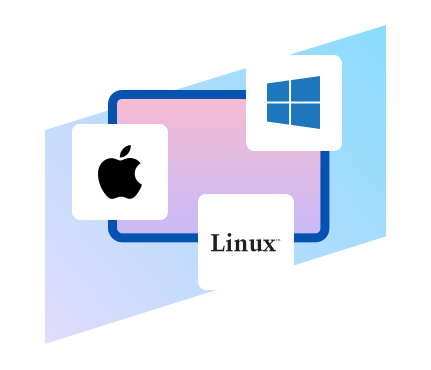
Flutter codebases that extend beyond mobile to web and desktop with targeted adaptation work, letting you reach Windows, macOS, and browser users from the same codebase you built your mobile app on.
When your business serves customers on both iOS and Android and cannot afford to leave either platform behind, cross-platform development is a strategic decision, not just a cost-saving measure. We have delivered it across every major vertical.
Cross-platform development has unique process requirements that differ from native builds. Device testing coverage, platform-specific behavior validation, and dual App Store submission all need to be built into the workflow from day one.
We evaluate Flutter versus React Native for your specific use case based on your UI complexity, backend integration requirements, team composition, and existing codebase, then document a scope that accounts for platform-specific requirements on both iOS and Android.
Platform-adaptive Figma designs that respect iOS Human Interface Guidelines and Android Material Design simultaneously, reviewed and signed off by your stakeholders before a single line of Dart or JavaScript is written.
Two-week sprints with working builds delivered to both TestFlight and Google Play Internal Testing at each sprint end, so your team can test on real iOS and Android devices simultaneously throughout development.
QA coverage across a physical device matrix of both iOS and Android devices, testing functional behavior, platform-specific UI rendering, performance, accessibility, and OS version compatibility in every release cycle.
We handle App Store and Google Play submissions in parallel, managing both sets of metadata, screenshots, compliance requirements, and review processes so your app launches on both platforms on the same date.
A single maintenance stream that handles OS compatibility updates for both platforms, bug fixes applied once and deployed everywhere, and feature iteration that stays synchronized across iOS and Android.
Shalehin Modasia
Marketing DirectorENGAGEMENT MODELS
From first-time founders validating a two-platform MVP to enterprise teams needing a dedicated cross-platform squad, we offer structured engagement models that align with where your product is and where it needs to go.
A full team of Flutter or React Native developers, a cross-platform UI/UX designer, a QA engineer, and a project manager fully committed to your product and working in your timezone from kickoff.
Get a free consultationFor products with a defined feature set and dual-platform launch target, we deliver against a fixed specification with milestone billing and simultaneous iOS and Android App Store submission included.
Get a free consultationSenior Flutter or React Native developers embedded into your existing team, contributing to your cross-platform codebase from sprint one with zero onboarding delay and full alignment to your processes.
Get a free consultationReal stories from real partners who experienced clarity, accountability, and measurable business growth.
We build with the two frameworks that have proven themselves in enterprise cross-platform production environments, Flutter and React Native, selected based on the specific requirements of your product rather than team preference.
Featured Technologies
Flutter
Dart
Flutter Desktop

Riverpod

BLoC

GetX
Every cross-platform application Junkies Coder delivers is engineered against the applicable regulatory framework and store submission requirements at the architecture layer, documented for audit and enterprise procurement processes.

GDPR
CCPA

DPDP Act, 2023
PIPEDA

PCI DSS
PSD2
ISO/IEC 27001
OWASP

Apple App Store Review

Google Play Developer Policy

WCAG

HIPAA

COPPA
Cross-platform done poorly produces apps that feel wrong on both platforms. Done correctly, it produces apps that feel right on both, ship faster, and cost less to maintain over their lifetime.
We evaluate Flutter versus React Native based on your UI complexity, animation requirements, and backend integration before recommending either, not our default preference.
iOS and Android builds are developed, tested, and submitted to their respective stores in parallel so your product launches on the same date on both platforms.
Our cross-platform UI approach adapts navigation and interaction design to each platform's conventions from a single design system so your app feels native on both.
Business logic and state management are shared across platforms while platform-specific behaviors are handled through native modules in Swift and Kotlin when required.
A single CI/CD pipeline manages builds for both platforms simultaneously, and OTA update infrastructure pushes changes to both iOS and Android users at the same time.
We document the shared codebase architecture so your team can maintain and extend the app after delivery without requiring our involvement for every change.

Cross-platform app development is the practice of building a single application codebase that compiles and runs on multiple operating systems, primarily iOS and Android, from the same shared code. Native app development produces separate applications for each platform using platform-specific languages: Swift and SwiftUI for iOS, Kotlin and Jetpack Compose for Android. The core difference is maintenance scope. A native approach requires two engineering teams, two QA cycles, two deployment pipelines, and two feature implementation tracks for every update. A cross-platform approach shares the business logic, state management, API integration, and large portions of the UI layer across both platforms, reducing ongoing development overhead by 40 to 60 percent for most feature releases. The practical trade-off is that native development gives full access to every platform API at the moment Apple or Google releases it, while cross-platform frameworks require a framework update cycle to support new platform APIs. For applications whose feature requirements are satisfied by current cross-platform framework capabilities, this trade-off rarely matters in production.
Cross-platform development is the correct choice when three conditions are met. First, the application's required features are available through Flutter or React Native without native module workarounds. Second, the business needs to reach iOS and Android users simultaneously within a budget that does not support two separate engineering streams. Third, the long-term maintenance model benefits from a shared codebase where feature releases do not require coordinating two engineering teams. Native development remains the correct choice when the application requires hardware APIs that cross-platform frameworks do not yet expose, when the UI requires deeply platform-specific interactions that the cross-platform rendering engine cannot replicate, or when the application's performance profile is at the upper limit of what the framework's rendering layer can achieve, as in high-frame-rate games or complex real-time graphics applications. For most enterprise applications in ecommerce, fintech, healthcare, and logistics, cross-platform development addresses all feature requirements without the limitations of native exclusivity.
Flutter and React Native represent two different architectural approaches to cross-platform development, and the choice between them shapes every subsequent technical decision in the engagement. Flutter uses Dart as its programming language and renders UI through its own Skia graphics engine, meaning it does not use platform-native UI components. This gives Flutter pixel-precise design consistency across iOS and Android: the same widget renders identically on both platforms. React Native uses JavaScript and TypeScript and renders through the host platform's native UI component library. This means React Native applications use iOS navigation patterns on iOS and Android navigation patterns on Android, giving them a more platform-native interaction feel at the cost of design consistency across platforms. Flutter is the correct choice when design consistency across platforms is the priority and when the development team is open to adopting Dart. React Native is the correct choice when platform-native interaction feel matters more than cross-platform design consistency, or when the team already has JavaScript expertise that accelerates development velocity.
Junkies Coder's cross-platform engineering stack is selected during the discovery phase based on the application's specific requirements. For Flutter engagements, the stack includes Flutter 3.x with Dart, BLoC or Riverpod for state management, Dio for API communication, Hive or Isar for local data storage, and Firebase for authentication, cloud messaging, and analytics. For React Native engagements, the stack includes React Native with TypeScript, Redux Toolkit or Zustand for state management, React Query for server state, React Navigation for routing, and Expo for managed workflow engagements where it reduces native module complexity. Backend infrastructure across both frameworks covers Node.js for real-time API requirements, GraphQL for flexible data fetching, PostgreSQL and Redis for data management, and AWS or Google Cloud for deployment and scaling. CI/CD tooling includes Fastlane for automated build and deployment, Bitrise or GitHub Actions for pipeline orchestration, and Sentry for post-launch error monitoring across both platforms.
Cross-platform app development cost in 2026 ranges from USD 25,000 for a well-scoped MVP to USD 200,000 or above for enterprise-grade applications with complex native integrations, compliance requirements, and multi-region infrastructure. A standard cross-platform MVP with core features, authentication, an API backend, and App Store and Play Store deployment typically requires USD 25,000 to USD 60,000 across a 10 to 16 week engagement. A mid-complexity application with payment processing, real-time features, third-party integrations, and a production-grade backend typically requires USD 60,000 to USD 120,000 across a 16 to 24 week engagement. Enterprise cross-platform applications with AI capabilities, HIPAA or PCI DSS compliance requirements, multi-region deployment, and long-term sprint capacity represent an investment above USD 150,000. The primary cost drivers are feature complexity, the extent of native module requirements, the compliance architecture needed for the target industry, and the backend infrastructure scope required to support the application's real-time and data management needs.
Cross-platform app development timeline depends on feature complexity, native integration requirements, and backend scope. A focused MVP with core features, standard authentication, and a clean API backend typically takes 10 to 16 weeks from discovery to App Store and Play Store approval. This breaks down as follows: discovery and technical architecture occupies weeks one and two, producing the framework selection assessment, feature specification, and API contract. UI design and prototyping runs from week two through week six. Development and QA testing runs from week four through week twelve to fourteen. App Store and Play Store submission and review occupies the final two weeks, with Apple's review process typically taking three to seven days and Google Play's review taking one to three days. Applications with complex native integrations, compliance requirements, or advanced real-time features require 16 to 28 weeks. The most common timeline risk is scope expansion during UI design, where additional platform-specific interaction requirements emerge that were not captured in the initial feature specification.
Quality assurance for cross-platform applications covers three distinct dimensions that native QA processes do not always address. First, UI fidelity testing verifies that the application renders correctly across the full range of device sizes and operating system versions for both iOS and Android, including edge cases like notch layouts, dynamic type sizing on iOS, and back button behaviour on Android. Second, performance testing validates frame rates, memory usage, and startup time across low-end Android devices, where cross-platform framework performance overhead is most visible. Third, native integration testing verifies that any native modules or platform channels behave correctly on both platforms, as failures in the native bridge layer typically manifest differently on each operating system. Security implementation follows OWASP Mobile Security Testing Guide guidelines: certificate pinning for API communication, secure local data storage using platform-native encryption APIs, biometric authentication implementation using Flutter's local_auth or React Native's biometric libraries, and runtime application self-protection where the compliance requirements demand it.
Cross-platform development delivers the strongest commercial return in industries where the application's feature requirements are met by current framework capabilities and where the business needs simultaneous iOS and Android coverage. Ecommerce applications are the most common use case: product catalogues, shopping carts, payment processing, push notifications, and order tracking are all well-served by Flutter and React Native. Fintech applications covering personal finance, investment tracking, and digital banking benefit from cross-platform's single codebase for compliance-aligned security implementations. Healthcare applications covering patient portals, appointment scheduling, and remote monitoring use cross-platform for cost-efficient multi-platform delivery with HIPAA-aligned security. Logistics and field operations applications covering driver tracking, delivery management, and warehouse operations benefit from cross-platform's offline data synchronisation capabilities and the reduced maintenance overhead of a shared codebase across the diverse Android device fleet common in logistics operations.
Migrating an existing native iOS or Android application to a cross-platform framework is a structured engineering engagement that Junkies Coder delivers in phases. The migration process begins with a technical assessment that inventories the existing application's native API usage, identifies which features require native modules in the target cross-platform framework, and documents the data architecture and backend API contracts that the new application must maintain compatibility with. Migration is typically phased rather than a full rewrite: the shared business logic, state management, and API integration layer are rebuilt first in the target framework, then the UI is reimplemented screen by screen against the existing design system. This approach maintains the existing native application as the production version throughout the migration, with the cross-platform version launched only after QA parity with the native baseline has been achieved. The timeline for a typical native-to-cross-platform migration ranges from 12 to 20 weeks depending on the complexity of the original native application and the extent of native API dependencies.
Every cross-platform app development engagement begins with a discovery consultation that covers five questions. First, what platforms does the application need to target immediately and in the next 12 months? Second, what native device capabilities does the application require? Third, what is the team's existing technology expertise and what framework learning curve is acceptable? Fourth, what is the performance profile of the application and are there frame rate or real-time requirements that constrain framework choice? Fifth, what is the long-term maintenance model and who will own the codebase after initial delivery? The answers to these questions determine the framework selection and the engagement structure. The discovery phase produces a framework selection document, a feature specification, an API contract, a technical architecture document, and a sprint plan with milestone deliverables. All discovery outputs are owned by the client. Contact the Junkies Coder team at junkiescoder.com to schedule the initial discovery consultation. Engagements are acknowledged within two business hours.