Custom artificial intelligence solutions for fintech, healthcare, logistics and enterprise verticals, engineered against your compliance architecture and delivered through a governed, outcome-accountable framework.

Automate Processes with Smart AI
Custom AI Solutions for Your Business
Empowering awards and recognition to Drive Innovation and Success with our unparalleled expertise and commitment to excellence.
Years of experience
Countries Served
Average cost P/H
Positive Feedbacks
Happy Success Stories
Experts & Engineers
CORE FEATURES
End-to-end AI engineering from use case feasibility and data pipeline development to model training, production deployment, and ongoing MLOps so your AI investment delivers measurable business outcomes.
Custom AI Solution Development
Generative AI and LLM Development
AI Agent and Agentic Workflow Development
Machine Learning Model Development
Computer Vision and NLP Development
AI Integration Into Existing Systems
AI projects without defined success metrics produce demos, not business outcomes. The PROOF Standard requires measurable performance benchmarks, responsible data assessment, model ownership transfer, accountable experiment reporting, and future-ready MLOps infrastructure at every stage of every AI engagement.
The business metric the AI system is built to move (cost reduction, processing time, accuracy improvement, conversion rate) is defined and agreed before any data preparation or model development begins. Model accuracy scores alone are not accepted as success criteria.
Your data quality, volume, labeling coverage, and structural adequacy are assessed against the requirements of your target AI use case before any development commitment is made. If your data cannot support the use case, we tell you before taking the engagement.
Trained model files, training datasets, feature engineering code, and experiment logs are transferred to your infrastructure at every milestone checkpoint. You own your AI system's complete lineage, not just the final model artifact.
Every model development milestone produces a written experiment report covering training metrics, validation results, benchmark comparison, and next iteration rationale. Your stakeholders understand what was built and why, not just what the accuracy score was.
Automated retraining pipelines, model performance monitoring, data drift detection, and A/B model comparison infrastructure are deployed alongside the model so your AI system improves over time rather than degrading silently after launch.
Every AI system in the Junkies Coder portfolio is live in production, serving real operational requirements and delivering outcomes measured against the business benchmarks confirmed at the start of the engagement.

Industry
Ecommerce
Platform
Cross-Platform - Flutter
Location
Bengaluru, India
Outcomes
Omni-channel Platform
Inspect & Buy App build by Junkies Coder - vision is to provide a seamless, personalized shopping experience that anticipates and fulfills the needs of customers while fostering trust and loyalty through product quality and exceptional services such as Wheelz, in-store shopping and online shopping.

Industry
Automotive
Platform
Web-Based B2B Marketplace
Location
Dubai, UAE
Outcomes
Scalable B2B Marketplace
SourceVehicle is a vehicle inventory aggregator connecting dealers with global buyers for passenger and commercial vehicles.Junkies Coder builds a scalable B2B marketplace with inventory management, multi-currency transactions, logistics and secure payments.

Industry
Agro Logistics
Technology
Web / IoT / ERP
Location
India
Outcomes
50% Reduction
Vaishnodevi Agro Resources Pvt. Ltd needed a digital tracking system to replace manual agro-logistics processes in Radhanpur, India, covering truck entries, weighbridge, seed processing, lab reporting and dispatch management.
Whether you're looking to develop a digital solution from scratch, scale your current offerings, or fully modernize your system, we are here to help.
OUR EXPERTISE
AI promises often don’t match production reality. Junkies Coder fixes this with a mandatory architecture review before any model training.
We design and build custom AI solutions aligned to your specific business problem, data environment, and operational workflows, moving from validated proof of concept to production deployment without the usual enterprise delays.
We build Generative AI applications powered by large language models, including document intelligence, content generation, AI-assisted search, and enterprise knowledge bases that work on your proprietary data.
Autonomous AI agents that perceive context, make decisions, and execute multi-step tasks across your enterprise systems without constant human oversight, built for procurement, customer service, and operations workflows.
Supervised, unsupervised, and reinforcement learning models built on your own datasets, trained for your specific prediction targets, and deployed into your production environment with ongoing performance monitoring.
We embed AI capabilities into your current software stack, CRM, ERP, mobile apps, and internal tools, adding intelligence to systems you already use without requiring a platform replacement.
A structured evaluation of your data assets, infrastructure, team capabilities, and use case viability that tells you exactly where AI can deliver measurable ROI and what it will take to get there.
We define your success metric and validate data readiness before building anything. Your AI initiative delivers a result your leadership can measure and your organization can build on.

Beyond standard AI model development, we bring engineering depth in the advanced AI capabilities that enterprise clients increasingly require as they move from first AI deployments to organization-wide AI adoption.
01
RAG architectures that ground your LLM's outputs in your own verified business documents, knowledge bases, and data sources, eliminating hallucinations and giving your AI system answers that are accurate, traceable, and current.
02
Multi-agent systems where specialized AI agents collaborate to complete complex multi-step business processes, from lead qualification to procurement approval to financial reconciliation, with defined escalation paths and audit trails.
03
Object detection, image classification, visual inspection, document digitization, and video analysis systems built for quality control, security monitoring, medical imaging, and retail shelf analytics use cases.
04
Custom NLP pipelines for contract analysis, sentiment monitoring, document classification, entity extraction, and multilingual text processing built on your domain-specific vocabulary and document types.
05
Time-series forecasting, demand prediction, churn modeling, risk scoring, and anomaly detection models trained on your historical data and integrated into your operational systems for real-time decision support.
06
Lightweight model optimization and on-device inference deployment for AI applications that need to run on mobile devices, IoT hardware, or industrial equipment without a constant cloud connection.
AI delivers the most measurable value in industries where decisions are complex, data volumes are high, and the cost of wrong answers is significant. These are the sectors where we focus our domain expertise alongside our engineering capability.
AI development is not a linear software project. It involves data discovery, model experimentation, and validation cycles that require a different process discipline. Ours is built around that reality.
We identify the highest-value AI use case for your organization, assess your existing data assets for quality and volume, define measurable success criteria, and produce a feasibility report before any model work begins.
We design and build the data ingestion, cleaning, labeling, and feature engineering pipelines that your AI model needs to train effectively, because no model performs better than the data it learns from.
Iterative model development with structured experiment tracking, hyperparameter optimization, and benchmark comparisons against baseline performance, with regular reviews so your team understands what is being built and why.
Model performance validation against held-out test data, edge case analysis, bias and fairness testing, and explainability review before any model is approved for production deployment.
Model serving infrastructure, API endpoints, monitoring dashboards, automated retraining triggers, and alerting pipelines deployed to your cloud environment with full documentation and team knowledge transfer.
Ongoing model performance monitoring, drift detection, periodic retraining on new data, and use case expansion support so your AI system improves over time rather than becoming stale after its initial deployment.
Shalehin Modasia
Marketing DirectorENGAGEMENT MODELS
AI projects look very different depending on whether you are exploring a use case for the first time, scaling a validated model, or embedding AI across an enterprise product. We offer three engagement structures designed for each of those situations.
A time-boxed engagement where we evaluate your use case, assess your data readiness, define success metrics, and build a working proof of concept that proves business value before a full development commitment is made.
Get a free consultationA dedicated team of AI engineers, ML specialists, a data engineer, and a project manager embedded in your product workflow, building and iterating on your AI systems with full accountability to your roadmap and KPIs.
Get a free consultationFor organizations with a validated AI model or third-party AI tool that needs to be integrated into existing products and workflows, we run structured integration sprints with defined deliverables and go-live timelines.
Get a free consultationReal stories from real partners who experienced clarity, accountability, and measurable business growth.
We select AI tooling based on your use case requirements, data environment, deployment constraints, and the long-term operability of the system by your team, not on which framework is generating the most conference talks this quarter.
Featured Technologies

OpenAI GPT-4o
Anthropic Claude
Google Gemini

Meta LLaMA
Mistral

Cohere
Enterprise clients expect strict compliance in AI development. Junkies Coder ensures regulatory readiness and documentation before any model training begins.

GDPR
ISO 27001

PCI-Dss
SOC 2
CCPA
HIPPA
FISMA

Data Protection Act

AI Ethics Guidelines
NIST

IEEE

AI EU Act

Explainable AI

FCRA
ISO 9001

ISO 42001

AI Model Transparency and Interpretability Standards

AI Algorithms Testing and Validation Guidlines

Model Training & Evaluation Frameworks

Edge AI Development Guidelines
Most AI vendors sell capability. We deliver outcomes. The difference is that we define a measurable business metric before building anything and treat production deployment as the actual deliverable.
We assess your data quality, volume, and structure against the requirements of your target use case and give you an honest feasibility assessment before any development commitment is made.
We train and fine-tune models on your own business data so your AI system understands your products, customers, and industry vocabulary rather than producing generic outputs.
Automated retraining pipelines, model performance dashboards, data drift detection, and alerting are deployed alongside every production AI system so your model is actively maintained after launch.
Model decision explanations, confidence scores, prediction audit logs, and override mechanisms are built into every AI system so your compliance team can answer regulator questions about AI decisions.
Bias detection, fairness metric evaluation, output boundary testing, and human-in-the-loop escalation are standard components of every AI engagement, not optional add-ons for regulated industries.
We define measurement instrumentation alongside the AI system so you can track the business metric the AI was built to move, connecting model performance to outcomes your leadership reports on.

An AI development company is a technology services firm that engineers artificial intelligence systems as production-ready software components, not research prototypes or vendor-bundled integrations. The core deliverable is a custom AI system built against your specific business problem, your existing data infrastructure and your operational constraints, rather than a pre-built tool licensed from a third party. The scope of what an AI development company delivers varies by engagement type. Machine learning engagements produce predictive models trained on your proprietary datasets and validated against your defined performance thresholds. Natural language processing engagements produce systems that extract structured information from text, classify intent or generate responses within defined parameters. Computer vision engagements produce image and video analysis pipelines for quality control, document processing or visual intelligence applications. Generative AI engagements integrate large language models or image generation systems into your existing platforms or build new AI-native interfaces around them. The distinguishing characteristic of a structured AI development engagement versus a software integration exercise is the data engineering work that precedes model development. Your datasets must be cleaned, labelled, structured and validated before any model training produces reliable results. A credible AI development company treats data engineering as a core deliverable within the engagement, not a prerequisite the client is expected to handle independently. At Junkies Coder, the data engineering and pipeline build phase is a documented, scoped phase within every AI development engagement.
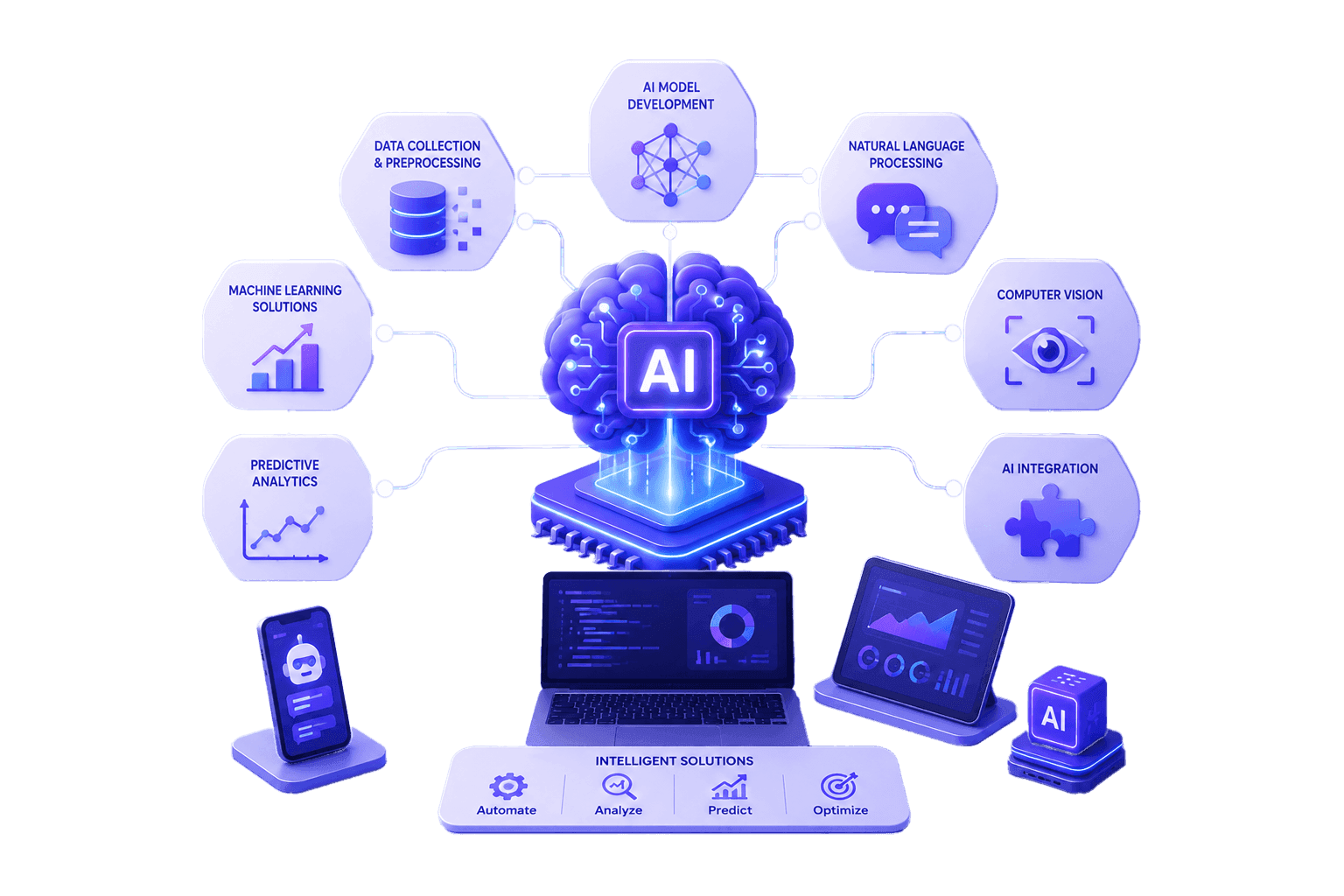
Junkies Coder's AI development services span the full technical lifecycle of artificial intelligence product delivery. The capability set covers machine learning model development, natural language processing, computer vision engineering, generative AI integration, large language model fine-tuning, predictive analytics, intelligent automation and AI strategy consulting. Machine learning engagements cover supervised, unsupervised and reinforcement learning models built for classification, regression, clustering, anomaly detection and recommendation use cases. NLP engagements cover named entity recognition, sentiment analysis, document summarisation, intent classification, information extraction and conversational AI systems. Computer vision engagements cover object detection, image classification, OCR, facial recognition within legally permissible frameworks and visual quality inspection systems. Generative AI development at Junkies Coder covers the integration of foundational models including GPT-4, Claude, Gemini and Mistral into enterprise workflows, as well as the fine-tuning of open-source models on proprietary data for domain-specific accuracy. Retrieval-augmented generation architecture is implemented for knowledge base applications where real-time accuracy and source attribution are operational requirements. AI strategy consulting engagements are scoped for leadership teams that have identified AI as a business priority but require structured guidance on use case prioritisation, data infrastructure readiness assessment and a phased implementation roadmap before committing to a full development engagement. Every Junkies Coder AI engagement, regardless of type, includes compliance architecture documentation and production-grade deployment as core components of the delivery.
Custom AI development delivers measurable operational value across virtually every industry that generates structured data at scale. The industries where Junkies Coder has delivered AI systems and where the return on AI investment is most clearly demonstrable include financial services, healthcare, logistics, ecommerce, manufacturing, real estate and government technology. Financial services organisations use AI for fraud detection, credit risk scoring, trading signal generation, regulatory compliance monitoring and customer churn prediction. Healthcare organisations use AI for diagnostic support tools, patient triage prioritisation, claims processing automation and clinical documentation intelligence. Logistics organisations use AI for route optimisation, demand forecasting, warehouse management automation and supply chain anomaly detection. Ecommerce platforms implement AI for personalised recommendation engines, dynamic pricing models, search relevance improvement and return rate prediction. Manufacturing organisations deploy computer vision and predictive maintenance AI to reduce equipment downtime and quality defect rates. Government technology programmes apply AI to document processing, fraud detection in benefits administration and service demand forecasting. The common factor across all of these applications is that the AI system must operate within an existing data infrastructure, meet the regulatory obligations of the industry and produce outputs that a human operator can validate and act upon. Junkies Coder structures every AI development engagement to address these three requirements regardless of the industry context.
The technology stack for any AI development engagement is determined by the use case, your existing infrastructure, your performance requirements and the regulatory environment the system must operate within. Junkies Coder does not apply a single fixed stack to every AI engagement. The selection rationale is documented in the solution architecture phase and reviewed with your technical leadership before development begins. For machine learning model development, the primary frameworks in use are TensorFlow and PyTorch, with Scikit-learn and XGBoost applied for structured data use cases where deep learning architecture is not required. Hugging Face Transformers is the primary framework for NLP model work, including fine-tuning of foundational language models on proprietary datasets. For computer vision, OpenCV, YOLO and Detectron2 are applied based on the detection and classification requirements of the specific engagement. For vector database and retrieval-augmented generation architecture, Junkies Coder engineers work with Pinecone, Weaviate and ChromaDB depending on the volume and latency requirements of the retrieval layer. MLOps and model lifecycle management is implemented through MLflow and Weights and Biases, with deployment infrastructure managed on AWS SageMaker, Google Vertex AI or Azure Machine Learning based on your existing cloud commitment. Data pipelines are engineered using Apache Spark, Apache Kafka and dbt for transformation and orchestration, with Airflow managing scheduling and pipeline monitoring. LangChain and LlamaIndex are used for LLM orchestration and agentic workflow construction where the engagement requires multi-step AI reasoning chains.
AI development cost is determined by four primary variables: the complexity of the problem the AI system must solve, the volume and quality of data available for model training, the compliance and security architecture the system must meet, and the integration requirements within your existing technology infrastructure. A focused AI engagement covering a single well-defined use case with clean, structured training data, no regulated data categories and a straightforward API-based integration into an existing system typically falls in the range of USD 40,000 to USD 120,000 for a production-ready delivery across a 10 to 16 week timeline. This range covers discovery, data engineering, model development, validation, integration and deployment. A mid-complexity AI engagement covering multiple interconnected models, unstructured training data requiring significant engineering work, integration with enterprise systems such as ERP or CRM platforms, and standard compliance requirements for data privacy under GDPR or PDPL typically falls in the USD 120,000 to USD 350,000 range across a 5 to 9 month delivery. Enterprise AI development engagements requiring custom foundational model training, multi-region deployment, HIPAA or PCI DSS compliance architecture, real-time inference at high concurrency, and a full MLOps infrastructure for ongoing model lifecycle management represent investments above USD 350,000, scoped after a paid discovery and architecture phase. The paid discovery phase for enterprise engagements is typically USD 8,000 to USD 15,000 and produces the architecture document and delivery commitment that governs the full engagement.
AI development timelines are determined by the complexity of the model, the state of the training data, the compliance requirements of the system and the integration scope. The timeline breakdown below applies to a focused, single-use-case AI engagement with available, structured training data. Discovery and data assessment: 2 to 3 weeks. Solution architecture and documentation: 1 to 2 weeks. Data engineering and pipeline build: 2 to 4 weeks, depending on the volume and transformation requirements of the source data. Model development and training: 3 to 6 weeks for a standard supervised learning engagement. Model validation and performance testing: 1 to 2 weeks. Integration, security testing and deployment: 2 to 3 weeks. Total range for a focused AI engagement: 11 to 20 weeks. Timelines extend for engagements where training data requires significant labelling and augmentation work, where the AI system must be integrated with multiple enterprise platforms, or where compliance validation under HIPAA, SOC 2 or GDPR requires additional testing cycles and documentation. Generative AI and large language model engagements that involve fine-tuning on proprietary datasets add 2 to 4 weeks to the model development phase compared to standard ML engagements, due to the computational requirements of fine-tuning and the additional validation required to assess output quality and safety before production deployment. Enterprise AI programmes spanning multiple use cases and a 12 to 18 month roadmap are scoped in phases, with each phase producing a production-deployed deliverable rather than waiting for a single large release.
Compliance and data security are treated as architecture requirements, not post-deployment additions. Before any data is ingested into a Junkies Coder AI development environment, the compliance obligations governing that data are documented and the technical controls required to meet those obligations are specified in the solution architecture. For engagements involving personal data under GDPR, the data handling architecture includes documented lawful basis for processing, data minimisation controls, purpose limitation enforcement at the pipeline level, and the ability to execute data subject access and erasure requests programmatically. For HIPAA-regulated health data, the architecture includes AES-256 encryption at rest and in transit, role-based access controls with audit logging, business associate agreement alignment and the technical safeguards required under the HIPAA Security Rule. For fintech engagements subject to PCI DSS, the data architecture segregates cardholder data from analytical and training data, with tokenisation used wherever model training objectives can be met without exposing raw payment data. For enterprise engagements under SOC 2 or ISO 27001 audit scope, the AI system's security controls are documented to align with the trust service criteria applicable to the engagement. OWASP AI Security guidelines are applied to every model integration to address prompt injection, model inversion, data poisoning and adversarial input risks. Security penetration testing of the AI system's API layer and inference endpoints is conducted before production deployment. Compliance documentation produced during the engagement is delivered to the client and is structured for use in vendor audits and procurement due diligence.
The evaluation of an AI development company should be structured around delivery accountability, not capability marketing. Most AI services providers can demonstrate compelling model outputs in a sales presentation. The evaluation criteria that separate delivery-capable partners from aspirational ones operate at a different level of specificity. First, assess whether the vendor requires a discovery and architecture phase before quoting development cost and timeline. Any AI development company that quotes a fixed price and timeline for a complex AI engagement before assessing your data infrastructure and compliance obligations is quoting without sufficient information. Credible vendors scope AI engagements only after understanding the problem, the data and the constraints. Second, assess the vendor's approach to data engineering. Model performance is determined primarily by data quality, not algorithmic sophistication. A vendor that does not treat data engineering as a core, scoped deliverable within the engagement is likely to underestimate the time and cost required to produce reliable training data. Third, assess whether the vendor has delivered AI systems in your regulatory environment. An AI development company that has never engineered an HIPAA-compliant AI system will not design adequate technical safeguards for a healthcare AI engagement, regardless of their model development capabilities. Request specific examples of compliance architecture delivered for comparable regulatory contexts. Fourth, assess the knowledge transfer model. An AI system that cannot be operated and maintained by your internal team without ongoing vendor dependency creates a long-term commercial risk. Evaluate what documentation, training and operational tooling the vendor delivers as part of the engagement, not as optional add-ons.
The post-deployment phase of an AI development engagement covers four distinct operational requirements that should each be addressed explicitly in the engagement contract before the system goes live. Model performance monitoring covers the tracking of accuracy, latency, error rates and output quality metrics against the benchmarks established in the architecture phase. Junkies Coder configures monitoring dashboards for every production AI system before deployment. These dashboards are operated by your team using the runbooks delivered as part of the engagement handover. Data drift detection covers the identification of changes in the statistical characteristics of the data the model receives in production compared to the data it was trained on. As your production data changes over time, the model's performance will degrade unless it is retrained or updated. The engagement contract defines the retraining trigger thresholds and the process for initiating a retraining cycle. Security patching and dependency management covers the ongoing maintenance of the AI system's infrastructure components, API dependencies and cloud services. For AI systems deployed on AWS, GCP or Azure, this includes updates to the serving infrastructure and monitoring of any security advisories affecting the model's runtime environment. Feature iteration covers the process for adding new capabilities or adjusting the model's behaviour based on feedback from production operations. Junkies Coder structures post-deployment feature work as a defined service rather than an informal support arrangement, with scope, timeline and cost confirmed before each iteration cycle begins.
The starting point for an AI development engagement with Junkies Coder is a discovery conversation, not a requirements document. Most clients who have identified an AI use case have a general problem statement and some familiarity with the data they have available. A discovery conversation covers the business problem, the data situation, the operational constraints and the commercial expectations of the engagement in 60 to 90 minutes. From the discovery conversation, Junkies Coder produces a preliminary engagement assessment that covers: the recommended engagement type based on your data and use case, the primary compliance and security considerations, an indicative timeline and cost range, and a recommendation on whether a paid discovery and architecture phase is appropriate before full development commitment. For engagements where the scope, data quality and compliance requirements are clearly defined from the initial conversation, Junkies Coder can proceed directly to a scoped proposal with a fixed architecture phase cost and a conditional development estimate tied to the architecture output. For engagements where the data situation is uncertain or the use case spans multiple interconnected AI systems, the paid architecture phase produces the foundation for a credible development commitment. To begin, contact the Junkies Coder team at [email protected] or through the consultation form on junkiescoder.com. The initial conversation is without cost or commitment, and the output is a clear picture of what a structured AI development engagement would require and deliver for your specific situation.