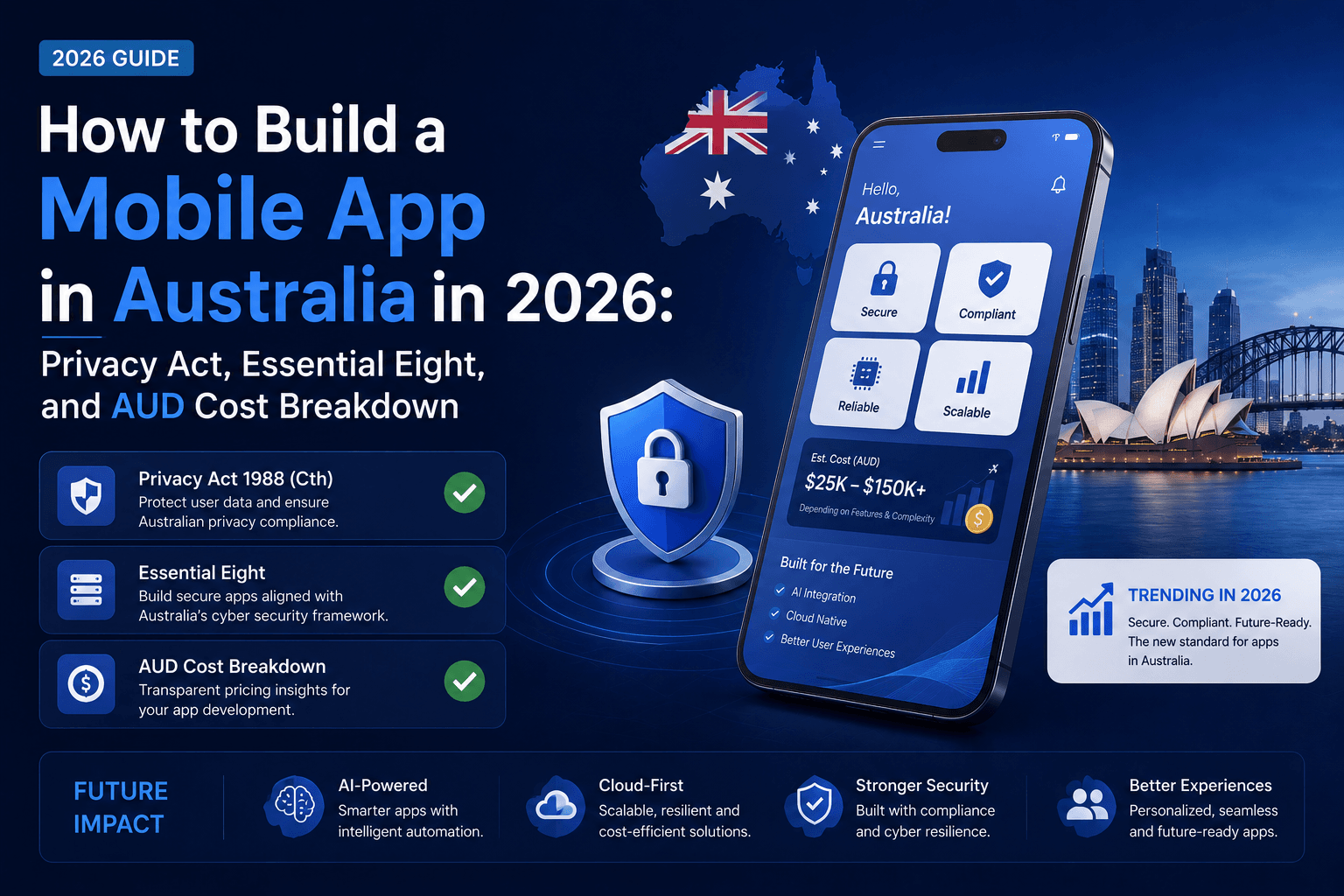
Melbourne's mobile app ecosystem in 2026 is being shaped by three major shifts: AI-powered experiences becoming a standard expectation, stronger security requirements around user data, and increasing demand for scalable digital solutions. Businesses across healthcare, finance, retail, and logistics are moving beyond basic apps and investing in intelligent platforms built for long-term growth.
Melbourne has quietly become one of Australia's most active tech delivery markets. This isn't a hype piece; it's a data-backed look at where the market is heading. Businesses looking for elite mobile app development Melbourne solutions are prioritising architecture that can handle both the extreme scaling of modern AI models and the strict regulatory frameworks of the state.
- AI is becoming a core feature in modern mobile applications.
- Security and privacy compliance are now essential for Australian businesses.
- Healthcare, finance, retail, and logistics are leading AI adoption.
- Scalable architecture and cross-platform development are shaping future apps.
AI App Development Melbourne: Adoption Rates and Statistics
To understand why choosing the right mobile app development company in Melbourne requires deep expertise in machine learning, we simply have to look at the numbers. Leading mobile app development companies in Melbourne are increasingly integrating AI, automation, and secure cloud architectures to help businesses build scalable digital products.
| Metric | Figure | Verified Source |
|---|---|---|
| Australian companies already using AI | 68% | CSIRO Data61 AI Roadmap (2025) |
| Victoria's business AI adoption rate | 27% | Victorian Chamber of Commerce & Industry |
| Australian SMEs adopting AI | 40% | Australian Bureau of Statistics (ABS) |
| Businesses reporting positive ROI in year one | 48% (avg return 3.5X) | McKinsey Global Tech Survey 2025 |
| Australia's AI market value, 2024 | AUD 4.80 billion | Statista Market Insights |
| CSIRO projected AI economic contribution by 2028 | AUD 315 billion | CSIRO Data61 |
| Large firm (500+ staff) AI adoption | 60%, vs. 20% for SMEs | Tech Council of Australia |
The gap between large firms and SMEs matters more than the headline adoption number. At 60% adoption for enterprise versus 20% for small and mid-sized businesses, there's still a real window for smaller Melbourne businesses to build genuine differentiation.
To capitalize on this window, many founders are partnering with specialized AI development services to ensure they are integrating machine learning effectively before it becomes a baseline expectation.
Where This Adoption Gap Shows Up By Industry
| Sector | AI Maturity in Melbourne | What's Driving It |
|---|---|---|
| Banking and finance | High | Fraud detection, real-time transaction monitoring, regulatory reporting automation |
| Healthcare | High | Diagnostic support tools, patient triage, administrative automation |
| Retail | High | Personalisation, demand forecasting, inventory and markdown optimisation |
| Logistics | Medium-High | Route optimisation, warehouse automation, predictive maintenance |
| Professional services | Medium | Document automation, client insights, internal knowledge tools |
| Hospitality and tourism | Low-Medium | Early-stage chatbot and booking optimisation adoption |
| Trades and local services | Low | Still primarily using apps for scheduling and payments, not AI features |
What's Actually Being Built: Real Melbourne AI Use Cases
Vendor marketing tends to describe AI in the abstract. What's more useful is what's actually shipped and in production across Melbourne right now. For complex organizations, these industry-specific solutions are redefining operational efficiency:
- Royal Melbourne Hospital (Healthcare): AI diagnostic tools working alongside radiologists to catch early-stage cancers, cutting diagnostic delays.
- Commonwealth Bank (Banking): Real-time fraud detection processing thousands of transactions per second.
- David Jones (Retail): AI-powered interactive displays giving product suggestions from browsing behaviour.
- Woolworths (Grocery): AI systems checking fresh food quality and timing markdowns to cut waste.
- Toll Group (Logistics): AI-optimised delivery routing and automated warehouse sorting robots.
The pattern across every one of these deployments is the same: AI is solving a specific, measurable operational problem, not being added as a generic feature. Before greenlighting an AI feature for your own app, ask yourself: What specific, measurable problem does this solve that a simpler feature couldn't?
Mobile App Security in Melbourne: Navigating the Privacy Act
Correction worth flagging: several Melbourne-focused app development articles currently reference GDPR as the relevant compliance framework for local apps. GDPR is the European Union's data protection regulation and doesn't govern Australian businesses directly. The actual framework Melbourne app builders need to work against is Australia's Privacy Act 1988 and its Notifiable Data Breaches (NDB) scheme, administered by the Office of the Australian Information Commissioner (OAIC).
With that corrected, the actual security trend lines for 2026 are consistent across every source reviewed for this piece:
| Security Feature | Why It's Becoming Standard |
|---|---|
| Multi-factor authentication (MFA) | Baseline expectation for any app handling payments, health data, or personal accounts |
| End-to-end encryption | Protects data in transit and at rest, increasingly expected rather than a premium feature |
| Biometric authentication | Fingerprint and face recognition adoption rising as device hardware support becomes near-universal |
| Notifiable Data Breach readiness | Apps need a documented breach response process to meet OAIC expectations |
| AI-specific risk controls | Model manipulation and data poisoning are emerging concerns distinct from traditional app security |
A Practical Security Checklist for 2026 Builds
For any Melbourne business building AI features into a customer-facing app, security review now needs to cover both the traditional app attack surface and the AI model's own risk profile:
- Encryption: Is personal data encrypted both in transit and at rest?
- Breach Response: Does the app have a documented, tested breach response process aligned with OAIC's notification expectations?
- Authentication: Is MFA available (and ideally default-on) for any account handling payment or health information?
- AI Model Safety: Has the model itself been reviewed for manipulation risk, not just the surrounding application code?
- Biometric Security: Is biometric data stored locally on-device rather than transmitted to a central server?
Mobile App Development Cost in Melbourne in 2026
| App Type | Typical Timeline | Indicative Cost Range |
|---|---|---|
| Standard app, no AI features | 3 to 6 months | AUD 25,000 to 80,000 |
| MVP with basic AI features | 12 to 20 weeks | AUD 60,000 to 150,000 |
| Full custom AI application | 6 to 12+ months | AUD 60,000 to 400,000+ |
The spread on AI-inclusive builds is wide because the cost driver isn't the AI concept, it's data readiness. A business with clean, structured, sufficient historical data can move through the AI development pipeline far faster and cheaper than one where the data itself needs to be collected and cleaned before any model work starts.
Emerging Mobile App Development Trends in Melbourne for 2026
Beyond the surge in artificial intelligence, several other core technical trends are shaping the Victorian digital economy:
- Cross-Platform Development as Default: Flutter and React Native adoption has reached the point where building genuinely separate native iOS and Android codebases requires specific justification. A single cross-platform codebase is the practical default in 2026, cutting both build cost and long-term maintenance overhead.
- 5G Enabling Real-Time Experiences: 5G's lower latency is enabling categories of app experience that were impractical on 4G, such as real-time collaborative tools, high-definition live streaming without buffering, and instant AR processing.
- Targeted AR and VR: Retail virtual try-on, real estate virtual property tours, and immersive education tools have moved from demo-stage to production use. They solve specific, high-friction problems rather than acting as a gimmick.
- Specialized Blockchain: 2026 adoption is narrowing toward supply chain provenance tracking and secure payment verification, where an immutable record provides clear, undeniable business value.
What Comes Next: 2027 and Beyond
Three shifts are worth planning around now rather than reacting to later:
- Agentic AI: Systems that complete multi-step tasks independently rather than just answering questions. Think of an app that doesn't just recommend a reorder but actually places it within pre-approved parameters.
- Edge AI: Processing AI locally on the device rather than in the cloud. This reduces latency, cuts cloud costs, and keeps sensitive data on-device, heavily simplifying Privacy Act compliance.
- Multimodal AI: Systems that process text, image, voice, and video together rather than in separate pipelines, enabling richer customer service and content analysis features.
The businesses likely to be ahead in 2027 are the ones treating AI, security, and compliance as one integrated architecture decision now, rather than bolting AI features onto an app that was designed without them in mind.
Frequently Asked Questions
Is AI now a mandatory feature for Melbourne apps, or still optional?
It depends heavily on sector. In retail, banking, and healthcare, competitors are already shipping AI features, making it close to a competitive necessity. In less AI-mature sectors like hospitality, trades, and local services, there's still a genuine window to build differentiation before adoption becomes universal.
What privacy law actually applies to Melbourne mobile apps?
The Privacy Act 1988 and its Notifiable Data Breaches scheme, enforced by the Office of the Australian Information Commissioner, not GDPR. GDPR only applies if you're processing data belonging to EU residents specifically.
How much does a basic AI feature add to app development cost?
Basic AI features (recommendations, simple chatbots) can be added within the AUD 60,000 to 150,000 MVP range. Full custom AI models with proprietary training data push costs toward AUD 300,000 to 400,000+.
How long does it realistically take to see ROI from an AI feature?
Basic automation features often show payback within 3 to 6 months. Larger, more complex AI implementations typically take about 12 months to show positive ROI, with roughly 48% of businesses reporting positive returns within their first year (Source: McKinsey Global Tech Survey 2025).
Should a small Melbourne business bother with AI, or wait?
Given SME adoption sits at roughly 20% versus 60% for large enterprises, there's a real first-mover window right now. Waiting until AI becomes the norm means competing on the same features as everyone else instead of ahead of them.
What security features should a Melbourne app have by default in 2026?
Multi-factor authentication, end-to-end encryption, and biometric authentication are becoming baseline expectations, alongside a documented breach response process for Notifiable Data Breach compliance.
Is cross-platform development (Flutter, React Native) good enough for a serious 2026 app, or do I need native?
For the large majority of business apps, cross-platform is now the practical default rather than a compromise. Native development is still worth the extra cost for apps with heavy, hardware-specific requirements, but that's a narrower set of use cases than it used to be.
Verified Data Sources & References
To ensure absolute accuracy and maintain high EEAT standards, the statistics cited in this article are derived from the following verified research bodies:
- CSIRO Data61 AI Roadmap (2025): National AI adoption sitting at 68%, with an estimated economic contribution of AUD 315 billion by 2028.
- Victorian Chamber of Commerce & Industry: Victoria's specific 27% business AI adoption rate.
- Australian Bureau of Statistics (ABS): 40% adoption rate among Australian SMEs.
- McKinsey Global Tech Survey 2025: 48% of businesses report positive ROI within year one, averaging a 3.5X return on machine learning initiatives.
- Statista Market Insights: Current Australian AI market valuation and 51% CAGR growth predictions through 2034.
- Tech Council of Australia: Measuring the enterprise vs SME adoption gap (60% vs 20%).
Conclusion
Melbourne's app ecosystem in 2026 is moving toward intelligent, secure, and scalable digital products. Businesses that plan AI integration, privacy protection, and flexible architecture from the beginning will be better positioned to compete in an increasingly digital market.
Choosing the right Melbourne mobile app development company is critical. Junkies Coder builds compliance-aware, security-first mobile applications for businesses navigating exactly this kind of AI and regulatory landscape. See our mobile app development services or explore our AI integration work for similar builds.