Enterprise modernization isn't separate from AI strategy, it is the foundation of successful AI adoption. Organizations that skip modernization often discover too late that legacy systems, fragmented data, and tightly coupled architectures prevent AI from delivering business value. The result is predictable: enterprises invest in AI pilots, only to discover that outdated applications, fragmented data, and limited integration capabilities prevent those initiatives from reaching production. Gartner predicted in June 2025 that over 40% of agentic AI projects will be canceled by the end of 2027, and identified legacy integration complexity as one of the primary causes. Separately, 41% of IT and business leaders cite difficulty integrating AI with legacy systems as a direct barrier to AI adoption, according to a joint HFS Research and Publicis Sapient study. The pattern is consistent: enterprises are approving AI budgets faster than they're fixing the infrastructure those AI programs depend on.
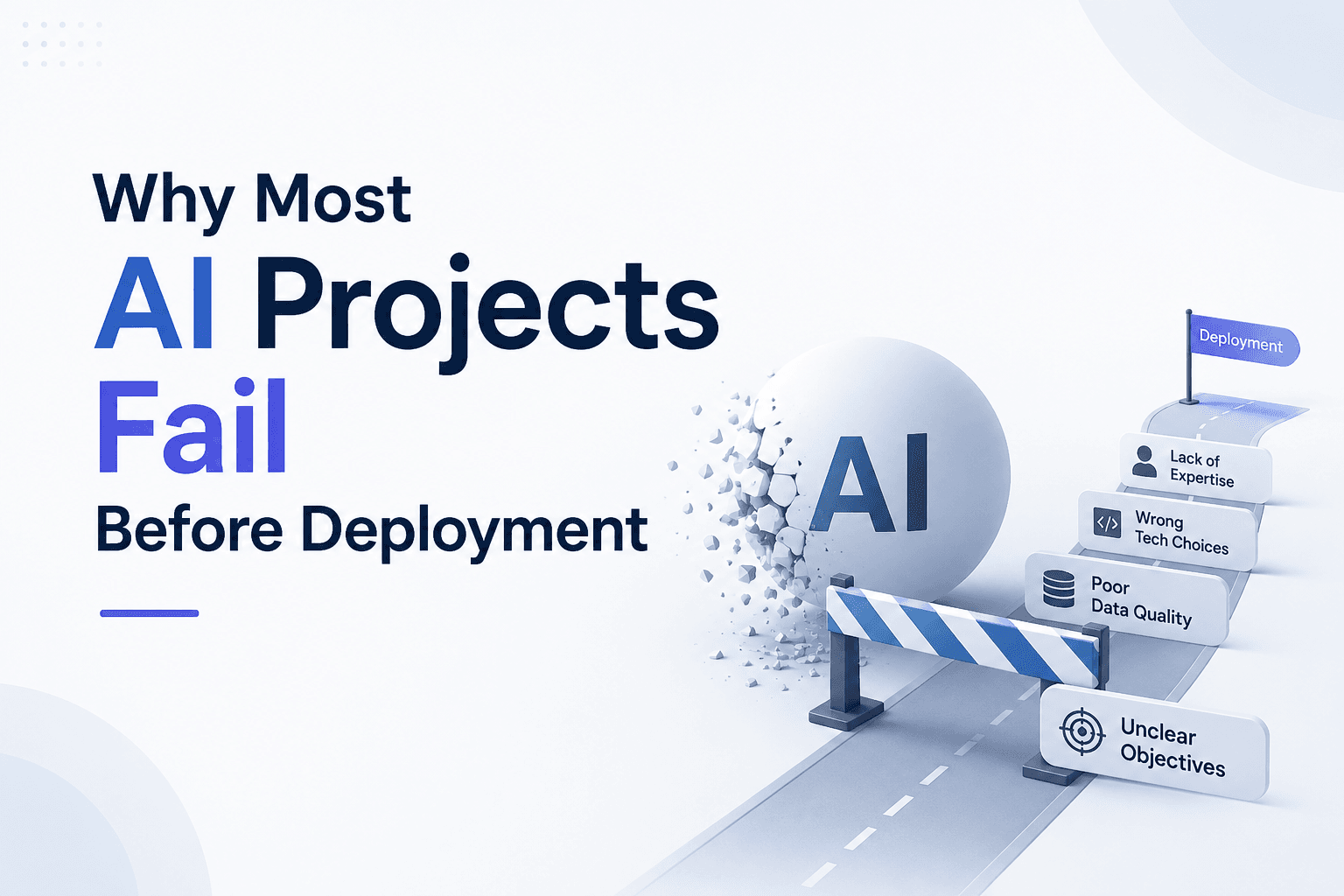
This is a natural continuation of a question worth asking honestly: why most AI projects fail before deployment. The answer, in a meaningful share of cases, traces back to a step enterprises skip entirely, modernizing the legacy systems, data architecture, and cloud infrastructure that any real AI implementation has to run on top of.
Is Your Enterprise Ready for AI? Before launching enterprise AI initiatives:
- Critical systems exposed through APIs
- Enterprise data is governed and accessible
- Real-time data pipelines exist
- Cloud infrastructure can scale AI workloads
- Security and compliance controls are defined
- Business and IT ownership is aligned
Why Enterprises Keep Skipping This Step
A 2025 survey of 504 US IT professionals by Saritasa found that half of enterprises haven't modernized their legacy systems for one specific reason: "the current system still works." The same survey found 62% of organizations are still running legacy software, and 43% cite security vulnerabilities as their top concern, yet the status quo persists regardless.
That reasoning has a timing problem. The best moment to modernize is while the system is stable, teams still have institutional context, and there's room to plan properly. Waiting until a legacy platform actually fails leads to rushed, patchwork fixes under pressure, exactly when you have the least room to do it carefully.
| Finding | Source |
|---|---|
| 50% of US enterprises cite "the system still works" as their reason for not modernizing | Saritasa 2025 survey, 504 US IT professionals |
| 62% of organizations are still running legacy software | Saritasa 2025 survey |
| 43% cite security vulnerabilities as their top legacy concern | Saritasa 2025 survey |
| Over 40% of agentic AI projects will be canceled by end of 2027 | Gartner, June 2025 prediction |
| 41% cite AI-legacy integration difficulty as a direct adoption barrier | HFS Research and Publicis Sapient joint study, 600+ leaders |
| Enterprises with unresolved technical debt risk being "locked out of the next wave of AI-native value creation" | HFS Research, Legacy Application Modernization Services 2025, 608 Global 2000 enterprises |
Taken together, these findings point to a consistent pattern: modernization delays are no longer just an IT concern. They directly influence whether AI initiatives reach production or stall before delivering measurable value.
The Direct Link Between Legacy Debt and AI Failure
Gartner's 40% agentic AI cancellation prediction doesn't mean agentic AI doesn't work. It means organizations are launching AI programs against infrastructure that structurally cannot deliver the outcomes those programs require. There are three specific technical reasons legacy systems block AI, not vague generalities:
- No real-time APIs. Most legacy systems communicate through batch processes and file-based integrations. Agentic AI requires low-latency, event-driven interfaces that legacy architectures were never designed to support.
- Siloed, inaccessible data. Modern AI models depend on unified, well-structured data. Legacy systems lock data in proprietary schemas, separate databases, and formats that AI pipelines cannot consume without significant transformation work.
- Tightly coupled architecture. Monolithic systems cannot connect to AI agents or analytics platforms without first being decoupled. There is no shortcut around this step.
These aren't AI problems. They are architecture problems that become visible when enterprises try to operationalize AI at scale. Every quarter that modernization gets deferred is a quarter in which already-approved AI investment produces diminishing returns against architectural barriers that were always going to surface eventually.
The Enterprise AI Readiness Stack
To conceptualize this dependency, we utilize The Enterprise AI Readiness Stack. It visualizes why attempting to deploy AI applications without addressing the underlying infrastructure inevitably leads to structural collapse:
graph TD
    A[AI Applications] --> B(Business Workflows)
    B --> C(Data & Governance)
    C --> D(API Integration Layer)
    D --> E(Modern Applications)
    E --> F(Cloud Infrastructure)
    F --> G(Legacy Systems)

    style A fill:#e6f7ff,stroke:#0066cc,stroke-width:2px
    style B fill:#cceeff,stroke:#0055aa,stroke-width:2px
    style C fill:#99ddff,stroke:#004488,stroke-width:2px
    style D fill:#66ccff,stroke:#003366,stroke-width:2px
    style E fill:#33bbff,stroke:#002244,stroke-width:2px
    style F fill:#0099cc,stroke:#001122,stroke-width:2px,color:#fff
    style G fill:#005588,stroke:#000000,stroke-width:2px,color:#fff
Each layer of the stack rests entirely on the layer below it. You cannot successfully deploy autonomous AI applications if the organization lacks the API integration layer or the modernized cloud infrastructure necessary to support them.
Enterprise Modernization Strategy: Where to Actually Start
| Focus Area | What It Actually Involves |
|---|---|
| Legacy system migration | Moving core systems off unsupported or obsolete platforms, ideally incrementally rather than as a single high-risk cutover |
| Technical debt reduction | Not eliminating all debt at once, prioritizing the debt sitting directly in the path of AI integration and business value delivery |
| Infrastructure updates | Refreshing the servers, networking, and platform layers that determine whether new AI workloads can run reliably at all |
| Modernizing core business apps | Focusing first on the applications AI initiatives actually need to touch, not a blanket refresh of every system in the estate |
| Legacy app overhaul | Reserved for systems too brittle or undocumented to modernize incrementally, a smaller subset than most enterprises initially assume |
| Enterprise IT refresh | The broader organizational commitment, budget, governance, and staffing, needed to sustain modernization as an ongoing practice rather than a one-time project |
The common mistake is treating modernization as an isolated infrastructure project. In reality, each of these initiatives removes a specific barrier that would otherwise limit AI deployment later.
Incremental beats full rewrite, and the data backs this up: incremental modernization programs typically deliver payback in 6 to 18 months. Full rewrites take 18 to 48 months and deliver no value until completion, according to a 2025 BayOne analysis of enterprise modernization programs. Half of enterprises delaying modernization are, in effect, choosing the slower, riskier path by default, simply by not choosing at all.
Data Readiness for AI: The Layer Most Teams Underestimate
| Focus Area | Why It Matters Before Any AI Work Starts |
|---|---|
| Data cleaning for AI | Inconsistent, duplicated, or inaccurate historical data produces AI outputs that inherit those same flaws, often invisibly until production |
| Data silo elimination | Customer, operations, and financial data trapped in disconnected systems means no single AI model can see the full picture it needs to make reliable decisions |
| Enterprise data governance | Defines who owns data quality, how it's classified, and how compliance requirements apply, without this, AI projects hit privacy and access walls mid-development |
| Structuring unstructured data | The bulk of enterprise data (documents, emails, call transcripts, PDFs) isn't usable for model training without deliberate preprocessing investment |
| Data quality for machine learning | A different bar than data quality for reporting, ML training data needs to be representative, balanced, and free of the labeling errors that silently degrade model accuracy |
| Unified data architecture | A single, coherent data layer that multiple AI initiatives can draw from, rather than every team building its own one-off data pipeline from scratch |
| Preparing data pipelines | The connective infrastructure moving data from source systems to AI models reliably, at the volume and latency AI features actually require in production |
The pattern is clear: data problems are rarely created by AI projects. They are exposed by AI projects. Modernization forces enterprises to address years of fragmented ownership, inconsistent systems, and inaccessible information. Structured, governed data is the fuel that allows models to function reliably in production environments.
This is the same conclusion IBM's own research reaches from a different angle: less than 1% of enterprise data has been incorporated into AI models to date. That's not a capability ceiling, it's an unused asset sitting behind exactly the data governance and structuring problems in the table above.
AI Readiness Gaps: What Actually Blocks Enterprise AI Programs
| Gap | How It Shows Up in Practice |
|---|---|
| AI readiness assessment (skipped or superficial) | Projects launch without a clear-eyed audit of what the existing architecture can and can't support, discovering the gaps only after development starts |
| Why AI projects fail | Most failure points, as covered in depth in our companion analysis, trace back to unclear problem definition and inadequate data readiness rather than model sophistication |
| Legacy tech AI barriers | No real-time APIs, siloed data, and tightly coupled architecture, the same three structural blockers Gartner identified as driving agentic AI project cancellations |
| AI implementation prerequisites | Clean data, accessible APIs, decoupled architecture, and governance, treated as optional extras rather than the baseline requirements they actually are |
| Technical debt vs AI ROI | Every dollar spent forcing AI onto unmodernized infrastructure is a dollar not spent on the modernization that would have made the AI initiative viable in the first place |
| Enterprise AI roadblocks | Organizational, not just technical, unclear ownership between IT and business units stalls AI initiatives as often as any infrastructure gap does |
| AI scaling challenges | A pilot succeeding on curated data in a controlled environment is a different achievement than a production system handling real volume, real edge cases, and real legacy integration |
These gaps reveal that the most significant hurdles to AI are architectural and organizational, not purely technical. Bridging them requires proactive alignment between engineering teams and business leadership.
Which Industries Feel This Gap Hardest
The modernization-before-AI gap isn't evenly distributed. Some sectors carry decades more legacy debt and tighter regulatory constraints than others, which changes both the urgency and the sequencing.
| Sector | Why the Gap Is Especially Acute | Typical First Modernization Priority |
|---|---|---|
| Financial services and insurance | Core systems often run on decades-old mainframe or COBOL platforms with heavy regulatory audit requirements | Exposing core transaction data through governed APIs before any AI fraud or underwriting model is scoped |
| Healthcare | Patient data sits in siloed, compliance-sensitive systems (EHRs, billing, scheduling) that rarely share a unified data layer | Data governance and structuring, given how directly patient data quality affects AI safety |
| Government and public sector | Extremely long system lifespans and procurement cycles mean some core systems predate modern API standards entirely | Incremental domain-by-domain modernization, given how disruptive a full rewrite would be to citizen-facing services |
| Manufacturing and industrial | Operational technology (OT) systems on factory floors are often decades old and physically harder to touch than office IT | Decoupling data collection from OT systems before attempting predictive maintenance AI |
| Retail and e-commerce | Faster-moving competitively, but often carrying legacy inventory and pricing systems bolted onto newer storefronts | Modernizing core pricing and inventory domains, the same pattern seen in the UK retailer case study above |
| Technology and SaaS | Generally furthest ahead, but rapid historical growth often leaves fragmented internal tooling and data silos of its own | Unified data architecture across acquired or organically grown internal systems |
This uneven distribution highlights why a one-size-fits-all approach fails. Organizations must prioritize the specific architectural constraints of their sector before adopting generic AI solutions.
Cloud and Architecture: The Foundation AI Actually Runs On
| Focus Area | Why It's an AI Prerequisite, Not a Separate Initiative |
|---|---|
| Cloud migration for AI | AI workloads need elastic compute that most on-premises legacy infrastructure simply wasn't built to provide |
| Microservices architecture | Breaking a monolith into independently deployable services is what allows AI features to be added to one part of a system without redeploying the entire application |
| API first strategy | AI agents and models interact with systems through APIs, if core business logic isn't exposed through a clean API layer, AI integration has nothing to connect to |
| Hybrid cloud for enterprise | Many regulated enterprises can't move everything to public cloud at once, hybrid approaches let AI-ready workloads move first while sensitive systems modernize on a longer timeline |
| Serverless infrastructure | Reduces the operational overhead of running AI inference workloads that have unpredictable, spiky demand patterns |
| Cloud native modernization | Designing (or redesigning) systems to take advantage of cloud elasticity and managed services, rather than just lifting legacy code onto cloud servers unchanged |
| Decoupling legacy systems | The specific technical work of separating tightly bound legacy components so they can be modernized, replaced, or connected to AI tools independently, without a full rewrite |
Modern cloud environments and decoupled architectures provide the essential elasticity and agility for AI. Attempting to force-fit AI models onto rigid on-premises infrastructure inevitably creates scalability bottlenecks.
Cloud migration and legacy modernization don't need to happen sequentially, and in the current AI readiness landscape, treating them as sequential is itself a mistake. Decoupling APIs, extracting data layers, and carving out modular components are the same architectural steps that enable both cloud-native deployment and AI integration. Running both workstreams in parallel is consistently the more efficient path.
Business Impact and ROI: Making the Case Beyond "It's Technically Necessary"
| Metric | What the Data Shows |
|---|---|
| Cost of technical debt | Compounds every quarter it's deferred, maintenance costs climb, institutional knowledge leaves with retiring developers, and compatibility with modern platforms narrows over time |
| Modernization ROI | Incremental modernization programs deliver payback in 6 to 18 months versus 18 to 48 months for full rewrites, a gap wide enough to change which approach is actually lower-risk |
| AI adoption timeline | Enterprises that modernize first typically reach production AI deployment faster overall than those attempting AI integration on unmodernized infrastructure and hitting mid-project rework |
| Operational efficiency gains | Realized incrementally as each modernized component ships, rather than deferred until a multi-year transformation program completes |
| Risk of skipping modernization | Directly reflected in Gartner's 40%+ agentic AI project cancellation prediction, a large share of that risk is architectural, not a reflection of AI capability itself |
| Enterprise agility metrics | Deployment frequency, time-to-integrate a new AI feature, and mean time to recovery all improve measurably once systems are decoupled and API-accessible |
| Long term AI scalability | Determined by architecture decisions made now, systems built on unified data and decoupled services can absorb new AI use cases without repeating the modernization work each time |
Ultimately, the financial case for modernization extends far beyond cost savings. It is a strategic prerequisite that accelerates AI adoption timelines and unlocks exponential operational agility.
Real Cases: What Incremental Modernization Actually Looks Like
UK retailer, core domain modernization: Rather than a full system rewrite, a major UK retailer's digital transformation team carved out specific domains, Pricing and Promotions, built modern microservices around them, and maintained safe communication with the legacy Oracle system through an anti-corruption layer. Each change delivered business value quickly without disrupting existing operations, and what began as incremental fixes became a system capable of far faster innovation over time. The lesson from incremental modernization is that enterprises do not need to replace every system before adopting AI. They need to remove the specific architectural barriers preventing AI value creation.
Insurance platform, VB6 to C# migration: An insurance platform running 327 VB6 files, 259 forms, 9,612 controls, and over 240,000 COM calls had become effectively impossible to scale or maintain. Rather than a full rewrite, the team executed a phased, GenAI-assisted migration to C#, eliminating dependencies incrementally and consolidating executables one step at a time. The system remained operational throughout the entire migration. The lesson from incremental modernization is that enterprises do not need to replace every system before adopting AI. They need to remove the specific architectural barriers preventing AI value creation.
A Practical Modernization-Before-AI Roadmap
Modernization doesn't have to be a multi-year transformation before AI work begins. The most successful organizations sequence modernization and AI readiness deliberately, starting with the components that unlock the greatest business value. Modernization before AI does not mean delaying AI initiatives for years. It means identifying and upgrading the architectural bottlenecks that prevent AI systems from delivering value while running AI preparation and modernization work in parallel.
- Run an honest AI readiness assessment first. Map what your current architecture can and cannot support before committing to an AI project timeline built on assumptions.
- Identify the specific components blocking AI integration. Usually a smaller list than expected, missing APIs, siloed data sources, and a handful of tightly coupled legacy modules.
- Sequence incrementally, starting with low-risk, high-value domains. Reporting layers, internal APIs, and administrative workflows are typically safer starting points than customer-facing core systems.
- Build the data layer AI actually needs in parallel. Data cleaning, governance, and pipeline work should run alongside architecture modernization, not wait for it to finish first.
- Treat cloud migration and decoupling as one workstream, not two. The same architectural steps enable both, running them separately just duplicates the work.
- Only then scope the AI feature itself. By this point, the AI project is being built on infrastructure that can actually support it, which is the entire point.
Frequently Asked Questions
Why does modernization need to happen before AI, not alongside it?
Because AI features depend on infrastructure, APIs, clean data, and decoupled architecture, that most legacy systems don't have. Gartner's prediction that over 40% of agentic AI projects will be canceled by 2027 traces directly back to legacy integration complexity, not AI capability limitations.
Can enterprises use AI to modernize legacy systems?
Yes. AI can assist with code analysis, documentation, migration planning, testing, and identifying dependencies in legacy applications. However, successful modernization still requires architecture decisions, governance, and engineering oversight.
Do companies need to replace all legacy systems before adopting AI?
No. Most enterprises should modernize incrementally by improving APIs, data accessibility, and architecture around the systems most important for AI initiatives rather than attempting a complete replacement.
What percentage of enterprises are still running legacy systems?
62% of organizations are still running legacy software, according to a 2025 Saritasa survey of 504 US IT professionals, and half cite "the system still works" as their primary reason for not modernizing.
Is a full system rewrite ever the right choice over incremental modernization?
Rarely, and usually only for systems too brittle or undocumented to modernize incrementally. Incremental modernization delivers payback in 6 to 18 months versus 18 to 48 months for full rewrites, and full rewrites carry a meaningfully higher failure and cancellation risk.
How does technical debt directly affect AI ROI?
Every dollar spent forcing AI onto unmodernized infrastructure is a dollar not spent on the modernization that would have made the AI initiative viable. HFS Research's analysis of 608 Global 2000 enterprises found that unresolved technical debt risks locking organizations out of the next wave of AI-native value creation entirely.
What are the three biggest technical barriers legacy systems create for AI?
No real-time APIs (legacy systems rely on batch processes AI agents can't use), siloed and inaccessible data (locked in proprietary schemas AI pipelines can't consume), and tightly coupled architecture (monolithic systems that can't connect to AI agents without being decoupled first).
Do we need to fix all our technical debt before starting AI initiatives?
No. The practical approach is prioritizing the debt sitting directly in the path of AI integration and business value delivery, not attempting to eliminate all technical debt across the entire estate before any AI work begins.
How long does data readiness work typically take before an AI project can start?
It varies by how siloed and unstructured the existing data is, but data preparation alone can consume a significant share of total AI project time. Starting this work in parallel with architecture modernization, rather than sequentially after it, is the more efficient path.
What's the difference between cloud migration and AI readiness?
They overlap significantly rather than being separate initiatives. Decoupling APIs, extracting data layers, and carving out modular components are the same architectural steps that enable both cloud-native deployment and AI integration, which is why running them as one combined workstream is more efficient than sequencing them.
Conclusion
The data across every source reviewed for this piece points to the same conclusion from different angles: enterprises aren't failing at AI because the technology doesn't work, they're failing because they're building AI initiatives on top of infrastructure that structurally can't support them. Gartner's 40%+ agentic AI cancellation prediction, HFS Research's 41% integration-barrier figure, and the Saritasa survey's finding that half of enterprises are stalled by "the system still works" thinking all describe the same underlying gap.
The competitive advantage won't come from adopting AI first. It will come from building an architecture capable of supporting AI for the next decade. Modernization isn't the project before AI, it's what makes AI possible.
JunkiesCoder helps enterprises modernize legacy systems, data architecture, and cloud infrastructure as the foundation for AI initiatives that actually reach production. See our legacy modernization services or explore our AI integration work for similar builds.