Most guides to building an app like Afterpay start with screens, payment gateways and feature lists. That is only the visible part of the problem.
An Afterpay-style product is not simply a consumer mobile application. It can involve customers, merchants, transaction infrastructure, payment workflows, decisioning, financial records, operational teams and external service providers.
The mobile app is the visible layer. Much of the complexity sits behind it.
For businesses considering an Afterpay-style product in Australia, the first question should therefore not be:
What features should our app have?
A more useful question is:
What financial product are we building, for whom, and what infrastructure is genuinely necessary to operate it?
That distinction changes the entire development process.
A generic attempt to reproduce every visible feature of an established BNPL platform could result in a large, expensive product without a clear reason for customers or merchants to choose it. A focused product built around a specific purchasing problem, merchant category or customer segment may create a stronger opportunity.
This guide explains how to validate an Afterpay-style opportunity, define the consumer and merchant product, plan the financial and operational infrastructure, understand Australian regulatory considerations, choose between building and partnering, and estimate the time and software investment required to bring the product to market.
What Does It Take to Build an Afterpay-Style App?
A complete platform may include:
Building an Afterpay-style product is a financial-platform project, not simply a mobile app project.
- Consumer mobile experiences
- Merchant infrastructure
- Transaction processing
- Payment workflows
- Decisioning capabilities
- Financial ledger and reconciliation systems
- Internal operational tools
- Security and monitoring
- Third-party financial infrastructure
Typical Development Timeline
A focused MVP may require several months, while a broader consumer, merchant and financial platform can require 12 months or more, depending on scope, integrations and operational requirements.
Indicative Software Development Cost
| Product Scope | Indicative Software Development Range |
|---|---|
| Focused MVP | AUD $150K–$300K |
| Consumer and merchant platform | AUD $300K–$600K |
| More complete financial platform | AUD $600K–$1.2M+ |
| Enterprise-scale platform | AUD $1.2M+ |
These are indicative planning ranges rather than fixed prices. They primarily relate to product design and software development. They should not be interpreted as the total capital required to launch or operate a BNPL or financial business.
Additional costs may arise from areas such as legal and regulatory work, licensing, funding arrangements, third-party providers, transaction operations and the financial resources required to operate the underlying product.
The final cost depends on product scope, team composition, integrations, security controls, regulatory requirements and the amount of merchant and operational infrastructure required.
Should You Build an Afterpay-Style Product?
The hardest part of building an Afterpay-style product may not be software development.
It may be deciding whether the business opportunity is strong enough in the first place.
Established BNPL platforms already benefit from brand recognition, merchant relationships, existing infrastructure and customer familiarity. A new business therefore needs more than a similar feature set. Before defining the MVP, businesses should first consider when building an Afterpay-style product makes business sense for their target market and operating model.
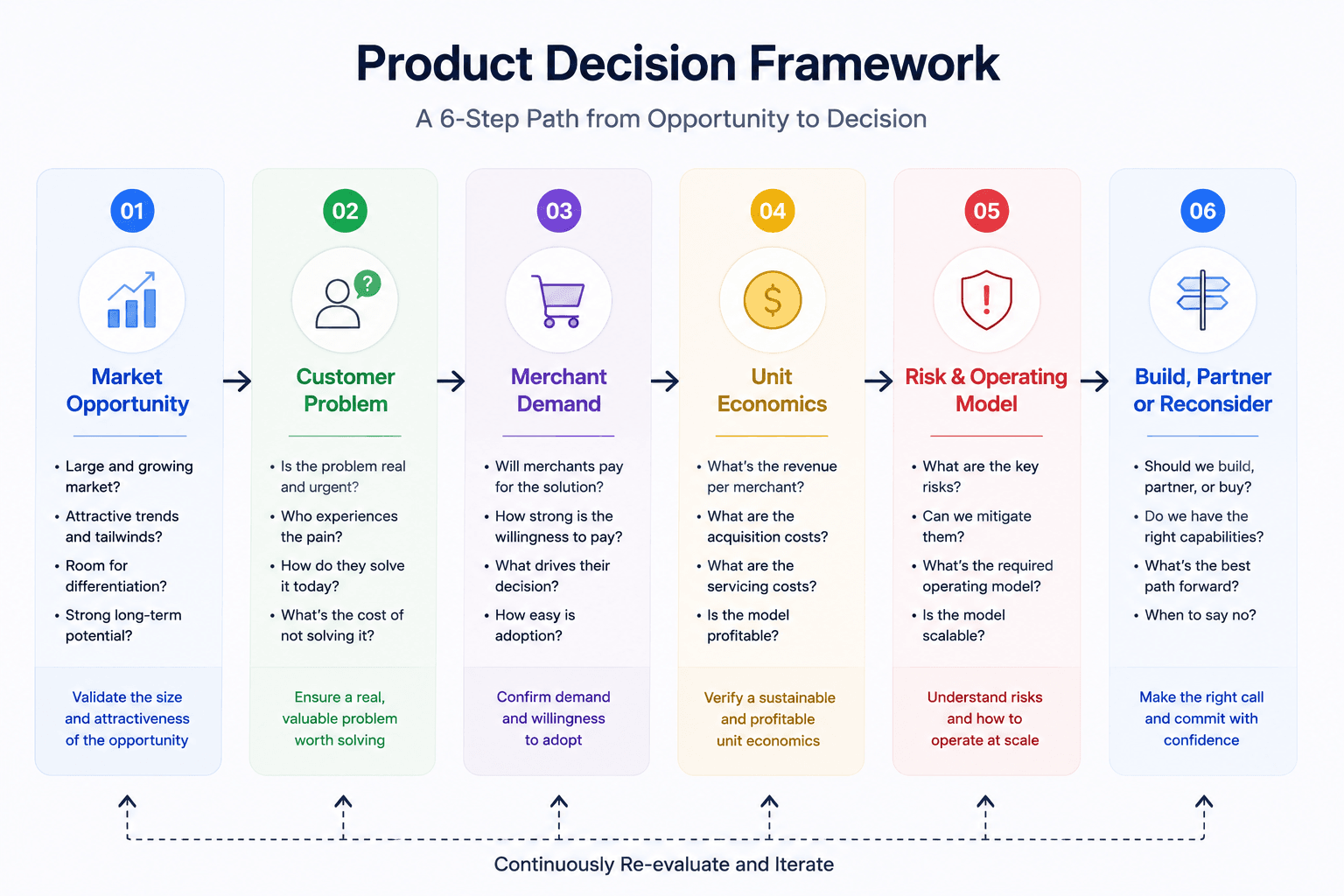
Start With the Market Problem
Before defining the MVP, answer five questions.
| Area | Question |
|---|---|
| Market | Is there a specific underserved customer segment? |
| Merchant | Can you acquire and retain merchants? |
| Economics | Can each transaction generate sustainable contribution margin? |
| Risk | Can you manage the relevant credit and fraud exposure? |
| Technology | Is proprietary infrastructure necessary to create an advantage? |
The question is not whether BNPL exists as a category.
The question is whether your version solves a meaningful problem for a clearly defined market.
Product Feasibility Framework
Understand the Unit Economics
One weakness in many BNPL development guides is that they move directly from features to technology.
That skips the business engine.
An Afterpay-style product can increase transaction volume while still creating financial pressure if the economics of each transaction are poorly understood.
Common Commercial Models
An Afterpay-style business may generate economics through combinations of:
- Merchant-related revenue
- Transaction-related revenue
- Other permitted product or service revenue, depending on the operating model
The appropriate revenue model depends on the product structure, customer proposition and applicable regulatory requirements.
A Basic Unit Economics Framework A simplified planning model may consider:
Revenue per transaction minus
Payment and infrastructure costs minus
Merchant acquisition and servicing costs minus
Customer acquisition costs minus
Operational costs minus
Losses and exception-related costs equals
Potential contribution margin The exact model will differ between businesses.
The important point is that product architecture should support business economics.
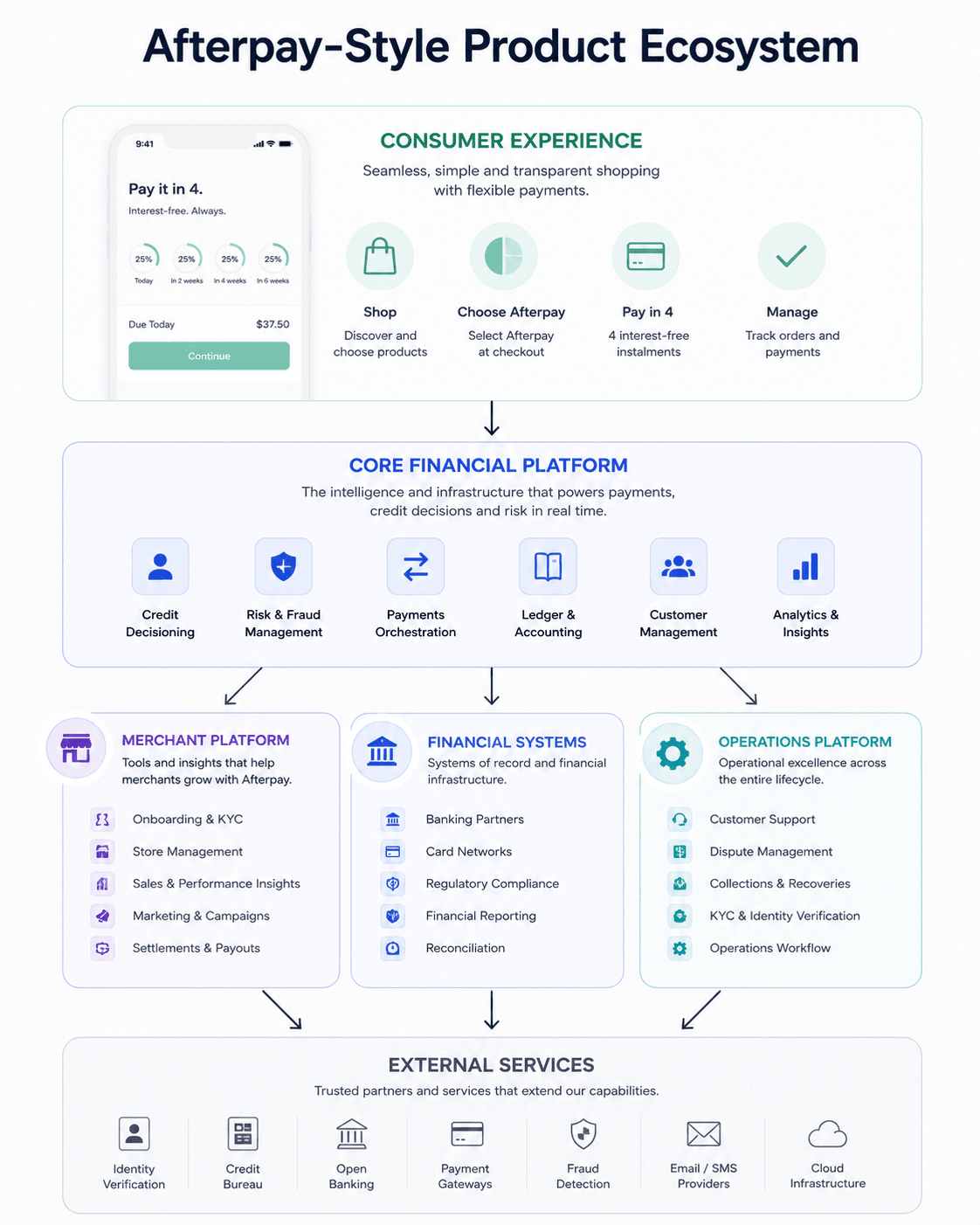
What Are You Actually Building?
An Afterpay-style product generally involves three connected environments.
Consumer Experience
This is the part customers see. It may include:
- Account creation
- Verification workflows
- Purchase activity
- Payment schedules
- Transaction history
- Notifications
- Payment management
- Customer support
- Merchant Platform
Merchants may require:
- Onboarding
- Technical integration
- Transaction visibility
- Refund workflows
- Settlement information
- Reporting
- Operational support
Operations Platform
The business itself may need systems for:
- Customer support
- Merchant management
- Transaction investigation
- Risk review
- Financial reconciliation
- Reporting
- Audit records
This is why estimating the project purely according to the number of mobile screens can produce a misleading development plan.
The consumer app may represent only one part of the total platform.
Afterpay-Style Product Ecosystem
How Does an Afterpay-Style Product Work?
The exact transaction flow depends on the operating model, but a simplified journey can be understood in stages.
1. The Customer Starts a Transaction
The customer interacts with the merchant or product interface.
2. Customer and Transaction Information Is Evaluated
The platform processes the information required for the relevant transaction workflow.
3. Decisioning Takes Place
The system applies the appropriate product and business rules.
4. The Transaction Is Processed
Relevant systems communicate the transaction outcome and continue the payment workflow.
5. The Transaction Enters Its Operational Lifecycle
The product may need to manage:
- Payment events
- Failed attempts
- Refunds
- Adjustments
- Merchant actions
- Customer support
The normal customer journey is important.
The exception journey is equally important.
A financial platform should be designed for the real world, where APIs time out, webhooks arrive late and transactions do not always follow the ideal path.
Core Consumer Features
The consumer application should make a complex financial product feel understandable. The consumer experience should be designed around real transaction workflows rather than visual similarity alone, making the wider mobile app development strategy an important part of product planning.
Account Onboarding
Depending on the product requirements, this may include:
- Registration
- Contact verification
- Account setup
- Required identity processes
- Payment method configuration
Consumer Dashboard
A useful dashboard may provide visibility into:
- Active purchases
- Upcoming repayments
- Recent transactions
- Important account information
Transaction Management
The application may allow users to:
- Review purchases
- View transaction status
- Understand payment arrangements
- Access relevant updates
Repayment Management
Customers may need visibility into:
- Upcoming payments
- Previous payments
- Payment status
- Available payment methods
Notifications
Useful notifications may include:
- Upcoming events
- Successful transactions
- Payment issues
- Refund updates
- Important account activity
Merchant Infrastructure
A consumer-facing product cannot scale effectively if merchants find the technology difficult to adopt.
Merchant infrastructure should therefore be treated as a product layer.
Merchant Onboarding
The journey may involve:
- Business registration
- Commercial configuration
- Technical setup
- Testing
- Production activation
Integration Options
Different merchants have different technical capabilities.
A platform may eventually need combinations of:
- APIs
- SDKs
- Hosted experiences
- E-commerce integrations
- Platform connectors
Transaction Management
Merchants may need to investigate:
- Transaction status
- Refunds
- Adjustments
- Exceptions
Admin and Operations
A platform may function technically while still creating operational problems if internal teams do not have the right tools.
Internal systems may need to support:
- Customer management
- Merchant management
- Case management
- Transaction investigation
- Support workflows
- Reporting
- Audit records
The objective is not simply to generate more data.
It is to make the relevant information understandable when something goes wrong.
Risk and Decisioning
Risk should not be treated as a single screen inside an admin panel.
It can become a core product capability.
The platform may eventually require separate consideration of:
- Transaction rules
- Customer behaviour
- Exceptions
- Fraud signals
- Review workflows
The architecture should avoid assuming that every decision will remain identical as the product evolves.
A configurable decisioning approach may be more sustainable than embedding all business decisions directly into application code.
This does not mean every startup needs an advanced machine-learning system from day one.
A focused MVP should begin with the level of decisioning required for the initial product scope and evolve based on evidence.
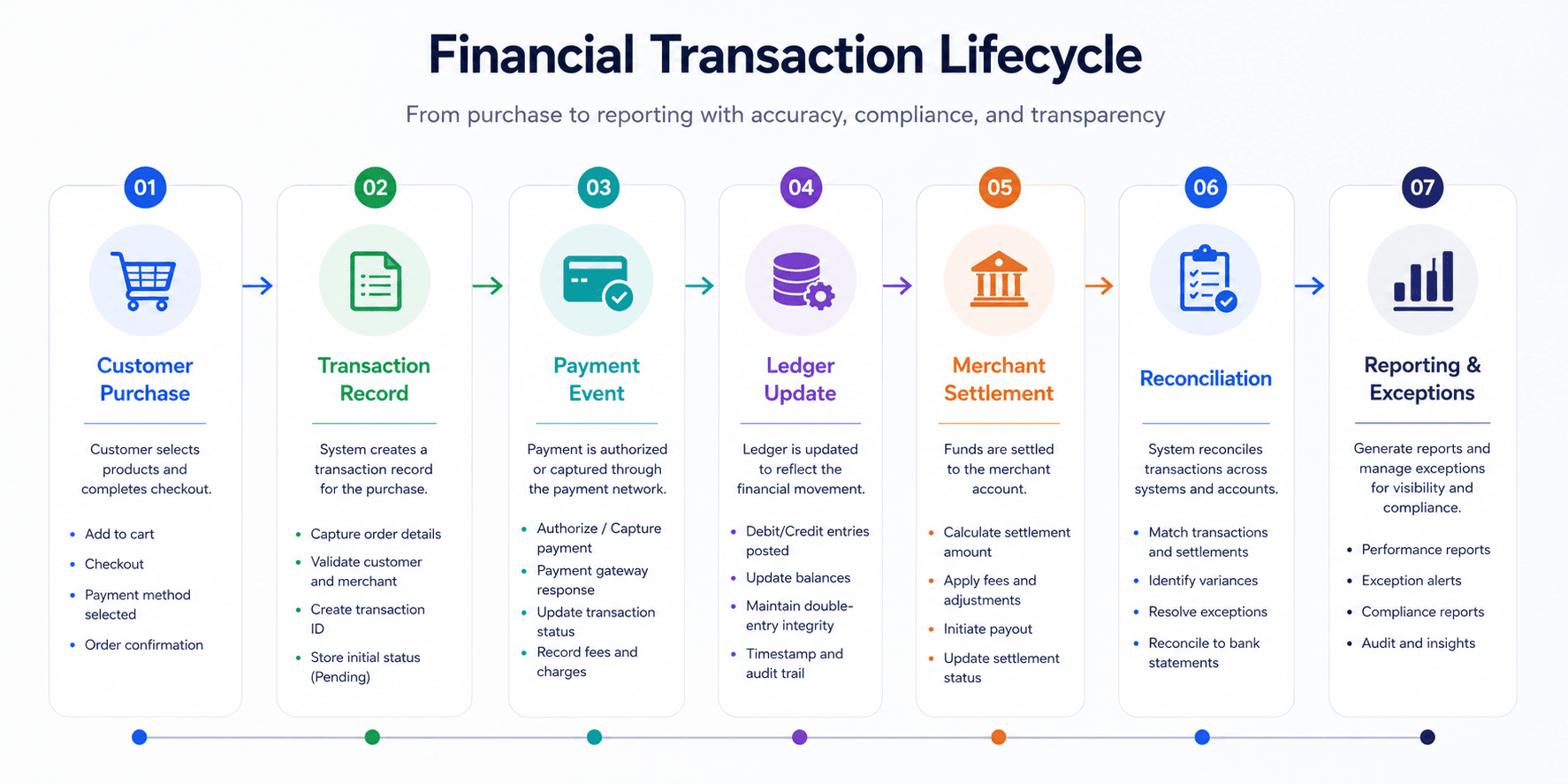
Financial Ledger and Reconciliation
This is one of the most important differences between a simple consumer app and a serious financial platform.
A transaction displayed in a customer interface is not necessarily the same thing as a financial ledger entry.
A user interface may show the current status of a purchase, while the underlying financial platform may need to preserve an auditable history of the events associated with that transaction.
Payment attempts, successful payments, refunds, reversals, adjustments and settlement events may all need to be recorded in a way that supports reconciliation and investigation.
For this reason, financial systems should not rely solely on mutable transaction-status fields.
The underlying design should preserve the relevant history of financial events so the business can understand what happened, when it happened and how the current state was reached.
Payment and transaction integrations should account for idempotency, webhook processing, retries, delayed responses and reconciliation so that repeated requests or delayed events do not unintentionally create duplicate financial events.
Why Reconciliation Matters
The business may eventually need to compare information across:
- Internal records
- Payment infrastructure
- Merchant systems
- Settlement data
Financial Transaction Lifecycle:
MVP vs Full-Scale Platform
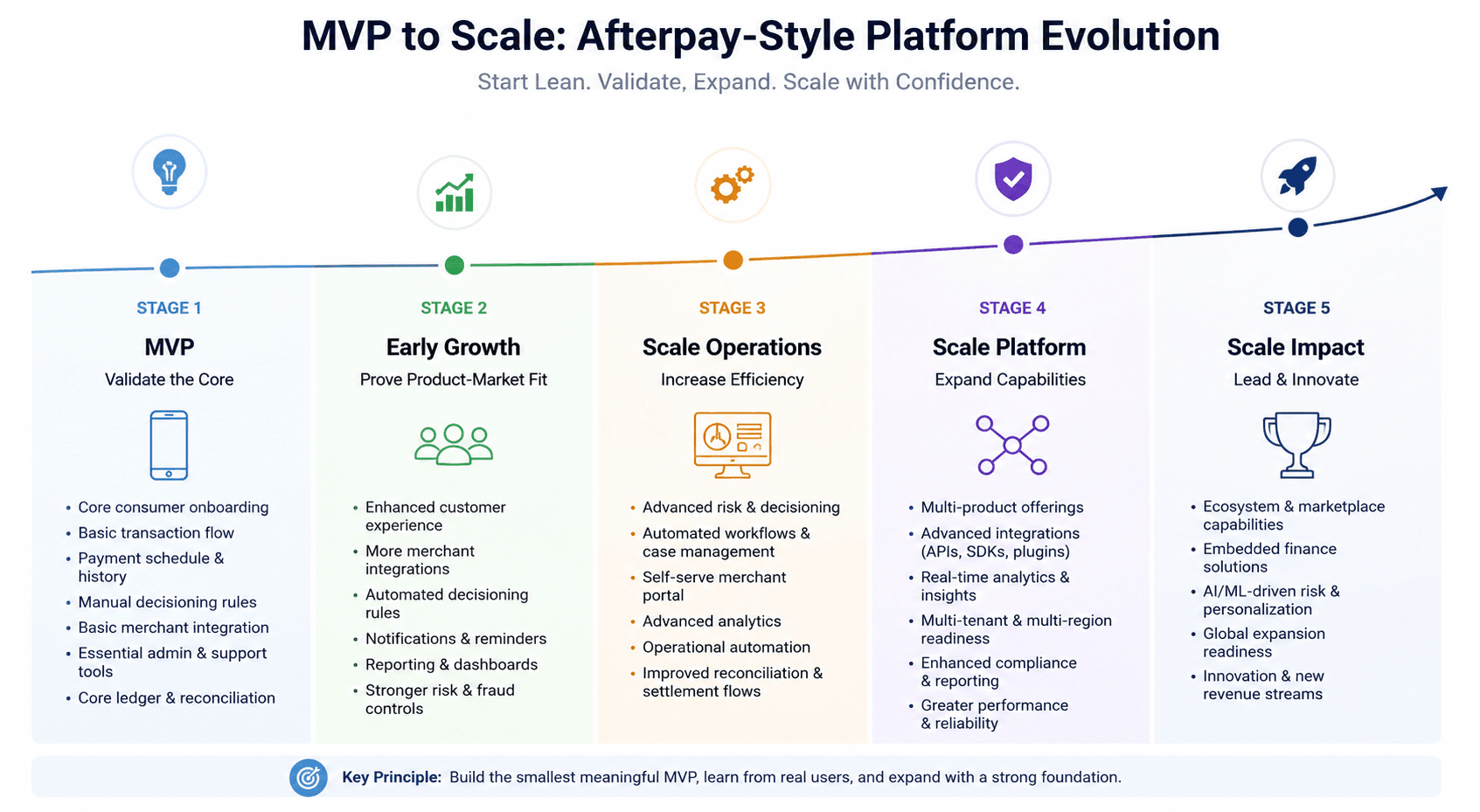
An MVP is not simply the full product with fewer buttons. For a broader strategic perspective on planning an Afterpay-style product in Australia, businesses should evaluate product scope before committing to full-scale development.
The MVP should answer the most important unanswered business questions.
| Area | Focused MVP | Mature Platform |
|---|---|---|
| Consumer experience | Core onboarding and transactions | Advanced journeys and expanded products |
| Merchant capabilities | Basic integration and visibility | Advanced integrations and merchant tooling |
| Operations | Essential support and monitoring | Automated workflows and case management |
| Risk | Initial decisioning rules | More sophisticated risk capabilities |
| Financial infrastructure | Core transaction records | Expanded ledger and reconciliation infrastructure |
| Analytics | Essential product monitoring | Advanced business and operational analytics |
| Infrastructure | Appropriate initial scale | Greater automation and scaling capability |
A Focused MVP May Include
Consumer: Core onboarding, transaction flow, payment visibility and transaction history.
Merchant: Basic onboarding, transaction visibility and appropriate integration capabilities.
Operations: Customer support access, monitoring and essential administrative tools.
A Mature Platform May Later Add
- Advanced merchant infrastructure
- Greater automation
- Multi-market capabilities
- Expanded analytics
- Additional products
- Advanced operational workflows
Build vs Partner vs White-Label
Not every company should build every component internally.
| Approach | Best For | Main Advantage | Main Limitation |
|---|---|---|---|
| Proprietary platform | Businesses with genuine technology differentiation | Greater control | Higher complexity |
| Partner model | Businesses seeking faster market access | Existing capabilities | Commercial dependency |
| White-label or embedded model | Existing platforms and retailers | Faster deployment | Less infrastructure ownership |
The right strategy is rarely about building everything or outsourcing everything. Businesses that require specialised engineering support can work with a team experienced in FinTech app development to define which capabilities should be built and which should be integrated.
It is about deciding what the business should own.
Recommended Technology Architecture
A practical architecture should separate user-facing applications, application services, financial domains and infrastructure.
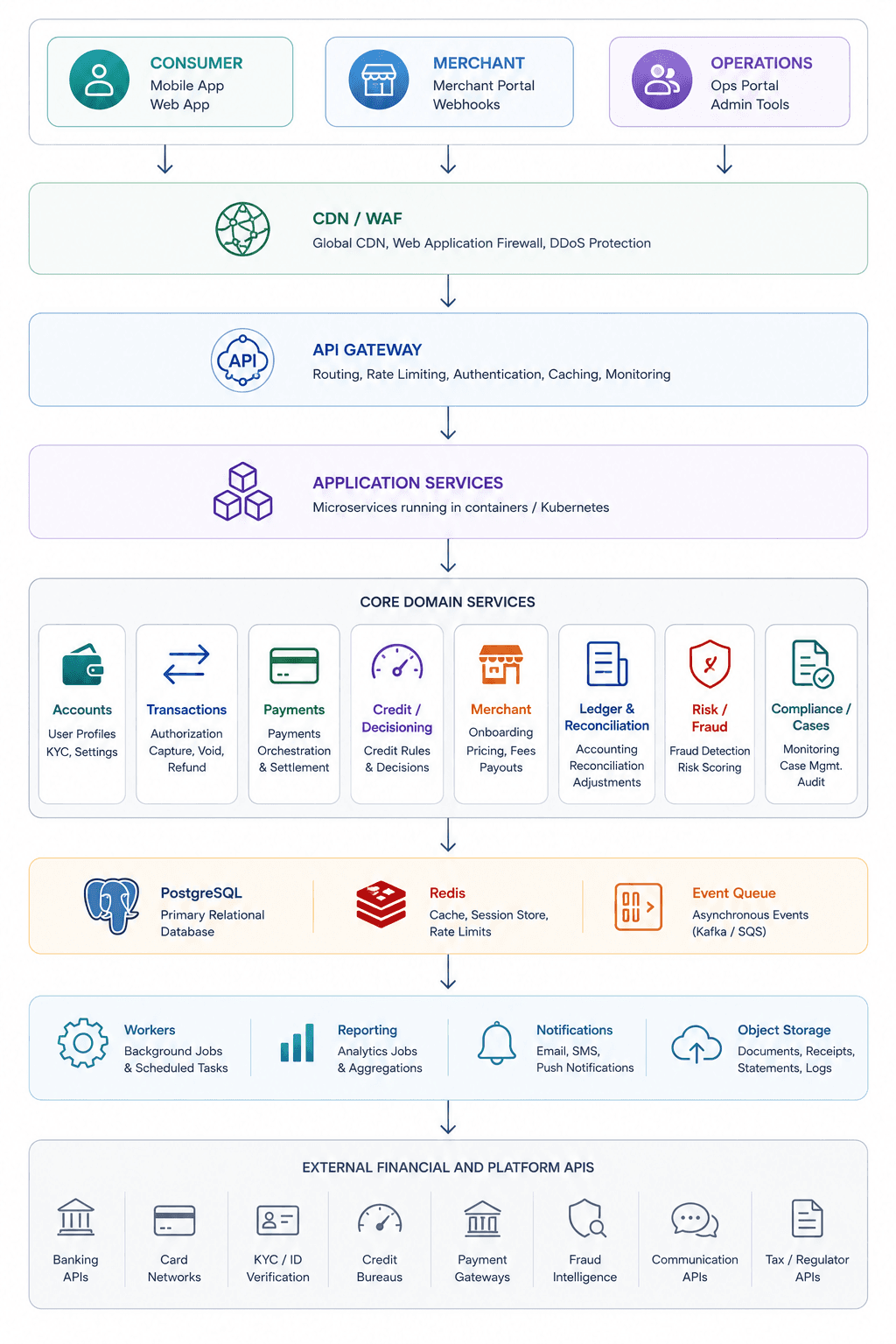
The architecture should be treated as a model rather than a mandatory implementation blueprint. The right architecture depends on the operating model, product complexity and long-term requirements, which is why a custom software development approach may be necessary for businesses building proprietary financial infrastructure.
A new product does not automatically need a highly distributed microservices environment.
Build vs Buy at the Capability Level
The build-versus-buy decision should be made at the capability level, not simply at the application level.
A business might own:
- Customer experience
- Transaction orchestration
- Merchant workflows
- Product rules
While integrating external infrastructure for:
- Identity
- Payments
- Messaging
- Specialist fraud capabilities
The question is not whether the entire platform should be built internally.
It is which capabilities create strategic value and justify greater ownership.
Third-Party Services and Integration Strategy
After deciding what the business should own, the next question is what should be integrated.
| Capability | Integration Category |
|---|---|
| Identity processes | Identity provider |
| Payments | Payment infrastructure |
| Banking connectivity | Financial infrastructure |
| Notifications | SMS, email or push service |
| Fraud support | Risk provider |
| Analytics | Product analytics platform |
| Monitoring | Observability platform |
| Customer support | Helpdesk system |
Integration strategy affects:
- Development effort
- Operational reliability
- Cost
- Security responsibilities
- Future flexibility
Possible Technology Stack
The following technologies are common options rather than mandatory choices.
| Layer | Possible Technologies | Typical Consideration |
|---|---|---|
| Mobile | Flutter, React Native, Swift, Kotlin | Cross-platform speed versus native control |
| Web | React, Next.js | Application requirements and team expertise |
| Backend | Java, .NET, Node.js, Go, Python | Team expertise, integrations and workload |
| Database | PostgreSQL | Transactional consistency and ecosystem |
| Cache | Redis | Performance and temporary data access |
| Messaging | Kafka, SQS, RabbitMQ | Event volume and operational complexity |
| Cloud | AWS, Azure, Google Cloud | Existing expertise and infrastructure needs |
| Monitoring | OpenTelemetry, Grafana, Datadog | Observability requirements |
| Containers | Docker | Consistent application packaging |
| Orchestration | Kubernetes or managed cloud services | Scale and operational complexity |
Technology should support the product strategy.
It should not become the product strategy.
Australian Regulatory Considerations
For an Afterpay-style product in Australia, regulatory planning should happen alongside product and technical planning.
Australia's BNPL framework changed on 10 June 2025, when reforms extending the consumer-credit framework to BNPL arrangements took effect. ASIC states that businesses engaging in relevant credit activities involving BNPL contracts must hold an Australian Credit Licence with the appropriate authorisations, subject to the applicable framework and any transitional arrangements.
The reforms also introduced low-cost credit contracts as a category of regulated credit. Where a BNPL contract meets the relevant definition, different obligations may apply, including the ability for providers to elect into modified responsible lending obligations under the applicable framework.
AFCA states that the reforms also brought relevant BNPL providers into the mandatory dispute-resolution framework, with consumers able to access AFCA where complaints cannot be resolved directly with the provider. AFCA's guidance also discusses obligations relating to areas such as complaints, hardship and credit reporting.
From a product-development perspective, the regulatory framework can affect:
- Customer onboarding
- Product disclosures and communications
- Decisioning workflows
- Financial hardship processes
- Complaint handling
- Internal case management
- Record keeping
- Audit trails
The exact obligations depend on the proposed product, business activities, contractual arrangements and operating structure.
Important: This section is not legal advice. Businesses should obtain appropriate Australian legal and regulatory advice before finalising or launching a BNPL product.
Useful authoritative resources:
ASIC: BNPL credit licensing guidance
ASIC: Regulatory Guide 281 and BNPL reform guidance AFCA: Supporting the 2025 BNPL reforms
Security and Operational Resilience
Security should be part of the platform architecture.
Important considerations include:
- Role-based access
- Secure authentication
- API security
- Data protection
- Monitoring
- Backup and recovery
- Failure handling
External systems can fail.
A production platform should therefore consider:
- Timeouts
- Delayed responses
- Duplicate requests
- Partial failures
- Retry behaviour
The goal is not to guarantee that nothing fails.
It is to ensure failures can be identified, contained and investigated.
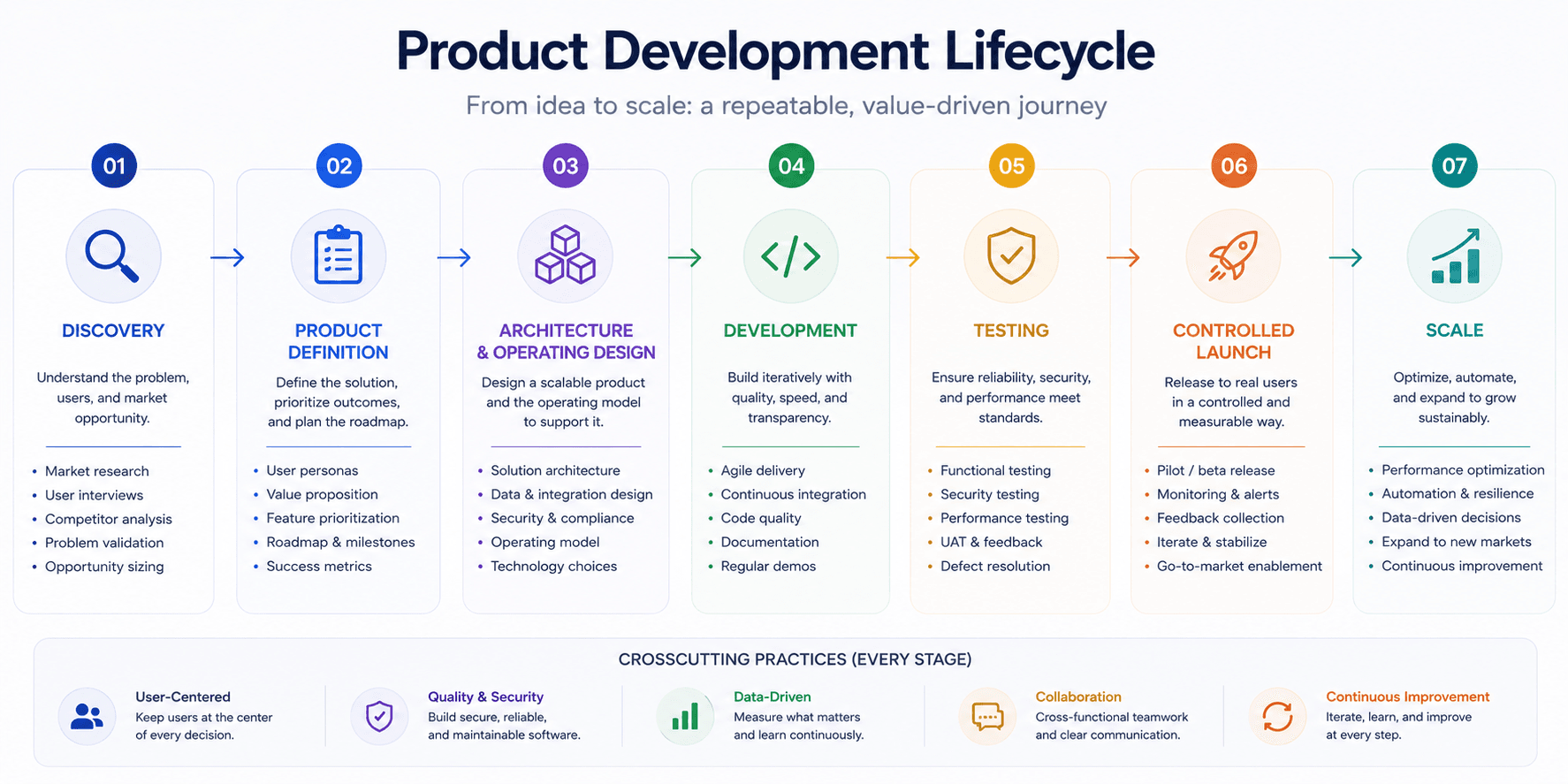
Development Team and Product Process
A serious financial product should not be approached as a sequence of screens handed directly to developers.
A practical delivery process may involve:
Product Discovery
Define:
- Customer problem
- Merchant requirements
- Business assumptions
- Initial product scope
Product Definition
Map:
- User journeys
- Core workflows
- Product rules
- MVP priorities
Architecture and Operating Design
Define:
- System boundaries
- Data flows
- Integration requirements
- Operational workflows
Development and Testing
Build and test both normal customer journeys and failure scenarios.
Controlled Launch
Launch with appropriate monitoring and operational readiness.
In-House Team vs Development Partner
An internal team can provide greater long-term ownership but requires greater fixed staffing commitment.
A development partner can provide faster access to specialised expertise but introduces external dependency.
A hybrid approach can allow the business to retain product and commercial ownership while using specialist engineering capabilities where needed.
Product Development Lifecycle
How Long Does It Take to Build an Afterpay-Style App?
There is no universal timeline.
An illustrative roadmap for a moderately complex product may look like this:
| Phase | Approximate Focus |
|---|---|
| Months 1–2 | Product discovery and definition |
| Months 2–4 | UX, architecture and detailed requirements |
| Months 4–8 | Core application and backend development |
| Months 6–9 | Integrations and operational infrastructure |
| Months 8–11 | Security, performance and testing |
| Months 10–12 | Pilot preparation |
| Month 12+ | Controlled launch and scaling |
These activities may overlap.
A focused MVP may move faster, while a broader platform may require significantly more time.
How Much Does It Cost to Build an App Like Afterpay in Australia?
The most honest answer is that the cost depends on what “an app like Afterpay” actually means.
A basic consumer application and a complete financial platform are not comparable projects.
| Product Scope | Indicative Software Development Range |
|---|---|
| Focused MVP | AUD $150K–$300K |
| Consumer and merchant platform | AUD $300K–$600K |
| More complete financial platform | AUD $600K–$1.2M+ |
| Enterprise-scale platform | AUD $1.2M+ |
Important: These figures are indicative planning ranges for software and product development. They are not estimates of the total capital required to launch or operate a BNPL business.
Actual investment can depend on:
- Product scope
- Team composition
- Integrations
- Security requirements
- Regulatory requirements
- Merchant infrastructure
- Operational complexity
Software Development Budget vs Financial Product Capital
Software development cost should be distinguished from the capital and financial resources required to operate the underlying product.
Depending on the operating model, additional financial requirements may relate to:
- Funding arrangements
- Legal and regulatory work
- Third-party provider fees
- Transaction operations
- Potential losses
- Ongoing business operations
This distinction is essential when evaluating the total investment required.
How to Control Development Costs
Reducing cost should not mean removing every complex component.
The better objective is to eliminate unnecessary scope.
Build the Smallest Meaningful MVP Validate the most important assumptions first.
Avoid Premature Infrastructure Do not build enterprise-scale infrastructure before the product has demonstrated the need for it.
Focus Investment on Differentiation Invest heavily in capabilities that create genuine strategic value.
Use Existing Infrastructure Where Appropriate Third-party services can sometimes provide non-differentiating capabilities more efficiently.
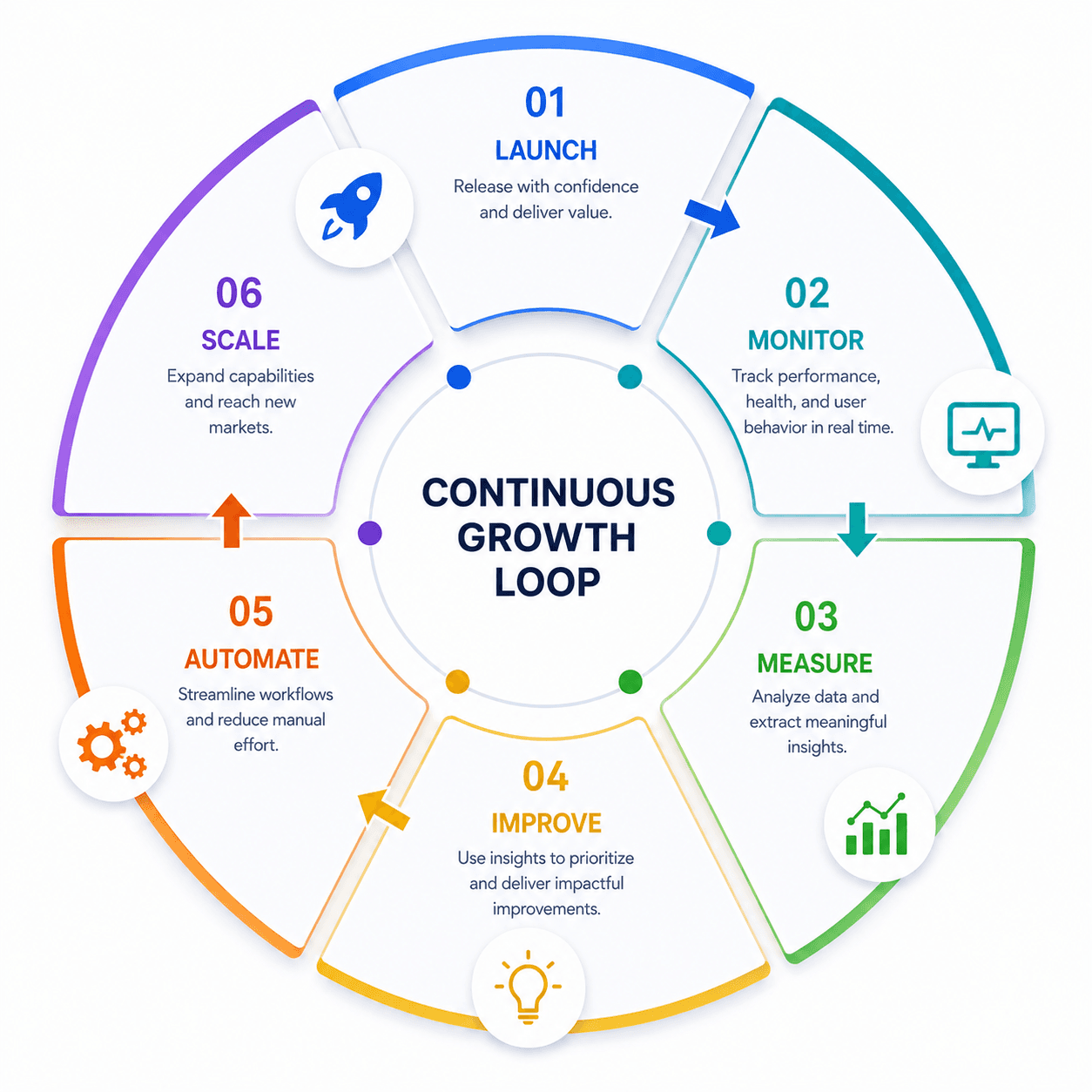
Post-Launch Scaling
Launching the product is the beginning of the operating lifecycle.
The first stage after launch should focus on learning.
Monitor:
- Customer behaviour
- Merchant adoption
- Support patterns
- Operational bottlenecks
- Technical performance
As the platform grows, the business may gradually improve:
- Reporting
- Monitoring
- Case management
- Support workflows
- Infrastructure capacity
Where AI Can Add Value
AI should not be presented as the centre of an Afterpay-style platform unless it solves a specific product or operational problem.
Potential use cases may include:
Operations
AI-assisted systems may help classify incoming requests or prioritise cases.
Customer Support
AI can support knowledge retrieval and first-level assistance where appropriate.
Risk Operations
Analytical systems may help teams identify patterns or prioritise investigation.
AI should remain connected to measurable operational or product value.
Adding generic “AI-powered BNPL” language without a defined use case would weaken the product strategy.
The Future: From Generic BNPL to Embedded Financial Products
The long-term opportunity may move beyond another general-purpose payment application.
A possible evolution is:
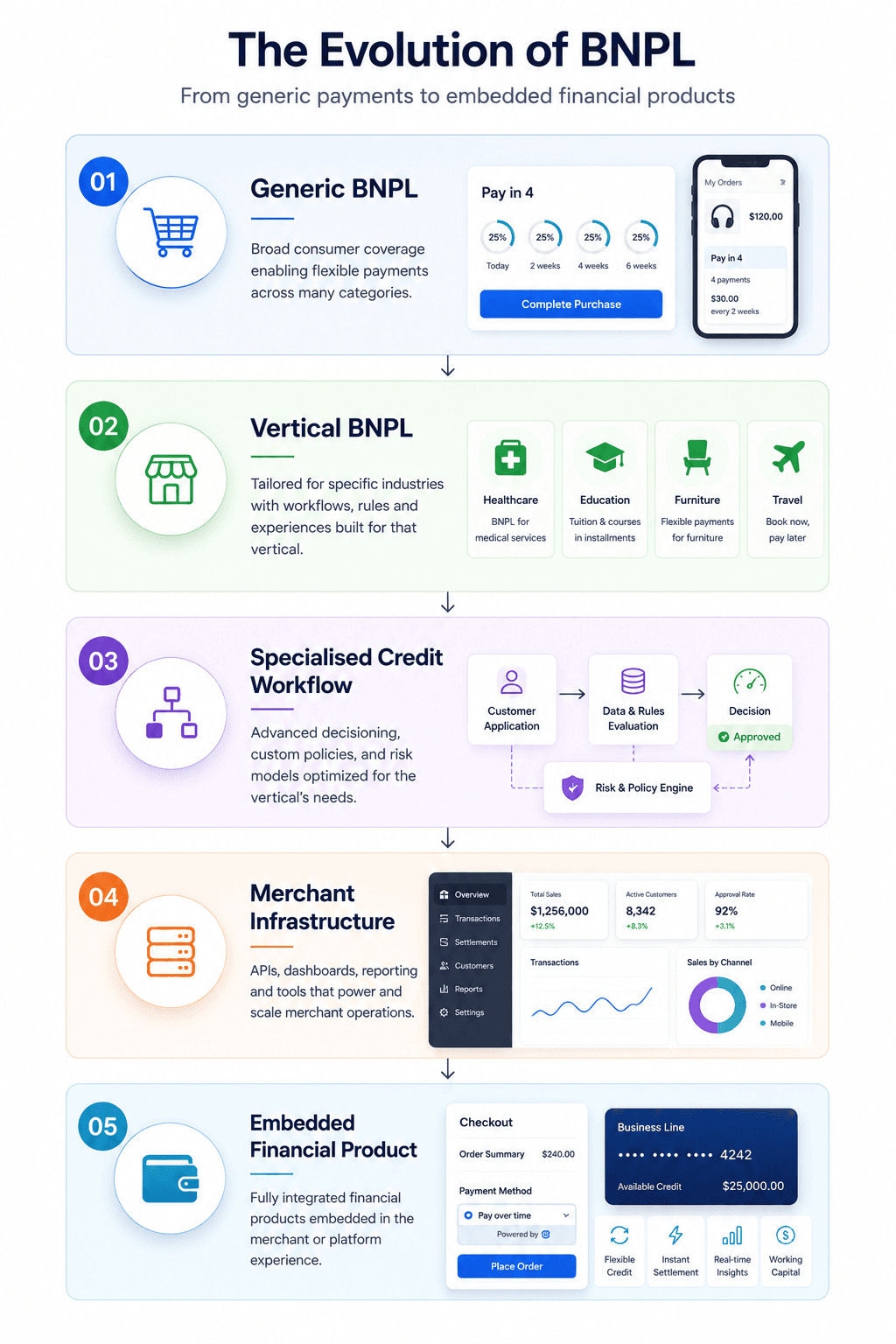
The strongest future opportunities may come from combining financial capabilities with a specific customer journey, industry or merchant ecosystem.
Frequently Asked Questions
What Features Are Needed to Build an Afterpay-Style App?
The product may require consumer onboarding, transaction workflows, payment management, merchant capabilities, internal operational tools and backend infrastructure.
How Much Does It Cost to Build an Afterpay-Style App in Australia?
Software development costs can vary significantly depending on whether the business is developing a focused MVP or a broader financial platform. The ranges in this article are indicative planning estimates and do not represent the total capital required to operate the financial product.
What Is the Difference Between an Afterpay Clone and an Afterpay-Style Platform?
An Afterpay clone generally focuses on reproducing visible features.
An Afterpay-style platform is a broader product involving customer and merchant workflows, transaction processing, decisioning, financial records, reconciliation, operational tooling, integrations, security and applicable regulatory requirements.
The second is substantially broader than building a mobile application.
Should a Startup Build the Entire Platform From Scratch?
Not necessarily. The business should identify which capabilities create its competitive advantage and where partnerships or third-party infrastructure are more appropriate.
How Long Does Development Take?
The timeline depends on scope, integrations, operational complexity and testing requirements. A focused MVP can take less time than a broader platform with consumer, merchant and operational systems.
Planning an Afterpay-Style FinTech Product in Australia?
Before committing to full-scale engineering, define the MVP, map the financial workflows and determine which capabilities should be built versus integrated. Discuss your FinTech product requirements with Junkies Coder and turn the concept into a practical product and development roadmap.
Final Thoughts
The biggest mistake in this category is starting with a feature checklist.
A stronger process is:
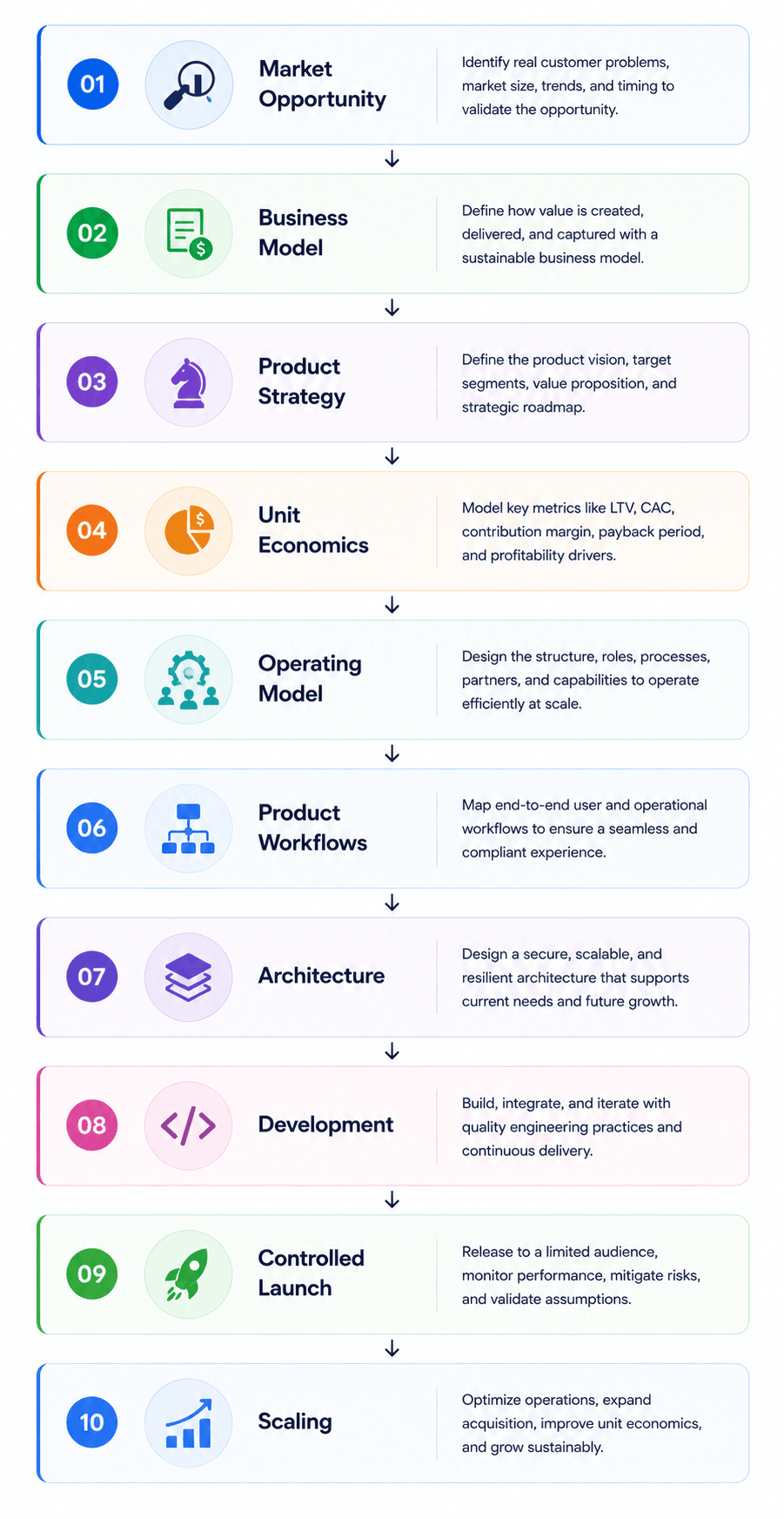
The goal should not be to recreate Afterpay feature for feature.
The more important question is:
What Afterpay-style financial product can your business build that solves a meaningful customer or merchant problem?
That answer should determine the MVP, architecture, integrations and long-term investment.
The strongest products will not necessarily be the ones with the longest feature lists.
They will be the products where the business model, customer experience, merchant proposition, financial infrastructure and operating model work together.
Building an Afterpay-style product in Australia is a financial-platform and operating-model challenge, not merely a mobile-app development project.