Defining the Contenders: Kimi K3, Claude, and GPT-5.5
For enterprise AI engineering buyers in 2026, navigating model procurement requires balancing capability against real-world cost. Three major names dominate this conversation:
- Kimi K3 (Moonshot AI): A recently released large-scale Mixture of Experts (MoE) model. Originating from China, it is positioned as a highly cost-efficient challenger featuring a massive 1M+ token context window.
- Claude (Anthropic): A family of models (including Fable 5, Opus 4.8, and Sonnet 5) heavily prioritized for enterprise safety, nuanced reasoning, and strict data compliance.
- GPT-5.5 (OpenAI): OpenAI's highly adopted frontier model. While OpenAI has recently introduced the GPT-5.6 family (Sol, Terra, Luna) as its newest generation, GPT-5.5 remains heavily embedded in enterprise workflows and serves as a critical baseline for cost-to-performance comparisons.
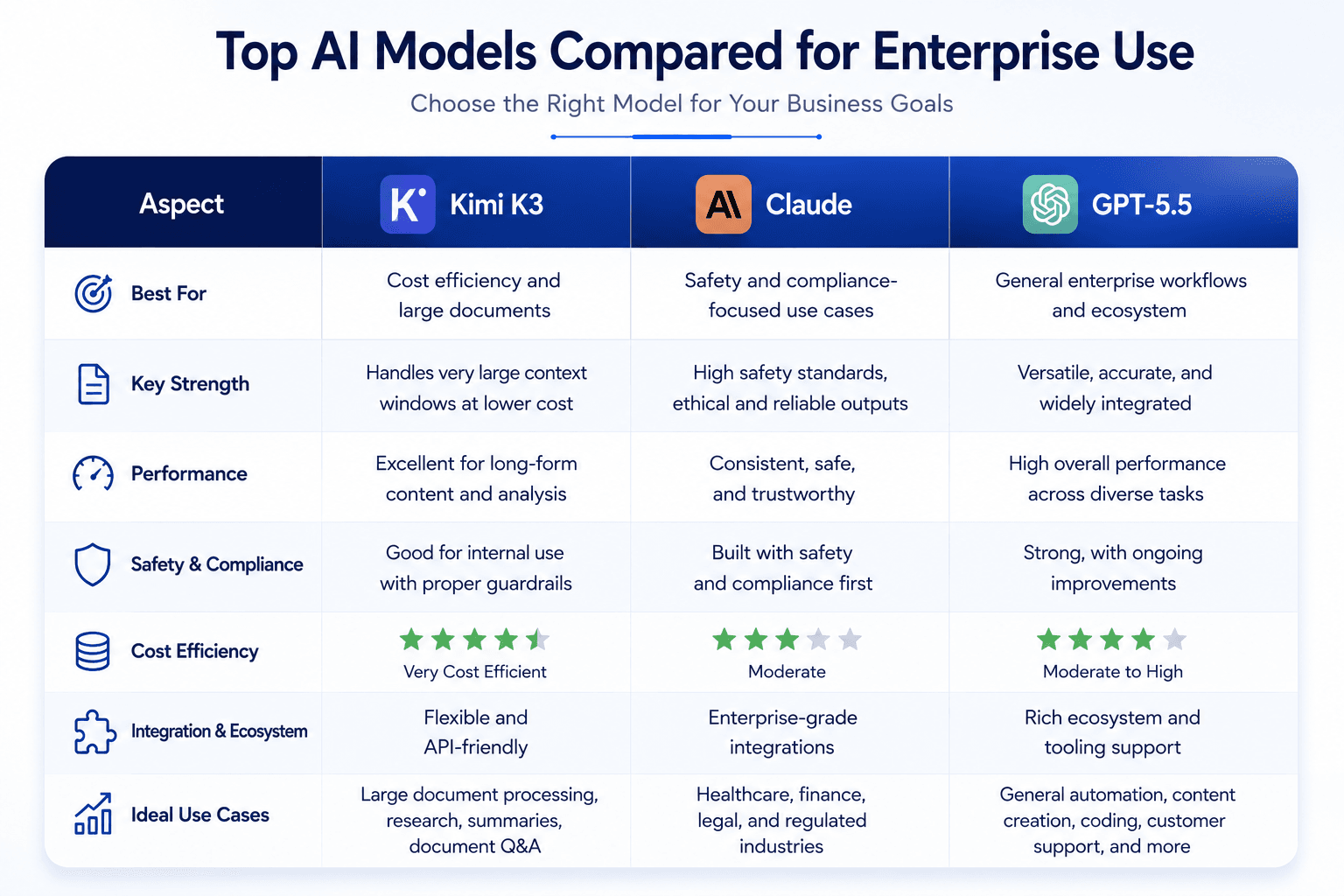
Direct answer: Enterprise buyers evaluating AI models today face a genuine three-way decision. You must choose between the established standard (GPT-5.5), the safety-and-reasoning focused leader (Claude), and a highly aggressive cost-to-performance challenger (Kimi K3). The right choice depends entirely on whether your organization prioritizes budget, coding efficiency, or regulatory compliance.
What Vendors Disclose About Their Models
When evaluating these models for enterprise deployment, it is critical to look past benchmark hype and understand the operational realities disclosed by the vendors themselves:
- Kimi K3's Operational Quirks: Moonshot AI notes that K3 is highly sensitive to "thinking history"—meaning that switching models mid-session without carrying over full context can lead to unstable outputs. They also acknowledge a gap in user experience polish compared to its US counterparts.
- Claude's Safety Routing: Anthropic builds automated safety reroutes into their premium models. If a query flags cybersecurity or biological safety filters, it is automatically routed to a different model tier (like Opus 4.8) at no additional charge to the user. Additionally, standard Claude usage requires a 30-day data retention period for safety monitoring, a crucial detail for data compliance teams.
- The GPT Transition: While GPT-5.5 is a highly capable and widely deployed model, OpenAI's rollout of GPT-5.6 introduces similar capabilities at matched or varied price points. Enterprises must evaluate if they should stick with the proven GPT-5.5 or transition to newer architectures.
Pricing and Cost Efficiency
For procurement teams, token pricing is the primary metric for forecasting ROI. Below is a simplified look at how these models compare on sticker price.
| Model | Input ($/M tokens) | Output ($/M tokens) | Context Window |
|---|---|---|---|
| Kimi K3 | $3.00 | $15.00 | ~1M tokens |
| GPT-5.5 | $5.00 | $30.00 | ~1M tokens |
| Claude Fable 5 | $10.00 | $50.00 | 200k - 500k |
| Claude Opus 4.8 | $5.00 | $25.00 | 200k - 500k |
Note: Pricing is subject to change. Anthropic offers specific Enterprise seat-based plans, and Kimi K3 offers heavy discounts for cached tokens.
Real-World Cost Per Task
Sticker price doesn't always equal operational cost. Independent tests measuring the actual cost to complete complex tasks suggest Kimi K3 generally undercuts GPT-5.5 and Claude Opus. However, Kimi K3 has shown a higher hallucination rate on very long tasks, which means enterprises may need to factor in the cost of retries or verification steps, bridging the gap between it and OpenAI's models.
Independent Benchmark Standing
While self-reported metrics can be skewed, independent intelligence benchmarks place these models in a tight race:
- Claude Fable 5 consistently ranks at the top for raw reasoning and complex problem-solving.
- GPT-5.5 / GPT-5.6 remain highly competitive, offering strong general-purpose reliability.
- Kimi K3 performs exceptionally well, especially in coding evaluations, proving it can stand shoulder-to-shoulder with closed-source frontier models despite its lower price.
Strategic AI Procurement: How to Choose
For business leaders, standardizing on a single AI model is rarely the most cost-effective strategy. Instead, organizations should match the model to the specific complexity of the task:
- Multi-Model Routing: Route routine, high-volume tasks (like basic customer support) to budget-tier models (like Claude Haiku or GPT-5.6 Luna), and reserve expensive models (like Claude Fable 5 or GPT-5.5) exclusively for complex analytical work.
- Security and Compliance: Anthropic's Enterprise tier offers mature compliance tooling out-of-the-box, including SCIM, audit logs, and HIPAA-ready options. Kimi K3 is newer to the enterprise space and its governance tools should be evaluated closely before deployment in regulated sectors.
- Ecosystem Maturity: GPT-5.5 benefits from an immense, mature ecosystem of developer tools, integrations, and community support, which often accelerates time-to-market for internal development teams.
Final Recommendations for Enterprise Buyers
There is no single "best" model for 2026. Your procurement decision should be driven by your specific operational workflows:
- Best for Cost Efficiency at Scale: Kimi K3. It offers the lowest cost-per-completed-task and a massive context window, making it ideal for processing large document sets where budget is a primary concern.
- Best for Regulated Industries and Compliance: Claude (Fable 5 / Opus 4.8). With built-in safety rerouting, robust data retention controls, and mature enterprise governance features, Claude is the safest choice for healthcare, finance, and legal sectors.
- Best for Complex Corporate Coding: Kimi K3 & GPT-5.5. Kimi K3 has shown remarkable success in independent coding benchmarks, while GPT-5.5 remains a highly reliable, general-purpose powerhouse with deep developer ecosystem support.
- Best for General Enterprise Reliability: GPT-5.5. If your organization requires a proven, universally supported model that balances high capability with predictable performance, GPT-5.5 remains a foundational choice.
FAQs
1. What is the difference between Kimi K3, Claude, and GPT-5.5?
Kimi K3 focuses on cost efficiency and large context capabilities, Claude focuses on safety and enterprise reasoning, while GPT-5.5 is known for general enterprise reliability and ecosystem support.
2. Which AI model is more cost-effective for enterprise use?
Kimi K3 is positioned as a cost-efficient option with competitive pricing, while GPT-5.5 and Claude may provide additional value through ecosystem maturity, reliability, and enterprise features.
3. Is Kimi K3 cheaper than GPT-5.5?
Yes, Kimi K3 generally offers lower token pricing compared with GPT-5.5, making it attractive for organizations focused on reducing AI operating costs.
4. Which AI model is best for enterprise applications?
The best model depends on business requirements. Claude may suit compliance-heavy industries, GPT-5.5 supports broad enterprise workflows, and Kimi K3 can be suitable for cost-sensitive workloads.
5. Is Claude better for regulated industries?
Claude is considered a strong option for regulated industries because of its focus on safety, governance, and enterprise controls.
6. Which AI model is better for coding tasks?
Kimi K3 and GPT-5.5 both provide strong coding capabilities. The better choice depends on development requirements, workflow integration, and budget considerations.
7. How should companies choose between multiple AI models?
Companies should evaluate AI models based on pricing, accuracy, security requirements, scalability, integration capabilities, and specific business use cases.
8. Does a cheaper AI model always provide better ROI?
No. ROI depends on more than pricing. Factors like accuracy, reliability, implementation cost, and business impact also determine the overall value.
9. What factors should enterprises consider before adopting an AI model?
Enterprises should consider cost, security, compliance, performance, data privacy, scalability, and vendor support before selecting an AI model.
10. Why is enterprise AI cost comparison important in 2026?
As AI adoption increases, comparing model pricing and performance helps businesses choose solutions that provide better efficiency, scalability, and long-term value.