Why Saudi Arabia Is the Smart Choice for 2026
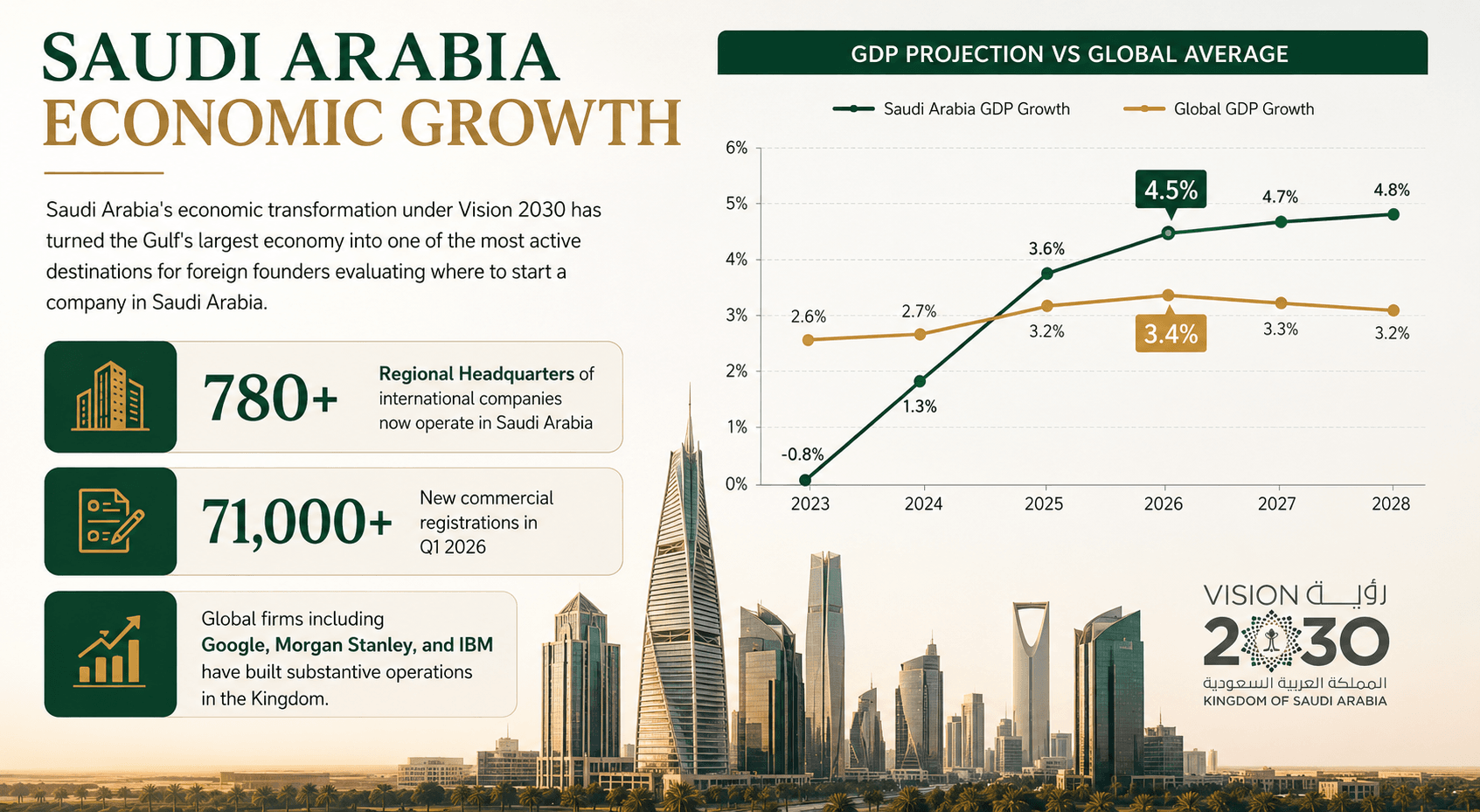
Saudi Arabia's economic transformation under Vision 2030 has turned the Gulf's largest economy into one of the most active destinations for foreign founders evaluating where to Saudi mobile app development guide. The timing reflects real momentum, not just policy announcements.
According to AstroLabs, Saudi Arabia now hosts over 780 regional headquarters of international companies, and in Q1 2026 alone, more than71,000 new commercial registrations were issued. The Kingdom's GDP is projected to grow 4.5% in 2026, nearly double the global average of 3.4%. Global firms including Google, Morgan Stanley, and IBM have all built substantive operations in the Kingdom rather than token sales offices.
The 2026 landscape is shaped by 100% foreign ownership now permitted across most strategic sectors, an accelerating Saudization push that's reshaping hiring timelines, and a digitized registration process running through MISA, ZATCA, and the Ministry of Labor portals. Anyone considering starting a business in Riyadh 2026 can now complete most documentation through these government portals before ever setting foot in the Kingdom.
Business Registration Timeline - Step by Step (2026)
Understanding the Saudi Arabia company registration process cost requirements 2026 is essential before filing your first document. The roadmap below walks through every phase.
Many new businesses in Saudi Arabia are investing in digital payment systems and fintech app development services to improve customer experience and operational efficiency.
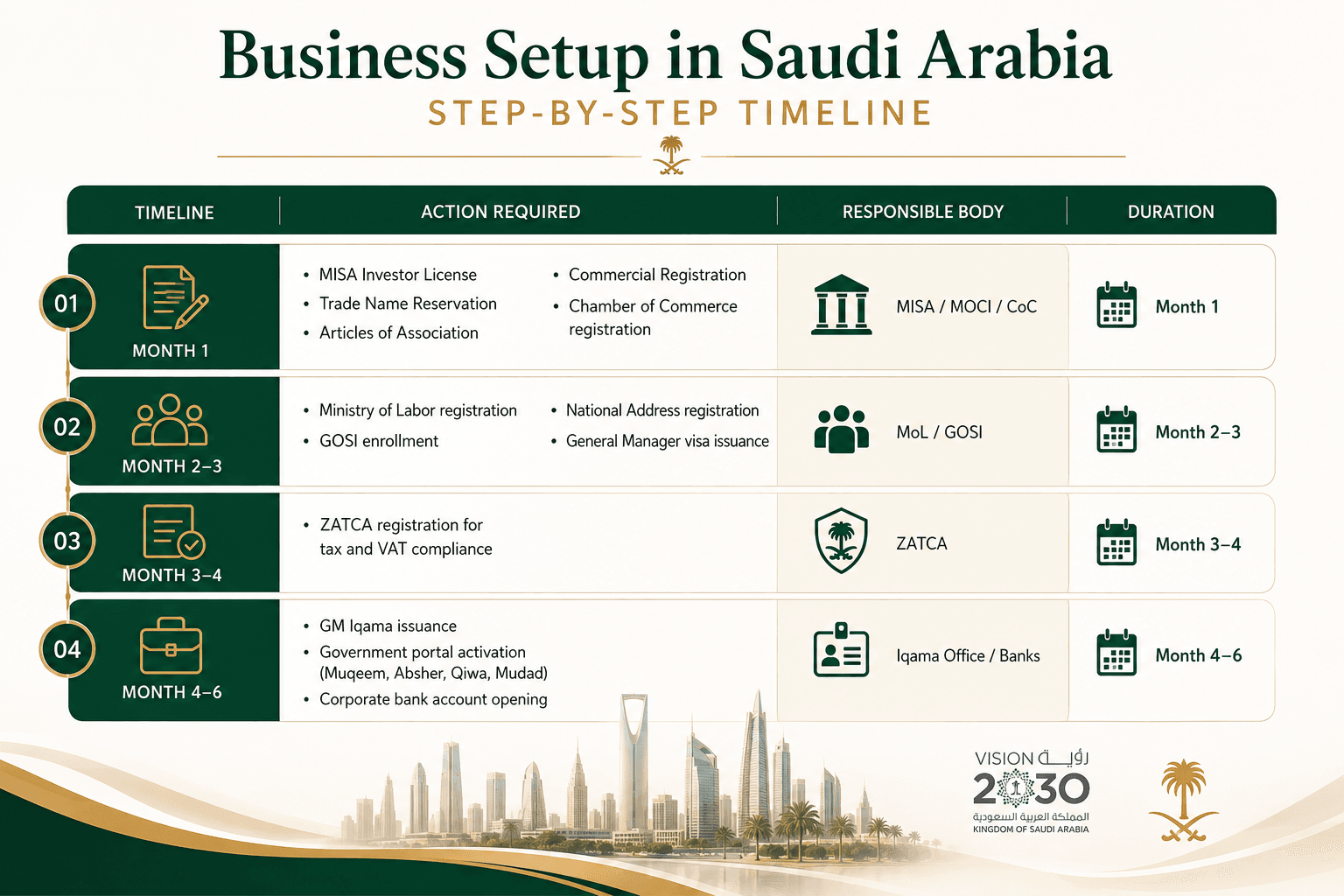
Most foreign founders complete the full process in around 6 months. Companies that prepare documentation in advance and engage local advisory support often cut this closer to 3 months, according to AstroLabs' client data.
Choose the Right Business Structure
Your choice of legal entity determines your tax liability, capital requirements, and ability to expand. Saudi Arabia offers several principal license routes, each suited to different investor profiles.
| License Type | Foreign Ownership | Min. Establishment Requirement | Best For |
|---|---|---|---|
| Service License | 100% | 1+ year operating abroad, minimum capital | IT, marketing, restaurants, consulting |
| Industrial License | 100% | 1+ year operating abroad | Manufacturing, industrial activity |
| Agricultural License | 100% | Standard establishment conditions | Farming, agribusiness |
| Mining License | 100% | 1+ year operating abroad | Mining and extraction |
| Trading License (100% route) | 100% | 3 overseas markets, SAR 30M Year 1, SAR 170M over 5 years | Large-scale import/export |
| Trading License (Saudi Partner route) | 75% foreign / 25% Saudi | SAR 26.67M capital, no overseas history needed | Mid-size trading operations |
| Professional License (Standard) | 75% max | 25% local partner required | Most professional service firms |
| Professional License (100% route) | 100% | 4 international branches, SAR 10M capital/branch, 7+ years' experience | Specialized engineering, large professional firms |
Most foreign founders complete the full process in around 6 months. Companies that prepare documentation in advance and engage local advisory support often cut this closer to 3 months, according to AstroLabs' client data.
Complete Cost Breakdown - Saudi Arabia Business Setup 2026
FULL COST REFERENCE TABLE — 2026
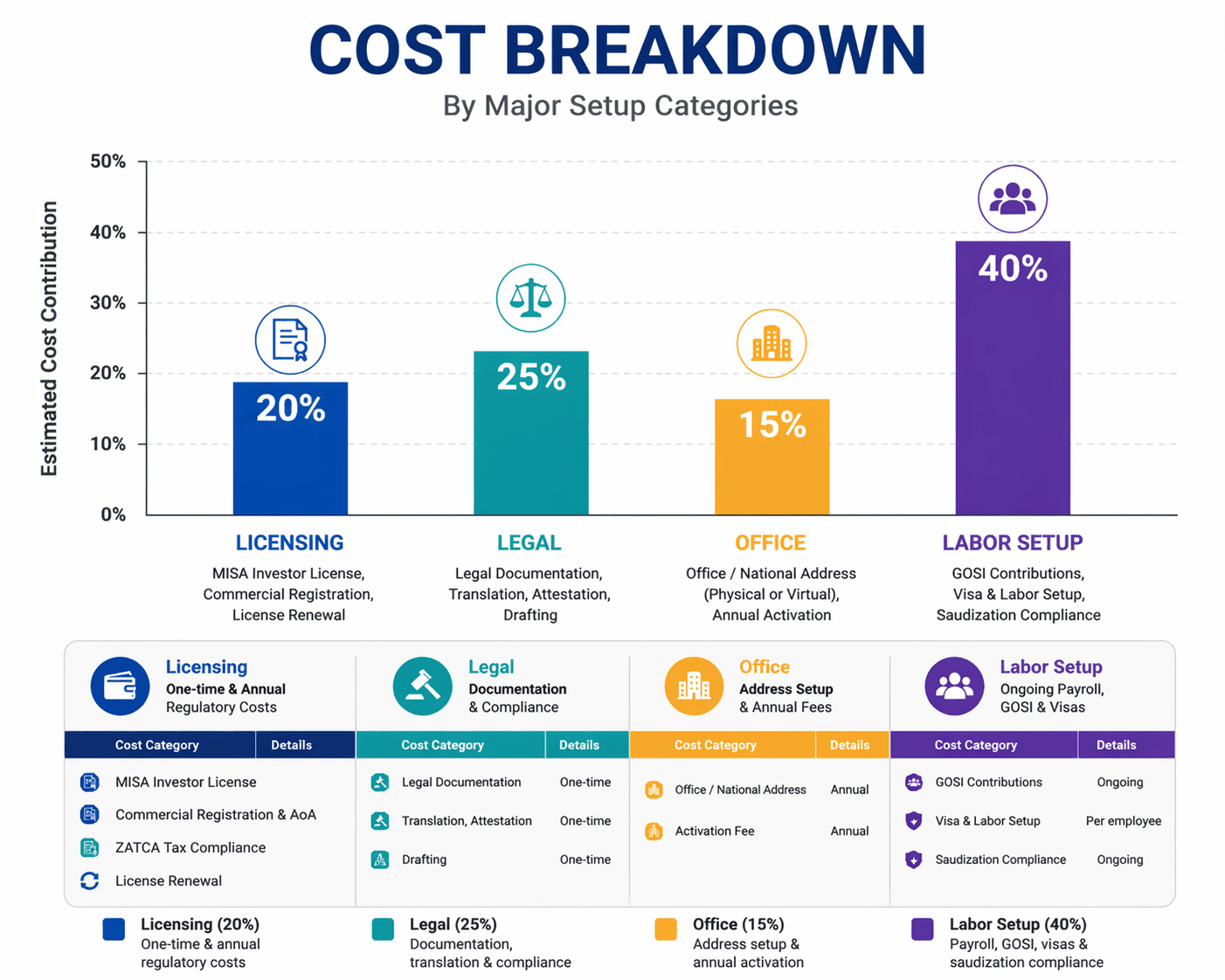
The average first-year setup cost runs around SR 550,000 (roughly $146,700), according to AstroLabs' 2026 cost analysis, covering licensing, legal documentation, office setup, and initial compliance support.
100% Foreign Ownership: Which Licenses Qualify
Full foreign ownership isn't automatic; it depends entirely on your license type and establishment history.
Service, industrial, agricultural, and mining licenses generally allow 100% ownership if your company has operated abroad for at least one year and meets minimum capital requirements.
Trading licenses require either substantial international presence and capital (three overseas markets, SAR 30 million in Year 1, SAR 170 million over five years) or a Saudi partner holding 25%, which lowers the capital bar significantly.
Standard professional licenses typically require a 25% local partner unless your firm meets stricter international presence and capital thresholds (four international branches, SAR 10 million capital per branch, 7+ years' experience).
License Types, Fees & Compliance
Saudi Arabia's licensing framework is activity-specific, and mismatched licensing is among the most common and costly mistakes made by foreign investors entering the market.
| License Type | Typical Use Case | Additional Requirements |
|---|---|---|
| Service | IT, consulting, F&B, marketing | Minimum 1-year overseas establishment |
| Industrial | Manufacturing, processing | Environmental clearance |
| Agricultural | Farming, agribusiness | Standard land-use approvals |
| Mining | Extraction, minerals | Sector-specific permits |
| Trading | Import/export | Capital thresholds or Saudi partner |
| Professional | Engineering, legal, accounting | 25% Saudi partner or international branch requirements |
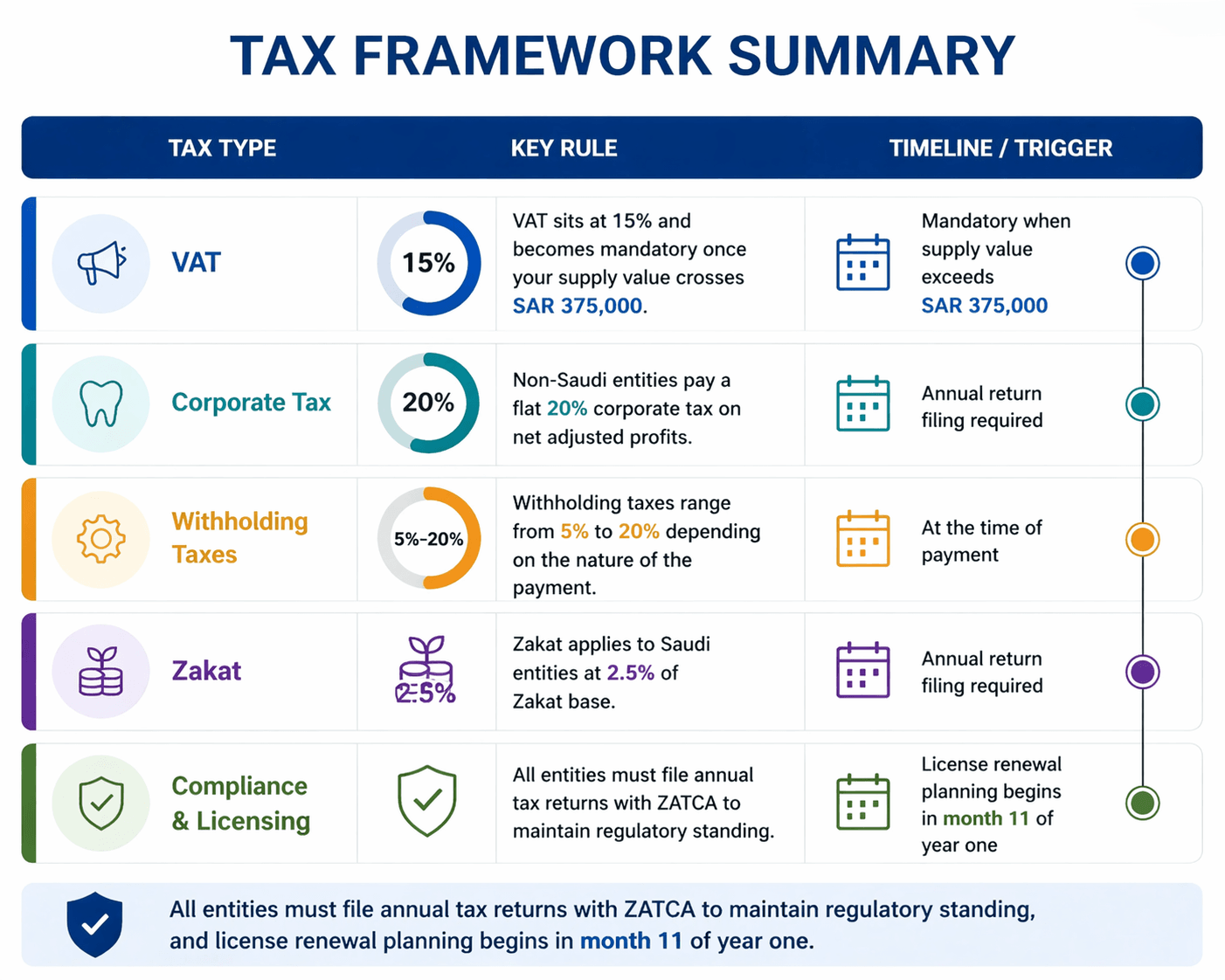
Saudi Tax Framework - What You Owe in 2026
Saudi Arabia's tax framework is structured but predictable once you understand the core obligations. Many foreign investors choose custom app development services to automate operations, improve customer engagement, and scale efficiently in the Saudi market.
6-Month Setup Roadmap: From Idea to Operations
This roadmap represents the realistic, fully compliant route to an operational Saudi business in 2026, assuming documentation is prepared in advance and a local advisory partner is engaged from day one.
- Month 1: MISA license, trade name, Articles of Association, Commercial Registration, Chamber of Commerce
- Month 2–3: Ministry of Labor, GOSI enrollment, National Address, GM visa
- Month 3–4: ZATCA registration for tax and VAT
- Month 4–6: GM Iqama, government portal activation, corporate bank account
For anyone serious about starting a business in Saudi Arabia, budget realistically beyond the SR 550,000 first-year figure for ongoing compliance support.
Annual Compliance Essentials
Registering your company is just the beginning. Saudi Arabia imposes a structured set of annual obligations on all operating entities.
Annual Renewal Calendar
MISA license renewal - annual Commercial Registration renewal - annual GOSI contribution rate increases - 0.5% annually through 2028 ZATCA tax return filing - annual, mandatory even if below VAT threshold Iqama renewal for General Manager and staff - annual License renewal process begins - Month 11 of Year 1
Saudization & Labor Compliance
Saudi labor regulations require companies to hire Saudi nationals based on a quota system that varies by sector and business size, known as Nitaqat or Saudization.
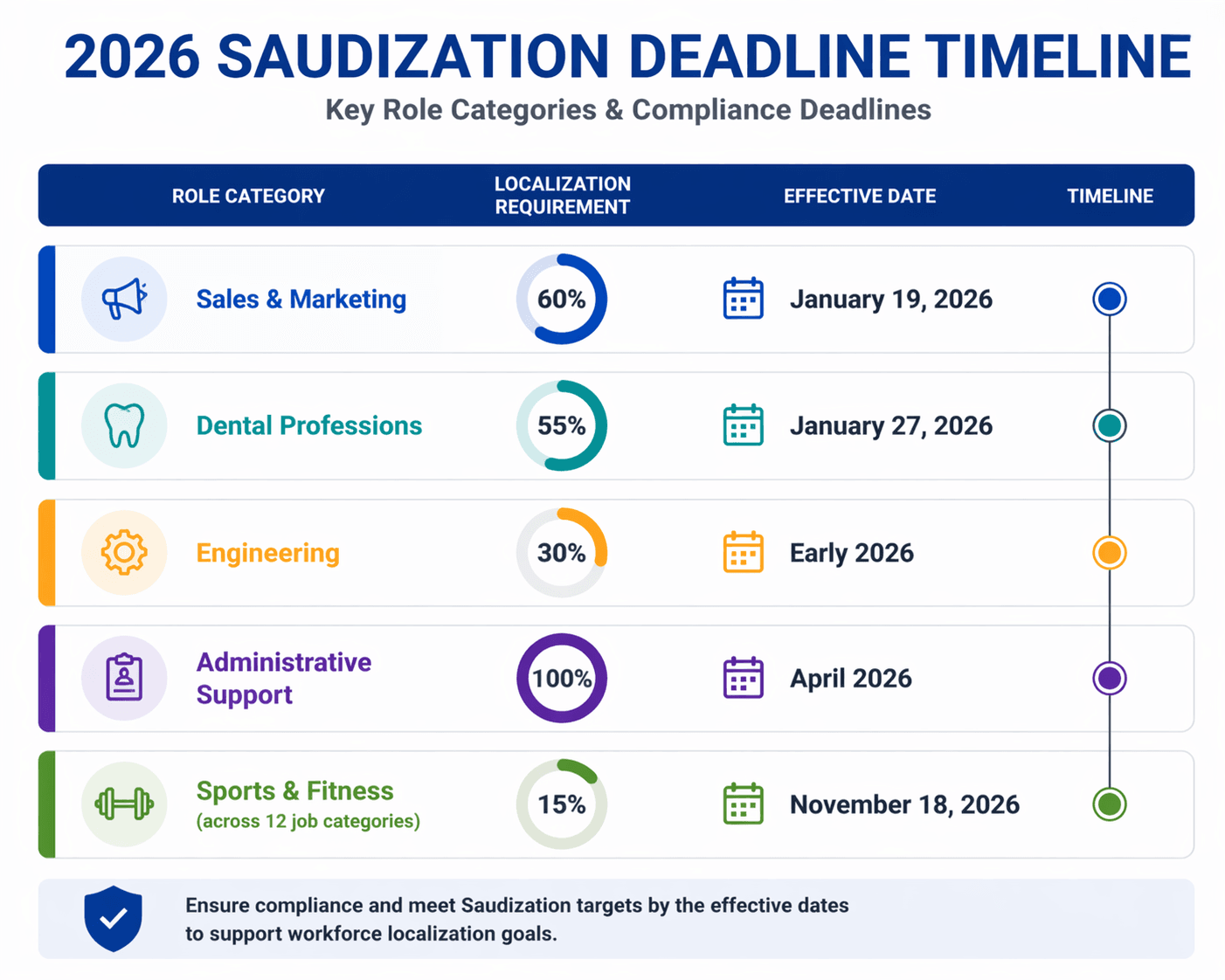
Non-compliance can result in Red Zone classification, restricting participation in government tenders and triggering operational limitations. GOSI contributions are also rising every year through 2028, climbing 0.5% annually from 9% toward 11% of contributory wages for both employer and employee.
Banking Requirements
- Saudi-resident General Manager with active Iqama required before account opening
- Corporate bank account is the final milestone in the three-phase setup process
- Common banking partners include SAB, Riyad Bank, and Albilad Bank
- Account opening typically follows Iqama issuance directly
- ZATCA and VAT payment delays can trigger cascading effects, including Muqeem suspension
Risk Assessment: Opportunities & Challenges
| ✅ Key Advantages | ⚠️ Key Challenges |
|---|---|
| 100% foreign ownership across most strategic sectors | Saudization quotas tightening across multiple sectors in 2026 |
| GDP growth of 4.5%, nearly double the global average | GOSI contribution rates rising annually through 2028 |
| 780+ regional HQs already established in the Kingdom | Trading licenses require high capital or a Saudi partner |
| Streamlined digital portals (Muqeem, Qiwa, Mudad) | GM visa delays can block banking and tax registration |
| Strong government procurement and sector demand | Frequent regulatory updates require ongoing monitoring |
| Access to Vision 2030 sector investment pipelines | Average first-year cost of SR 550,000 ($146,700) |
Frequently Asked Questions
Q1. Can foreigners start a business in Saudi Arabia?
Yes. Foreigners can hold 100% ownership across most sectors, including services, manufacturing, mining, and agriculture, subject to MISA licensing and Saudization compliance.
Q2. What is the most practical business structure for a foreign founder?
An LLC under a service or industrial license is typically the most accessible route for most commercial activities entering the market in 2026.
Q3. How long does it actually take to start a business in Saudi Arabia?
The full process averages 6 months across three phases, though founders with prepared documentation and local advisory support often become operational in around 3 months.
Q4. Is Saudi Arabia expensive to start a business in?
Plan for roughly SR 550,000 ($146,700) in your first year, covering licensing, legal setup, and compliance support, with renewal costs recurring from month 11 onward.
Q5. Do foreign companies pay tax in Saudi Arabia?
Yes. Non-Saudi entities pay 20% corporate tax on net adjusted profits, and VAT registration becomes mandatory once supply value exceeds SAR 375,000.
Q6. What happens if I miss Saudization quotas?
Non-compliance can trigger Red Zone classification, which restricts your ability to participate in government tenders and limits broader operations.
Q7. How many shareholders are required to start a business in Saudi Arabia?
At least one shareholder is required, and that shareholder can be either a Saudi resident or a foreigner, depending on your chosen license type.
Q8. Do I need a Saudi-resident General Manager?
Yes. Your company must designate a General Manager who holds a Saudi Iqama, and this person must appear in person in Saudi Arabia to complete the registration process.
Q9. Can I open a corporate bank account before my GM Iqama is issued?
No. The GM's Iqama is required before a corporate bank account can be opened, which is why visa delays are one of the most common causes of setup slowdowns.
Q10. Which business activities qualify for 100% foreign ownership without a Saudi partner?
Service, industrial, agricultural, and mining licenses generally allow full ownership if your company has operated abroad for at least one year and meets minimum capital requirements.
Conclusion: Is Saudi Arabia Right for You in 2026?
Saudi Arabia in 2026 presents a genuinely compelling opportunity for foreign founders willing to navigate a more structured, not simpler, entry process. The combination of 100% foreign ownership across most sectors, 4.5% projected GDP growth, and a digitized registration system spanning MISA, ZATCA, and the Ministry of Labor creates conditions few regional markets can match. As digital adoption continues to expand, mobile app development companies in Saudi Arabia are also supporting businesses entering the market by building secure, scalable, and locally aligned digital solutions.
For founders entering now, the priority is planning Saudization, GOSI, and tax compliance into the setuimeline from day one, not treating registration as the finish line. Budget realistically around SR 550,000 for your first year, partner with experienced local advisory support, and target sectors aligned with Vision 2030, technology, healthcare