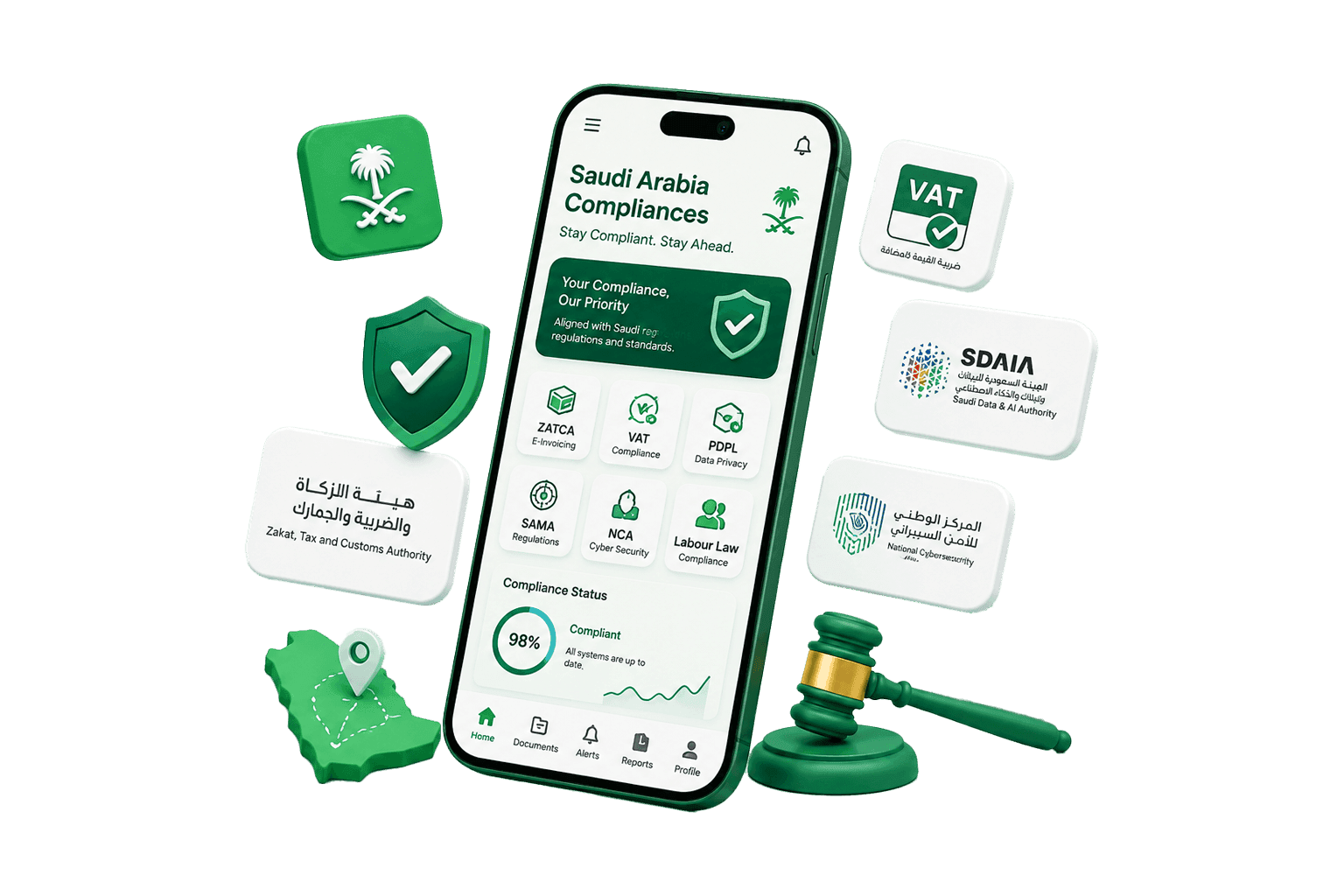
Custom machine learning, Arabic NLP and intelligent automation engineered within PDPL, SDAIA guidelines and Vision 2030 digital transformation priorities for enterprise and government organizations across Riyadh, Jeddah and the Kingdom.

Empowering awards and recognition to Drive Innovation and Success with our unparalleled expertise and commitment to excellence.
Years of experience
Countries Served
Average cost P/H
Positive Feedbacks
Happy Success Stories
Experts & Engineers
Arabic Language NLP Development
PDPL-Governed Machine Learning Development
Government Service AI for Vision 2030 Programmes
Financial Services AI for Saudi Banking
Computer Vision for Saudi Industrial Sectors
AI Consulting and Vision 2030 Architecture Advisory
Each Saudi engagement follows a five-phase lifecycle addressing PDPL, SDAIA alignment, and Arabic requirements upfront, ensuring compliance before engineering begins and avoiding rework later.
Assess data assets, Arabic NLP readiness, and map PDPL obligations including consent, localization, and transfer rules. For government clients, SDAIA alignment is also evaluated to set the compliance baseline.
Design AI architecture aligned with Saudi data residency and SDAIA guidelines, including PDPL controls and relevant sector frameworks like SAMA. Architecture is reviewed and approved before development begins.
Develop and fine-tune models with Arabic NLP capability using PDPL-compliant data handling. All training is versioned, logged, and validated against Saudi-domain performance benchmarks.
Integrate models with PDPL-aligned access controls, audit logs, and security testing. Validate consent management, data rights, and compliance with Saudi regulatory requirements before deployment.
Deploy on Saudi-approved infrastructure with monitoring, drift detection, and retraining setup. Provide full documentation and compliance records for independent operation and audit readiness.
Saudi enterprises and government clients require PDPL and SDAIA compliance at the AI architecture stage. Junkies Coder embeds Saudi regulatory requirements and delivers compliance-ready AI systems.

Smart solutions designed to adapt across industries effortlessly, helping businesses streamline operations, enhance performance, and drive sustainable growth.
We follow a transparent, collaborative process, from discovery to deployment. Designed to help founders move fast, stay lean, and build reliable, scalable products.
We explore your vision, goals, and market to create a strategic roadmap through meetings, assessments, and planning.
Wireframes and mockups bring your product to life with intuitive, user-focused design ready for seamless implementation.
We build clean, scalable code supported by testing plans and bug fixing to ensure stability, performance, and reliability.
Agile sprints drive continuous improvement. We support product launch, PR, investor readiness, and long-term growth strategies.
Shalehin Modasia
Marketing DirectorENGAGEMENT MODELS
We adapt to the way your business operates. Whether you need end-to-end ownership of an engagement, additional senior engineering capacity, or a long-term dedicated team aligned to your goals, our engagement models give you the flexibility to scale delivery at the pace your business demands.
When your in-house team needs specialized engineering capacity without the overhead of long-term hiring, our team augmentation model fills that gap immediately. Our engineers integrate directly with your existing workflows, bring the technical depth required to maintain delivery quality and adapt to your tools, processes and communication standards from day one. You retain full control over direction while we provide the execution capacity your roadmap requires.
Get a free consultationFor engagements that require sustained focus and long-term commitment, our dedicated team model delivers the consistency and accountability that project-based arrangements cannot. We assemble a cross-functional team of engineers, designers and QA specialists built exclusively around your engagement, operating within your delivery cadence with full sprint ownership, direct stakeholder communication and complete accountability from initiation through post-launch evolution.
Get a free consultationWhen you need a single partner to manage a complex engagement end to end while your own teams stay focused on core business operations, we assume complete ownership. From discovery and architecture through design, engineering, testing and deployment, every technical decision and every delivery milestone sits with our team. You define the business objectives. We translate them into production ready outcomes with full transparency at every stage.
Get a free consultationReal stories from real partners who experienced clarity, accountability, and measurable business growth.
By combining innovation, strategy, and modern technologies, we help businesses improve efficiency, scale faster, and achieve sustainable growth.
Featured Technologies
OpenAi
Claude
Falcon
Gemini
Mistral
Grok
Meta
AI development for Saudi enterprises and government follows PDPL, SDAIA, SAMA and Ministry of Health regulations, built into architecture, development and deployment.

PDPL

SDAIA National AI Strategy

SAMA Cybersecurity Framework
ISO 27001
ISO 9001
SOC 2

PCI-DSS

GDPR
HIPPA
NIST

CMMI

HL7/FHIR

The Saudi Authority for Data and Artificial Intelligence serves as the regulatory and strategic anchor for AI development in the Kingdom. SDAIA publishes the National AI Strategy setting sectoral deployment targets across government, healthcare, financial services, logistics and industrial sectors under Vision 2030. It enforces PDPL through the National Data Management Office and publishes technical guidelines governing how AI systems processing personal data about Saudi nationals must be designed and operated. For an AI development company in Saudi Arabia, SDAIA alignment means engineering systems that address data localization requirements, consent management for data subject rights, transparency obligations for automated decisions affecting Saudi residents, and the technical standards applicable to AI deployed in government service contexts. Junkies Coder maps SDAIA guidelines at the architecture stage of every Saudi engagement.
Saudi Arabia's Personal Data Protection Law introduces engineering obligations that must be addressed technically, not just through policy documentation. PDPL requires documented consent for collection and processing of personal data used in AI model training, imposes cross-border transfer restrictions that affect cloud infrastructure selection for Saudi AI systems, and grants Saudi data subjects the right to access, correction and deletion of personal data used in automated processing. For AI systems making automated decisions affecting Saudi individuals, transparency and review rights must be implemented through explainability architecture. Junkies Coder addresses PDPL obligations at the architecture stage by mapping data flows, confirming lawful basis for processing, implementing data minimization in training pipelines and producing records of processing activities for the client's NDMO compliance documentation.
Arabic language processing requires model architecture decisions that cannot be resolved by applying standard English-language NLP frameworks with a translation layer. Arabic morphological complexity, right-to-left script handling, Modern Standard Arabic versus Gulf dialect variation, and domain-specific Arabic vocabulary create specific engineering requirements that must be built into the model architecture from the training data stage. Junkies Coder builds Arabic NLP systems using transformer architectures pretrained on Arabic corpora, fine-tuned on domain-specific Saudi datasets for the target use case. For Saudi government service AI, models are trained on formal Arabic administrative language. For Saudi banking client communication, Gulf Arabic dialect patterns are incorporated. For Saudi industrial document processing, technical Arabic vocabulary specific to oil and gas, construction and manufacturing sectors is addressed in the training data and validation benchmarks.
AI development cost for Saudi clients follows the same structure as enterprise AI engagements globally, with PDPL compliance architecture and Arabic language processing capability adding engineering scope where required. A focused Arabic NLP system or a structured machine learning model integrated into an existing Saudi enterprise application typically falls in the USD 35,000 to USD 90,000 range for production-ready delivery over 8 to 16 weeks. A mid-complexity engagement involving custom model architecture, PDPL compliance implementation, Arabic language training data preparation and multi-system integration typically falls in the USD 90,000 to USD 260,000 range over four to six months. Enterprise AI platform development for Vision 2030-aligned government or quasi-government clients requiring multiple model types and full PDPL governance documentation represents an investment above USD 260,000 and is scoped through a paid discovery engagement.
Timeline for Saudi AI development engagements depends on data readiness, PDPL compliance architecture complexity, Arabic language training data quality and integration scope. A constrained Arabic NLP feature or structured machine learning model with available data and a clear integration path can reach production in 8 to 14 weeks. A mid-complexity engagement requiring PDPL data assessment, Arabic language model development and multi-system integration typically requires four to six months. For Saudi government clients participating in Vision 2030 programmes, SDAIA guideline review and government procurement approval processes introduce timeline requirements beyond the core development scope. Arabic language training data collection and preparation is the most common cause of timeline extension in Saudi NLP engagements when the client does not have a pre-existing labelled dataset in the target domain.
Junkies Coder serves Saudi clients across government services, banking and financial services, healthcare, logistics and supply chain, energy and industrial sectors, and retail. In government services, AI engagements address citizen service automation, document processing intelligence and administrative workflow AI aligned to Vision 2030 digital government targets. In banking, engagements cover fraud detection, credit risk modelling, AML monitoring and customer analytics under SAMA oversight and PDPL requirements. In healthcare, AI systems address patient pathway automation and clinical documentation processing for Ministry of Health-aligned facilities. In logistics, predictive analytics address demand forecasting and supply chain optimization for Saudi logistics operators. In energy and industrial sectors, computer vision and predictive maintenance AI serve operational technology environments of Saudi industrial clients in the economic diversification programme.
Saudi Arabia's PDPL and government procurement standards impose data residency requirements that affect infrastructure selection for every AI system processing personal data about Saudi nationals or operating within government contracts. Junkies Coder addresses data residency at the architecture stage by confirming whether the client's data is subject to PDPL cross-border transfer restrictions, identifying applicable Saudi cloud infrastructure options including AWS, Microsoft Azure and Google Cloud infrastructure within the Kingdom, and designing data pipeline, model training environment and inference infrastructure to keep personal data within Saudi territory where required. For government clients, additional NDMO data governance framework requirements may mandate specific infrastructure configurations beyond standard PDPL requirements. These are identified during the data and feasibility assessment and addressed in the architecture documentation.
Saudi Vision 2030 creates AI development demand across multiple dimensions simultaneously. The program targets economic diversification through AI-driven productivity gains across government services, healthcare, logistics, financial services and industrial sectors. SDAIA's National AI Strategy sets specific sectoral targets that create procurement demand for AI systems aligned to those targets. For an AI development company in Saudi Arabia, Vision 2030 creates opportunities in government service automation, where AI is being deployed to reduce processing times and improve citizen experience across ministry-level services. It creates demand in healthcare AI for capacity optimization and clinical workflow intelligence as Saudi healthcare infrastructure expands. It creates demand in financial services for AI-driven credit access and customer analytics in a banking sector serving a young demographic.
Saudi enterprises should apply five criteria when evaluating AI development companies. First, verify that the vendor understands PDPL obligations at an engineering implementation level, including data subject rights architecture, consent management in training pipelines and cross-border transfer restrictions. Regulatory awareness at a policy level is not sufficient for production AI deployment in the Kingdom. Second, confirm the vendor has genuine Arabic language processing capability built into model architecture, not approximated through translation layers. Third, assess whether the vendor understands SDAIA guidelines and can produce documentation required for Vision 2030-aligned government engagements. Fourth, confirm the vendor conducts a data and feasibility assessment before committing to a price and timeline. Fifth, verify the engagement concludes with PDPL-compliant governance documentation and operational handover records your internal team can use independently.
Saudi clients begin an AI development engagement through a discovery conversation with a senior technical consultant with knowledge of the Saudi regulatory environment and Arabic language processing requirements. This conversation covers the business problem being addressed, the data assets available including Arabic language data quality assessment where relevant, PDPL obligations applicable to the AI system and the integration requirements of the target production environment. Following the discovery conversation, Junkies Coder produces a scoping proposal documenting the proposed architecture, delivery phases, PDPL compliance considerations, SDAIA alignment requirements, timeline and cost range for review before any commitment is made. Saudi clients can submit an enquiry through the consultation form at junkiescoder.com.