The most expensive mistake in AI agent development isn't choosing the wrong model, it's choosing an architecture that becomes expensive to operate at scale.
In 2026, a custom AI agent project may range from approximately $5,000 for a focused proof of concept to $400,000+ for a complex enterprise-grade AI platform, based on Junkies Coder engineering planning estimates and typical software cost structures. At the upper end, budgets reflect multiple legacy integrations, enterprise security, dedicated VPC infrastructure, extensive testing, compliance controls, observability, and multi-team deployment requirements, not simply the cost of building the AI agent code itself.
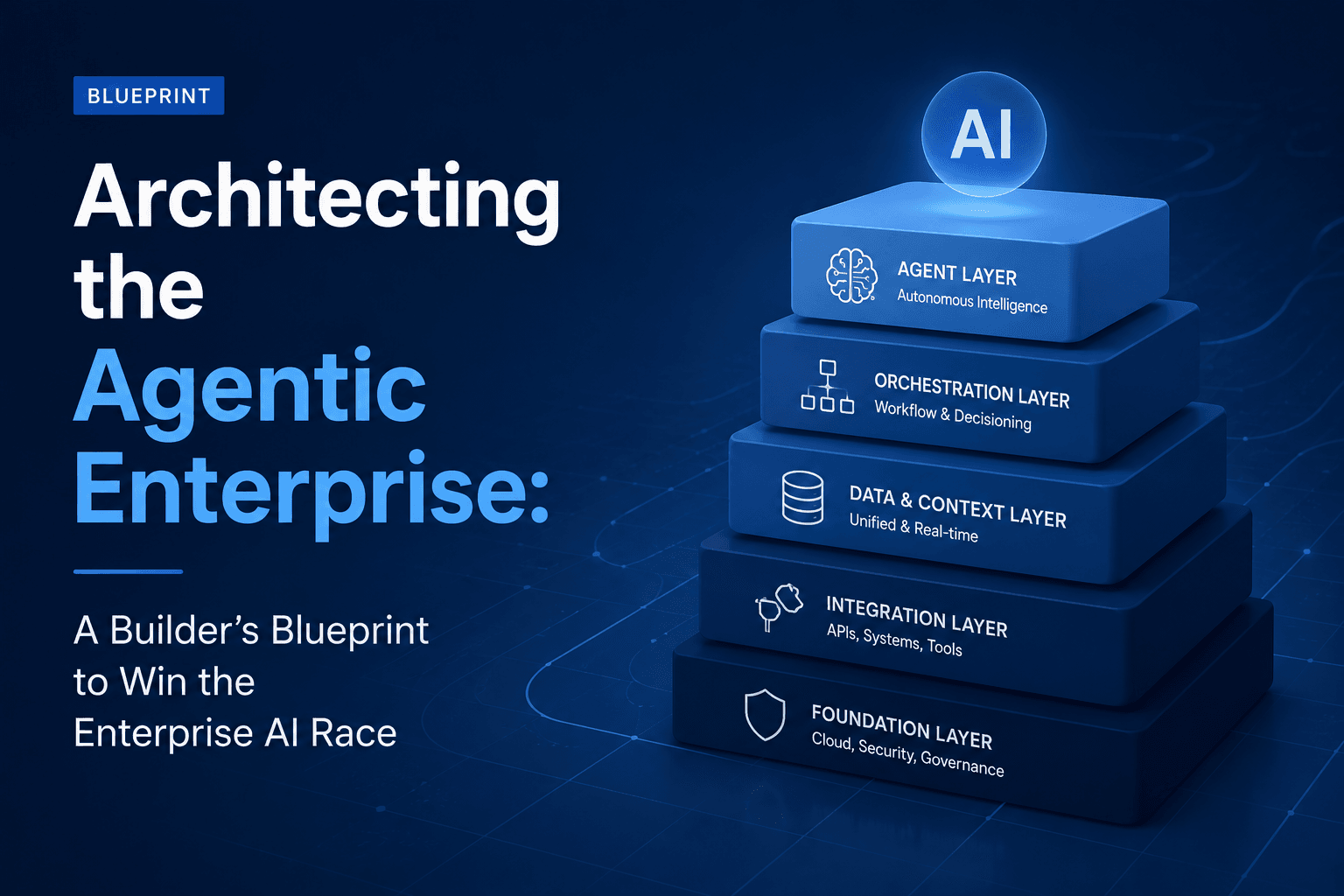
AI AGENT COST DEPENDENCY FLOW:
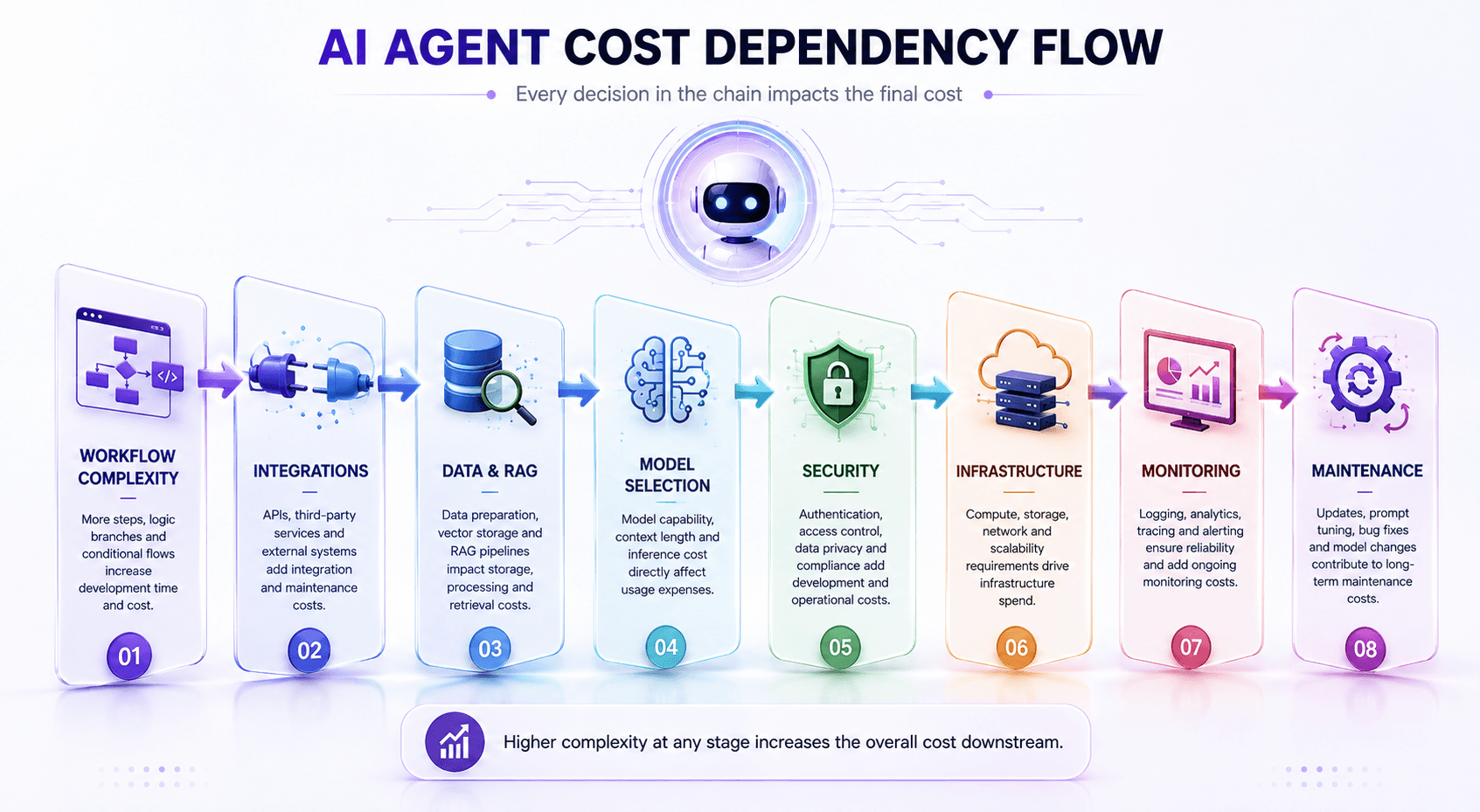
This guide breaks down AI agent development cost in 2026 across architectural tiers, official model provider pricing tiers, AI vs Chatbot vs RPA cost comparisons, vendor quotation inclusions, 3-year Total Cost of Ownership (TCO) tables, and financial payback formulas.
How Much Should You Budget for an AI Agent in 2026?
Note: The following planning ranges reflect Junkies Coder engineering planning estimates rather than a universal standardized price list. Actual project costs depend on workload complexity, geographic engineering rates, model selection, traffic volume, and compliance requirements.
| Project Tier | Illustrative Build Budget | Typical Timeline | Monthly Operating Cost |
|---|---|---|---|
| Proof of Concept (PoC) | $5,000 – $25,000 | 2 – 4 weeks | $100 – $1,000+ |
| Production Workflow Agent | $25,000 – $75,000 | 6 – 10 weeks | $500 – $5,000+ |
| Advanced Enterprise Agent | $75,000 – $200,000+ | 3 – 6 months | $2,000 – $15,000+ |
| Multi-Agent Platform | $150,000 – $400,000+ | 4 – 8+ months | $5,000 – $25,000+ |
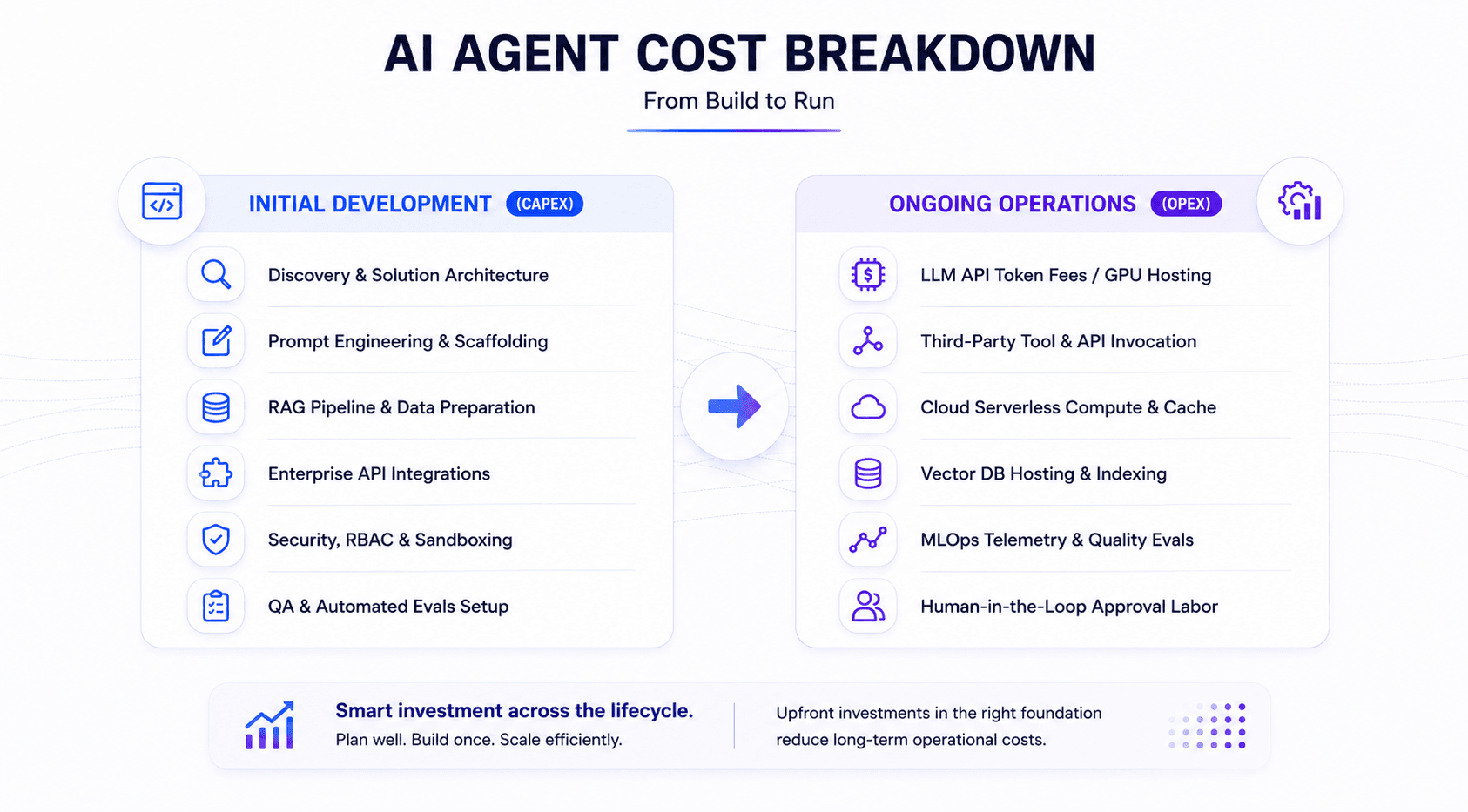
Initial Development Cost vs. Ongoing Operating Cost
To budget effectively, decision-makers must distinguish between one-time capital expenditures (CAPEX) and recurring operational expenses (OPEX):
AI Agent Development Cost by Company Size
| Company Size | Illustrative Budget | Expected Tasks/Mo | Integrations Required | Security Level | Recommended Architecture |
|---|---|---|---|---|---|
| Startup / Early-Stage | $5,000 – $25,000 | < 10,000 | 1 – 2 standard APIs | Standard SSL/OAuth | Single-agent PoC, basic RAG, commercial LLM APIs |
| SMB | $25,000 – $75,000 | 10k – 50k | 2 – 5 SaaS APIs (CRM/Billing) | Role-Based Access (RBAC) | Mid-level workflow agent, managed vector DB |
| Mid-Market | $75,000 – $200,000+ | 50k – 250k | 5 – 10 APIs + SQL databases | RBAC, Audit Logging, SOC 2 | Advanced enterprise agent, hybrid search, HITL portals |
| Enterprise | $150,000 – $400,000+ | 250,000+ | 10+ Legacy ERP/CRM connectors | HIPAA / GDPR / Air-Gapped | Autonomous multi-agent platform, private VPC / GPU |
AI Agent vs. Chatbot vs. RPA: Cost & Selection Comparison
Public market benchmarks based on AWS, Azure, and enterprise RPA vendor licensing benchmarks:
| System Type | Initial Build Cost | Monthly Operating Cost | Intelligence & Capability |
|---|---|---|---|
| Rule-Based Chatbot | $1,000 – $10,000 | $50 – $300 | Low (fixed decision trees, hardcoded scripts) |
| Robotic Process Automation (RPA) | $15,000 – $75,000 | $500 – $3,000 | Medium (structured UI automation, rigid screen scraping) |
| Custom AI Agent System | $5,000 – $400,000+ | $500 – $15,000+ | High (multi-step reasoning, dynamic tool calls, RAG context) |
When to Choose Which Technology
- Choose a Rule-Based Chatbot when: FAQ and content retrieval is the primary requirement, limited static actions are needed, and the workflow is completely deterministic.
- Choose RPA when: Existing legacy applications have no usable APIs, the workflow is highly structured and repetitive, and UI screen-scraping automation is sufficient.
- Choose a Custom AI Agent when: Workflows require interacting across multiple dynamic APIs/tools, processing unstructured data (PDFs, natural text), making adaptive decisions, and handling unexpected exception paths.
How AI Agent Costs Are Calculated
Unlike traditional static software and SaaS application development projects, an AI agent's budget is determined by nine core operational and technical variables:
- Monthly Task Volume: The number of business workflows executed per month.
- Model Calls per Task: The number of internal reasoning, classification, and retrieval steps required to complete one task.
- Input & Output Token Ratios: The prompt context size passed to the model and the volume of generated text.
- Number & Complexity of Integrations and Tool Calls: Straightforward API webhooks vs. custom connectors to legacy ERP, CRM, SQL databases, external search tools, and transactional APIs.
- RAG & Data Volume: Data preparation, OCR, metadata tagging, and vector database indexing.
- Cloud & Hosting Infrastructure: Serverless containers, background queues, VPC isolation, and caching layers.
- Human Review Workflows: Review portals and supervisor approval time for high-risk actions.
- Security & Regulatory Controls: Secret masking, role-based access control (RBAC), sandboxing, and audit logging.
- Latency & Reliability Requirements: High availability, low-latency responses, redundancy, failover infrastructure, retries, and dedicated capacity.
Foundation Models & 2026 Inference Pricing Tiers
Model selection represents a balance between upfront setup costs and ongoing token consumption fees. Model rates sourced from official OpenAI, Anthropic, and Google Cloud API pricing documentation:
| Model Category | Representative Models | Official API Rates (per 1M Tokens) | Typical Agent Use Case |
|---|---|---|---|
| Fast / Small Models | GPT-4o-mini, Claude 3.5 Haiku, Gemini 1.5 Flash | ~$0.15–$0.80 Input / $0.60–$4.00 Output | Intent classification, routing, preliminary triage |
| Mid-Tier Models | GPT-4o, Claude 3.5 Sonnet, Gemini 1.5 Pro | ~$2.50–$3.00 Input / $10.00–$15.00 Output | RAG retrieval synthesis, document extraction, tool calls |
| Frontier Reasoning Models | OpenAI o1/o3-mini, Claude 3 Opus | ~$15.00–$30.00 Input / $60.00–$120.00 Output | High-value decision support, complex code auditing |
| Open-Source Self-Hosted | Llama 3.1 70B / 405B, Mistral Large | Dedicated GPU hosting ($1.50–$4.00/hr) | Self-hosted enterprise workloads & strict data privacy |
Note: Model pricing varies continuously by provider, model tier, context length, reasoning usage, and caching. Check official provider pricing pages at deployment time.
AI Agent Development Cost Breakdown by System Complexity
System complexity is one of the biggest drivers of initial development cost, alongside integrations, data requirements, security, and reliability requirements:
1. Basic Task Agent ($5,000 – $25,000)
Executes linear, single-step tasks with minimal state persistence using standard prompt templates, simple document lookup, or optional lightweight RAG.
- Capabilities: Linear email routing, basic FAQ lookup, simple form processing, or single-document text summaries.
- Timeline: 2 to 4 weeks.
2. Mid-Level Workflow Agent ($25,000 – $75,000)
Executes multi-step reasoning loops, maintains short- and long-term memory, and interacts with external enterprise systems via structured tool calls.
- Capabilities: Interactive customer support, data extraction from unstructured PDFs, CRM record updating, and context-aware RAG search.
- Timeline: 6 to 10 weeks.
3. Advanced Enterprise AI Agent ($75,000 – $200,000+)
Combines enterprise RAG, persistent memory, multiple tools, ERP/CRM integrations, security controls, observability, automated evaluations, and human approval portals.
- Capabilities: Enterprise search, customer operations, financial decision-support, and IT automation.
- Timeline: 3 to 6 months.
4. Autonomous Enterprise Multi-Agent System ($150,000 – $400,000+)
Coordinates multiple specialized AI agents through an orchestration layer, featuring dynamic planning, error recovery, strict RBAC, and auditing.
- Capabilities: Autonomous financial auditing, supply chain optimization, and multi-department customer operations.
- Timeline: 4 to 8+ months.
Core Architecture Principle: Start with the simplest reliable architecture. Add specialized agents only when specialization creates measurable value in accuracy, reliability, or workflow performance.
Typical AI Agent Development Cost by Industry (Illustrative Ranges)
AI agent development costs vary significantly by industry due to regulatory requirements, integration complexity, domain-specific data security standards, and the specialized expertise needed to deliver reliable enterprise AI product deployment services.
Junkies Coder engineering planning estimates:
| Industry Sector | Illustrative Cost Range | Key Architectural Requirements | Primary Use Cases |
|---|---|---|---|
| Customer Support & Service | $15,000 – $100,000+ | Multi-channel API routing (Zendesk, Intercom), RAG document lookup | Automated ticketing, resolution routing, 24/7 chat |
| E-Commerce & Retail | $20,000 – $150,000+ | Real-time inventory sync (Shopify, ERPs), payment webhooks | Product recommendations, order tracking, returns |
| Internal Enterprise Operations | $25,000 – $200,000+ | Enterprise search (Confluence, Jira), HR/IT ticket triaging | IT desk automation, HR policy lookup, knowledge base Q&A |
| Healthcare & Life Sciences | $50,000 – $250,000+ | Controls for HIPAA/GDPR obligations, EHR integrations, PII scrubbing | Patient intake triage, clinical doc extraction |
| Finance & Banking | $75,000 – $300,000+ | SOC 2 / PCI-DSS controls, audit logging, legacy banking API connectors | Loan underwriting, audit analysis, compliance checking |
Cost by Deployment Model
| Deployment Model | Initial Setup Cost | Monthly Scaling Expense | Best For |
|---|---|---|---|
| Cloud API (OpenAI/Anthropic) | $0 – $5,000 | Variable (pay-per-token) | Fast launch, low-to-moderate volume |
| Managed Cloud (AWS Bedrock/Vertex) | $5,000 – $20,000 | Usage + Cloud Instance fees | Enterprise cloud compliance |
| Self-Hosted Open Source | $15,000 – $50,000 | Dedicated GPU infrastructure ($1.5K–$6K+/mo) | High, predictable workloads with sufficient GPU utilization |
| Private VPC / On-Premises | $30,000 – $100,000+ | Infrastructure hardware & IT maintenance | Strict data sovereignty & air-gapped security |
Commercial APIs are often more economical at low-to-moderate volumes because they eliminate upfront infrastructure and GPU management costs. At high and predictable volumes, dedicated or self-hosted inference may become economically attractive, depending on utilization and engineering overhead.
Core Architectural Cost Drivers
1. Foundation Models & Inference Strategy
Commercial APIs remove setup costs, with monthly fees driven by task volume, token length, model selection, and prompt caching.
Important Clarification: Fine-tuning and self-hosting are separate architectural decisions. Fine-tuning may improve domain-specific behavior, while self-hosting can provide greater control over data and inference infrastructure. Neither automatically reduces total cost. The economics depend on model size, GPU utilization, traffic volume, engineering effort, redundancy, maintenance, and support requirements.
2. Orchestration & Scaffolding ($15,000 – $60,000 Illustrative Estimate)
State management, tool-invocation handling, and retry loops built with LangChain, LlamaIndex, CrewAI, or AutoGen.
3. RAG & Vector Data Pipelines ($5,000 – $30,000 Illustrative Upfront)
Vector storage costs vary based on storage and query volume. Managed vector databases (Pinecone, Qdrant) cost relatively little at small scales; the larger expense is data preparation, ingestion, and access control.
4. Enterprise Integrations ($2,000 – $15,000+ Per Connector)
Straightforward API webhooks ($2,000–$5,000) vs. legacy ERP or custom database connectors ($5,000–$15,000+).
Hidden & Non-Included Costs
When evaluating quotes, clarify whether estimates include:
- Data Cleaning & OCR: Formatting, deduplication, OCR, and metadata tagging ($2,000–$10,000+).
- Security Engineering & Audits: Penetration testing, secrets management, and controls required to support HIPAA, GDPR, or SOC 2.
- Third-Party API & GPU Fees: LLM API token consumption, GPU hosting, and external tool charges.
- Integration Maintenance: API schema updates, webhook monitoring, and third-party SaaS breaking changes.
- Model & Prompt Version Management: Maintenance of evaluation datasets and prompt versioning.
- Failed Agent Execution Loops: Managing retries, rate-limiting, and runaway model call loops.
- Data Re-Indexing & Incident Response: Periodic vector re-indexing, failover setup, and emergency technical support.
What Is Included in an AI Agent Development Quote?
Before signing a contract, evaluate what is explicitly included versus excluded in your vendor quote to ensure you are comparing authentic AI engineering services on scope, deliverables, and long-term support, not just the initial development price.
| Typically Included in Base Quote | Typically Excluded (Billed Separately) |
|---|---|
| Discovery & Solution Architecture | Third-party LLM API token fees |
| Chat / UI / Voice Interface | Cloud & dedicated GPU hosting infrastructure |
| Agent Orchestration & State Machine | Third-party SaaS API licensing |
| Prompt Engineering & System Instructions | External paid database/OCR licenses |
| Custom Tool & API Integrations | Ongoing post-launch maintenance |
| RAG Pipeline & Vector DB Setup | Independent security & compliance audits |
| Authentication & RBAC Filters | Continuous Human-in-the-Loop reviewer labor |
| QA & Benchmark Evaluation Testing | Major post-launch feature additions |
| Production Deployment & Monitoring | |
| Technical Documentation & Handoff |
Build vs. Buy vs. Customize
| Approach | Initial Cost | Flexibility | Best For |
|---|---|---|---|
| Buy a SaaS AI Agent | Low | Low–Medium | Standardized workflows (e.g., FAQ chat) |
| Customize an Existing Platform | Medium | Medium–High | Businesses with specific workflows |
| Build a Custom AI Agent | High | Very High | Complex or proprietary workflows |
When Should You NOT Build a Custom AI Agent?
Building a custom AI agent may not make sense when:
- Workflow Is Solved by SaaS: Standard chat or email sorting is handled by off-the-shelf software at a fraction of custom build costs.
- Task Volume Is Too Low: Infrequent workflows cannot amortize custom engineering costs.
- No Proprietary Integration Required: Standard tools work fine if internal APIs or private datasets aren't needed.
- Manual Process Is Cheaper: Low-volume tasks may remain cheaper with human labor.
- ROI Cannot Justify Maintenance: Ongoing MLOps and API maintenance exceed the value generated.
Cost Per Completed Task: A Better AI Agent Metric
Token pricing alone does not tell you how much an AI agent really costs. An agent may make several model calls before completing one business task.
Cost per user and cost per completed task should be tracked separately because a single user may generate dozens or hundreds of agent tasks each month.
$$\text{Cost per completed task} = \frac{\text{Total AI and infrastructure cost}}{\text{Successfully completed tasks}}$$
Example: If an agent infrastructure costs $2,000/month and successfully completes 20,000 business tasks, the effective cost is $0.10 per completed task. This provides a clearer ROI comparison than comparing raw per-token API prices.
AI Agent Cost Calculator: Worked Example
Before requesting a quote, collect these 10 core inputs to estimate your expected monthly costs:
- Monthly active users | 2. Tasks per user | 3. Model calls per task | 4. Input tokens per call | 5. Output tokens per call | 6. Model tier selection | 7. Tool / external API calls | 8. RAG vector storage volume | 9. Cloud compute infrastructure | 10. Human review percentage
$$\text{Monthly Agent Cost} = \text{LLM Cost} + \text{Tool/API Cost} + \text{Compute} + \text{Storage} + \text{Observability} + \text{Human Review}$$
$$\text{LLM Cost} = (\text{Input Tokens} \times \text{Input Rate}) + (\text{Output Tokens} \times \text{Output Rate}) - \text{Caching Savings} + \text{Reasoning Overhead}$$
Worked Calculation Breakdown Table
Consider a mid-market customer support workflow agent executing 10,000 tasks/month (50,000 model calls/month):
| Cost Component | Monthly Estimate (Illustrative) | Key Cost Drivers |
|---|---|---|
| LLM Model Inference | $150 – $350 | Blended routing (SLMs for routing + frontier models for generation) with prompt caching |
| Tool & External API Calls | $100 – $250 | Webhooks, CRM lookup calls, search APIs |
| Serverless Compute Infrastructure | $300 | Cloud container hosting (AWS Fargate/GCP Cloud Run), Redis queue |
| Managed Vector DB Storage | $200 | Pinecone/Qdrant index hosting and read/write queries |
| Observability & Telemetry | $150 | LangSmith/Arize Phoenix trace logging & evaluation |
| Total Estimated Operating Cost | $900 – $1,250 / month | Combined running operational expense |
Under a specific blended-model pricing scenario, the LLM component could fall within this range; however, this should not be treated as a general benchmark. Actual costs depend on the specific models selected, input/output token ratios, cached-token usage, reasoning tokens, batching, tool calls, provider pricing, and processing tier.
AI Agent Payback Period & Financial ROI
To evaluate financial viability, calculate annual net benefit, first-year return on investment, and payback period:
$$\text{Annual Net Benefit} = \text{Annual Business Value} - \text{Annual Operating Cost}$$
$$\text{First-Year ROI (%)} = \frac{\text{Annual Net Benefit} - \text{Initial Investment}}{\text{Initial Investment}} \times 100$$
$$\text{Payback Period (Months)} = \frac{\text{Initial Development Cost}}{\text{Monthly Net Benefit}}$$
Business value may include labor savings, increased revenue, reduced processing time, avoided costs, or other measurable financial benefits.
Worked Financial Example
If a workflow agent costs $50,000 to build, costs $1,000 per month to operate, and saves $11,000 per month in employee labor:
- Monthly Net Benefit: $11,000 − $1,000 = $10,000/month
- Annual Net Benefit: $10,000 × 12 = $120,000/year
- Payback Period: $50,000 ÷ $10,000 = 5 months
- First-Year ROI: 140%
Development Cost vs. 3-Year Total Cost of Ownership (TCO)
Budgeting for 3-year TCO ensures organizations evaluate continuous return rather than treating AI as a static asset:
$$\text{3-Year TCO} = \text{Initial Build Cost} + \text{Cloud Infrastructure} + \text{Model Usage} + \text{Tool Fees} + \text{Maintenance} + \text{Security Audits} + \text{Human Operations}$$
Illustrative 3-Year TCO Breakdown Table
| Cost Category | Year 1 | Year 2 | Year 3 |
|---|---|---|---|
| Initial Development | $50,000 | — | — |
| Infrastructure & Hosting | $12,000 | $15,000 | $18,000 |
| Model & API Token Usage | $12,000 | $18,000 | $24,000 |
| Maintenance & API Updates | $15,000 | $20,000 | $25,000 |
| Security & Compliance Audits | $5,000 | $5,000 | $5,000 |
| Total Annual Cost | $94,000 | $58,000 | $67,000 |
| Cumulative 3-Year TCO | $219,000 |
Note: This example assumes a $50,000 initial build and a specific workload profile; it is an illustrative scenario rather than a universal enterprise TCO benchmark. For enterprise planning, TCO should also account for expected workload growth, model-price changes, infrastructure scaling, and integration maintenance over the three-year period.
What to Ask Before Hiring an AI Agent Development Company
Before signing a contract, ask development partners these critical questions:
- Source Code Ownership: Which parts of the codebase, prompts, workflows, evaluation assets, and orchestration logic will we own?
- API & Infrastructure Costs: Are third-party LLM token fees and cloud GPU hosting included in the quote, or billed separately as pass-through expenses?
- Integration Maintenance: Who handles updates when third-party SaaS APIs, CRM schemas, or webhooks change post-launch?
- Model Performance Evaluation: What continuous evaluation datasets and accuracy benchmarks will be used during development and after deployment?
- Provider Pricing Mitigation: Is the agent architecture designed with model routing to easily swap model providers if pricing or performance changes?
- Security & Compliance Controls: What security, RBAC, secret masking, and data protection controls are included in the base development scope?
Final Takeaway
The cost of building an AI agent in 2026 depends less on the model itself and more on the architecture surrounding it.
A simple AI assistant may cost a few thousand dollars to build, while a production workflow agent can require tens of thousands of dollars, and a sophisticated enterprise or multi-agent platform can exceed $400,000.
The goal should not simply be to build the most advanced AI agent. The goal is to build the simplest architecture capable of reliably delivering the required business outcome at an acceptable total cost of ownership.
Request an Enterprise AI Agent Cost & Architecture Review
Share your workflow requirements, expected monthly task volume, legacy integrations, legacy application modernization needs, and compliance constraints with our engineering team. We will deliver a customized architecture blueprint, initial development budget, monthly operating estimate, and 3-year TCO.
Explore Our Custom AI Software Development Services to schedule a detailed architectural and budget assessment.
Frequently Asked Questions
How much does an AI agent cost in 2026?
AI agent development cost in 2026 typically ranges between $5,000 and $400,000+ based on illustrative project-planning estimates. Basic task automation prototypes cost $5,000 to $25,000; mid-level workflow RAG agents cost $25,000 to $75,000; advanced enterprise AI agents cost $75,000 to $200,000+; and autonomous multi-agent platforms range from $150,000 to $400,000+.
How much does it cost to build an AI agent for a small business?
For a small business, a basic task automation agent or PoC costs $5,000 to $25,000. A mid-level workflow agent with CRM integrations and document search typically costs $25,000 to $75,000.
How much does a customer service AI agent cost?
Customer service AI agents typically range from $15,000 to $100,000+ depending on support channels (Zendesk, Intercom, WhatsApp), RAG knowledge base integration depth, and CRM integration requirements.
Can building an AI agent be cheaper than hiring employees?
It can be, particularly when task volume is high, workflows are repeatable, and the agent can reliably automate a meaningful share of the work. The comparison should include development, model usage, infrastructure, maintenance, human review, and employee costs.
What is the cheapest way to build an AI agent?
The most cost-effective path is starting with off-the-shelf SaaS solutions. If custom functionality is required, build a single-agent prototype using commercial LLM APIs and managed vector stores before expanding to custom infrastructure.
How long does it take to build an AI agent?
A basic AI agent proof of concept can typically take 2–4 weeks, while production workflow agents may require 6–10 weeks. Advanced enterprise agents can take 3–6 months, and complex multi-agent platforms may require 4–8 months or longer depending on integrations, security, data, testing, and compliance requirements.
How much does it cost to run an AI agent monthly?
Running a production AI agent generates ongoing operational costs ranging from a few hundred dollars to $15,000+ per month, while high-volume enterprise deployments can exceed this range. This covers model API inference or GPU hosting, serverless infrastructure, database/vector storage, and telemetry tools.
What factors drive agentic AI cost the most?
The main drivers of agentic AI cost are system complexity (single-agent vs multi-agent), model selection, vector database data preparation, custom legacy API integrations, security controls, and ongoing MLOps observability requirements.
Is a multi-agent system more expensive than a single AI agent?
Usually, yes. Multi-agent systems generally require additional orchestration, model calls, state management, testing, and monitoring. They should be justified by measurable workflow requirements rather than complexity alone.
Is it cheaper to use commercial APIs or fine-tune open-source models?
Commercial APIs are often more economical at low-to-moderate volumes because they avoid upfront GPU infrastructure and specialized operations. At high, predictable volumes, dedicated or self-hosted inference may become attractive, but the decision should account for GPU utilization, redundancy, engineering, maintenance, latency, and support costs, not inference price alone.
How can enterprises reduce ongoing AI agent operational costs?
Enterprises can lower operational expenses by implementing hybrid model routing, deploying semantic caching (Redis), setting execution token limits, and optimizing retrieval context windows.