Most enterprises now have AI pilots. Very few have agentic systems running in production. That gap is the race and it is already underway. The companies pulling ahead are not the ones with the flashiest demos; they are the ones quietly wiring autonomous agents into real workflows, governing them properly, and compounding the advantage every quarter. This is a builder's blueprint for the agentic enterprise: what it is, how to architect it, how to power it, and how to orchestrate, accelerate, and govern it without losing control.
What is the agentic enterprise?
An agentic enterprise is an organization where AI agents software that can plan, decide, and take action across tools and systems handle meaningful work autonomously, under human oversight and engineered governance. It is the step beyond chatbots and copilots.
The progression is simple to see:
- RPA followed rigid, pre-defined rules.
- Generative AI produced content when prompted.
- Agentic AI reasons about a goal, chooses tools, executes multi-step tasks, and adapts.
What makes an enterprise genuinely agentic is the combination of autonomous agents, real tool use, orchestration across systems, and the governance to keep all of it safe.
Why winning the enterprise AI race matters now
Agentic systems compound. They learn from interactions, scale across teams, and lower the cost of every task they touch. An organization that deploys them early doesn't just save money once, it widens the gap with every cycle while laggards stay stuck in pilot purgatory.
Three forces make this urgent. Agent frameworks have matured from experiments into production-grade tooling. The cost per task has collapsed as reasoning models get cheaper and faster. And your competitors are already moving. Waiting for the technology to "settle" is itself a decision to fall behind.
How to architect the AI-first enterprise
Winning starts with architecture, not tooling. A durable, vendor-neutral design has four layers.
The data and knowledge layer. Agents are only as good as what they can retrieve. This layer handles your source-of-truth data, retrieval (RAG), and critically permissions enforced at the data tier so agents never see what their user shouldn't.
The agent layer. Here live the agents themselves: the models, the tools they can call, and the planner/executor patterns that let them break a goal into steps. Model choice matters; agentic reasoning rewards capable models such as the Claude Opus class.
The orchestration layer. This routes work between agents, coordinates multi-agent hand-offs, and inserts human-in-the-loop checkpoints where the stakes demand them.
The governance and observability layer. Guardrails, audit trails, and evaluation pipelines wrap everything else not as an afterthought, but as part of the architecture.
Design these as distinct layers and you stay free to swap models, frameworks, and vendors as the market shifts. Couple them tightly to one product and you inherit that product's ceiling.
Powering the agentic enterprise: the stack
Powering an agentic enterprise means assembling real components: foundation models for reasoning, agent frameworks for structure, vector stores for retrieval, robust API and tool integration, and evaluation tooling to measure quality.
The first big decision is build vs. buy vs. blend:
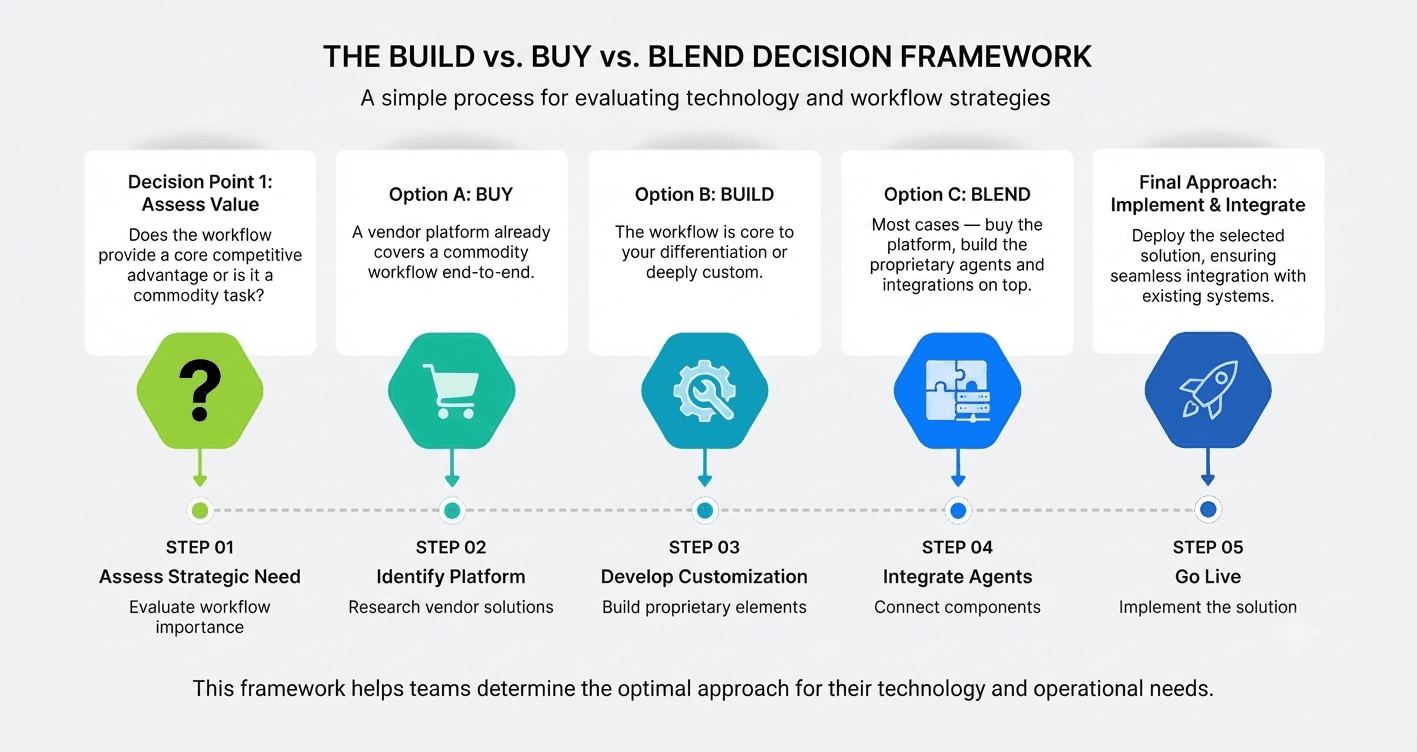
For most enterprises, blend is the honest answer: license what's commoditized, build what's truly yours.
Orchestrate, accelerate, and govern
Orchestrating agents at scale. Start with a single agent and add complexity only when you need it. Many problems need one well-equipped agent, not a swarm. When you do go multi-agent, define clean hand-offs and introduce a planner only when tasks genuinely branch.
Accelerating safe adoption. Pick narrow, high-value "golden path" use cases first. Build reusable agent templates so each new deployment is faster than the last. Momentum comes from shipping small wins, not boiling the ocean.
Governing agentic systems. Governance for agents is engineered, not a compliance checkbox. That means guardrails on what agents can do, permission scoping so an agent acts only within its remit, full audit trails of every decision and tool call, evaluation pipelines that catch regressions, and human approval gates for high-impact actions.
A 90-day roadmap to your first agentic workflow
- Days 1–30: Choose one high-value, low-risk workflow. Instrument and clean the data it depends on.
- Days 31–60: Build the agent with guardrails and an evaluation suite from day one.
- Days 61–90: Run a human-in-the-loop pilot, measure real outcomes, then expand to adjacent workflows.
Ninety days gets you from idea to a governed agent earning its keep and a template for the next ten.
Most enterprises now have AI development and AI pilots. Very few have agentic systems running in production. That gap is the race and it is already underway. The companies pulling ahead are not the ones with the flashiest demos; they are the ones quietly wiring autonomous agents into real workflows, governing them properly, and compounding the advantage every quarter. This is a builder's blueprint for the agentic enterprise: what it is, how to architect it, how to power it, and how to orchestrate, accelerate, and govern it without losing control.
Common pitfalls (and how to avoid them)
- Runaway tool calls → cap actions and add circuit breakers.
- Hallucinated actions → require confirmation for anything irreversible.
- Cost blow-ups → monitor token and tool spend per task from the start.
- No safety net → never ship an agent without evals.
- "Agent-washing" → don't rebrand a basic chatbot; real agents act, not just answer.
Build with a partner who's done it
Architecting, powering, and governing an agentic enterprise is a deep engineering effort and the cost of getting the foundations wrong is high. At Junkies Coder, we design vendor-neutral agentic architectures, build and integrate the agents themselves, and wire in the governance that keeps them safe in production. We work across models and frameworks, so the system we build serves your roadmap, not a vendor's.
Frequently asked questions
What is an agentic enterprise?
An organization where AI agents autonomously plan, decide, and act across systems under human oversight and engineered governance beyond chatbots and copilots.
How is agentic AI different from generative AI?
Generative AI produces content when prompted. Agentic AI pursues a goal: it reasons, chooses tools, and executes multi-step actions.
How do you govern AI agents safely?
With guardrails, scoped permissions, audit trails, evaluation pipelines, and human approval gates for high-impact actions.
How long to deploy a production agent?
A focused, governed first workflow is realistic in about 90 days.
The bottom line
The enterprise AI race won't be won by whoever pilots the longest. It will be won by the organizations that architect, power, orchestrate, and govern real agentic systems and start now. Ready to build your agentic enterprise? Book an AI strategy consultation with Junkies Coder.