- Licensed intermediary model: Integrate the retail Digital Dirham through a licensed UAE bank, exchange house, finance company, or approved payment service provider, not as an unlicensed direct CBUAE participant. Review the CBUAE Digital Dirham primer for the official CBDC context.
- CBDC-native wallet architecture: Build a CBDC-native wallet architecture with UAE PASS-based identity verification where available, biometrics, AML/CFT controls, audit trails, Arabic-English RTL UX, and real-time payment status.
- Unified engineering discipline: Treat API integration, payment processing, reconciliation, refunds, and partner-failure resilience as one connected engineering discipline.
- Governed compliance framework: Combine identity, KYC, data privacy, and compliance into a single governed onboarding and transaction framework; keep cybersecurity and AI governance as separate operational layers.
- Practical retail use cases: Prioritize practical retail use cases: P2P transfers, merchant QR payments, e-commerce checkout, bills, payroll, and loyalty.
- Realistic budgeting: Budget separately for discovery, build, partner certification, compliance, security, and recurring operations; a realistic retail-ready build may start around AED 750,000–1.6 million, while enterprise merchant platforms can exceed AED 3.5 million.
- Future-ready roadmap: Prepare for future opportunities, programmable payments, tokenized-asset settlement, tourist wallets, open finance, and cross-border CBDC interoperability, only when officially supported and permitted.
To integrate the retail Digital Dirham into a UAE fintech mobile app, build the product around an intermediated, two-tier CBDC model: the Central Bank of the UAE (CBUAE) issues and redeems the Digital Dirham, while a licensed financial institution or approved payment intermediary provides wallet access, compliance, and API connectivity to your app. Your app should not attempt to operate as an unlicensed issuer or connect directly to the CBUAE ledger.
This guide is written for UAE fintech product owners, CTOs, mobile app teams, banks, PSPs, and enterprise innovation leaders planning a compliant Digital Dirham-ready payment experience.
Important Regulatory Note
Digital Dirham integration depends on the current rollout status, applicable Central Bank of the UAE (CBUAE) requirements, and the eligibility of the participating financial institution or payment service provider. Before beginning development, fintech businesses should verify available integration options, technical specifications, and production access with an eligible partner.
For official updates, refer to the Central Bank of the UAE and the UAE Government Portal.
What Is the Retail Digital Dirham?
The retail Digital Dirham is the UAE’s central bank digital currency (CBDC): a digital form of the dirham issued and guaranteed by the CBUAE for use by individuals and businesses. It is designed for online, in-store, commercial, peer-to-peer, and potentially government-related payments, with capabilities such as offline usability, smart contracts, and cross-border transactions under evaluation.
The Digital Dirham should be distinguished from privately issued stablecoins, cryptocurrencies, and commercial bank deposits. Its legal treatment, distribution arrangements, and permitted use cases depend on the UAE’s applicable legal and regulatory framework. Fintech businesses should consult the official UAE legislation portal and relevant CBUAE announcements when assessing their proposed implementation.
Retail vs. Wholesale Digital Dirham
| Dimension | Retail Digital Dirham | Wholesale Digital Dirham |
|---|---|---|
| Primary users | Consumers, merchants, SMEs, fintech app users | Banks and licensed financial institutions |
| Main use case | P2P transfers, retail checkout, bill payments, B2C payments | Interbank settlement, cross-border trade settlement |
| App integration | Customer-facing wallets and payment flows | Backend treasury, liquidity, and settlement systems |
| Distribution | Two-tier, intermediated model | Direct participation through licensed institutions |
| Enterprise opportunity | Payments, wallets, loyalty, merchant acquiring, financial inclusion | Settlement efficiency, liquidity management, trade finance |
The CBUAE has developed infrastructure for issuing, trading, and using the Digital Dirham, including digital wallets for individuals and businesses, and has conducted real-value retail pilots to assess design and use cases.
Digital Dirham vs. Traditional Digital Payments
The Digital Dirham differs from conventional digital payment methods in its underlying monetary structure and issuing authority. While card payments, bank transfers, and private digital wallets typically rely on commercial financial institutions and payment networks, the Digital Dirham represents digital central bank money.
When evaluating integration options, UAE fintech businesses should compare the Digital Dirham with bank transfers, card payments, commercial wallet balances, and privately issued stablecoins in terms of settlement arrangements, customer experience, integration requirements, fees, and regulatory obligations.
The actual advantages and operating characteristics will depend on the available Digital Dirham implementation and the participating institution’s approved services.
| Payment method | Issuing/underlying structure | Typical integration focus | Key consideration |
|---|---|---|---|
| Digital Dirham | Digital central bank money issued by the CBUAE | Licensed intermediary wallet and approved payment APIs | Availability, eligibility, and partner-approved capabilities |
| Bank transfer | Commercial bank money moved through banking rails | Open banking, bank APIs, account verification | Settlement timing and bank coverage |
| Card payment | Card-network-based payment | PSP, tokenization, 3DS, acquiring | Fees, chargebacks, and merchant acceptance |
| Commercial wallet | Prepaid or stored-value balance held through a provider | Wallet SDK, top-ups, P2P, merchant checkout | Wallet rules, float, and KYC requirements |
| Stablecoin | Privately issued digital token | Blockchain wallet, custody, compliance | Issuer risk, regulatory treatment, and redemption arrangements |
Digital Dirham vs. AED Stablecoins
UAE fintech teams should also distinguish the Digital Dirham from AED-backed stablecoins. Both may be denominated in dirhams, but they have different issuing structures, risk profiles, and regulatory treatments.
| Factor | Digital Dirham | AED stablecoin |
|---|---|---|
| Issuer | Central Bank of the UAE | Licensed private issuer, subject to applicable regulation |
| Monetary status | Central bank digital currency | Private digital token, typically dirham-referenced |
| Primary role | Sovereign digital money and payment infrastructure | Programmable digital asset or payment instrument |
| Redemption | Through approved CBDC arrangements | Through the issuer’s approved redemption process |
| Risk focus | CBDC design, access, and operational resilience | Issuer reserves, redemption, governance, and market confidence |
| App integration | Licensed intermediary and approved CBDC rails | Issuer APIs, custody, compliance, and accepted payment flows |
For regulatory context, consult the CBUAE Payment Token Services Regulation and the CBUAE licensing register. These resources help businesses distinguish between central bank digital currency and privately issued dirham payment tokens, and verify the authorization status of relevant providers. The CBUAE regulation covers payment token issuance, conversion, custody, and transfer, and treats digital money services as a licensed financial activity.
Digital Dirham, Open Finance and UAE Payment Rails
A Digital Dirham-ready app should be designed as part of the UAE’s wider financial infrastructure, not as an isolated wallet. Future integration models may need to interact with instant payment rails, open-finance data-sharing frameworks, domestic card schemes, bank APIs, and merchant acceptance networks.
For fintech product teams, this means designing modular connections for:
- Bank-account verification and funding.
- Instant AED transfers and wallet top-ups.
- Merchant acceptance across online and in-store channels.
- Open-finance-based account information and payment initiation, where authorized.
- Future interoperability between Digital Dirham, conventional payment rails, and approved digital-asset services.
The UAE’s Financial Infrastructure Transformation Programme includes initiatives such as Aani, Jaywan, open finance, and the Digital Dirham, indicating a direction toward connected payment infrastructure rather than standalone products.
The practical architecture should use an abstraction layer so the app can add or change payment rails without rebuilding the customer experience.
The Integration Model: Who Connects to What?
A UAE fintech app should generally integrate through a licensed intermediary, not directly with the CBUAE. The CBUAE has described a phased rollout using an intermediated two-tier distribution model and wallet-based access.
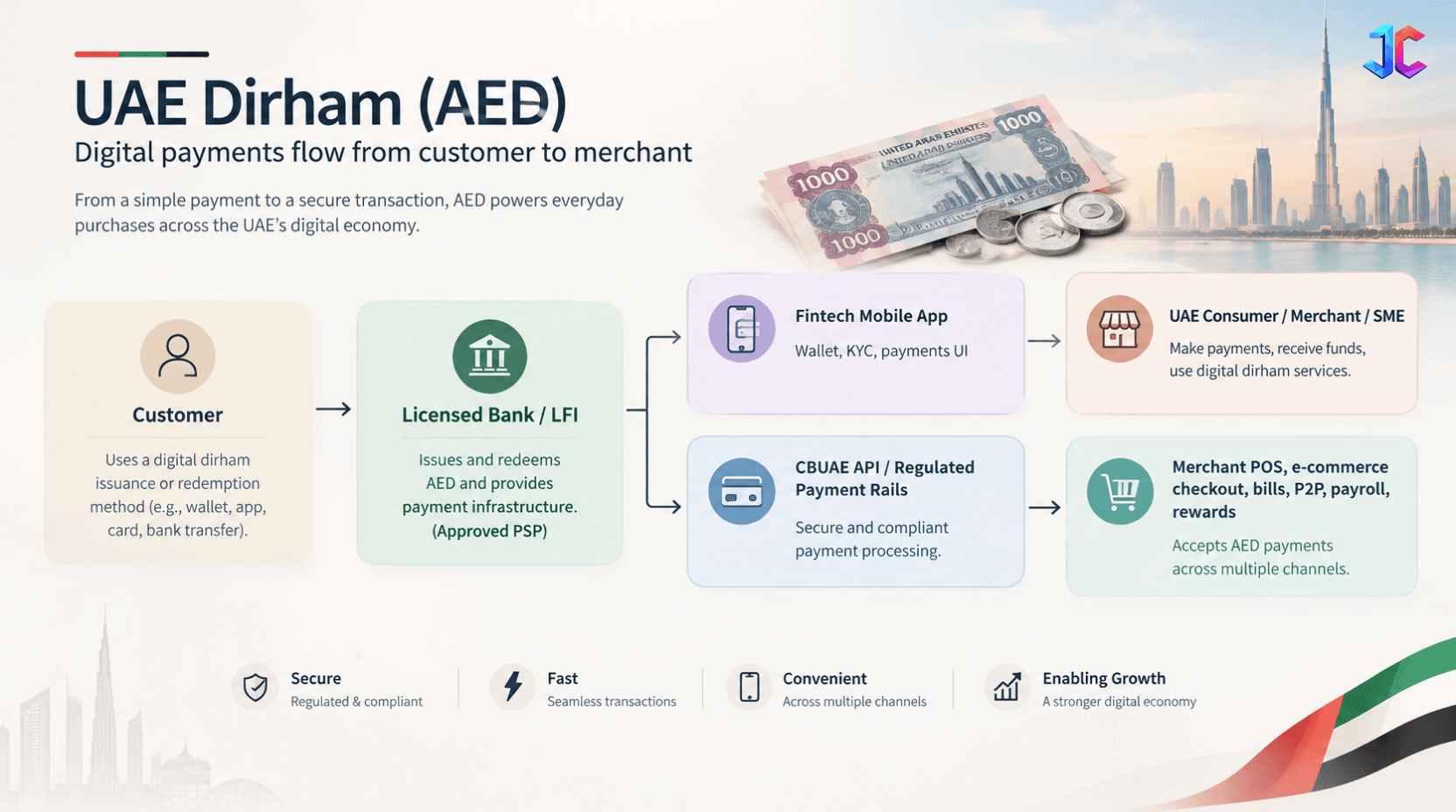
Integration Roles
| Stakeholder | Responsibility in a Digital Dirham app |
|---|---|
| CBUAE | Issues, redeems, governs, and safeguards the Digital Dirham; defines technical and policy requirements. |
| Licensed bank / LFI | Provides regulated wallet issuance, settlement, liquidity, AML/CFT controls, and access to CBDC infrastructure. |
| Licensed PSP / fintech | Builds the customer experience, merchant acceptance, payment orchestration, notifications, and value-added services. |
| App development partner | Delivers iOS/Android architecture, secure wallet UX, UAE PASS integration, biometrics, offline handling, and API layers. |
| Merchant / enterprise | Accepts Digital Dirham payments through POS, QR, in-app checkout, or payment gateway integration. |
Step 1: Confirm Your Regulatory Pathway
Before development begins, classify your product’s regulated activity. A wallet-only consumer app, merchant acquiring platform, cross-border remittance product, and payroll disbursement app may each require different licensing, partnership, and compliance structures. An experienced mobile app development company in UAE can help align your product architecture with these requirements before implementation.
Regulatory Verification Before Development
Before selecting a technology provider or starting mobile app development, confirm whether your proposed business model requires additional authorization or must operate through an eligible participating institution. An existing payment services licence or e-wallet product should not automatically be treated as authorization to distribute or process Digital Dirham transactions.
Review the applicable requirements with your legal and compliance teams and consult the CBUAE official website and the UAE legislation portal for relevant regulations and official announcements.
Regulatory Options
| If your app will… | Likely integration route | Key compliance focus |
|---|---|---|
| Offer Digital Dirham wallets to consumers | Partner with a licensed UAE bank or authorized intermediary | KYC, AML/CFT, consumer protection, wallet custody rules |
| Accept Digital Dirham for merchants | Integrate through a licensed acquirer/PSP | Merchant onboarding, settlement, fraud, chargeback/dispute handling |
| Enable P2P transfers | Use an authorized wallet provider or bank rail | Identity verification, transaction limits, sanctions screening |
| Support payroll or B2B disbursements | Build through a licensed financial institution | Corporate onboarding, audit trails, programmable-payment governance |
| Test an innovative use case | Participate in a relevant regulatory sandbox or innovation-testing pathway | Controlled rollout, risk assessment, exit criteria |
Step 2: Design a CBDC-Native Wallet Architecture
Your app should treat the Digital Dirham as a first-class payment instrument, not as an afterthought added to an existing wallet.
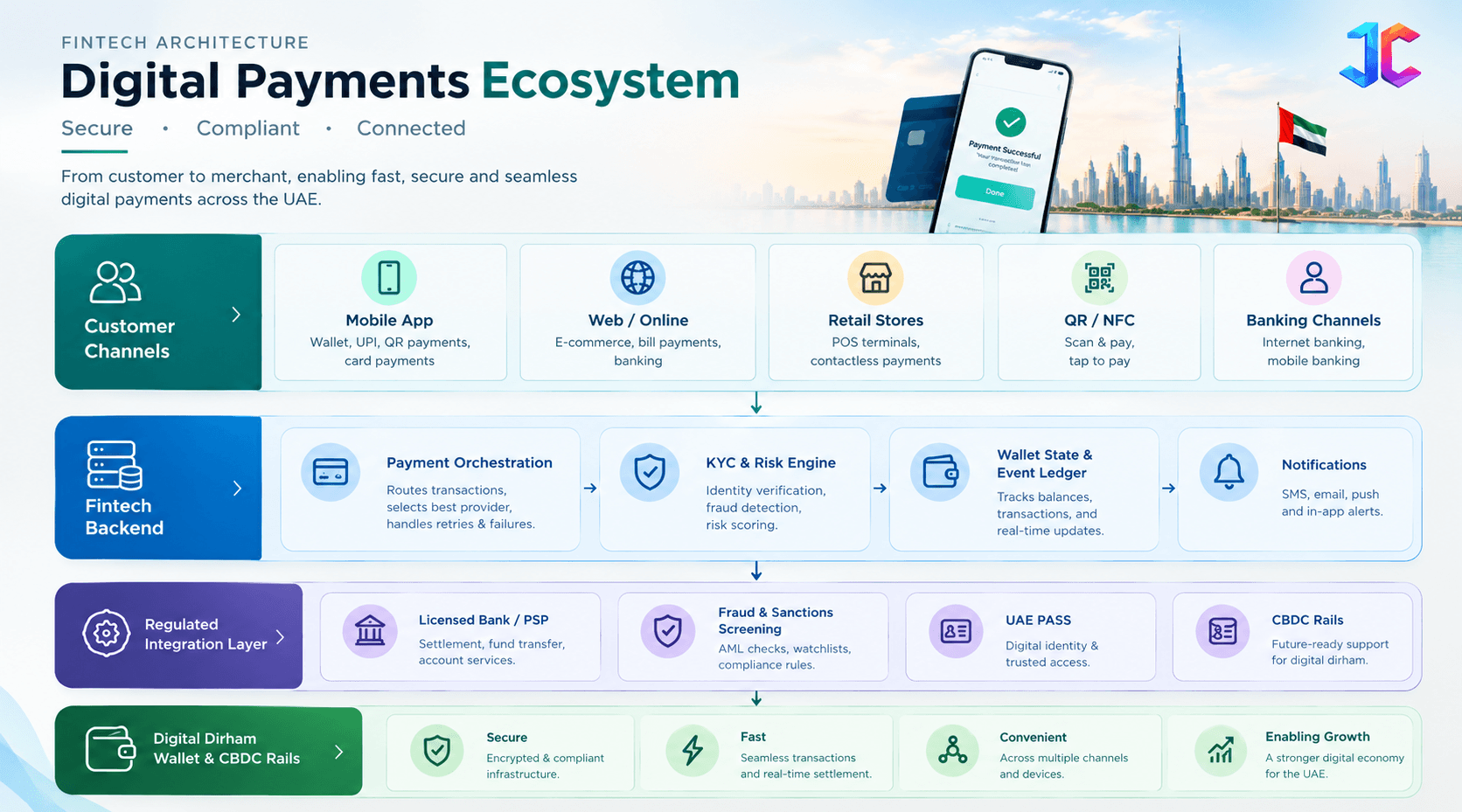
Recommended Mobile App Architecture
Core Wallet Capabilities
- Wallet provisioning: Create, link, recover, suspend, and close Digital Dirham wallets through the licensed intermediary.
- Balance and transaction history: Show available balance, pending transactions, payment status, and a clear distinction between Digital Dirham and conventional AED balances.
- P2P transfers: Support mobile-number, QR-code, UAE PASS-linked, or contact-based transfers with confirmation, receipts, and dispute trails.
- Merchant payments: Enable QR-based in-store payments, in-app checkout, recurring bills, and merchant-specific payment references.
- Fiat on/off ramps: Let users move value between bank accounts, cards, conventional AED balances, and Digital Dirham balances through approved rails.
- Offline resilience: Design for intermittent connectivity, especially for retail checkout and financial-inclusion scenarios; the CBUAE has identified offline usability as a Digital Dirham capability under consideration.
- Programmable payments: Prepare for conditional disbursements, escrow, installment rules, supplier payments, and automated splits where permitted by the intermediary and applicable rules.
Technical Integration, Payment Processing and Operational Resilience
A secure Digital Dirham integration should separate the mobile application from regulated payment execution. The app communicates with the fintech backend, which connects to the approved financial institution or payment intermediary using its authorized APIs.
API and Payment Architecture
Key technical components include:
- API integration layer: Connects the app backend to the partner’s approved wallet and payment services.
- Authentication and authorization: Implements the security mechanisms specified by the integration partner.
- Payment orchestration: Manages payment initiation, validation, transaction status, and customer notifications.
- Webhook processing: Handles payment status updates, duplicate notifications, and delayed events.
- Transaction reconciliation: Matches internal payment records against partner-confirmed transaction records.
- Error handling: Provides clear responses for rejected, pending, timed-out, and failed transactions.
- Security monitoring: Detects suspicious activity, unauthorized access, and unusual payment patterns.
Actual API endpoints, authentication methods, transaction limits, and production access must be confirmed with the participating institution. Do not assume that public APIs or sandbox environments provide access to live Digital Dirham infrastructure.
Payment Lifecycle
A reliable Digital Dirham payment journey should include the following stages:
- Authenticate the customer and validate wallet eligibility.
- Collect the recipient or merchant details, payment amount, and transaction reference.
- Apply applicable transaction limits, fraud checks, and compliance controls.
- Submit the payment through the approved partner integration.
- Retrieve or receive the authoritative transaction status.
- Display a receipt and notify the customer when the relevant outcome is confirmed.
- Reconcile transaction records and investigate unresolved exceptions.
The app should distinguish between initiated, processing, completed, rejected, and unknown transaction states according to the partner’s technical specifications. This approach improves transparency, reduces duplicate-payment risks, and supports customer service and financial reconciliation.
Operational Resilience
A Digital Dirham app must remain reliable when a partner API is slow, a webhook is delayed, a mobile network is unavailable, or a payment status is uncertain.
Recommended resilience controls include:
- Retry policies with exponential backoff and maximum attempt limits.
- Idempotency keys to prevent duplicate payment execution.
- Queue-based processing for delayed or failed webhook events.
- Status reconciliation jobs that compare internal records with partner-confirmed outcomes.
- Circuit breakers and graceful degradation when a partner service is unavailable.
- Clear customer messaging for pending, delayed, and unresolved transactions.
- Incident runbooks for payment outages, reconciliation gaps, and security events.
A timeout should not automatically be interpreted as a failed payment. The backend should verify the transaction status through the partner’s approved mechanism before retrying an uncertain transaction. The app should never display a payment as completed solely because the user interface timed out or a webhook was delayed.
Refunds, Disputes and Failed Transactions
A production-ready Digital Dirham payment experience needs clearly defined procedures for rejected payments, duplicate requests, merchant disputes, refunds where supported, and transactions with uncertain outcomes.
The app should maintain transaction references, timestamps, payment status history, and customer-facing explanations. Refund processing should follow the participating institution’s approved transaction model rather than assuming that a completed Digital Dirham transfer can always be reversed.
Support teams should have documented escalation procedures, reconciliation tools, and response timelines aligned with applicable requirements and partner agreements.
Step 3: Build UAE Identity, Compliance and Data Protection
UAE fintech apps cannot treat Digital Dirham onboarding like a generic e-wallet signup. Identity verification, customer due diligence, sanctions controls, privacy, and auditability must be embedded in the same governed journey.
UAE Digital Identity and KYC
UAE fintech apps should integrate digital identity verification according to the requirements of their regulated business model and participating financial institution. UAE PASS may support identity verification and authentication where the relevant service and integration are available, but it should not automatically be treated as a substitute for every KYC or customer due diligence requirement.
For identity integration, consult the official UAE PASS website. UAE PASS is the UAE’s national digital identity and digital signature solution, enabling smartphone-based authentication for government and private-sector services.
Compliance and Data Protection Controls
| Layer | Implementation requirement | Why it matters |
|---|---|---|
| UAE PASS | Integrate government-backed digital identity for verified onboarding and account linking where available | Reduces synthetic identity risk and supports trusted KYC |
| Emirates ID data validation | Validate user identity through approved verification workflows | Supports regulatory KYC and customer due diligence |
| Biometric authentication | Use Face ID, fingerprint, or device-bound biometrics for high-risk actions | Protects wallet access and payment authorization |
| AML/CFT controls | Apply risk scoring, transaction monitoring, sanctions screening, and suspicious-activity workflows | Required for regulated financial activity |
| Audit logging | Maintain immutable, time-stamped records of consent, authorization, payment, and failure events | Supports audits, disputes, and regulator inquiries |
| Data privacy | Apply data minimization, encryption, access controls, retention schedules, and consent management | Supports UAE Personal Data Protection Law expectations |
| Customer communication | Provide clear Arabic-English disclosures for identity, data use, limits, refunds, and complaints | Builds trust and reduces disputes |
Privacy, data retention, and processing requirements should be assessed against applicable UAE legislation, including the UAE Personal Data Protection Law. Implement data minimization, encryption, access controls, secure credential management, and auditable authorization workflows. Confirm the applicable requirements with your compliance team and integration partner before processing customer information.
Cybersecurity and AI Governance
Digital Dirham-ready applications should protect customers against account takeover, social engineering, payment manipulation, malicious applications, and unauthorized access to sensitive information.
Security Controls
Recommended controls include:
- Secure session management and short-lived access tokens.
- Device-level security checks and app-integrity validation.
- Risk-based authentication and step-up verification for high-risk actions.
- Backend authorization for every sensitive request.
- Encrypted communications and protected key-management infrastructure.
- Controlled administrative access and least-privilege permissions.
- Continuous fraud monitoring, alerting, and incident response.
API credentials and private signing keys should remain in appropriately protected backend or key-management infrastructure. Security testing should cover payment authorization, duplicate requests, compromised accounts, partner API failures, and recovery scenarios. A reliable mobile app development company in Dubai can incorporate these security controls into the application architecture and testing process from the outset.
AI Governance and Fraud Prevention
Digital Dirham-ready fintech apps can use AI to improve fraud detection, customer risk scoring, and operational decision-making, but AI should support, not replace, regulated controls.
Potential AI use cases include:
- Detecting unusual login behaviour, device changes, and account-takeover patterns.
- Scoring payment risk based on transaction amount, recipient history, merchant category, time, and location.
- Identifying potential money mule activity, rapid pass-through transactions, and abnormal P2P behaviour.
- Prioritizing suspicious transactions for compliance review.
- Generating customer-friendly explanations for declined, delayed, or under-review transactions.
AI models should be governed through documented model-risk controls, human review paths, bias testing, explainability requirements, and clear customer communication. UAE financial institutions are increasingly expected to apply governance disciplines to AI-enabled services, including documented frameworks and customer-facing transparency.
Do not use AI to automatically block payments without defined fallback rules, appeal mechanisms, and compliance oversight.
Step 4: Build the Retail Payment Experience
The strongest commercial opportunity is not simply “adding another payment method.” It is redesigning checkout, disbursement, and money-movement journeys around instant, final, low-friction digital cash.
High-Value Retail Use Cases
| Use case | App feature | Enterprise value |
|---|---|---|
| In-store retail checkout | Dynamic QR, NFC-ready flow, offline fallback | Faster checkout and lower settlement friction |
| E-commerce payments | Digital Dirham as a checkout option beside cards and wallets | New payment choice for UAE consumers |
| P2P transfers | Contact, QR, and mobile-number payments | Higher engagement and wallet retention |
| Government and utility bills | Bill presentment and one-tap settlement | Convenient recurring-use behaviour |
| Payroll and gig payouts | Instant worker disbursements with audit trails | Better cash-flow control for SMEs |
| Loyalty and cashback | Programmable rewards or merchant-funded incentives | Higher repeat purchase rates |
| Cross-border-ready services | Future-facing remittance and trade settlement flows | Supports UAE’s CBDC and mBridge strategy. |
SME Embedded Finance and Programmable Payouts
For SMEs, the Digital Dirham can become more than a consumer payment method. It can support faster supplier payments, payroll disbursements, marketplace settlements, invoice-linked financing, and automated reconciliation.
Potential enterprise workflows include:
- Instant salary or gig-worker payouts with audit trails.
- Supplier payments released after invoice approval.
- Marketplace settlements split between sellers, platforms, and service providers.
- Conditional disbursements for logistics, construction, insurance, or trade finance.
- Cash-flow dashboards that distinguish pending, settled, and reconciled Digital Dirham transactions.
The value for SMEs is not only speed. It is reducing reconciliation effort, improving payment visibility, and enabling financial products that are tied to verified business activity. Programmable payroll and conditional settlement are among the future use cases associated with Digital Dirham development.
UX Rules for UAE Fintech Apps
- Offer Arabic and English with fully tested right-to-left Arabic layouts.
- Display the Digital Dirham clearly as central bank money, not crypto.
- Use plain-language explanations for wallet setup, limits, refunds, and data use.
- Separate Digital Dirham balance, bank balance, and reward balance visually.
- Provide real-time payment status: initiated, authorized, settled, failed, or pending offline synchronization.
- Avoid dark patterns around fees, limits, data sharing, or wallet recovery.
- Build accessible flows for users with limited banking experience, older users, and non-residents.
Merchant Onboarding and Tourist Wallets
Merchant Onboarding and POS Integration
Merchant acceptance requires coordination between the fintech app, participating financial institution, payment service provider, and merchant’s checkout infrastructure.
A merchant integration plan should address merchant verification, payment identifiers, QR-code generation, transaction confirmation, refunds where supported, reconciliation, and settlement reporting. Existing POS terminals and payment gateways should not be assumed to support Digital Dirham automatically.
Before launching merchant payments, validate the required hardware or software changes, payment confirmation process, support responsibilities, and the partner’s approved acceptance capabilities.
Tourist and Non-Resident Wallet Journeys
Tourism creates a distinctive Digital Dirham opportunity for UAE fintech apps. CBUAE leadership has described a potential tourist journey in which visitors can top up a CBDC wallet, convert foreign currency into Digital Dirham, spend across UAE merchants, and convert remaining value back before departure.
A tourist-ready app experience may include:
- Simplified onboarding for short-term visitors.
- Multi-currency funding and conversion flows.
- Merchant discovery and Arabic-English checkout support.
- Clear FX disclosure, limits, receipts, and refund paths.
- Secure wallet closure or balance conversion at departure.
This use case can support financial inclusion and improve the visitor payment experience, but it also requires strong identity, sanctions, AML/CFT, FX, and data-protection controls. Fintech businesses should not launch tourist wallets until the participating institution confirms eligibility and approved onboarding requirements.
Step 5: Prepare for Programmability and Future Payments
The Digital Dirham’s strategic value goes beyond a faster payment button. The CBUAE has highlighted smart contracts, offline usability, and cross-border transactions as capabilities that can improve payment-system efficiency and financial inclusion.
Programmable payments should be implemented only when the approved platform supports the required functionality and the proposed use case complies with applicable regulatory requirements. Each workflow should include authorization rules, failure handling, dispute resolution, and safeguards against unintended execution. Fintech businesses should not assume that arbitrary smart contracts can be deployed directly on Digital Dirham infrastructure.
Product-Building Opportunities
| Future capability | Example app feature | Enterprise impact |
|---|---|---|
| Smart-contract payments | Escrow for marketplace orders or property deposits | Reduces manual reconciliation and counterparty risk |
| Conditional disbursement | Insurance claim paid when verified conditions are met | Automates payout operations |
| Split payments | Automatically divides a payment among seller, platform, and VAT/tax handling | Improves marketplace settlement accuracy |
| Merchant financing triggers | Repayment schedules linked to approved sales events | Enables embedded finance |
| Cross-border CBDC flows | Remittance or trade settlement through approved CBDC bridges | Supports lower-friction international value transfer. |
Do not market “smart contracts” as unrestricted automation. Every programmable rule must be reviewed for consumer protection, error handling, reversibility, dispute resolution, and regulatory approval.
Digital Dirham and Tokenized Asset Settlement
Beyond retail payments, the Digital Dirham could support settlement for tokenized assets, fractional ownership models, and condition-based commercial transactions. The CBUAE has highlighted tokenization and smart contracts as areas where Digital Dirham-based settlement may enable new financial services, including examples involving fractionalized real-estate ownership.
Potential app-level use cases include:
- Escrow-backed property transactions with milestone-based release.
- Marketplace payments released after delivery confirmation.
- Investment platforms settling tokenized asset purchases in Digital Dirham.
- Supplier finance workflows with conditional repayment rules.
- Insurance payouts triggered by verified events.
These use cases should be treated as future product opportunities, not current universal features. Each workflow requires approved platform functionality, legal review, dispute handling, and safeguards against unintended execution.
UAE fintech apps integrate the retail Digital Dirham by partnering with a licensed bank, exchange house, finance company, or approved payment service provider. The app connects to the intermediary’s Digital Dirham wallet and payment APIs, implements UAE PASS-based identity verification where available, biometric authentication, AML/CFT monitoring, Arabic-English UX, and merchant or P2P payment flows. The CBUAE issues and redeems the Digital Dirham, while licensed intermediaries provide customer-facing distribution under the UAE’s two-tier CBDC model.
Digital Dirham Mobile App Integration Cost: A Practical Budget Model
The cost of preparing a UAE fintech application for Digital Dirham integration cannot be accurately estimated from app screens alone. The final budget depends on whether you are extending an existing wallet, building a new CBDC-native product, integrating merchant acceptance, or adding enterprise payout workflows.
A realistic cost model should include four separate budgets:
- Discovery and regulatory readiness
- Product design and mobile app development
- Partner integration, compliance, and security
- Launch, operations, support, and ongoing maintenance
Payment-related activities such as payment account issuance, merchant acquiring, payment aggregation, fund transfers, payment tokens, and payment initiation may fall within the CBUAE’s licensing framework under the Retail Payment Services and Card Schemes Regulation.
Cost Drivers That Matter Most
| Cost driver | Low-impact scenario | High-impact scenario | Budget implication |
|---|---|---|---|
| Existing product maturity | Existing wallet with modular APIs | New app or legacy monolith | New architecture, data migration, and longer QA cycles increase cost |
| Regulatory position | Already licensed and working with an eligible partner | New licence, new partner, or sandbox entry | Legal, compliance, capital, audit, and onboarding costs rise |
| Wallet scope | View balance and make basic P2P payments | Full wallet with top-ups, merchant QR, bills, payroll, and refunds | More payment states, reconciliation rules, and support workflows |
| Merchant acceptance | In-app checkout only | POS, QR, refunds, settlement reports, multi-store merchants | Hardware, POS certification, merchant onboarding, and settlement tooling add cost |
| Compliance depth | Basic KYC and transaction monitoring | Risk-based KYC, sanctions, fraud models, audit, and regulator reporting | Higher build and ongoing vendor costs |
| Security requirements | Standard mobile security | Device attestation, key management, penetration testing, SOC monitoring | Security engineering and recurring managed-service costs increase |
| AI and analytics | Basic rule-based alerts | AI-led fraud scoring, behavioural analytics, explainability | Model development, data pipelines, governance, and monitoring add cost |
| Bilingual UX | English-first with Arabic translation | Fully native Arabic RTL design system and localized support | Higher design, QA, content, and customer-service cost |
| Cross-border readiness | UAE-only payments | Multi-currency, FX, remittance, or CBDC bridge readiness | Treasury, compliance, liquidity, and partner integration costs increase |
UAE fintech builds commonly require dedicated work for CBUAE-related payment-service requirements, AML/CFT monitoring, PDPL-aligned data handling, UAE PASS/eKYC, and secure transaction infrastructure; these requirements materially affect both initial build cost and ongoing operating cost.
Indicative Build Budget Scenarios
The figures below are planning ranges only, not quotations or official CBUAE costs. They assume a UAE-focused fintech product and should be validated through partner discovery and a detailed solution estimate.
| Scenario | What is included | Indicative initial build budget | Typical timeline |
|---|---|---|---|
| Digital Dirham-ready MVP | Existing wallet extended with a basic Digital Dirham balance, P2P transfer, transaction history, UAE PASS/eKYC integration, notifications, and reconciliation | AED 350,000–750,000 | 4–7 months |
| Retail payment app | Consumer wallet, merchant QR checkout, bill payments, fraud controls, Arabic-English RTL UX, payment orchestration, and operational dashboards | AED 750,000–1.6 million | 6–10 months |
| Enterprise merchant platform | Consumer wallet plus merchant onboarding, POS/QR acceptance, refunds, settlement reporting, reconciliation, role-based access, and multi-merchant support | AED 1.6 million–3.5 million+ | 9–15 months |
| Licensed fintech / bank-grade platform | Full CBDC-native wallet, open-finance readiness, AI-assisted risk controls, advanced compliance reporting, high-availability architecture, and enterprise integrations | AED 3.5 million–7 million+ | 12–20 months |
These ranges align with broader UAE market benchmarks: UAE fintech app projects are commonly estimated from roughly AED 250,000–300,000 for a basic fintech MVP to AED 500,000–600,000+ when P2P transfers, cross-border functionality, AI-driven scoring, or investment features are added; enterprise banking platforms can reach AED 1.47 million–4.4 million or more. Digital Dirham-specific integration can push a project into a higher tier because it adds regulated wallet access, partner certification, and CBDC-specific payment controls.
Workstream-Level Cost Allocation
For a Digital Dirham-ready retail app, a practical initial budget may be allocated as follows:
| Workstream | Share of initial build budget | What it covers |
|---|---|---|
| Product discovery, UX, and Arabic-English design | 10–15% | User research, wallet journeys, RTL design system, accessibility, merchant and support flows |
| Mobile app development | 20–30% | iOS and Android wallet UI, biometrics, QR flows, notifications, offline states, deep links |
| Backend, APIs, and payment orchestration | 20–30% | Wallet services, partner API layer, transaction states, webhooks, reconciliation, reporting |
| Compliance, KYC, fraud, and risk controls | 10–20% | UAE PASS/eKYC, AML/CFT workflows, sanctions screening, limits, audit trails, case management |
| Security, QA, and production readiness | 10–15% | Secure SDLC, penetration testing, performance testing, recovery drills, release governance |
| Partner onboarding and certification | 5–15% | Technical discovery, sandbox testing, certification, production access, operational runbooks |
The exact split will change if you already have a wallet, a licensed partner, a fraud engine, and a mature backend. If you are building from scratch, engineering and compliance readiness will usually consume a larger share of the budget.
Recurring Costs After Launch
Initial development is only part of the total cost of ownership. A Digital Dirham-enabled app also needs a recurring operating budget.
| Recurring cost area | What to budget for |
|---|---|
| Cloud infrastructure | App hosting, backend services, monitoring, logging, backup, disaster recovery, and scaling |
| Partner and payment fees | Partner onboarding, API usage, settlement, wallet, or transaction-related commercial terms |
| KYC and identity verification | Per-verification charges, re-verification, liveness checks, document checks, and UAE PASS-related service costs |
| AML, fraud, and risk tools | Screening, transaction monitoring, case management, device intelligence, and model monitoring |
| Security operations | Vulnerability management, penetration testing, key management, incident response, and SOC monitoring |
| Customer support | Arabic-English support, dispute handling, refunds, reconciliation investigations, and escalation |
| Compliance and audit | Regulatory reporting, policy updates, internal audit, external audit, and periodic control reviews |
| Product maintenance | OS updates, API version upgrades, bug fixes, performance optimization, and feature releases |
| Merchant operations | Terminal or SDK updates, merchant training, settlement support, and acceptance monitoring |
UAE market estimates suggest that compliance-related build work can add meaningful cost to a fintech product, while identity verification, AML tooling, and ongoing vendor services can create recurring monthly or per-transaction expenses.
Hidden Costs Businesses Often Miss
- Partner certification rework: A partner may require changes to authentication, data formats, transaction states, or reconciliation after technical review.
- Refund and dispute workflows: Refunds, partial refunds, merchant disputes, and uncertain transaction states require separate UX, backend, and support logic.
- Reconciliation engineering: Matching internal records with partner-confirmed transactions is often underestimated, especially when webhooks are delayed or duplicated.
- Arabic RTL QA: Translation alone is not enough; layouts, numerals, currency display, forms, errors, receipts, and accessibility must be tested in Arabic.
- Merchant hardware and POS changes: Existing terminals and gateways may need software updates, certification, or replacement.
- Fraud-model operations: AI models need monitoring, retraining, explainability reviews, and human escalation paths.
- Customer-support readiness: Support teams need transaction-status visibility, refund procedures, escalation scripts, and reconciliation tools before launch.
- Regulatory and policy updates: CBDC rules, partner requirements, and UAE financial regulations may evolve after launch.
- Production access delays: Sandbox success does not guarantee immediate production access; certification, security review, and operational approval can extend timelines.
Cost-Control Strategy
A disciplined approach is to build a modular Digital Dirham-ready foundation before committing to every advanced feature:
- Start with one high-value journey, such as P2P transfer or merchant QR payment.
- Build reusable services for identity, payment orchestration, notifications, reconciliation, and audit logging.
- Use feature flags to separate wallet access, merchant acceptance, offline payments, and programmable payments.
- Negotiate partner pricing after technical discovery, not before the integration scope is clear.
- Budget for post-launch operations from day one, especially compliance monitoring, support, and security.
- Avoid custom-building capabilities that an eligible partner already provides in an approved form.
- Treat compliance, security, and reconciliation as core product investment—not optional add-ons.
Questions to Ask Before Approving the Budget
- Does the participating institution provide a wallet API, payment initiation API, webhook service, reconciliation report, and production certification process?
- Which Digital Dirham use cases are approved for our business model?
- What are the partner’s setup, transaction, settlement, refund, and support fees?
- Does the partner require specific security certifications, penetration tests, or infrastructure controls?
- Is UAE PASS integration included, or does it require a separate identity provider and per-user cost?
- What merchant hardware, SDK, or POS changes are required for acceptance?
- Who owns reconciliation, dispute handling, refunds, and customer support?
- What are the expected service-level commitments, incident-response responsibilities, and rollback procedures?
- What recurring compliance, monitoring, and audit costs will apply after launch?
Before finalizing the budget, verify whether the proposed service involves a Digital Dirham wallet, payment token service, merchant acquiring, or payment initiation activity. The CBUAE Payment Token Services Regulation provides the regulatory context for dirham payment tokens and related payment-token services.
Implementation Roadmap and Production Readiness
The following roadmap combines discovery, build, testing, partner certification, and controlled launch into one delivery plan.
| Phase | Duration guide | Key deliverables and testing focus |
|---|---|---|
| Discovery and regulatory mapping | 3–6 weeks | Use-case definition, licensing/partnership assessment, data-flow map, compliance gap analysis |
| Intermediary selection | 4–8 weeks | Bank/PSP shortlist, API and wallet capability review, commercial and security due diligence |
| MVP architecture | 6–10 weeks | Wallet UX, UAE PASS integration, payment orchestration, fraud controls, bilingual design system |
| Pilot build and integration testing | 8–14 weeks | iOS/Android app, merchant QR flow, P2P transfer, wallet provisioning, successful/rejected/pending/timed-out transactions, duplicate requests, delayed webhooks, authentication failures, reconciliation discrepancies, and audit records |
| Controlled launch | 4–8 weeks | Limited user group, merchant pilot, production certification, security review, customer notifications, receipts, support escalation, operational runbooks, and dispute workflows |
| Scale-up | Ongoing | Programmable payments, offline payments, enterprise integrations, cross-border readiness, AI risk models, and advanced merchant services |
Before production launch, validate the integration against the participating institution’s approved testing environment and technical specifications. Production deployment should proceed only after the required partner testing, security reviews, operational approvals, and applicable regulatory conditions have been satisfied. Sandbox access should not be interpreted as authorization for live transactions.
Frequently Asked Questions (FAQs)
Can any fintech app integrate the Digital Dirham?
No. A fintech app needs an appropriate regulatory pathway, either its own authorization or a partnership with a licensed bank, exchange house, finance company, or approved payment intermediary. The CBUAE’s described model uses intermediated distribution and wallet-based access.
Is the Digital Dirham the same as cryptocurrency?
No. The Digital Dirham is a CBDC issued by the CBUAE. It is distinct from virtual assets, privately issued cryptocurrencies, stablecoins, and commercial bank deposits.
What APIs are required for Digital Dirham integration?
The required APIs depend on the participating institution’s approved technical architecture. Potential interfaces may cover wallet management, balance enquiries, payment initiation, transaction status, notifications, and reconciliation.
Can an existing UAE fintech wallet add Digital Dirham support?
Potentially, subject to the fintech’s regulatory position, the partner’s eligibility requirements, and the availability of the required integration services. Existing wallet infrastructure does not automatically provide Digital Dirham access.
Can Digital Dirham payments be integrated into an existing payment gateway?
This depends on whether the gateway and its participating institution support the relevant Digital Dirham payment flow. Compatibility with conventional card or bank-transfer rails should not be assumed.
Can users pay merchants with the Digital Dirham?
The Digital Dirham is designed for online, in-store, commercial, and peer-to-peer payments. A fintech app can support merchant acceptance through QR codes, in-app checkout, POS integrations, and payment orchestration, subject to the licensed intermediary’s approved capabilities.
Does the Digital Dirham support smart contracts?
The CBUAE has identified smart contracts as a Digital Dirham capability and has highlighted their potential for payment innovation, but app teams should implement programmable features only within approved intermediary and regulatory boundaries.
Should UAE fintech apps support offline Digital Dirham payments?
Fintech teams should evaluate offline payment support as a potential future capability, but should not advertise it as an available production feature without confirmation from the participating institution and applicable technical specifications. Offline transactions require appropriate security controls, transaction limits, synchronization mechanisms, and safeguards against duplicate spending. Until supported functionality is confirmed, apps should communicate connectivity limitations clearly.
Is the Digital Dirham relevant to cross-border payments?
Yes. The UAE’s CBDC strategy includes mBridge for real-value cross-border CBDC transactions and proof-of-concept work on bilateral CBDC bridges, including with India. Retail app teams should design modular payment rails so cross-border functionality can be added when eligible.
Can tourists use a Digital Dirham wallet in the UAE?
Tourist wallets may become an important use case, with potential flows for currency conversion, merchant spending, and balance conversion before departure. However, availability, onboarding requirements, FX rules, and limits must be confirmed with the participating institution before launch.
How can fintech businesses prepare before production access becomes available?
Businesses can assess their regulatory pathway, identify suitable partners, design modular payment architecture, prepare bilingual UX, document security controls, and build testable payment workflows. Production functionality should be enabled only when the relevant access and approvals are confirmed.
How much does Digital Dirham integration cost?
A Digital Dirham-ready MVP may require an initial build budget of roughly AED 350,000–750,000, while a retail payment app may fall in the AED 750,000–1.6 million range. Merchant-facing enterprise platforms and bank-grade CBDC products can cost AED 1.6 million–7 million or more, depending on partner requirements, compliance depth, merchant acceptance, and existing infrastructure. These are planning ranges, not official CBUAE prices.
Conclusion
Integrating the retail Digital Dirham into a UAE fintech mobile app requires a combination of regulatory readiness, an eligible financial-institution partnership, secure API architecture, and a customer-focused payment experience.
Fintech businesses should begin by confirming the current programme status and applicable requirements, selecting an eligible integration partner, and designing a payment infrastructure that supports transaction monitoring, reconciliation, security, and transparent customer communication.
Capabilities such as offline payments, programmable transactions, tokenized-asset settlement, tourist wallets, and cross-border CBDC interoperability should be implemented only when officially supported and permitted for the intended use case. A phased, partner-led approach can help UAE fintech businesses prepare for Digital Dirham opportunities while maintaining regulatory clarity and operational reliability.