- A Tabby-like product is a complete BNPL fintech ecosystem, not only a mobile app.
- It requires customer, merchant, payment, risk, ledger, settlement, compliance and operations layers.
- A focused MVP should begin with one market, one payment processor, one KYC provider and one installment product.
- AI can support fraud detection, risk analysis, document processing, payment-failure prediction and customer support, but high-impact decisions require governance and explainability.
- BNPL 2.0 will focus on affordability, open banking, responsible repayment and embedded finance.
- A focused BNPL software MVP may cost approximately US$50,000–90,000, while a multi-market enterprise platform can exceed US$500,000.
- A Tabby-like platform needs to balance transaction growth with affordability, risk management, compliance and customer trust.
Introduction
Building an app like Tabby in 2026 is not simply a mobile app development project. It is the design of a BNPL fintech platform that connects customers, merchants, payment providers, risk systems, compliance operations and repayment infrastructure.
Tabby is a flexible payment method that allows eligible customers to pay for purchases immediately and split the cost into installments. Its official integration documentation shows that a customer selects Tabby at checkout, eligibility is checked through an API, the merchant receives authorization and the customer repays according to the selected plan.
This article discusses the platform scope and architecture required for a Tabby-like product. It does not assume Tabby’s proprietary technology, internal risk models or business operations.
The visible experience may look simple: a customer selects an installment plan, pays an initial amount and completes the remaining payments later. Behind that flow are identity verification, affordability decisioning, payment authorization, tokenization, ledger management, refunds, disputes, merchant settlement, fraud controls, collections and reporting.
A focused BNPL software MVP may require approximately US$50,000–90,000, while a production, AI-enabled or multi-market platform can require US$250,000–500,000+. These are indicative software-development estimates, not fixed market prices. Licensing, lending capital, legal advice, partner onboarding and ongoing operations are separate costs.
What Are You Actually Building?
A Tabby-like platform is a complete fintech ecosystem rather than only a customer-facing application.
Main platform components
- Customer app: Onboarding, eligibility, checkout, repayment schedules, notifications, refunds and support.
- Merchant checkout infrastructure: APIs, SDKs, hosted checkout, payment widgets, plugins, webhooks and transaction status.
- Merchant dashboard: Settlements, refunds, disputes, analytics, orders, conversion rates and team permissions.
- Risk and decisioning layer: Eligibility rules, affordability checks, fraud detection, exposure management and decision explanations.
- Payment and repayment infrastructure: Authorizations, tokenized payment methods, installment schedules, retries, collections and reconciliation.
- Marketplace layer: Partner discovery, product catalogues, offers, cashback and direct shopping, if required.
- Operations and compliance console: KYC/AML workflows, case management, audit logs, policy configuration, reports and human review.
This means “build an app like Tabby” involves building connected financial infrastructure, not simply copying a mobile interface.
Tabby-Like Platform vs. Basic BNPL App
This comparison describes platform scope, not Tabby’s proprietary internal architecture.
| Component | Basic BNPL app | Tabby-like platform |
|---|---|---|
| Customer app | Included | Included |
| Installment plans | One basic product | Multiple plans and policies |
| KYC | Basic integration | Multi-provider and regional workflows |
| Merchant APIs | Limited checkout API | APIs, SDKs, plugins and webhooks |
| Risk engine | Rules-based | Rules plus governed ML models |
| Ledger | Basic balance tracking | Auditable double-entry ledger |
| Settlement | Manual or simple | Automated merchant reconciliation |
| Marketplace | Usually absent | Optional but scalable |
| Multi-market support | Limited | Regional policies and expansion |
| AI | Optional | Risk, fraud, support and personalization |
| Compliance | Basic controls | Extensive operational governance |
| Analytics | Customer-level | Customer, merchant and portfolio analytics |
| Operations | Small admin panel | Risk, disputes, collections and audit console |
How a BNPL App Works
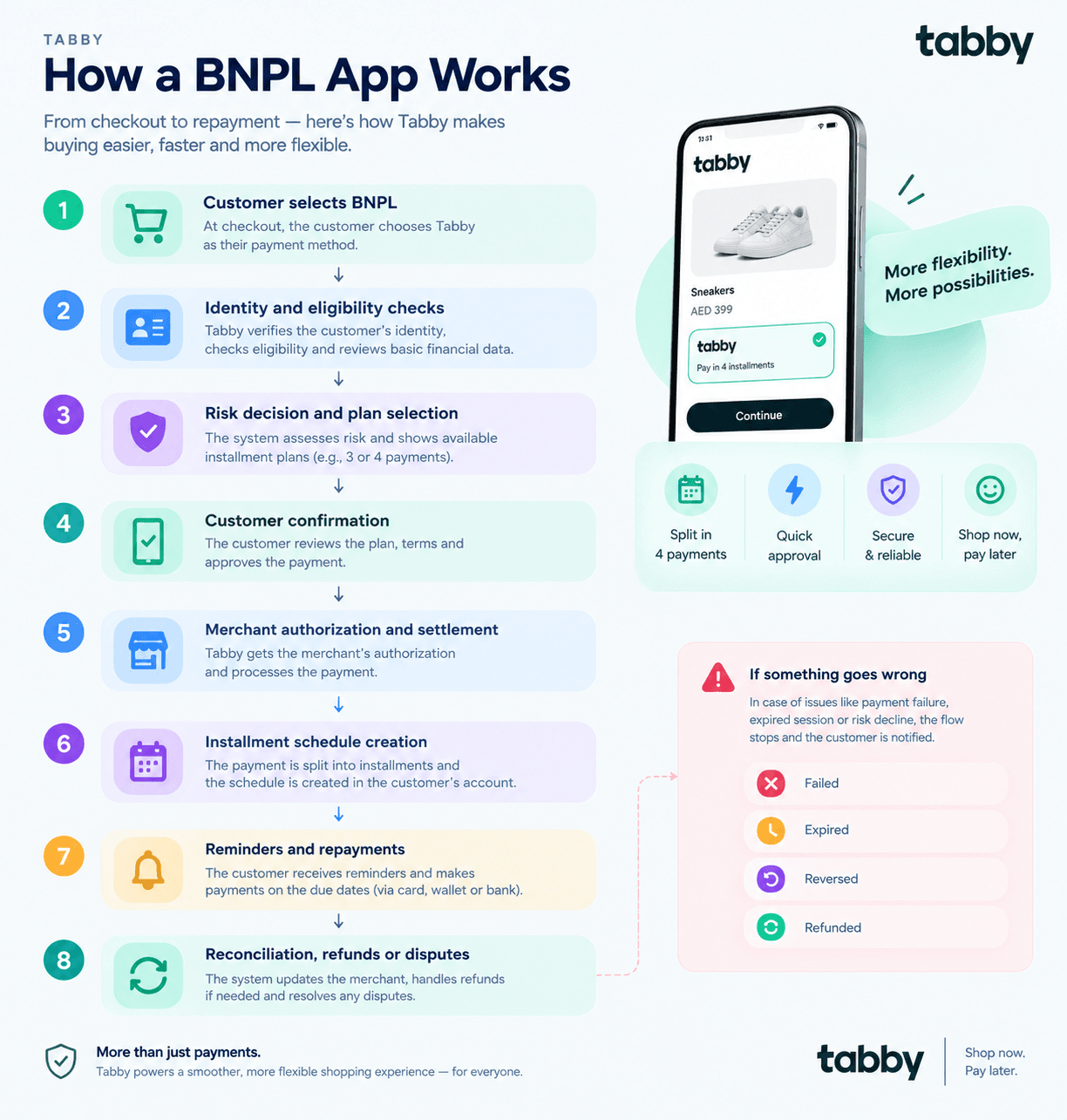
The exact repayment structure, fees, credit classification and licensing requirements depend on the launch market. A Tabby-like product should not copy another provider’s terms without local financial and legal review.
Core Features
Customer onboarding and KYC
A BNPL app may include:
- Mobile or email registration.
- Government-ID verification.
- Document capture and OCR.
- Liveness checks where legally permitted.
- Sanctions and watchlist screening.
- Device and account-risk checks.
- Address and contact verification.
- Consent management.
- Secure account recovery.
KYC affects eligibility, fraud exposure, regulatory records and account recovery.
Eligibility and affordability
The decisioning layer may evaluate:
- Transaction amount.
- Repayment history.
- Existing exposure.
- Account age.
- Merchant risk.
- Device and session signals.
- Open-banking data where permitted.
- Credit-bureau data where available.
- Customer affordability information.
- Fraud and identity signals.
Alternative data is not an automatic replacement for regulated credit information. Its use depends on consent, legality, explainability and local regulation.
Installment-plan engine
The plan engine should support:
- Pay-in-four schedules.
- Flexible durations.
- Initial-payment calculation.
- Due-date generation.
- Early repayment.
- Partial payments where permitted.
- Rescheduling rules.
- Failed-payment handling.
- Refund adjustments.
- Customer notifications.
- Merchant settlement rules.
Each plan should be a versioned financial object so the platform can explain how the schedule was created.
Automated deductions
The repayment system may support:
- Tokenized cards.
- Multiple payment methods.
- Preferred-method selection.
- Pre-debit notifications.
- Retry logic.
- Failed-payment handling.
- Card replacement.
- Mandate records.
- Cancellation workflows.
Avoid storing raw card details unless the architecture and compliance scope explicitly support it. Use a compliant payment processor, payment gateway or regulated payment provider, depending on the market and architecture.
Merchant integrations
A production BNPL API may include:
- REST or GraphQL APIs.
- Mobile and web SDKs.
- Hosted checkout.
- Payment widgets.
- Shopify, Magento and WooCommerce connectors.
- Payment links.
- QR or in-store checkout.
- Webhooks.
- Sandbox environments.
- Reconciliation exports.
- Technical documentation.
Merchant dashboard
Include:
- Transaction management.
- Settlement reports.
- Refunds and cancellations.
- Dispute workflows.
- Conversion analytics.
- Approval and decline rates.
- Payment-plan performance.
- Webhook logs.
- Team permissions.
- API credentials.
Customer repayment centre
Customers should view:
- Active plans.
- Upcoming payments.
- Completed payments.
- Outstanding balance.
- Early-repayment options.
- Payment methods.
- Receipts.
- Refund status.
- Dispute status.
- Support conversations.
- Consent and data settings.
BNPL Fintech Architecture
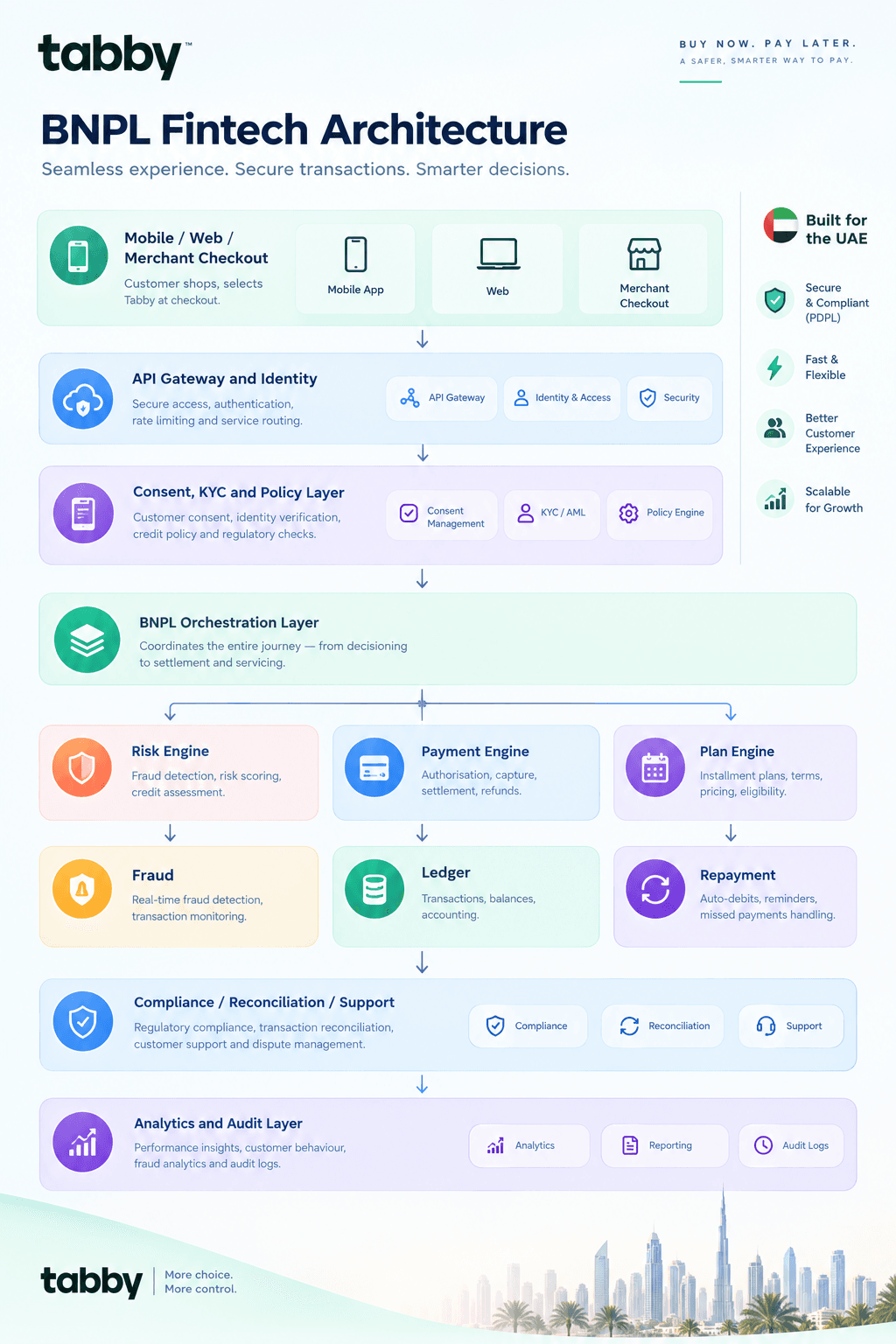
Service boundaries
| Service | Responsibility |
|---|---|
| Identity | Registration, authentication and recovery |
| KYC | Verification, screening and consent |
| Risk | Eligibility, affordability and fraud signals |
| Plan | Installment schedules and plan changes |
| Payment | Authorization, tokenization and collection |
| Ledger | Double-entry financial records |
| Settlement | Merchant and partner settlement |
| Refund | Returns, cancellations and adjustments |
| Dispute | Customer and merchant cases |
| Notification | Reminders and transactional messages |
| Compliance | Reporting, audit and policy enforcement |
| Analytics | Product, merchant and portfolio metrics |
Ledger-first architecture
Do not calculate balances only from interface events or payment-provider responses. Use a ledger that records transactions, obligations, payments, fees, refunds, chargebacks, write-offs, settlements and reconciliation status.
Financial records should be auditable and corrected through controlled adjustment or reversal entries rather than silently overwritten.
2026 BNPL Technology Stack
| Layer | Technology categories |
|---|---|
| Mobile | Flutter, React Native, native iOS and Android |
| Web and checkout | React, Next.js and hosted checkout |
| Backend | Go, Java, Kotlin, Node.js or Python |
| API gateway | Managed gateway with authentication and rate controls |
| Database | PostgreSQL or another ACID-compliant database |
| Cache | Redis for sessions, idempotency and short-lived state |
| Event streaming | Kafka, Pulsar or managed event services |
| Ledger | Double-entry ledger service with auditable records |
| Payments | Payment processor, gateway or regulated payment provider |
| KYC | Regulated identity-verification provider |
| Risk | Rules engine, feature store and model-serving layer |
| Analytics | Data warehouse, BI tools and risk dashboards |
| Cloud | AWS, Azure, Google Cloud or approved regional infrastructure |
| Security | Key management, secrets management, MFA and monitoring |
| Observability | Traces, logs, metrics and transaction-level audit events |
Vector search may help support search or document retrieval, but it should not be the authoritative source for balances, repayment obligations or settlement.
AI and Machine Learning
AI can improve operations, but it introduces fairness, explainability and governance requirements.
Responsible AI use cases
- Fraud and account-takeover detection.
- Identity-risk classification.
- Merchant-risk monitoring.
- Support-ticket routing.
- Document extraction.
- Payment-failure prediction.
- Collections prioritization.
- Personalized financial education.
- Merchant-offer ranking.
- Settlement anomaly detection.
Models should use documented data, undergo bias testing, support human review, offer appropriate explanations and remain subject to drift monitoring.
AI financial assistant
An AI assistant can explain repayment dates, compare plan options, locate receipts, set reminders, provide support and direct users to financial-literacy resources. It should not provide unqualified financial advice or encourage additional borrowing.
BNPL 2.0: Responsible, Open-Banking-Powered Financing
BNPL is evolving beyond a simple “Pay in 4” checkout. Future platforms may combine consent-based open banking, affordability assessment, explainable AI, exposure monitoring and responsible repayment support.
Open-banking-powered financing can use consented financial data to improve affordability and risk assessment, but implementation depends on local regulation, data access and customer permission.
BNPL 2.0 architecture
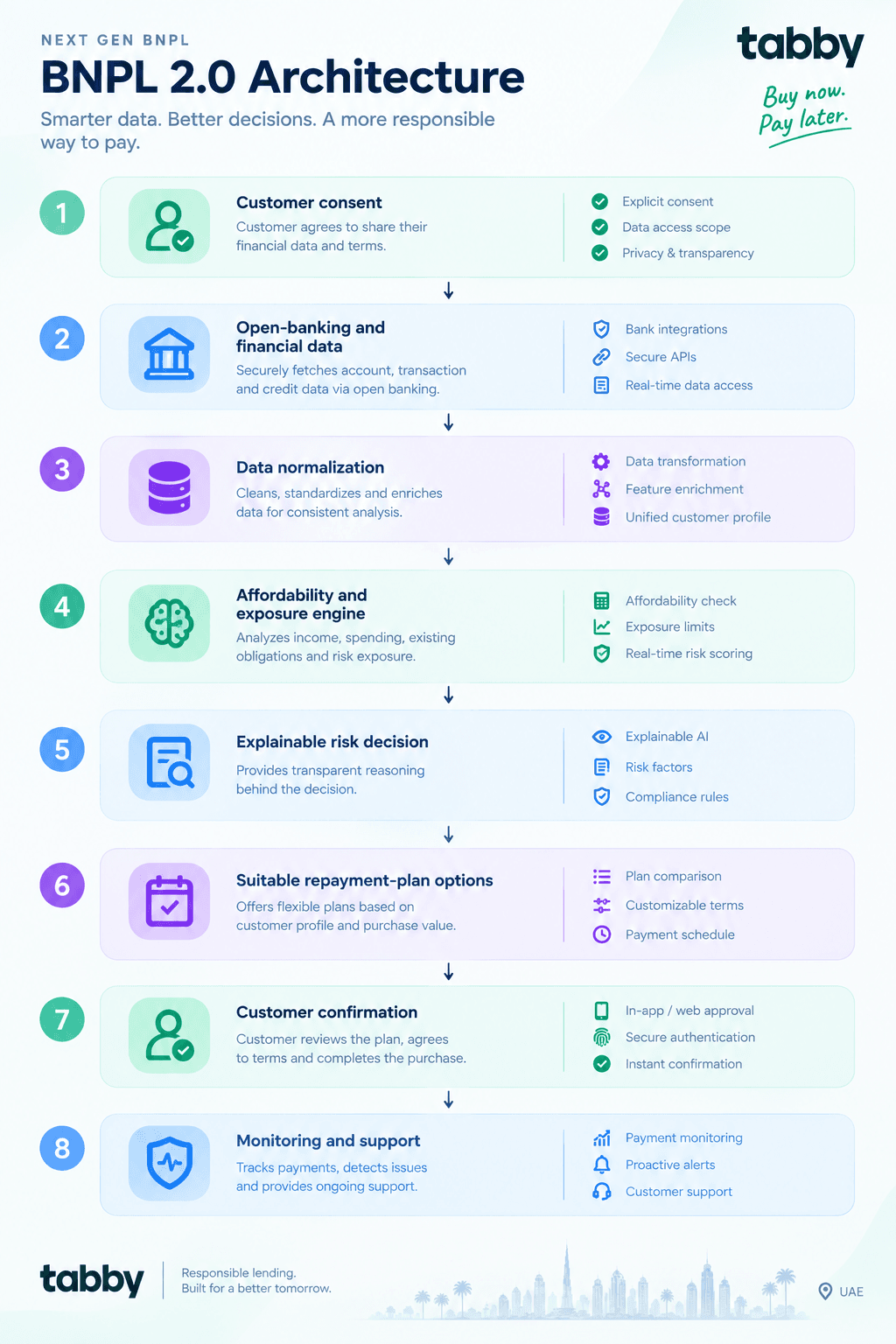
The platform should not automatically recommend the highest-value plan. It should consider affordability, existing exposure, repayment history and the customer’s consented financial context.
Financial hardship and repayment support
A production BNPL platform should support:
- Early payment-risk detection.
- Clear missed-payment notifications.
- Self-service repayment support.
- Hardship-request workflows.
- Rescheduling where legally permitted.
- Human escalation.
- Transparent fees and consequences.
- Customer communication preferences.
- Dispute and support workflows.
Build vs. Buy
Usually build internally
- Customer experience.
- BNPL orchestration.
- Installment-plan engine.
- Ledger and business logic.
- Risk-policy layer.
- Merchant APIs.
- Admin workflows.
- Reconciliation logic.
- Product analytics.
- Customer-support experience.
Usually integrate
- KYC and identity verification.
- Payment processing.
- Card tokenization.
- Credit-bureau data.
- Open-banking connections.
- SMS and email delivery.
- Cloud security tooling.
- Fraud data sources.
- Address and document verification.
BNPL MVP vs. Full Platform
| Capability | BNPL MVP | Full-scale platform |
|---|---|---|
| Customer onboarding | Included | Multi-provider and regional |
| KYC | One provider | Multiple workflows and fallbacks |
| Payment provider | One | Multiple providers and routing |
| Installment product | One or two plans | Multiple products and policies |
| Eligibility | Basic rules | Rules, ML and affordability |
| Fraud | Basic controls | Real-time risk and investigation |
| Ledger | Core ledger | Double-entry and multi-entity |
| Reconciliation | Basic exports | Automated matching and settlement |
| Merchant integration | One API or plugin | APIs, SDKs, webhooks and POS |
| Marketplace | Not required | Optional large-scale module |
| Open banking | Optional | Regional and consent-aware |
| AI | Limited | Risk, fraud, support and personalization |
| Compliance | One market | Multi-market policy engine |
| Infrastructure | Single region | Multi-region and failover |
Team Required
A serious BNPL product needs:
- Product manager.
- Fintech product analyst.
- UX/UI designer.
- Mobile developers.
- Backend engineers.
- Payments/ledger engineer.
- Risk or data engineer.
- QA and automation engineers.
- DevOps or cloud engineer.
- Security engineer.
- Data/ML engineer.
- Customer-support and operations specialists.
- Compliance and legal specialists.
Legal and compliance specialists should not be treated as substitutes for software engineers, and developers should not provide legal approval.
Fraud, Security and Privacy
A BNPL platform handles identity information, payment tokens, financial obligations and behavioral data.
Include:
- Strong authentication.
- MFA or risk-based verification.
- Device and session controls.
- Encryption.
- Tokenized payment data.
- Key management.
- Role-based access.
- Tenant isolation.
- API signing.
- Idempotency keys.
- Rate limiting.
- Secret rotation.
- Penetration testing.
- Incident response.
Monitor account takeover, synthetic identities, device farms, card testing, merchant collusion, refund abuse, multiple-account exposure, velocity anomalies and suspicious repayment patterns.
Compliance as a Product Feature
Compliance should be designed into the product rather than added after development.
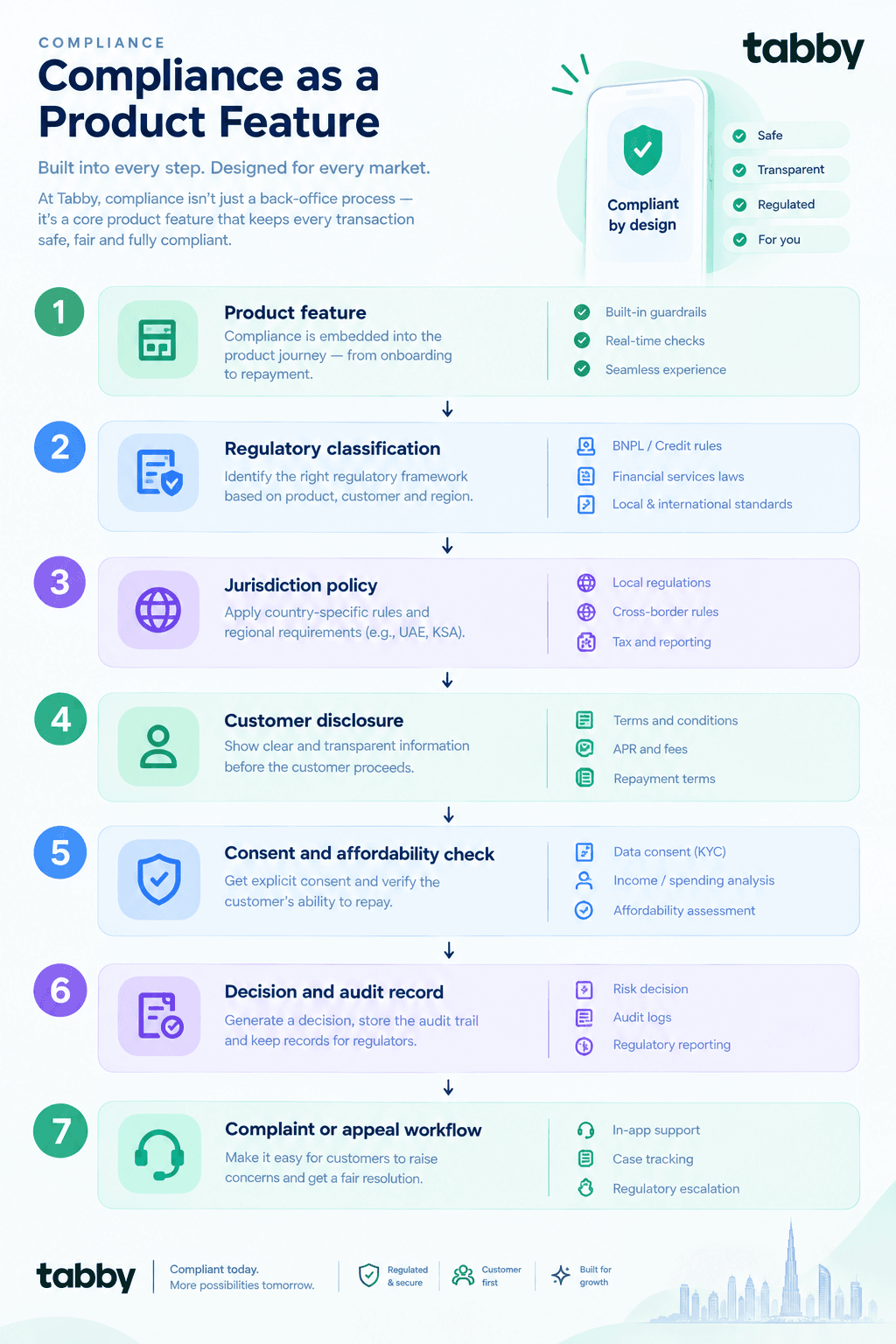
This includes:
- Jurisdiction-specific eligibility rules.
- Pre-contract information.
- Transparent installment terms.
- Affordability checks.
- Customer complaints.
- Appeals.
- Hardship support.
- Regulatory reporting.
- Versioned policies.
- Auditable records.
BNPL regulation differs by market. In the UK, for example, the FCA began regulating Deferred Payment Credit, commonly known as BNPL, on July 15, 2026, with protections involving clearer information, affordability checks and support for customers in difficulty.
Collections and Recoveries Architecture
A production BNPL platform must manage the complete repayment lifecycle.
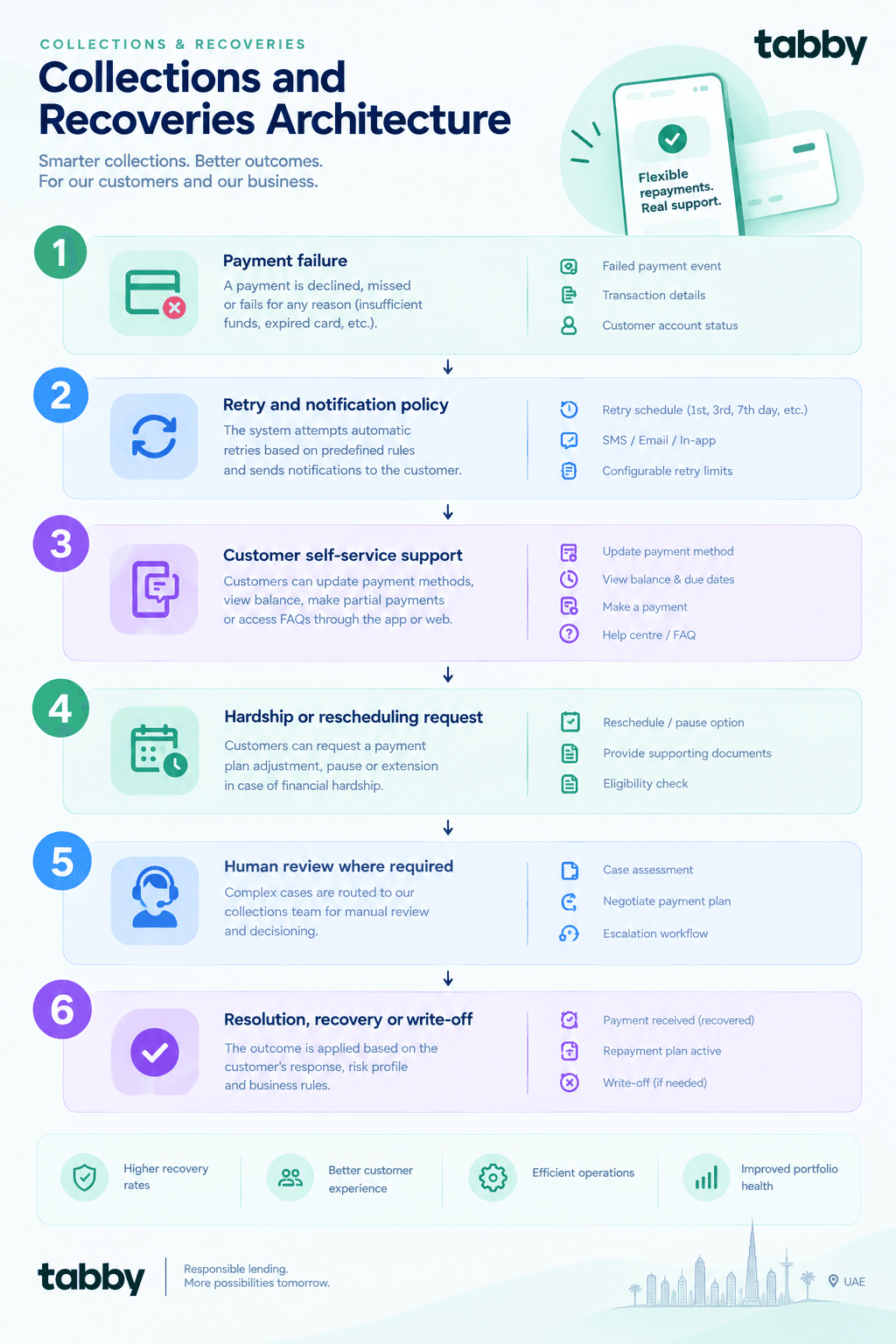
Include:
- Failed-payment detection.
- Smart retry rules.
- Customer reminders.
- Grace-period policies.
- Hardship requests.
- Repayment-plan modification.
- Human support escalation.
- Dispute handling.
- Write-off and recovery records.
- Fair-collections monitoring.
Merchant Settlement and Reconciliation
Merchant settlement should handle:
- Approved transactions.
- Cancellations.
- Partial refunds.
- Full refunds.
- Chargebacks.
- Settlement timing.
- Merchant fees.
- Tax or invoice references.
- Currency conversion where relevant.
- Failed settlement.
- Reconciliation differences.
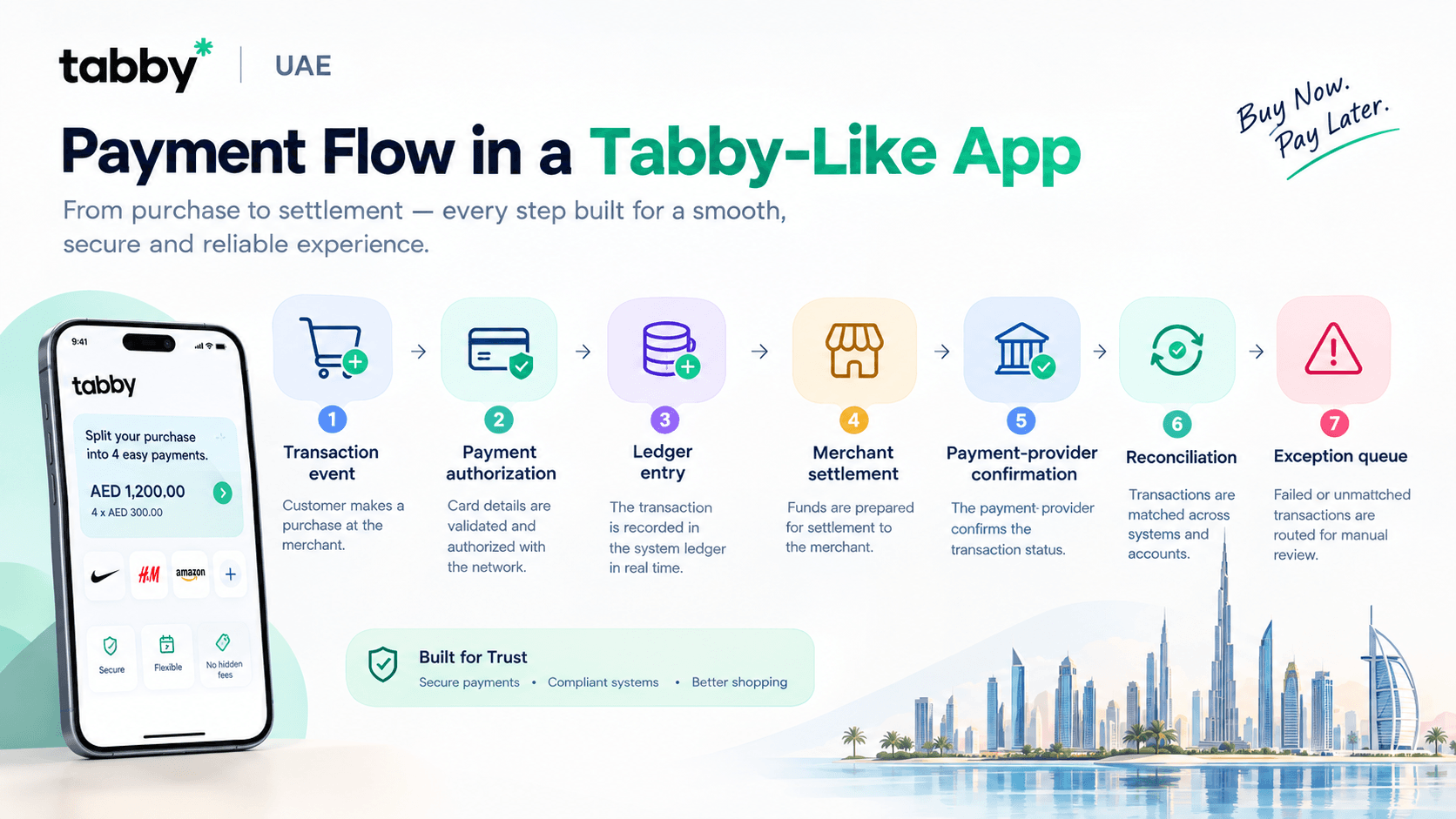
A transaction should not be considered financially complete until the internal ledger, payment provider and merchant records reconcile.
B2B BNPL: An Expansion Opportunity
A future BNPL platform can expand beyond consumer purchases into:
- Business-to-business purchases.
- Invoice financing.
- Inventory financing.
- SME procurement.
- Marketplace seller financing.
- Supplier payments.
- Equipment purchases.
- Subscription and recurring business expenses.
B2B BNPL requires business KYC and KYB, ownership verification, multi-user permissions, invoice workflows, approval limits, accounting integrations, supplier settlement and business credit assessment.
This is an expansion opportunity, not a mandatory component of a consumer-focused MVP.
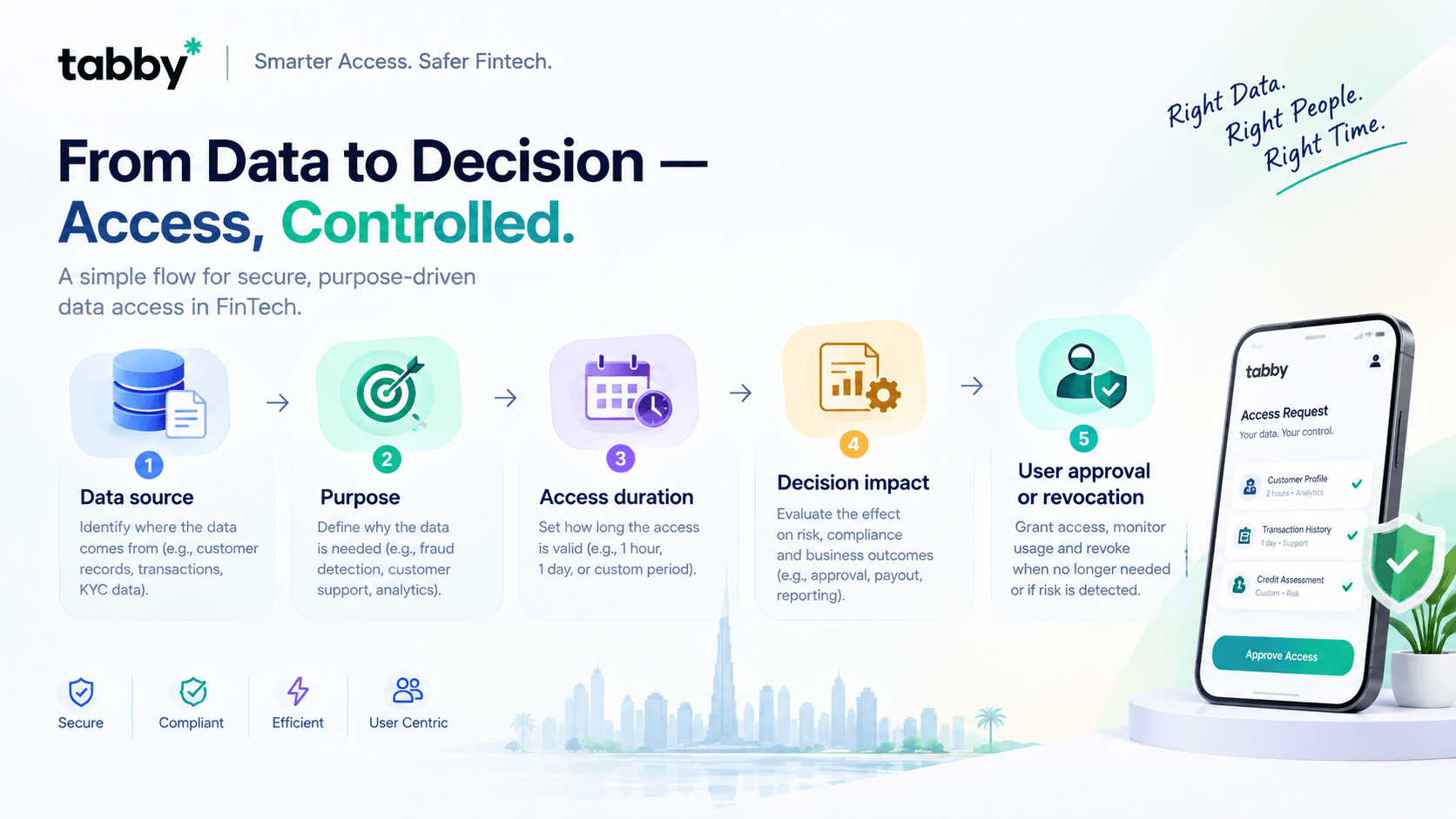
BNPL Data Permissions and Consent Dashboard
Customers should be able to see:
- Which data source is connected.
- Why the data is being used.
- What decision it supports.
- When access expires.
- Which provider receives it.
- How to revoke access.
- What data is stored.
- How to request deletion.
Explainable BNPL Decisioning
If an application is declined or a plan is restricted, the platform should provide a clear explanation where required.
Examples include:
- Existing repayment exposure is above the current limit.
- Identity verification could not be completed.
- The transaction requires additional review.
- The selected plan is not currently available.
- More information is required to assess affordability.
Do not expose fraud-detection rules in a way that helps attackers bypass them.
Monetization Models
A BNPL platform may earn through:
- Merchant transaction fees.
- Merchant subscription plans.
- Platform or integration fees.
- Sponsored marketplace placement.
- Affiliate or referral revenue.
- Premium merchant analytics.
- B2B checkout licensing.
- Permitted payment economics.
- Permitted financing or service fees.
Pricing must comply with local financial and consumer-protection rules.
What Drives BNPL Development Cost?
Software-development cost is influenced by:
- Number of markets.
- Licensing and partner model.
- Number of payment providers.
- KYC and AML integrations.
- Credit-bureau or open-banking connections.
- Risk-engine complexity.
- Ledger and reconciliation requirements.
- Merchant API and SDK requirements.
- Marketplace scope.
- AI and ML requirements.
- Security and compliance testing.
- Expected transaction volume.
- Number of customer, merchant and admin applications.
- Data migration and reporting needs.
Cost figures should be labelled as indicative software-development estimates, not guaranteed pricing for a regulated fintech launch.
Cost to Build an App Like Tabby
The following ranges cover software development only. They exclude lending capital, regulatory licensing, legal fees, credit losses, partner onboarding and full operating teams.
| Product stage | Typical scope | Indicative cost |
|---|---|---|
| Discovery and compliance prototype | Market mapping, UX, architecture and partner plan | US$15,000–40,000 |
| Focused BNPL MVP | Customer app, one market, basic plans, KYC and payment integration | US$50,000–90,000 |
| Merchant-ready platform | Customer, merchant and admin portals with APIs and reconciliation | US$120,000–250,000 |
| Advanced production platform | Risk, fraud, analytics, support and multiple integrations | US$250,000–500,000+ |
| Multi-market enterprise platform | Ledger, settlement, high availability and governance | US$500,000–1.5 million+ |
Published estimates vary because they use different features, markets, compliance assumptions and team models.
Main cost drivers
- Customer, merchant and admin applications.
- Payment and KYC providers.
- Risk and fraud models.
- Ledger and settlement.
- Security and compliance.
- Data and reporting.
- AI infrastructure.
- Expected transaction volume.
- Number of markets.
BNPL Development Timeline
| Phase | Estimated duration |
|---|---|
| Discovery and regulatory assessment | 3–6 weeks |
| UX and technical architecture | 3–5 weeks |
| MVP development | 10–16 weeks |
| Integrations and testing | 4–8 weeks |
| Security and compliance hardening | 3–6 weeks |
| Production launch | Depends on licensing and partners |
These phases can overlap, so total calendar time is not the sum of every phase. Regulatory approvals, lender partnerships, payment-provider onboarding and KYC-provider approval may extend the launch independently.
How to Build a BNPL App
Phase 1: Market and regulatory discovery
Define the target country, customer and merchant segments, installment structure, funding model, licensing partners, affordability policy, data responsibilities and revenue model.
Phase 2: Product and risk design
Create the customer and merchant journeys, risk policy, KYC flow, payment rules, ledger model, retention policy, disputes process and fraud threat model.
Phase 3: Focused MVP
Launch with one market, one or two payment plans, one KYC provider, one payment processor, limited merchant integration, basic risk rules, a repayment centre, merchant dashboard and reconciliation tools.
Phase 4: Production hardening
Add automated fraud models, advanced merchant APIs, double-entry ledger, provider fallback, load testing, penetration testing, disaster recovery, audit reporting and model evaluation.
Phase 5: Expansion
Introduce more markets, merchant discovery, POS and QR checkout, virtual cards where permitted, open banking, responsible personalization and enterprise APIs.
Future Trends in BNPL and Fintech
Responsible affordability
Future platforms will balance conversion with affordability, repayment capacity and repeated-borrowing risk.
Real-time risk decisioning
Payment and identity signals can support fast decisions, but speed should not eliminate explainability, appeals or human review.
Embedded finance
BNPL will increasingly appear inside e-commerce, travel, healthcare, education, procurement, subscriptions and super apps.
Alternative payment rails
Open banking, account-to-account payments, digital wallets, tokenized credentials and regional real-time payments may reduce dependence on card-only repayment.
AI operations
AI will support merchant underwriting, fraud investigations, payment-failure prediction, collections prioritization, dispute classification, product recommendations and financial education.
Portable financial identity
With consent, customers may reuse verified identity, affordability preferences and repayment history across approved services, subject to strong privacy and revocation controls.
Explainable credit experiences
Customers will increasingly expect to understand why a plan was approved, restricted or declined and how to request a review.
Frequently Asked Questions
Can I build a Tabby-like BNPL app without becoming a lender?
Possibly, but the answer depends on product structure, jurisdiction, funding model, contractual arrangements and licensed partners. Using a payment gateway does not automatically remove lending, credit or consumer-protection obligations. Obtain local legal and regulatory advice before launch.
How much does it cost to build a fintech app?
A general production fintech app with compliance, payment integrations and security may cost approximately US$150,000–300,000+. An advanced BNPL platform with risk, ledger, settlement and multiple integrations may cost US$250,000–500,000+, while a multi-market enterprise BNPL platform can exceed US$500,000.
How much does it cost to develop a mobile app in 2026?
A standard mobile app may begin around US$30,000–80,000, while a regulated BNPL platform can require US$120,000–500,000+ depending on risk, compliance, integrations and operating scope.
How much does it cost to build an app like Tabby?
A focused Tabby-like BNPL MVP may cost approximately US$50,000–90,000. A merchant-ready platform may cost US$120,000–250,000. A multi-market, AI-enabled platform can exceed US$500,000.
How long does it take to build a BNPL app?
A focused MVP may take approximately 4–6 months. A merchant-ready product may require 6–10 months. A multi-market platform with advanced risk, ledger, settlement, compliance and high availability may take 10–18 months or more.
What features should a BNPL app include?
Core features include KYC, eligibility decisioning, installment plans, payment authorization, automated deductions, reminders, repayment management, refunds, disputes, merchant APIs, settlement, reconciliation, fraud controls and admin operations.
How does AI improve a Tabby-like app?
AI can support fraud detection, risk classification, document processing, payment-failure prediction, support automation, merchant-risk monitoring, personalized financial education and offer ranking. High-impact decisions should remain explainable and governed.
What technology stack is suitable for a BNPL app?
A common stack includes Flutter or React Native, Go, Java, Node.js or Python services, PostgreSQL for transactional data, Redis for short-lived state, Kafka for events, secure cloud infrastructure, payment and KYC providers, model-serving infrastructure and a double-entry ledger.
Should a BNPL app use alternative credit data?
Alternative data may support risk decisioning where legally permitted and where the user has provided appropriate consent. It is not a universal substitute for credit-bureau or affordability data and requires bias, explainability and governance testing.
How do BNPL apps make money?
Common models include merchant transaction fees, merchant subscriptions, integration fees, marketplace placement, referral revenue, analytics services and permitted payment or financing economics. The model must comply with local financial and consumer-protection rules.
What are the main risks of launching a BNPL app?
Key risks include regulatory misclassification, credit losses, fraud, data breaches, payment failures, merchant disputes, inadequate affordability controls, model bias, poor reconciliation and insufficient customer support.
How can a BNPL platform reduce development cost?
Start with one market, one core installment product, one payment processor, one KYC provider and a limited merchant integration. Build the ledger, risk policy, reconciliation and compliance foundation before adding marketplace, AI, open banking or multi-market features.
How can a BNPL app scale to 100,000 users?
It needs horizontally scalable services, an ACID-compliant ledger, event-driven processing, idempotent payments, rate limiting, queue-based workflows, fraud monitoring, database observability, regional failover and customer-support capacity. User count alone does not determine value; transaction volume, repayment performance and contribution margin matter more.
Conclusion
Building an app like Tabby in 2026 requires much more than creating a checkout screen with installment payments. The product must combine customer experience, merchant distribution, KYC, affordability, risk decisioning, fraud prevention, payments, ledger integrity, settlement, refunds, disputes and regulatory governance.
The practical strategy is to start with one market, one repayment product, one payment processor and a limited merchant integration. Build the ledger, risk policy, reconciliation and compliance foundation correctly before adding a marketplace, advanced AI decisioning, open banking or multi-market features.
The future of BNPL will be shaped by responsible affordability, explainable AI, open-banking connectivity, embedded finance, real-time risk systems and secure interoperability. A Tabby-like platform needs to balance transaction growth with affordability, risk management, compliance and customer trust.