Building an app like HotDoc is not primarily a mobile app development project. It is a healthcare platform development challenge involving patients, clinics, practitioners, operational teams and external healthcare systems.
The booking interface is only the visible layer.
Behind it, the platform may need to manage appointment availability, practice workflows, notifications, patient data, integrations, telehealth sessions, payments, administrative operations and, depending on the product model, connections to Australia's broader digital-health infrastructure.
The objective should not be to copy another company's interface. A stronger approach to build a healthcare app like HotDoc is to understand the workflow problems that make a healthcare platform valuable and then design a product around the specific market opportunity you want to address.
Cost, Timeline and Scope
For planning purposes, the following are indicative software-development estimates, not independently verified Australian market averages:
| Platform Scope | Indicative Development Cost | Typical Timeline |
|---|---|---|
| Focused healthcare booking MVP | AUD $80K–$180K | 4–6 months |
| Integrated healthcare platform | AUD $180K–$400K | 6–10 months |
| Enterprise or multi-sided platform | AUD $400K–$750K+ | 9–12+ months |
These estimates primarily relate to product design and software development. They do not include legal advice, clinical governance, compliance consulting, staffing, marketing, transaction fees, third-party provider costs or other healthcare-business operating expenses.
Costs can also vary significantly depending on the development team, integration requirements, security scope, third-party services and whether native or cross-platform applications are used.
The central point: you are not building a booking app. You are building a healthcare platform in which booking is one part of a larger operational system.
What Are You Actually Building?
A useful way to think about a HotDoc-style healthcare product is as a connected ecosystem.
The platform has three primary experiences
Patient Experience
Patients need to discover practitioners, understand availability, book appointments, manage their healthcare journey and receive relevant communications.
Clinic Experience
Practices need control over calendars, appointment types, availability rules, practitioners, cancellations and operational workflows.
Operations Experience
The platform owner needs tools for support, monitoring, exceptions, integrations, reporting and administration.
A product architecture may therefore look like this:
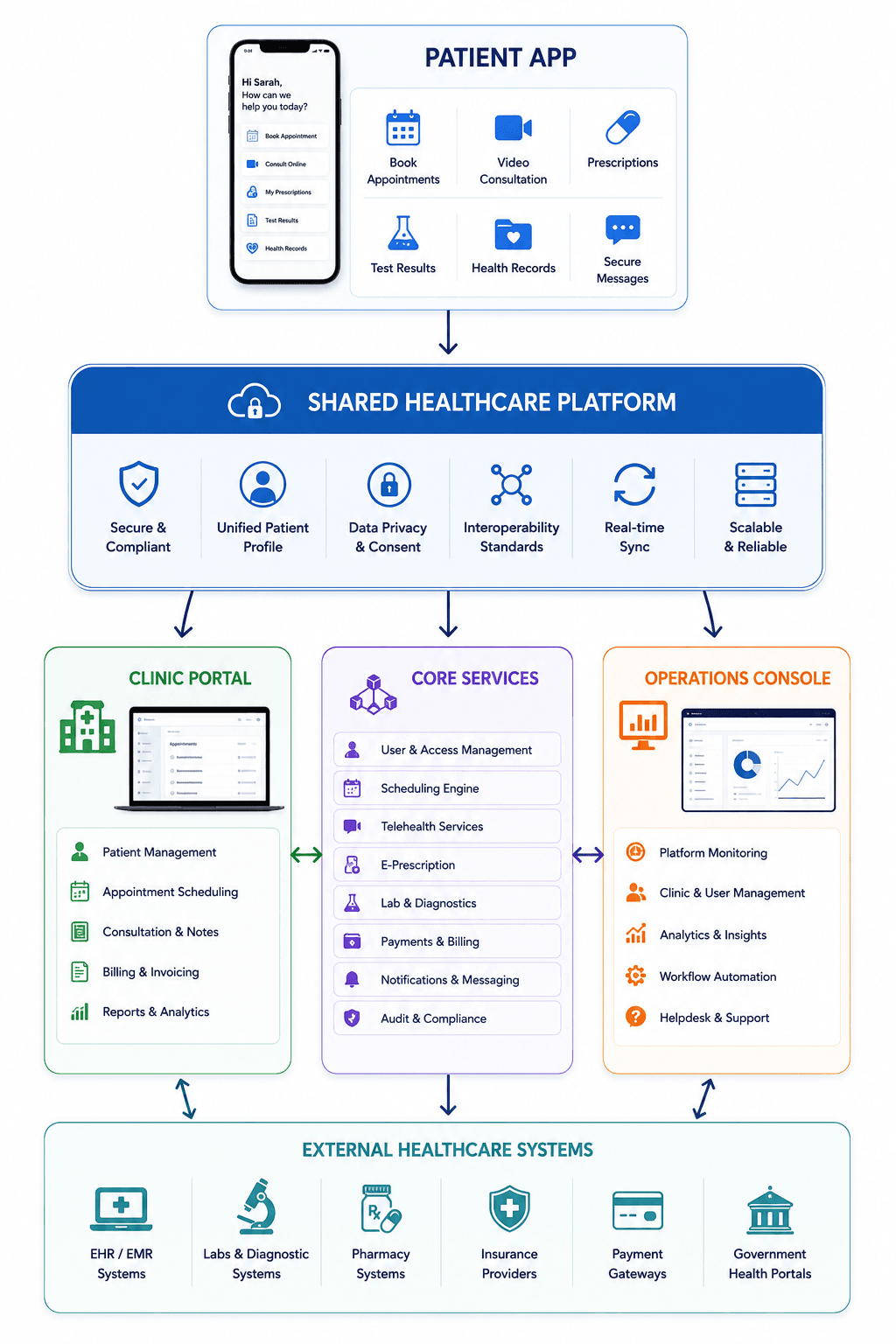
This is one of the most important distinctions in the entire project.
A healthcare booking platform becomes difficult not because one booking screen is technically complicated, but because different participants need to interact with the same underlying workflow.
How Does a Healthcare Booking Platform Work?
A typical patient journey may look simple:
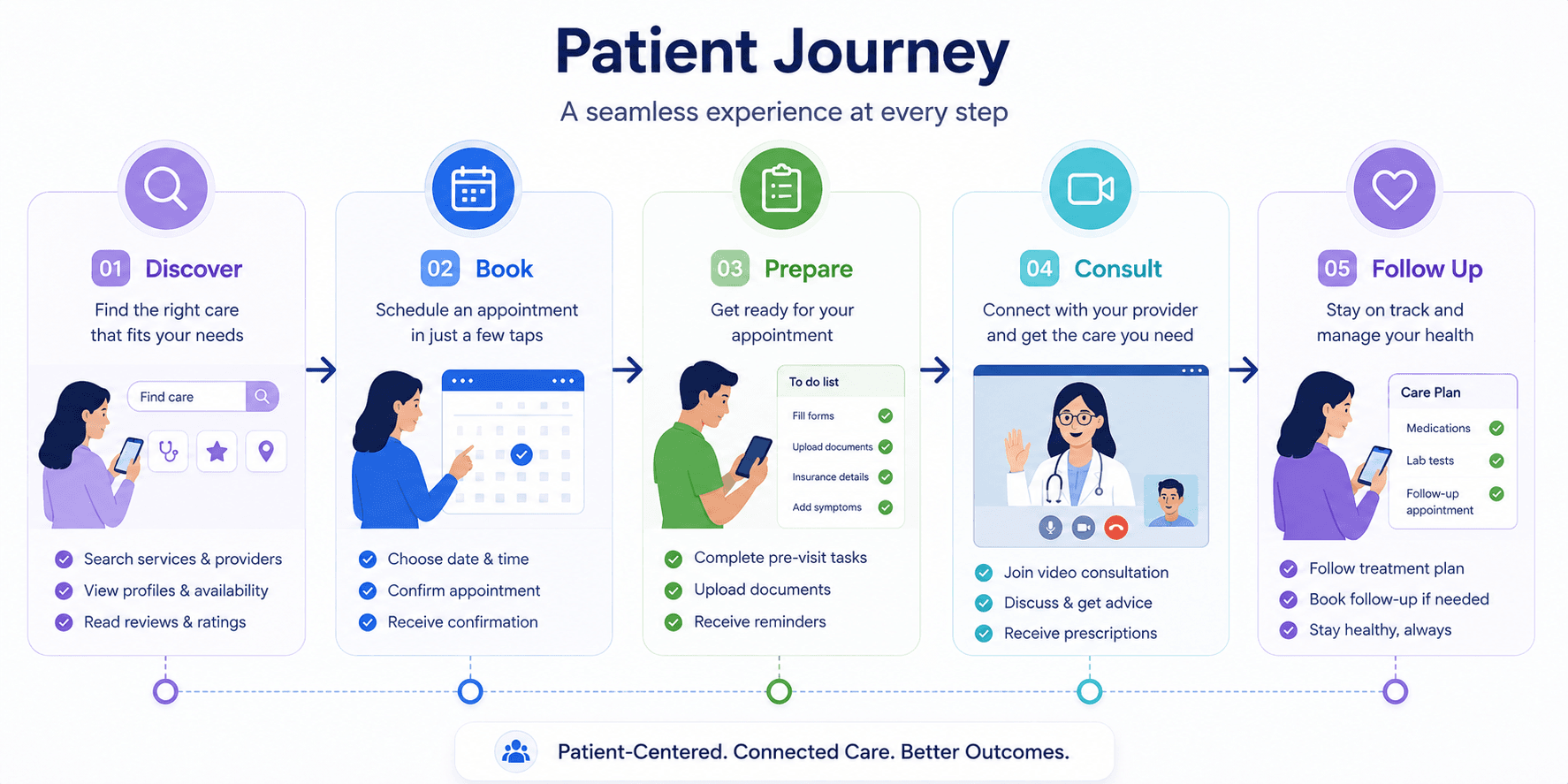
However, each stage can involve multiple systems.
Discover
The patient searches by location, practitioner, specialty, availability or other relevant criteria.
Book
The platform identifies available appointment slots and creates a booking while ensuring that the underlying practice schedule remains accurate.
Prepare
The patient may receive reminders, forms, instructions or other information required before the appointment.
Consult
The appointment may happen in person or through an integrated telehealth workflow.
Follow Up
The platform may support subsequent bookings, communications, reminders or other patient-engagement workflows.
The technical challenge is maintaining a reliable source of truth throughout this journey.
If a clinic changes an appointment externally, the patient-facing platform may need to reflect that change. If a patient cancels through the app, the clinic system may need to receive the update.
This is why integration design often matters more than the number of screens in the application.
HotDoc-Like App: What Should You Learn From the Model?
HotDoc provides a useful reference point because its current practice ecosystem goes beyond online appointment discovery. Its official materials describe capabilities including online bookings, telehealth, appointment reminders, SMS recalls, mobile and kiosk check-in, digital forms and online payments.
That does not mean a new healthcare product should attempt to reproduce all of those capabilities.
Instead, founders should ask:
- Which healthcare workflow are we improving?
- Who is the first customer?
- Is the product patient-led, clinic-led or practitioner-led?
- Which existing systems must remain the source of truth?
- Which workflow creates the strongest commercial advantage?
A platform targeting specialist clinics may need a completely different product strategy from one serving general practices, allied health providers or large healthcare networks.
Core Features for a Healthcare Booking Platform
Patient Registration and Identity
The patient experience usually begins with account creation and identity management.
Depending on the product, this may include:
- Account registration
- Authentication
- Profile management
- Family or dependent profiles
- Contact preferences
- Consent management
Healthcare platforms should avoid collecting unnecessary information simply because it may be useful later.
Every additional category of sensitive information creates additional privacy, security and operational responsibilities.
Search and Discovery
Search functionality may include:
- Location
- Specialty or speciality
- Practitioner
- Clinic
- Availability
- Appointment type
- Language
- Accessibility requirements
The best search model depends on how patients actually select healthcare services.
For some products, the patient is searching for a known practitioner. For others, the patient may be trying to find the earliest appropriate appointment.
These are different product problems.
Real-Time Availability
Availability is one of the most important platform capabilities.
A healthcare platform may need to consider:
- Practitioner working hours
- Appointment duration
- Different appointment types
- Buffers
- Multiple staff requirements
- Leave
- Emergency availability
- External calendar or practice-system changes
The booking engine should be designed around the real operational rules of the clinic rather than an oversimplified calendar.
Booking, Cancellation and Rescheduling
Patients generally expect to:
- Book appointments
- Cancel when appropriate
- Reschedule
- Receive confirmation
- Receive reminders
The hidden challenge is maintaining consistency when actions occur across different channels.
For example, the platform must decide how to handle situations where:
- The patient attempts to book an unavailable slot
- The practice changes the schedule
- An external integration fails temporarily
- A request is submitted twice
- A webhook arrives late
- A cancellation occurs while another system is updating the appointment
This is why idempotency, retries, reconciliation and integration monitoring should be considered early.
Clinic and Practitioner Infrastructure
The clinic-facing experience should not simply be treated as an administrative version of the patient app.
Healthcare organisations have different requirements.
Schedule Management
Clinics may need to control:
- Practitioner availability
- Appointment durations
- Location
- Leave
- Buffers
- Appointment rules
- Service types
Practitioner Profiles
Depending on the marketplace model, profiles may include:
- Professional information
- Areas of practice
- Languages
- Location
- Availability
- Appointment types
The platform should clearly define which information is maintained by the practitioner, clinic or central operations team.
Patient Workflow Visibility
Operational teams may require visibility into:
- Upcoming appointments
- Booking changes
- Cancellations
- Failed communications
- Integration issues
- Support cases
This becomes increasingly important as the platform grows.
Practice-Management Integrations: The Hidden Complexity
For many healthcare platforms, the biggest hidden development cost is not the mobile application. It is integration.
Target clinics may already use established systems for appointments, patient management and practice operations.
The important questions are:
- Which systems does the target market already use?
- What integration mechanisms are available?
- Can the platform read availability?
- Can it create or update appointments?
- Which system is the source of truth?
- How are failures detected and resolved?
The integration strategy should be decided before the platform architecture is finalised.
Building a polished booking experience before understanding how appointment data will synchronise with clinic systems can create expensive rework later.
Telehealth Integration for Australian Healthcare Apps
Telehealth is not simply a video-call button.
A production telehealth workflow may involve:
- Appointment eligibility
- Practitioner availability
- Virtual waiting rooms
- Video or audio infrastructure
- Authentication
- Connection monitoring
- Session reliability
- Post-consultation workflows
Australia's Medicare telehealth environment also requires careful consideration of the applicable service and claiming requirements. Services Australia telehealth guidance explains current eligibility and claiming information, while MBS telehealth item guidance provides information about available telehealth items.
A development team should not assume that adding video technology automatically makes a consultation eligible for a particular Medicare benefit.
The product workflow, practitioner circumstances and applicable requirements need to be considered separately.
Video Infrastructure
A healthcare platform may choose to:
- Build on WebRTC infrastructure
- Use a specialist video provider
- Integrate a third-party communications platform
The decision should be based on requirements around:
- Reliability
- Scale
- Security
- Recording policies
- Integration
- Cost
- Operational support
For an MVP, buying specialised infrastructure may often be more practical than attempting to build every communication capability internally.
AI Features for Healthcare Platforms
AI can add value to healthcare workflows, but it should not be included simply because AI is currently a popular feature.
The strongest use cases solve a specific workflow problem.
AI-Assisted Administrative Work
Potential applications include:
- Appointment enquiry assistance
- Information retrieval
- Communication drafting
- Administrative summaries
- Workflow routing
Predictive Operations
With appropriate data and validation, models may help identify patterns such as:
- Potential no-show risk
- Appointment demand
- Operational bottlenecks
These outputs should support operational decision-making rather than become unquestioned automated decisions.
Ambient Documentation and Workflow Support
AI may help healthcare professionals reduce administrative effort through structured drafting and summarisation.
However:
AI-generated output should not automatically be treated as clinically correct.
Appropriate review and governance processes remain essential.
AI Data Governance
Before integrating an AI provider, businesses should understand:
- What data is sent to the provider
- Where processing occurs
- Whether data is retained
- Who can access the output
- Whether human review is required
- How actions are audited
Healthcare AI architecture should begin with data governance, not the chatbot interface.
Australian Healthcare Integrations and Digital Infrastructure
A healthcare product should map relevant Australian digital infrastructure before development begins.
The Australian Digital Health Agency's Implementer Hub provides resources for developers connecting software to services such as My Health Record and the Healthcare Identifiers Service.
Healthcare Identifiers
The Healthcare Identifiers Service is part of Australia's national digital-health infrastructure and uniquely identifies individuals, healthcare providers and healthcare organisations.
Whether a particular platform requires connection depends on the product and integration model.
My Health Record
My Health Record integration should not be added merely because it sounds like an advanced healthcare feature.
The business should first establish:
- What information is required?
- Why does the user need it?
- Which connection model is appropriate?
- What conformance and security requirements apply?
The Australian Digital Health Agency provides different connection mechanisms, including B2B and FHIR Gateway options. The FHIR Gateway is specifically designed for developers building consumer-facing apps and products.
The current guidance also covers areas such as registration, testing, security, consent and incident management.
This is a good example of why national healthcare integration should be treated as a defined workstream rather than a small API task.
Australian Privacy and Security Considerations
Healthcare information requires serious attention to privacy and security.
The Office of the Australian Information Commissioner provides guidance on the Australian Privacy Principles. APP 11 requires APP entities to take reasonable steps, appropriate to the circumstances, to protect personal information from misuse, interference, loss and unauthorised access, modification or disclosure.
The exact obligations for a particular product depend on factors including the organisation, services provided, information handled and applicable legislation. Working with an experienced mobile app development company in Australia can also help ensure privacy and security considerations are addressed during the product design and development process. Healthcare businesses should validate specific requirements with appropriate legal and privacy professionals.
Security Architecture
A serious healthcare platform may require:
- Strong authentication
- Role-based access control
- Multi-factor authentication where appropriate
- Encryption
- Secure session management
- Audit logging
- Monitoring
- Backup and recovery procedures
- Incident response processes
The Australian Signals Directorate's Essential Eight provides a useful risk-based cyber-security baseline, although it should not be treated as a complete substitute for a healthcare-specific security programme. ASD Essential Eight guidance
Security architecture should be designed before launch, not added after the first major incident.
Recommended Healthcare Platform Architecture
A practical architecture could follow this structure:
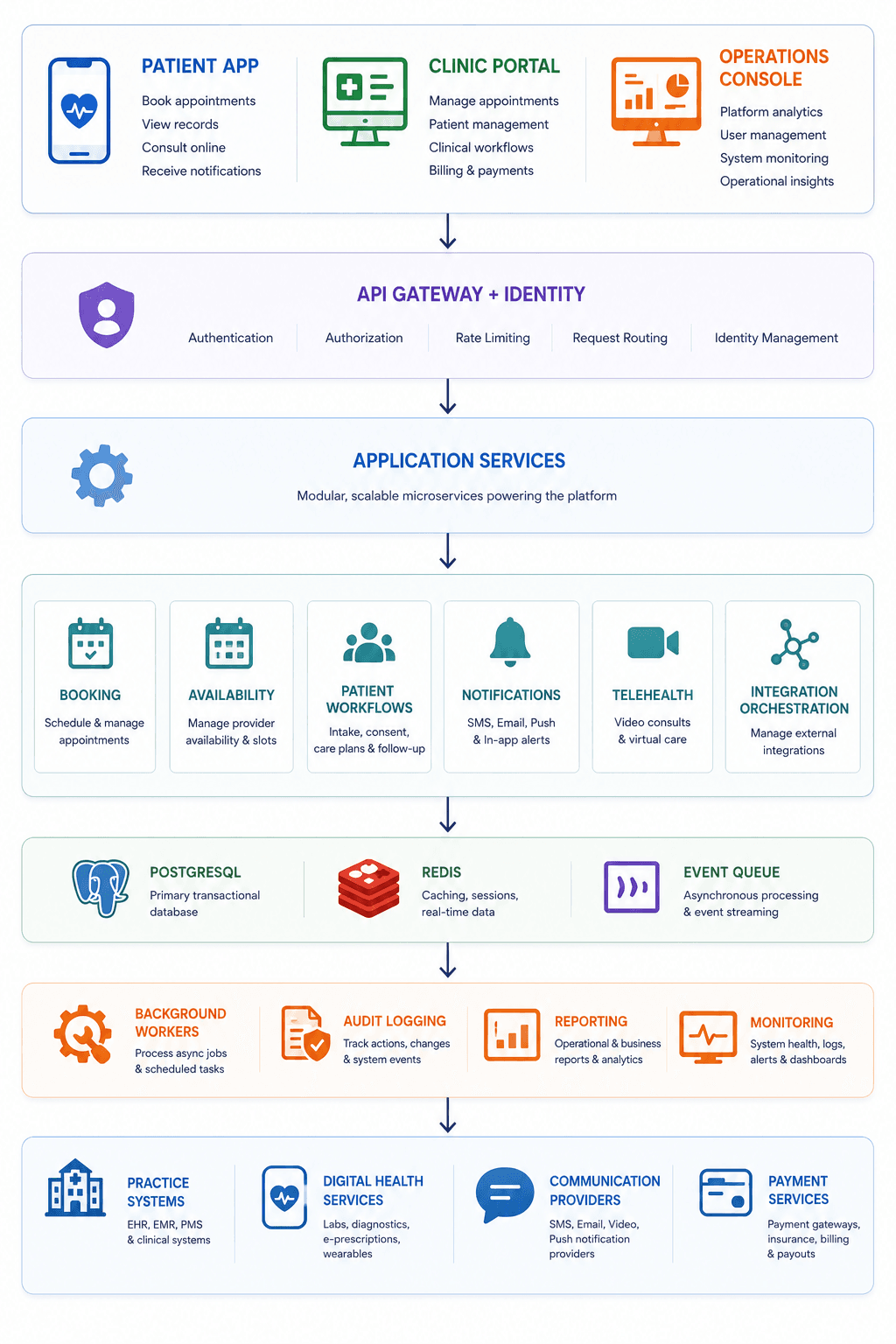
The architecture should not become more complicated simply to appear enterprise-grade.
The real question is:
Which parts of the system require independent ownership, reliability and scalability?
Integration Reliability
Healthcare platforms should plan for:
- Idempotency
- Webhook processing
- Retry handling
- Delayed responses
- Failed synchronisation
- Duplicate-event prevention
- Reconciliation
- Operational alerts
A successful API response is not always sufficient evidence that the entire business workflow completed correctly.
Possible Technology Stack
There is no universal technology stack for every healthcare platform.
The following are examples rather than mandatory choices.
| Layer | Possible Technologies | Typical Consideration |
|---|---|---|
| Mobile | Flutter, React Native, Swift, Kotlin | Cross-platform speed versus native control |
| Web | React, Next.js | Portal and operational interfaces |
| Backend | Java, .NET, Node.js, Go, Python | Team expertise and workload requirements |
| Database | PostgreSQL | Transactional consistency and ecosystem maturity |
| Cache | Redis | Performance and short-lived data |
| Messaging | Kafka, SQS, RabbitMQ | Event volume and operational complexity |
| Cloud | AWS, Azure, Google Cloud | Existing expertise and infrastructure requirements |
| Monitoring | OpenTelemetry, Grafana, Datadog | Observability and incident response |
| Containers | Docker | Deployment consistency |
| Orchestration | Kubernetes or managed services | Scale and operational complexity |
Technology should follow the product.
A platform with a small initial clinic network does not necessarily require the same infrastructure strategy as a national multi-sided marketplace.
What Should Your Healthcare MVP Include?
One of the biggest mistakes in healthcare app development is treating an MVP as a complete platform with fewer screens.
A better MVP answers one important question:
Can this specific healthcare workflow create enough value to justify further investment?
Build First
| Capability | MVP Priority |
|---|---|
| Patient registration | Yes |
| Practitioner or clinic search | Yes |
| Availability | Yes |
| Appointment booking | Yes |
| Cancellation or rescheduling | Yes |
| Notifications | Yes |
| Basic clinic portal | Yes |
| One critical integration | Yes |
| Basic analytics | Yes |
| Security and audit logging | Yes |
Build Later Unless Required by the Business Model
| Capability | Later Phase |
|---|---|
| Advanced telehealth | Often later |
| AI workflows | Often later |
| Advanced analytics | Later |
| Multiple complex integrations | Later |
| My Health Record integration | Depends on workflow |
| Highly customised operational automation | Later |
The MVP boundary should be based on workflow importance, not feature popularity.
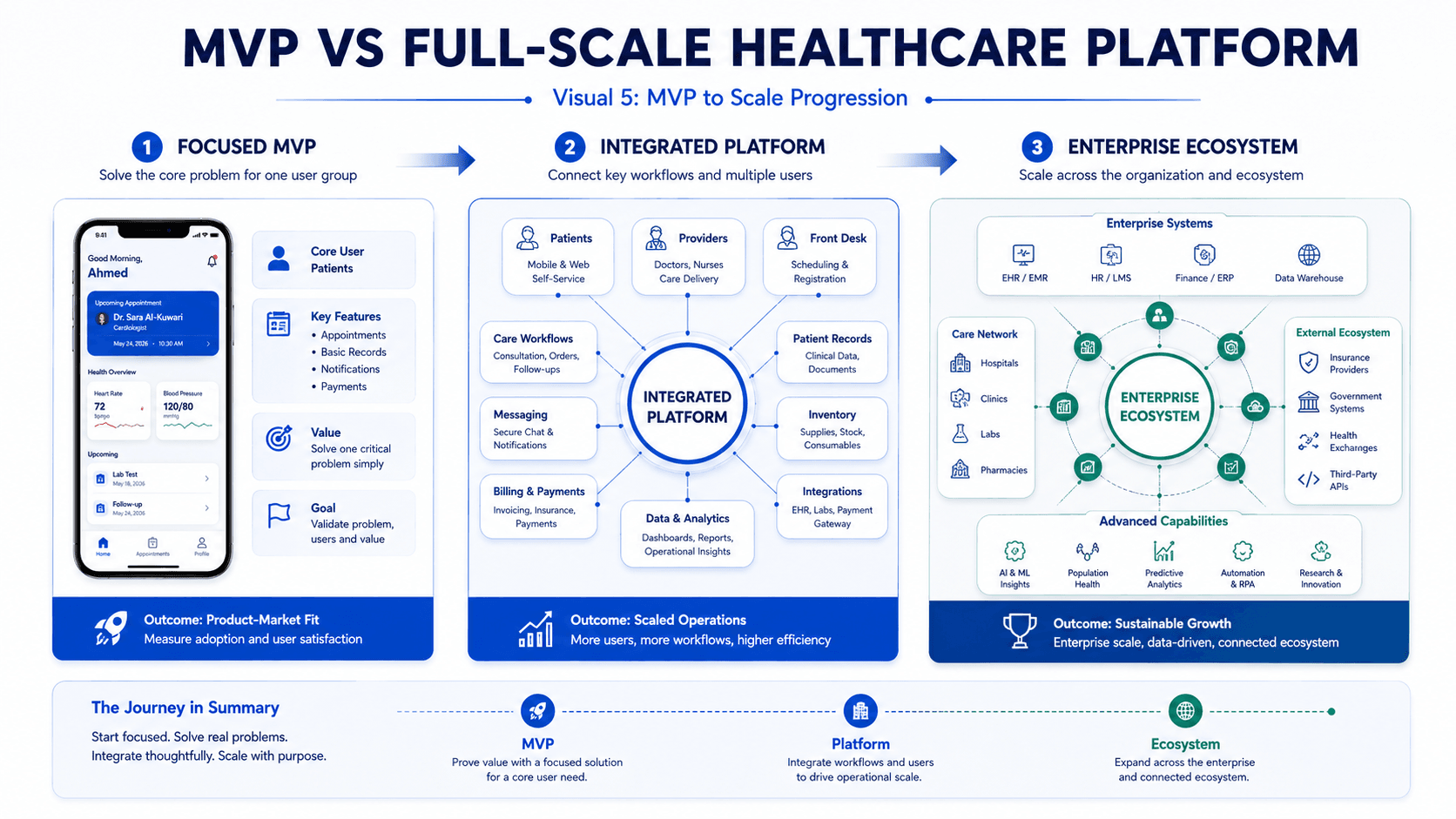
MVP vs Integrated Platform vs Enterprise Platform
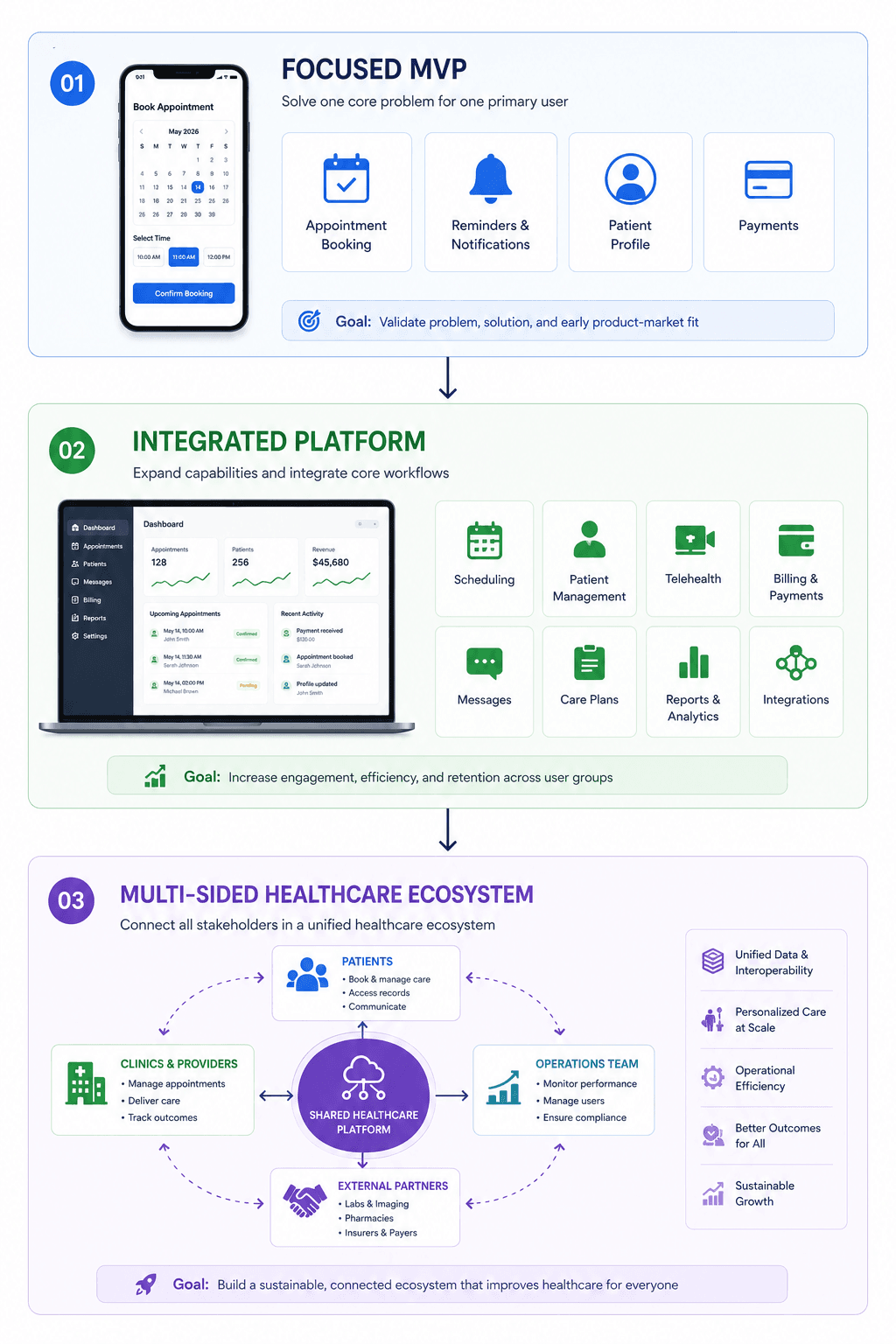
| Area | Focused MVP | Integrated Platform | Enterprise Platform |
|---|---|---|---|
| Patient experience | Core workflow | Expanded journeys | Multi-product ecosystem |
| Clinic tools | Basic | Advanced | Multi-organisation |
| Integrations | One critical connection | Multiple systems | Broad integration layer |
| Telehealth | Optional | Integrated | Advanced workflows |
| AI | Experimental or limited | Targeted workflows | Governed AI infrastructure |
| Operations | Basic dashboard | Dedicated console | Enterprise operations |
| Scale | Early validation | Growth | High-volume infrastructure |
This progression is more useful than starting with a massive feature list.
Build vs Buy: What Should You Develop?
The build-versus-buy decision should be made at the capability level, not the application level.
A company might own:
- Customer experience
- Healthcare workflow design
- Product rules
- Integration orchestration
- Proprietary operational intelligence
While integrating:
- Messaging
- Video infrastructure
- Identity services
- Payment capabilities
- Specialist AI infrastructure
In-House Development
Advantages
- Greater internal ownership
- Long-term technical knowledge
- Direct team control
Limitations
- Higher fixed staffing commitment
- Longer specialist hiring process
Development Partner
Advantages
- Faster access to specialised expertise
- Flexible team composition
- Easier initial scaling
Limitations
- External dependency
- Strong governance is required
Hybrid Model
For many early-stage healthcare products, a hybrid model can work well.
The business retains ownership of:
- Product strategy
- Commercial decisions
- Clinical and operational knowledge
A specialist engineering partner contributes:
- Product design
- Architecture
- Development
- Integrations
- Security engineering
The important question is not simply:
Should we outsource development?
It is:
Which capabilities should the business strategically own?
How Long Does It Take to Build a Healthcare App?
A realistic development process could look like this:
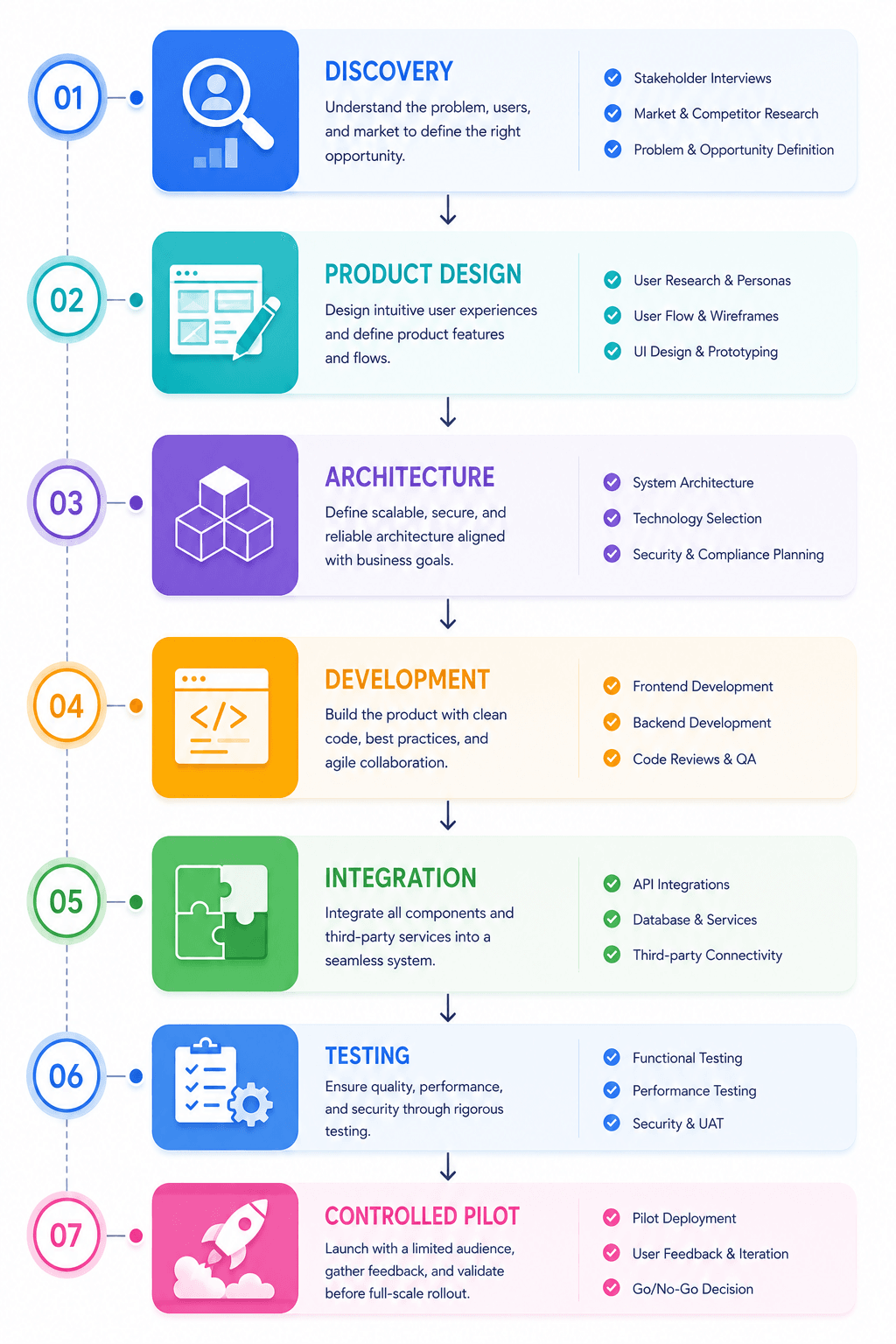
A rough planning model is:
| Phase | Approximate Focus |
|---|---|
| Months 1–2 | Discovery and product definition |
| Months 2–3 | UX, architecture and technical planning |
| Months 3–6 | Core development |
| Months 5–8 | Integration work |
| Months 7–9 | Testing and operational preparation |
| Months 9–12+ | Controlled launch and scaling |
These phases can overlap. The exact timeline depends heavily on product scope and integration complexity.
How Much Does It Cost to Build an App Like HotDoc in Australia?
For planning purposes, the same indicative ranges should be used consistently throughout the project:
| Platform Scope | Indicative Software Development Cost |
|---|---|
| Focused healthcare booking MVP | AUD $80K–$180K |
| Integrated healthcare platform | AUD $180K–$400K |
| Enterprise or multi-sided platform | AUD $400K–$750K+ |
These are indicative software-development planning estimates rather than fixed market prices. The number of screens is not a reliable way to estimate healthcare software development cost.
Integration complexity, workflow rules, security requirements and operational infrastructure can have a much greater impact.
What Affects Development Cost?
| Cost Driver | Typical Impact |
|---|---|
| Patient mobile application | Medium |
| Clinic web portal | Medium–High |
| Telehealth | Medium–High |
| Practice-management integrations | High |
| National digital-health integration | High |
| AI workflows | Medium–High |
| Security engineering | High |
| Operations platform | Medium–High |
Costs Beyond Software Development
The software budget should also be distinguished from the broader cost of operating a healthcare business.
Additional costs may include:
- Legal and privacy advice
- Clinical governance
- Security testing
- Cloud infrastructure
- SMS and email services
- Video usage
- Third-party APIs
- Integration and conformance activities
- Support operations
- Ongoing maintenance
A business should therefore avoid interpreting an AUD $80K–$180K MVP estimate as the total capital required to launch a healthcare company.
How to Control Healthcare App Development Costs
The wrong approach is simply choosing the cheapest development team.
A better approach is reducing unnecessary complexity.
Start With One Clear Workflow
Avoid attempting to solve every healthcare problem in version one.
Validate Integrations Early
Before promising functionality, confirm:
- Technical access
- Integration method
- Commercial requirements
- Data ownership
- Operational dependencies
Use Existing Infrastructure Where It Makes Sense
Not every capability creates competitive advantage.
A company may benefit from integrating established infrastructure for commodity functions while focusing internal investment on the product experience and workflow.
Avoid Premature Enterprise Architecture
Build for credible future growth without creating unnecessary infrastructure complexity on day one.
Healthcare App Trends and Priorities for 2026
The next generation of healthcare platforms is likely to compete less on basic appointment booking and more on how effectively different parts of the healthcare journey connect.
Better Interoperability
Disconnected systems create friction for patients and healthcare organisations.
The long-term opportunity is often not another isolated application but a better connection between existing systems.
Workflow-Focused AI
The strongest AI use cases are likely to support:
- Administrative efficiency
- Information retrieval
- Documentation workflows
- Operational analysis
AI should solve a measurable workflow problem rather than exist as a generic feature.
Digital Healthcare Journeys
Patients increasingly expect continuity between:
- Discovery
- Booking
- Preparation
- Consultation
- Follow-up
The opportunity is to reduce friction across the entire journey.
More Sophisticated Operations
As platforms scale, operational infrastructure becomes increasingly important.
Support teams need to understand what happened, why it happened and which system owns the next action.
This is another reason a healthcare platform should not be designed as a consumer mobile app alone.
Frequently Asked Questions
How Much Does It Cost to Build an App Like HotDoc in Australia?
For planning purposes, a focused healthcare booking MVP may require approximately AUD $80K–$180K in software development investment. A more integrated platform may range from AUD $180K–$400K, while a larger enterprise or multi-sided platform may exceed AUD $400K–$750K+.
These are indicative planning estimates rather than fixed market averages.
How Long Does It Take to Develop a Healthcare Booking App?
A focused MVP may take approximately four to six months, while a larger integrated platform can require six to ten months or more. Complex integrations and compliance requirements can significantly affect the timeline.
Do Healthcare Apps Need Telehealth?
Not necessarily.
Telehealth should be included when it supports the core business model and patient workflow. Adding it without a clear use case can increase complexity without improving the initial product proposition.
Should AI Be Included in a Healthcare App MVP?
Only if AI directly supports the core workflow being validated.
For many products, it is more valuable to validate the patient, clinic and operational workflow before adding advanced AI capabilities.
Is My Health Record Integration Required?
Not for every healthcare application.
The need for integration depends on the product, the information being handled and the intended workflow. Developers considering integration should review the current Australian Digital Health Agency guidance before making architectural commitments.
What Is the Difference Between a Doctor Booking App and a Healthcare Platform?
A doctor booking app primarily focuses on finding and booking appointments.
A healthcare platform can include patient experiences, clinic infrastructure, integrations, telehealth, communications, operational tooling and shared services. The difference is the underlying system required to support the complete workflow.
Final Thoughts
The phrase "build an app like HotDoc" can make the project sound simpler than it actually is.
The real challenge is not reproducing a booking interface.
It is deciding:
- Which healthcare workflow the product will own
- Who the first users are
- Which systems remain the source of truth
- Which integrations are essential
- What belongs in the MVP
- What should be built internally versus integrated
- How the platform will operate after launch
A strong healthcare product strategy starts with those questions before full-scale engineering begins.
Planning a healthcare platform in Australia?
Junkies Coder can help turn a validated concept into a practical product, technical architecture and MVP roadmap, including feature scope, integration requirements, development priorities, timeline and indicative investment before full-scale engineering begins. If you’re exploring your healthcare app development project, our team can help define the right path before development starts.