Enterprise software development company building custom platforms engineered to your operational complexity, compliance requirements and integration architecture.

Built for Scale, Security & Growth
Enterprise-Grade Software Solutions
Empowering awards and recognition to Drive Innovation and Success with our unparalleled expertise and commitment to excellence.
Years of experience
Countries Served
Average cost P/H
Positive Feedbacks
Happy Success Stories
Experts & Engineers
CORE FEATURES
End-to-end enterprise software engineering from domain modeling and compliance architecture to phased delivery, legacy coexistence, and long-term platform evolution support.
Custom Enterprise Platform Development
Enterprise Resource Planning Development
Enterprise Workflow Automation
Enterprise API and Microservices Development
Legacy Enterprise System Modernization
Enterprise Software Consulting and Architecture
Enterprise software projects fail because vendors design for an idealized version of the client organization with clean data, cooperative stakeholders, and no legacy constraints. The PROOF Standard designs for the real organization, complete with its dependencies, compliance obligations, and change management requirements.
System performance under enterprise data volumes, compliance control requirements (GDPR, HIPAA, SOC 2), and uptime SLA targets are defined and documented before any architecture decisions are made.
Every stakeholder group, legacy system dependency, data migration requirement, and organizational change constraint is documented before development begins so complexity is visible and planned for, not discovered mid-project.
All source code, architecture documentation, data models, and integration specifications belong to your organization from contract signing. No components are licensed back to you or held under vendor lock-in arrangements.
Development is structured in phases that deliver business value incrementally while maintaining full operational continuity with existing systems throughout the transition period. No business process is interrupted during development.
Before go-live, a senior architect reviews the system against your organization's five-year growth projections covering user volume, data accumulation, regulatory evolution, and planned capability additions.
Each project in this portfolio required a platform capable of managing complex workflows, multiple user types and live operational data under the load conditions of a trading business.

Industry
Automotive
Platform
Web-Based B2B Marketplace
Location
Dubai, UAE
Outcomes
Scalable B2B Marketplace
SourceVehicle is a vehicle inventory aggregator connecting dealers with global buyers for passenger and commercial vehicles.Junkies Coder builds a scalable B2B marketplace with inventory management, multi-currency transactions, logistics and secure payments.

Industry
Agro Logistics
Technology
Web / IoT / ERP
Location
India
Outcomes
50% Reduction
Vaishnodevi Agro Resources Pvt. Ltd needed a digital tracking system to replace manual agro-logistics processes in Radhanpur, India, covering truck entries, weighbridge, seed processing, lab reporting and dispatch management.
Whether you're looking to develop a digital solution from scratch, scale your current offerings, or fully modernize your system, we are here to help.
OUR EXPERTISE
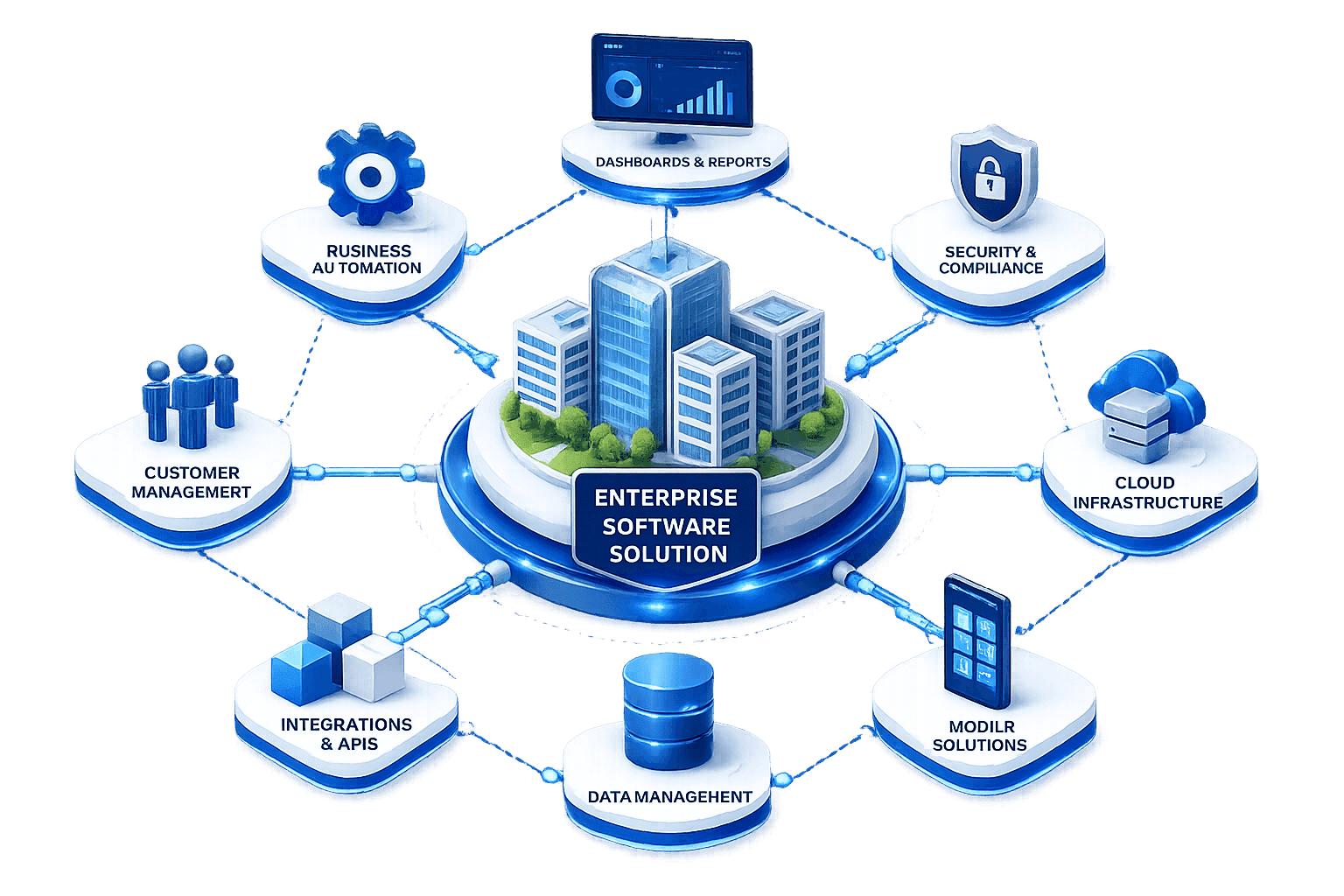
Enterprise software development engineered to match the operational complexity, compliance requirements and integration architecture your business demands, built around your processes rather than a vendor's roadmap.
Design and build scalable, mission-critical enterprise applications tailored to your business workflows, covering ERP, CRM, HRMS, and custom business intelligence platforms from ground up.
Get expert guidance on your IT infrastructure, technology requirements, and digital roadmap, aligning your enterprise software strategy to long-term business goals and maximum ROI.
Re-engineer outdated enterprise systems with modern programming languages, cloud-ready architecture, and containerization, improving performance, security, and scalability without disrupting operations.
Connect your ERP, CRM, IoT platforms, and third-party applications through API, microservices, and cloud-based integration, eliminating data silos and enabling real-time data flow across systems.
Orchestrate end-to-end digital transformation across your enterprise, from application modernization and AI-powered automation to deployment of modern frameworks and cloud migration.
Build centralized, structured data systems using big data, data science, and predictive analytics, transforming fragmented enterprise data into accurate, actionable business intelligence.
We map every legacy dependency, compliance obligation, and stakeholder constraint before any architecture decision is made. Your enterprise software is built for the organization you have today and the scale you are building toward.

Beyond standard development, we bring specialized enterprise capabilities to every engagement, enabling faster delivery, stronger compliance, and measurable business value at each stage.
01
We embed Generative AI, large language models, and core ML pipelines directly into your enterprise software, powering intelligent automation, predictive decision-making, and AI-driven workflow optimization across your business operations.
02
We connect enterprise software with IoT sensor networks, industrial devices, and smart hardware, enabling real-time data ingestion, automated triggers, and live operational visibility across your physical and digital infrastructure.
03
We re-platform legacy enterprise systems onto AWS, Azure, and GCP using Docker and Kubernetes containerization, giving your organization the scalability, resilience, and cost efficiency of cloud-native infrastructure without full application rebuilds.
04
We implement low-code and no-code automation layers for repetitive enterprise workflows, approval chains, and data entry processes, cutting operational overhead and freeing your teams to focus on work that requires human judgment.
05
We design API-first enterprise architectures with decoupled microservices, API gateways, and service mesh configuration, giving your organization the flexibility to integrate new systems, scale individual components, and evolve your platform without full rebuilds.
06
Compliance requirements are engineered into your software architecture from day one, covering data residency controls, consent management, audit logging, access governance, and the technical documentation your legal and compliance teams need.
Our enterprise software development teams bring proven domain knowledge across industries where regulatory compliance, application performance, and data security are critical business requirements.
A structured, repeatable delivery methodology designed for enterprise complexity, where every phase has clear milestones, quality gates, and stakeholder checkpoints that keep programs on time and on budget.
We conduct detailed stakeholder workshops and IT infrastructure assessments to capture functional and non-functional requirements, validating project feasibility before architecture work begins.
Our architects design the complete system blueprint, covering application layers, integration touchpoints, data models, cloud infrastructure topology, and enterprise security controls.
Development proceeds in agile sprints with continuous stakeholder demos and feedback integration, ensuring the enterprise software evolves with real business needs and passes quality gates at every stage.
Every module undergoes rigorous functional, performance, security, and integration testing, including load testing, penetration testing, and UAT cycles before any production deployment.
We manage production deployment with structured hypercare support, SLA-backed incident response, and a comprehensive handover covering documentation, release management, and team knowledge transfer.
Shalehin Modasia
Marketing DirectorENGAGEMENT MODELS
Whether you need end-to-end project delivery, a dedicated development team, or specialized staff augmentation, we offer structured commercial models that align to your enterprise program size, budget, and governance requirements.
Best suited for enterprise software projects with well-defined scope and requirements. We take full delivery ownership, from architecture design and development to QA, deployment, and handover, within agreed timelines and budget.
Get a free consultationA fully managed team of senior enterprise software engineers and architects embedded into your delivery cadence, scaling up or down as program requirements evolve, with no overhead of direct hiring.
Get a free consultationInject specialized enterprise expertise directly into your in-house teams, filling critical skill gaps in application architecture, DevSecOps, cloud migration, data engineering, or system integration.
Get a free consultationReal stories from real partners who experienced clarity, accountability, and measurable business growth.
We work with proven enterprise technologies, selected for stability, long-term vendor support, security patch coverage, and compatibility with complex enterprise integration environments.
Featured Technologies
Angular
Flutter

Laravel
ASP.NET Core
Node.js

React Native

React

Spring Boot
Enterprise software that processes regulated data carries compliance obligations at the architecture layer that cannot be addressed through post-launch patching. Junkies Coder reviews every regulatory requirement applicable to the client's industry and user base during the architecture phase, embeds the necessary controls in the data model, authentication layer and audit logging design, and documents the implementation for the enterprise procurement and compliance audit processes that regulated organisations face.

GDPR
HIPAA

PCI-DSS
SOC2
ISO/IEC 27001
CCPA

WCAG
Enterprise software fails when vendors underestimate the complexity of regulated data environments, legacy system dependencies, and organizational change requirements. We account for all three before the first sprint.
Our architects have designed systems handling multi-tenant data isolation, role-based access hierarchies, cross-departmental workflow orchestration, and audit compliance requirements at scale.
GDPR data residency controls, HIPAA audit logs, SOC 2 access governance, and ISO 27001-aligned practices are built into the system architecture from the design phase, not added after the fact.
Structured stakeholder review gates, change management documentation, and escalation paths keep large organizations aligned throughout development without misaligned expectations.
We design enterprise software to coexist with existing systems during transition periods, with phased data migration strategies and parallel operation support so operations are never interrupted.
Multi-tenant architecture, horizontal scaling, database sharding, and load testing against projected user volumes are built in so capacity planning is not a crisis six months after go-live.
Enterprise engagements are managed by a dedicated account director alongside the technical project manager, with executive-level escalation access and named contacts for every stakeholder.

Enterprise software development is the engineering of software systems designed to serve the operational requirements of large or complex organisations: platforms that manage multiple business functions, support high user concurrency, enforce role-based access controls, integrate with multiple external systems and maintain audit trails that meet regulatory requirements. The scale, compliance obligations and integration complexity of these systems place them in a different engineering category from standard consumer or departmental applications. The differences between enterprise software and standard application development are architectural, not just cosmetic. An enterprise ERP system that processes thousands of transactions per hour across finance, procurement and inventory must be designed for horizontal scalability, database partitioning and query optimisation from the outset. A consumer mobile application can be rebuilt or migrated when it outgrows its original architecture at a manageable cost. Rebuilding an enterprise platform that carries five years of operational data and workflow configuration is a multi-year programme. Compliance requirements in regulated industries create a second category of difference. Healthcare enterprise software must implement HIPAA-compliant data handling at the database, API and application layers simultaneously. Financial services enterprise software must meet PCI DSS requirements at the transaction processing layer and GDPR requirements at the customer data layer independently. These are not features added to a standard application. They are architectural constraints that determine how the system is structured from the first sprint. The third difference is maintenance horizon. Standard applications are built for a two to three year lifecycle before replacement. Enterprise software is built for a five to ten year operational horizon with continuous feature iteration, dependency upgrades and security patching throughout. Junkies Coder engineers enterprise software with this operational horizon in the architecture from the first design decision, not retrofitted when the system reaches a scale the original design did not anticipate.
Junkies Coder develops enterprise software across six primary categories, each requiring distinct architectural approaches and domain knowledge. Custom ERP platforms for organisations that have reached the operational ceiling of commercial ERP solutions. The most common triggers for custom ERP development are multi-entity consolidation requirements that the commercial platform handles through expensive licensed add-ons, manufacturing or inventory workflows specific enough that the standard module structure cannot represent them without significant custom configuration, and compliance reporting requirements that require field-level audit trails the commercial platform does not generate. CRM systems for sales-led organisations whose pipeline structure, territory model and customer lifecycle stages are specific enough that no commercial CRM configuration produces an accurate view of the business without extensive workarounds. This is most common in B2B organisations with long deal cycles, complex multi-stakeholder relationships and post-sale customer success requirements that the commercial CRM handles as separate objects rather than a continuous relationship record. Workforce management platforms for operations with shift scheduling complexity, multi-location staffing, skills-based assignment requirements and labour regulation reporting obligations. Healthcare, logistics, retail and facilities management organisations are the most frequent users of custom workforce management software because the commercial HRMS platforms are designed for office-based knowledge worker workflows. Data management and analytics platforms for organisations where the data volume, query complexity and governance requirements exceed what a generic BI platform or data warehouse service can handle. Clinical trial data management, real-time financial risk calculation and supply chain demand forecasting are three categories where custom data platform development consistently delivers performance that commercial tools do not. Legacy system modernisation, where the goal is not to replace the system but to rebuild it on a maintainable, cloud-ready architecture that preserves the business logic encoded in the original system while eliminating the operational risks of running on unsupported infrastructure. Enterprise mobile and web applications that extend enterprise system functionality to field teams, remote workers and customer-facing operations with the security, audit logging and offline capability that enterprise environments require.
The build vs buy vs configure decision is one of the most consequential choices in any enterprise software engagement, and it is the question that separates an advisory-led engineering partner from an agency that recommends custom development because that is how it earns revenue. Off-the-shelf commercial software is the correct choice when the business process the software needs to support is standard enough that a commercial platform covers it without material configuration, when the organisation does not have a competitive differentiator that depends on how that process works, and when the total cost of the commercial platform over five years is lower than the cost of building and maintaining a custom system. Most finance teams using standard chart of accounts, most HR teams running conventional payroll cycles and most marketing teams running standard email and CRM workflows should use commercial software. Configuration of an existing platform is the correct choice when the organisation already runs on a commercial platform that covers most of its requirements but has specific workflows, reporting needs or integration requirements that can be addressed through configuration and custom modules without rebuilding the core system. This is the most cost-effective path when it is technically viable and when the configuration work does not produce a system so heavily modified that it can no longer be upgraded when the vendor releases new versions. Custom development is the correct choice when the business process the software needs to support is genuinely specific to how that organisation operates and represents a competitive differentiator, when the integration requirements are complex enough that no commercial platform can connect to all of the required systems without significant custom development regardless, or when the compliance requirements of the industry place constraints on how data is stored and processed that commercial platforms do not meet without expensive certified add-ons. Junkies Coder's discovery phase produces a documented build vs buy vs configure recommendation with a total cost of ownership comparison over a five-year horizon before any development contract is signed.
Legacy system modernisation is one of the most technically complex categories of enterprise software engagement because it requires preserving operational continuity and business logic while replacing the platform that carries both. Three primary migration architectures cover the range of scenarios, and the correct choice depends on the system's criticality, the volume of business logic it encodes and the organisation's tolerance for operational risk during the transition. The strangler fig pattern replaces legacy functionality incrementally, routing specific system functions to new components while the legacy system continues to run for the functions not yet migrated. This is the lowest-risk migration architecture for mission-critical systems because the legacy platform remains operational throughout the transition. The risk is timeline: a strangler fig migration of a complex legacy system can take two to four years if the system is large and the business logic is deeply entangled. Parallel-run migration runs the new and legacy systems simultaneously for a defined period, comparing outputs to validate that the new system produces correct results before the legacy system is decommissioned. This architecture is appropriate when the organisation needs confidence that the new system handles every edge case before cutting over, and when the operational cost of running two systems simultaneously for three to six months is acceptable. It is most commonly used for financial and clinical systems where incorrect output has regulatory consequences. Big-bang migration replaces the legacy system in a single cutover event, typically over a maintenance window. This architecture is only appropriate for systems with low operational criticality, well-documented requirements and a new system that has been extensively tested against the full range of the legacy system's inputs. For any system handling financial transactions, clinical data or real-time operational decisions, big-bang migration introduces unacceptable risk. Junkies Coder's legacy modernisation engagements begin with a system inventory that classifies each function by criticality, documents the business logic, and recommends a migration architecture with a rationale before development begins.
Enterprise software development cost is determined by four primary factors: the number and complexity of system modules, the user concurrency and data volume requirements the system must handle, the compliance architecture requirements specific to the industry, and the number and complexity of integrations with existing systems. Understanding what drives cost in each category is more useful than a headline range. Departmental enterprise tools covering a focused function for a defined user group of 20 to 100 users typically require USD 40,000 to USD 120,000. This includes a dedicated dashboard or workflow application, a backend API, authentication and role-based access controls, one to three third-party integrations and a 12-week to 20-week delivery timeline. The most common examples are internal reporting platforms, approval workflow systems and operational monitoring dashboards. Enterprise platform builds covering multiple business functions with concurrent user loads of 100 to 1,000 users, complex data models and five to ten system integrations typically require USD 150,000 to USD 500,000. The delivery timeline for this category is 6 to 12 months. ERP modules, mid-market CRM platforms and workforce management systems for logistics or healthcare organisations fall in this range. Mission-critical enterprise systems serving more than 1,000 concurrent users, requiring real-time data processing, multi-region infrastructure, extensive compliance architecture and integration with more than ten external systems represent investments above USD 500,000, scoped after a paid discovery phase. Financial trading platforms, clinical data management systems and supply chain orchestration platforms are in this category. The most frequently underestimated cost driver in enterprise software engagements is compliance architecture. Adding HIPAA-compliant data handling to a healthcare platform after the architecture is set costs three to five times more than designing for it at the outset. Junkies Coder's discovery phase identifies every compliance requirement before the development contract is signed so the architecture reflects the full scope from the first sprint.
Enterprise software development timeline is determined by the scope of functional requirements, the number of modules, the integration complexity and the compliance validation required before production deployment. Compressing this timeline below the minimum required for each phase produces defects that cost more to fix in production than the time saved in development. Focused departmental tools with well-defined requirements typically require 10 to 20 weeks from discovery sign-off to production deployment. Timeline breakdown: discovery and architecture in weeks one and two, UI and data model design in weeks two through four, core feature development in weeks four through twelve, integration testing in weeks twelve through fifteen, compliance review and load testing in weeks fifteen through eighteen, and production deployment with monitoring configuration in weeks eighteen through twenty. Enterprise platform builds covering multiple modules with complex data models and multiple system integrations typically require 6 to 12 months. Each additional module adds discovery time at the front of the engagement and integration testing time at the back. Compliance-heavy platforms, such as those requiring HIPAA certification or SOC 2 audit preparation, add 4 to 8 weeks of security review and documentation to the testing phase. Mission-critical platform builds requiring multi-region infrastructure, high-availability architecture and extensive load testing under peak concurrency require 12 to 24 months for the initial production release. These engagements include a phased delivery model where functional modules go to production before the full platform is complete, reducing the business risk of a single large-scale launch. The most common timeline risk in enterprise software development is scope expansion during the design phase, where functional requirements that were not visible in the initial discovery become apparent when the UI and data model are defined in detail. Junkies Coder's discovery phase is structured to surface these requirements before the development contract is signed, not after the first sprint. A second timeline risk specific to regulated industries is the lead time for compliance review and penetration testing by external assessors. For platforms requiring a third-party security assessment before launch, Junkies Coder's delivery plan schedules the assessment 6 to 8 weeks before the target launch date to create buffer for the remediations that security assessments typically generate.
Enterprise software quality assurance covers four distinct testing categories that standard application testing does not address with the same depth. Each category addresses a different failure mode that matters at enterprise scale. Functional testing validates that every user workflow, business rule and edge case produces the correct output. For enterprise software, functional testing coverage must extend to the failure scenarios, the boundary conditions and the permission model edge cases that will occur in production but rarely appear in standard happy-path testing. Junkies Coder's QA team writes functional test cases from the business requirements document, not from the implemented code, so tests validate what the system is supposed to do rather than what the engineer built. Integration testing validates that data flowing between the enterprise system and each connected external system is accurate, correctly transformed and correctly handled when the external system returns errors or unexpected responses. Every integration Junkies Coder builds is tested against documented failure scenarios: what happens when the external API is unavailable, returns a schema change or rejects an authentication token. Performance and load testing validates that the system meets its response time, throughput and concurrency requirements under the peak load conditions the business will actually experience. For enterprise systems, this means testing under the concurrency of the busiest business period, not the average day. A financial reporting system that performs correctly with 50 concurrent users but degrades below acceptable response times with 500 concurrent users on quarter-close day will fail when the business most needs it. Security testing for enterprise software includes automated static analysis scanning using SonarQube to identify vulnerabilities in the application code, dependency scanning to identify known vulnerabilities in third-party libraries, and for regulated-industry platforms, manual penetration testing by an external security assessor before production deployment. The penetration test scope covers authentication bypass, injection vulnerabilities, privilege escalation paths and data exposure scenarios specific to the compliance framework the system operates under.
The post-launch period for enterprise software is operationally distinct from the post-launch period for consumer applications. Enterprise systems carry business-critical data and operational workflows that cannot tolerate unplanned downtime, and they operate in technical environments that change continuously as operating systems, browsers, cloud infrastructure and third-party dependencies release updates. The post-launch maintenance model must account for all of this proactively. Dependency and framework updates: Enterprise software built on Node.js, Java, .NET or Python runtimes requires planned dependency updates on a scheduled cycle to address security vulnerabilities published in third-party libraries. Junkies Coder's post-launch programme schedules dependency reviews quarterly, with emergency patching for critical security vulnerabilities published between scheduled reviews. Clients receive a documented change log for every dependency update deployed to production. Cloud infrastructure management: Enterprise platforms hosted on AWS, Azure or Google Cloud require ongoing infrastructure management as cloud providers deprecate services, change pricing models and release new service versions that require migration. Junkies Coder's infrastructure management service covers the monitoring, capacity planning and service migration work that keeps the platform running at its designed performance and cost profile. Performance regression monitoring: Enterprise systems that perform correctly at launch can degrade as data volume grows, as query patterns change and as the number of connected systems increases. Junkies Coder configures Prometheus and Grafana monitoring dashboards at launch with alert thresholds calibrated to the system's production performance baseline, so degradation is detected and diagnosed before users report it. Feature iteration: Enterprise software serves organisations whose requirements evolve as the business grows. Junkies Coder clients engage sprint-based feature iteration under the same delivery structure as the initial build, with each feature addition scoped through a mini-discovery process that assesses its impact on the existing architecture before development begins. This prevents feature additions from introducing technical debt that degrades the system's long-term maintainability.
Starting an enterprise software development engagement begins with a requirements mapping consultation, a structured working session where Junkies Coder's enterprise software architects review the operational problems the organisation needs the software to solve, the systems it must connect to, the users it must serve and the compliance obligations it must satisfy. The consultation is not a discovery phase. It is a preliminary conversation that determines whether the engagement makes commercial sense before either party commits time to a formal scope. Junkies Coder's architects assess whether the requirements point toward custom development, platform configuration or a hybrid approach, and provide an honest assessment of the cost and timeline range before any engagement structure is agreed. For engagements that proceed, the formal discovery phase runs for 2 to 4 weeks depending on system complexity. This phase produces the enterprise software architecture document: system component diagram, data model, API contract per integration, security and compliance requirements mapped to architecture decisions, and a phased delivery plan with milestone deliverables. The discovery phase deliverables are owned by the client regardless of whether the development engagement proceeds. Clients with an urgent requirement, a system cutover with a hard deadline or a compliance audit driving a specific software requirement can begin an accelerated assessment within 48 hours of initial contact. Contact the Junkies Coder team at junkiescoder.com to schedule the requirements mapping consultation. Engagements are acknowledged within two business hours. The team assigned to the consultation includes an enterprise solutions architect with delivery experience in your industry and a lead engineer familiar with the technology stack the system must integrate with.
We serve fintech, healthtech, logistics, manufacturing, retail, legal, and regulated government sectors each engagement built with industry specific compliance requirements, integration standards, and domain logic embedded into the software architecture from the ground up.