- A Careem-like app can cost $30,000–$60,000 for an MVP and $300,000–$500,000+ for a full platform.
- Major costs include real-time tracking, dispatch, payments, integrations, security and backend infrastructure.
- The platform needs rider, driver and admin systems connected through a real-time backend.
- Flutter or React Native can reduce duplicated development across platforms.
- AI can support demand forecasting, matching, ETA prediction, fraud detection and customer support.
- A future-ready architecture should include modular services, APIs, observability, security and scalable data.
- Ongoing costs include cloud, maps, payments, monitoring, maintenance and AI usage.
- Development can take 3–4 months for an MVP and 12–18+ months for a full super app.
- Choose developers based on real-time systems, backend, payments, AI, security and regulatory experience.
- Future mobility will increasingly involve AI, EVs, autonomous mobility, voice interfaces and Mobility-as-a-Service.
- Start with a focused MVP while keeping the architecture secure, maintainable, observable and adaptable.
Building an app like Careem in 2026 is not a single fixed-cost project. A focused ride-hailing MVP requires a very different level of engineering than a multi-city mobility platform with real-time dispatch, AI, payments, driver operations, safety systems and additional services.
For planning purposes, a basic Careem-style MVP can start around $30,000–$60,000, while a more advanced ride-hailing platform can move into the $100,000–$300,000+ range. A full multi-service super app with food delivery, payments, loyalty, corporate services and AI-driven operations can exceed $500,000, depending on scope, integrations, compliance and infrastructure.
The final cost depends less on the number of screens and more on the technology operating behind them: real-time location, dispatch logic, payment workflows, third-party integrations, security, analytics, AI models and operational dashboards.
What Changes the Cost of a Careem-Like App in 2026?
The cost of a Careem-like application is primarily shaped by its platform architecture, real-time infrastructure and operational complexity, rather than the rider interface alone.
| Platform Type | Estimated Cost | Typical Scope |
|---|---|---|
| Focused Ride-Hailing MVP | $30,000–$60,000 | Rider app, driver app, admin panel, booking, GPS, basic payments and dispatch |
| Standard Ride-Hailing Platform | $60,000–$150,000 | Real-time tracking, advanced dispatch, driver verification, ratings, analytics and multiple integrations |
| Advanced AI-Enabled Platform | $150,000–$300,000+ | AI-assisted matching, demand forecasting, ETA intelligence, fraud detection and advanced operations |
| Multi-Service Super App | $300,000–$500,000+ | Ride-hailing plus delivery, wallet, loyalty, corporate services and multi-city architecture |
These are planning ranges rather than fixed market prices. Multiple cities, complex dispatch rules, local payment systems, AI capabilities, corporate accounts, loyalty, delivery and wallet functionality can substantially increase both development and operational costs.
Core Ecosystem Architecture
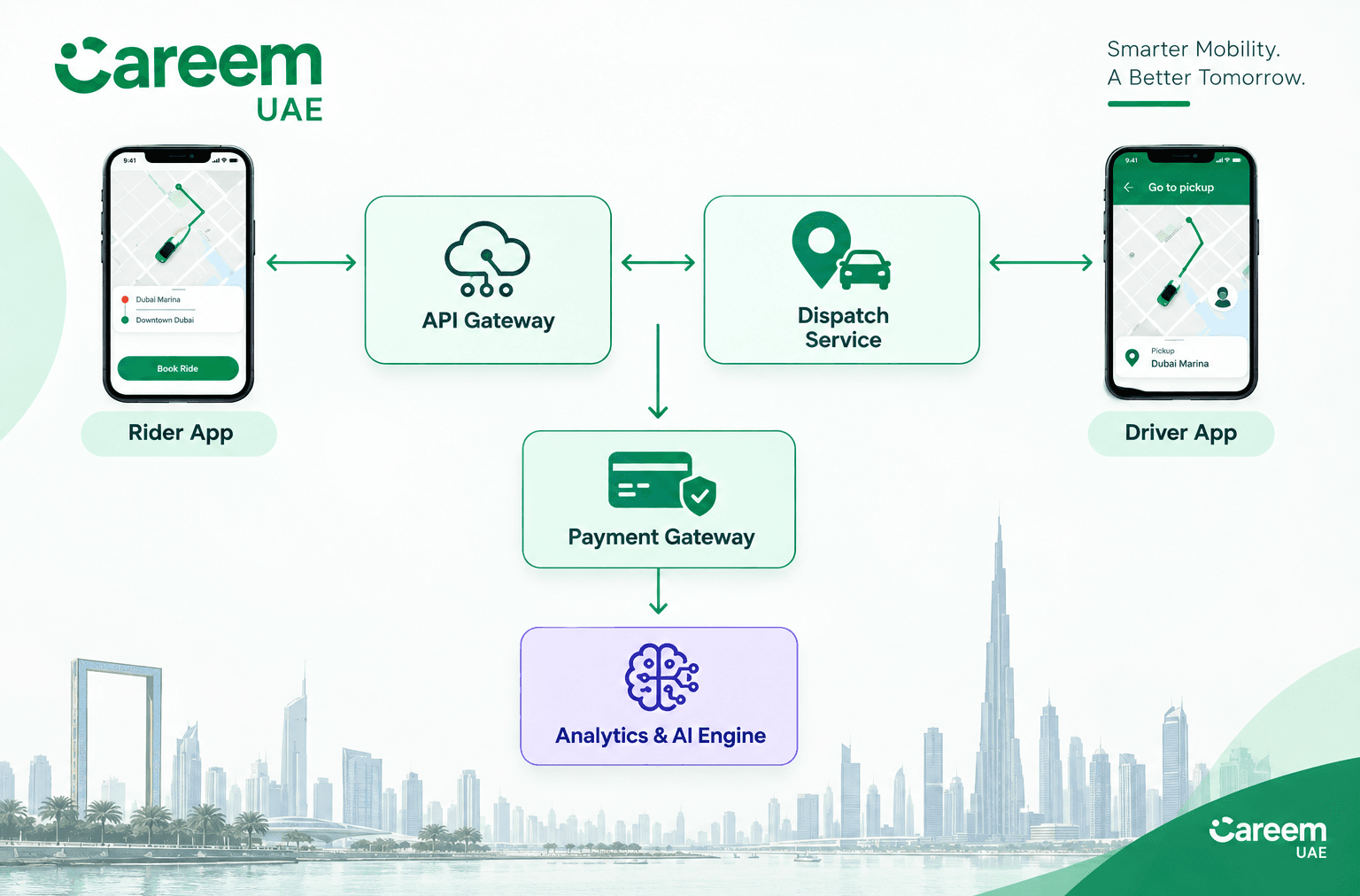
A Careem-like platform is not a single mobile application. It is a connected ecosystem in which rider, driver and administrative interfaces communicate with a central backend and real-time services.
The architecture typically consists of three primary interfaces.
Passenger (Rider) App
The rider application is responsible for onboarding, location access, ride discovery, booking, payment, live tracking and post-trip interactions.
Core Features
- User registration and profiles: OTP signup, social login and profile management
- Live location tracking: Real-time GPS positioning with map integration
- Ride booking: Instant and scheduled rides with vehicle-category selection
- Fare estimator: Upfront fare calculation based on distance, time and vehicle type
- Multiple payment methods: Cards, digital wallets and supported local payment methods
- Live driver tracking: Real-time vehicle location and ETA updates
- Driver ratings and reviews: Post-trip feedback and rating workflows
- Multi-language support: Arabic, English and other target-market languages
- In-app chat and calling: Rider-driver communication during the trip
- Customer support: Live chat, ticketing and help-centre workflows -Emergency SOS: Safety controls and emergency-contact workflows -Promos and offers: Discount codes and campaign management
- Trip history: Previous rides, receipts and expense records
- Wallet: Stored-value or wallet functionality where supported
Indicative Cost A rider application with this level of functionality may represent approximately $18,000–$28,000 of development effort.
However, this should not be added directly to the driver and admin estimates to calculate the complete project cost. Development workstreams overlap across design, backend engineering, QA, DevOps, integrations and shared services.
Driver App
The driver application requires persistent location capabilities, trip-request handling, navigation, availability management and earnings information.
Core Features
- Trip requests: Accept and decline controls with real-time dispatch
- Turn-by-turn navigation: Integration with mapping and navigation services
- Earnings dashboard: Daily, weekly and monthly earnings
- Availability toggle: Online and offline status control
- Document upload: Driver licence, vehicle registration and insurance verification
- Driver ratings: Passenger feedback and performance metrics
- Trip history: Completed rides, earnings and ratings
- Push notifications: Ride alerts, operational messages and updates
- Background location: GPS reporting during active trips
- Multi-vehicle support: Support for different vehicle categories where required
Indicative Cost A driver application with these capabilities may represent approximately $15,000–$25,000 of development effort, depending on navigation, background-location requirements, integrations and platform-specific functionality.
Platform Architecture
Admin Dashboard
The administrative platform provides the operational controls required to manage drivers, riders, trips, pricing, safety, payments and regional expansion.
Core Features
- Live dispatch map: Real-time vehicle and trip monitoring
- Driver onboarding and verification: Document-review workflows
- Fare and surge settings: Dynamic pricing and zone-based configuration
- Commission and payout management: Driver settlement and commission rules
- User and driver dispute management: Support, refunds and issue resolution
- Analytics and reporting: Trips, revenue, driver performance and operational metrics
- Corporate accounts: Business ride management and invoicing
- Multi-city support: Regional configuration and expansion controls
- Safety monitoring: SOS alerts and incident management
Indicative Cost An administrative dashboard may represent approximately $10,000–$20,000 of development effort, depending on the number of operational workflows, roles, reporting requirements and integrations.
Important: These component-level figures are indicative planning estimates. They should not be added together to calculate the total project price because common backend services, design, QA, DevOps and integration work are shared across the platform.
What Makes a Careem-Like App More Expensive Than a Standard Mobile App?
A ride-hailing platform is considerably more complex than a conventional booking or e-commerce application because multiple systems must operate simultaneously.
A typical trip may require the rider application to request a ride, the backend to identify eligible drivers, the driver application to receive the request, the mapping layer to calculate location and ETA information, the dispatch system to manage assignment, the payment system to process the transaction and the notification layer to keep both parties updated.
Case Study: A Dubai-based startup built a ride-hailing MVP for $45,000 in 4 months, then expanded to food delivery after 12 months with an additional $120,000 investment
This creates several cost-intensive engineering areas:
- Real-time location and trip tracking
- Driver-rider matching and dispatch
- Route and ETA calculation
- Background GPS processing
- Payment and wallet workflows
- Driver onboarding and verification
- Pricing and commission rules
- Safety and emergency workflows
- Real-time notifications and communication
- Admin analytics and operational controls
- Fraud detection and account security
- Multi-city and multi-service architecture
The larger development cost therefore comes from the real-time backend, integrations, reliability requirements and operational logic supporting the application, rather than simply the number of screens.
Modern Tech Stack for a Careem-Like App in 2026
For many startups and product teams,Flutter or React Native can reduce duplicated mobile development effort by allowing a substantial portion of the application code to be shared across iOS and Android.
However, cross-platform development does not eliminate the need for native engineering. Native modules can still be appropriate when the product depends heavily on background location, advanced mapping, vehicle connectivity, device-level capabilities or platform-specific integrations.
The technology stack should therefore be selected around the product's operational requirements rather than following a single framework trend.
Technology Stack Overview
| Layer | Recommended Technologies | Purpose |
|---|---|---|
| Mobile Frontend | React Native + Expo or Flutter | Shared iOS and Android application development |
| UI/UX Design | Figma and AI-assisted design tools | Prototyping, design systems and interface development |
| Backend & Database | PostgreSQL, Supabase or Firebase | Data management, authentication and application services |
| Backend Framework | Node.js, Django or Python/FastAPI | API development and backend business logic |
| Real-Time Communication | WebSockets, Socket.io | Live GPS tracking, dispatch updates and chat |
| Geospatial Processing | Google Maps, Mapbox or HERE Maps | Routing, geocoding, location and navigation services |
| Payment Gateway | Stripe, Adyen, HyperPay, PayTabs or Telr | Card payments, wallets and payment workflows |
| Cloud Infrastructure | AWS, Google Cloud or Vercel | Application hosting, compute, storage and deployment |
| Caching & Real-Time Data | Redis | Low-latency caching, session data and high-frequency operations |
| AI & Analytics | Python, TensorFlow, OpenAI API or Anthropic Claude API | Forecasting, intelligent automation and AI-assisted operations |
| DevOps & CI/CD | GitHub Actions, Docker, Kubernetes or Jenkins | Automated testing, deployment and infrastructure management |
The final stack depends on the expected trip volume, geographic coverage, real-time requirements, security model, integrations and engineering team.
Why Cross-Platform Development Can Reduce Development Effort
Flutter and React Native can be useful for a Careem-style product when the goal is to maintain a shared application layer across iOS and Android.
A shared codebase can reduce duplicated mobile development work and simplify ongoing maintenance. However, it should not automatically be treated as a fixed 30–40% saving because the actual impact depends on the product architecture and how much platform-specific functionality is required.
Native modules may still be required for capabilities such as:
- Advanced background location
- Platform-specific navigation
- Bluetooth or vehicle integrations
- Apple CarPlay or Android Auto
- High-performance mapping
- Device-level security features
- Platform-specific payment or identity workflows
For a production ride-hailing platform, a practical architecture can combine cross-platform application development with native modules wherever platform capabilities or performance requirements justify them.
AI Features That Can Influence Careem-Like App Development Cost
AI can add significant value to a ride-hailing platform, but not every AI capability needs to be included in the first release.
Instead of treating AI as a single feature, it is more useful to divide it into operational intelligence, predictive systems and customer-facing automation.
Demand Forecasting
Historical trip data, location patterns, traffic conditions and time-based demand can be analysed to identify areas where driver supply may become insufficient.
A demand forecasting system can support:
- Supply planning
- Driver allocation
- Peak-period preparation
- Zone-level demand analysis
- Operational decision-making
The development effort depends on data quality, model complexity, infrastructure and the level of automation required.
Intelligent Driver-Rider Matching
Matching does not necessarily need to rely only on geographic distance.
Depending on the available data and business rules, the system can consider:
- Estimated driver arrival time
- Vehicle type
- Driver availability
- Driver location
- Operational constraints
- Trip characteristics
- Historical performance data
This can make the dispatch engine more sophisticated than a simple nearest-driver algorithm.
ETA Prediction
Machine-learning models can supplement conventional routing systems by using historical and real-time trip data to improve estimated arrival times.
Potential applications include:
- More accurate pickup estimates
- Improved drop-off predictions
- Better driver route planning
- More useful rider notifications
- Improved dispatch decisions
Fraud and Anomaly Detection
AI and statistical models can help identify unusual booking patterns, suspicious accounts, payment anomalies or abnormal trip behaviour for further investigation.
The system can flag patterns such as:
- Repeated suspicious transactions
- Unusual account behaviour
- Abnormal booking activity
- Potential payment anomalies
- Unusual trip patterns
High-risk actions should remain subject to appropriate business rules and human review.
AI Customer Operations
AI agents can assist with common support workflows such as trip-status questions, cancellation explanations, refund requests and support-ticket classification.
Potential use cases include:
- Automated support responses
- Refund-request routing
- Trip dispute classification
- Sentiment analysis
- Support-ticket summarisation
- 24/7 customer assistance
For more sensitive actions, AI should operate within predefined rules, permissions and human-approval workflows.
What Determines AI Development Cost?
AI cost should not be estimated simply by counting AI features.
The actual engineering effort depends on:
- Available historical data
- Data quality and structure
- Model requirements
- API or model selection
- Integration complexity
- Infrastructure
- Monitoring
- Model evaluation
- Human-review workflows
- Security and privacy requirements
How to Make a Careem-Like App Future-Ready
A ride-hailing product should not be architected only for its first launch.
If the roadmap includes multiple cities, delivery, payments, corporate mobility or other services, the initial architecture needs enough modularity to support those additions without requiring a complete rebuild.
A future-ready architecture should include:
- Modular service boundaries so new capabilities can be introduced independently
- API-first architecture for mobile applications, admin systems and third-party integrations
- Event-driven workflows for trip updates, notifications, payments and operational events
- Observability across APIs, databases, dispatch services and mobile applications
- Feature flags for controlled rollout of new functionality
- Scalable data architecture for growing trip, location and transaction volumes
- Role-based access control for riders, drivers, operations teams and administrators
- Privacy-by-design for location and personal data
- Automated CI/CD for safer and more frequent releases
- AI-ready data pipelines so future predictive systems can use structured operational data
This architecture can increase initial engineering effort, but it can also reduce the need for major restructuring as the platform expands into new cities, services and AI capabilities.
Careem-Like App Development Cost by Complexity in 2026
| App Type | Estimated Cost | Typical Scope |
|---|---|---|
| Focused Ride-Hailing MVP | $30,000–$60,000 | Rider app, driver app, admin panel, booking, GPS, basic payments and dispatch |
| Standard Ride-Hailing Platform | $60,000–$150,000 | Real-time tracking, advanced dispatch, driver verification, ratings, analytics and multiple integrations |
| Advanced AI-Enabled Platform | $150,000–$300,000+ | AI-assisted matching, demand forecasting, ETA intelligence, fraud detection and advanced operations |
| Multi-Service Super App | $300,000–$500,000+ | Ride-hailing plus delivery, wallet, loyalty, corporate services and multi-city architecture |
These figures are planning ranges rather than fixed quotations. Actual project pricing depends on product scope, development team location, integrations, compliance requirements, third-party services, infrastructure and post-launch support.
Why These Costs Can Increase
The initial development estimate does not necessarily represent the complete cost of operating the platform.
A production ride-hailing application may also require spending on:
- Cloud infrastructure
- Maps and geolocation APIs
- SMS and OTP services
- Payment processing
- Monitoring and analytics
- Customer-support infrastructure
- Security testing
- App-store and developer accounts
- Compliance and legal work
- Ongoing maintenance
- AI model and API usage
- Driver onboarding and operational systems
For this reason, the development budget should be separated from the ongoing operating budget when planning a Careem-like business.
Compliance Should Be Estimated as a Requirement, Not a Fixed Development Fee
Regulatory requirements can affect architecture, workflows, integrations and launch timelines. They should therefore be considered during product planning rather than treated as a universal fixed development cost.
For a Dubai-focused ride-hailing platform, the applicable transport regulations, licensing requirements and integration requirements should be confirmed with the relevant authorities and qualified local advisers before development and budgeting.
Similarly, privacy and data-protection requirements should be translated into concrete engineering work such as:
- Data encryption
- Access controls
- Consent and privacy workflows
- Data retention rules
- Audit logging
- Secure API design
- Incident-response processes
- Vendor and third-party risk controls
This approach creates a more realistic cost model than assigning one generic "compliance" fee to every project.
Development Timeline
The timeline to build an app like Careem depends on scope, complexity, integrations and team size.
Typical Development Phases
| Phase | Duration | Activities |
|---|---|---|
| Discovery & Planning | 2–4 weeks | Requirements, product planning, architecture and technology selection |
| UI/UX Design | 4–8 weeks | Wireframes, prototypes, user flows and design system |
| MVP Development | 12–16 weeks | Rider app, driver app, admin panel, backend and core integrations |
| AI Integration | 4–8 weeks | Predictive models, intelligent dispatch or AI support capabilities |
| Testing & QA | 4–6 weeks | Functional, performance, security and user-acceptance testing |
| Regulatory & Integration Readiness | 4–8 weeks | Required approvals, third-party integrations and compliance-related implementation |
| Launch & Deployment | 2–4 weeks | Store submission, production deployment and monitoring setup |
These phases can overlap. A project should therefore not be estimated by simply adding every duration together.
Total Timeline by Complexity
- Basic MVP: 3–4 months
- Mid-Level Platform: 5–7 months
- Advanced AI-Powered Platform: 8–12 months
- Full Super App: 12–18+ months
The actual timeline can change significantly when a project includes multiple payment providers, regulatory integrations, complex dispatch rules, multiple countries or additional services.
How to Evaluate a Mobile App Development Company for a Careem-Like Product
For a Careem-like product, evaluating a development company requires looking beyond a portfolio of ordinary mobile applications.
The more relevant question is whether the team can demonstrate experience with the architecture, infrastructure and operational systems required by a real-time mobility platform.
Look for evidence of:
- Real-time location and dispatch experience
- Multi-sided platform development
- Flutter/React Native and native development capability
- Backend and API architecture expertise
- Payment and wallet integrations
- Cloud and DevOps capabilities
- AI/ML implementation experience
- Security and privacy engineering
- QA and performance testing
- Post-launch monitoring and maintenance
- Regional regulatory and integration experience
A useful evaluation should include technical architecture discussions, relevant case studies, integration experience, testing processes and post-launch support rather than relying only on company rankings or directory listings.
Future of Careem-Like Apps: 2026–2030
The next stage of ride-hailing development is moving beyond basic booking and GPS tracking toward intelligent mobility infrastructure.
AI-Assisted Mobility Operations
Demand forecasting, intelligent dispatch, ETA prediction and fraud detection can increasingly support operational decision-making.
The role of AI is likely to expand from isolated features toward systems that continuously analyse operational data and assist human teams.
Autonomous and Semi-Autonomous Mobility
As autonomous mobility develops, ride-hailing platforms may need architecture capable of supporting new vehicle types, fleet-management systems and external mobility services.
This makes flexible fleet and vehicle-management architecture increasingly relevant for long-term platforms.
EV and Sustainable Mobility
Electric-vehicle categories can introduce new requirements around vehicle attributes, charging-location data, battery information and fleet management.
A mobility platform designed for future expansion may therefore need to accommodate more than conventional fuel-powered vehicles.
Voice-First Ride Booking
Voice interfaces can allow users to search, book, modify and track rides without navigating multiple screens.
For example, a rider could use conversational interaction to request a ride, confirm a destination or ask about an active trip.
Agentic Customer Operations
AI agents can eventually handle multi-step support workflows rather than simply answering FAQs.
For example, an agent could understand a trip issue, retrieve the relevant booking information, identify the applicable policy and prepare the next action.
Higher-risk actions should remain subject to human approval, permissions and predefined business rules.
Mobility-as-a-Service
Longer-term mobility platforms can connect ride-hailing with:
- Public transport
- Delivery
- Micromobility
- Parking
- EV charging
- Digital payments
- Corporate mobility
This creates an opportunity to evolve from a ride-booking application into a broader mobility ecosystem.
The key architectural requirement is therefore not simply adding more features. It is creating a platform that remains secure, maintainable, observable and adaptable as mobility services evolve.
FAQs: Building an App Like Careem in 2026
How much does it cost to build an app like Careem in 2026?
A focused ride-hailing MVP can start around $30,000–$60,000, while a standard platform can move into the $60,000–$150,000 range. Advanced AI-enabled platforms can reach $150,000–$300,000+, while broader multi-service platforms can exceed $500,000 depending on scope, integrations, infrastructure and operational requirements.
How long does it take to develop a ride-hailing app like Careem?
A basic MVP may take around 3–4 months, a mid-level platform around 5–7 months, an advanced AI-powered platform around 8–12 months, and a broader super app can require 12–18+ months.
The timeline depends on integrations, team size, platform complexity and regulatory requirements.
What are the core features required for a ride-hailing app?
The core ecosystem generally includes a rider app, driver app and admin platform, supported by real-time GPS, booking, dispatch, payments, notifications, driver management, trip history, analytics and safety workflows.
Advanced capabilities such as AI forecasting, intelligent matching and fraud detection can be introduced as the platform matures.
What tech stack is recommended for building a Careem-like app in 2026?
A possible stack includes Flutter or React Native for mobile development, Node.js, Django or FastAPI for backend services, PostgreSQL/Supabase or Firebase for data services, Google Maps, Mapbox or HERE for geospatial functionality, payment platforms such as Stripe, Adyen, HyperPay or PayTabs, and AWS or Google Cloud for infrastructure.
The final stack should be selected according to performance, scale, integrations, security and regional requirements.
What regulatory requirements apply to a ride-hailing app in Dubai?
Ride-hailing operations in Dubai are subject to applicable transport regulations, licensing and integration requirements. These requirements should be confirmed with the relevant authorities and qualified local advisers before launch because the applicable obligations depend on the operating model and services being offered.
Can I start with an MVP and expand to a super app later?
Yes. A product can begin with a focused ride-hailing experience and later expand into services such as delivery, payments, loyalty or corporate mobility.
The important architectural consideration is to establish modular service boundaries, scalable APIs, structured data and reusable backend services from the beginning so future expansion does not require rebuilding the entire platform.
What are the ongoing costs of operating a ride-hailing app?
Ongoing costs vary significantly based on trip volume, cloud infrastructure, map usage, payment processing, SMS/OTP volume, customer support, monitoring, security, maintenance and AI usage.
These operating expenses should be planned separately from the initial product-development budget.
How do I choose a mobile app development company for a Careem-like product?
Evaluate whether the company has relevant experience with real-time location, dispatch systems, multi-sided platforms, payment integrations, cloud infrastructure, AI/ML, security, QA, DevOps and post-launch operations.
It is also useful to assess how the team approaches architecture, scalability, testing, monitoring and regional integrations before selecting a development partner.
What AI features should I include in a 2026 ride-hailing app?
Potential AI capabilities include demand forecasting, intelligent driver-rider matching, ETA prediction, fraud and anomaly detection, customer-support automation and operational analytics.
Not every capability needs to be included in the first release. AI should be prioritised according to available data, business value, technical readiness and operational requirements.
Can I build a ride-hailing app with a limited budget?
Yes. A focused MVP can reduce the initial scope to essential capabilities such as rider booking, driver management, GPS tracking, basic dispatch, payments and an operational dashboard.
Cross-platform development can also reduce duplicated mobile development effort. More advanced AI, multi-city functionality, delivery, loyalty and other services can be introduced as the product gains users and operational data.
Is the cost of building a Careem-like app the same as hiring mobile app developers?
No. Developer hiring cost refers to the salary, hourly rate or engagement cost of the people building the product.
The total application-development cost can also include UI/UX design, mobile development, backend engineering, real-time infrastructure, APIs, maps, payments, AI, security, QA, DevOps, compliance-related work and deployment.
For a Careem-like platform, the project budget should therefore be evaluated separately from the cost of hiring individual developers.
Conclusion
Building an app like Careem in 2026 requires more than recreating a ride-booking interface. The core investment is in the infrastructure behind the experience: real-time location, dispatch, payments, driver operations, security, analytics, integrations and scalable backend services.
A focused ride-hailing MVP can be developed within a substantially smaller budget, while AI-powered features, multiple cities, advanced operational systems and additional services can push the project into significantly higher development ranges.
The most useful cost-planning approach is to separate three budgets from the beginning:
- Product development - design, mobile applications, backend, APIs and integrations. -** Advanced capabilities** - AI, real-time intelligence, fraud detection, analytics and automation.
- Ongoing operations - cloud infrastructure, maps, payment processing, monitoring, maintenance and support.
Starting with a focused MVP while designing the underlying architecture for future expansion allows the product to evolve toward a broader mobility or super-app ecosystem without requiring every advanced feature to be built on day one.
The long-term goal should be an application architecture that remains secure, maintainable, observable and adaptable as the product, technology and mobility ecosystem evolve.