
Introduction
Let me be direct about something most outsourcing articles avoid saying clearly.
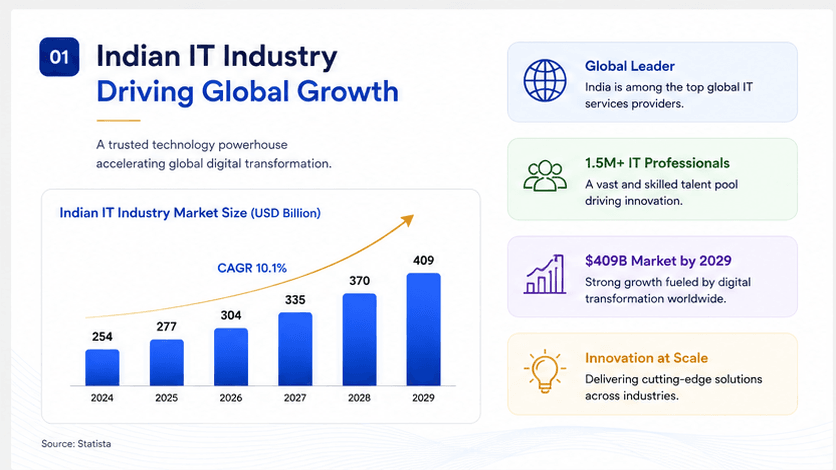
The conversation about Indian IT companies versus US software firms stopped being a cost debate a long time ago. Businesses in Helsinki, Budapest, Toronto, and Singapore are not choosing Indian technology partners because they want to save money. They are choosing them because they cannot find equivalent engineering depth, technology breadth, and delivery speed anywhere else at any price.
I have spent more than a decade reviewing technology partnerships across markets. The pattern is consistent: companies that initially approach Indian IT firms looking for a budget option end up staying because of the quality. The cost advantage is real, Indian vendors deliver complex digital transformations at 40 to 60 percent lower cost than equivalent onshore teams, but that is almost a side benefit at this point.
Technology has become the core growth driver for businesses of every size. Startups need mobile products built fast. Mid-market companies need legacy systems replaced before they become liabilities. Enterprises need AI integrated into workflows that were designed before machine learning existed. Finding reliable partners who can handle all of that, across compliance requirements, time zones, and industry contexts, is genuinely hard.
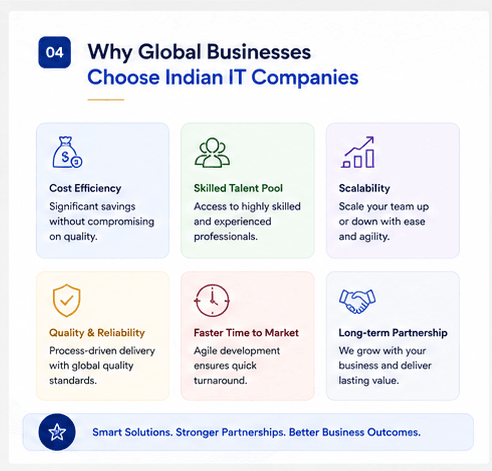
This is why global companies keep choosing software development companies in India for long-term technology collaboration. Not because they have to. Because it works.
The Rise of Indian IT Companies as Global Technology Partners
There is a version of this story that gets told frequently and gets it wrong. It frames Indian IT companies as a cheaper alternative, good enough for basic work, risky for anything complex.
That story was outdated ten years ago. Today it is simply incorrect.
Indian IT companies have transformed from traditional outsourcing providers into full-scale technology innovation partners. The evidence is not anecdotal. India's software services export market reached USD 158.19 billion in 2025. The country operates 1,650 Global Capability Centres employing 1.6 million professionals. These are not support functions running routine maintenance. They are engineering hubs driving product innovation for global financial institutions, healthcare companies, government agencies, and technology firms.
Modern Indian software development companies help businesses with things that require genuine engineering expertise:
- Custom software development built around specific business workflows, not generic templates
- Enterprise application development for ERP, CRM, and industry-specific platforms
- Cloud-native solutions including migrations from aging on-premise infrastructure
- AI-powered applications covering everything from generative AI integration to custom ML pipelines
- Mobile app development services across iOS, Android, and cross-platform environments
- Digital transformation services from initial strategy through full production deployment
- Software modernization for businesses whose technical debt has become a growth constraint
The shift that matters most is this: the focus has moved from reducing cost to creating measurable business outcomes. Indian technology partners are now evaluated on revenue impact, time-to-market improvement, and operational efficiency, the same metrics applied to any internal engineering team.
India vs USA Software Development: Understanding the Difference
1. Cost-Effective Software Development Without Compromising Quality
Here is what the cost advantage actually looks like in practice.
A senior full-stack developer in the United States earns between USD 130,000 and USD 180,000 per year in base salary alone, before benefits, equity, and overhead. The equivalent profile in India, same technology stack, same architectural capability, often comparable experience, earns roughly 10 percent of that figure.
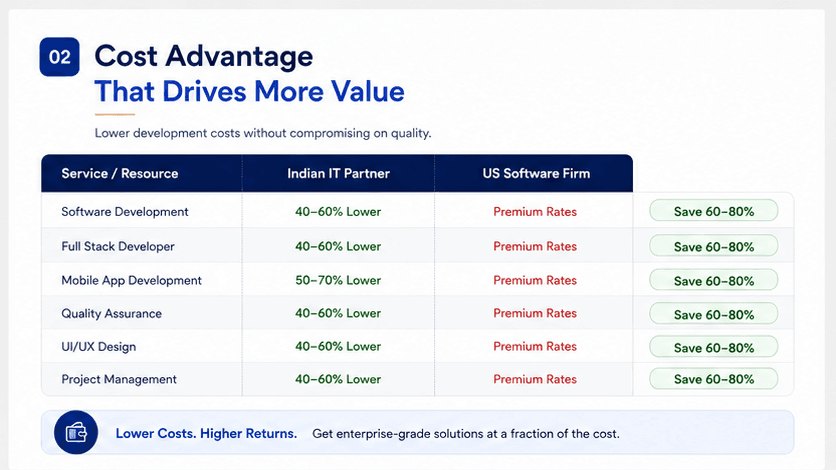
This is not a quality gap dressed up as a bargain. It is a structural economic difference between two markets. Indian engineers are trained at the same global technology standards, certified on the same cloud platforms, and often hold the same professional qualifications as their US counterparts. The cost difference comes from where they live, not what they know.
For a business building a product, this means something concrete: the budget that would hire one mid-level developer in San Francisco can build a full cross-functional team in India, a team lead, two senior engineers, a QA specialist, and a DevOps engineer. That is not a marginal difference. That is a fundamentally different business model for technology investment.
What businesses actually gain from a well-structured offshore software development model:
- Senior engineering talent across multiple specializations simultaneously, not one generalist
- Faster product development cycles because dedicated teams do not share attention across competing priorities
- Flexible team scaling, expand or reduce based on project phases without the hiring and redundancy costs of permanent headcount
- Reduced operational expenses that free capital for product innovation rather than engineering overhead
- The ability to run parallel workstreams that would be sequentially bottlenecked with a smaller onshore team
2. Large Pool of Skilled Technology Professionals
India has over 5.4 million software engineers. More than 1.5 million engineering graduates enter the market every year. In 2025, India surpassed the United States in absolute developer numbers.
For companies in markets where specialized technology talent is genuinely scarce, Finland, Hungary, and many other European markets fit this description, this matters enormously. You can post a senior React Native role in Helsinki and wait eight months. You can work with an Indian technology partner and have a qualified engineer contributing to your codebase within three weeks.
The talent pool covers every modern specialization:
- Web application development across all major frameworks, React, Angular, Vue, Node.js, Django, .NET
- Mobile application development in native Swift, Kotlin, Flutter, and React Native
- AI and machine learning engineering with real production experience, not just certification
- Cloud architecture and DevOps across AWS, Azure, GCP, Kubernetes, and Terraform
- Enterprise software including SAP, Salesforce, Oracle, and custom ERP implementations
- Cybersecurity and compliance architecture for regulated industries
This is why India remains the preferred destination for companies building long-term technology partnerships. The talent is there, at scale, across specializations.
Why Enterprises Prefer Indian Software Development Companies
Enterprise Software Development Expertise
Enterprise software development is different from building a startup product. The stakes are higher, the complexity is deeper, and the consequences of architectural errors last for years. Large organizations need technology partners who understand this, who treat compliance, security, and scalability as first principles rather than afterthoughts.
Indian technology companies have been delivering enterprise-grade solutions for global organizations for decades. That accumulated experience shows up in concrete ways: better architecture decisions at the start of projects, fewer integration surprises mid-delivery, and teams who know what "production-ready" actually means in a regulated enterprise environment.
The services that matter most to enterprise clients:
- Enterprise software development at organizational scale, designed for growth and maintainability
- Business automation solutions that reduce manual overhead without creating brittle processes
- CRM and ERP solutions built to match actual business workflows, not vendor defaults
- API integrations that connect enterprise systems across disparate platforms without creating new technical debt
- Workflow automation that removes repetitive decision overhead from knowledge workers
- Legacy application modernization for businesses whose aging systems have become growth constraints
These capabilities translate into two outcomes that enterprise procurement teams care about: better operational efficiency and measurably improved customer experiences.
Digital Transformation Capabilities of Indian IT Partners
Modern businesses need more than traditional development. The companies that are winning in their markets right now are using technology to do things their competitors have not yet figured out how to do. That requires partners who can contribute to technology strategy, not just execute implementation briefs handed to them.
Indian IT companies are actively helping organizations adopt:
- Artificial Intelligence integrated into existing business workflows, not bolted on as a feature
- Generative AI solutions including LLM integration, retrieval-augmented generation, and custom model deployment
- AI-powered automation that replaces repetitive decision workflows with systems that improve over time
- Data-driven platforms built on real-time analytics pipelines, not weekly report exports
- Cloud transformation that moves businesses from infrastructure they own to infrastructure that scales
- Intelligent workflows combining process automation with AI decision engines
From strategy to implementation, Indian technology companies support complete digital transformation journeys. This is operational reality, not marketing language. The 1,650 Global Capability Centres operating in India today are contributing to product roadmaps, architecture decisions, and innovation strategy for enterprises across financial services, healthcare, retail, and technology.
Mobile App Development: A Major Strength of Indian Tech Companies
Ask anyone who has shipped a production mobile application what the hard parts are, and they will not say writing the code. They will say managing App Store compliance changes, handling edge cases on a hundred different device configurations, designing for accessibility standards their team did not know existed, and keeping the application performant six months after launch when it has ten times the users and half the planned infrastructure budget.
Indian mobile app development companies have shipped thousands of production applications. That accumulated experience is what separates competent teams from excellent ones.
The full range of mobile development services Indian teams provide:
- Android app development in native Kotlin with cross-platform options where appropriate
- iOS app development in native Swift, designed for App Store guidelines from the first sprint
- Cross-platform applications in Flutter and React Native where a unified codebase makes business sense
- Enterprise mobile applications with security, role-based access, and backend system integration
- AI-integrated mobile solutions covering on-device ML, recommendation engines, and conversational interfaces
What businesses actually get when they work with experienced Indian mobile teams:
Planning → Design → Development → Testing → Deployment → Support
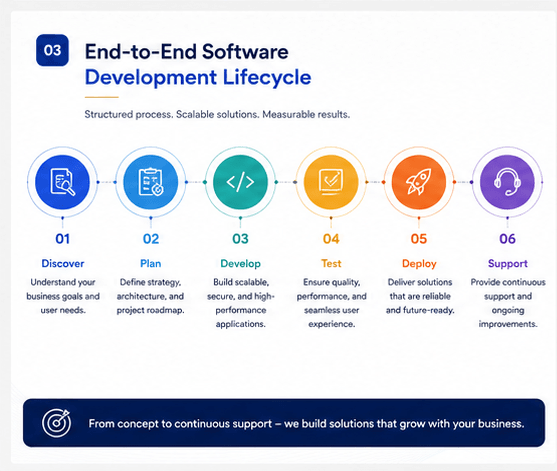
The full lifecycle, with a single accountable partner. This matters more than it sounds. Fragmented vendor relationships, one firm for design, another for development, a third for QA, create accountability gaps that always surface at the worst possible moment.
Offshore vs Onshore Software Development: Which Model Works Better?
The honest answer is that the offshore versus onshore framing is increasingly outdated. Most serious technology organizations now operate hybrid models. The question is not whether to work with offshore partners, it is how to structure the engagement so that it actually delivers what the business needs.
Comparison: Indian IT Partner vs US Software Firm
| Factor | Indian IT Partner | US Software Firm |
|---|---|---|
| Development Cost | 40–60% lower than onshore | Premium market rates |
| Talent Availability | Immediate access, large pool | Constrained, slow hiring |
| Scalability | Team expansion in weeks | Expensive, months-long |
| Technology Expertise | Wide specialization at accessible rates | Strong, premium pricing |
| AI and ML Depth | Extensive production experience | Available at high cost |
| Engagement Flexibility | Multiple models — dedicated, extended, project | Usually fixed scope |
| Compliance Architecture | GDPR, ISO 27001, sector-specific experience | Variable |
| Time Zone Coverage | Multi-timezone delivery | Single timezone |
The right choice depends on business goals, compliance context, and what the team actually needs to build. But for companies in Europe and North America evaluating technology partnerships, the data consistently points toward hybrid and offshore models with Indian partners as the highest-value combination of capability and investment.
What Makes India a Preferred Software Development Destination?
Faster Time-to-Market
Dedicated development teams eliminate the hiring cycles, onboarding delays, and organizational friction that come with building engineering capacity from scratch. When a business has a production deadline that matters, working with an Indian technology partner who already has the team, the tools, and the delivery infrastructure in place is meaningfully faster than any alternative.
Flexible Engagement Models
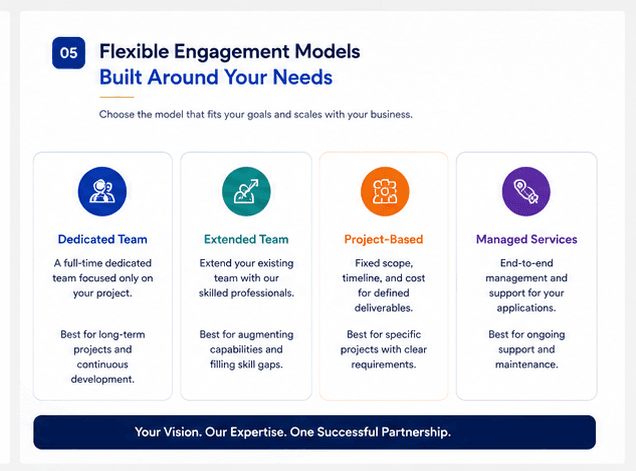
This is something US software firms genuinely struggle to match. Indian IT companies will structure the engagement around what the business actually needs:
- Dedicated developers for specific capability gaps without replacing the whole team
- Extended teams as a structured offshore extension with shared tooling and sprint cadence
- Project-based development with defined scope, timeline, and deliverable accountability
- Long-term partnerships for businesses that treat technology as a strategic function
Innovation-Driven Approach
The idea that offshore development is for maintenance work is a decade out of date. Indian technology providers are building AI-native products, designing cloud-native architectures, and engineering enterprise compliance systems for organizations with demanding standards. The innovation is not happening in spite of the offshore model. It is being enabled by it.
Key areas where Indian IT innovation is most active right now:
- Generative AI and agentic systems integrated into enterprise workflows
- Intelligent automation across finance, operations, and customer service functions
- Cloud-native architecture replacing infrastructure that cannot scale with demand
- Modern software architecture patterns, microservices, event-driven design, API-first development
Offshore Software Development for Finland and Hungary
Why Finnish Businesses Are Choosing Indian Software Development Partners
Finland operates one of the most digitally advanced economies in the world, with demanding GDPR compliance requirements and a national expectation of technical precision that shapes how enterprises evaluate vendors. The local talent shortage is real, specialized engineering roles in Finland can take six to twelve months to fill through conventional hiring.
Indian IT companies have consistently demonstrated the ability to work within these requirements. Compliance-first development practices, security-by-design architecture, and structured delivery governance align with Finnish enterprise standards. For Finnish companies building GDPR-compliant platforms, healthcare technology, or government-integrated digital services, Indian partners offer technical depth and compliance experience that the local market cannot provide at scale.
Why Hungarian Enterprises Are Choosing Indian Software Development Partners
Hungary's IT sector has grown significantly, with Ericsson launching a 6G laboratory in Budapest in 2025 and major enterprises expanding their local R&D operations. The country's IT outsourcing market is projected to reach USD 800 million by end-2025 and grow to USD 1.16 billion by 2029.
But Hungarian businesses building EU-compliant digital products face a clear challenge: competitive local engineering salaries and a shortage of AI, cloud, and mobile specializations at scale. Indian IT companies, with ISO 27001 certifications, GDPR-ready development practices, and documented compliance architecture experience, are a natural fit for Hungarian enterprises that need to build and scale digital products across European markets.
How to Choose the Right Software Development Company in India
This is where most businesses make avoidable mistakes. They evaluate on portfolio and price, sign a contract, and discover six months later that the communication process is broken, the IP terms are ambiguous, or the team that was presented during the sales process is not the team delivering the work.
Before selecting a technology partner, evaluate these things carefully:
Technical expertise: with evidence, not claims. Ask for architecture documentation, code samples, and technology-specific case studies. A firm that cannot produce these has not done the work.
Industry experience that matches your compliance context. A partner who has built GDPR-compliant fintech applications understands your regulatory environment. A generalist who claims they can handle any industry usually means they have handled none of them deeply.
Security practices with certifications to back them up. ISO 27001 status, GDPR data processing agreements, penetration testing protocols, these should be documented and current, not described in sales calls.
**Communication process that survives timezone differences. **Ask specifically how they handle sprint reviews, issue escalation, and stakeholder updates. This is the most common failure point in offshore partnerships, and it is entirely preventable with the right process in place.
Development methodology with real delivery structure. Agile claims are universal. Sprint structures, definition of done, QA integration, and deployment processes separate firms that understand delivery from those that have read about it.
**Long-term support with commercial terms. **Every production application needs ongoing maintenance, security patches, and feature iterations. If a technology partner is not prepared to discuss post-deployment support before contract signing, that is a significant warning sign.
A strong technology partner should align with your business objectives and governance requirements. Firms that only want to talk about what they will build, and not how they will support it, are optimizing for their interests rather than yours.
Final Thoughts
Indian IT companies have earned their position as the preferred technology partners for global businesses through decades of consistent delivery, structured capability building, and genuine adaptation to what enterprise clients actually need.
Whether companies need enterprise software development, production-ready mobile applications, AI-integrated workflows, or complete digital transformation services, Indian technology partners provide the depth of capability required to compete in a market where technology moves faster than most organizations can respond.
The global IT outsourcing market is heading toward USD 981.6 billion by 2030. The businesses leading their industries through that decade are making technology partnership decisions now. Those decisions consistently point toward Indian IT companies, not as a cost-reduction tactic, but as a strategic choice for organizations serious about what they want to build.
The future belongs to businesses that choose technology partners who can genuinely innovate, adapt, and grow with them. Indian IT companies have built the capacity to be that partner. The evidence is in the delivery records of every major industry, across every major market, over more than two decades.
Frequently Asked Questions
Q1. Why do companies choose Indian IT companies over US software development firms?
The short answer is capability combined with investment efficiency. Indian IT companies offer engineering depth, technology breadth, and delivery experience that US firms cannot match at equivalent cost. The decision has moved beyond cost savings, businesses choose Indian partners because of AI expertise, compliance capability, and the ability to scale engineering teams quickly in response to market demands.
Q2. Is software development genuinely more cost-effective in India compared to the USA?
Yes, and the difference is substantial. Indian full-stack developers earn approximately 10 percent of equivalent US salaries, and enterprise development projects are delivered at 40 to 60 percent lower cost than comparable onshore engagements. The savings come from structural economic differences between markets, not from lower engineering standards.
Q3. Are Indian software development companies reliable for enterprise-scale and regulated projects?
Yes. Indian IT companies have delivered enterprise systems for global banks, healthcare organizations, government agencies, and technology companies for decades. Multi-year contracts signed with major Indian IT firms through 2025 reflect sustained enterprise confidence. ISO 27001 certifications, GDPR-compliant development practices, and compliance-first architecture are standard capabilities at established firms.
Q4. What services do Indian IT companies provide in 2026?
Enterprise software development, custom iOS and Android applications, generative AI integration, cloud architecture and migration, ERP and CRM implementation, business process automation, legacy modernization, DevOps engineering, cybersecurity architecture, and digital transformation consulting from strategy through production deployment.
Q5. How do I choose the right software development company in India for my business?
Evaluate technical expertise with verifiable evidence rather than portfolio claims. Assess industry-specific delivery experience within your compliance environment. Verify security certifications and data processing practices. Confirm intellectual property ownership terms before contract execution. Assess communication protocols and project management methodology. A partner with documented delivery experience in your sector is more valuable than one with a broader but shallower general portfolio.
Q6. Which industries get the most value from partnering with Indian software development companies?
Financial services, healthcare, government technology, enterprise SaaS, retail, logistics, and media consistently benefit most. These are sectors where compliance requirements, scalability demands, and technology complexity create the highest value from experienced engineering partners with documented sector-specific delivery.
Q7. What is the long-term outlook for Indian IT companies as global technology partners?
India's IT sector is projected to reach USD 400 billion by 2030, driven by AI-native development, cloud transformation, and Global Capability Centre expansion. Indian IT companies are moving from delivery vendors to embedded strategic partners, contributing to product roadmaps and architecture decisions, not just executing against specifications. That transition is already well underway.
Comparison: Indian IT Companies vs US Software Firms
| Criteria | Indian IT Companies | US Software Firms |
|---|---|---|
| Hourly Development Rate | USD 25–75 | USD 100–200+ |
| Developer Talent Pool | 5.4M+ professionals | ~4M professionals |
| AI and ML Expertise | Extensive, accessible | Strong, premium cost |
| Enterprise Delivery Track Record | Decades across global markets | Strong, US-centric |
| GDPR and EU Compliance | Architecture-level experience | Variable |
| Mobile App Development | Full lifecycle delivery | Full lifecycle delivery |
| Time to Onboard a Team | 2–4 weeks | 4–12 weeks |
| Engagement Model Flexibility | High — multiple structures | Low to medium |
| Post-Deployment Support Model | Long-term default | Often project-oriented |