Why the UAE Is the Smart Choice for 2026
The UAE's continuous push toward faster, more flexible company formation has made it one of the most accessible markets in the region for founders evaluating where to start a company in the UAE. The 2026 shift isn't about new incentives so much as speed and choice becoming the default.
According to MBG Corporate Services, the UAE now operates more than 45 free zones, each structured around specific sectors, from DMCC for trading to specialized zones for media, tech, and logistics. Several jurisdictions now issue business licenses the same day documents are submitted for straightforward activities, a process that took weeks even two years ago.
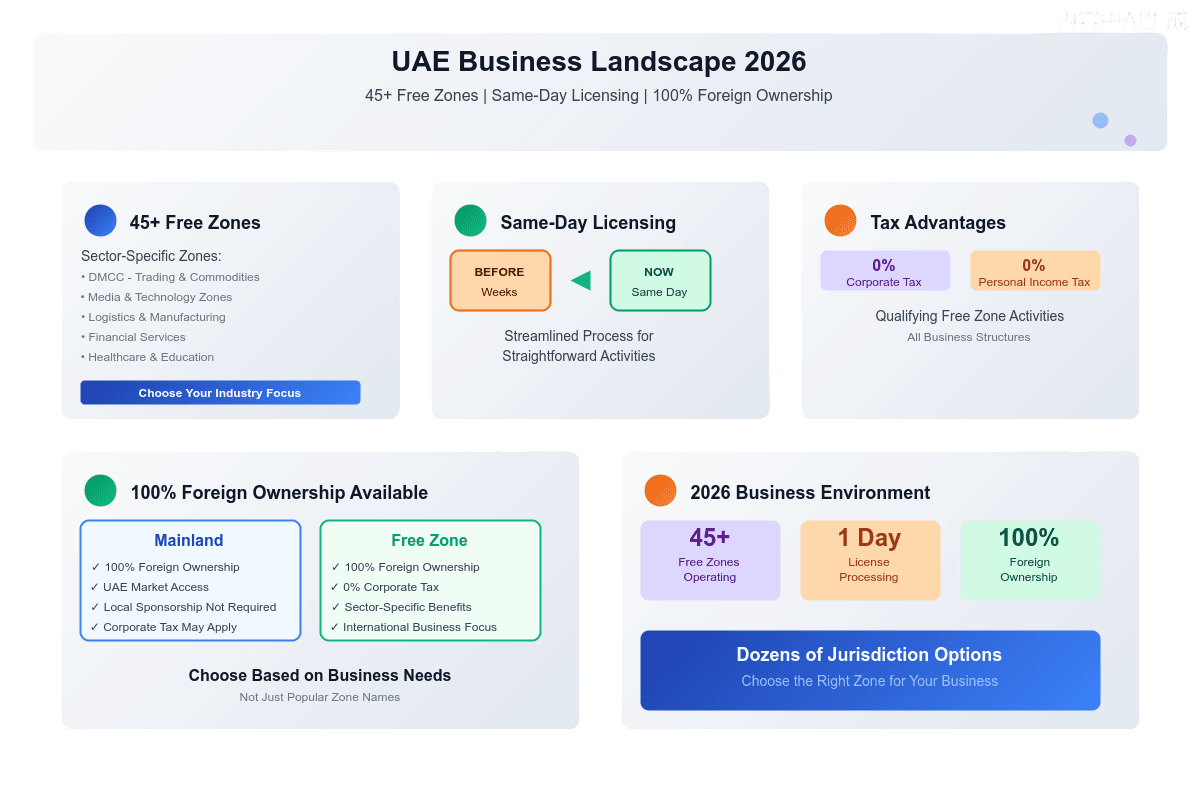
The 2026 landscape is shaped by 100% foreign ownership available across both mainland and free zone structures, 0% corporate tax for qualifying free zone activities, and zero personal income tax regardless of business structure. Anyone considering starting a business in Dubai 2026 can now choose from dozens of jurisdiction options rather than defaulting to the most familiar free zone name.
Business Registration Timeline - Step by Step (2026)
Understanding the UAE company registration process cost requirements 2026 starts with knowing which steps apply to your chosen jurisdiction.
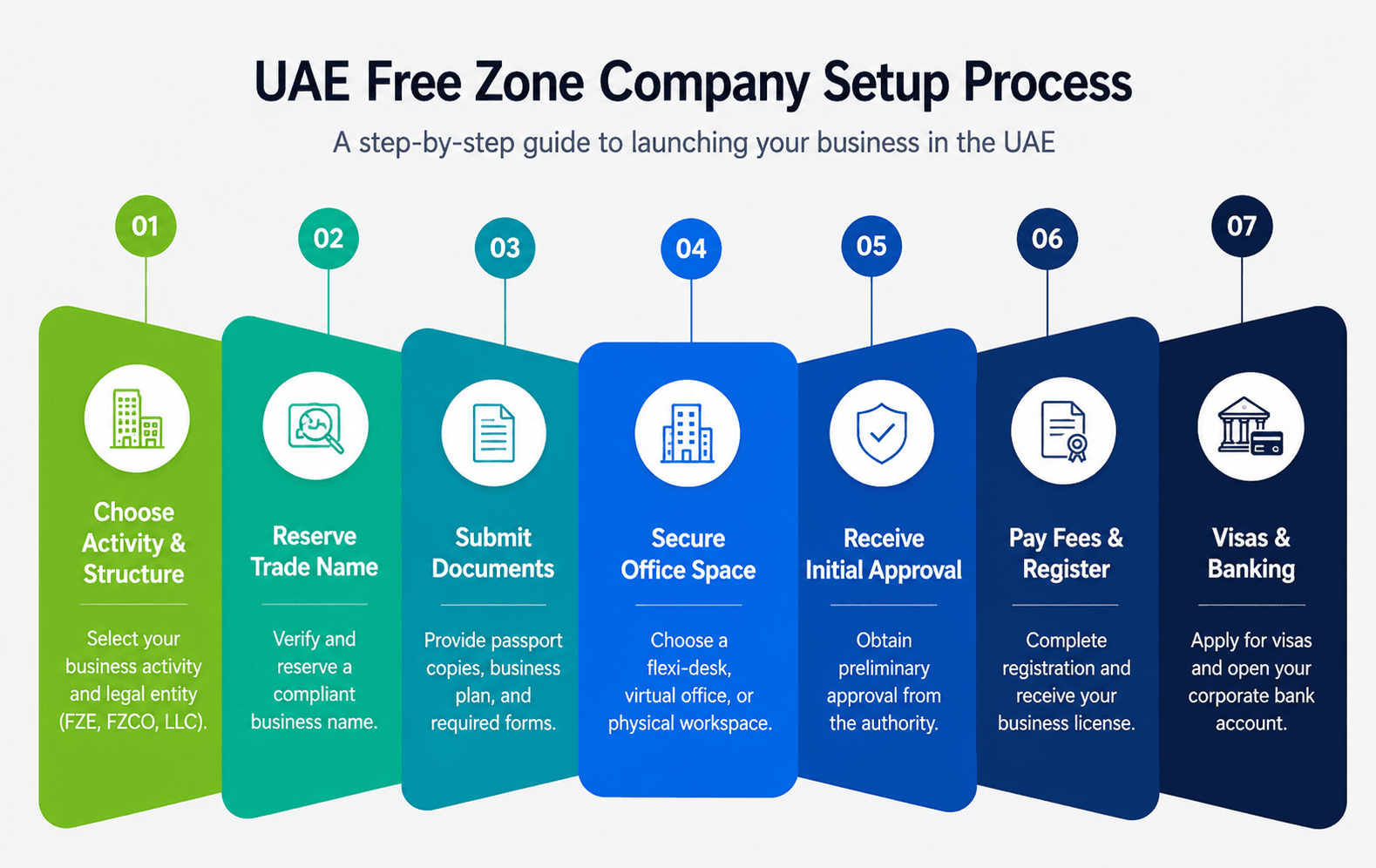
Most straightforward free zone setups complete licensing within 1–2 weeks, while mainland setups with additional approvals typically run 2–4 weeks end to end.
As your company expands, customer engagement and mobile accessibility become increasingly important. Partnering with a trusted mobile app development company in UAE can help businesses reach users through seamless mobile experiences.
Choose the Right Business Structure
Your choice of jurisdiction and entity type shapes your licensing cost, tax exposure, and ability to operate inside the UAE versus internationally.
| Structure | Min. Capital | Ownership | Best For |
|---|---|---|---|
| Free Zone Establishment (FZE) | Varies by zone | 100% Foreign | Single-shareholder tech, consulting, trading entities |
| Free Zone Company (FZCO) | Varies by zone | 100% Foreign | Multi-shareholder free zone businesses |
| Mainland LLC | Varies by activity | 100% in most activities | Local retail, government contracts, broad market access |
| Branch Office | Parent company liability | 100% Foreign | Market entry for established foreign parent companies |
| Offshore Company | None required | 100% Foreign | Holding structures, international trading, no UAE office needed |
Complete Cost Breakdown — UAE Business Setup 2026
FULL COST REFERENCE TABLE — 2026
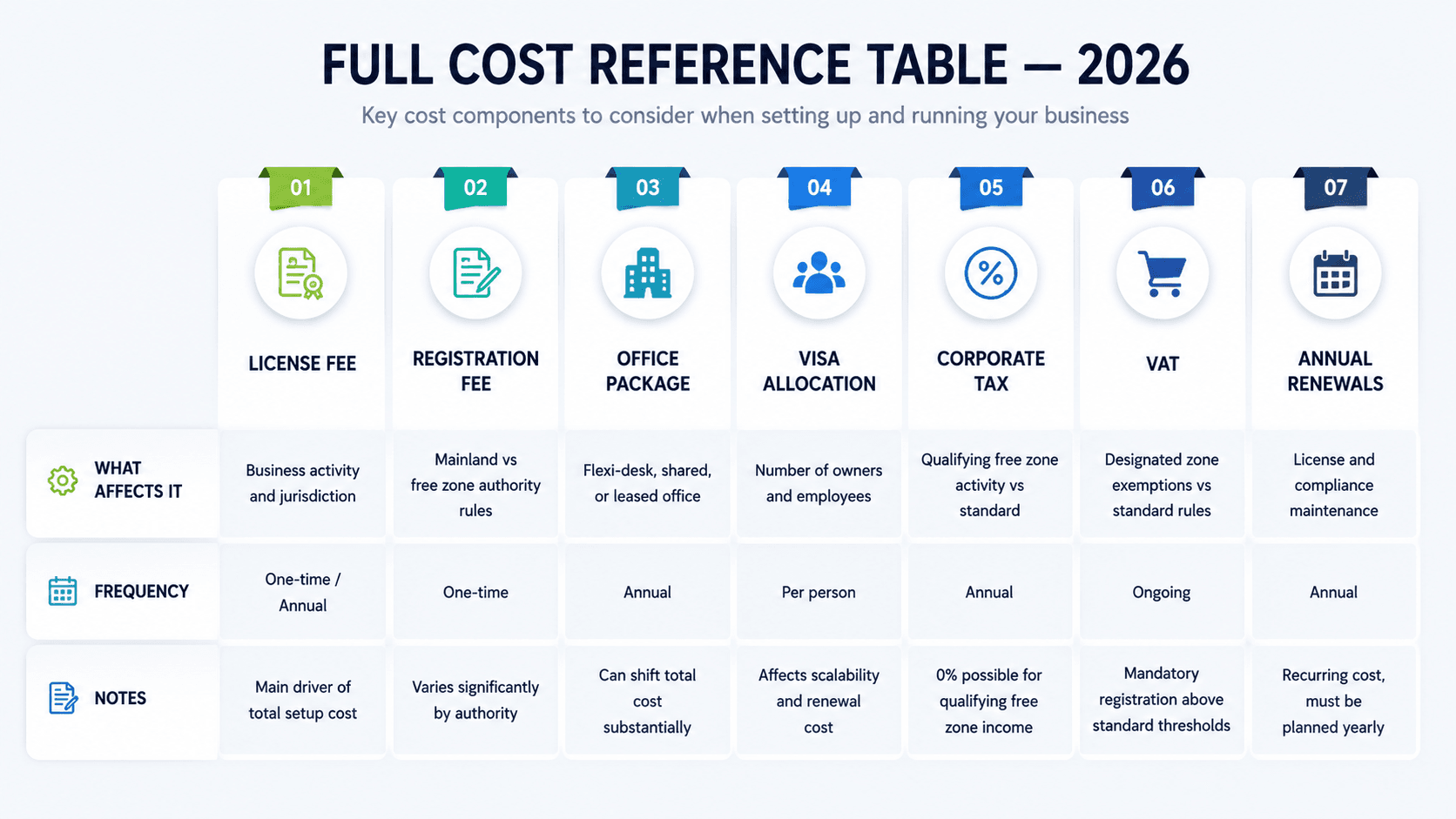
License fees remain the primary cost driver, varying significantly between mainland and free zone, and between individual free zones themselves, according to MBG Corporate Services. Office packages and visa allocation tied to owner and employee count round out the rest of your first-year budget.
Mainland vs Free Zone vs Offshore
This single decision shapes your licensing, your tax exposure, and your ability to operate inside the UAE versus internationally.
| Feature | Mainland | Free Zone | Offshore |
|---|---|---|---|
| Foreign Ownership | 100% in most activities | 100% always | 100% always |
| UAE Market Access | Full domestic access | Limited without extra licensing | No UAE operations permitted |
| Corporate Tax | Standard UAE corporate tax applies | 0% possible on qualifying activities | Not applicable (no UAE operations) |
| VAT | Standard VAT rules apply | Exemptions in designated zones | Not applicable |
| Office Requirement | Typically required | Flexi-desk/virtual options in many zones | No physical office required |
| Best For | Local retail, government contracts | Tech, international trading, consulting | Holding companies, international structures |
Free zone setup gives you 100% foreign ownership without a local partner, full repatriation of profits and capital, and VAT exemptions in designated zones. The tradeoff: free zone companies generally can't trade directly into the UAE mainland market without additional licensing.
Mainland setup gives you direct access to the broader UAE market and government contracts, without the trading restrictions free zones carry.
License Types, Fees & Compliance
UAE licensing is activity-specific, and choosing the wrong jurisdiction for your activity is among the most common costly mistakes foreign founders make.
| License Type | Typical Use Case | Additional Requirements |
|---|---|---|
| Commercial License | Trading, retail, import/export | Customs registration for mainland trading |
| Professional License | Consulting, IT, legal, accounting | Professional body approval where applicable |
| Industrial License | Manufacturing, processing | Environmental and municipality clearance |
| E-Commerce License | Online retail, digital platforms | Payment gateway and platform-specific approvals |
| Freelancer Permit | Individual service providers | Available in several free zones, lower-cost entry route |
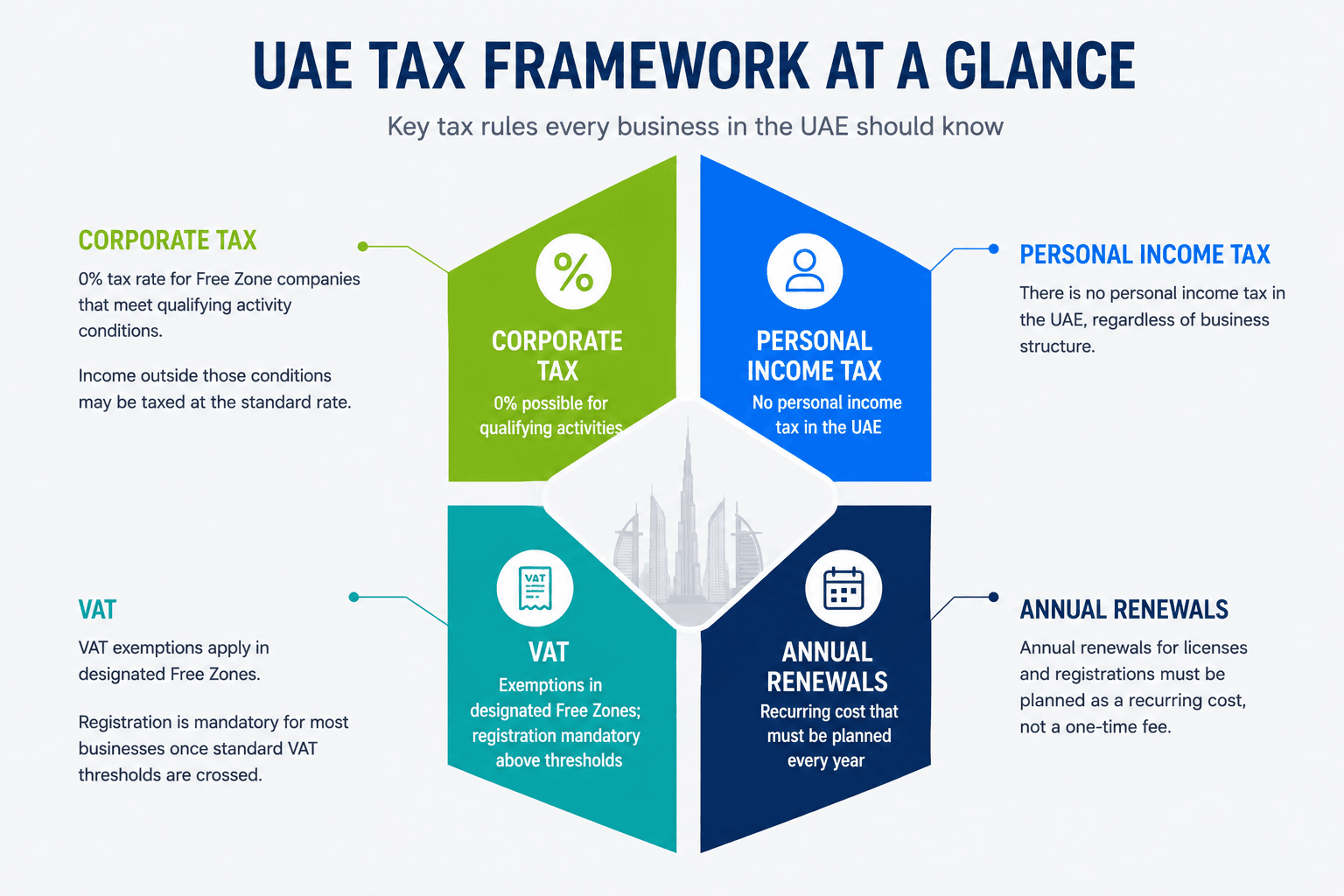
UAE Tax Framework - What You Owe in 2026
The UAE's tax environment remains one of the most business-friendly globally, but qualifying conditions matter.
4-Week Launch Roadmap: From Idea to Operations
This roadmap represents the fastest realistic route to an operational UAE business in 2026 for a straightforward free zone setup with documents prepared in advance.
- Week 1: Choose activity, structure, and jurisdiction; reserve trade name
- Week 2: Submit application, documents, and secure office space
- Week 3: Receive initial approval, pay license fees, complete registration
- Week 4: Apply for visas, open corporate bank account
For anyone serious about starting a business in the UAE, budget a buffer beyond the license fee for office setup and visa processing before targeting your first operational week.
Annual Compliance Essentials
Licensing is just the starting point. The UAE imposes a structured set of annual obligations across most jurisdictions.
Efficient business operations often require tailored digital solutions. Investing in custom software development services can help automate workflows, improve productivity, and support long-term business growth.
Annual Renewal Calendar
- Trade license renewal — annual, varies by jurisdiction
- Office lease renewal — annual, tied to license renewal in most free zones
- Visa renewals for owners and employees — every 2–3 years depending on visa type
- Corporate tax return filing — annual, even for 0%-qualifying entities
- VAT return filing — quarterly or annually, depending on registration status
Visa & Labor Compliance
Visa allocation in the UAE is tied directly to your license type, jurisdiction, and office package.
- Visa quotas vary by free zone and office size (flexi-desk packages typically allow fewer visas)
- Mainland companies generally have more flexible visa allocation tied to office size
- Activity restrictions mean your license only covers registered activities; expansion often requires an amendment
- Employee visa processing typically includes medical testing and Emirates ID registration
Banking Requirements
- Corporate bank account opening typically follows license issuance
- Free zone companies sometimes face more documentation requirements than mainland entities
- Account opening timelines vary by bank and jurisdiction, generally 2–4 weeks
- Multi-currency corporate accounts are widely available across major UAE banks
Risk Assessment: Opportunities & Challenges
| Key Advantages | Key Challenges |
|---|---|
| ✓ 100% foreign ownership across mainland and free zone | Free zone companies face mainland trading restrictions |
| ✓ 0% corporate tax possible for qualifying free zone activities | Qualifying activity conditions must be met and maintained |
| ✓ No personal income tax regardless of structure | 45+ free zones make jurisdiction selection complex |
| ✓ Same-day licensing available in several jurisdictions | Office package choice significantly affects total cost |
| ✓ Full profit repatriation, no capital controls | Banking documentation can be more demanding for free zone entities |
| ✓ Strong global connectivity and business infrastructure | Annual renewals require ongoing budget planning |
Frequently Asked Questions
Q1. Can foreigners start a business in the UAE?
Yes. Foreign founders can start businesses across most sectors, subject to choosing the right jurisdiction, free zone, mainland, or offshore, and the correct activity license.
Q2. Is mainland or free zone better for starting a business in the UAE?
It depends on your market. Mainland gives broader access to the local UAE market, while free zones are often easier for full foreign ownership and specific sector setups, especially for international-facing businesses.
Q3. Is the UAE expensive to start a business in?
Costs vary widely based on license type, office requirements, and visa needs. Free zone setups can start relatively lean, while mainland and trading-heavy structures usually cost more upfront.
Q4. How long does it take to start a business in the UAE?
Many UAE setups move quickly, with some jurisdictions now offering same-day licensing for straightforward activities and complete documentation.
Q5. Do businesses pay corporate tax in the UAE?
There's no personal income tax. Corporate tax can be 0% for qualifying free zone activities, though standard corporate tax applies outside qualifying conditions.
Q6. Is a physical office required to start a business in the UAE?
Most free zones require physical office space, though flexi-desk and virtual office options are available in several zones, particularly for startups and freelancers.
Q7. How many free zones are available for starting a business in the UAE?
The UAE has more than 45 free zones, including major ones like DMCC, JAFZA, and DAFZA, each focused on different sectors with their own licensing requirements.
Q8. Can a free zone company trade directly into the UAE mainland market?
Generally no, not without additional licensing. Free zone companies are typically restricted from direct mainland trading, which is why founders targeting local retail often choose mainland setup instead.
Q9. What documents do I need to start a business in the UAE?
Most applications require passport copies, a business plan, and proof of address, though additional documents may be requested depending on your specific business activity.
Q10. Do I need a local partner to start a business in the UAE?
Free zone setups allow 100% foreign ownership without a local partner. Mainland setups have expanded foreign ownership options too, though this depends on your specific business activity.
Conclusion: Is the UAE Right for You in 2026?
The UAE in 2026 continues to lower the barrier to entry for foreign founders, with same-day licensing, 45+ free zone options, and 0% corporate tax available to qualifying businesses. The decision that matters most isn't speed, it's choosing the jurisdiction that matches where you actually plan to sell.
For founders targeting international markets or building tech-driven businesses, free zones remain the faster, more flexible route. For founders who need direct access to the local UAE market or government contracts, mainland setup is worth the additional licensing steps. Budget realistically for office packages and visa allocation, since these, not the headline license fee, are what shift total cost the most.