RevenueCat and Superwall solve different problems in subscription apps. RevenueCat helps developers manage purchases, entitlements, and subscription infrastructure. Superwall helps teams improve paywall conversion through experimentation and remote updates. For many growing subscription apps, the answer is not choosing one, it is using both together.
Most comparisons of these two tools frame it as a binary choice: pick one, walk away. RevenueCat’s documentation lists Superwall as an official third-party integration RevenueCat Superwall Integration Docs showing how the two tools work together. If you’re deciding between RevenueCat and Superwall, you’re evaluating platforms designed to handle different layers of your subscription stack.
While both platforms now overlap in subscription management and paywalls, their primary strengths remain distinct. RevenueCat is infrastructure first, whereas Superwall is optimization first. RevenueCat manages in-app purchase validation, entitlements, and cross-platform subscription data, while also offering native paywall capabilities (RevenueCat Paywalls Docs). Superwall has expanded its subscription capabilities, but its strongest differentiation remains paywall optimization and experimentation (Superwall Documentation). One manages subscription state and user entitlements. The other focuses on maximizing conversion through paywall optimization.
Quick Verdict
- Choose RevenueCat if your biggest challenge is managing subscriptions, entitlements, and purchases across platforms.
- Choose Superwall if your biggest challenge is improving paywall conversion without app releases.
- Use both if you are building a serious subscription business, as the two platforms officially integrate and solve complementary problems.
5 Key Takeaways
- While both platforms now overlap in subscription management and paywalls, their primary strengths remain distinct. RevenueCat is infrastructure first (entitlements, receipt validation, cross-platform subscription data). Superwall is optimization first (paywall experimentation, remote updates, conversion testing).
- RevenueCat now officially integrates with Superwall. RevenueCat’s current documentation describes an integration that automatically sends billing, subscription, and revenue events to Superwall, letting teams use both together rather than picking one exclusively.
- Superwall’s own team guides users based on primary need. In a November 2025 post, Superwall’s team explicitly recommends RevenueCat for teams whose primary requirement is cross-platform subscription infrastructure, rather than paywall optimization alone.
- Superwall’s pricing is usage-based on attributed revenue only. Superwall charges based on revenue generated directly through its paywalls (Superwall Pricing Guide), not your total app revenue, meaning legacy subscribers and revenue from native paywalls are not billed.
- The right choice depends on your primary bottleneck: infrastructure vs conversion. Teams with solid entitlement logic but unoptimized, static paywalls benefit most from Superwall. Teams with no subscription backend at all need RevenueCat first, regardless of paywall design.
RevenueCat vs Superwall: At a Glance
| Need | Best Choice |
|---|---|
| Subscription infrastructure | RevenueCat |
| Paywall testing | Superwall |
| Remote paywalls | Superwall |
| Receipt validation | RevenueCat |
| Cross-platform entitlements | RevenueCat |
| Mature subscription business | Both |
What Each Platform Actually Does
RevenueCat: Subscription Infrastructure & Entitlements
RevenueCat exists to solve a specific, unglamorous problem: reliably knowing who has paid for what, across iOS, Android, Stripe, and Amazon, without your engineering team building and maintaining receipt validation logic from scratch. It tracks entitlements, handles renewal and cancellation events, and gives you one source of truth for subscriber status regardless of which store the purchase came through.
In practical terms, RevenueCat answers questions like:
- Is this user entitled to premium features right now?
- When does their subscription renew or expire?
- What is our subscription revenue across all platforms?
Superwall: Remote Paywalls & Conversion Optimization
Superwall exists to solve a different problem: getting more of the people who see your paywall to actually subscribe. Its core capability is a no-code paywall editor, meaning you can change paywall copy, layout, pricing, and targeting rules remotely without shipping a new app version through App Store review.
Built-in A/B testing lets you run multiple paywall variants and measure which one:
- Converts more users
- Drives higher lifetime value (LTV)
- Performs best for specific audience segments
While Superwall has expanded its subscription capabilities, its strongest differentiation remains no-code paywall experimentation and rapid conversion optimization.
RevenueCat vs Superwall Feature Comparison
| Capability | RevenueCat | Superwall |
|---|---|---|
| Core focus | Subscription infrastructure and entitlement management | Remote paywall configuration and conversion optimization |
| Paywall customization | Offers native paywalls; custom code for full control | No-code drag-and-drop paywall editor |
| Remote paywall updates | Supported for native paywall templates | Core feature, no app update required |
| A/B testing | Available for basic paywall experiments | Purpose-built A/B testing engine for paywalls |
| Cross-platform revenue tracking | Yes, covering iOS, Android, Stripe, and Amazon in one view | Focused primarily on mobile paywall conversion data |
| Receipt validation & entitlements | Core strength | Available through Superwall's subscription features and integrations, though conversion optimization remains its primary focus |
| Pricing basis | Usage-based on tracked revenue and subscribers | Usage-based on Superwall attributed revenue only |
| Official integration with the other | Sends subscription and billing events to Superwall | Consumes RevenueCat events to power paywall logic |
RevenueCat vs Superwall Pros and Cons
RevenueCat
Pros:
- Excellent subscription infrastructure and receipt validation
- Unified cross-platform entitlement management
- Single source of truth for subscription state
- Robust analytics and third-party integrations
Cons:
- Requires SDK integration for all platforms
- Paywall experimentation tooling is not its primary focus
- Advanced paywall customization requires developer resources
Superwall
Pros:
- No-code remote paywall editor
- Powerful purpose-built A/B testing engine
- Instant paywall updates without App Store review
- Designed for growth, marketing, and product teams
Cons:
- Does not replace core subscription infrastructure
- Requires sufficient user traffic for statistically significant experiments
- Adds an additional SDK to your mobile codebase
RevenueCat vs Superwall Pricing & ROI
RevenueCat pricing is based on usage related to subscription management, making it economical for early stage apps and MVPs that need low barrier entitlement plumbing. Superwall pricing focuses on subscription revenue attributed to purchases influenced by its paywalls, which delivers the highest ROI for growth-stage apps actively running paywall conversion experiments.
| App Stage | Better Choice | Pricing Rationale |
|---|---|---|
| MVP subscription app | RevenueCat | Low barrier subscription infrastructure and receipt validation |
| Growth-stage app testing paywalls | Superwall | High ROI on paywall conversion experimentation and remote updates |
| Large scaling subscription app | RevenueCat + Superwall | Unified entitlement backend combined with dedicated conversion optimization |
Teams should compare pricing based on their subscription volume, platform needs, and experimentation goals.
Who Should Use Which?
| If you are... | Best Choice |
|---|---|
| Launching your first subscription app | RevenueCat |
| Optimizing paywall conversion | Superwall |
| Scaling an existing subscription business | RevenueCat + Superwall |
When to Choose RevenueCat
If your app does not yet have reliable subscription infrastructure, with no clean way to check “is this user entitled to premium features right now?” across every platform, that gap needs solving before paywall optimization matters at all.
A beautifully tested paywall that converts users into a subscription system which occasionally fails to unlock premium content is not a paywall problem, it is an infrastructure problem.
Choose RevenueCat first if:
- You need one reliable source of truth for entitlements across iOS, Android, web, and Amazon.
- Your team has engineering resources but wants to avoid building in-app purchase validation and renewal logic internally.
- You are earlier in your subscription journey and have not yet reached the stage where paywall conversion is your primary bottleneck.
Once RevenueCat is in place, you can later add a dedicated paywall experimentation layer on top when paywall conversion becomes your primary growth focus.
When to Choose Superwall
Superwall makes the most sense when the subscription plumbing already works, but the paywall has not changed much since launch.
Choose Superwall first if:
- Your subscription infrastructure already works, but your paywall is static and untested.
- You want marketers or product managers to test paywall variants without requiring engineering changes for every paywall iteration.
- Conversion rate and paywall attributed LTV are your current growth bottlenecks, not entitlement tracking.
Superwall reports that its platform is "powering paywalls for apps generating over $1B in subscription ARR" (Superwall Official Portal). Because Superwall's pricing is tied to revenue attributed to its paywalls, its incentives are closely aligned with helping customers improve conversion rates.
The Option Most Comparisons Skip: Using Both
Because RevenueCat officially sends subscription and billing events to Superwall (RevenueCat Third Party Integrations), teams already running RevenueCat for infrastructure can layer Superwall on top specifically for paywall testing, without rearchitecting entitlement logic.
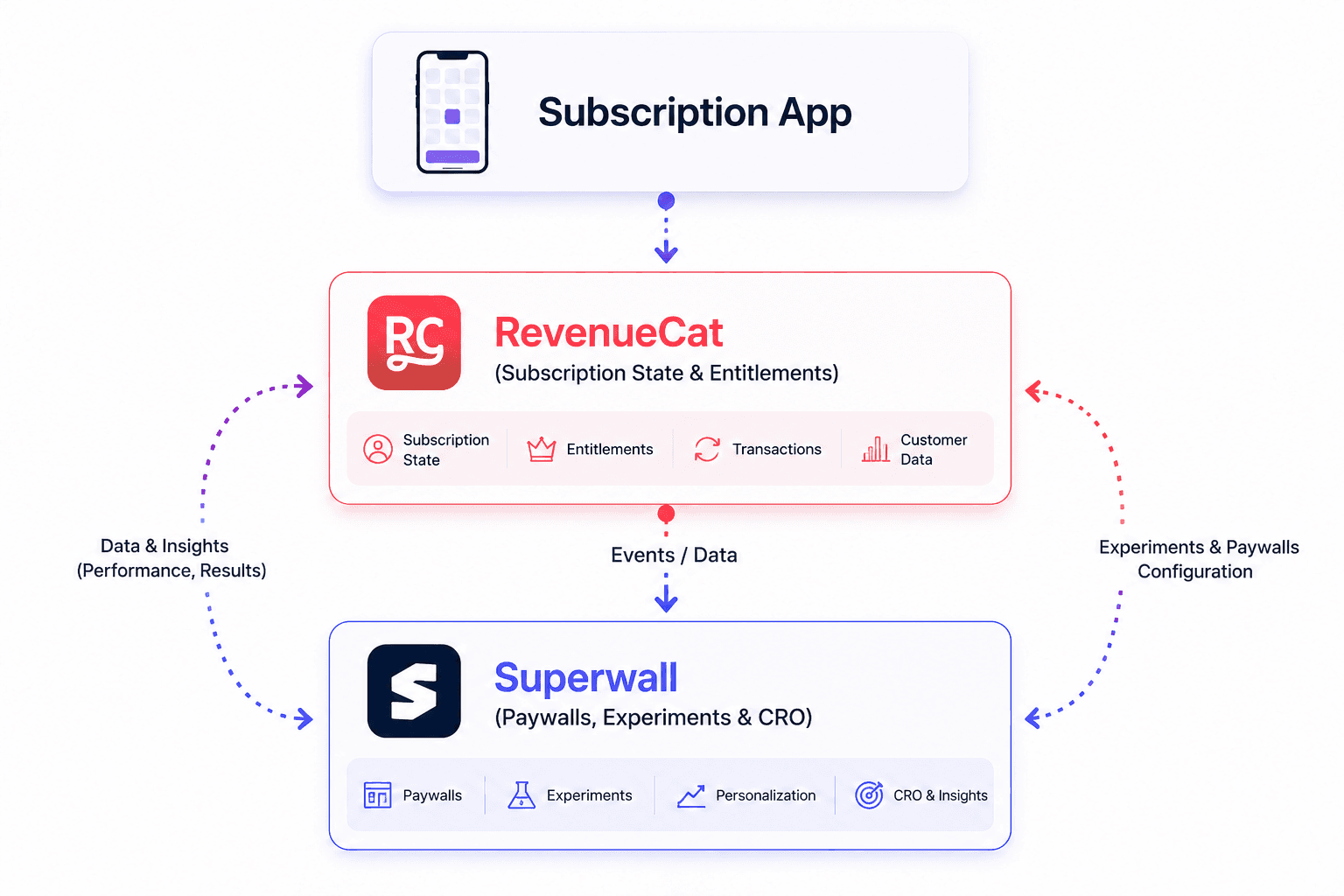 In that setup:
- RevenueCat manages subscription state and user entitlements (which features to unlock, on which platforms, for how long).
- Superwall determines which paywall variant the user saw, why they bought, and which configurations attracted the highest value customers.
For a mature subscription app, “RevenueCat vs Superwall” is often the wrong question. The more useful question is whether you need both, and in what order to implement them.
Can You Switch Between RevenueCat and Superwall?
Yes, but the migration path depends on your architecture. RevenueCat is usually deeper in the purchase flow, while Superwall sits closer to paywall presentation and experimentation. Teams considering a RevenueCat alternative or Superwall alternative should plan identity management, SDK integration, and analytics tracking carefully before switching tools.
RevenueCat vs Superwall FAQs
Are RevenueCat and Superwall direct competitors?
Only partially. RevenueCat focuses primarily on subscription infrastructure and entitlements, while Superwall specializes in paywall optimization and conversion testing. RevenueCat’s documentation lists an official Superwall integration, and many teams use both together.
Can I use Superwall and RevenueCat together?
Yes. RevenueCat supports sending billing, subscription, and revenue events to Superwall once both SDKs share the same user identity, letting you manage entitlements in RevenueCat while testing and optimizing paywalls in Superwall.
Which platform is better for a team with no developers?
Superwall’s no-code paywall editor allows product and growth teams to create and test paywalls without requiring engineering changes for every paywall iteration. RevenueCat’s setup is more developer centric.
Does Superwall replace the need for RevenueCat?
No. While Superwall has expanded its subscription capabilities, in-app purchase validation and cross-platform entitlement tracking remain RevenueCat’s core architectural strength.
How does Superwall’s pricing actually work?
Superwall charges based on revenue directly attributed to purchases made through its paywalls, not your app’s total revenue. Legacy subscribers and revenue from native, non-Superwall paywalls are excluded from billing.
Which tool should I choose if I am just starting out?
If you do not yet have reliable subscription infrastructure across platforms, start with RevenueCat. If your infrastructure already works and your paywall has not been tested or updated, Superwall addresses that specific gap faster.
Conclusion
The key point about “Superwall vs RevenueCat” is that the binary comparison itself is outdated. While both platforms now overlap in subscription management and paywall tooling, RevenueCat's strength lies in entitlement management and subscription infrastructure, while Superwall's strength lies in paywall conversion optimization without app updates.
The two officially integrate specifically because most serious subscription apps eventually need both, not because one wins outright. Start with whichever gap is actually costing you more revenue right now:
- Broken or fragile entitlement logic: fix infrastructure with RevenueCat.
- Stable infrastructure but underperforming paywalls: improve conversion with Superwall.
Architecting Your Mobile Subscription Stack
Need guidance designing your subscription stack? Our mobile app development engineering team builds custom mobile app architectures that seamlessly integrate subscription backends and conversion engines.