- Vibe coding creates prototypes; production engineering creates products. The gap between a working demo and a dependable product is where most AI-built apps fail, through security incidents, untested failure paths, unclear ownership, and missing observability.
- The real question is no longer "Can AI build the app?" It is: "Can the business securely operate, scale, monitor, explain, and evolve the app after real users arrive?" That distinction determines whether an AI-generated application becomes a successful product or a costly rewrite.
- AI application security, AI software testing, AI code governance, and AI production readiness are now commercial differentiators. Teams that can move from prototype velocity to production confidence, without losing speed, will win enterprise deals, avoid compliance blockers, and scale beyond early adopters.
- Ownership debt is the hidden risk. An AI-built app becomes dangerous when no one can explain which business rule a function enforces, which AI tool or model introduced it, what data it can access, or how to roll it back safely. Code without provenance, tests, and accountable owners is not production-ready, even if it works.
- The next phase of AI software development is not about generation speed. It is about productionization speed: how quickly teams can add secure architecture, tested business logic, data protection, observability, scalable infrastructure, governance, and accountable ownership to AI-generated code. That is where the real competitive advantage lies.
Vibe coding can turn a product idea into a working interface in hours. But a convincing demo is not the same thing as a dependable product.
The real production gap begins when unpredictable users, sensitive data, payment flows, concurrent traffic, third-party failures, and compliance requirements meet software generated primarily from prompts.
The question is no longer:
“Can AI build the app?”
The more important question is:
“Can the business securely operate, scale, monitor, explain, and evolve the app after real users arrive?”
That distinction is becoming one of the most important issues in AI-native software development.
AI coding agents can dramatically accelerate implementation. But production readiness still depends on architecture, specifications, verification, security controls, observability, governance, and accountable human ownership.
The Production Gap, Visualized
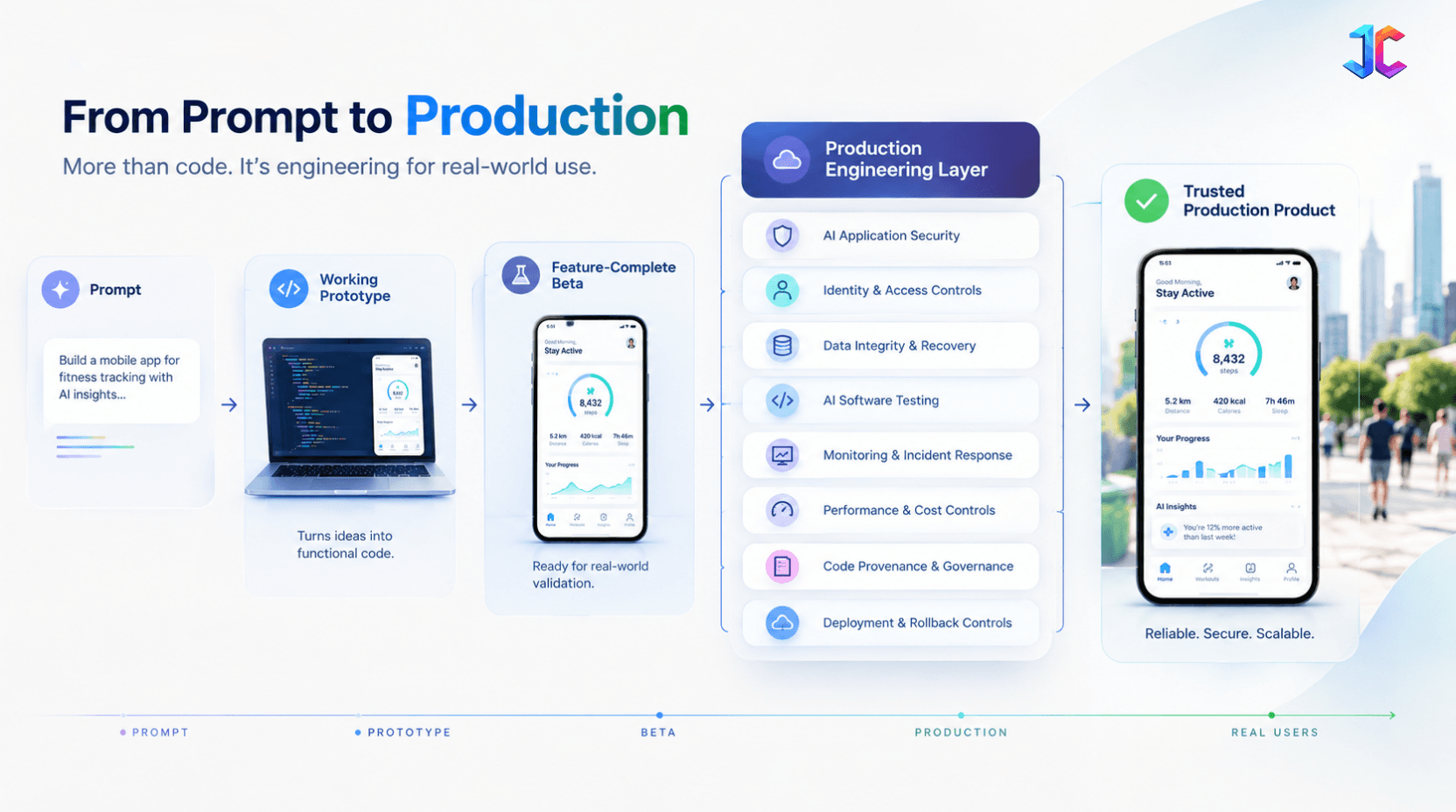
The gap is not simply “bad AI code.”
The larger problem is missing non-functional engineering: the controls and systems that determine whether software remains secure, reliable, observable, scalable, maintainable, and commercially viable after launch.
A prototype proves that something can work.
Production engineering proves that it can keep working when things go wrong.
The Cost of Failure: Why This Gap Matters
The vibe coding production gap is not an academic problem. It has measurable business impact:
- Security incidents: Exposed secrets, broken authorization, or weak tenant isolation can lead to data breaches, regulatory penalties, and loss of customer trust.
- Downtime and outages: Missing observability, untested failure paths, or unmonitored dependencies can cause extended outages that directly impact revenue and reputation.
- Failed payments and revenue loss: Untested payment flows, race conditions, or missing idempotency can cause double charges, failed transactions, or refund storms.
- Compliance exposure: Lack of audit trails, unclear data handling, or undocumented AI-generated components can create issues for GDPR, HIPAA, SOC 2, or enterprise procurement.
- Technical debt acceleration: Prompt-only development without specifications or ownership can produce a codebase that is hard to explain, harder to modify, and expensive to maintain.
For startups, this can mean a failed launch or a costly rewrite. For enterprises, it can mean blocked deployments, failed audits, or production incidents that reach executives.
This is why AI application security, AI software testing, AI code governance, AI app scalability, and AI production readiness are becoming core commercial differentiators, not optional engineering extras.
Prototype vs. Production-Ready AI-Built App
| Area | Vibe-Coded Prototype | Production-Ready AI-Built App |
|---|---|---|
| Source of truth | Prompt history and generated files | Versioned product specification, architecture decisions, repository |
| Security | Basic login or client-side checks | Server-enforced authorization, secrets management, rate limits, security review |
| Data | Happy-path schema | Constraints, migrations, backups, retention, recovery testing |
| Testing | Manual clicks and happy paths | Unit, integration, E2E, negative-path, load and regression testing |
| Reliability | Console errors | Safe failure states, retries, idempotency, alerts and runbooks |
| Observability | Limited logs | Structured logs, traces, metrics, dashboards and alerting |
| Governance | Unknown code origin | AI code provenance, approvals, dependency scanning and audit evidence |
| Scalability | Works for test accounts | Load-tested infrastructure, caching, queues, tenant isolation and cost controls |
| Deployment | Direct or manual deployment | CI/CD controls, staging, feature flags and rollback procedures |
| Ownership | “The AI generated it” | Named owners, documentation and accountable engineering decisions |
The Hidden Risk: Ownership Debt
Most discussions about vibe coding stop at:
“Add testing, security, and monitoring.”
Those controls matter. But the deeper issue is ownership debt.
An AI-built application becomes increasingly risky when nobody can confidently answer:
- Which business rule does this function enforce?
- Who owns this component?
- Which requirement caused this code to exist?
- Which AI tool, model, prompt, or dependency introduced it?
- What customer data can this endpoint access?
- What happens when a payment provider fails?
- What happens when an API times out?
- Can a faulty deployment be rolled back in minutes?
- Can an engineer modify this feature without breaking another workflow?
This is where AI code governance and AI-generated code provenance become commercially important.
A feature without an owner, decision record, test evidence, and operational telemetry may be technically functional, but it is not necessarily production-ready.
For enterprise software, that distinction can determine whether a product is deployable, auditable, supportable, and safe to scale.
From Prompt to Pull Request
The strongest AI-native engineering teams will treat prompts as inputs to development—not as the product specification.
1. Define the product contract
Document:
- User roles
- Core workflows
- Business rules
- Data fields
- Permissions
- Edge cases
- External integrations
- Success metrics
- Unacceptable outcomes
The clearer the contract, the less room there is for an AI coding agent to make assumptions that later become production defects.
2. Generate within constraints
Give AI coding agents the approved:
- Architecture
- Coding standards
- API contracts
- Security requirements
- Data rules
- Testing requirements
- Dependency policies
AI becomes significantly more useful when it operates inside an engineering system rather than inventing that system from scratch.
3. Require a pull request, not a direct deployment
Every meaningful AI-generated change should be reviewable.
That review should consider:
- Code diff
- Test results
- Dependency changes
- Database migration impact
- Security findings
- Performance implications
- Rollback plan
- Ownership
The goal is not to prevent AI from writing code.
The goal is to ensure that AI-generated code enters production through the same accountability mechanisms as human-written code.
4. Validate behavior, not just syntax
A successful build does not prove that a product works.
Production-oriented testing should deliberately exercise failure conditions:
- Denied access
- Duplicate submissions
- Expired sessions
- Slow networks
- Failed webhooks
- Malformed uploads
- Payment failures
- Partial database failures
- Third-party API outages
- Concurrent requests
This is where AI software testing becomes more than automated unit tests. The objective is to verify the behavior of the complete system under realistic conditions.
5. Release gradually
Before exposing a new AI-generated capability to every customer, use:
- Staging environments
- Feature flags
- Limited beta cohorts
- Production monitoring
- Audit logs
- Rollback controls
- Incident ownership
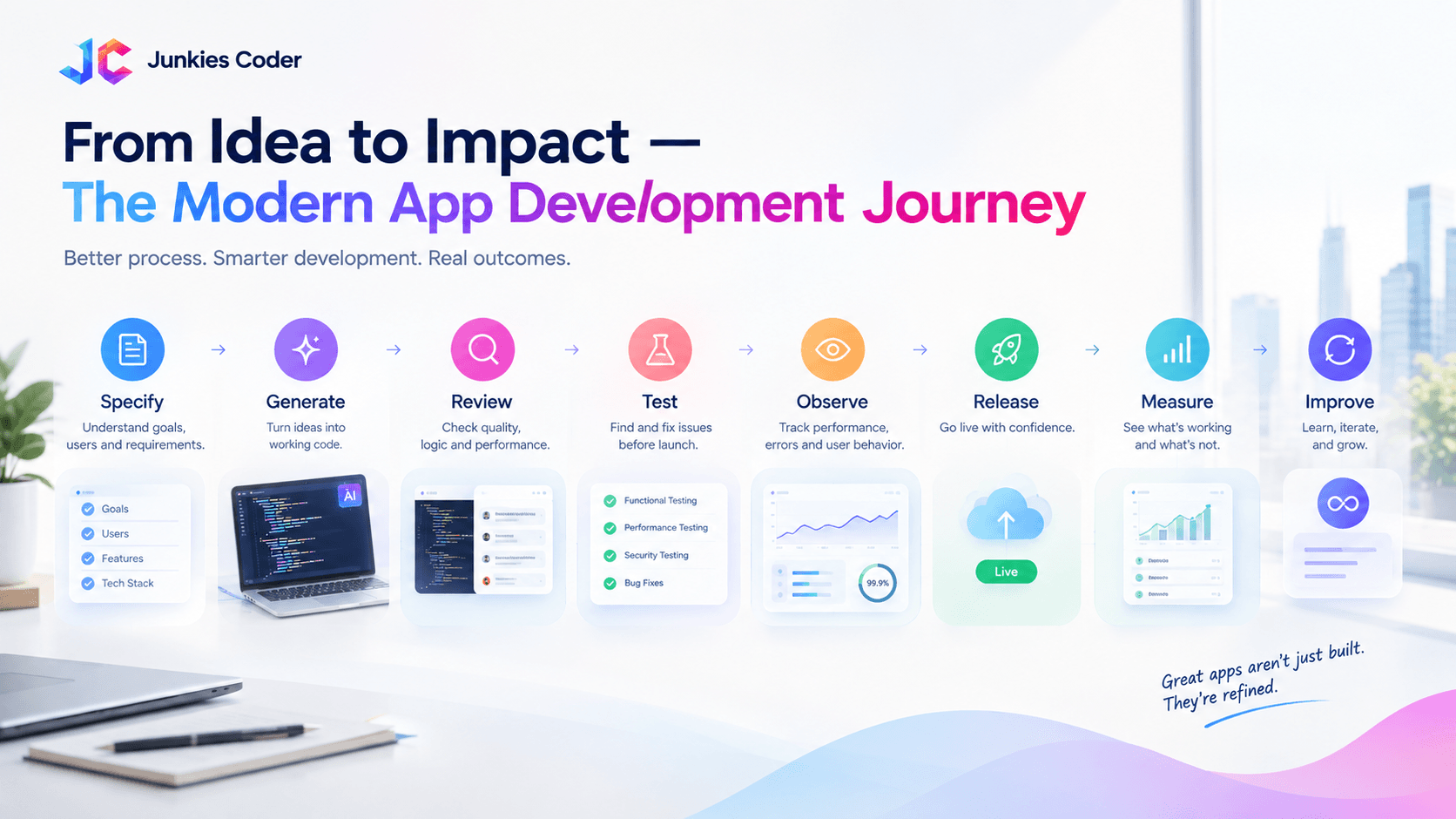
The safest AI application lifecycle is not:
Generate → Deploy → Hope
It is:
AI-Generated Code Provenance Is Becoming a Business Requirement
AI code provenance answers a simple but increasingly important question:
What created this code, and what evidence supports its release?
For high-impact AI-generated components, organizations should consider retaining:
- The approved requirement or specification
- AI tool and model information
- Relevant generation context
- Human reviewer and approval status
- Dependency and license information
- Security scan results
- Test coverage
- Failed-test history
- Remediation records
- Deployment version
- Environment information
- Rollback reference
This becomes particularly important for regulated products, fintech, healthcare, HR platforms, enterprise SaaS, and applications handling sensitive customer information.
The emerging AI software supply chain will increasingly require organizations to understand not only what code entered production, but also where it came from and what controls were applied before release.
AI Application Security: Where the Real Risk Starts
A polished AI-generated interface can create a false sense of security.
The most serious vulnerabilities often exist behind the UI:
- Broken authorization
- Excessive API permissions
- Exposed secrets
- Weak tenant isolation
- Unvalidated inputs
- Insecure file uploads
- Missing rate limits
- Unsafe database queries
- Improper session handling
- Insecure third-party integrations
This is why AI application security must be validated at the architecture and API layers, not just through a visual review of the generated interface.
Client-side checks are not security boundaries.
If an operation is sensitive, authorization must be enforced on the server.
Can Vibe-Coded Mobile Apps Scale?
Yes, but only when the mobile application is treated as one component of a larger production system.
The question is not whether an AI tool can generate React Native, Flutter, Swift, or Kotlin screens.
The question is whether the entire system can handle:
- Real device diversity
- Unreliable networks
- Concurrent traffic
- Authentication failures
- API outages
- App-store releases
- Backend version changes
- Payment failures
- Push notifications
- Offline behavior
A scalable mobile architecture needs durable authentication, server-side authorization, database controls, API throttling, queue-based processing, crash monitoring, release governance, and observability.
Before launch, review:
- Secure token storage
- Session expiration
- API-level authorization
- Offline and poor-network behavior
- Crash reporting
- Deep-link behavior
- Payment edge cases
- Notification failures
- Permission handling
- Third-party SDKs
- App-store privacy requirements
- Compatibility between old app versions and new APIs
A polished mobile UI can hide serious backend risk.
Production readiness must be validated across the app, API, database, integrations, infrastructure, and deployment pipeline, not just on a simulator.
When Should You Stop Vibe Coding?
Vibe coding is excellent when the cost of being wrong is low.
The risk changes when the application begins handling:
- Customer payments
- Personal or sensitive information
- Multiple customer organizations
- Authentication and authorization
- Business-critical workflows
- Regulatory requirements
- Large traffic volumes
- Complex third-party integrations
A useful rule is:
The more expensive a failure becomes, the less acceptable prompt-only development becomes.
You do not necessarily need to stop using AI.
You need to move from unstructured vibe coding to controlled AI-native engineering.
From AI-Generated Prototype to Production Release
Use this decision gate before committing serious launch budget, marketing spend, or customer acquisition.
| Launch Gate | What Must Be True |
|---|---|
| Product readiness | Core workflows, roles, edge cases and success metrics are documented |
| AI application security | Secrets are protected, authorization is server-enforced and abuse controls exist |
| AI software testing | Critical journeys and failure paths have automated coverage |
| AI observability | Logs, traces, metrics, crash reporting and alerts are active |
| AI app scalability | Queries are optimized, traffic assumptions are tested and expensive APIs have quotas |
| AI code governance | Ownership, reviews, change history and dependency checks are documented |
| Deployment security | Environments are separated and rollback procedures are tested |
| Data protection | Backups, retention, encryption and recovery procedures are verified |
| Commercial readiness | Support, analytics, privacy, terms and incident communication are prepared |
If several of these answers are “not yet,” the application may be a successful prototype, but it is not ready for unrestricted production traffic.
AI Coding Agents vs. Vibe Coding
Vibe coding and AI coding agents are not competing philosophies.
They represent different levels of engineering maturity.
| Vibe Coding | AI-Native Engineering |
|---|---|
| Prompt-led | Specification-led |
| Exploratory | Controlled |
| Optimized for visible output | Optimized for reliable outcomes |
| Chat-context dependent | Repository and system-context aware |
| Manual experimentation | Automated verification |
| Limited traceability | Code provenance and ownership |
| Best for prototypes | Suitable for production systems |
| Fast implementation | Fast implementation + engineering controls |
The future is not “vibe coding versus engineers.”
The more likely direction is agentic software development with engineering guardrails.
AI will increasingly accelerate:
- Product prototyping
- Implementation
- Testing
- Refactoring
- Documentation
- Code review
- Infrastructure tasks
- Operational workflows
Humans will remain responsible for:
- Risk
- Architecture
- Security decisions
- Customer trust
- Business rules
- Compliance
- Production ownership
That is the shift from AI-generated code to AI-native software engineering.
Production-Readiness Priorities
For founders, product leaders, and CTOs, prioritize remediation by potential blast radius.
1. Fix identity and access first
Address authentication, authorization, tenant isolation, session security, privilege boundaries, and rate limits.
2. Protect data second
Validate inputs, enforce transactions, secure migrations, maintain backups, encrypt sensitive information, and test recovery.
3. Make failures visible third
Implement error tracking, structured logs, traces, dashboards, alerts, and clear incident ownership.
4. Automate critical verification fourth
Prioritize payments, sign-up, permissions, data writes, authentication, and third-party integrations.
5. Control change fifth
Use pull requests, staging environments, security scans, feature flags, approval gates, and tested rollback procedures.
6. Optimize scale and cost sixth
Review database performance, caching, queues, API budgets, concurrency assumptions, infrastructure limits, and load-test results.
Future Impact: The Next Phase of AI Software Development
The next phase of AI software development will not be defined only by how quickly teams can generate applications.
It will increasingly be defined by how quickly they can productionize those applications safely.
That creates a new engineering category around:
- AI application security
- AI software testing
- AI code governance
- AI code provenance
- AI application observability
- AI app scalability
- AI-native DevSecOps
- AI production readiness
The competitive advantage will belong to teams that can move from prototype velocity to production confidence without losing the speed that made AI coding attractive in the first place.
Organizations that treat vibe coding as a starting point, not a complete strategy, will be better positioned to:
- Win enterprise deals that require security and compliance evidence
- Avoid costly rewrites after early traction
- Build products that can scale beyond early adopters
- Maintain engineering velocity without accumulating unmanageable technical debt
FAQs
What is vibe coding in AI?
Vibe coding is a prompt-first approach to software creation where someone describes an application or feature in natural language and relies heavily on AI-generated code rather than manually implementing every component.
It is highly effective for rapid experimentation and prototyping. However, AI-generated output still requires engineering verification before it handles sensitive data, payments, authentication, or business-critical workflows.
What AI tools are used for vibe coding?
Teams use conversational AI coding assistants, AI app builders, agentic IDEs, and code-generation platforms.
The important evaluation criteria are not simply which AI model generates the most code. For production environments, teams should also evaluate repository awareness, testing capabilities, code review workflows, security controls, environment management, dependency handling, and deployment support.
How do you develop an app with vibe coding?
Start with a narrow problem and a structured product specification. Generate a small working workflow, validate it with target users, and then introduce production engineering controls before broad release.
Use version control, documented requirements, automated testing, human review, security scanning, observability, and staged deployment from the first meaningful beta.
What are successful vibe-coded apps?
Early successful use cases tend to be relatively constrained products such as internal dashboards, marketing tools, lightweight workflow automation, customer portals, MVPs, and single-purpose utilities.
The key factor is not whether AI generated the application.
It is whether the team matched the development approach to the application's risk level.
Can an AI-built app be production-ready?
Yes.
AI-built applications can be production-ready when teams add secure architecture, tested business logic, data protection, observability, scalable infrastructure, governance, and accountable ownership.
AI generation is not the blocker. Shipping without sufficient evidence, controls, and ownership is.
The Commercial Opportunity Behind the Production Gap
The next phase of AI software development will not be defined only by how quickly teams can generate applications.
It will increasingly be defined by how quickly they can productionize those applications safely.
That creates a new engineering category around:
- AI application security
- AI software testing
- AI code governance
- AI code provenance
- AI application observability
- AI app scalability
- AI-native DevSecOps
- AI production readiness
The competitive advantage will belong to teams that can move from prototype velocity to production confidence without losing the speed that made AI coding attractive in the first place.
The strongest commercial positioning is therefore not:
“We build apps with AI.”
It is:
“We turn AI-generated applications into production-ready software, secure, observable, scalable, governed, and maintainable by your team.”
If you are evaluating an AI-built application for launch, the most valuable next step is not another feature.
It is a structured production-readiness review: mapping current gaps in security, testing, observability, governance, and scalability, and prioritizing fixes that directly reduce business risk.
That is where the real value of AI-native engineering begins.