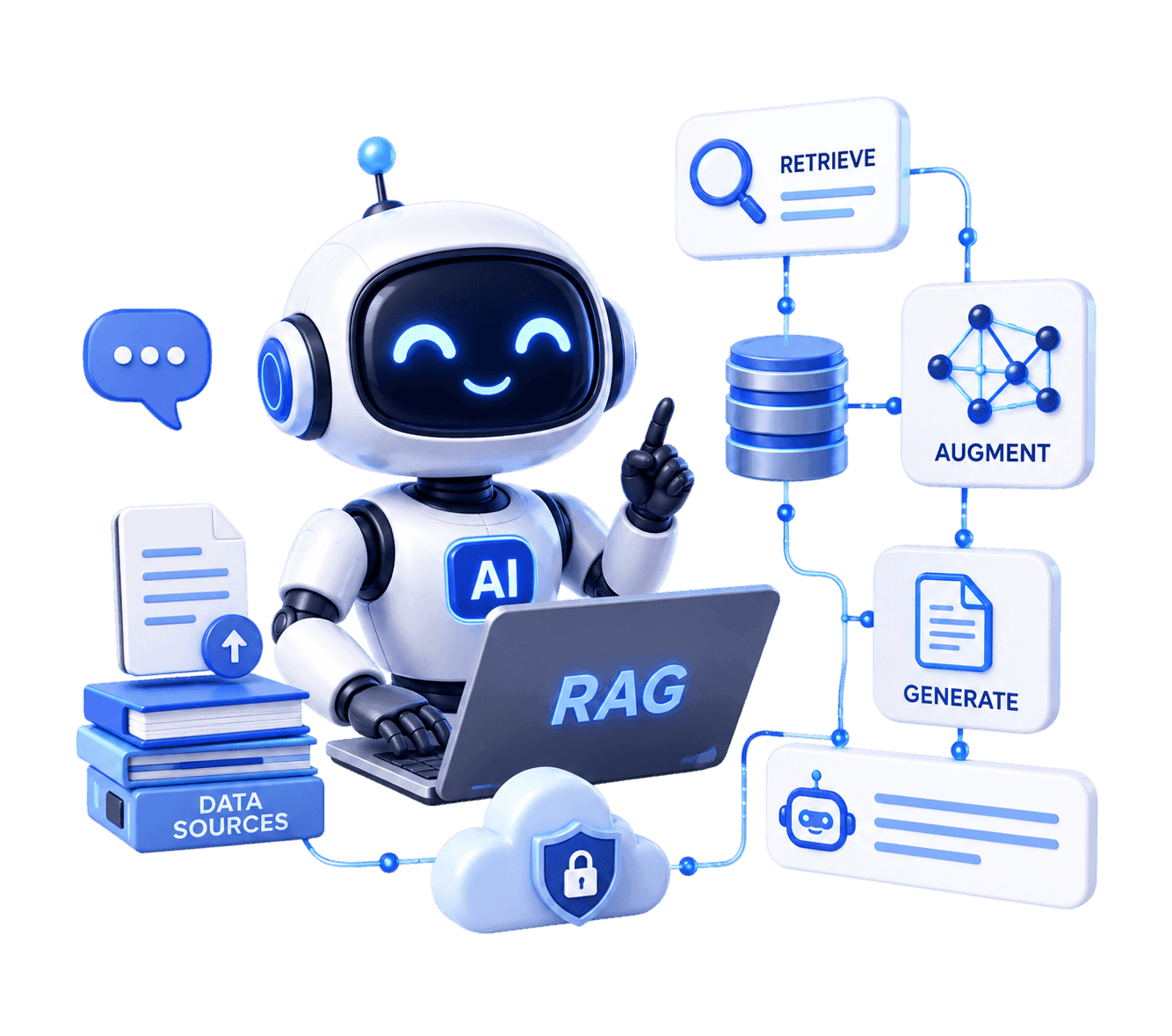
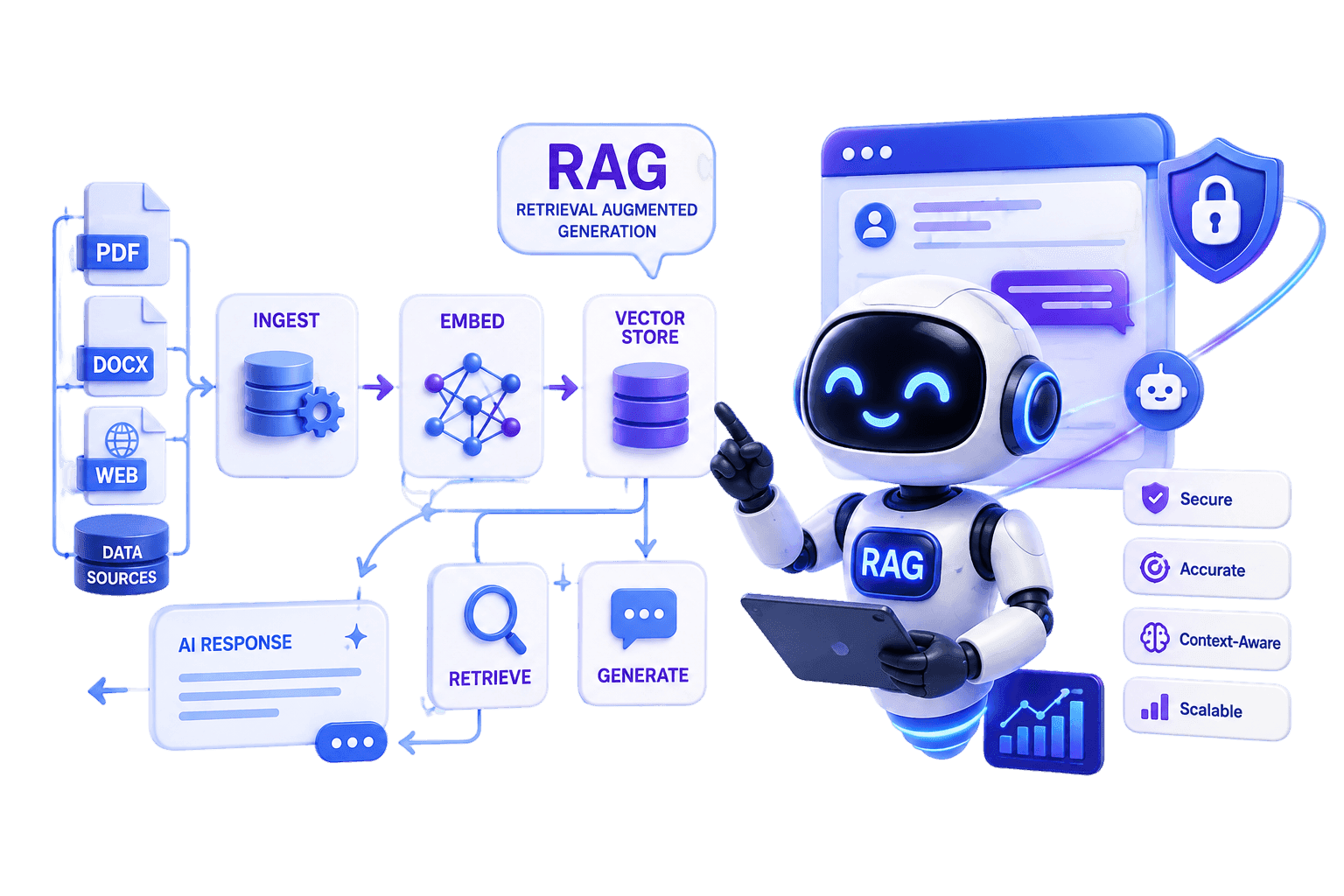
Retrieval-Augmented Generation (RAG) development services empower enterprises to connect foundation Large Language Models (LLMs) to their proprietary data repositories, internal wikis, and structured databases. By framing AI deployment as an open book exam, a professional RAG engineering pipeline pulls authoritative facts from company PDFs, legal contracts, live SQL tables, and enterprise platforms (SharePoint, Confluence, Notion) to eliminate hallucinations and securely ground outputs in your business logic without requiring model retraining.

Enterprise RAG Pipelines
Vector Search & Agentic AI
Empowering awards and recognition to Drive Innovation and Success with
our unparalleled expertise and commitment to excellence.
Years of experience
Countries Served
Average cost P/H
Positive Feedbacks
Projects delivered
Experts & Engineers
CORE FEATURES
Junkies Coder builds RAG systems around your data, workflows, and AI use cases. We combine hybrid retrieval, semantic search, reranking, and agentic workflows for stronger context and accuracy. Our architectures are secure, scalable, and production-ready.
Hybrid Retrieval (Vector + BM25)
Vector Databases (Pinecone/Qdrant)
Agentic Multi-Agent Workflows
Enterprise Security & Private VPC
Zero-Hallucination Guardrails & Ragas
Multi-Format Parsers & OCR
Moving from an initial PoC to an enterprise RAG platform requires a structured engineering roadmap delivered within predictable timelines.
Define business goals, audit document schemas, and select vector store technologies.
Build document parsers, chunking rules, and embed proprietary knowledge assets.
Engineer hybrid search logic, re-ranking algorithms, and token context limits.
Connect Text-to-SQL tools, enterprise webhooks, and user interface widgets.
Run Ragas benchmarks, test prompt injection defenses, and audit compliance.
Deploy to production on private cloud VPCs with live telemetry trace logging.
Explore custom Retrieval-Augmented Generation solutions engineered for enterprise document search, internal knowledge retrieval, and automated workflow execution.

Industry
Artificial Intelligence
Platform
Web & Enterprise API
Location
New York, USA
Outcomes
Production Ready Runtime
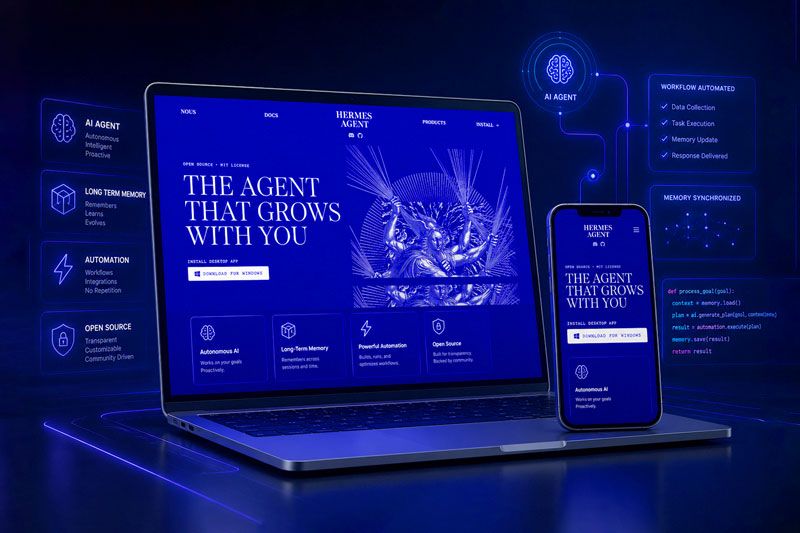
Nous Research developed the Hermes model family, featuring advanced agentic reasoning and complex function calling capabilities. Junkies Coder engineered the enterprise integration runtime and secure sandbox environment for Hermes, enabling businesses to deploy autonomous software agents within secure, production ready workflows.
Whether you're looking to develop a digital solution from scratch, scale your current offerings, or fully modernize your system, we are here to help.
OUR EXPERTISE
From unstructured document engineering to hybrid vector retrieval, prompt optimization, and agentic workflows, we engineer production grade RAG pipelines tailored to your security, scale, and latency targets.
Schedule a technical consultation to discuss your data sources, vector architecture, and custom RAG engineering roadmap.

We integrate your RAG system with the platforms, databases, and communication channels your team already uses, enabling seamless information flow and context-aware responses.
01
Dense vector retrieval coupled with sparse BM25 keyword matching for high recall and precision across corporate document repositories.
02
Adaptive text chunking strategies preserving document context across parent-child relationships and metadata tags.
03
Deploying Cohere Rerank models to filter top-k retrieved passages before LLM prompt injection.
04
Coordinated swarms of specialized autonomous agents executing multi step retrieval and operational tool logic.
05
Autonomous agents translating natural language questions into secure SQL queries for relational databases.
06
Sanitization boundaries preventing prompt injection attacks and sensitive employee or customer data leakage.
07
Strict prompt rules enforcing explicit document names, links, and page number citations in generated answers.
08
Redis-backed semantic query caching reducing LLM API token consumption by up to 40% on recurring queries.
09
Containerized execution deployed within private VPCs or on-premises infrastructure for total data sovereignty.
10
Automated synthetic evaluation pipelines measuring faithfulness, answer relevance, and context recall.
11
Ingesting unstructured text from PDFs, Word docs, scanned files via OCR, and live spreadsheets into vector stores.
12
Custom embedding adapters tuned on specialized corporate terminology, legal contracts, or medical guidelines.
Our RAG development teams deliver domain-specific retrieval solutions engineered for regulated industries, complex data workflows, and internal knowledge search.
A structured engineering methodology built to deliver accurate, grounded RAG applications with zero data leakage and enterprise-grade security.
Evaluate unstructured data sources (PDFs, SQL, SharePoint, Confluence), define privacy boundaries, and set retrieval targets.
Configure semantic chunking logic, select embedding models, and index data into high-performance vector databases (Pinecone, Qdrant).
Implement hybrid dense-sparse vector search, integrate ML re-rankers (Cohere Rerank), and optimize token context windows.
Design system prompts, enforce source citations, and connect autonomous agentic tools like Text-to-SQL or API webhooks.
Run automated Ragas evaluation suites, test PII guardrails, deploy to private cloud VPCs, and configure live trace logging.
Shalehin Modasia
Marketing DirectorENGAGEMENT MODELS
Flexible commercial structures tailored to your project scope, technical requirements, and long-term AI strategy.
Defined milestone delivery for scoped custom RAG builds with guaranteed timelines and budgets.
Schedule Scoping CallFull-time Machine Learning Engineers, Vector Search Architects, and Full-Stack Developers operating as an extension of your team.
Hire Dedicated RAG SquadOn-demand AI engineers specializing in Python, LlamaIndex, LangChain, RAG pipelines, and vector database integrations.
Augment Your AI TeamReal stories from real partners who experienced clarity, accountability, and measurable business growth.
We select foundation models, vector databases, orchestration frameworks, and evaluation tools engineered for sub-second retrieval, zero hallucination, and private cloud deployment.
Featured Technologies

Pinecone

Qdrant
Milvus
PGVector
Enterprise RAG platforms handle proprietary business data. We embed strict access permissions, role-based controls, and regulatory compliance standards directly into the retrieval and inference layers.
We engineer RAG solution architectures around modular microservices, vector retrieval, strict security guardrails, and continuous MLOps evaluation.
Connect foundation LLMs directly to private databases and wikis without expensive model retraining cycles.
Deploy within private AWS, Azure, or GCP cloud VPCs with strict role based access controls.
Every AI response includes explicit document names, page numbers, and verifiable source citations.
Optimized vector indexing and Redis caching delivering fast query responses at scale.
Autonomous agents decompose complex queries into specialized subtasks and tool lookups before synthesizing answers.
Continuous benchmarking pipelines evaluating answer faithfulness, relevance, and context recall prior to release.
Sanitization boundaries shielding internal vector databases from malicious prompt injections and data leaks.
Dense embedding retrieval coupled with BM25 sparse keyword matching to maximize search recall across specialized terminology.

Retrieval-Augmented Generation (RAG) connects foundation Large Language Models (LLMs) to private, authoritative business datasets. Before generating a response, the system retrieves relevant document passages from a vector database, grounding the LLM output strictly in verified facts to eliminate hallucination.
Fine-tuning updates model weights to adapt tone or task behavior, but is expensive and static. RAG acts as an open book exam, retrieving real time information from dynamic company databases without needing model retraining.
RAG pipelines process unstructured text from PDFs, Word documents, scanned files via OCR, spreadsheets, live SQL databases, and internal knowledge platforms like SharePoint, Confluence, or Notion.
Vector databases index document chunks as high dimensional numerical embeddings. They enable semantic search based on context and meaning rather than simple keyword matches, dramatically improving retrieval relevance.
Standard RAG executes a single fetch and answer step. Agentic RAG deploys autonomous AI agents equipped with tools (Text-to-SQL, web search, API webhooks) to perform multi step reasoning, query decomposition, and self-correction before returning a final answer.
Data privacy is enforced by deploying RAG pipelines inside private cloud VPCs (AWS, Azure, GCP), implementing role based access controls (RBAC), applying PII redactors, and ensuring zero data retention policies on foundation model APIs.
Developing a custom RAG solution typically takes 4 to 6 weeks for a proof of concept (PoC) or basic MVP, and 10 to 16 weeks for a full production grade system with hybrid retrieval, agentic tools, and MLOps evaluation.
Chunking strategies depend on document structure. We implement dynamic semantic chunking, parent-child hierarchical chunking, and sliding window techniques with metadata preservation to ensure complete contextual retention across multi page PDFs and manuals.
Vector search retrieves top candidate chunks based on approximate nearest neighbors. Cohere Rerank applies a secondary cross encoder machine learning model to score semantic relevance against the exact query, filtering out noise before prompt injection.
Yes. We integrate multi format document parsers such as LlamaParse and Unstructured.io alongside vision enabled OCR models to extract tables, diagrams, and scanned text into structured vector representations.