Outsource software development to a team that brings senior engineering capacity, domain-specific delivery experience and a structured governance model accountable to your technical requirements and business outcomes.

Trusted Software Outsourcing Partner
Empowering awards and recognition to Drive Innovation and Success with our unparalleled expertise and commitment to excellence.
Years of experience
Countries Served
Average cost P/H
Positive Feedbacks
Happy Success Stories
Experts & Engineers
CORE FEATURES
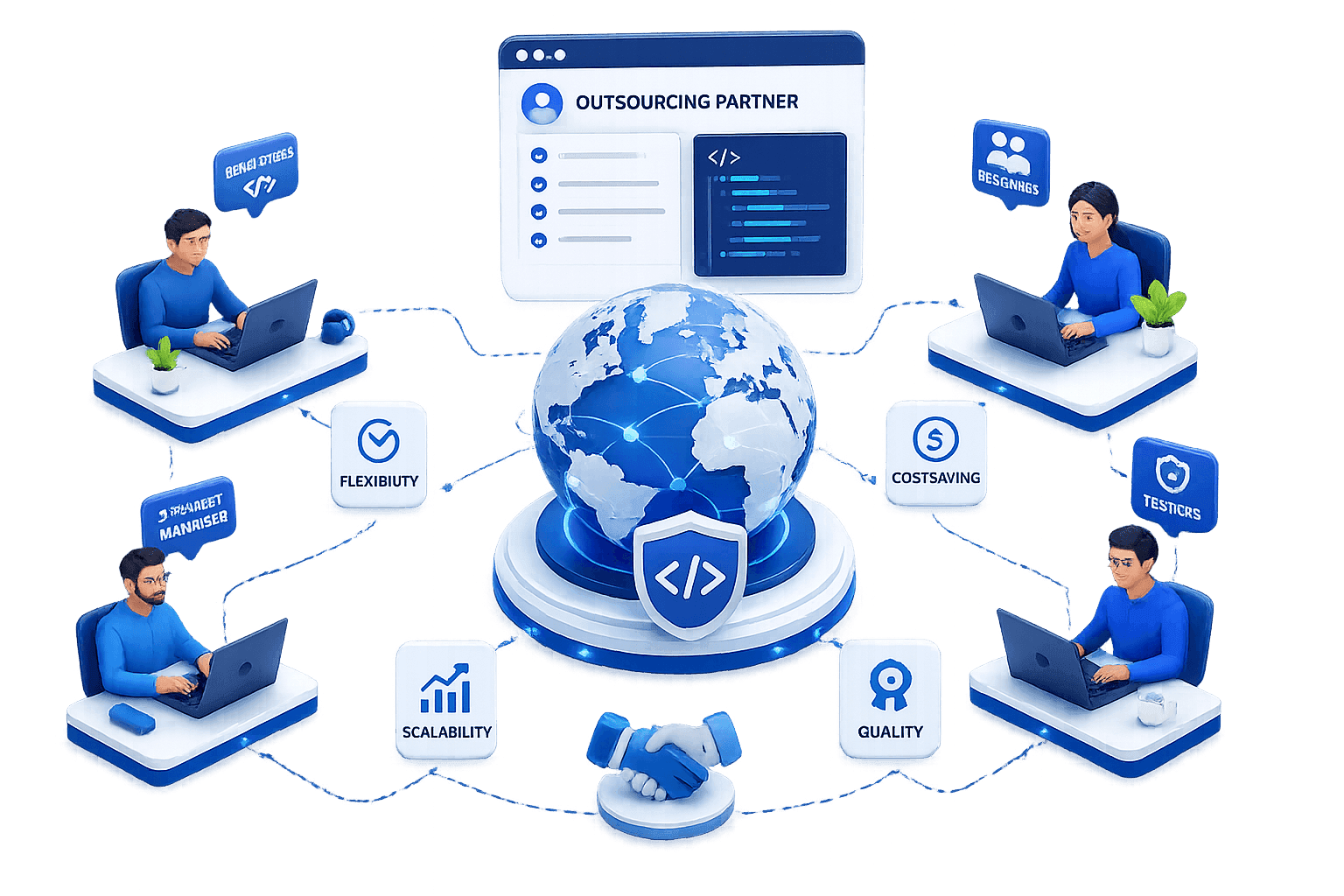
From dedicated offshore development teams to individual developer augmentation, we cover every outsourcing model your organization needs to extend engineering capacity without sacrificing delivery quality.
Dedicated Offshore Development Team
Developer Staff Augmentation
Full-Stack Web Development Outsourcing
Mobile App Development Outsourcing
QA and Testing Outsourcing
DevOps and Cloud Engineering Outsourcing
Outsourcing fails when vendors optimize for billable hours rather than delivery outcomes. The PROOF Standard applies to every outsourced engagement at Junkies Coder, meaning performance commitments, responsible staffing, code ownership, sprint accountability, and future-ready contribution standards apply regardless of engagement size.
Velocity targets, code quality standards, review turnaround times, communication response SLAs, and definition-of-done criteria are agreed in writing before the first developer joins your sprint. Expectations are not implied, they are documented.
Every developer presented for your engagement has passed our internal technical assessment. You conduct a technical interview before any developer is confirmed. The developer you interview is the developer who works on your project.
All code written by Junkies Coder developers is committed to your repositories under your ownership from the first commit. If the engagement ends, you have every line of code written to that point with no retrieval friction.
Every sprint closes with a written delivery report and velocity update. You have permanent access to the live project tracker in real time. You never depend on asking for a status update because the status is always visible.
Every developer contribution follows documented coding standards, includes inline documentation for non-obvious logic, and passes automated quality gates before merge. The codebase you receive is one your internal team can maintain and extend independently.
Each platform shown here was commissioned as an outsourced delivery where Junkies Coder held full engineering ownership from discovery through post-launch, serving real users across real operational conditions.

Industry
Automotive
Platform
Web-Based B2B Marketplace
Location
Dubai, UAE
Outcomes
Scalable B2B Marketplace
SourceVehicle is a vehicle inventory aggregator connecting dealers with global buyers for passenger and commercial vehicles.Junkies Coder builds a scalable B2B marketplace with inventory management, multi-currency transactions, logistics and secure payments.

Industry
Agro Logistics
Technology
Web / IoT / ERP
Location
India
Outcomes
50% Reduction
Vaishnodevi Agro Resources Pvt. Ltd needed a digital tracking system to replace manual agro-logistics processes in Radhanpur, India, covering truck entries, weighbridge, seed processing, lab reporting and dispatch management.
Whether you're looking to develop a digital solution from scratch, scale your current offerings, or fully modernize your system, we are here to help.
OUR EXPERTISE
Software development outsourcing spans multiple delivery models, each structured around a different engineering requirement, aligned to your actual capability gap before any engagement is agreed.
Build and scale a high-performing offshore software development team in India, combining senior technical talent, agile delivery practices, and cost-effective outsourcing that reduces engineering costs by up to 60%.
Get a fully managed, dedicated development team that works exclusively on your projects, with committed capacity, direct team access, and embedded delivery governance aligned to your internal processes.
Outsource end-to-end software development, from business analysis and UI/UX design to development, QA testing, DevOps, and post-deployment maintenance under one delivery accountability structure.
Rapidly embed pre-vetted, senior software engineers into your existing in-house teams, addressing skill gaps, scaling sprint capacity, or accelerating time-critical development milestones within days.
Strengthen software quality without growing your internal QA headcount, covering functional, automation, performance, and security testing for web, mobile, and enterprise software platforms.
Get strategic guidance on outsourcing model selection, offshore team governance, and vendor management before committing to an engagement, reducing setup risk and accelerating your outsourcing program ROI.
Structured onboarding, sprint-level accountability, and full code ownership from day one. Your dedicated development team is contributing to your sprints by week two.

Beyond immediate cost savings, our software development outsourcing model delivers compounding advantages that improve delivery speed, strengthen software quality, and reduce operational risk over time.
01
Outsourcing your software development to India eliminates recruitment overhead, benefits costs, office infrastructure, and bench management expenses, delivering the same senior engineering output at up to 60% of the total cost of an equivalent local hire.
02
Our pre-vetted developer bench means your outsourced team is profiled, matched, and contributing to your sprint within 2 to 3 weeks of kickoff, not the 6 to 8 weeks most enterprise hiring cycles require.
03
Every developer presented for your project is the developer who works on your project. We do not pitch senior profiles and deliver junior replacements, and every engineer passes a technical assessment before client introduction.
04
You own 100% of the code, architecture, and intellectual property from day one. Every engagement is covered by a comprehensive NDA and IP assignment agreement so your competitive advantage stays yours, not ours.
05
Our India-based development teams operate across IST, overlapping with US, UK, and European business hours, giving your product continuous development momentum and same-day response to critical issues across time zones.
06
Every outsourcing engagement includes a dedicated project manager who owns communication, sprint planning, and escalation management, with weekly sprint reports, live project trackers, and direct developer access so you always know exactly where your project stands.
Domain knowledge is what separates a strategic outsourcing partner from a generic development vendor. Our outsourced teams carry real delivery experience in industries where software complexity and compliance requirements are highest.
A structured, low-friction onboarding process that gets offshore teams productive within weeks, building the operational foundation needed for reliable, long-term software outsourcing success.
We analyze your software development goals, technology stack, team skill gaps, budget, and timeline, then recommend the right engagement model, offshore team composition, and developer profiles.
We handpick pre-vetted engineers based on technical skill assessment, domain expertise, and cultural fit, presenting shortlisted profiles for your team to interview and approve before onboarding.
A dedicated onboarding sprint covers codebase walkthroughs, toolchain access, agile process alignment, communication cadence setup, and initial backlog grooming, getting teams productive fast.
The offshore team delivers in structured sprints with automated velocity tracking, weekly stakeholder reviews, risk reporting, and escalation protocols, giving you complete program visibility without micromanagement.
Quarterly business reviews analyze delivery metrics, team performance, and roadmap alignment, proactively adjusting team composition, tech stack, or sprint capacity before bottlenecks impact delivery.
Shalehin Modasia
Marketing DirectorENGAGEMENT MODELS
From fixed-budget projects to long-term Offshore Development Center contracts, our commercial engagement models give you the right level of financial predictability, team flexibility, and delivery control.
Maximum flexibility for evolving requirements and exploratory programs. You pay for actual effort delivered with full transparency into timesheets, sprint output, and team utilization, ideal for agile outsourcing engagements.
Get a free consultationIdeal for custom software projects with stable, well-defined scope. We commit to a fixed timeline and delivery budget with milestone-based payment gates and shared risk accountability on any scope variances.
Get a free consultationA fully committed offshore development team working exclusively on your programs under a long-term capacity contract, with dedicated engineers, KPI-linked performance reviews, and direct management access.
Get a free consultationReal stories from real partners who experienced clarity, accountability, and measurable business growth.
We don't place generalists, every outsourced developer brings hands-on delivery experience in the specific technology stack your software project requires.
Featured Technologies
Node.js
Python

Java

Spring Boot
.NET Core

PHP

Laravel

Golang
Every outsourced software development engagement is engineered against the applicable regulatory framework from the architecture phase, with documented compliance implementation delivered as part of the engagement.
SOC 2 Type II
ISO/IEC 27001
ISO 9001

GDPR
CCPA

FERPA
HIPAA

HITECH

PCI-DSS
SSAE 18
CSA STAR Certification
FISMA
NIST SP 800-53

FedRAMP

ITAR
SOX
CMMI
SAMHSA
MIPS
MACRA

HL7
FHIR
Outsourcing works when the vendor operates with the same accountability standards as an internal team. Our model is built around delivery outcomes, not engagement extension.
Every developer on your project has passed a multi-stage technical assessment. The developer presented in the profile interview is the developer who works on your project.
Our structured onboarding process means your outsourced team members are reading your codebase in week one and contributing to your sprint by week two.
Every sprint produces a written delivery report covering completed work, test coverage, open risks, and next sprint scope with live project tracker access at all times.
Our India-based teams operate with structured overlap hours covering US Eastern, US Pacific, UK, and Central European time zones for same-day responses and continuous development momentum.
Comprehensive NDA, IP assignment agreement, and source code escrow are executed before development begins. Your code is legally yours from the first commit with no ambiguity at engagement close.
Team size adjustments and technology additions are processed within one to two weeks without new procurement cycles, making engagement scaling genuinely flexible.

Software development outsourcing is the practice of engaging an external engineering team to take delivery responsibility for part or all of a software development programme. It includes any arrangement where engineering work is performed by a team outside the client organisation under a defined commercial structure, from full engagement outsourcing where the external team owns every technical decision, to staff augmentation where individual engineers join an existing internal team. What outsourcing includes depends on the engagement model. Full cycle software development outsourcing covers the complete lifecycle: product discovery, technical architecture, UI and interaction design, frontend and backend engineering, quality assurance, cloud infrastructure provisioning, compliance validation and post-launch support. The client defines the business outcome required. The outsourcing partner owns every delivery decision between the architecture approval and the production deployment. Staff augmentation outsourcing places specific engineers inside an existing delivery workflow. The client retains delivery ownership and management. The outsourcing partner provides engineers who contribute under the client's processes, tools and sprint cadence. This is the correct model when the client has an existing engineering team and a specific skill gap or throughput constraint. Dedicated team outsourcing assigns a defined engineering team to operate exclusively on the client's product. The team is managed by the outsourcing partner under a governance structure the client participates in through regular milestone reviews. This model sits between full cycle outsourcing and staff augmentation in terms of client delivery involvement. Junkies Coder delivers all three models, selecting the correct structure based on whether the client has an internal engineering function, what delivery ownership they want to retain, and what the compliance and domain knowledge requirements of the engagement are.
Businesses choose software development outsourcing over in-house hiring for reasons that vary by company size and situation, but five motivations appear consistently across the clients Junkies Coder works with. Access to domain-specific experience without the recruitment timeline. Hiring a senior engineer with prior delivery experience in fintech compliance architecture or healthcare HIPAA-aligned data handling takes months through a standard recruitment process. Engaging an outsourcing partner with that experience in the team takes weeks. For businesses with a time-sensitive delivery requirement, the recruitment timeline alone makes in-house hiring the slower path. Cost structure flexibility. An internal engineering team carries fixed costs regardless of delivery volume: salaries, benefits, tools, office infrastructure and the management overhead of running a technical team. An outsourcing engagement scales to the scope of the work. When the delivery programme ends, the cost ends with it. For businesses commissioning a defined platform build rather than maintaining an ongoing engineering operation, outsourcing produces a lower total cost over the engagement horizon. Absence of an internal technical leadership function. Many businesses commissioning their first software platform do not have a CTO, VP of Engineering or senior technical lead capable of defining the architecture, evaluating technology decisions and managing engineering delivery. Outsourcing transfers that function to the external partner. The client sets commercial priorities and business requirements. The partner makes every technical decision within the agreed governance structure. Speed of capacity scaling. Adding three senior backend engineers to an outsourcing engagement takes one to two weeks. Adding three engineers to an internal team takes two to four months when accounting for job posting, screening, interviews, offer negotiation and notice periods. For businesses responding to an accelerated delivery requirement or a time-sensitive commercial opportunity, outsourcing provides the only realistic path to rapid capacity increase. Risk distribution. A software development outsourcing arrangement places delivery risk on the external partner. When delivery timelines slip, the outsourcing partner carries the cost of additional engineering effort to recover. When technical decisions produce poor performance outcomes, the outsourcing partner is accountable for remediation within the agreed commercial structure.
The choice between engagement models is the most consequential decision in any software development outsourcing arrangement, and it is one that most businesses make without adequate information because the models are often presented as alternatives on a cost spectrum rather than as solutions to distinct client situations. Full cycle software development outsourcing is the correct model when the client has no internal engineering function capable of managing a software delivery programme, when the delivery requirement has a defined scope and timeline, and when the client's primary concern is the business outcome the software delivers rather than the technical decisions made along the way. This model transfers the most delivery responsibility to the partner and requires the most trust in the partner's engineering judgement. Dedicated team outsourcing is correct when the client has a product that requires ongoing engineering investment over 12 months or more, when the scope evolves continuously rather than following a fixed delivery plan, and when the client wants a team with accumulated knowledge of the product rather than a new team assigned to each phase. A dedicated team is appropriate when the client wants delivery ownership at the milestone level but not at the individual task level. Staff augmentation is correct when the client has an existing internal engineering team that is managing delivery effectively but lacks specific skills or sufficient throughput for a defined period. The client retains delivery management. The augmented engineers contribute under the existing team's processes and reporting structure. This is not a substitute for full outsourcing when no internal team exists, and it should not be used as a cost-reduction mechanism when the engagement requires integrated delivery ownership. Junkies Coder produces a written engagement model recommendation as part of the initial discovery consultation, based on the client's existing engineering capacity, the delivery scope, the compliance requirements and the commercial timeline.
The discovery phase is the structured work done before development begins that converts a business requirement into a deliverable engineering specification. It is necessary because software development outsourcing engagements that begin without a discovery phase consistently produce two failure modes: scope misalignment, where the software delivered does not match what the business required, and budget overruns, where requirements that were not identified at the start require significant rework mid-engagement. Junkies Coder's outsourcing discovery phase runs for 2 to 4 weeks depending on the complexity of the software being built and produces five documented deliverables. The first is the product requirements specification: a structured document that defines every system function, user role, data entity and external integration the software must support. The second is the system architecture document: component diagram, data model, API contracts and infrastructure topology. The third deliverable is the UI and interaction specification: wireframes for every user flow that has been identified in the requirements specification, validated against the business logic that drives each screen. The fourth is the compliance requirements mapping: every regulatory standard applicable to the software and the specific architectural controls required to meet it, documented before any engineering decisions are made. The fifth deliverable is the phased delivery plan: a milestone schedule with defined deliverables per sprint, client review points, and a total engagement timeline that reflects the documented scope. This plan becomes the baseline against which delivery progress is measured throughout the engagement. All discovery deliverables are owned by the client at the conclusion of the discovery phase, regardless of whether the development engagement proceeds with Junkies Coder. Clients who commission a discovery phase receive a complete engineering specification they can take to any development partner.
Software development outsourcing cost is determined by four variables: the scope of engineering work, the seniority of the engineers required, the duration of the engagement and the compliance architecture requirements of the industry. For a focused platform build with a defined feature set, a standard backend API, cloud deployment and no regulated industry compliance requirements, a full cycle outsourcing engagement typically costs USD 50,000 to USD 150,000 across a 12 to 20 week delivery timeline. This range covers product discovery, architecture, frontend and backend development, QA and production deployment. For a mid-complexity platform with real-time features, multiple third-party integrations, a mobile application component and standard compliance requirements (GDPR, basic data encryption), the cost typically falls in the USD 150,000 to USD 350,000 range across a 6 to 10 month engagement. ERP integrations and complex data transformation requirements are the most frequent cost drivers that move engagements from the lower to the upper end of this range. Enterprise-grade platform outsourcing requiring HIPAA, PCI DSS or SOC 2 compliance architecture, multi-region cloud infrastructure, high-concurrency load design and a phased feature roadmap spanning 12 months or more represents an investment above USD 350,000, scoped after a paid discovery phase. Compliance architecture is the cost multiplier most frequently underestimated at the proposal stage: adding HIPAA-compliant data handling after an architecture is set costs three to five times more than designing for it at the outset. Staff augmentation outsourcing is priced at an engineering day rate reflecting the seniority and specialist experience of the augmented engineers. Senior engineers with prior compliance architecture experience carry higher day rates than generalist backend engineers, and this difference in rate reflects a difference in the time required to produce correct technical decisions, not just a difference in billing.
Software development outsourcing engagement duration is determined by the scope of engineering work defined during discovery, the complexity of the system being built and the number of integration points with external systems. Timeline estimates produced before a discovery phase is complete are indicative only. Following completion of a discovery phase, the timeline for a focused platform build with a defined feature set typically runs 10 to 18 weeks from the start of development to production deployment. This includes frontend and backend engineering, QA, integration testing and cloud deployment, but not the 2 to 4 weeks of discovery that precede it. A mid-complexity platform with real-time features, mobile components and multiple integration points typically requires 5 to 9 months of development following discovery. Integrations with ERP systems are the most common source of timeline extension in this category because ERP APIs are frequently underdocumented and require custom connector development. Enterprise platform builds with compliance architecture, multi-region infrastructure and a phased feature roadmap typically run 10 to 18 months for the initial production release, with ongoing delivery capacity retained after launch for feature iteration. The timeline risk that outsourcing clients most consistently underestimate is mid-engagement scope addition. Requirements that were not captured during discovery but emerge during the development phase require assessment, architecture review and prioritisation before development begins. Junkies Coder's discovery phase is designed to surface these requirements before the development contract is signed. Where scope additions arise during development, a defined change control process assesses the timeline and cost impact before the work begins, so the client makes an informed decision rather than discovering the impact after the fact.
Intellectual property protection in a software development outsourcing arrangement requires a specific contractual structure, not a general confidentiality assurance. Junkies Coder's engagement agreements include four elements that together provide the protection a client commissioning a software development programme requires. Non-disclosure agreement with explicit scope. The NDA signed at the outset of every engagement covers the client's business concept, technical requirements, architecture documents, user data structures and any proprietary business logic documented during discovery. The NDA applies to all Junkies Coder personnel assigned to the engagement and remains in force after the engagement ends. IP assignment clause with milestone-based transfer. Source code and all associated engineering artefacts, including architecture documents, API specifications, database schemas and deployment configurations, are assigned to the client at each milestone delivery. The client owns the code that has been delivered and approved at each sprint review. There is no end-of-engagement transfer event where IP changes hands in a single transaction. Source code access and escrow. The client has read access to the source code repository throughout the engagement. For enterprise clients with a specific requirement for code escrow, Junkies Coder supports a third-party escrow arrangement where the current codebase is held by an independent escrow agent and released to the client under defined trigger conditions. Personnel assignment disclosure. The specific engineers assigned to the engagement are disclosed to the client at the start of engagement. No third-party subcontracting of engineering work occurs without the client's written consent. The engineers working on the client's code are Junkies Coder personnel, not contractors sourced through an undisclosed third party.
Transitioning software development work from a failing outsourcing vendor is one of the most operationally sensitive activities in software programme management. The risk of getting the transition wrong includes losing delivery momentum, losing access to code that has not been properly transferred, and inheriting technical debt that the previous vendor did not disclose. The first step is a codebase and documentation audit conducted by the incoming engineering team before any transition timeline is agreed. Junkies Coder's codebase audit covers code quality, test coverage, documentation completeness, dependency currency and the presence of security vulnerabilities in the existing implementation. The audit produces a technical debt assessment that determines whether the existing code can be maintained and extended or whether specific components must be rebuilt. The second step is access transfer. The client must hold, or obtain from the outgoing vendor, access to the source code repository, deployment infrastructure credentials, third-party API keys, database access credentials and any documentation the outgoing vendor produced. Junkies Coder's engagement agreement requires clients to confirm they hold all necessary access rights before the transition engagement begins. The third step is a parallel-run period where Junkies Coder engineers familiarise themselves with the existing codebase before taking delivery ownership. For critical production systems, a parallel-run of 2 to 4 weeks is recommended to reduce the risk of a delivery disruption at the point of vendor change. Junkies Coder can begin a transition assessment within 48 hours of initial contact for clients with an urgent vendor transition requirement. The assessment produces a transition plan with a timeline, a codebase assessment and a recommended approach before the transition engagement is formally commissioned.
Evaluating a software development outsourcing proposal without an internal technical function is one of the most common challenges for business leaders commissioning their first software engagement. Five evaluation criteria can be applied by any decision-maker, regardless of technical background. Specificity of scope documentation. A credible outsourcing proposal describes what will be built with enough specificity that a non-technical reader can verify it matches the requirements discussed. Proposals that respond to a complex brief with generic capability statements and a cost range are not proposals; they are sales materials. Ask for a written description of the system architecture, the technology choices and the rationale for each. Discovery phase as a precondition for development cost commitment. Any outsourcing partner that provides a fixed development cost estimate before conducting a discovery phase is pricing the work without understanding it. Development cost estimates produced before discovery are marketing estimates that protect the partner, not the client. Require a discovery phase before committing development budget. Reference engagement specificity. Ask for references from engagements that are comparable to yours in scope, industry and technical complexity. A reference from a logistics platform build is a relevant data point for a logistics platform engagement. A reference from a consumer mobile app is not. Ask specifically what the reference client would do differently if they engaged the partner again. Team composition disclosure. The proposal should name the specific engineers who will work on the engagement, their experience in the relevant technology stack and their prior delivery experience in the relevant industry. Proposals that describe a team in aggregate terms, citing headcount and years of experience without naming individuals, do not allow the client to evaluate the actual engineering capability being offered. Governance and milestone structure. The proposal should define how the client will be kept informed and how delivery decisions will be made. Milestone review frequency, client approval requirements and change control processes should be specified in the proposal, not discussed verbally after the contract is signed.
Starting a software development outsourcing engagement with Junkies Coder begins with a delivery model consultation, a structured conversation where the Junkies Coder solutions team reviews what the client is trying to build, what internal engineering capacity exists, what the commercial timeline requires and what the compliance obligations of the industry are. The consultation produces a written engagement model recommendation: full cycle outsourcing, dedicated team or staff augmentation, with a rationale that maps the recommendation to the client's specific situation. It also produces an indicative scope outline and timeline range that gives the client a basis for internal budget approval before committing to a formal discovery phase. Clients who proceed commission the discovery phase. This is a 2 to 4 week engagement that produces the product requirements specification, system architecture document, UI design, compliance requirements mapping and phased delivery plan. Discovery phase cost is fixed and scoped separately from the development engagement. All discovery deliverables are owned by the client. Development engagement follows discovery sign-off. The delivery timeline and milestone schedule from the discovery phase become the baseline for the development contract. Sprint reviews occur at defined intervals with client approval required at each milestone before the next phase of development begins. Contact the Junkies Coder team at junkiescoder.com to schedule the delivery model consultation. Engagements are acknowledged within two business hours. The team assigned includes a solutions architect with delivery experience in the relevant industry and a delivery lead who manages the governance structure throughout the engagement.