Custom machine learning, NLP and intelligent automation built for the security, explainability and performance standards that American fintech, healthcare and enterprise organizations require from every production system.

Empowering awards and recognition to Drive Innovation and Success with our unparalleled expertise and commitment to excellence.
Years of experience
Countries Served
Average cost P/H
Positive Feedbacks
Happy Success Stories
Experts & Engineers
HIPAA-Compliant Healthcare AI Development
Fintech Machine Learning and Fraud Detection
Natural Language Processing for Legal and Enterprise
Computer Vision for Manufacturing and Logistics
Generative AI Integration for Enterprise Platforms
Federal and Government AI Consulting
Each engagement follows a five-phase lifecycle covering data readiness, compliance, and feasibility upfront, reducing rework, delays, and cost in US regulated AI projects.
Evaluate client data assets and identify applicable US compliance requirements (HIPAA, CCPA, PCI DSS, SOC 2, federal). Deliver a readiness report and compliance register that establishes the governance baseline before architecture begins.
Define AI architecture, infrastructure, and tech stack aligned with client systems and compliance needs. Documented design is reviewed and approved by stakeholders before any development starts.
Build and train models using controlled, versioned experiments with defined benchmarks. All sensitive data is processed under approved compliance safeguards.
Integrate models with security controls like encryption, access control, and audit logging. Conduct compliance and security testing in production-like environments before deployment.
Deploy with monitoring, drift detection, and retraining triggers. Provide full documentation and handover for independent client operation with optional ongoing support.
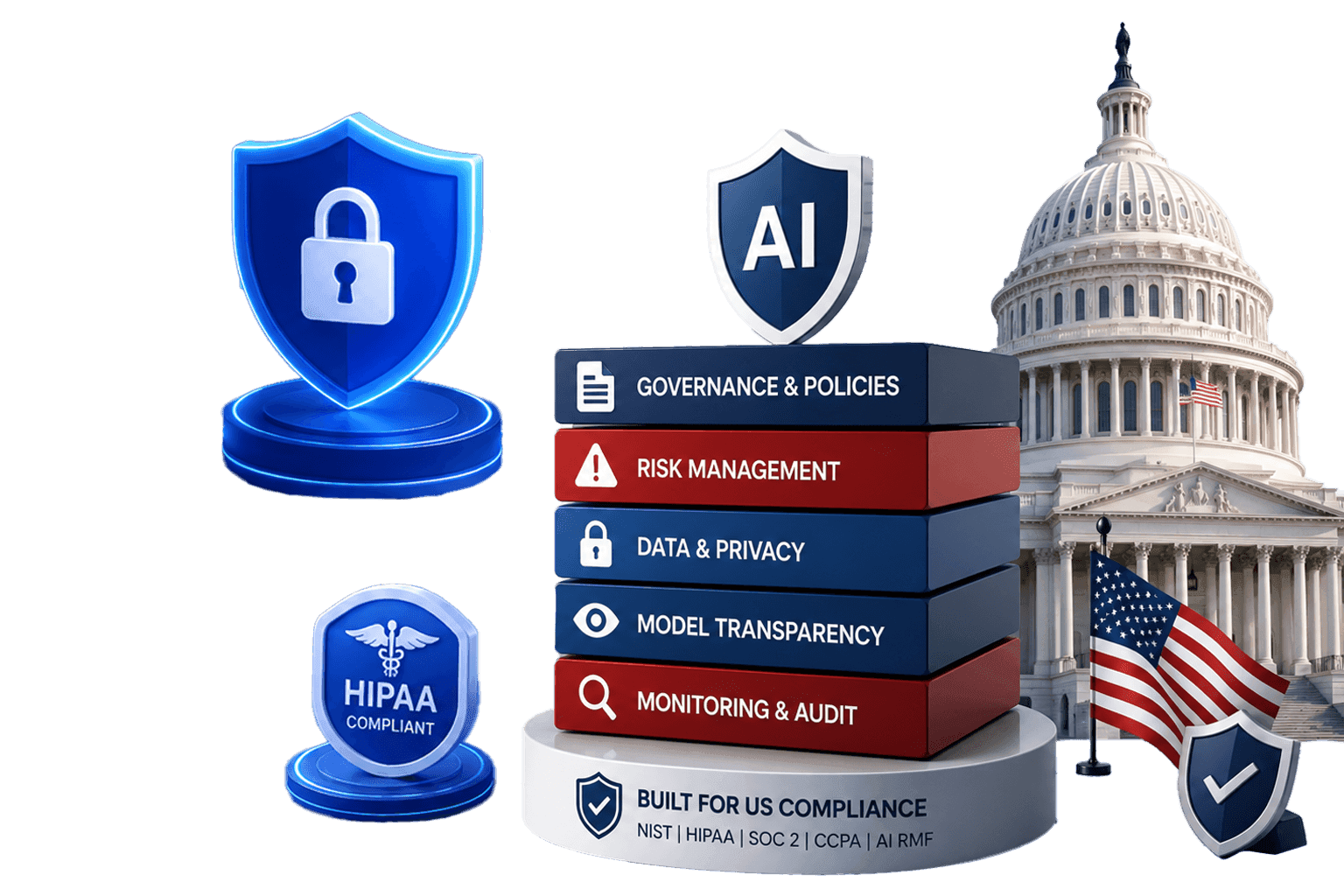
US enterprise and healthcare clients require compliance from the AI architecture stage. Junkies Coder embeds HIPAA, SOC 2, PCI DSS and federal requirements and delivers audit-ready AI systems.

Smart solutions designed to adapt across industries effortlessly, helping businesses streamline operations, enhance performance, and drive sustainable growth.
We follow a transparent, collaborative process, from discovery to deployment. Designed to help founders move fast, stay lean, and build reliable, scalable products.
We explore your vision, goals, and market to create a strategic roadmap through meetings, assessments, and planning.
Wireframes and mockups bring your product to life with intuitive, user-focused design ready for seamless implementation.
We build clean, scalable code supported by testing plans and bug fixing to ensure stability, performance, and reliability.
Agile sprints drive continuous improvement. We support product launch, PR, investor readiness, and long-term growth strategies.
Shalehin Modasia
Marketing DirectorENGAGEMENT MODELS
We adapt to the way your business operates. Whether you need end-to-end ownership of an engagement, additional senior engineering capacity, or a long-term dedicated team aligned to your goals, our engagement models give you the flexibility to scale delivery at the pace your business demands.
When your in-house team needs specialized engineering capacity without the overhead of long-term hiring, our team augmentation model fills that gap immediately. Our engineers integrate directly with your existing workflows, bring the technical depth required to maintain delivery quality and adapt to your tools, processes and communication standards from day one. You retain full control over direction while we provide the execution capacity your roadmap requires.
Get a free consultationFor engagements that require sustained focus and long-term commitment, our dedicated team model delivers the consistency and accountability that project-based arrangements cannot. We assemble a cross-functional team of engineers, designers and QA specialists built exclusively around your engagement, operating within your delivery cadence with full sprint ownership, direct stakeholder communication and complete accountability from initiation through post-launch evolution.
Get a free consultationWhen you need a single partner to manage a complex engagement end to end while your own teams stay focused on core business operations, we assume complete ownership. From discovery and architecture through design, engineering, testing and deployment, every technical decision and every delivery milestone sits with our team. You define the business objectives. We translate them into production ready outcomes with full transparency at every stage.
Get a free consultationReal stories from real partners who experienced clarity, accountability, and measurable business growth.
By combining innovation, strategy, and modern technologies, we help businesses improve efficiency, scale faster, and achieve sustainable growth.
Featured Technologies
OpenAi
Claude
Falcon
Gemini
Mistral
Grok
Meta
Every AI system at Junkies Coder is designed for US enterprise and regulated clients with compliance built in from architecture through deployment and verification.
HIPPA

HITECH
SOC 2

PCI- DSS
CCPA

FedRAMP
NIST
FISMA

FERPA
ISO 27001
ISO 9001

GDPR

CMMI

HL7

ITAR

Dependability for US enterprise clients means three things that separate genuine delivery partners from generalist agencies that have repositioned for the AI market. First, every AI system Junkies Coder delivers is production-ready, tested under production-equivalent conditions and compliance-documented before handover. No proof-of-concept work is presented as a production delivery. Second, compliance obligations are addressed at the architecture stage rather than reviewed before launch. A HIPAA compliance review conducted after model development is complete is not a compliance architecture. Third, every engagement concludes with operational documentation that allows the client's internal team to maintain and retrain the system without returning to the delivery team for routine tasks. These three commitments, verified through a decade of US enterprise delivery since 2016, define what dependable AI development means for American regulated industry clients.
Junkies Coder delivers AI development services to US clients across machine learning, NLP, computer vision, intelligent process automation and generative AI integration. Healthcare clients receive HIPAA-compliant clinical AI, medical document processing and patient workflow automation. Fintech clients receive fraud detection models, credit scoring systems, transaction categorization engines and regulatory reporting automation. Enterprise clients receive knowledge management AI, contract analysis systems, predictive analytics platforms and process intelligence tools. Every engagement is supported by an advisory track for clients who need a data readiness assessment and delivery roadmap before committing to a development scope. This track produces the information the client needs to make an informed investment decision before engineering begins.
HIPAA compliance in AI development is addressed at the architecture stage of every healthcare engagement, not introduced as a pre-deployment review. Junkies Coder maps all PHI that will be present in model training data, inference inputs or system outputs at the start of the engagement and defines the access controls, encryption standards and audit logging requirements for each PHI category. Training data handling follows a documented protocol covering de-identification methods, storage controls, access restrictions and disposal procedures. Model inference endpoints are secured with role-based access control, transmission encryption and request logging meeting HIPAA audit trail requirements. Business associate agreement alignment is confirmed at the commercial stage before technical work begins. Post-deployment, the system is handed over with documentation covering data flows, access control configurations and audit logging architecture so the client's compliance team can present records to OCR or internal audit without engineering team involvement.
AI development cost for US enterprise clients depends on model complexity, data readiness, integration scope and compliance architecture requirements. A focused AI capability such as a document classification model or a structured NLP pipeline integrated into an existing application typically falls in the USD 30,000 to USD 80,000 range over 8 to 16 weeks of production-ready delivery. A mid-complexity engagement involving custom model architecture, data pipeline development and multi-system integration in a regulated US environment typically falls in the USD 80,000 to USD 250,000 range over three to six months. Enterprise AI platform development requiring multiple model types, real-time inference infrastructure and full HIPAA or SOC 2 compliance documentation represents an investment above USD 250,000 and is scoped through a paid discovery engagement. Estimates provided before a data and feasibility assessment are not reliable for US regulated industry environments and Junkies Coder does not offer them.
Timeline for US enterprise AI engagements varies based on data readiness, compliance architecture complexity and integration scope. A constrained AI feature with available and well-structured training data and a clear integration path can reach production in 8 to 12 weeks. A mid-complexity system requiring data preparation, HIPAA or SOC 2 compliance architecture and multi-system integration typically requires four to six months. An enterprise AI platform with multiple model types and full regulatory documentation typically requires six to twelve months. For US federal procurement clients, FedRAMP authorization planning adds timeline requirements beyond the core development scope and must be incorporated into the engagement plan at the architecture stage. Delayed data access and stakeholder availability gaps during compliance review stages are the most common causes of timeline extension in US engagements.
Junkies Coder serves US clients across fintech, healthcare, insurance, legal services, logistics, ecommerce, manufacturing and enterprise software. In fintech, AI engagements address fraud detection, credit risk modelling, AML transaction monitoring and regulatory reporting automation within SOC 2 and PCI DSS frameworks. In healthcare, engagements cover clinical documentation AI, patient intake automation, prior authorization processing and medical imaging support within HIPAA compliance architecture. In insurance, AI systems address claims triage, underwriting automation and policy document analysis. In legal services, NLP systems handle contract review, case document classification and discovery automation. In logistics, predictive analytics address route optimization, demand forecasting and warehouse automation. Each of these sectors represents delivered production experience, not a consulting assessment of feasibility.
Data security in US AI engagements is governed by the compliance architecture defined at the start of each engagement, not by a generic security checklist applied at delivery. For HIPAA engagements, security covers PHI access controls, encryption at rest and in transit, audit logging, BAA compliance and documented training data disposal. For SOC 2 engagements, controls cover access governance, change management, availability monitoring and incident response procedures applicable to the AI system's infrastructure. For federal clients, NIST SP 800-53 control families applicable to AI systems are mapped at the architecture stage and implemented throughout delivery. Security testing is conducted against production-equivalent conditions before deployment. Security documentation is delivered at handover for the client's internal security review and audit use.
Integrating AI capabilities into existing enterprise infrastructure is a standard delivery track for Junkies Coder, not a specialized engagement type. Most US enterprise AI engagements involve adding a new AI capability to a system the client already operates: a CRM, an EHR, a core banking platform, a document management system or a logistics operations platform. Integration work covers API design, data pipeline connectivity, authentication and access control alignment with the existing system's security model, and performance testing under production load conditions. Integration is documented with API specifications, data flow diagrams and operational runbooks. Where the existing system carries compliance requirements such as HL7 FHIR for healthcare or PCI DSS for payment systems, the integration architecture addresses those requirements from the design stage.
US businesses evaluating AI development companies should apply five criteria that distinguish capable delivery partners from agencies that have added AI to their service list. First, verify production delivery experience in your specific industry vertical and compliance environment. Second, confirm the vendor conducts a data and feasibility assessment before committing to a price and timeline. Estimates made without examining actual training data are not reliable for US regulated environments. Third, evaluate the vendor's approach to model lifecycle management post-deployment, including monitoring, drift detection and retraining protocols. Fourth, assess whether the vendor can produce the compliance documentation your enterprise security review or regulatory audit requires. Fifth, confirm that the engagement concludes with operational handover that does not require continued external dependency for routine model maintenance.
US clients begin an AI development engagement through a discovery conversation with a senior technical consultant. This conversation, typically 60 to 90 minutes, covers the business problem being addressed with AI, the data assets available for model training, the compliance obligations the system must meet and the integration requirements of the target production environment. Following the discovery conversation, Junkies Coder produces a scoping proposal documenting the proposed architecture, delivery phases, compliance considerations, timeline and cost range for the client's review before any commitment is made. For engagements where significant data assessment is required before architecture decisions can be confirmed, a paid discovery engagement is available as a standalone deliverable. To begin, submit an enquiry through the consultation form at junkiescoder.com.