- One industry estimate values the global AI companion app market at USD 8.36 billion in 2025 and projects it to reach USD 54.79 billion by 2035, although market figures vary by research methodology and category definition.
- An AI girlfriend app is a governed AI product, not simply a chatbot with romantic prompts.
- The strongest platforms combine conversational AI with permission-based memory, privacy controls, voice, synthetic-media governance, and reliable infrastructure.
- The right AI girlfriend app development company should provide product strategy, architecture, safety planning, cost modelling, testing, deployment, and long-term support.
- User trust depends on transparent AI identity, editable memory, responsible notifications, clear boundaries, and simple account deletion.
- Google Play requires AI-generated-content apps to prevent restricted content and provide in-app reporting or flagging features.
- Businesses should evaluate total cost of ownership, data portability, model migration, and contribution margin, not only the initial development quote.
- Future growth opportunities include privacy-first companions, multilingual products, creator-owned characters, branded experiences, and enterprise licensing.
Introduction
AI girlfriend app development has moved beyond a basic chat interface. In 2026, a serious AI companion product may involve text, voice, synthetic images, adaptive characters, long-term memory, user-generated content, subscription billing, content moderation, regional controls, and real-time analytics.
The technical challenge is not simply connecting an application to an AI model. A production-ready platform must decide what the companion can remember, how it should respond, when it should refuse a request, how users can control their data, and how the business can manage continuous AI usage costs.
For founders, entertainment companies, and enterprises, selecting the right AI girlfriend app development company is therefore a strategic technology decision. The right partner should understand AI engineering, consumer product design, privacy, safety, cloud infrastructure, monetization, and operational governance.
Market Context and Opportunity
The AI companion category is attracting investment and product experimentation, but market-size estimates vary because research companies use different definitions, geographies, revenue categories, and forecast periods.
One published estimate places the global AI companion app market at USD 8.36 billion in 2025 and projects it to reach USD 54.79 billion by 2035. This figure should be treated as directional market context rather than a guaranteed revenue forecast for an individual AI girlfriend app.
For a development company, the practical opportunity is not just market size. The stronger opportunity lies in building products that combine recurring engagement with responsible personalization, controlled infrastructure costs, transparent monetization, and enterprise-grade data governance.
Market-data note: Industry estimates can differ substantially because some reports cover only dedicated companion apps, while others include broader AI platforms, APIs, virtual goods, enterprise solutions, or adjacent relationship products.
What Does an AI Girlfriend App Development Company Do?
An AI girlfriend app development company creates digital companion experiences that allow users to interact with AI-powered characters through text, voice, images, and interactive narratives.
Depending on the business model, the development partner may build:
- A private AI companion application.
- A fictional-character platform.
- A voice-first companion product.
- A multilingual relationship experience.
- An interactive entertainment application.
- A creator-owned AI character marketplace.
- An enterprise-branded companion platform.
The engagement may include product discovery, user experience design, AI model integration, personality systems, memory governance, moderation, payment infrastructure, analytics, cloud deployment, maintenance, and scaling.
A specialist agency should explain not only how to launch the application, but also how the platform will remain reliable, safe, cost-efficient, and adaptable after launch.
Why a Normal Chatbot Is Not Enough
A standard chatbot generally handles individual questions. An AI companion is designed for recurring interaction and must maintain consistent relationship context.
The system may need to manage:
- Character identity.
- Conversation history.
- Approved user preferences.
- Relationship boundaries.
- Safety policies.
- Personalization settings.
- Notification permissions.
- User corrections.
- Data deletion.
- Model selection.
This requires a companion orchestration layer between the user interface and the AI model. It selects relevant context, retrieves permitted memories, applies policy rules, chooses the appropriate model, and validates the generated response.
Without orchestration, an app may produce contradictory memories, inconsistent personality, unsafe outputs, slow responses, and unpredictable operating costs.
Key Product Opportunities in 2026
Privacy-first companionship
Privacy can become a central product differentiator. A companion app may offer short retention periods, user-controlled memory, encrypted conversations, private deployment, regional storage, and clear restrictions on how data is used for model improvement.
Voice-first interaction
Voice can become the primary interface for users who want natural, hands-free interaction. A voice-first product needs low latency, interruption handling, speech-quality monitoring, recording consent, audio-retention settings, and usage-based cost control.
Multilingual and regional companions
A local-language AI companion should do more than translate English responses. It should understand dialects, cultural references, politeness, humor, relationship expectations, and regional safety concerns.
Original character ecosystems
Writers, artists, influencers, and entertainment studios may create original AI characters with their own stories, voices, visual identities, and conversation rules.
Such ecosystems require creator verification, copyright review, content moderation, voice and likeness permissions, revenue-sharing systems, and takedown workflows.
Enterprise and branded companions
The same infrastructure can be adapted for entertainment brands, fan communities, interactive storytelling, lifestyle products, and private deployments.
Enterprise buyers may require:
- Tenant isolation.
- Administrative access controls.
- Private knowledge bases.
- Custom policy rules.
- Audit logs.
- Analytics.
- Regional hosting.
- Service-level commitments.
- Dedicated support.
The Companion Operating System
Instead of building one chatbot, structure the product as a modular companion operating system.
Character identity layer
This layer controls:
- Personality.
- Communication style.
- Interests.
- Values.
- Emotional expression.
- Preferred language.
- Conversation boundaries.
- Response length.
- Brand restrictions.
Store identity in structured configurations so the team can test, update, and expand characters without rebuilding the entire application.
Conversation orchestration layer
This layer manages:
- Prompt construction.
- Context selection.
- Model routing.
- Character rules.
- Safety checks.
- Conversation summaries.
- Streaming responses.
- Usage limits.
- Fallback behaviour.
It also makes it easier to introduce new models or providers without redesigning the entire platform.
Permission-based memory layer
Memory should not mean storing everything indefinitely. Separate the following categories:
- Temporary session context.
- User-approved preferences.
- Relationship milestones.
- Expiring information.
- Safety restrictions.
- Deleted or suppressed information.
Users should be able to view, correct, pause, export, and delete memories. A visible memory centre can become a strong trust feature.
Safety and policy layer
The policy engine determines what the companion can say, remember, generate, and initiate.
It should address:
- Age-related access.
- Sensitive or mature content.
- Harassment.
- Non-consensual image requests.
- Personal-data exposure.
- Self-harm-related conversations.
- Impersonation.
- Voice misuse.
- Repeated policy violations.
Google Play AI-generated content requirements require AI-generated-content apps to prevent restricted content and include an in-app reporting or flagging mechanism for offensive outputs.
Model-routing layer
Not every task needs the same model. Model routing can assign lightweight models to routine operations and higher-capability models to complex conversations.
This can improve:
- Response speed.
- AI margins.
- Reliability.
- Multilingual quality.
- Provider flexibility.
- Outage recovery.
Observability layer
Track:
- Response latency.
- Model failures.
- Memory-retrieval quality.
- Safety-filter activity.
- Voice usage.
- Image-generation usage.
- Cost per user.
- Subscription conversion.
- Refunds.
- User reports.
- Moderation escalations.
Data Privacy and Memory Governance
AI companion apps can process personal conversations, preferences, voice data, images, and relationship histories. Privacy must therefore be designed into the product rather than hidden inside a legal document.
A mature platform should include:
- Clear data-collection notices.
- Consent for memory storage.
- Encryption in transit and at rest.
- Configurable retention periods.
- Individual memory deletion.
- Full account deletion.
- Conversation export.
- Internal access controls.
- Enterprise tenant isolation.
- Transparent third-party AI-provider policies.
- Clear disclosure about model-training use.
A professional development company should provide a data-flow diagram showing where user information is collected, processed, stored, retrieved, and deleted.
Age Assurance and Minor Protection
Age assurance should be planned before launching voice, images, mature features, or creator-generated content.
A responsible implementation may include:
- Age-appropriate onboarding.
- Restricted default settings.
- Separate general-audience and adult experiences.
- Additional checks for mature features.
- Reporting and escalation workflows.
- Minor-safety testing.
- Account restrictions.
- Reassessment when product capabilities change.
This is a product and architecture decision, not merely a disclaimer added during app-store submission.
Responsible Retention Without Emotional Manipulation
AI companion products naturally encourage recurring interaction. However, retention should not rely on guilt, simulated suffering, jealousy, possessiveness, or fear of abandonment.
Avoid:
- Messages claiming the AI is lonely because the user left.
- Paid features that imply affection will disappear.
- Emotional penalties for inactivity.
- Excessive notifications during vulnerable hours.
- Artificial jealousy mechanics.
- Prompts encouraging users to withdraw from real-world relationships.
Use healthier engagement methods:
- Optional check-ins.
- User-controlled notifications.
- Quiet hours.
- Story progression.
- Character discovery.
- Personal goals.
- Conversation history.
- Custom schedules.
- Easy pause and exit controls.
Responsible retention can improve brand credibility and reduce long-term safety and reputational risk.
AI Evaluation and Red-Team Testing
A professional AI girlfriend app development company should test more than the normal conversation flow.
Evaluation should cover:
- Character consistency.
- Memory accuracy.
- Privacy leakage.
- Prompt injection.
- Memory poisoning.
- Jailbreak attempts.
- Bias and stereotyping.
- Cultural sensitivity.
- Unsafe responses.
- Emotional manipulation.
- Voice impersonation.
- Synthetic-image misuse.
- Response latency.
- Recovery after user correction.
Use automated evaluation and human review. Maintain test datasets across model versions so an update does not improve speed while damaging character quality or safety.
Synthetic Voice, Likeness, and Image Governance
Voice and visual features create identity and intellectual-property risks.
Before launch, define:
- Voice ownership.
- Consent for voice cloning.
- Use restrictions.
- Likeness permissions.
- Synthetic-media disclosures.
- Download and sharing controls.
- Impersonation prevention.
- User reporting.
- Takedown procedures.
- Creator verification.
Real people’s voices, faces, or personalities should not be used without appropriate authorization. Creator marketplaces should retain documentation for all licensed voices, characters, and visual assets.
Build Versus Buy
Businesses should decide whether to use a white-label platform, modular custom architecture, or a fully custom enterprise system.
| Approach | Suitable for | Main benefit | Main limitation |
|---|---|---|---|
| White-label platform | Rapid market testing | Faster initial launch | Limited differentiation and control |
| Modular custom build | Startups and growth-stage companies | Balance of speed and flexibility | Requires stronger architecture planning |
| Fully custom platform | Enterprises and proprietary products | Maximum ownership and control | Higher investment and longer delivery |
| External AI APIs | MVPs and early validation | Fast access to capable models | Provider dependency and variable costs |
| Private or self-hosted models | Sensitive enterprise use cases | Greater data and model control | Higher infrastructure responsibility |
The right choice depends on data sensitivity, expected user volume, product differentiation, model-control requirements, and long-term ownership.
Total Cost of Ownership
Development cost is only one part of the financial model. A business should also budget for:
- Model inference.
- Voice processing.
- Image and video generation.
- Cloud infrastructure.
- Database storage.
- Moderation.
- Customer support.
- Analytics.
- Security testing.
- Payment fees.
- Refunds and chargebacks.
- Model evaluation.
- Provider migration.
The development company should provide two estimates:
- Initial product development.
- Recurring operating cost after launch.
This gives decision-makers a more realistic view of the business.
Data Portability and Vendor Lock-in
Businesses should avoid locking memories, prompts, character configurations, analytics, and generated assets into one provider or agency.
Before development begins, clarify:
- How user data can be exported.
- How memories can be migrated.
- Whether character configurations belong to the business.
- Whether another model provider can be introduced.
- Whether cloud infrastructure can be moved.
- Whether API documentation will be provided.
- Whether data structures are model-independent.
Portability protects the business if API pricing changes, a provider removes a capability, or the company changes development partners.
Human-in-the-Loop Operations
Automated moderation cannot handle every complex case. Human review may be required for serious safety reports, repeated violations, account compromise, voice misuse, non-consensual media reports, payment fraud, or vulnerable-user concerns.
A governed moderation operation should include:
- Moderation queues.
- Severity levels.
- Review deadlines.
- Staff access controls.
- Moderator training.
- Appeal procedures.
- Evidence handling.
- Incident documentation.
- Privacy-preserving review tools.
Internal reviewers should access only the minimum information required to resolve an issue.
External Policy Readiness
AI-generated content creates platform responsibilities in addition to product responsibilities. Google Play AI-generated content requirements require AI-content applications to prevent restricted content and provide in-app reporting or flagging tools.
Apple App Review Guidelines for user-generated content require apps containing user-generated content to provide filtering, reporting, blocking, and timely responses to complaints.
These requirements make moderation, reporting, age assurance, and escalation workflows part of the initial product architecture, not tasks to be completed immediately before launch.
Responsible Experimentation
AI companion products frequently change prompts, models, pricing, characters, and notifications. Use feature flags and controlled rollouts for:
- New AI models.
- Character configurations.
- Memory behaviour.
- Notification frequency.
- Voice features.
- Pricing changes.
- Safety policies.
- Image-generation workflows.
Every experiment should measure both growth and risk. Time spent in the app alone is not enough; also track complaints, reports, cancellations, spending patterns, and user-control actions.
Reliability and Disaster Recovery
A companion app is expected to maintain continuity. Prepare for:
- AI-provider outages.
- Speech-service failures.
- Image-generation delays.
- Database interruptions.
- Payment failures.
- Traffic spikes.
- Rate limits.
- Lost conversation state.
- Account recovery issues.
- Disaster recovery.
- Secure backups.
- Fallback models.
The application should fail safely and communicate clearly instead of producing inconsistent character responses.
Post-Launch Model Change Management
Changing the underlying model can affect personality, response length, safety behaviour, latency, and memory interpretation.
Before moving to a new model, test:
- Character consistency.
- Memory retrieval.
- Refusal behaviour.
- Language quality.
- Voice compatibility.
- Image compatibility.
- Cost per request.
- Response latency.
- Safety incidents.
- User satisfaction.
Maintain a rollback plan in case the new model performs poorly in production.
Monetization Strategy
Subscription plans
Subscriptions may include:
- Higher message limits.
- Better model access.
- Extended memory.
- Voice minutes.
- Character customisation.
- Cross-device synchronization.
- Premium stories.
Transparent usage credits
Credits may apply to:
- Long voice sessions.
- Custom image generation.
- Video scenes.
- Premium narrative experiences.
- Advanced voice styles.
Users should see the cost before confirming an action.
Creator marketplace
Approved creators can publish characters, storylines, voices, and visual experiences. The platform should define creator verification, copyright review, character approval, content moderation, revenue reporting, and takedown workflows.
Enterprise licensing
Enterprise revenue may come from branded companions, private deployments, custom policies, analytics, dedicated support, regional hosting, and API access.
Measure Commercial Health
Track:
- Activation rate.
- First-session completion.
- Week-one retention.
- Conversation frequency.
- Memory opt-in rate.
- Voice adoption.
- Premium conversion.
- Churn.
- Refunds.
- Chargebacks.
- Report rate.
- Moderation escalation.
- Response latency.
- AI cost per active user.
- Cost per retained user.
- Contribution margin.
Use this formula:
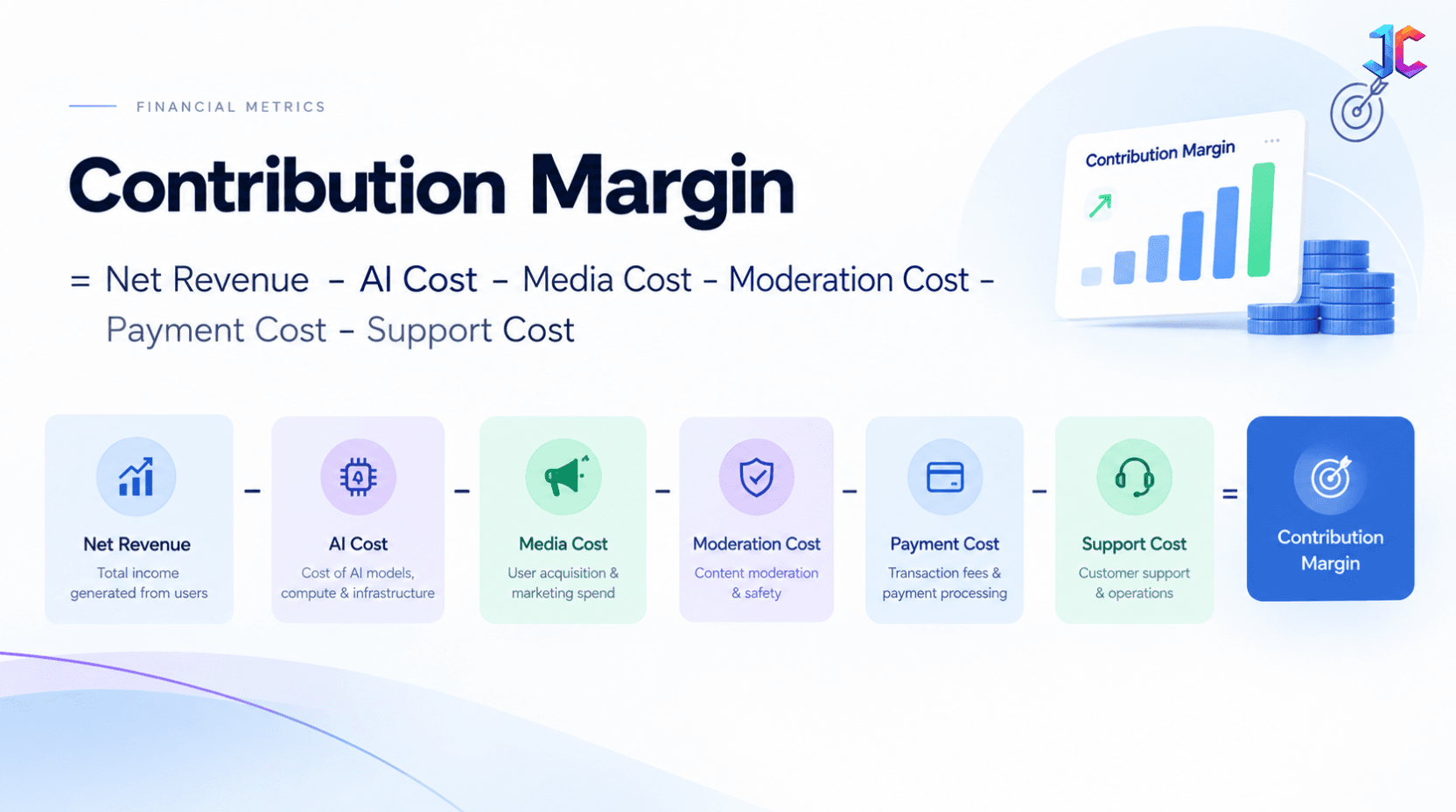
Market reports show category potential, but your own operating data should guide product decisions after launch. For example, if voice increases retention but reduces contribution margin, the business may offer voice minutes through a premium plan instead of making the feature unlimited.
What a Professional Project Proposal Should Include
A serious development proposal should contain more than a feature list and a delivery price. It should explain:
- Target audience and product positioning.
- MVP boundaries.
- AI-model assumptions.
- Data-flow and memory architecture.
- Safety and moderation responsibilities.
- Expected model and infrastructure costs.
- Analytics and reporting.
- Testing and acceptance criteria.
- Code, data, and asset ownership.
- Model-provider migration options.
- Outage and disaster-recovery procedures.
- Post-launch maintenance.
- Support response expectations.
A low initial quote may not represent a lower total cost if it excludes moderation, evaluation, analytics, security testing, model migration, or long-term maintenance.
How to Select an AI Girlfriend App Development Company
Review product strategy
Ask the agency:
- Which audience should the product target first?
- Which features belong in the MVP?
- Which features create the highest operating cost?
- Which risks require specialist review?
- Which metrics should define success?
Assess architecture quality
Request:
- System architecture.
- Data-flow diagram.
- Memory design.
- Model-routing strategy.
- Safety workflow.
- Cost-monitoring plan.
- Disaster-recovery plan.
- Deployment process.
Ask for evidence
Request:
- A relevant case study.
- A sample architecture diagram.
- A data-retention and deletion workflow.
- A sample AI-evaluation report.
- A cost model for text, voice, and images.
- A moderation escalation flow.
- A clear source-code ownership clause.
- A post-launch support plan.
A company should be able to explain what happens when a user deletes an account, reports harmful content, exceeds usage limits, requests a memory correction, or interacts during an AI-provider outage.
Review relevant experience
Look for proven experience with:
- Conversational AI.
- Personalization.
- User-generated content.
- Subscription products.
- Voice applications.
- Moderation systems.
- Mobile and web platforms.
- High-volume cloud infrastructure.
Confirm ownership
Your agreement should clarify ownership of:
- Source code.
- Prompt configurations.
- Character definitions.
- Evaluation datasets.
- Generated media.
- Cloud accounts.
- API credentials.
- User data.
- Analytics data.
- Documentation.
Enterprise-Readiness Checklist
Before launch, confirm support for:
- Role-based access.
- Separate staging and production environments.
- Tenant isolation.
- Audit logs.
- Data-deletion workflows.
- Moderation queues.
- Incident-response processes.
- Model-version tracking.
- Cost dashboards.
- Regional configuration.
- Backup and recovery.
- Security testing.
- Privacy documentation.
- Customer-support escalation.
Recommended Development Roadmap
Phase 1: Product and risk discovery
Define the audience, companion type, content boundaries, business model, platform strategy, privacy requirements, and success metrics.
Phase 2: Controlled MVP
Launch with:
- Account creation.
- One focused companion experience.
- Context-aware text chat.
- Permission-based memory.
- Basic safety controls.
- Privacy settings.
- Usage monitoring.
- User feedback.
- Reporting.
Phase 3: Economics validation
Measure retention, conversion, AI cost, support demand, safety events, and contribution margin before adding expensive features.
Phase 4: Multimodal expansion
Introduce voice, images, avatars, local-language capabilities, or creator tools based on validated demand.
Phase 5: Platform scale
Add enterprise administration, model routing, regional deployment, advanced analytics, creator ecosystems, and automated evaluation.
Why Choose Our AI Girlfriend App Development Services?
Use only genuine, verifiable company capabilities in this section:
- Product strategy and technical discovery.
- Custom AI companion application development.
- Conversational AI integration.
- Character and personality systems.
- Permission-based memory.
- Voice and multimodal experiences.
- Privacy and moderation architecture.
- Subscription and usage-based billing.
- Admin and analytics dashboards.
- Cloud deployment.
- Ongoing maintenance and optimization.
Add authentic case studies, technical team information, client industries, measurable outcomes, and genuine testimonials. Avoid unsupported claims, fake reviews, and invented statistics.
Conclusion
Building an AI girlfriend app in 2026 requires a complete product, technology, safety, and business strategy. The strongest applications combine conversational quality with memory control, privacy, age assurance, model evaluation, synthetic-media governance, reliable infrastructure, transparent monetization, and measurable operating economics.
When choosing an AI girlfriend app development company, evaluate its ability to build and govern the full companion ecosystem, not only its ability to connect an AI model to a mobile interface.
A scalable AI companion should be personal without becoming invasive, engaging without becoming manipulative, and intelligent without hiding how it works. These principles provide a stronger foundation for user trust, enterprise adoption, and sustainable growth.
FAQs
What does an AI girlfriend app development company provide?
It can provide product strategy, AI model integration, character systems, memory architecture, web and mobile development, voice and visual capabilities, moderation, payments, analytics, cloud deployment, and ongoing support.
How do I choose an AI girlfriend app development company?
Evaluate its AI architecture, privacy approach, safety capabilities, relevant experience, ownership terms, cost model, maintenance process, and ability to explain how the platform will scale.
How much does AI girlfriend app development cost?
The cost depends on platforms, AI models, memory, voice, visuals, moderation, payment systems, integrations, and enterprise controls. Separate the initial build budget from ongoing AI, cloud, media, moderation, and support costs.
How long does it take to build an AI girlfriend app?
A focused MVP takes less time than a platform with voice, images, creator tools, localization, and enterprise administration. A milestone-based discovery process provides a more accurate timeline.
What features should an AI girlfriend app include?
Important features include consistent character identity, context-aware conversations, permission-based memory, privacy controls, moderation, age-appropriate access, reporting, transparent billing, analytics, and account deletion.
Can an AI girlfriend app support voice and image generation?
Yes. These capabilities require consent controls, moderation, data-retention rules, synthetic-media disclosures, identity consistency, intellectual-property protection, and cost management.
How can an AI girlfriend app generate revenue?
Revenue can come from subscriptions, usage credits, premium characters, creator revenue sharing, branded companions, and enterprise licensing. Pricing should not depend on emotional pressure or simulated relationship punishment.
Is an AI girlfriend app suitable for enterprise use?
Yes. Enterprise use cases may include branded characters, entertainment, interactive storytelling, private communities, and customized digital experiences. Enterprise deployment requires data isolation, access control, auditability, analytics, and governance.
What is the future of AI girlfriend apps?
Future products are likely to become more multilingual, voice-first, privacy-controlled, multimodal, creator-driven, and enterprise-integrated. Long-term success will depend on user autonomy, responsible engagement, transparent AI identity, and strong safety governance.