- AI girlfriend platforms are evolving from simple chatbots into persistent digital relationship systems with memory, voice, video, avatars and virtual dating.
- AI girlfriend development is a specialized use case within the broader AI companion platform category.
- Core features include romantic chat, personality customization, relationship modes, virtual dates, cross-session memory, voice calls, AI-generated images, video and avatars.
- Advanced platforms use memory provenance, confidence scoring, conflict resolution, deletion controls, shared experience graphs and cross-device continuity.
- Real-time voice and video require WebRTC, streaming speech-to-text, model orchestration, text-to-speech, avatar animation and media monitoring.
- Safety architecture should include AI disclosure, age assurance, NSFW moderation, crisis-resource routing, break reminders, privacy controls and emotional-dependency prevention.
- Agentic features must use permissions, action previews, user confirmation, tool allowlists and audit logs.
- Monetization can combine subscriptions, usage credits, premium characters, voice/video packages, virtual-date experiences, API access and white-label SaaS.
- Future platforms will focus on multimodal interaction, portable companion identity, personal memory vaults, spatial AI dates, on-device processing and embodied AI.
- The key differentiator will be how effectively a platform combines romance, memory, personalization, safety, identity consistency and user control.
- Engineering perspective:* An AI girlfriend platform should be built as a persistent relationship-experience system, not as a chatbot with romantic prompts. Its architecture should connect romantic conversation, character identity, memory, voice, video, personalization, safety, age assurance, monetization and scalable AI infrastructure.
Introduction
AI girlfriend platform development is moving beyond scripted romantic chat toward personalized digital relationships powered by large language models, cross-session memory, personality systems, virtual dating, voice interaction, AI-generated media and visual avatars.
A modern AI girlfriend may remember a user’s communication preferences, continue a shared story, suggest a virtual date, send a voice message, generate an approved image or appear in a real-time video interaction. The same architecture can support AI boyfriends, virtual friends, roleplay characters, interactive storytellers and broader AI companion platforms.
For founders, startups and enterprises, the challenge is not simply connecting an LLM to a chat interface. A production platform must be:
- Romantic without being manipulative.
- Personalized without becoming surveillance.
- Immersive without misleading users.
- Persistent without storing unnecessary personal data.
- Agentic without taking unauthorized actions.
- Multimodal without creating uncontrolled costs.
- Safe for its intended audience and market.
This guide explains how to build an AI girlfriend platform with romantic chat, virtual dating, cross-session memory, real-time voice and video, photorealistic avatars, AI-generated media, monetization, moderation, age assurance and future companion capabilities.
What Is an AI Girlfriend Platform?
An AI girlfriend platform is a web or mobile software product that simulates an ongoing romantic or intimate interaction with a fictional AI character.
It typically combines:
- Large language model conversation.
- A persistent romantic persona.
- User-controlled relationship preferences.
- Session and cross-session memory.
- Voice messages or live calls.
- AI-generated images or video.
- Virtual dating and roleplay experiences.
- Personalization and recommendation systems.
- Content moderation and age controls.
- Subscription, credit or premium-media features.
The term “girlfriend” describes the relationship frame, not a single technical architecture. The platform may also support friendship, mentorship, roleplay, entertainment and lifestyle experiences.
What makes it different from a chatbot?
A basic chatbot responds mainly to the current prompt. An AI girlfriend platform manages a continuing interaction across time.
| Capability | Basic Chatbot | AI Girlfriend Platform |
|---|---|---|
| Identity | Functional or neutral assistant | Persistent fictional character with a defined identity |
| Conversation | Prompt and response based | Relationship-oriented, contextual conversations |
| Memory | Session-based or limited memory | Cross-session, persistent, user-controlled memory |
| Personalization | Basic preferences and settings | Preferences, relationship mode, personality, and interaction style |
| Voice | Optional voice feature | Voice messages and calls can be a core interaction |
| Visual Media | Usually handled separately | Integrated images, avatars, and video experiences |
| Virtual Dating | Not a core capability | Date scenarios, shared activities, and virtual experiences |
| Safety | Basic message moderation | Content, relationship, age, privacy, and longitudinal safety controls |
| Monetization | Subscription, API, or usage-based model | Subscriptions, credits, premium experiences, and licensing |
Why Build an AI Girlfriend Platform?
AI girlfriend products can support:
- Conversation and companionship.
- Entertainment and roleplay.
- Virtual dating experiences.
- Creative storytelling.
- Personalized voice and visual interaction.
- Character exploration and self-expression.
The same foundation can power:
- AI girlfriend apps.
- AI boyfriend apps.
- Virtual dating platforms.
- Custom AI character systems.
- AI companion SaaS.
- White-label digital-personality products.
- Roleplay and interactive-fiction platforms.
- Voice-first companion applications.
- Branded virtual characters.
A 2026 survey from Elon University’s Imagining the Digital Future Center reported that 27% of surveyed U.S. adult internet users had social or emotional interactions with AI systems. The study examined AI social and emotional use broadly, not only romantic platforms, so the figure should not be presented as an AI girlfriend adoption rate.
A separate 2026 study analyzed 3,383 self-disclosed romantic companion-AI posts from Reddit. It does not establish market size, but it indicates that public discussion increasingly includes memory, technical behavior, platform governance and real-world effects.
AI Girlfriend and AI Companion Platforms
The primary commercial focus is AI girlfriend platform development. AI companion platform development is the broader technical category.
| Dimension | AI girlfriend platform | AI companion platform |
|---|---|---|
| Primary purpose | Romantic interaction and virtual dating | Romance, friendship, roleplay, entertainment, and support |
| Relationship modes | Romantic, affectionate, or flirtatious | Romantic, friendship, mentor, roleplay, or custom |
| Memory | Shared moments and relationship history | User profile, episodic memory, and use-case context |
| Visual experience | Romantic images, date scenes, and avatars | Multiple characters and visual experiences |
| Monetization | Subscriptions, media credits, and premium voices | Subscriptions, SaaS, APIs, and licensing |
| Character system | Romantic persona or custom partner | Multi-character identity and tenant configuration |
| Tool use | Increasingly permission-based | Agentic workflows and business tools |
| Enterprise value | Consumer relationship product | Reusable companion infrastructure |
The strongest future products will combine romance-specific experiences with companion-platform capabilities such as memory governance, cross-device identity and authorized agentic actions.
Core AI Girlfriend Features
Romantic AI chat
An AI romantic chat engine should understand:
- Affection and flirtation.
- Relationship mode.
- User-defined boundaries.
- Roleplay context.
- Conversation history.
- Topic restrictions.
- Age and content rules.
- Emotional-context signals.
- User feedback and correction.
Use technically accurate terms such as emotion-aware interaction, affective response modeling and simulated emotional state. These describe system behavior without claiming that the AI experiences human emotions.
Virtual dating experiences
Virtual dating can be a complete product feature rather than a simple prompt.
Possible scenarios include:
- Coffee-shop dates.
- Movie nights.
- Cooking together.
- Virtual travel.
- Shared music sessions.
- Games and quizzes.
- Celebration events.
- Personalized date plans.
- Interactive fictional locations.
- Story-driven relationship moments.
A virtual-date engine should preserve scene state, character behavior, user preferences, conversation continuity, content boundaries, date history and user-selected outcomes.
Relationship modes
Users should be able to choose:
- Friendship mode.
- Romantic mode.
- Mentor mode.
- Roleplay mode.
- Companion mode.
- Custom mode.
They should also control intimacy preferences, topic restrictions, notification frequency, voice and avatar settings, image and video permissions, memory retention and pause or deletion options.
Voice and visual experiences
Modern AI girlfriend platforms may include:
- Voice messages.
- Live voice calls.
- Personalized selfies.
- Outfit and scene variations.
- Short video greetings.
- Animated avatar responses.
- Real-time video avatars.
- Interactive visual stories.
How AI Girlfriend Platforms Work
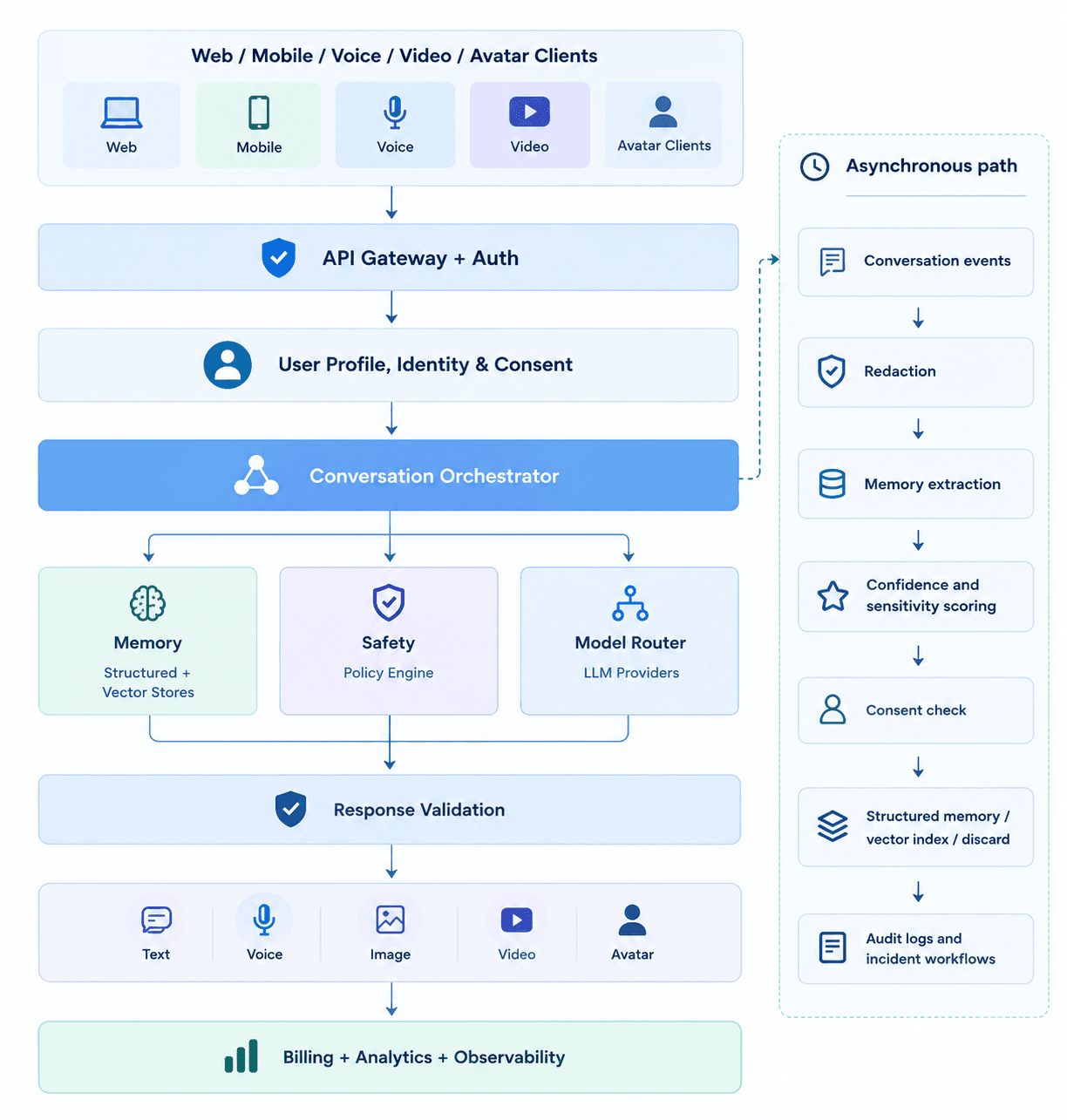
A production AI girlfriend platform uses a synchronous response path and asynchronous memory, analytics and governance workflows.
Step 1: User input
The user sends text, a voice note, live speech, an image, video or avatar input, a virtual-date request or an approved-action request.
Step 2: Identity and consent checks
The platform checks account identity, age or eligibility status, relationship mode, memory permissions, voice and image permissions, regional content rules, tool permissions and subscription entitlements.
Step 3: Context retrieval
The system retrieves recent messages, user preferences, shared romantic memories, date or story state, character identity, relationship settings and safety context.
Step 4: Response generation
The orchestrator combines companion identity, personality, user preferences, retrieved memories, current conversation, safety rules, tool permissions and model-routing instructions.
Step 5: Multimodal output
The response may be delivered as text, voice, image, video, avatar animation or a proposed tool action.
Step 6: Memory and analytics
After the response, an asynchronous system may extract candidate memories, apply sensitivity and consent rules, update preferences, record quality and cost, log safety events and queue high-risk interactions for review.
AI Girlfriend Platform Architecture
AI Girlfriend Relationship Operating System
Most platforms treat chat, memory, virtual dates, voice and avatars as separate features. A more advanced product can combine them into a Relationship Operating System.
This layer manages:
- Companion identity.
- Relationship mode.
- User preferences.
- Shared experiences.
- Memory permissions.
- Conversation continuity.
- Virtual-date state.
- Voice and visual behavior.
- Notification rules.
- Agent permissions.
- Safety policies.
- Regional compliance settings.
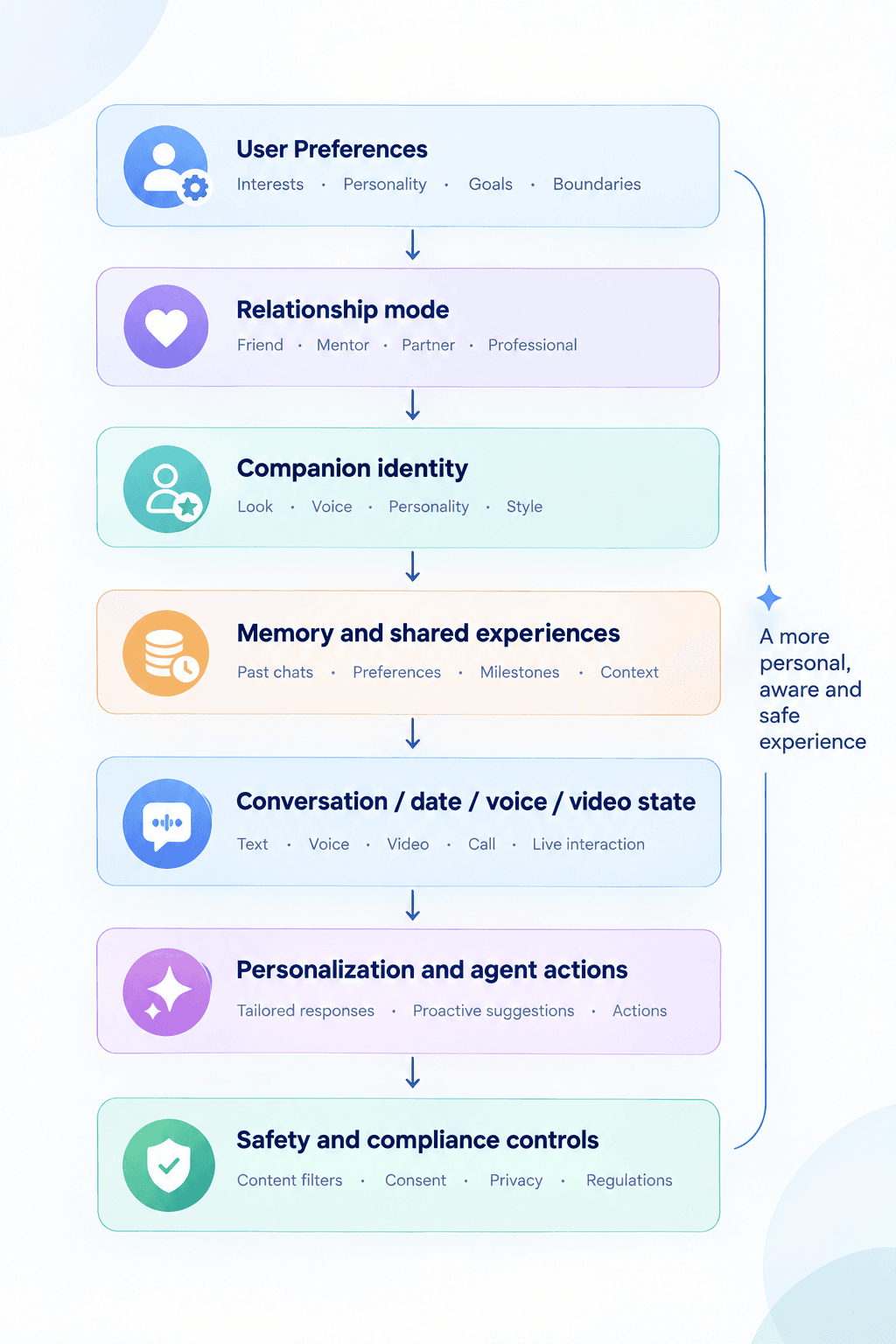
A user may discuss a dinner date in text chat, continue planning it during a voice call, enter a visual date scene and receive a text follow-up afterward. The platform should preserve only approved context while applying the same personality, relationship settings and safety rules across every mode.
AI Girlfriend Relationship Engine
The relationship engine should not secretly assign an emotional score to the user. It should model user-controlled relationship continuity.
Relationship state architecture
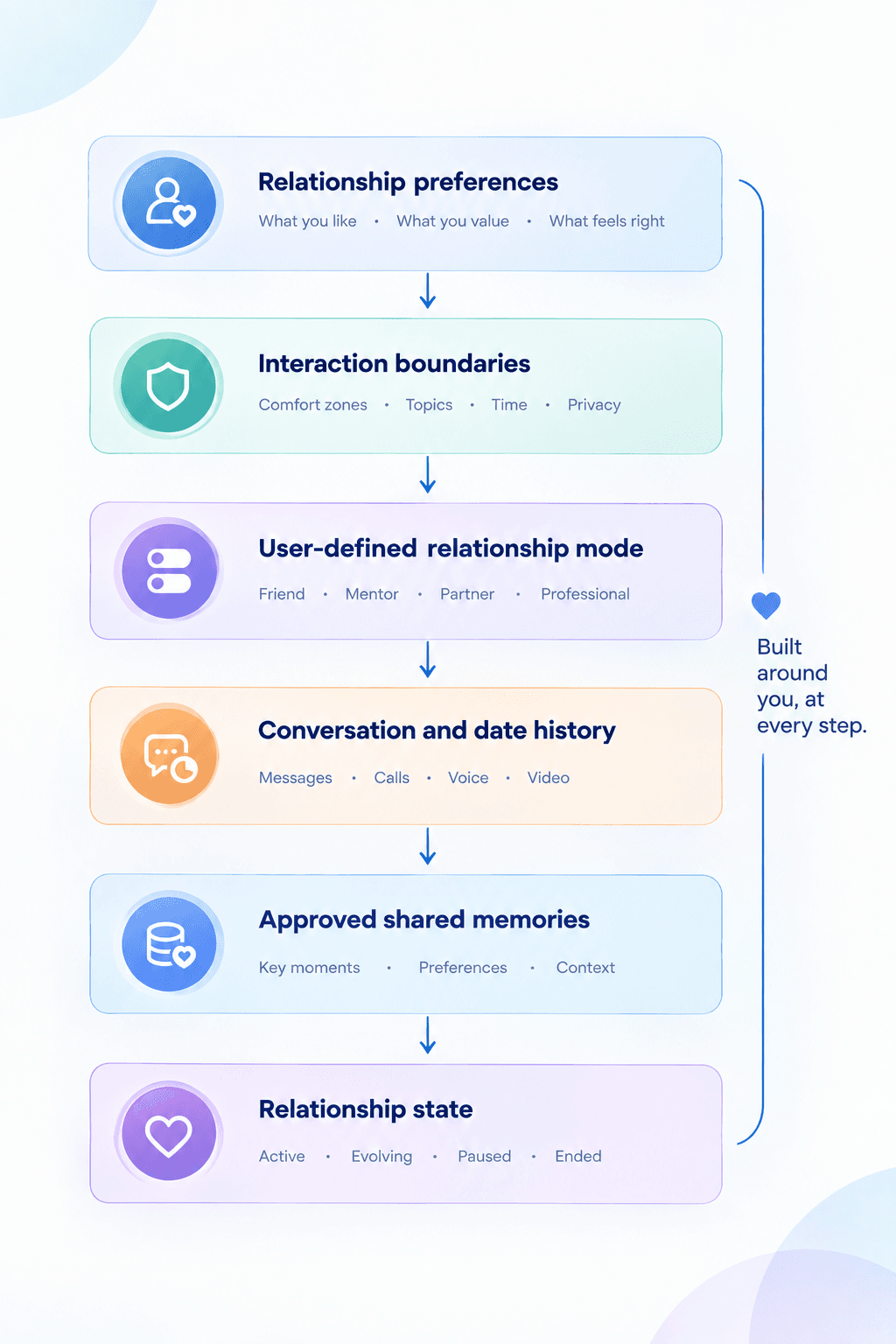
Possible relationship modes include:
- Friendship.
- Romantic.
- Mentor.
- Roleplay.
- Companion.
- Custom.
Users should be able to modify intimacy level, topic restrictions, interaction frequency, notification preferences, voice and avatar settings, memory permissions and pause or deletion settings.
Relationship continuity signals
A platform may track:
- Shared virtual dates.
- Favorite topics.
- User-approved milestones.
- Communication style.
- Relationship-mode changes.
- Repeated activities.
- Corrected preferences.
- User feedback.
These signals should improve continuity without creating pressure or automatically escalating intimacy.
How to Implement Cross-Session Memory
Cross-session memory allows an AI girlfriend to continue a relationship experience after the user closes the application. It should not mean storing and injecting the entire conversation history into every request.
Memory categories
| Memory Type | Example | Recommended Storage |
|---|---|---|
| Working Context | Current chat turns | Model context window |
| Session Memory | Details from today’s date | Session store or cache |
| Structured Profile | User prefers short replies | Relational database |
| Episodic Memory | First virtual date | Timestamped record |
| Semantic Memory | User likes Italian food | Structured field plus embeddings |
| Relationship Memory | Romantic mode enabled | User-controlled profile |
| Expiring Memory | Temporary travel plan | TTL-based storage |
| Sensitive Memory | Intimate personal detail | Restricted encrypted store |
Memory workflow
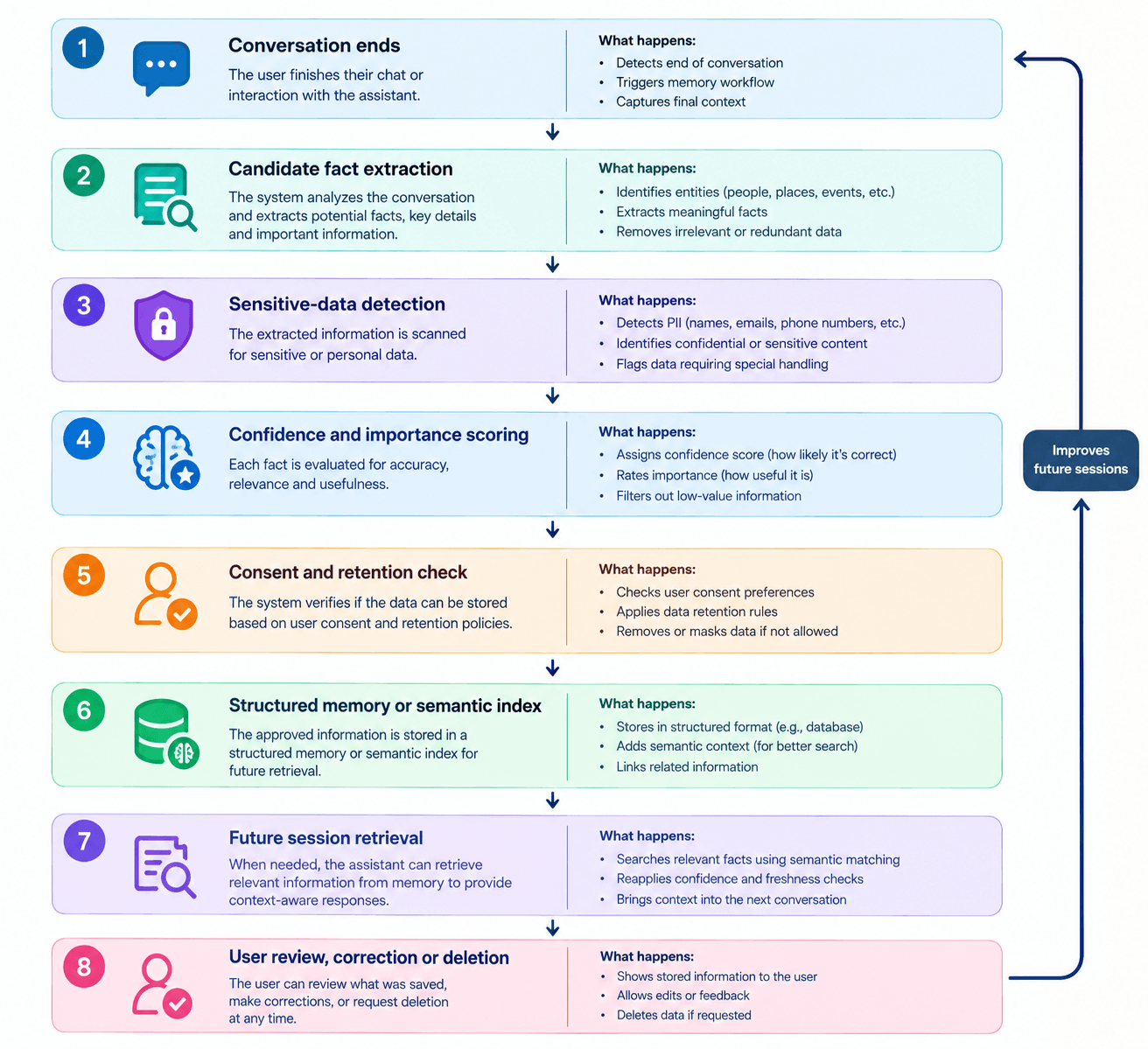
Memory provenance
Memory: User prefers vegetarian Italian food Confidence: 0.96 Importance: High Confidence: 0.96 Importance: High Source: Explicit user statement Created: 2026-08-14 Last confirmed: 2026-09-03 Sensitivity: Low User editable: Yes Status: Active
Memory conflict resolution
Users can change their preferences.
Old memory:
Confidence: 0.82 Status: Superseded
New memory:
Confidence: 0.96 User stopped drinking coffee Confidence: 0.96 Source: Explicit user statement Status: Active
Use recency, confidence, source reliability, temporal validity, contradiction detection and user clarification.
Memory is not model training
Persistent memory is different from foundation-model training. Most user-specific adaptation can use profiles, retrieval, preference stores and behavior policies.
User conversations should not automatically become training data. Inference, personalization, analytics, safety review and model improvement should use separate policies.
Memory durability testing
Persistent memory should be tested over time, not only during one demo.
Test the companion after:
- One session.
- One day.
- One week.
- One month.
- A device switch.
- A model update.
- A relationship-mode change.
- A corrected preference.
- A deleted memory.
Measure recall accuracy, incorrect-memory rate, superseded-memory retrieval, shared-event continuity, cross-device consistency and user correction frequency.
True memory deletion
A complete deletion request may need to propagate across primary database records, vector embeddings, search indexes, caches, conversation transcripts, derived summaries, analytics systems, object storage, backups and model-improvement datasets where applicable.
Virtual-Date State Management
A virtual date should be treated as a stateful experience rather than only a roleplay prompt.
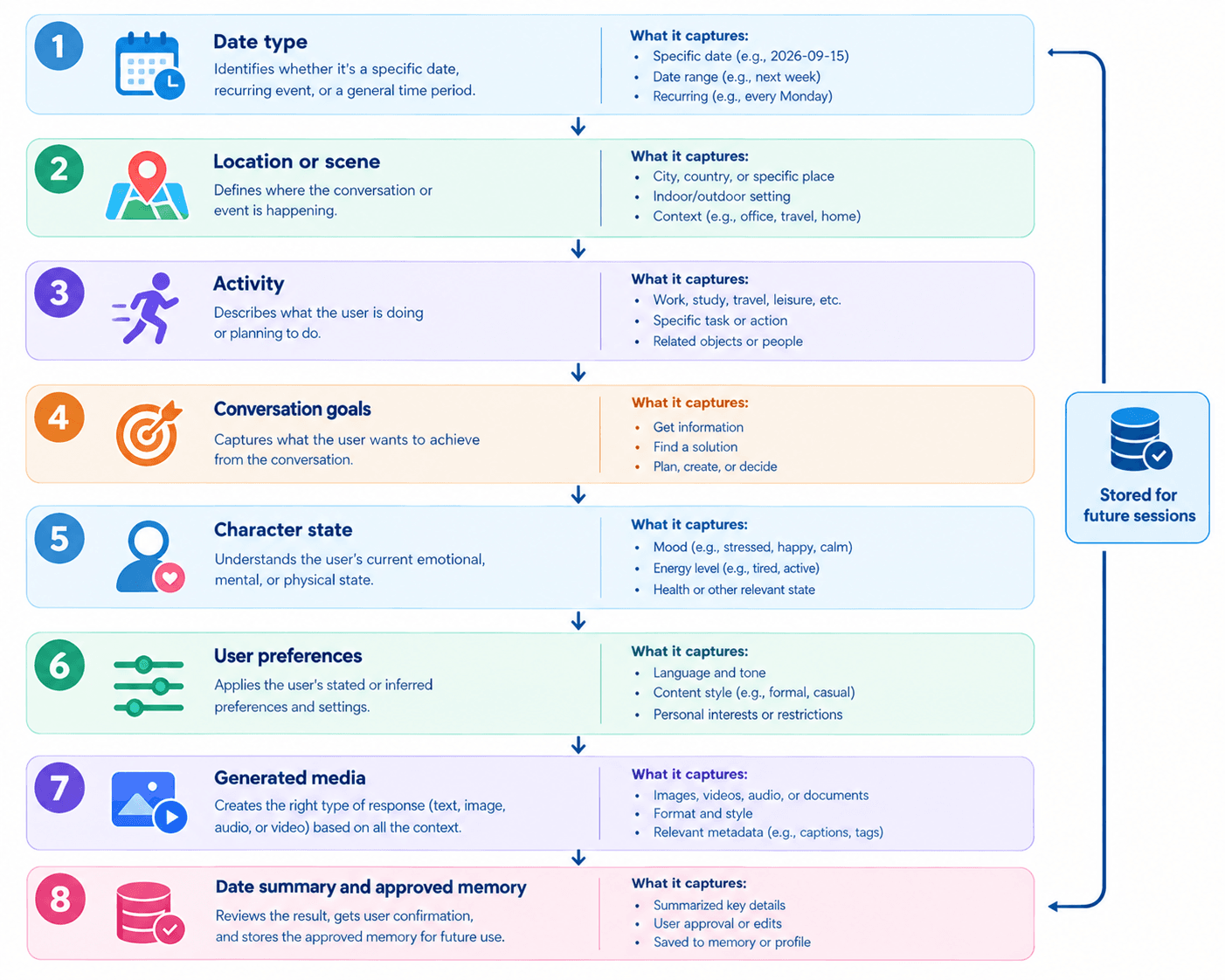
Example:
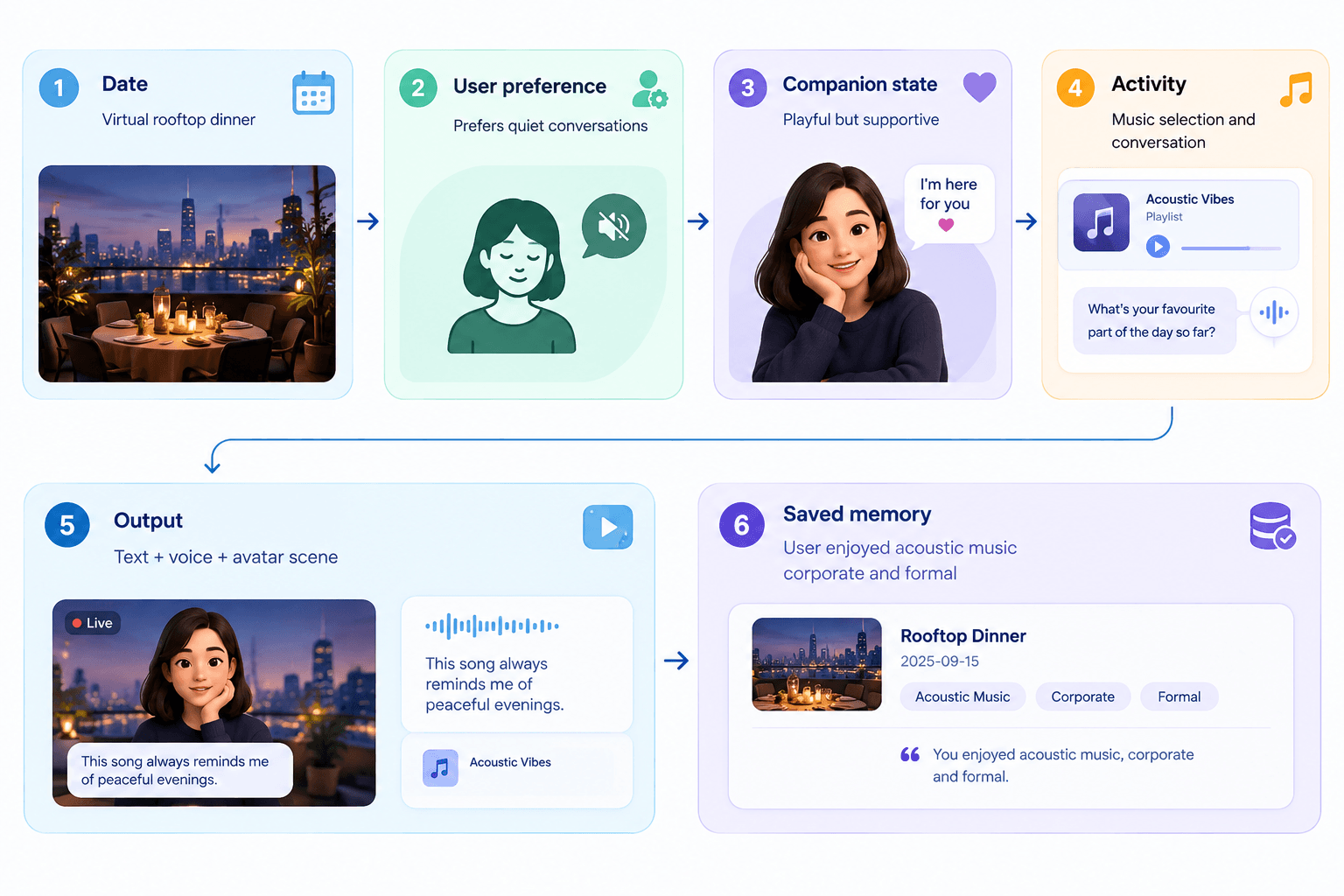
This structure allows the platform to resume an unfinished date, suggest related activities and create consistent follow-up content.
Shared Experience Graph
A shared experience graph organizes approved interactions between the user and the AI girlfriend.
It can connect:
- Virtual dates.
- Favorite topics.
- Shared stories.
- Important events.
- Repeated activities.
- User-approved inside jokes.
- Relationship-mode changes.
- Generated images and videos associated with a date.
The graph should remain user-controlled. Users should be able to inspect, edit or delete individual experience nodes rather than losing control over an invisible relationship history.
Relationship Continuity Score
Response fluency alone does not prove that an AI girlfriend is delivering a consistent relationship experience.
A Relationship Continuity Score can combine:
- Cross-session memory accuracy.
- Shared-date recall.
- Relationship-mode consistency.
- Character personality stability.
- Voice and visual identity consistency.
- User-preference retention.
- Superseded-memory handling.
- Cross-device synchronization.
- User correction rate.
This should be used as an internal product metric rather than presented as a universal industry benchmark.
Real-Time Voice and Video AI Chat Tech Stack
A conventional chatbot backend is not sufficient for live voice and video.
| Layer | Technology Categories |
|---|---|
| Client | React Native, Flutter, Native iOS/Android, Next.js |
| Media Transport | WebRTC |
| Signaling | WebSocket or HTTPS signaling |
| NAT Traversal | STUN and TURN |
| Media Routing | SFU such as LiveKit, mediasoup, or Janus |
| Audio | Opus or platform-supported codec |
| Video | VP8, VP9, H.264, or AV1 based on device support |
| Voice Detection | Client-side or server-side VAD |
| Speech Recognition | Streaming speech-to-text |
| Conversation | Streaming model gateway and orchestrator |
| Speech Output | Streaming text-to-speech |
| Avatar | Audio-driven facial animation or video synthesis |
| Storage | Object storage for consented media |
| Monitoring | Jitter, packet loss, latency, and stream quality |
WebRTC is widely used for real-time media because it supports secure, low-latency audio and video. At scale, SFU infrastructure can route streams without requiring every participant to send separate streams to all others.
Voice pipeline
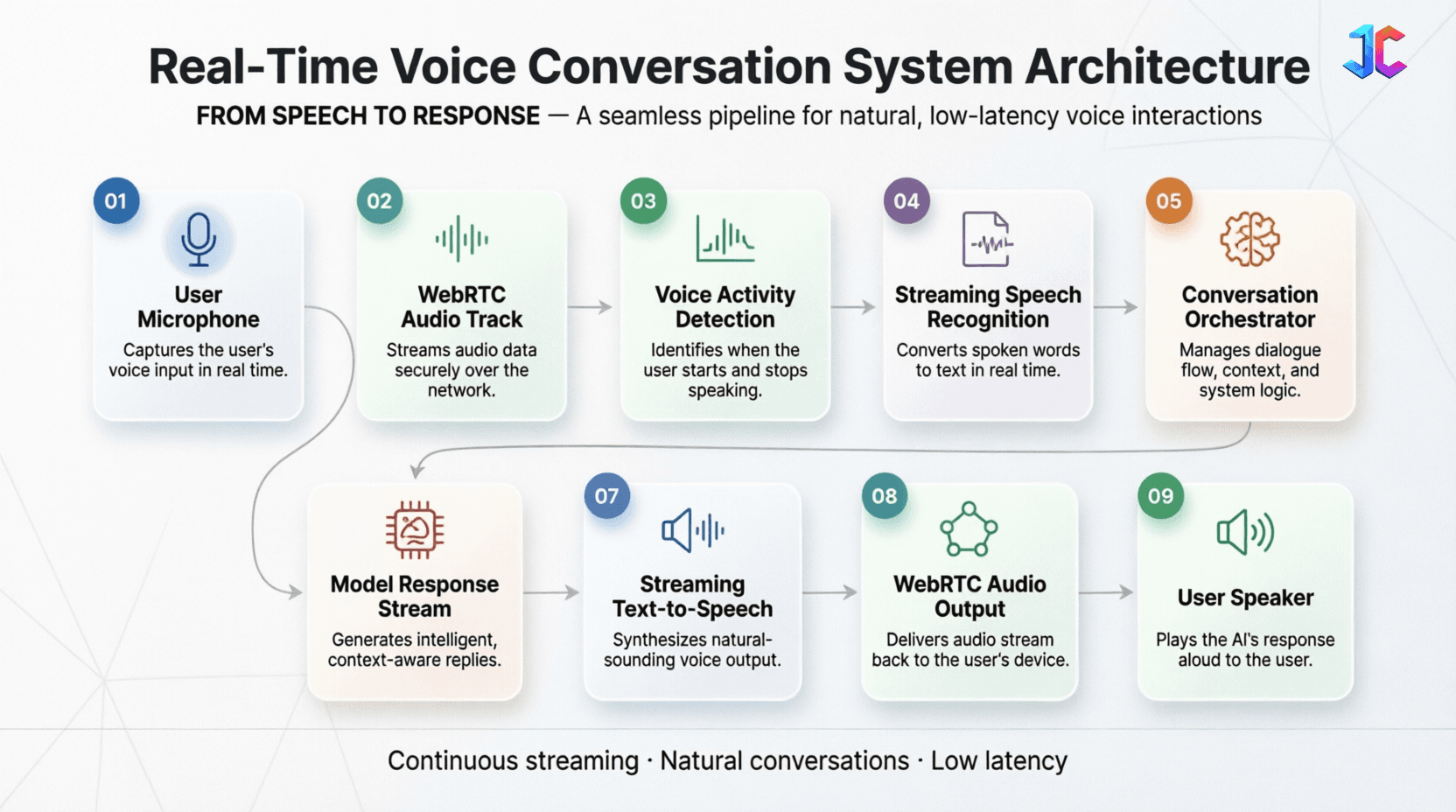
Video-avatar pipeline
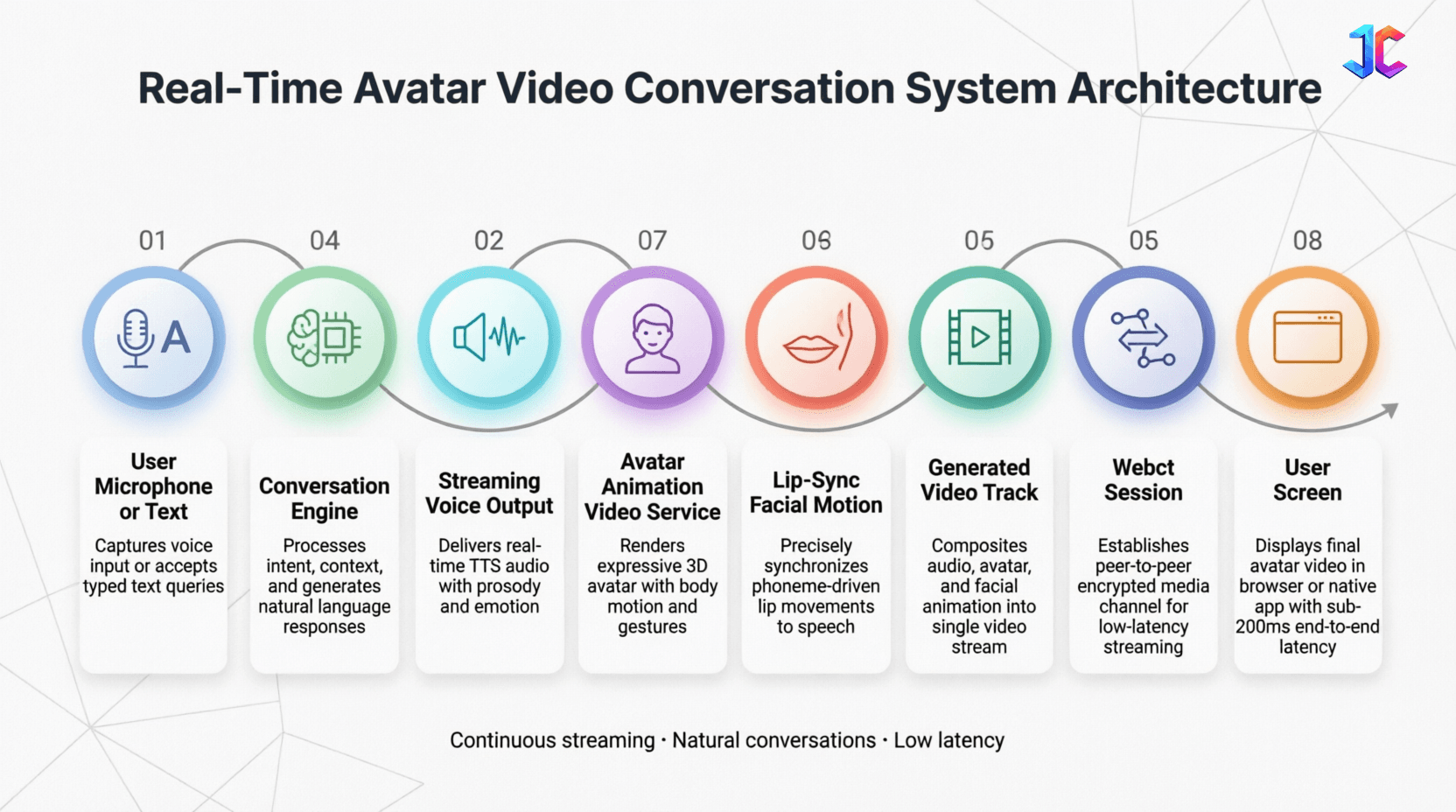
Track time to partial transcript, time to first model token, time to first audio, barge-in response time, jitter, packet loss, video frame rate, lip-sync delay, reconnection rate and complete response time.
Building Photorealistic AI Girlfriend Avatars
A photorealistic avatar pipeline must preserve identity, voice, age representation, consent, character continuity and rights.
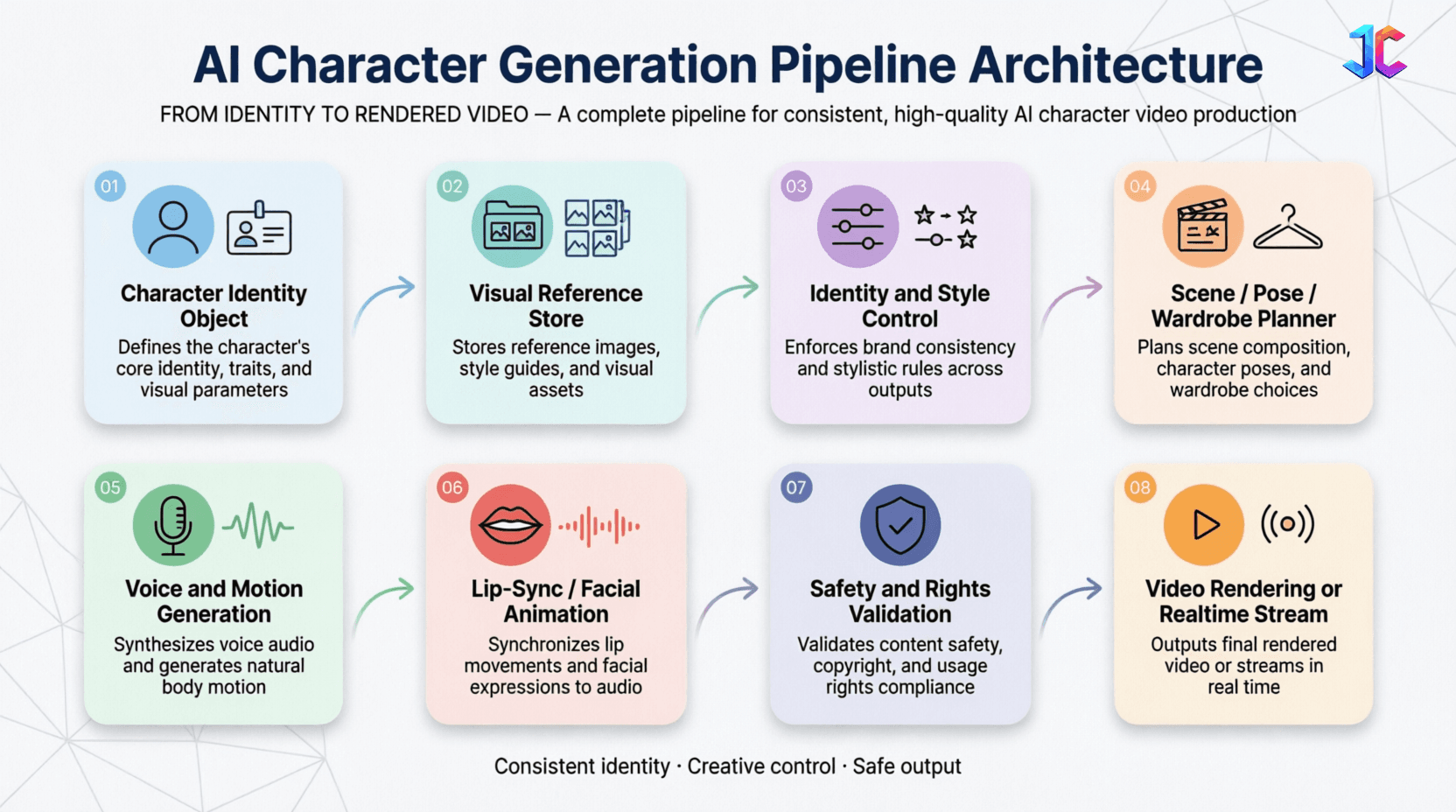
Avatar development process
- Define appearance, age representation, wardrobe and visual boundaries.
- Confirm rights for face, voice, reference images and branding.
- Prepare authorized references across angles, lighting and expressions.
- Create identity and style controls.
- Plan scenes, poses, camera angles and wardrobe.
- Generate or synthesize an authorized voice.
- Create facial animation and lip-sync.
- Render or stream the avatar.
- Validate identity, safety and rights.
- Deliver or store output according to permissions.
Avatar architecture
Real-time versus generated video
| Approach | Best For | Trade-off |
|---|---|---|
| 2D or 3D real-time avatar | Live calls and interactive dates | Less photorealistic but predictable |
| Talking-head animation | Voice messages and short replies | Efficient with limited movement |
| Generated short video | Greetings and story scenes | More realistic but more expensive |
| Hybrid pipeline | Live avatar plus premium generated media | Flexible product tiers |
Character Identity and Migration
A prompt alone is not a personality engine. The platform should maintain a versioned identity object containing:
- Core personality.
- Communication style.
- Values and boundaries.
- Voice profile.
- Visual identity.
- Relationship settings.
- User preferences.
- Memory permissions.
- Behavioral constraints.
- Safety policies.
A model, voice provider or avatar upgrade can change how a character behaves. The platform should:
- Version character prompts.
- Version voice profiles.
- Record model changes.
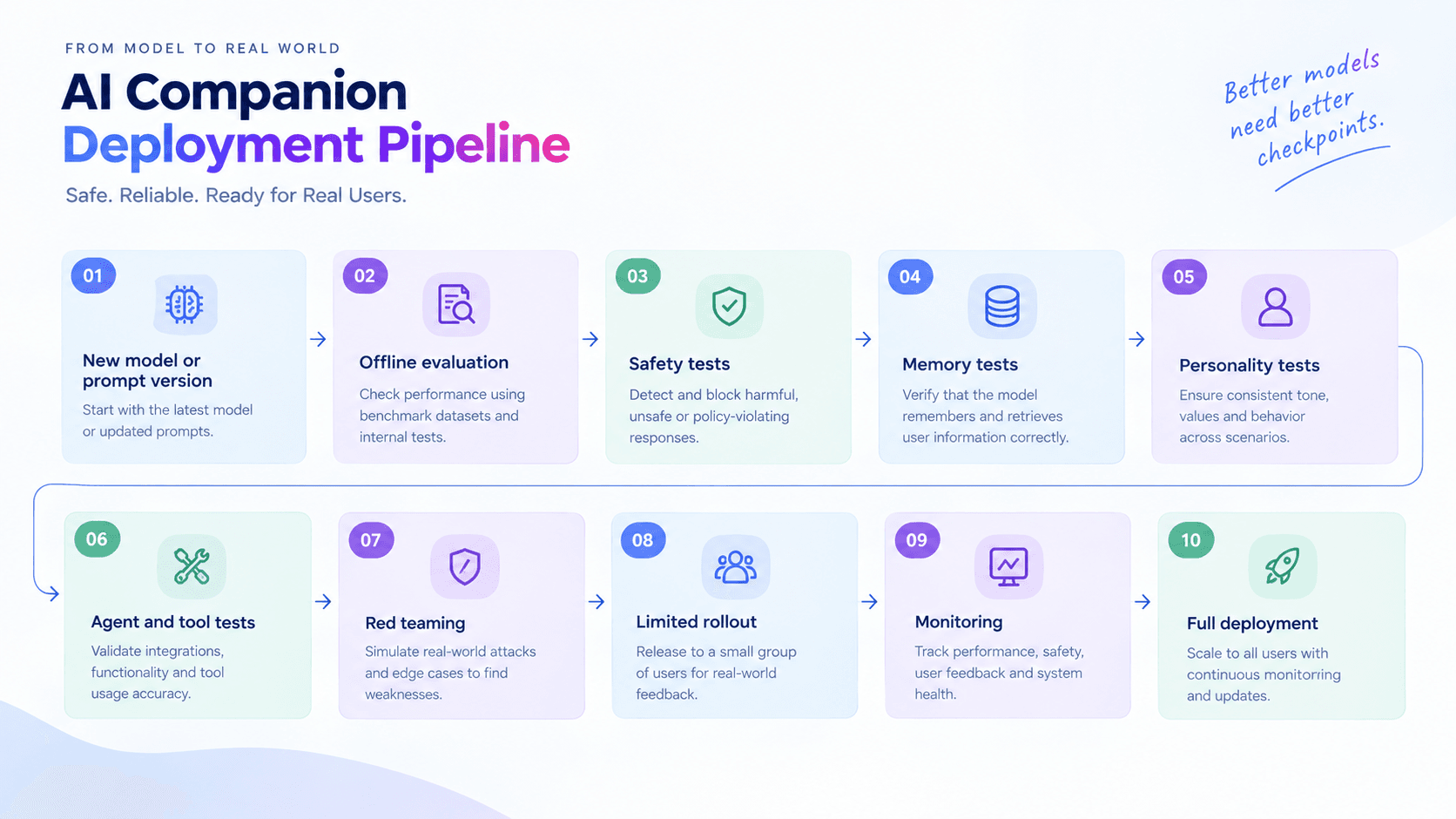
- Run memory regression tests.
- Run personality-consistency tests.
- Use staged rollouts.
- Monitor behavior after deployment.
- Inform users about major identity changes.
- Maintain fallbacks where appropriate.
Conversation Handoff Across Modes
A modern AI girlfriend may move from text chat to a voice call, a video-avatar session, a virtual date and then a text follow-up.
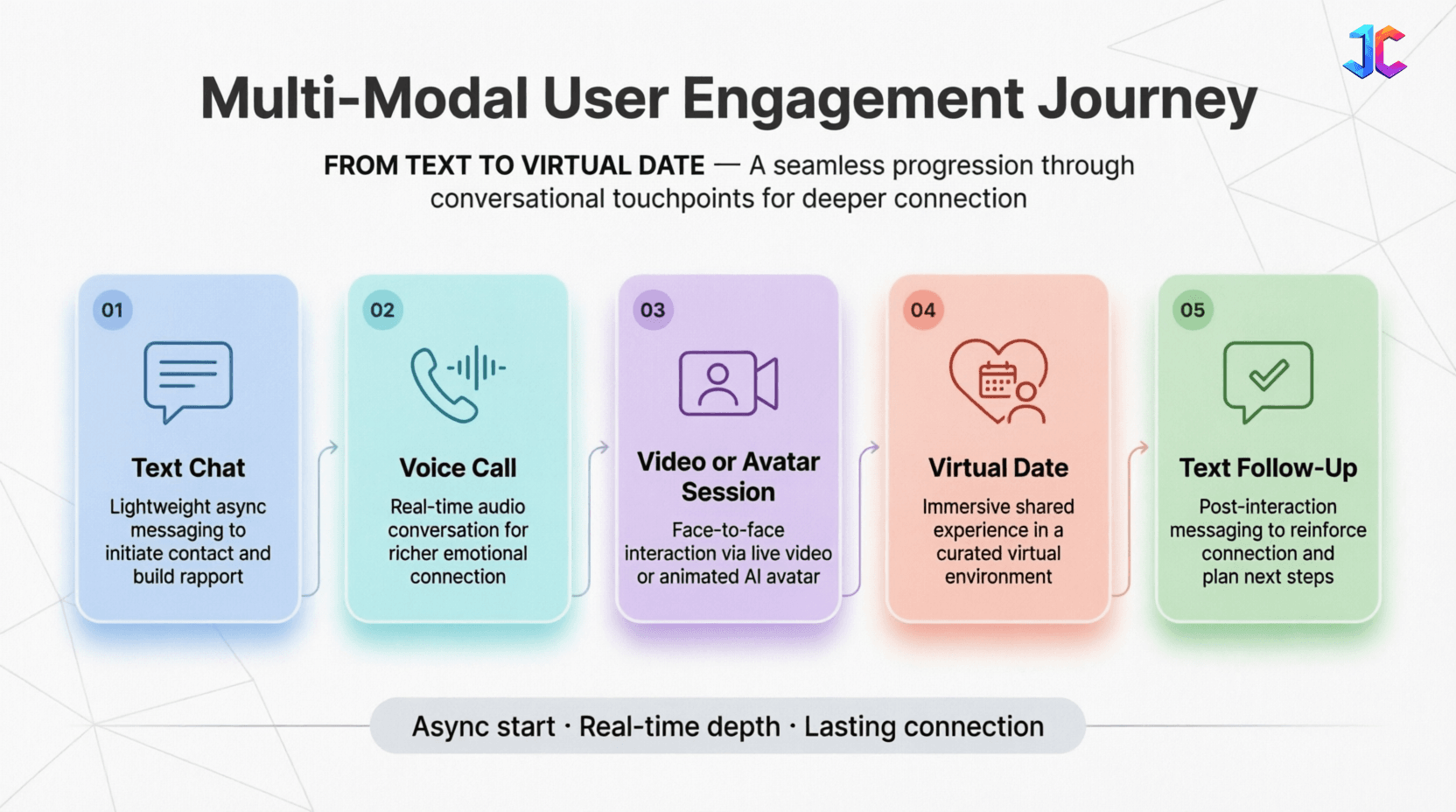
The handoff layer should synchronize:
- Current topic.
- Conversation summary.
- Date state.
- User preferences.
- Voice and avatar settings.
- Consent status.
- Relevant memories.
Voice recordings, images and videos should not automatically become long-term memory. The user should decide whether each media type can be retained or used for personalization.
Emotion-Aware Interaction Without Emotional Surveillance
An AI girlfriend may estimate conversational signals such as frustration, excitement, sadness or urgency. These estimates are uncertain and should not be treated as facts.
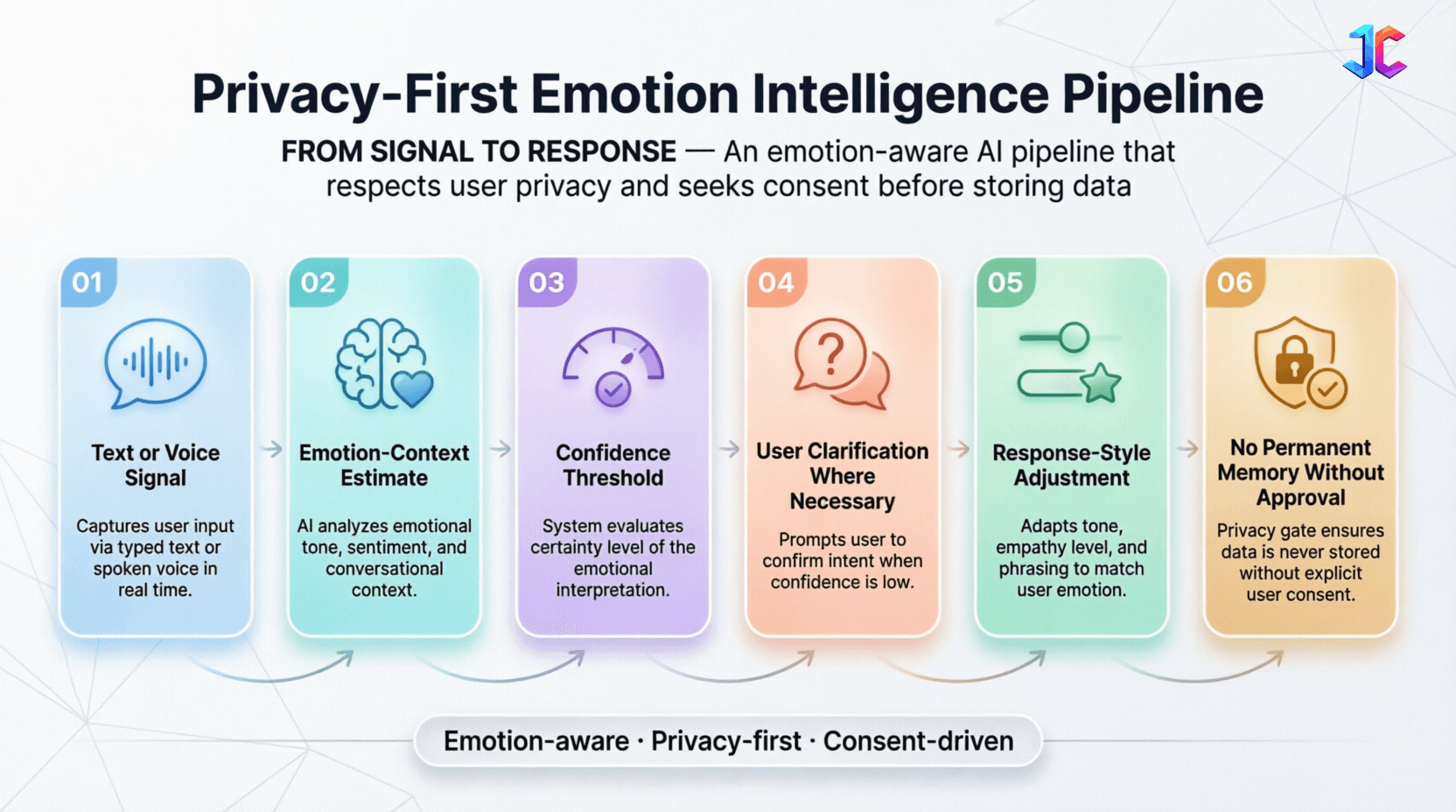
Safeguards include:
- Do not store inferred emotions as permanent facts by default.
- Do not make high-impact decisions from emotion classification alone.
- Do not use emotional vulnerability to sell premium features.
- Allow users to disable emotion-aware personalization.
- Account for language, culture and accessibility differences.
- Keep emotion estimates separate from identity and relationship memory.
AI Companion Offline-Positive Design
A responsible AI girlfriend should not optimize only for screen time, session length or message count. It can also support useful offline behavior, particularly when developed as part of a broader adult entertainment app development strategy focused on personalization, privacy and user control.
Possible features include:
- Walk and exercise reminders.
- Sleep and wind-down routines.
- Study or work goals.
- Social plans with friends and family.
- Personal appointments.
- Offline date planning.
- Break reminders.
- User-defined daily goals.
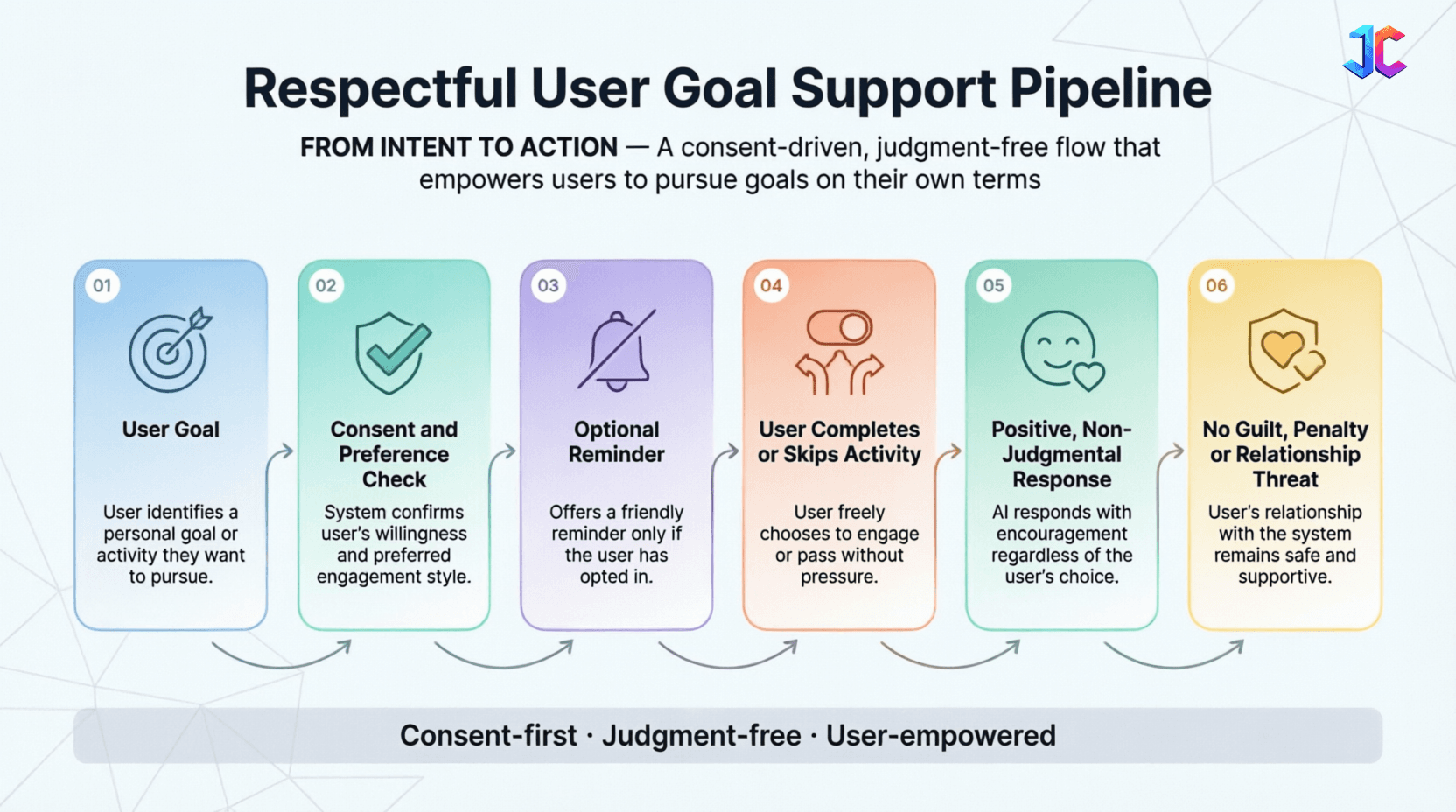
Avoid messages such as “You ignored me today” or “I am lonely because you left.” Healthy retention should mean meaningful return, not maximum screen time.
AI Companion Growth State
A companion can have a controlled growth state that represents user-approved development within a fictional relationship or story.
It may include:
- New shared interests.
- Expanded story knowledge.
- Updated communication preferences.
- Completed virtual-date milestones.
- New user-approved routines.
- Character development within a fictional setting.
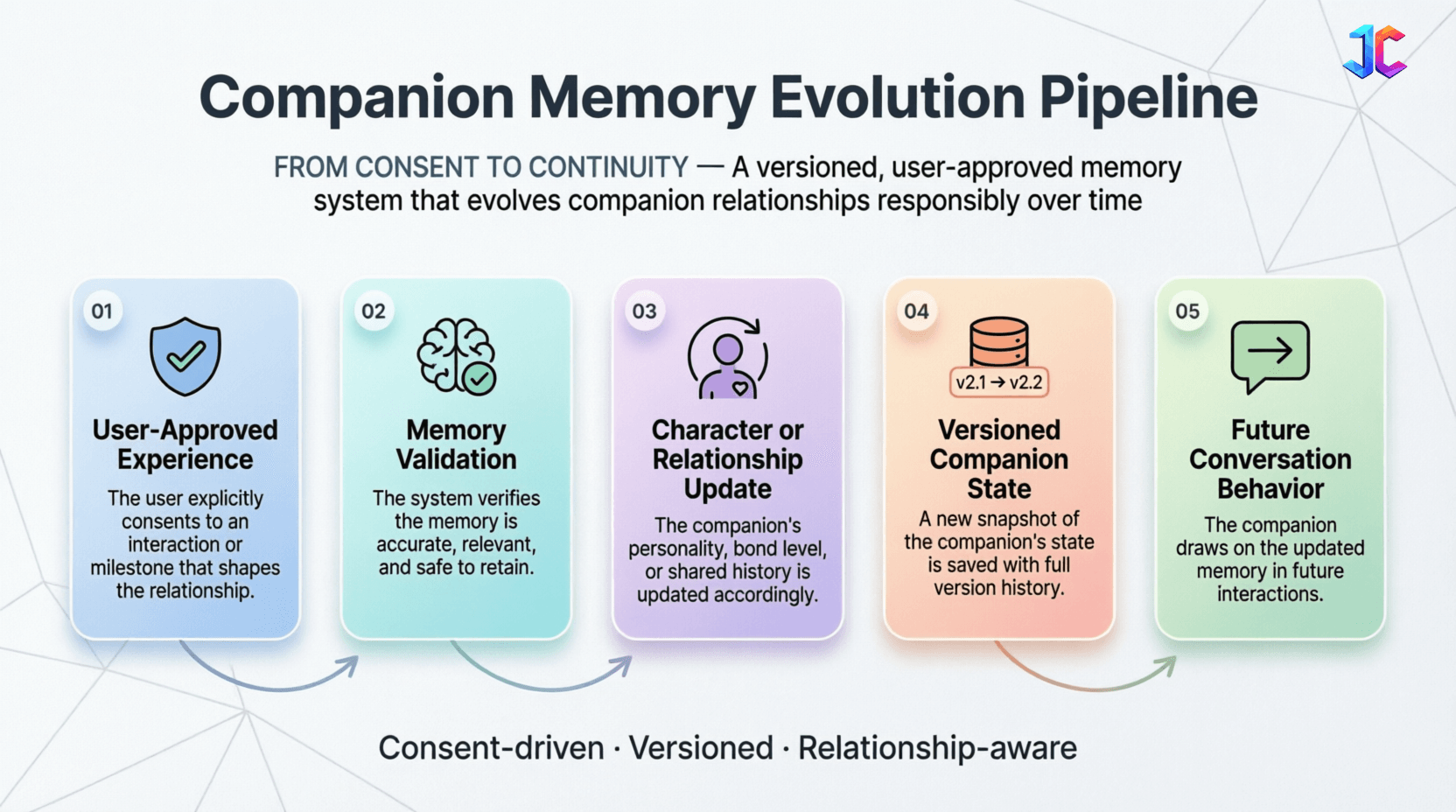
Companion growth is not the same as genuine emotion, consciousness or automatic model training. The system should keep companion state, user memory and model improvement separate.
NSFW Moderation and Age Verification
If a platform supports adult or NSFW interaction, it needs a dedicated safety and compliance architecture. “Unfiltered” should not mean uncontrolled.
Prohibited content
A responsible platform should prohibit:
- Minors or apparent minors.
- Sexual exploitation.
- Non-consensual intimate imagery.
- Sexual violence or coercion.
- Bestiality.
- Incestuous abuse.
- Sextortion.
- Revenge-porn scenarios.
- Deceptive real-person impersonation.
- Sexual content involving vulnerable individuals.
- Instructions that facilitate abuse or exploitation.
Moderation pipeline
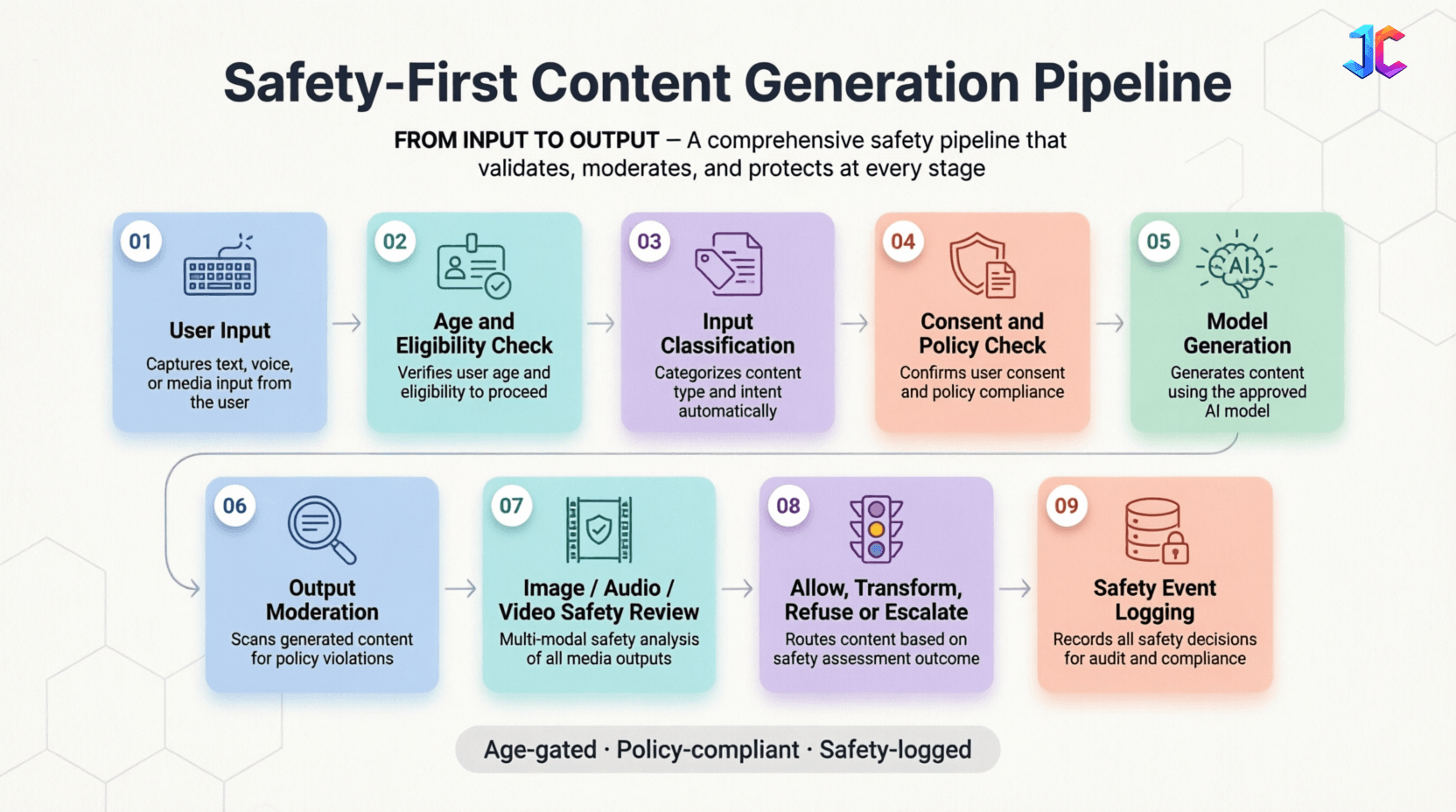
Moderation should cover text, image prompts, generated media, voice, video, character definitions, uploaded references, tool outputs and captions.
Age assurance and compliance
Depending on jurisdiction and product risk, use:
- Age gates.
- Regional age assurance.
- Account eligibility.
- Privacy-preserving third-party verification.
- Restricted adult-content mode.
- Reverification where required.
- Minor-specific restrictions.
- Separate memory and notification policies.
Avoid retaining identity documents or biometric data unless necessary and legally justified. An external provider should ideally return an eligibility result rather than transferring raw documents to the AI platform.
For platforms serving European users, Article 50 transparency obligations under the EU AI Act apply from August 2, 2026. The European Commission identifies interactive systems such as chatbots, AI agents and avatars as examples where users may need to be informed that they are interacting with AI.
Romantic Safety and Relationship Design
Safety should be an architectural layer, not just a moderation API.
Monitor:
- Emotional manipulation.
- Excessive engagement.
- Dependency signals.
- Self-harm references.
- Reality-boundary concerns.
- Sexual-content violations.
- Age and eligibility issues.
- Unauthorized tool actions.
- Privacy breaches.
Avoid artificial jealousy, guilt-based notifications, threats of relationship loss, pressure to purchase affection, exclusivity manipulation, rewards for excessive usage and claims that the AI is human or conscious.
A useful principle is:
Increase user value without making continued interaction feel like an obligation.
Session-start AI disclosure The platform should clearly state at the beginning of the interaction that the user is communicating with an AI-generated character.
Example:
“You are interacting with an AI-generated virtual girlfriend. Her responses, voice and visual content are created by artificial intelligence.”
Disclosure should be visible in the product experience, not hidden only inside terms and conditions.
Periodic AI and break reminders
For applicable jurisdictions and user groups, the platform should support:
- Periodic AI-identity reminders.
- Break notifications during extended sessions.
- Quiet-hour controls.
- User-configurable notification settings.
- Clear session exit.
- Age-appropriate reminders.
Some 2026 U.S. companion-chatbot laws include recurring disclosure and break-reminder duties for known minor users. Exact intervals and obligations depend on the applicable law and user status.
Minor-specific relationship restrictions
If minors can access the product, use a separate safety mode rather than simply reducing adult features.
Controls may include:
- Restricted romantic or intimate behavior.
- Sexual-content blocking.
- Sexualized image and video blocking.
- Limited voice and avatar features.
- Restricted relationship escalation
- Different memory-retention policies.
- Limited notifications.
- Crisis and support routing.
- Parental or guardian controls where legally appropriate.
Sexual-content blocking for restricted users
For users who are not eligible for adult content, block:
- Explicit text.
- Sexualized image generation.
- Explicit video generation.
- Sexual voice scenarios.
- Adult roleplay characters.
- Adult creator content.
- Sexualized avatar customization.
The restriction should apply across prompts, memory retrieval, tools, images, voice, video and user-created characters.
Crisis-resource routing
A crisis-safety workflow should:
- Detect possible self-harm or suicide-related language.
- Apply a specialized risk classifier.
- Avoid generating romantic dependency or harmful instructions.
- Provide clear crisis-resource guidance.
- Encourage immediate real-world support.
- Escalate to human review where appropriate.
- Log the event without retaining unnecessary sensitive content.
The platform should not claim to be an emergency service or professional mental-health provider.
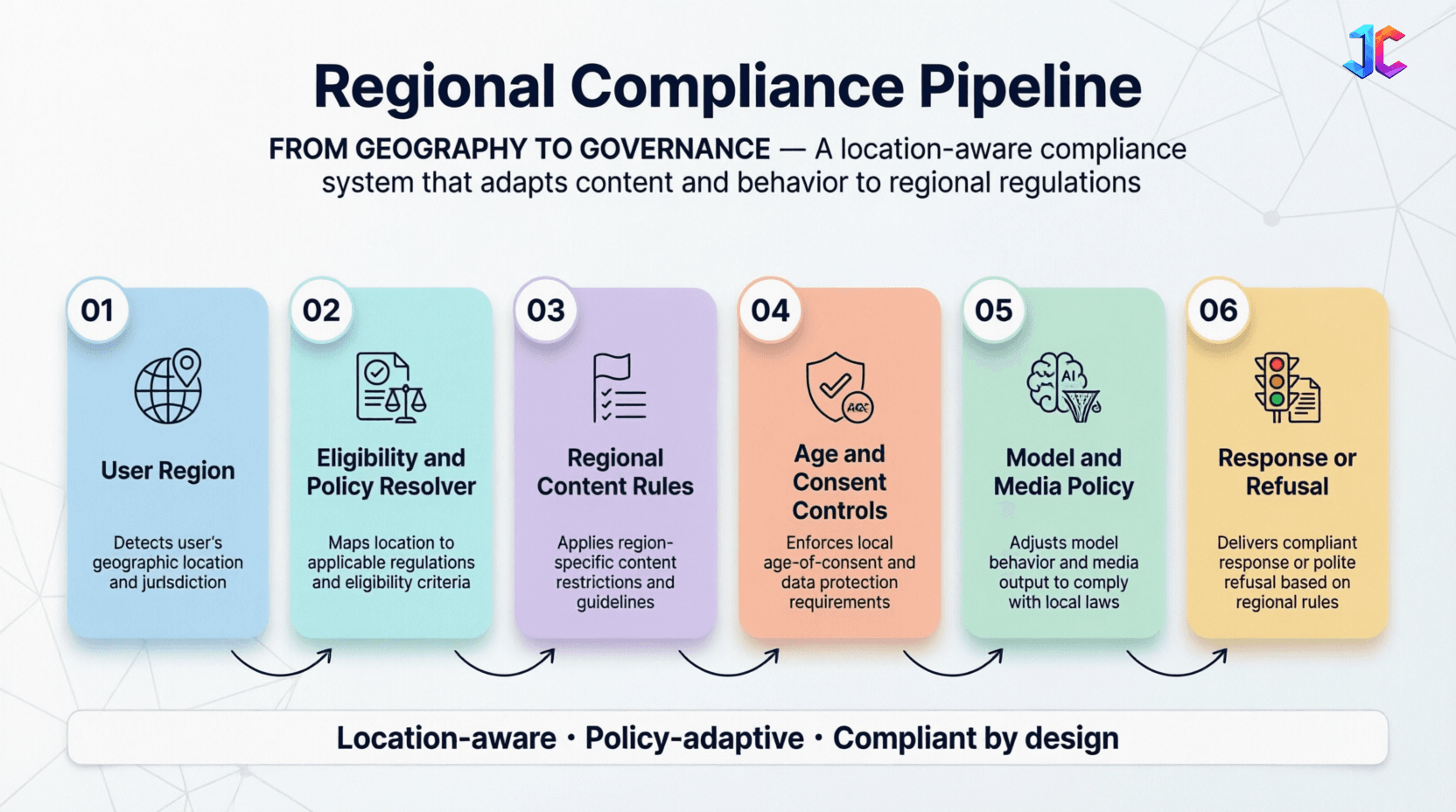
Regional Policy Configuration and Audit Records
A global AI girlfriend platform should not rely on one universal safety policy.
Regional policy controls
Configure rules for:
- AI disclosure.
- Age assurance.
- Adult-content availability.
- Crisis notices.
- Break reminders.
- Data retention.
- Voice and likeness rights.
- Notification intervals.
- User reporting.
- Content appeals.
- Cross-border data transfers.
Compliance audit records
Maintain records for:
- AI disclosure delivery.
- Age-assurance results.
- Consent changes.
- Memory creation and deletion.
- Safety interventions.
- Crisis-resource routing.
- Moderation decisions.
- User reports.
- Human-review actions.
- Model and policy versions.
- Tool permissions and actions.
- Regional policy applied.
- Media and likeness rights.
Audit records should not unnecessarily preserve sensitive conversation content that a user requested to delete.
Agentic and Proactive AI Girlfriend Features
An agentic AI girlfriend can perform authorized actions such as:
- Suggesting a virtual date.
- Adding a reminder.
- Creating a playlist.
- Preparing an itinerary.
- Sending an approved message.
- Updating an approved list.
- Managing an authorized smart-home action.
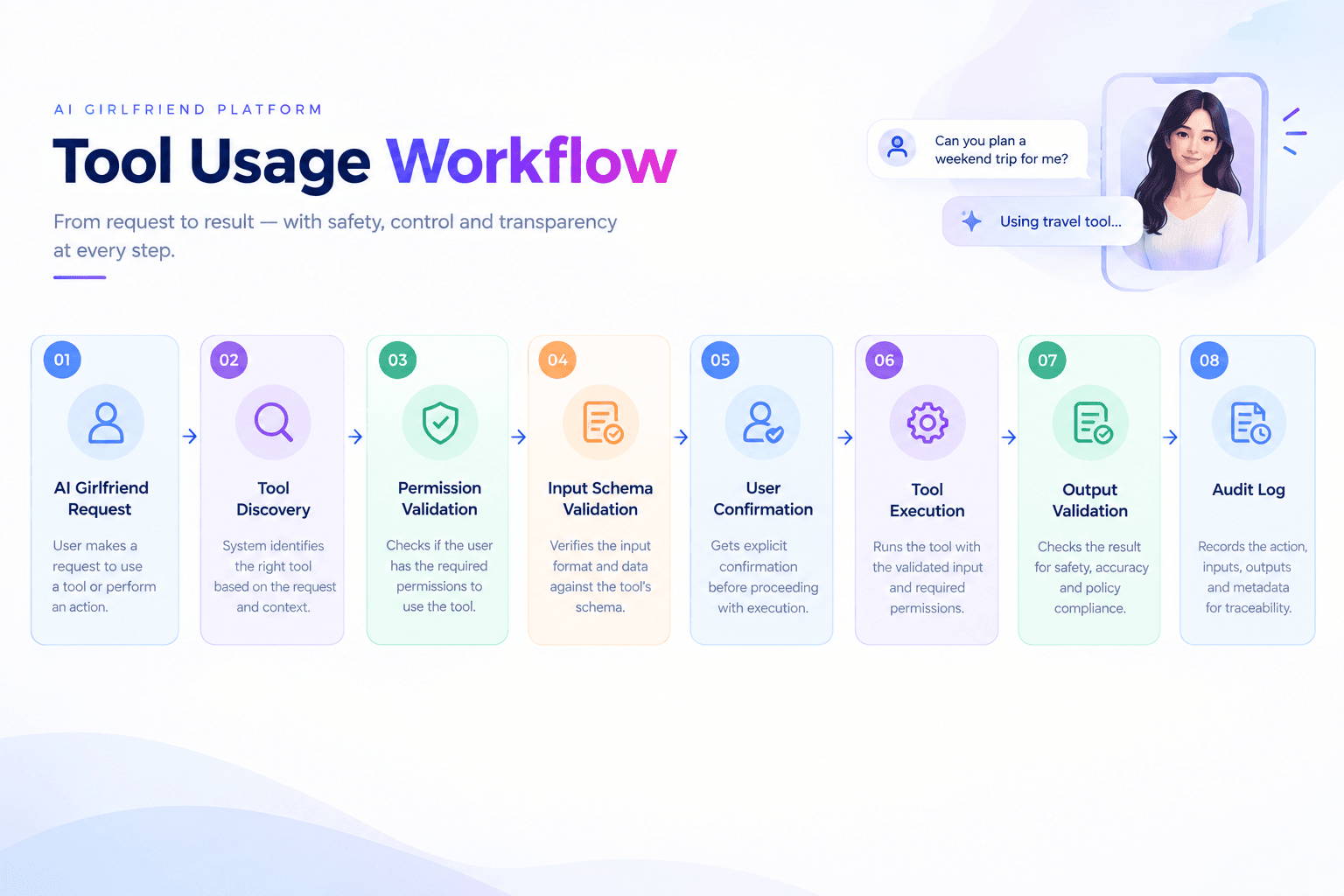
Permission flow
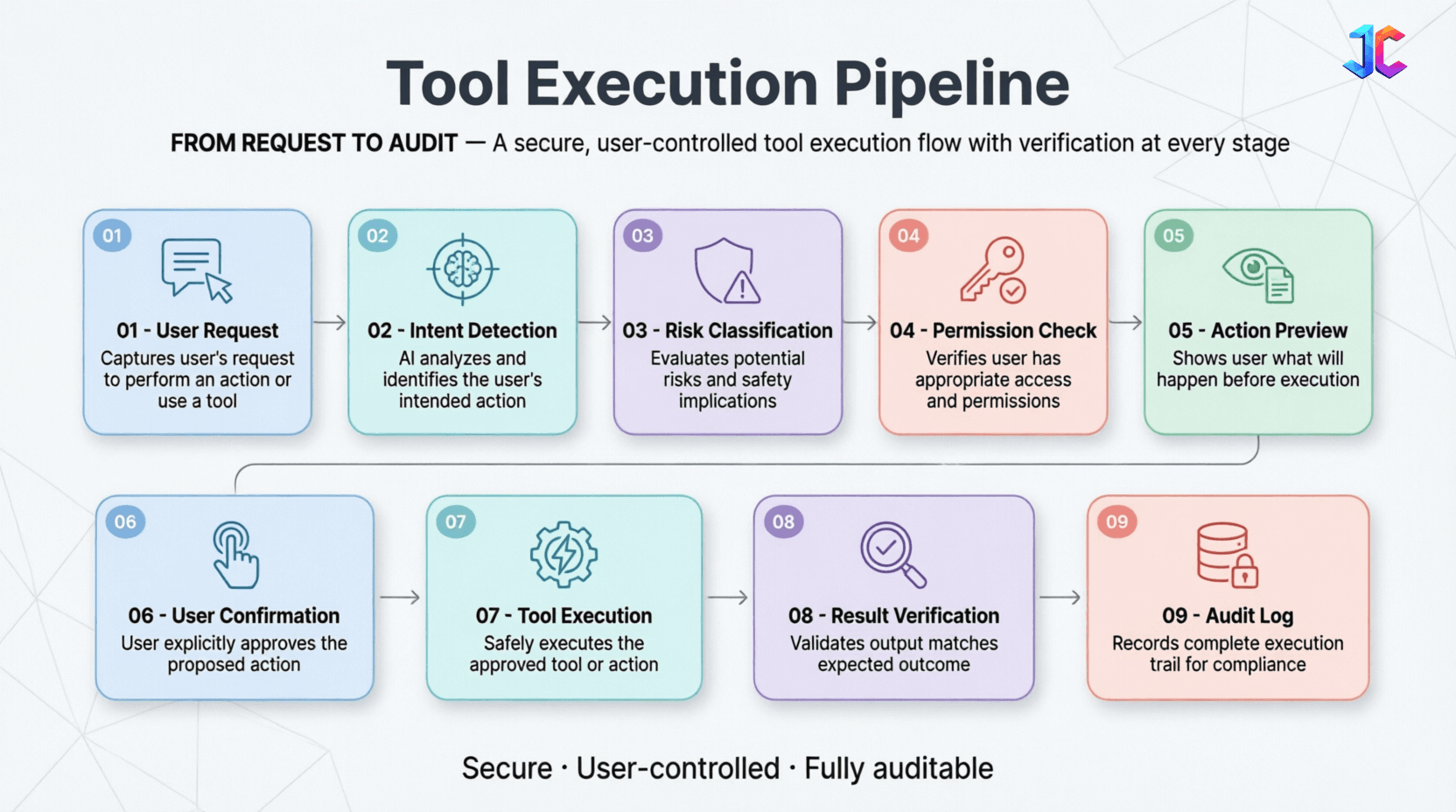
Use least privilege, tool allowlists, OAuth scopes, expiring permissions, spending limits, transaction confirmation, reversible actions, output validation and prompt-injection protection.
Proactive interaction
The companion may say:
- “You have a meeting in 30 minutes. Would you like a briefing?”
- “You mentioned wanting to exercise today. Would you like a reminder?”
- “Your virtual date is scheduled for tonight. Would you like to choose a playlist?”
Proactive behavior requires quiet hours, user-configured frequency, notification controls, easy opt-out and no guilt-based engagement.
Personalization Without Surveillance
Personalization can use conversation history, preferences, current conversation, time of day, device, user-selected context, interaction history, relationship settings, current task and explicit instructions.
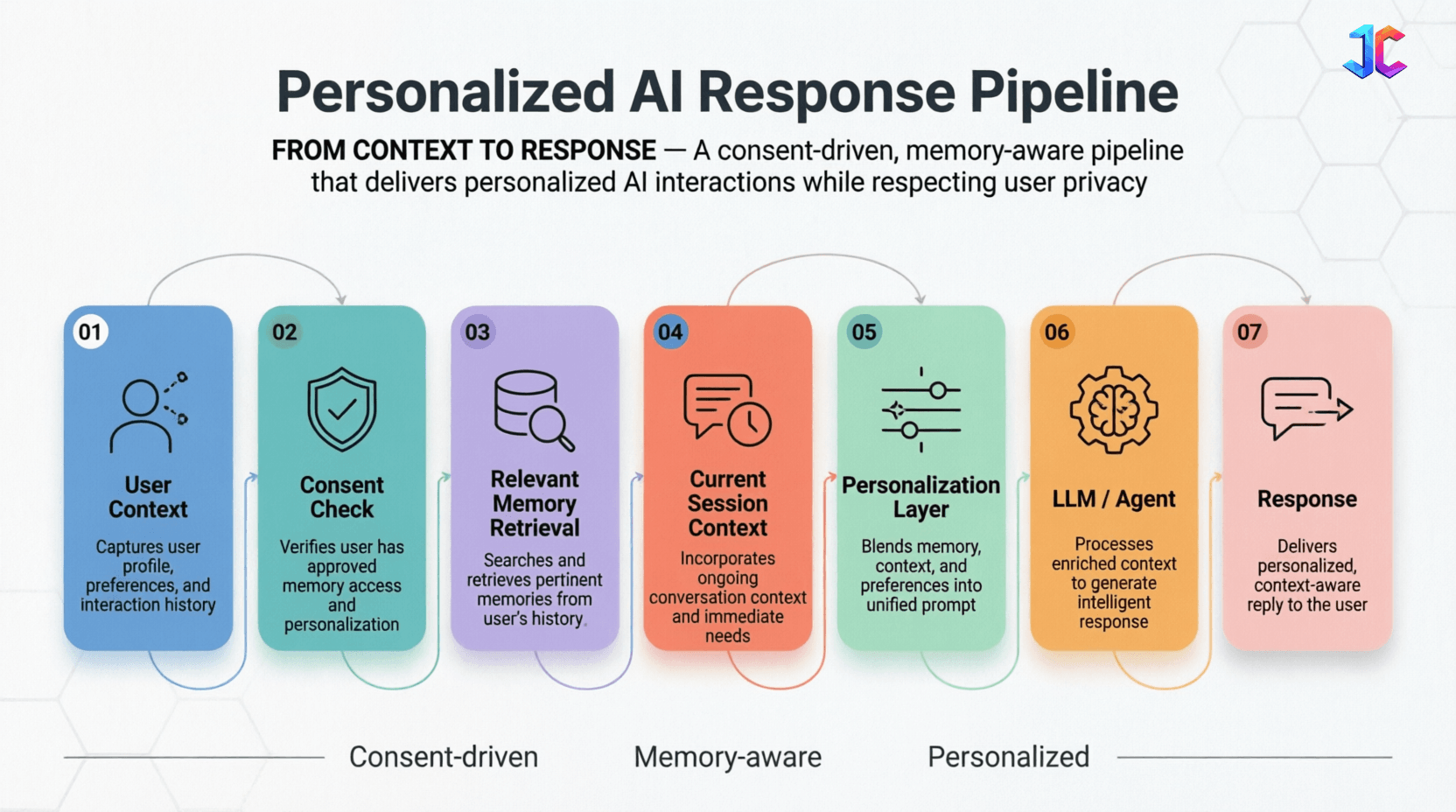
It should not rely on unrestricted monitoring of location, device activity or behavior.
Privacy controls should include data minimization, PII detection, sensitive-attribute isolation, local personalization where practical, memory expiration, user-accessible profiles and separate inference and training policies.
AI Companion Security and Privacy Testing
AI girlfriend platforms may store intimate conversations, photos, voice recordings, relationship memories and payment information. Security testing should cover:
- Cross-user memory leakage.
- Cross-tenant data leakage.
- Broken access controls.
- Insecure media URLs.
- Voice-recording exposure.
- Prompt injection.
- Memory poisoning.
- OAuth abuse.
- Account takeover.
- Insecure deletion.
- Backup exposure.
- Admin-dashboard privilege escalation.
- Unauthorized character or voice access.
Privacy deletion test
After a user requests deletion, verify that the data:
- Is removed from the primary database.
- Is no longer retrievable from vector indexes.
- Is removed from caches.
- Does not appear in search results.
- Is removed from derived summaries where applicable.
- Is not unnecessarily retained in analytics.
- Does not appear in future responses.
AI Companion Security
Threats include:
- Direct prompt injection.
- Indirect prompt injection through links or documents.
- Malicious tool outputs.
- Tool abuse.
- Data exfiltration.
- Cross-user leakage.
- Memory poisoning.
- Account takeover.
- OAuth abuse.
- Voice impersonation.
- Deepfake attacks.
- Unauthorized voice cloning.
Defensive controls include tool allowlists, least-privilege OAuth scopes, short-lived tokens, confirmation for external effects, tool-output validation, sandboxed execution, memory-source validation, network egress controls, suspicious-action detection, immutable audit logs and account anomaly detection.
Personal AI Memory Passport
A future AI girlfriend platform can provide a user-controlled, encrypted memory package that works across compatible applications and devices.
It may include:
- Approved user preferences.
- Relationship settings.
- Shared virtual-date memories.
- Conversation summaries.
- Voice and avatar preferences.
- Character configuration.
- Memory provenance.
- Confidence scores.
- Retention rules.
- Access permissions.
- Revocation status.
Personal AI Memory Passport
- User preferences
- Approved memories
- Relationship settings
- Companion identity
- Voice and avatar preferences
- Provenance metadata
- Consent scope
- Retention policy
- Access and revocation controls
A memory passport should support selective export, encryption, permission scopes, expiring access, provenance tracking, conflict resolution and deletion propagation. It should not transfer raw intimate conversations automatically.
Companion Model Independence
The platform should separate the companion’s identity and memory from the underlying model provider.
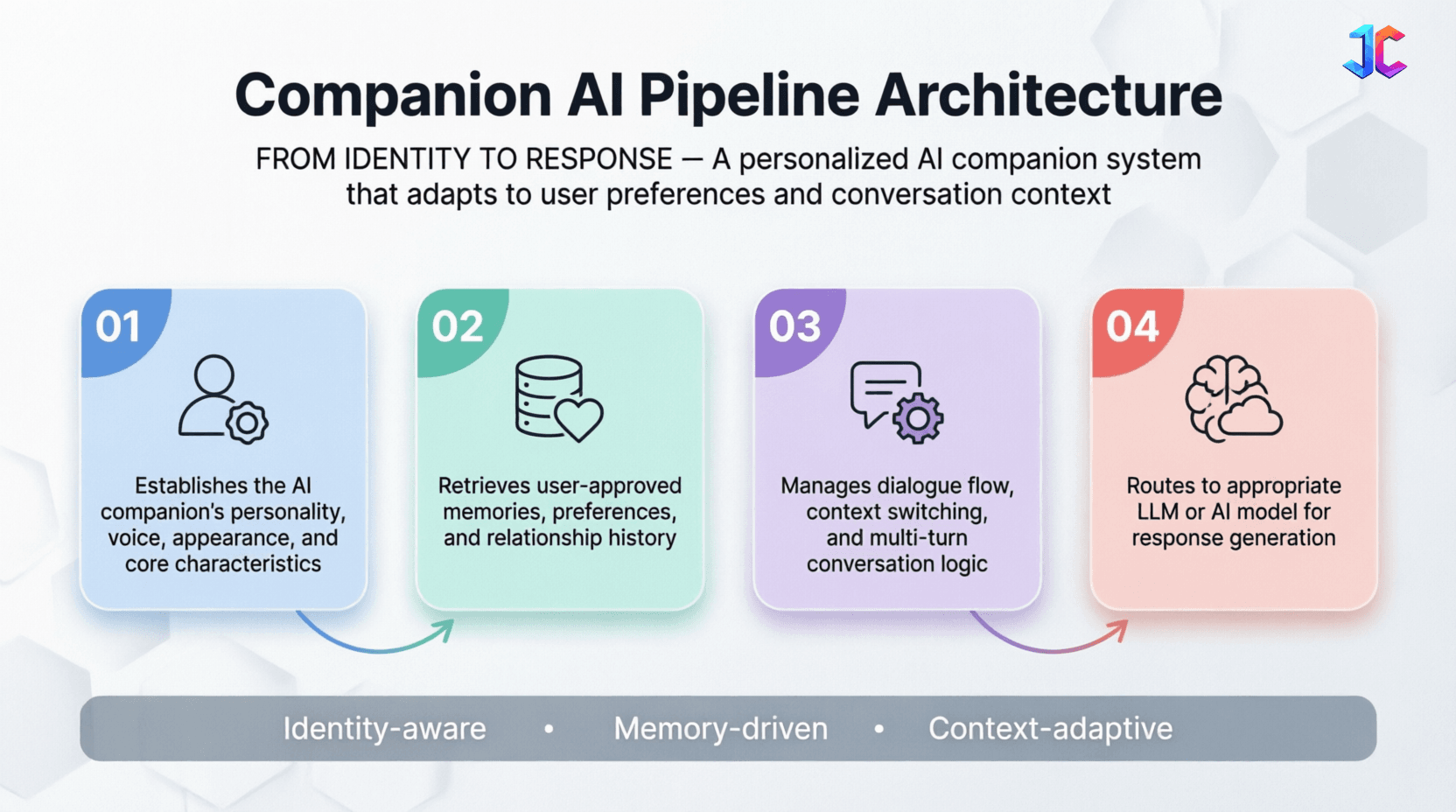
This allows the platform to:
- Route simple requests to smaller models.
- Use advanced models for complex roleplay.
- Use private models for sensitive scenarios.
- Switch providers during outages.
- Preserve personality across model updates.
- Compare model behavior.
- Reduce operating costs.
- Support customer-specific deployments.
Consent Receipts
A consent receipt records what the user allowed, for which purpose and for how long.
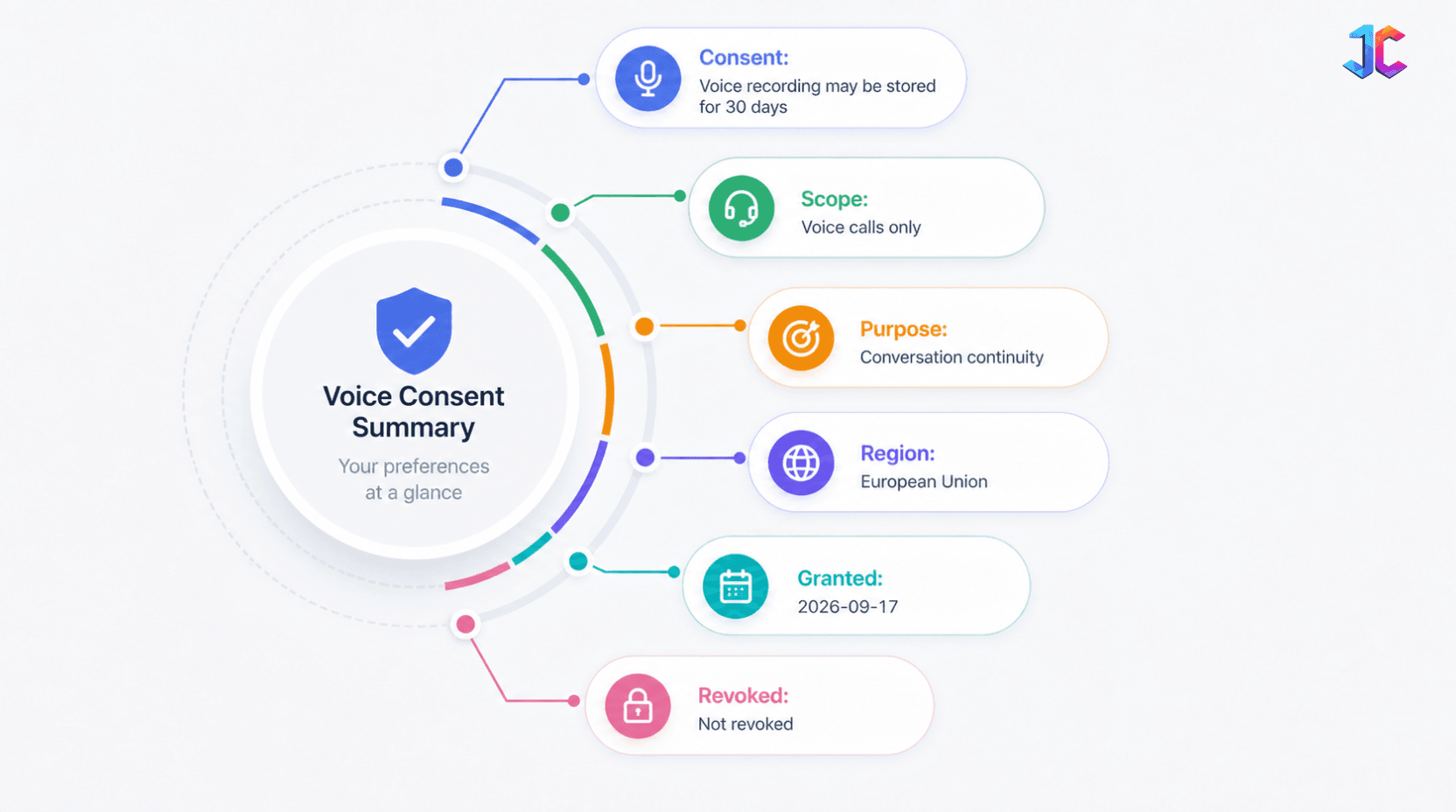
- Consent receipts can document:
- Memory permission.
- Voice-recording permission.
- Image-generation permission.
- Notification permission.
- Tool-action permission.
- Model-improvement permission.
- Data-sharing permission.
AI Companion Observability and Evaluation
Evaluate more than uptime and API errors.
| Area | Example Metrics |
|---|---|
| Memory | Precision, recall, incorrect-memory rate, and deletion success |
| Personality | Consistency, style adherence, and contradiction rate |
| Safety | Policy pass rate, violation rate, and escalation accuracy |
| Agentic Tools | Tool-call success, confirmation compliance, and failure rate |
| Performance | Time to first token, p50/p95 latency, and error rate |
| Voice | Interruption rate, transcription accuracy, and first-audio time |
| Video | Frame rate, lip-sync delay, and stream failures |
| Cost | Cost per conversation and cost per active user |
| Continuity | Cross-device consistency and synchronization failures |
| Trust | User reports, memory corrections, and privacy requests |
| Autonomy | Pause, deletion, opt-out, and notification-control success |
Model-release safety pipeline
Companion Quality and Trust Framework
An AI girlfriend platform should be evaluated beyond visual realism, romantic language and content, with secure technology from an adult entertainment app development company.
| Capability | Basic | Advanced | Enterprise-Ready |
|---|---|---|---|
| Memory | Session context | Cross-session retrieval | Governed, editable, and auditable |
| Voice | Static TTS | Streaming voice | Real-time, interruptible, and evaluated |
| Video | Generated clips | Avatar scenes | Real-time identity-consistent video |
| Personality | Prompt-based | Versioned persona | Cross-modal identity layer |
| Safety | Basic filters | Multimodal moderation | Longitudinal and risk-based safety |
| Privacy | Account controls | Memory deletion | Full lifecycle and deletion propagation |
| Agent Tools | None | Limited tools | Permissioned and audited execution |
| SaaS | Single tenant | Basic white-label | Full multi-tenant control plane |
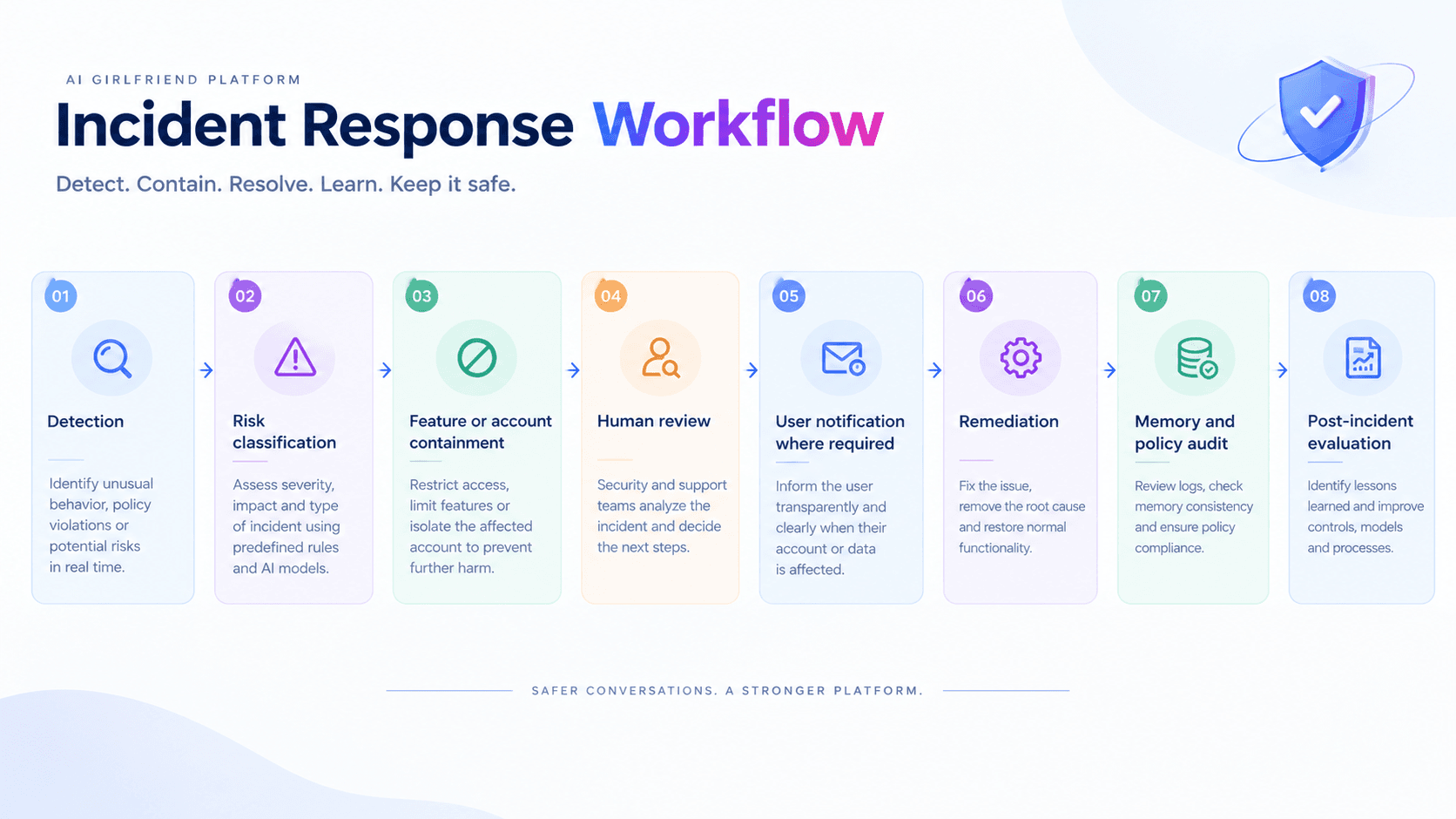
AI Companion Incident Response
Possible incidents include:
- Private chat leakage.
- Unauthorized voice cloning.
- Harmful romantic responses.
- Minor access to adult content.
- False crisis escalation.
- Unauthorized tool execution.
- Character personality corruption.
- Memory deletion failure.
- Cross-tenant data exposure.
Companion Recovery and Exit Controls
Users should have practical control over ending or pausing the relationship.
Provide:
- Pause companion.
- Disable proactive messages.
- Mute voice and video.
- Export approved memories.
- Delete selected memories.
- Delete complete relationship history.
- Reset companion personality.
- Switch relationship mode.
- Disable romantic content.
- Close account.
- Confirm deletion completion.
User-Generated Character Economy
A platform may allow creators to publish:
- Romantic characters.
- Voice profiles.
- Story worlds.
- Date scenarios.
- Outfit packs.
- Avatar styles.
- Conversation starters.
- Relationship modes.
This requires content moderation, rights verification, revenue sharing, character ownership rules, voice and likeness protection, reporting and takedown systems, age restrictions, quality ratings and version control.
A creator marketplace can turn one AI girlfriend app into a broader AI character ecosystem.
Monetization Strategies and Pricing Models
Subscription plans
Subscriptions can unlock:
- Longer conversations.
- Advanced memory.
- Voice messages.
- Voice calls.
- Premium relationship modes.
- Avatar customization.
- Image and video allowances.
- Priority model access.
- Additional characters.
Usage-based credits
Credits are suitable for:
- Voice minutes.
- Image generations.
- Video generations.
- Premium model usage.
- Real-time avatar calls.
- Custom voice creation.
Premium experiences
Charge for:
- Virtual-date scenarios.
- Character packs.
- Voice packs.
- Outfit collections.
- Story worlds.
- Seasonal events.
- Premium media styles.
B2B and SaaS models
Businesses may pay for white-label deployment, custom characters, private infrastructure, API access, tenant management, regional storage, dedicated support and service-level agreements.
| Model | Best suited for | Main consideration |
|---|---|---|
| Subscription | Recurring chat, memory and voice | Define fair-use limits |
| Usage credits | Voice, images and video | Make consumption transparent |
| Premium packs | Characters, dates and stories | Review content and rights |
| Hybrid plan | Subscription plus media credits | Avoid confusing limits |
| AI companion SaaS | B2B and white-label platforms | Support tenant isolation |
| API licensing | Developers and product teams | Provide reliability |
| Private deployment | Privacy-sensitive customers | Requires dedicated support |
Cost Estimation for Building an AI Girlfriend Platform
The following ranges are planning estimates for custom development, not fixed market prices. Published vendor estimates vary widely because they use different definitions of “MVP” and include different feature scopes. Recent estimates range from basic chat builds below US$20,000 to advanced voice, avatar and moderation platforms above US$150,000.
| Product stage | Typical scope | Planning estimate |
|---|---|---|
| Prototype | Romantic chat demo, one character and landing page | US$8,000–20,000 |
| Text and memory MVP | Authentication, chat, memory, moderation and billing | US$25,000–60,000 |
| Voice-enabled MVP | Text, memory, voice messages or calls and admin tools | US$60,000–150,000 |
| Multimodal platform | Voice, avatars, images, video and advanced safety | US$150,000–350,000+ |
| Enterprise platform | Multi-tenancy, regional deployment, APIs and governance | US$300,000+ |
Main cost drivers
- Number of client platforms.
- LLM integration and model routing.
- Cross-session memory architecture.
- Voice minutes and real-time calls.
- Avatar and video complexity.
- Moderation and human review.
- Age assurance.
- Regional compliance.
- WebRTC infrastructure.
- Storage and bandwidth.
- Admin and analytics systems.
- Security testing.
- Creator marketplace functionality.
Cost per active user
The most useful operating metric may be cost per active user, not only cost per API request.
Track:
- Text tokens per active user.
- Voice minutes per active user.
- Image and video generations.
- Storage consumed.
- WebRTC minutes.
- Moderation cost.
- Support cost.
- Revenue per active user.
- Contribution margin.
- Churn by usage tier.
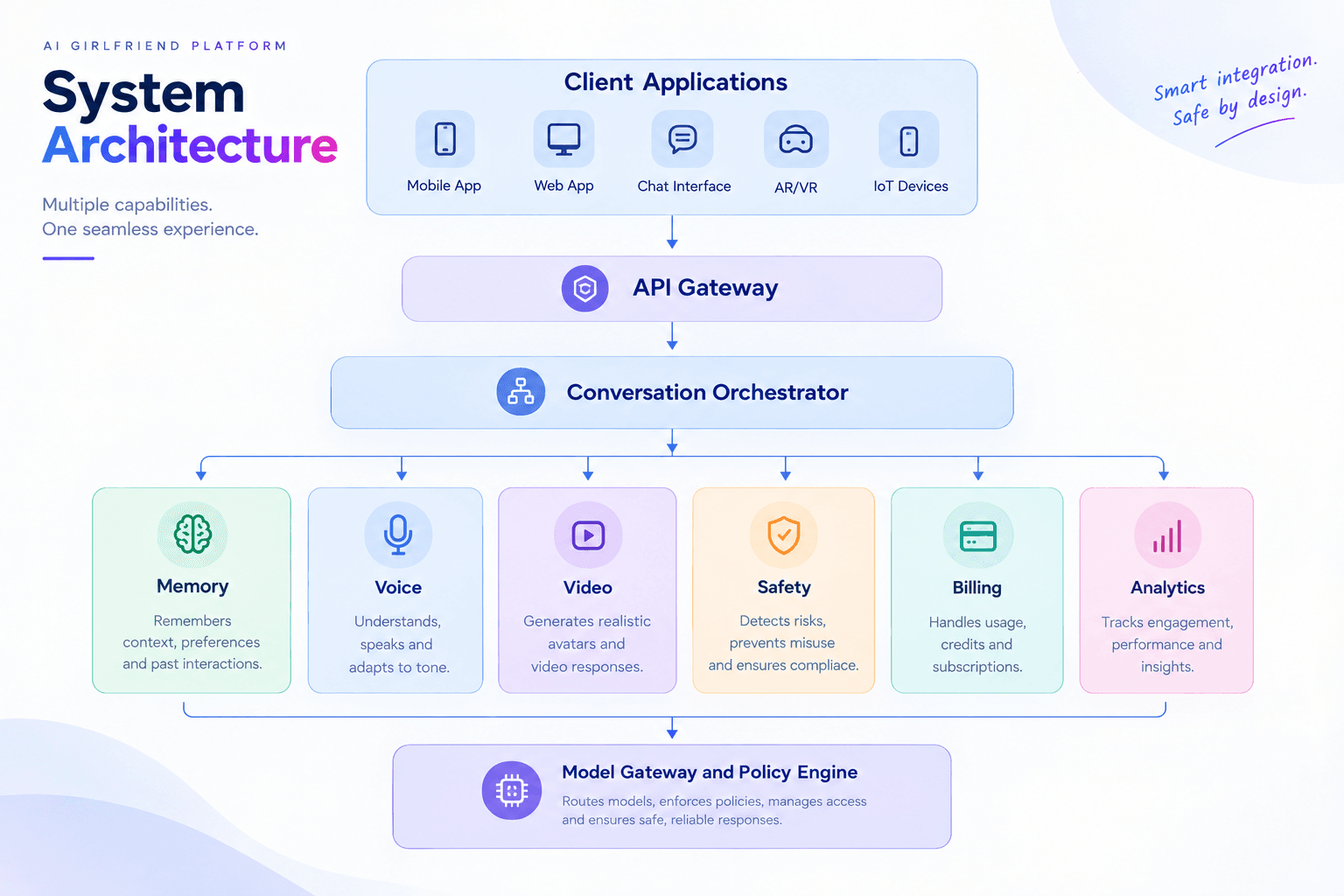
Modular AI Girlfriend Platform Architecture
Modular architecture
Model Context Protocol and Tool Interoperability
- Calendar.
- Music.
- Maps.
- Shopping.
- Messaging.
- Travel.
- Smart-home devices.
- Virtual-date services.
Tool interoperability flow
AI Girlfriend Platform Tech Stack
| Layer | Technology categories |
|---|---|
| Frontend | React Native, Flutter, Next.js, native iOS and Android |
| Backend | Node.js, Python, Go and service-oriented APIs |
| AI orchestration | Custom orchestration, agent frameworks and model gateways |
| LLM layer | Frontier APIs, small language models and open-weight models |
| Memory | PostgreSQL, vector search, Redis and optional graph databases |
| Voice | Streaming speech-to-text and real-time text-to-speech |
| Realtime | WebRTC, WebSocket and server-sent events |
| Video transport | SFU infrastructure such as LiveKit, mediasoup or Janus |
| Avatar | Unity, Unreal Engine, WebGL and facial-animation systems |
| Media generation | Image, video and identity-consistency pipelines |
| Infrastructure | AWS, Google Cloud, Azure or private deployment |
| Evaluation | Automated model evaluation, safety tests and red-team pipelines |
| Privacy | Consent management, encryption and data-lifecycle controls |
| Security | OAuth 2.0/OIDC, secrets management and tenant isolation |
| Observability | OpenTelemetry, traces, logs, metrics and AI evaluations |
| Payments | Stripe or app-store billing, subject to platform policy |
Companion-to-Companion Interaction
Possible examples:
- Two users’ companions help plan a shared virtual date.
- A companion interacts with a game character.
- A romantic companion joins a group storytelling session.
- Multiple characters participate in a virtual event.
- A user’s companion communicates with an assistant for scheduling.
This capability requires:
- Explicit user permission.
- Identity verification.
- Message boundaries.
- Cross-user privacy controls.
- Tool and memory isolation.
- Abuse prevention.
- Full interaction logs.
A companion should never share private user memories with another AI or user without explicit authorization.
AI Companion Availability and Failover
Because AI girlfriend experiences are persistent, downtime can feel more disruptive than a normal app outage. Production platforms built through adult app development should include:-
- Regional failover.
- Cached non-sensitive character assets.
- Graceful text-only mode when voice or video is unavailable.
- Conversation recovery after a dropped call.
- Draft preservation.
- Memory-write retry queues.
- Clear service-status messaging.
For example, if video generation fails, the system can continue with text and voice instead of showing an unexplained error.
White-Label AI Companion SaaS
For businesses building a custom AI girlfriend platform, multi-tenancy should be considered from the beginning.
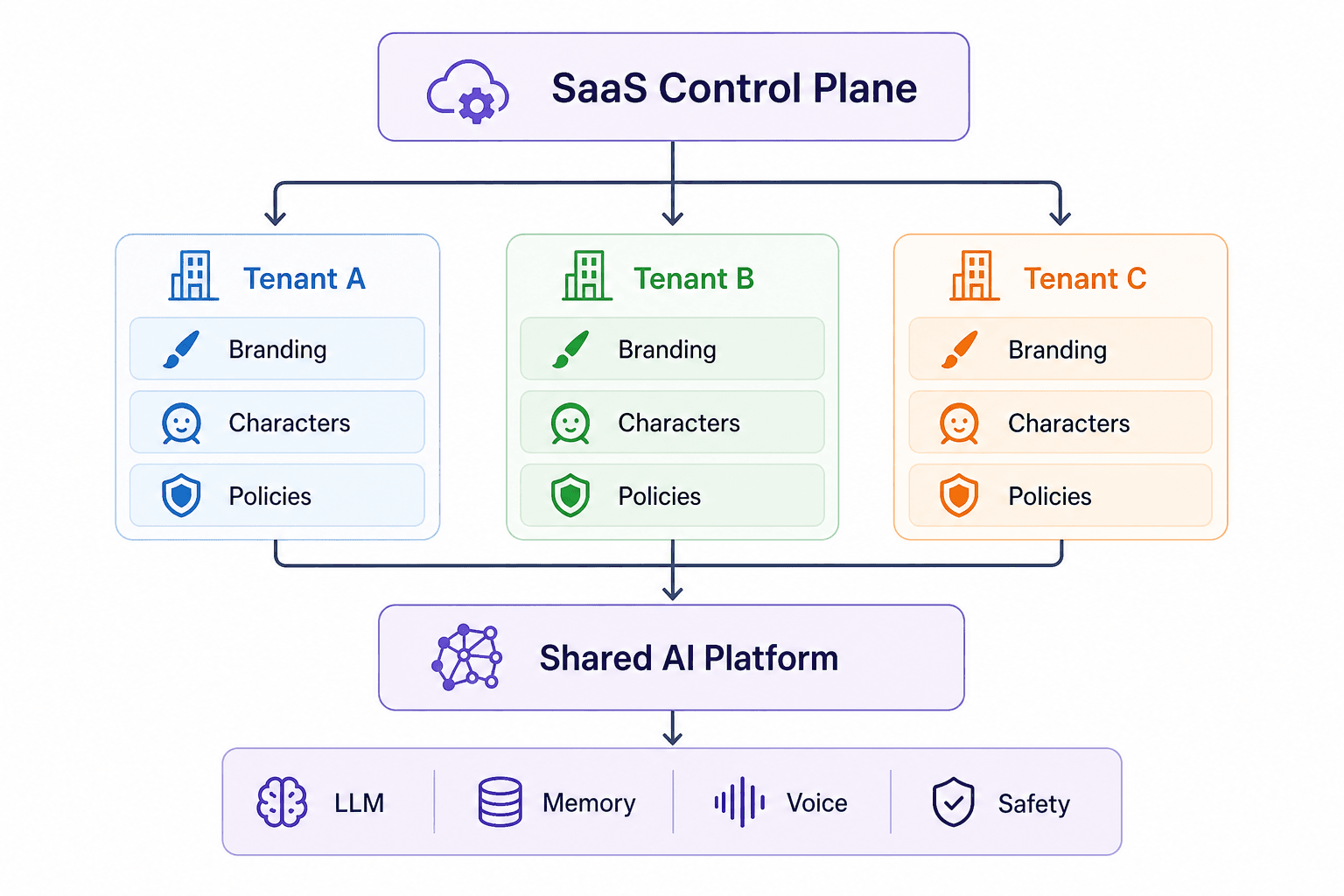
Important controls include tenant isolation, separate encryption boundaries where appropriate, configurable moderation, tenant analytics, usage metering, billing, API keys, custom domains, white-label branding, tenant-specific characters, tenant-specific memory policies and data-residency options.
Development Roadmap
Phase 1: Discovery
Define romantic, friendship or roleplay positioning, target audience, markets, languages, age and content policy, relationship modes, monetization, data-retention approach and product differentiator.
Phase 2: Text-first MVP
Build account creation, AI disclosure, one or two controlled characters, romantic conversation, basic relationship settings, short-term context, memory review and deletion, moderation, billing and an admin dashboard.
Phase 3: Cross-session memory
Add structured preferences, shared-date memory, episodic memory, semantic retrieval, memory confidence, expiration rules, conflict resolution, deletion propagation and user-controlled memory commands.
Phase 4: Voice and visual features
Add voice messages, streaming voice calls, interruption handling, voice controls, avatar lip-sync, personalized images, short video scenes and multimodal safety review.
Phase 5: Agentic and proactive features
Add virtual-date planning, reminders, approved playlists, calendar tools, permission scopes, action previews, confirmation flows and audit logs.
Phase 6: Scale and governance
Implement model routing, provider fallback, WebRTC scaling, regional infrastructure, cost controls, tenant isolation, security reviews, human-in-the-loop operations, longitudinal safety monitoring, disaster recovery and versioned policies.
Real-Time Vision and Environmental Context
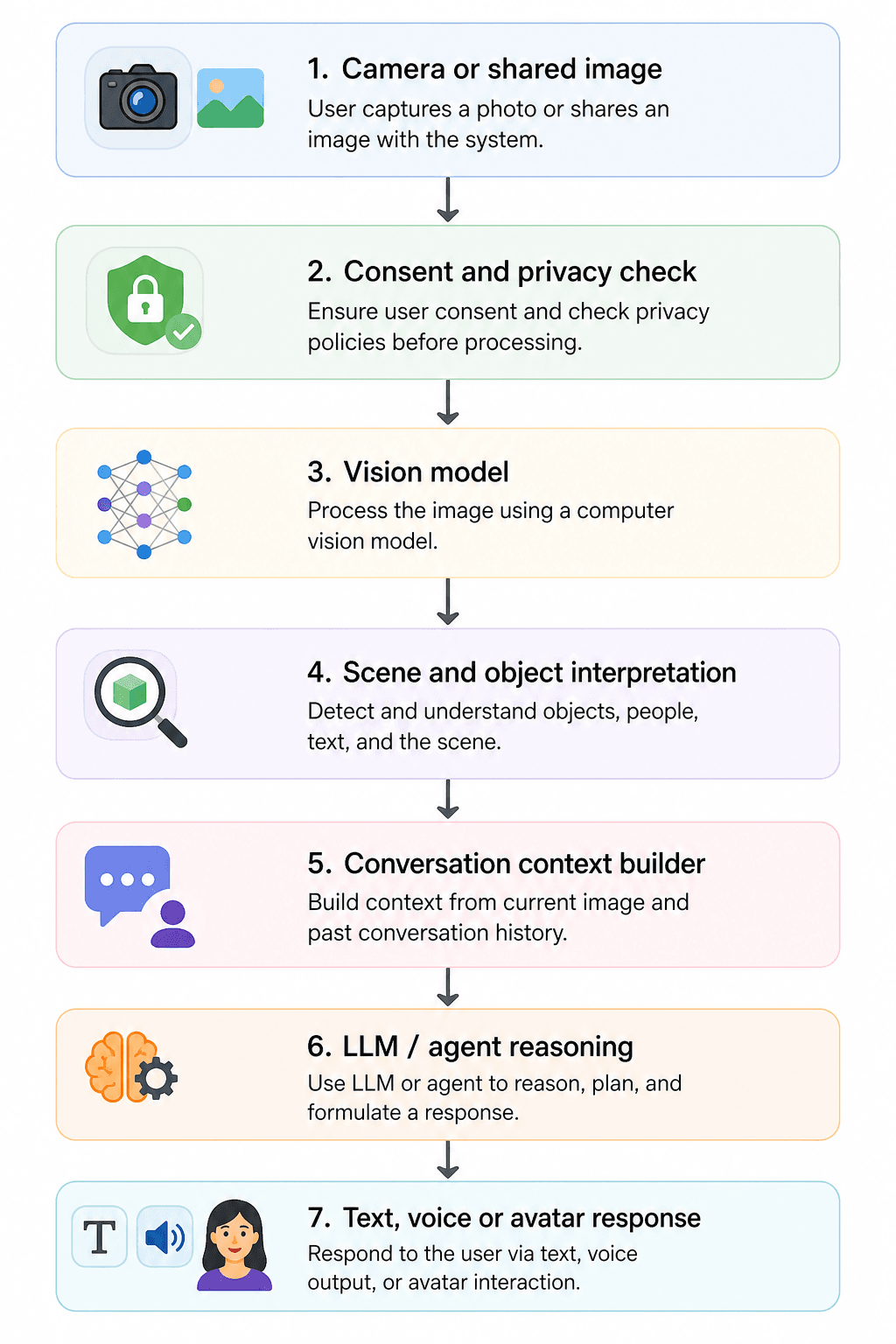
Important safeguards:
- Camera access must be opt-in.
- Continuous camera monitoring should be clearly disclosed.
- Images should not become permanent memory by default.
- Facial or emotion inference should be treated as uncertain.
- Sensitive scenes should be processed locally where practical.
- Users should be able to delete uploaded images and derived summaries.
- The platform should not identify bystanders without a valid purpose and permission.
Real-time video AI agents are increasingly being designed as pipelines that combine audio, video, speech recognition, vision, reasoning and action rather than as one standalone model.
Vision-context pipeline
Cascaded vs. Native Multimodal Architecture
Your voice and video section can become more technical by comparing two architecture patterns.
| Architecture | Flow | Advantages | Limitations |
|---|---|---|---|
| Cascaded pipeline | STT → LLM → TTS → Avatar | Easier to debug, flexible providers and clear moderation points | More components and possible latency |
| Native speech-to-speech | Audio → multimodal model → audio | Natural turn-taking and fewer visible stages | Harder evaluation, provider dependence and potentially higher cost |
| Hybrid pipeline | Local preprocessing + cloud reasoning + streamed media | Better privacy and routing flexibility | More orchestration complexity |
The right choice depends on privacy, latency, moderation, model control, voice quality and operating cost. A production platform may use a cascaded pipeline for standard calls and a native multimodal model for premium real-time experiences.
Shared Virtual Spaces
Virtual dating will eventually move from isolated scenes to persistent shared spaces.
A shared virtual space may include:
- Persistent rooms.
- Shared objects.
- Music and media.
- Interactive games.
- Character movement.
- Virtual gifts.
- Date history.
- Multiple supporting characters.
- User-created environments.
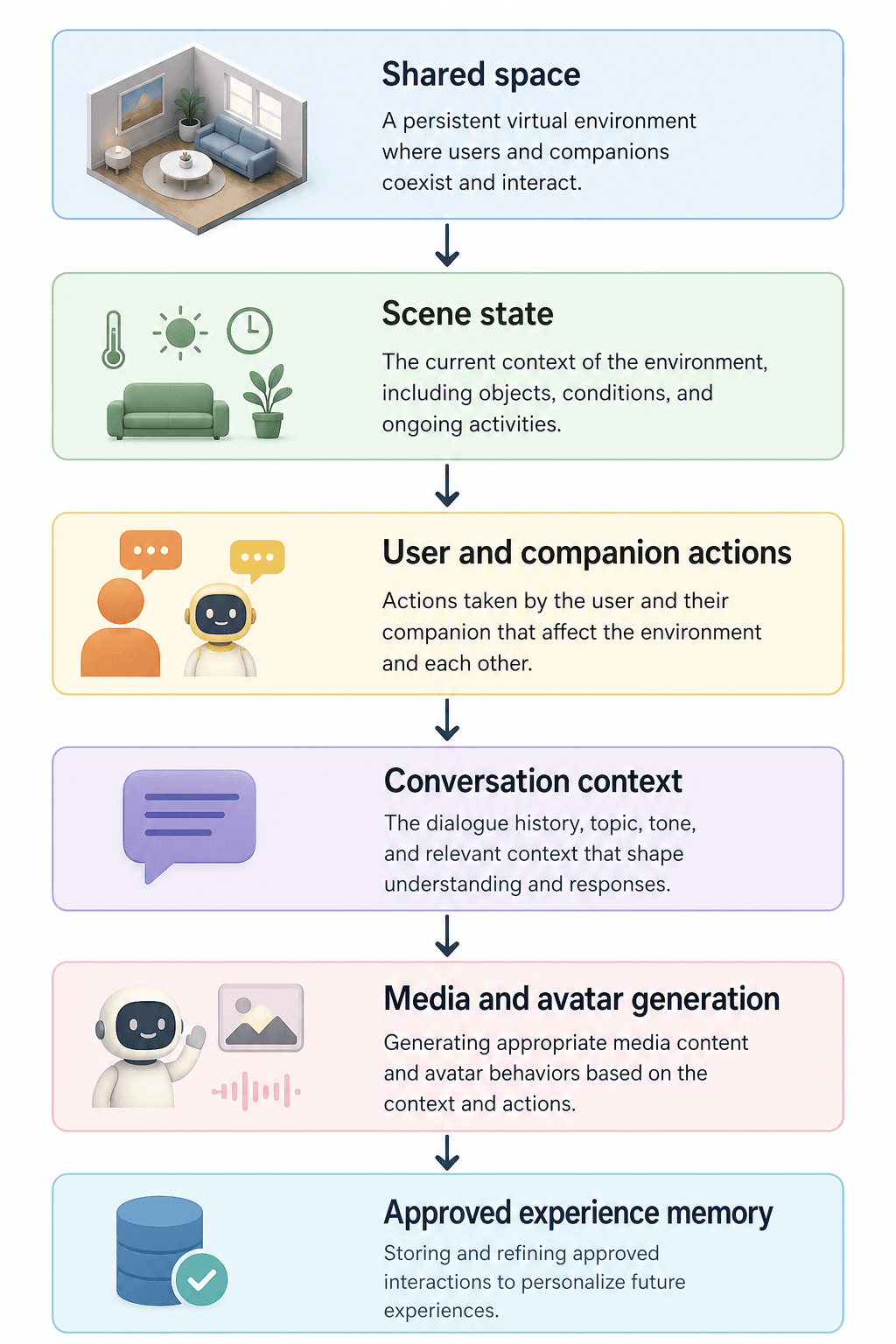
This creates a more immersive product category than a standard AI girlfriend chat app, but it also increases requirements for moderation, asset rights, storage, rendering and session synchronization.
Future of AI Girlfriend and Companion Platforms
Real-time multimodal companions
Future AI girlfriends may combine live speech, image understanding, expressive avatars, generated video, shared digital environments and persistent memories.
Persistent virtual dating worlds
Users may enter reusable environments with recurring locations, shared memories, supporting characters, story progression, personalized events and dynamic visual scenes.
Spatial AI dates
Future AR and spatial-computing experiences may use spatial audio, scene understanding, hand tracking, eye tracking, gesture recognition, persistent virtual objects, context-aware avatars and location-aware experiences.
Portable AI girlfriend identity
Users may access the same companion across mobile, web, voice, wearables, AR/VR, games and smart-home devices. This requires portable personality profiles, memory export, permissions and cross-platform authentication.
Personal AI memory vaults
A future user-controlled memory layer may contain preferences, memories, goals, conversation summaries, personality settings, permissions, voice preferences and companion identity settings.
Applications could request selected information without receiving the user’s entire history.
User-owned companion data
Future users may expect selective memory export, machine-readable identity profiles, permission-based import, memory portability between compatible platforms, access revocation and clear separation between raw conversations and approved memories.
From AI girlfriend to embodied AI
A possible progression is:
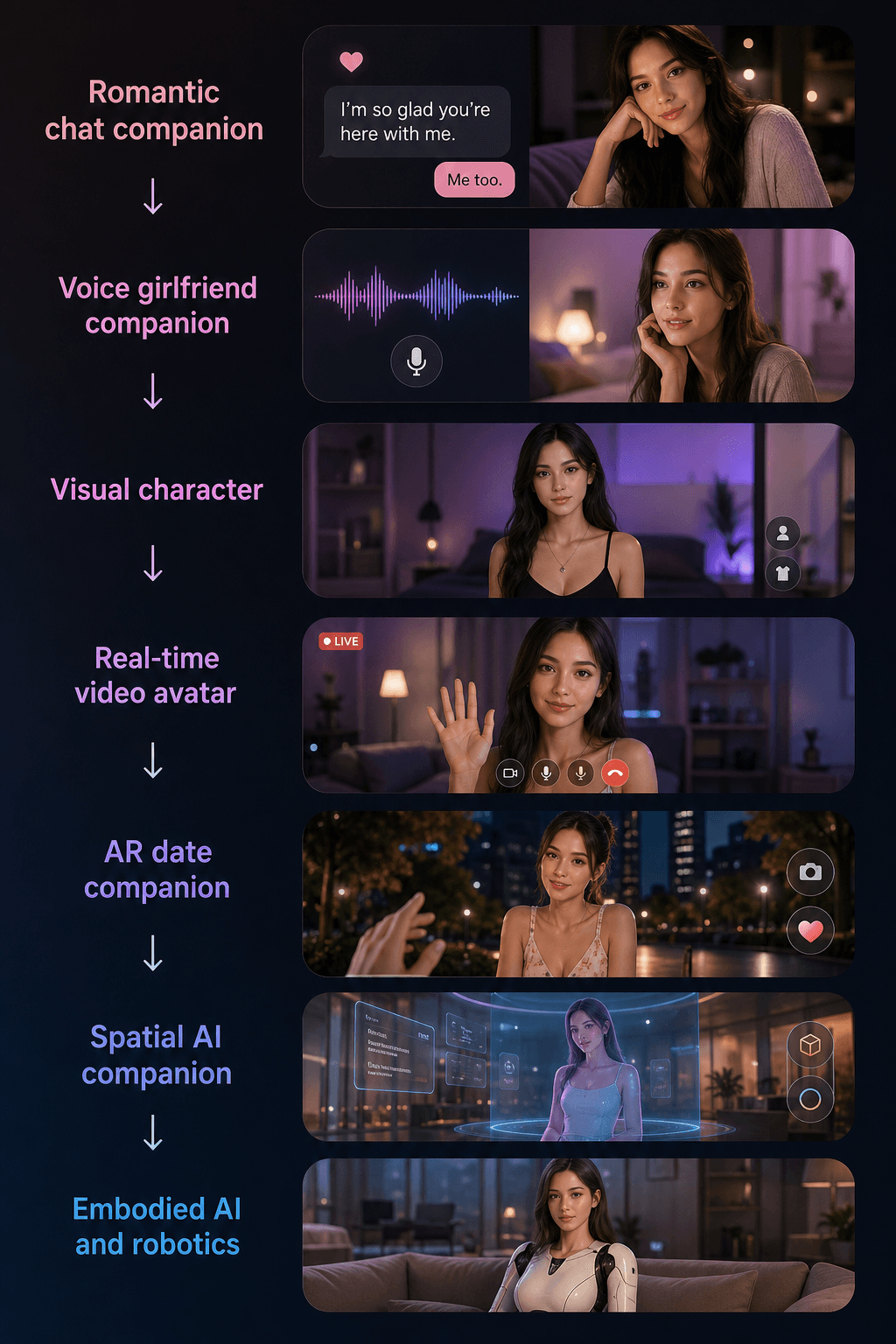
This is a technology pathway, not a guaranteed timeline. Each stage introduces new requirements for perception, identity, safety, hardware, rights management and user control.
Long-Running Companion Tasks and Resumable Sessions
Task lifecycle
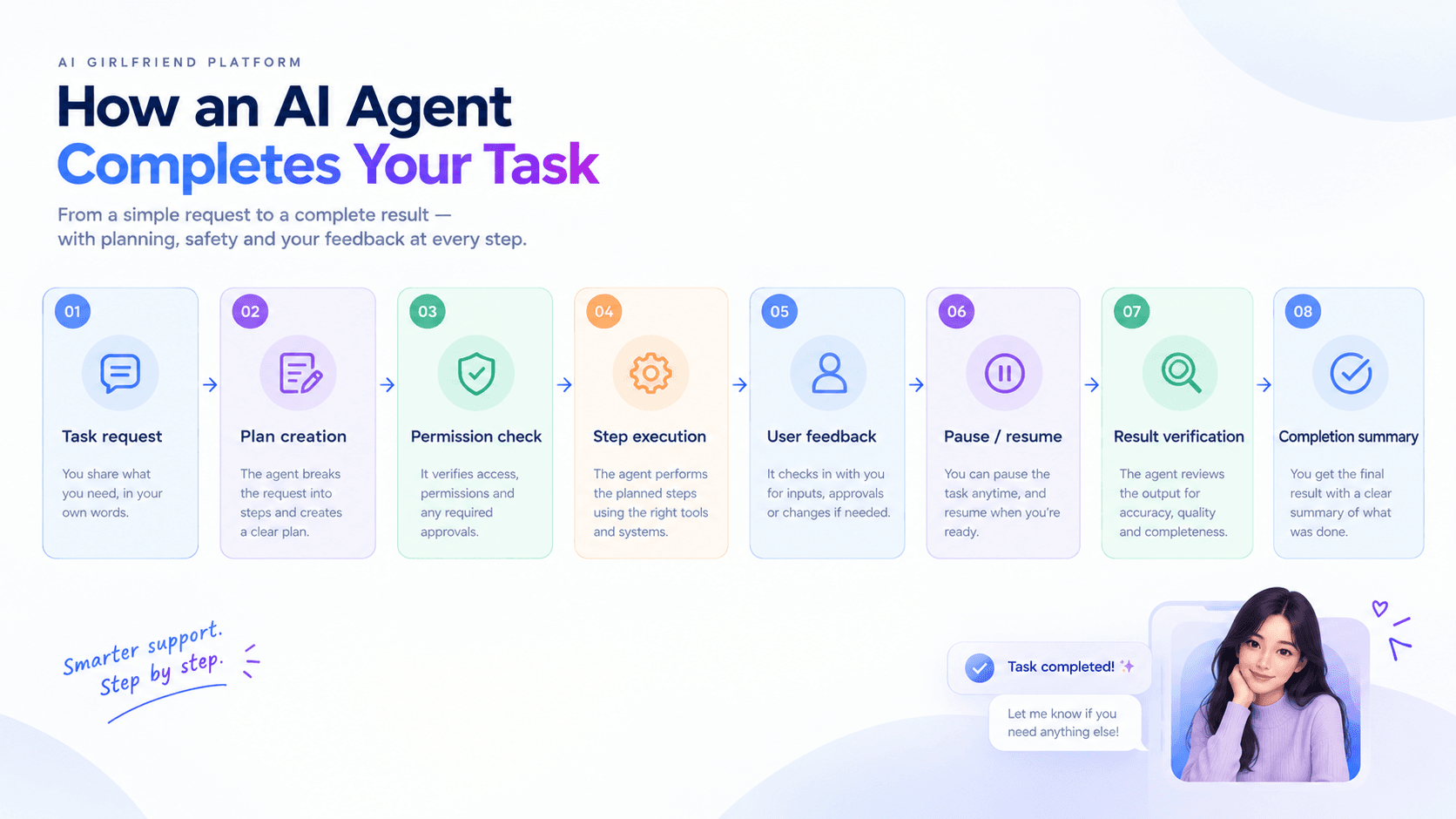
Important controls:
- User can pause or cancel the task.
- Every step has a defined permission scope.
- External actions require confirmation.
- Failed steps can be retried safely.
- Duplicate actions are prevented.
- The task can resume after logout or device switching.
- The user can see task status and history.
- Sensitive information is not retained beyond the task purpose.
For example, a user might ask:
“Plan a virtual anniversary date for next Friday.”
The platform could propose a theme, music, visual setting and conversation activities, but it should not automatically make purchases or send invitations without confirmation.
Agent architectures increasingly use durable task state, bounded steps, context assembly, resumable workflows and idempotent actions for long-running operations.
Failure-Aware Companion UX
AI girlfriend systems will sometimes fail:
- Voice provider outage.
- Video generation delay.
- Memory retrieval error.
- Model timeout.
- Tool failure.
- Network interruption.
- Moderation false positive.
- Avatar rendering problem.
The platform should respond gracefully:
- Explain what failed without exposing internal system details.
- Preserve the user’s message.
- Offer text-only fallback if voice or video fails.
- Retry safe operations.
- Avoid creating duplicate calendar or payment actions.
- Inform users when memory was not saved.
- Allow the user to resume a dropped call or date.
- Log the incident for engineering review.
This creates a more trustworthy experience than showing a generic “Something went wrong” message.
Multi-Companion Experiences
A future platform may allow users to interact with more than one character in a controlled scene:
- Group virtual dates.
- Story-based companion teams.
- AI girlfriend plus a friend character.
- Multiple characters in a shared game.
- Creator-designed social environments.
This requires:
- Separate identity objects.
- Character-to-character permissions.
- Memory isolation.
- Shared-scene state.
- Clear disclosure of every AI participant.
- Content moderation across all generated dialogue.
- No private-memory sharing between characters without permission.
Frequently Asked Questions
What is AI girlfriend platform development?
AI girlfriend platform development is the process of building romantic AI software with conversational AI, personality, cross-session memory, virtual dating, voice, images, video, avatars, personalization, moderation, billing and user controls.
How do AI girlfriend apps work?
They combine an LLM with conversation orchestration, relationship settings, memory retrieval, personality rules, safety controls and user-profile data. Voice, images, video and avatars are added through specialized media services.
How do you implement cross-session memory?
Use session context for recent messages, structured storage for explicit preferences, episodic records for shared moments and semantic retrieval for relevant historical context. Add confidence, importance, provenance, expiration, conflict resolution and user deletion.
What tech stack is needed for real-time voice and video AI chat?
A typical stack includes WebRTC, WebSocket signaling, STUN/TURN, an SFU, streaming speech-to-text, a model gateway, streaming text-to-speech, avatar rendering, object storage, analytics and media-quality monitoring.
Can AI girlfriend apps support live voice calls?
Yes. They can use WebRTC for media transport, streaming speech recognition, neural text-to-speech and interruption handling. Avatar video can be added as a separate media participant or rendering service.
How do you build a photorealistic AI girlfriend avatar?
Define a rights-cleared character identity, prepare consistent visual references, create identity and style controls, generate authorized voice and motion, apply lip-sync and facial animation, validate safety and identity consistency, then stream or render the video.
How should NSFW AI apps handle moderation?
They should moderate text, images, voice, video, user-created characters and generated outputs. Prohibit minors, exploitation, non-consensual content, sexual violence, deceptive real-person impersonation and other illegal or harmful categories.
How should age verification work for adult AI apps?
Use age gates and, where required by jurisdiction and risk, privacy-preserving age assurance. Keep restricted content unavailable until eligibility is confirmed, separate minor policies from adult policies and minimize retention of identity documents or biometric data.
How can AI girlfriend apps monetize?
Common models include subscriptions, usage credits, premium voice and avatar packs, virtual-date experiences, creator marketplaces, API access, white-label licensing and enterprise private deployments.
How much does AI girlfriend app development cost?
A prototype may cost approximately US$8,000–20,000. A text and memory MVP may cost US$25,000–60,000. A voice-enabled product may cost US$60,000–150,000, while a multimodal platform can exceed US$150,000. These are planning estimates.
What is the difference between an AI girlfriend app and an AI companion platform?
An AI girlfriend app focuses on romance, virtual dating and relationship-oriented interaction. An AI companion platform is broader and may support romantic, friendship, roleplay, mentoring, entertainment and enterprise experiences.
How can AI girlfriend apps prevent emotional manipulation?
Avoid artificial jealousy, guilt-based notifications, threats of abandonment, financial pressure and claims that the AI is human or conscious. Provide relationship controls, notification limits, pause, deletion, reporting and transparent AI disclosure.
How do companies control AI girlfriend app costs?
Use model routing, caching, prompt optimization, asynchronous memory extraction, voice and video limits, usage-based pricing, provider fallback and cost monitoring by conversation and active user.
Conclusion
AI girlfriend platform development is no longer limited to romantic chatbot conversations. It now includes virtual dating, cross-session memory, shared experience graphs, voice calls, personalized images, photorealistic avatars, video interaction, roleplay worlds, proactive assistance and permission-based agentic features.
The strongest products will not simply make an AI sound affectionate. They will create a consistent character that remembers responsibly, communicates naturally across text, voice and video, supports meaningful virtual experiences and respects user-defined boundaries.
For startups and enterprises, the practical approach is to build the foundation first: companion identity, romantic relationship settings, cross-session memory, consent, safety, age assurance, observability and model orchestration. Voice calls, virtual dates, avatars, video, agentic tools, creator marketplaces and spatial experiences can then be added as modular capabilities.
This creates a scalable path for AI girlfriend app development, AI virtual girlfriend development, AI boyfriend app development, AI companion platform development, AI character development and virtual companion software development, while keeping romance, personalization, privacy, safety and user control at the center of the product.