AI chatbot development has evolved from basic question-and-answer interfaces into systems that can retrieve enterprise information, use external tools, and support business workflows. Modern chatbot projects require more than choosing an LLM. Teams also need to consider data quality, system integration, security, evaluation, scalability, and ongoing operating costs. This guide explains the major cost factors, architecture patterns, features, and development steps involved in building production-ready AI chatbots.
1. 2026 AI Chatbot Development Cost & ROI Benchmarks
AI chatbot development costs can range from a few thousand dollars for a basic platform implementation to several hundred thousand dollars for a complex enterprise system. The final cost depends primarily on customization, integrations, data engineering, security, infrastructure, and ongoing operational requirements.
Illustrative AI Chatbot Development Cost Ranges
The following ranges are illustrative planning estimates. Actual project costs vary significantly based on scope, integrations, data complexity, security requirements, infrastructure, and development location.
| System Complexity Tier | Typical Build Cost Range | Average Timeline | Core Enterprise Use Case | Maintenance Expectation |
|---|---|---|---|---|
| SaaS Platform Setup | $3,000 – $10,000 | 2 – 4 Weeks | Rapid MVP validation, basic FAQ resolution, limited custom workflow testing | Platform subscription fees |
| RAG-Powered Knowledge Bot | $35,000 – $120,000 | 8 – 14 Weeks | Internal HR portals, technical documentation search, complex corporate support desks | Ongoing index maintenance & updates |
| Transactional AI Agent | $30,000 – $90,000 | 6 – 12 Weeks | Autonomous booking, continuous order taking, dialogue-driven payment processing | API & webhook maintenance |
| Agentic Multi-Agent System | $90,000 – $250,000+ | 14 – 20 Weeks | Multi-step autonomous operations across ERP, CRM, and external APIs | Continuous agent evaluation & monitoring |
| Custom Enterprise Suite | $150,000 – $500,000+ | 20 – 30+ Weeks | Fine-tuned domain models, air-gapped infrastructure, strict regulatory security | Dedicated internal MLOps & engineering support |
In-Depth Analysis of Development Cost Tiers
Understanding the engineering requirements behind each cost tier allows organizational leaders to align budget allocation with business goals.
Tier 1: Off-the-Shelf SaaS Platform Setup ($3,000 – $10,000)
For organizations requiring rapid validation without custom code, platform implementations utilize pre-built wrappers such as Chatbase, Voiceflow, or Botpress. Upfront expenditure covers account configuration, basic system prompt tailoring, domain DNS mapping, and branding alignment. While deployment is rapid, customization is strictly constrained by platform vendor APIs, and ongoing platform subscription fees scale rapidly with message volume.
Tier 2: RAG-Powered Knowledge Assistants ($35,000 – $120,000)
Custom Knowledge Assistants connect Large Language Models to internal enterprise document repositories. The primary cost drivers in this tier include data extraction pipelines, semantic text chunking, vector embedding generation, and custom search retrieval tuning. These systems replace internal search engines, allowing employees or customers to query complex technical manuals, policy PDFs, and intranet databases while reducing the risk of unsupported or inaccurate responses.
Tier 3: Transactional Dialogue Systems ($30,000 – $90,000)
Transactional chatbots focus on guided conversation flows that complete specific user actions. Development investment centers on writing reliable state-machine logic, integrating payment gateways like Stripe or PayPal, and establishing bidirectional webhooks into booking calendars or order management platforms.
Tier 4: Autonomous Agentic Multi-Agent Frameworks ($90,000 – $250,000+)
Agentic multi-agent systems utilize multiple specialized AI agents operating under a central supervisor agent. One agent may handle user intent classification, another queries backend databases, while a third executes API actions. Capital investment covers multi-agent orchestration setup (using frameworks like AutoGen or CrewAI), complex error-recovery protocols, and continuous agent evaluation pipelines.
Tier 5: Custom Air-Gapped Enterprise AI Suites ($150,000 – $500,000+)
Built for highly regulated industries such as healthcare, defense, or banking, custom enterprise suites isolate model compute within private cloud or on-premise infrastructure. Engineering tasks involve model adaptation on proprietary domain datasets, establishing air-gapped data pipelines, building granular document-level access controls, and passing third-party security audits.
Detailed Breakdown of Ongoing Operational & Infrastructure Expenses
Deploying a conversational AI agent into production introduces ongoing infrastructure and model consumption expenses that must be planned alongside upfront development capital.
- Cloud Infrastructure & Host Compute: Hosting backend orchestration services, API microservices, and database proxy layers on cloud platforms like AWS or Microsoft Azure costs vary based on concurrency, memory requirements, and request throughput.
- Large Language Model Usage: Primarily depends on input and output token volume, model selection, caching mechanisms, and request frequency across commercial APIs or self-hosted instances.
- Vector Database & Retrieval Infrastructure: Costs vary based on storage capacity, query volume, indexing requirements, vector dimensionality, and the chosen hosting model.
- Continuous Maintenance & System Governance: Ongoing maintenance costs depend on infrastructure, model usage, monitoring requirements, knowledge-base updates, security patching, and the level of post-launch support required.
2. Must-Have Features of 2026 Conversational AI Systems
Modern AI chatbots operate as active operational extensions of human workforce teams. They move beyond basic conversational text by executing tasks autonomously within enterprise environments.
Advanced Retrieval-Augmented Generation (RAG)
A hybrid retrieval approach can improve retrieval quality by combining semantic similarity with keyword-based matching. A reranking stage can then prioritize the most relevant documents before they are passed to the language model. The effectiveness of the approach should be measured against the organization's own evaluation dataset rather than assumed from a generic accuracy benchmark.
Retrieval Techniques Comparison
| Retrieval Technique | Best Used For |
|---|---|
| Vector Search | Semantic and conceptual queries |
| BM25 / Keyword Search | Exact terms, product IDs, names and codes |
| Hybrid Retrieval | Combining semantic and keyword-based search |
| Reranking | Improving the relevance of retrieved results |
Autonomous Tool Execution & API Integration
Agentic chatbots can use structured function calling to trigger actions in connected business systems. When a user requests an account update or an order cancellation, the chatbot generates structured JSON payloads that invoke external REST or GraphQL APIs, updating records in Salesforce, processing refunds in Stripe, or modifying inventory in SAP without human intervention.
{
  "action": "execute_tool",
  "tool_name": "update_crm_lead",
  "parameters": {
    "lead_id": "LD-90823",
    "status": "Qualified",
    "notes": "User confirmed budget approval for enterprise deployment in Q3 2026."
  }
}
Stateful Multi-Session Memory & Context Persistence
Stateless conversations create user friction. Modern conversational architectures employ persistent key-value caching engines such as Redis or PostgreSQL context tables to store user preferences, conversation history, and transaction context across sessions. The system recognizes returning users, remembering past choices and open service requests across multiple weeks.
Omnichannel & Real-Time Multimodal Native Streams
Users expect fluid interaction across text and voice channels. A unified conversational engine feeds web chat interfaces, iOS and Android mobile apps, WhatsApp Business API endpoints, Slack channels, and real-time voice synthesis streams powered by low-latency WebRTC protocols.
Enterprise Guardrails & Regulatory Security
Security governance is mandatory for production deployments. Native guardrail middleware masks Personally Identifiable Information (PII) before data reaches external LLM endpoints, enforces document-level Role-Based Access Control (RBAC), and maintains immutable audit logs. Compliance requirements can materially increase engineering effort because they may require additional controls for data handling, access management, audit logging, retention, monitoring, and deployment architecture.
Security should also account for prompt injection, excessive tool permissions, sensitive-data exposure, authentication, authorization, auditability, and third-party API access. These controls should be designed into the system architecture rather than added after deployment.
3. High-Level Modular 5-Layer AI Chatbot Architecture
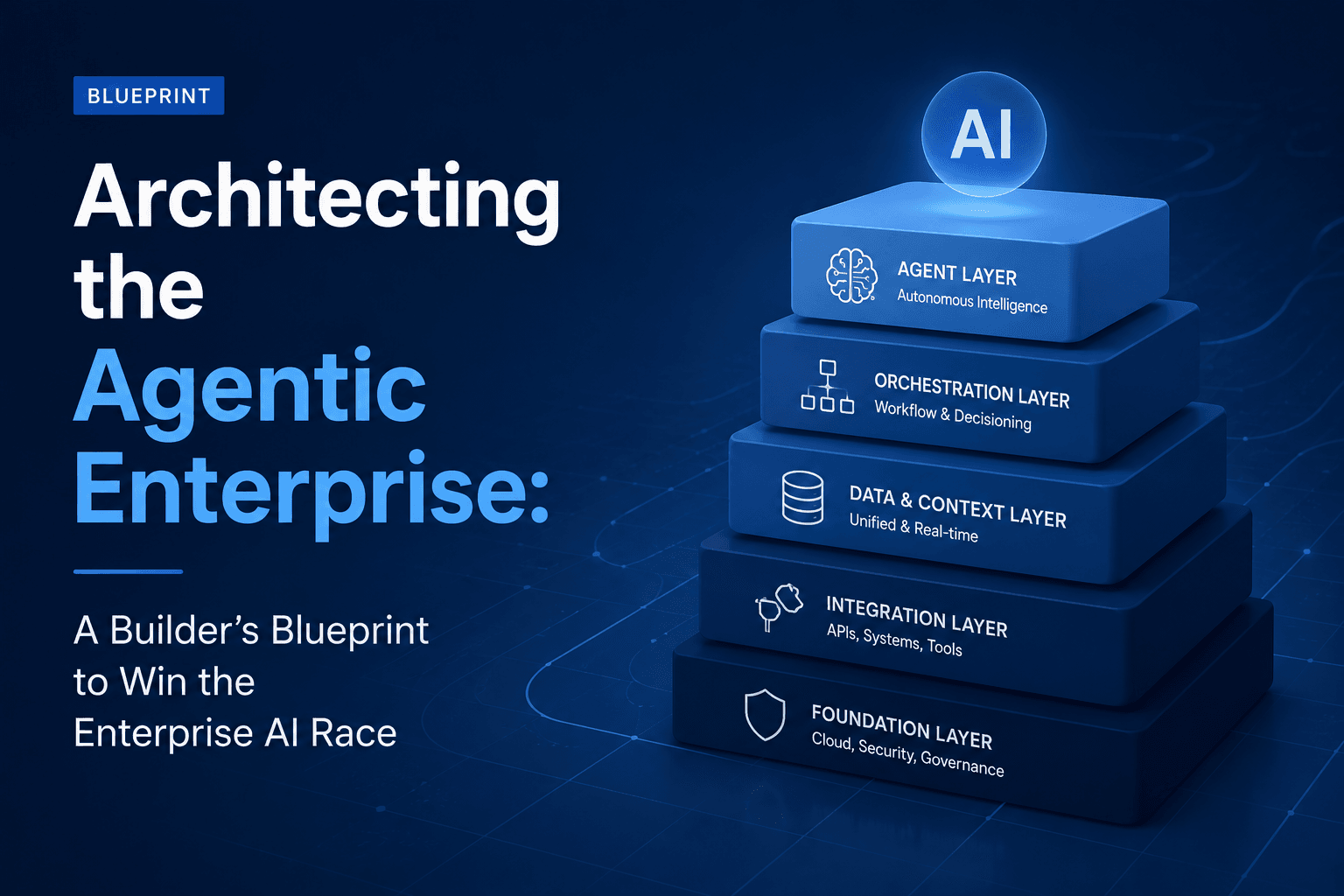
A practical approach to AI chatbot architecture separates operational responsibilities into five decoupled layers.
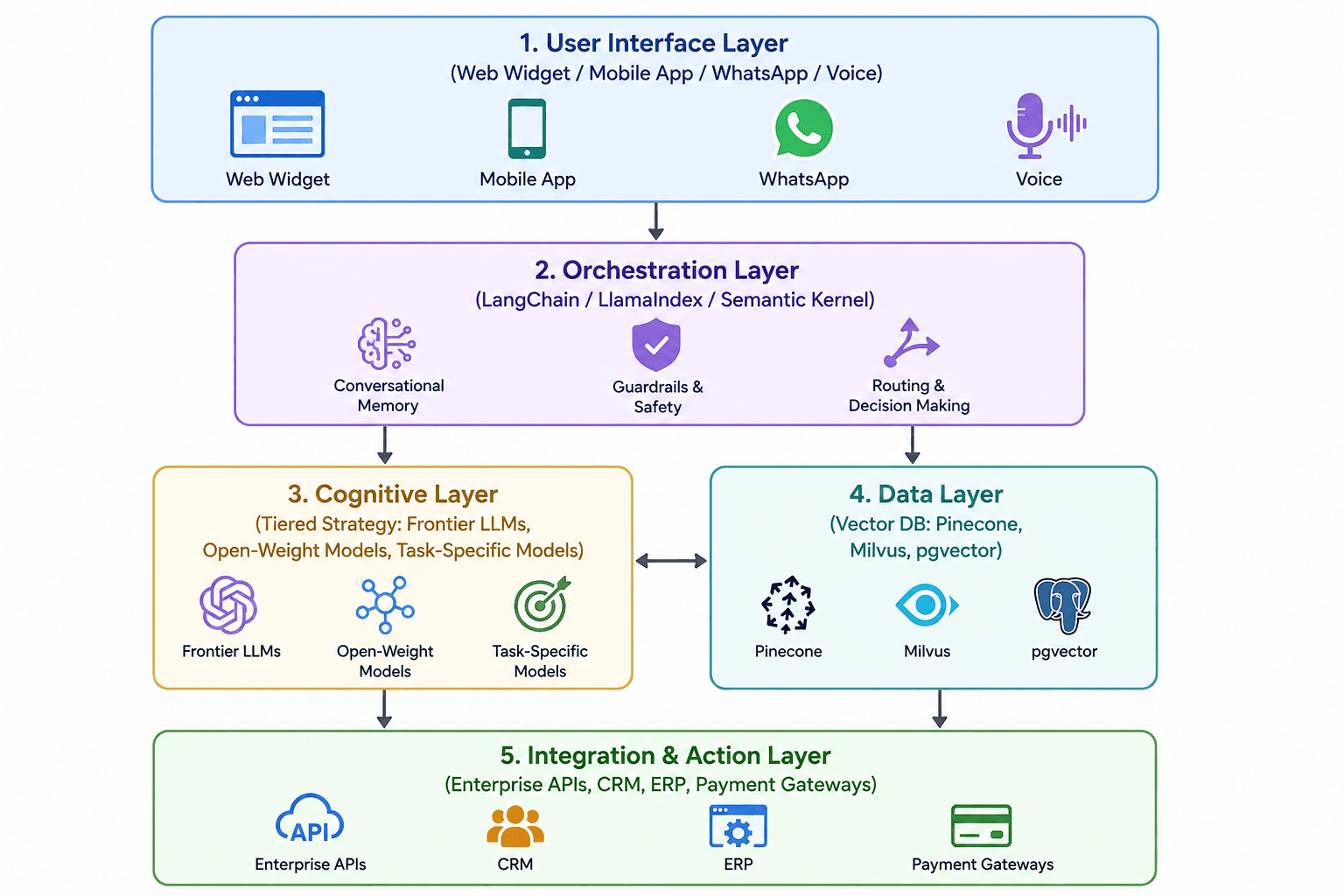
Layer 1: User Interface & Channel Ingestion Layer
The touchpoint layer accepts multi-channel input, including web chat widgets, mobile SDKs, social messaging APIs, and voice streams. It normalizes diverse data payloads and manages persistent WebSocket or WebRTC connections required for streaming token responses to the user interface.
Layer 2: Orchestration & Guardrail Layer
The orchestration layer functions as the central logic supervisor using frameworks such as LangChain, LlamaIndex, or Microsoft Semantic Kernel. It manages conversational state, executes PII redaction filters, validates input safety against prompt injection attacks, and builds dynamic system prompts before querying the cognitive models.
Layer 3: Cognitive & Model Tiering Layer
A model-routing strategy can send simpler tasks to smaller or lower-cost models while reserving more capable models for complex reasoning and agentic workflows. The routing policy should be based on accuracy, latency, cost, and task complexity rather than a fixed percentage.
Layer 4: Data Storage & Vector Retrieval Layer
Powers the RAG engine by chunking enterprise text, documentation, and database schemas, then converting them into high-dimensional vector representations via embedding models like OpenAI text-embedding-3-large. Vector databases such as Pinecone, Milvus, and PostgreSQL with pgvector can support large-scale similarity search, but actual retrieval latency depends on index configuration, dataset size, infrastructure, filtering, and query patterns.
Layer 5: Integration & Action Execution Layer
The action layer translates system intents into real-world business operations. Secure API gateways, microservices, and database connectors execute SQL queries, trigger webhooks, update CRM records, and place asynchronous messages onto queues such as Apache Kafka or RabbitMQ.
4. The 6-Step AI Chatbot Development Lifecycle
Building a production-ready conversational AI platform requires an iterative, data-centered development process.
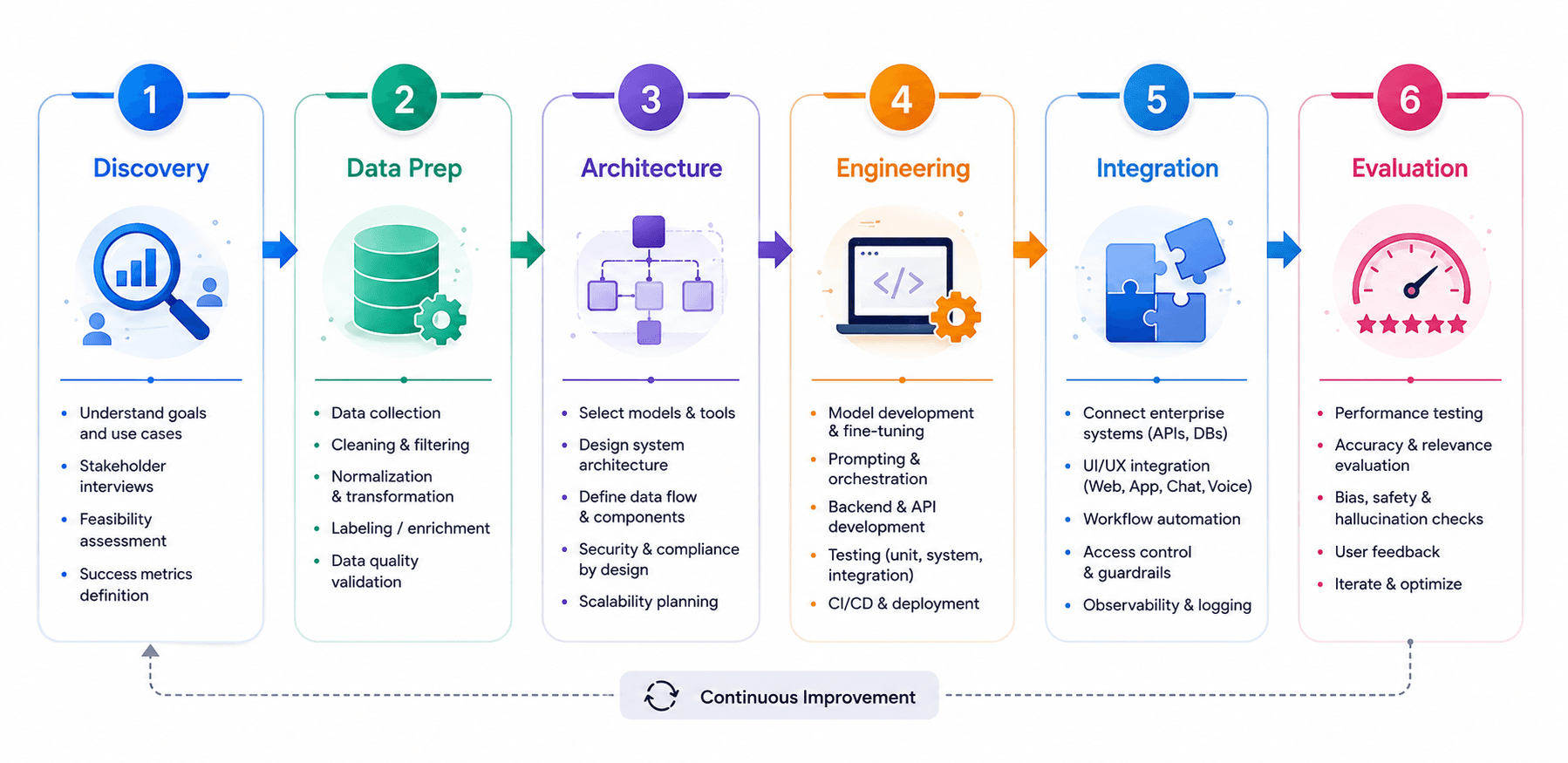
Step 1: Discovery & Business Metric Alignment
Define clear success parameters and operational guardrails before writing code. Establish key performance indicators such as target containment rates and explicit rules for human agent handoffs. Define latency targets based on the application's user experience requirements, model response time, retrieval latency, and downstream API performance.
Step 2: Data Cleansing, Chunking & Tokenization
Corporate data repositories require substantial preparation. Engineering teams remove redundant or outdated documentation and attach metadata tags for document-level access permissions. Choose chunk sizes and overlap based on document structure, retrieval performance, and the evaluation results rather than applying a single fixed configuration.
Step 3: Tech Stack & Security Framework Selection
Select cloud hosting infrastructure (AWS, Microsoft Azure, Google Cloud Platform, or private air-gapped environments), database engines, orchestration frameworks, and model access methods. Configure data encryption standards (AES-256 for data at rest, TLS 1.3 for data in transit) and authentication mechanisms.
Step 4: Prompt Engineering & Model Fine-Tuning
Craft robust system prompts, configure dynamic context injection templates, and calibrate retrieval hyperparameters including vector score thresholds and top-k document retrieval counts. Where prompt engineering, retrieval, and model selection are insufficient for a specialized use case, teams can evaluate fine-tuning or other model-adaptation techniques using domain-specific datasets.
Step 5: Middleware & Enterprise Systems Integration
Develop containerized microservices and API middleware that connect chatbot orchestration layers to internal databases, CRM systems, ERPs, and billing portals. Implement robust error-handling mechanisms to handle downstream service timeouts gracefully.
Step 6: AI Evaluation, QA & Continuous Observability
Test conversational accuracy using evaluation suites like Ragas or TruLens, measuring faithfulness, context precision, and answer relevance. Perform red-teaming tests to defend against prompt injection exploits. Following deployment, implement continuous observability dashboards using LangSmith or Arize to monitor hallucination rates, token usage, and user drop-off points.
Common Challenges in Production AI Chatbot Development
Production chatbot projects often encounter problems that are not visible in an initial prototype. Common issues include poor retrieval quality, stale knowledge sources, prompt injection, excessive tool permissions, inconsistent model outputs, context-window limitations, API failures, and unexpected inference costs.
These issues are best addressed through evaluation datasets, retrieval testing, structured tool schemas, permission boundaries, observability, fallback workflows, and human escalation paths. A chatbot should therefore be evaluated as a complete software system rather than only by the quality of its generated responses.
5. Strategic Decision Framework for Enterprise Leaders
Enterprise leaders planning a conversational AI initiative must resolve three foundational architectural decisions:
- Defining Primary Core Intent: Determine whether the solution targets internal employee knowledge management, external customer service containment, or dialogue-driven transaction processing. Internal applications prioritize access control and accuracy, whereas external tools demand low latency and user experience design.
- Selecting a Development Partner: Evaluate potential partners based on their experience with AI architecture, data engineering, enterprise integrations, security, testing, observability, and production support. A good partner should be able to explain the technical trade-offs behind its proposed architecture rather than focusing only on model capabilities.
- Mapping System Integrations: Audit internal databases (PostgreSQL, MongoDB), CRMs (Salesforce, HubSpot), and ERP platforms during discovery. Defining integration interfaces upfront prevents major architectural redesigns during development.
6. Frequently Asked Questions
How much does an enterprise AI chatbot cost to build in 2026?
Development costs vary significantly depending on the chatbot's complexity, data requirements, integrations, security controls, and deployment model. A basic implementation may cost a few thousand dollars, while custom enterprise systems can require significantly larger engineering budgets.
What is the difference between a traditional chatbot and an agentic AI system?
Traditional chatbots follow rigid decision trees or keyword rules. Agentic AI systems use Large Language Models to evaluate complex requests, construct multi-step operational plans, and autonomously call external APIs to execute real-world tasks.
Should every business use an AI chatbot?
Not necessarily. An AI chatbot is most useful when there is a clear, repeatable problem involving information retrieval, customer interaction, or workflow automation. If the underlying documentation, processes, or integrations are unreliable, adding an LLM may increase complexity without delivering meaningful business value. A smaller automation or conventional application may be a better fit in some cases.
Can RAG reduce AI hallucinations?
Retrieval-Augmented Generation can reduce unsupported responses by providing the model with relevant source material. However, RAG does not guarantee that every generated answer will be correct. Production systems should combine retrieval with source attribution, evaluation, access controls, validation, and appropriate human escalation.
What are the main ongoing monthly costs of operating an AI chatbot?
Ongoing expenses include cloud hosting compute, LLM API token consumption, vector database infrastructure, and continuous system maintenance.
How long does it take to develop a custom AI chatbot?
A basic RAG knowledge bot requires 8 to 14 weeks from discovery to production release. Complex multi-agent enterprise suites with custom backend integrations require 14 to 20+ weeks of engineering.
How does modular 5-layer architecture prevent vendor lock-in?
Decoupling the User Interface, Orchestration, Cognitive, Data, and Integration layers allows developers to replace underlying LLMs (such as switching from OpenAI to Anthropic or open-source models) without modifying application logic or backend integrations.
Interested in exploring AI chatbot architecture for your organization? Learn more about Junkies Coder's AI development services or start a project discussion.