Most enterprise modernization programs do not fail because the technology is inadequate. They fail because modernization is approached as a code conversion exercise rather than a business architecture transformation.
Historically, traditional modernization has underdelivered for three core reasons:
- Loss of Institutional Knowledge: Original architects leave, making manual code review slow, incomplete, and expensive.
- Disproportionate Testing Bottlenecks: Testing and validation can consume a significant portion of modernization budgets, particularly when production-realistic environments and regression coverage must be created manually.
- Erosion of the Business Case: Multi-year, linear rollouts allow business priorities to shift before value is realized.
Simply translating old code into a modern framework reproduces these same architectural limitations in a new environment.
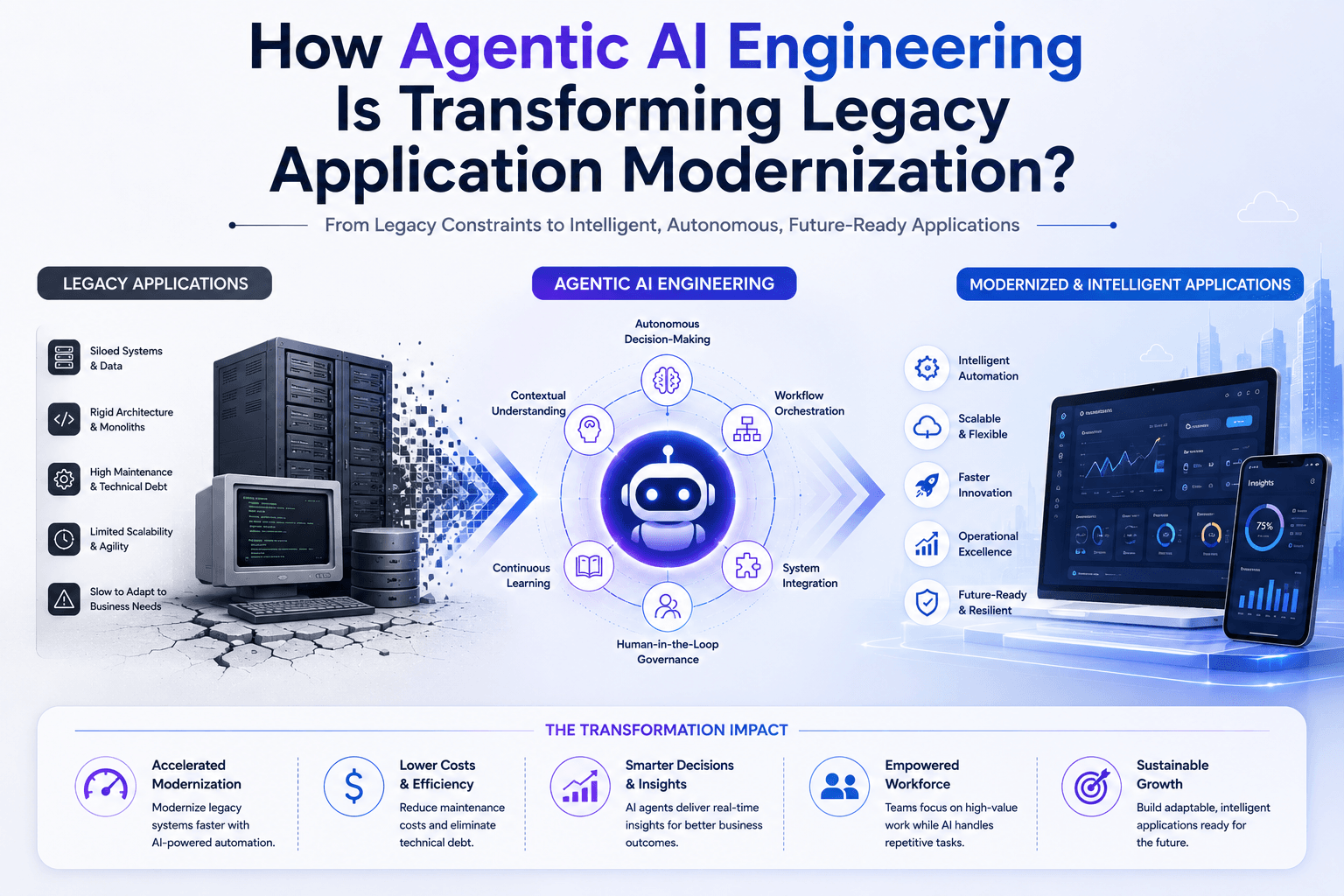
AI introduces a different approach: instead of translating legacy code line by line, organizations can use AI to discover business logic, map dependencies, automate documentation, accelerate testing, and design modern architectures around business capabilities.
This article presents a practical framework for using AI to modernize legacy applications, reduce modernization risk, and create a stronger foundation for cloud-native and agentic AI workloads.
Modernization Starts With Business Capability, Not Code
Before selecting an AI modernization tool, enterprise leaders should identify which business capabilities the legacy system supports.
The objective is not to modernize every application equally. Instead, organizations should prioritize systems based on business criticality, maintenance cost, technical risk, data value, integration complexity, and future strategic importance.
A useful modernization assessment should answer:
- Which applications are critical to revenue or operations?
- Which systems create the highest maintenance burden?
- Where are the largest integration bottlenecks?
- Which applications contain valuable business logic?
- Which systems are candidates for replacement, re-platforming, refactoring, or retirement?
- Which capabilities will be required for future AI initiatives?
This approach prevents organizations from spending modernization budgets on systems that deliver limited strategic value.
Not Every Legacy System Should Be Rewritten
AI should not automatically lead to a full rewrite. Different applications may require different modernization strategies.
Retire — When the system no longer provides meaningful business value.
Replace — When a modern commercial or SaaS platform can provide the capability more efficiently.
Rehost — When the immediate objective is infrastructure modernization with minimal application change.
Refactor — When the existing business capability remains valuable but the architecture needs improvement.
Rearchitect — When the system must be redesigned for cloud-native scalability, APIs, or AI workloads.
Rewrite — When the existing architecture cannot reasonably support future business requirements.
AI can accelerate the assessment, but the final modernization strategy should be based on business value, technical risk, and long-term architecture goals.
From Code Translation to Business Logic Extraction
The goal of AI-driven modernization is not simply to convert one programming language into another. It is to understand what the legacy system actually does and redesign those capabilities for the target architecture.
AI can help identify business rules, dependencies, data relationships, workflows, and system behaviors. Architects can then use this information to determine which capabilities should be retained, redesigned, consolidated, replaced, or retired.
How AI Code Discovery and Mapping Works
Generative AI can analyze large enterprise codebases and produce structured insights that would otherwise require significant manual effort. The AI identifies active business rules, flags dead code (unreachable functions that consume maintenance budgets without serving any operational purpose), maps system dependencies across interconnected modules, and generates plain-language documentation of what each functional block actually does.
Behavioral Reverse-Engineering vs. Line-by-Line Translation
Traditional code translation preserves the structural flaws of the original system. If the legacy application used an inefficient data access pattern because of hardware constraints that no longer exist, a line-by-line translation faithfully reproduces that inefficiency in the new environment.
AI-driven behavioral reverse-engineering takes a fundamentally different approach. Rather than translating syntax, the AI analyzes what the system functionally does, what inputs it accepts, what outputs it produces, and what business states it transitions between. It then redesigns the logic to achieve identical functional outcomes using modern architectural patterns, eliminating accumulated technical debt in the process.
AI Accelerates Execution, Architects Govern the Outcome
AI should not replace enterprise architects, domain experts, security teams, or compliance stakeholders. Its role is to reduce repetitive analysis and accelerate decision-making.
AI can generate:
- Business-rule documentation
- Dependency maps
- Test cases
- Architecture recommendations
- Code transformations
- API specifications
- Synthetic datasets
Human experts should validate:
- Business-critical logic
- Architecture decisions
- Security controls
- Compliance requirements
- Data ownership
- Production readiness
The strongest modernization model is therefore not AI versus humans, but AI-assisted execution with human governance.
Compressing Multi-Year Timelines
Traditional modernization relies on linear, sequential phases that extend project durations. AI enables parallel execution across multiple applications simultaneously. Specialized models assist in converting legacy frameworks into modern microservices while restructuring logic for scalability. Some industry analyses indicate that AI-assisted modernization can reduce project effort and timelines in specific scenarios, although actual results vary by application complexity and modernization scope.
Furthermore, agentic AI introduces autonomous workflows that plan and execute multi-step migration tasks under human supervision. By letting AI handle repetitive translation and dependency mapping, architects can focus on governance and structural design, significantly compressing overall delivery schedules.
Eliminating Testing Bottlenecks with AI Automation
Testing legacy replacements is often one of the largest risk factors and cost centers in modernization programs. The challenge is not writing test cases. It is creating production-realistic test environments that accurately simulate real-world transactional loads without exposing sensitive customer data.
Synthetic Data Generation
AI addresses this by generating synthetic data profiles that preserve the statistical properties and edge-case distributions of production workloads without exposing actual customer records. While synthetic data significantly reduces privacy risks and compliance overhead compared to manual data sanitization, organizations should still validate privacy guarantees and re-identification risks before deployment.
Shadow Testing at Scale
Rather than batch-validating the new system after completion, AI enables continuous shadow testing throughout development. AI can automate large-scale transactional comparisons between legacy and modernized systems, helping teams identify behavioral differences earlier in the development cycle.
The practical impact is the potential to significantly reduce deployment risk and enable controlled, low-disruption cutovers when supported by appropriate architecture, observability, rollback mechanisms, and production validation.
AI-Assisted Testing Should Cover More Than Functional Equivalence
Successful modernization requires more than proving that the new application produces the same output as the legacy system.
Testing should also evaluate:
- Performance
- Scalability
- Security
- Data integrity
- API behavior
- Failure scenarios
- Transaction consistency
- Business-rule accuracy
- Observability
This ensures that the modernized system is not merely functionally equivalent, but operationally better suited to its future environment.
Preparing Enterprise Data for Agentic AI
Modernizing applications without simultaneously modernizing the data layer creates a structural ceiling on the value the upgraded system can deliver. A modernized application running against a legacy data architecture inherits the same integration limitations, data quality issues, and access constraints that plagued the original system.
Modernizing the Data Layer for AI Readiness
AI-driven data modernization can help organizations build a modern data architecture by normalizing inconsistent data structures, separating monolithic data models into domain-oriented data products, and exposing legacy data through secure APIs.
Data Governance Is Non-Negotiable
A modern data architecture also requires strong governance. Organizations should define data ownership, quality standards, lineage, access controls, retention policies, and security requirements before exposing enterprise data to AI systems.
Without governance, creating more accessible data can increase risk rather than business value.
Why This Matters for Agentic AI Readiness
Enterprise AI agents require access to clean, well-structured, real-time data to function effectively. Organizations that modernize their applications but leave their data in legacy silos will find that their AI initiatives stall at the data access layer, regardless of how modern their application architecture is.
Security Must Be Designed Into the AI Modernization Pipeline
Enterprise modernization introduces a new security boundary: the AI system itself.
Organizations should evaluate:
- Where source code is processed
- Whether prompts and code are retained
- Whether data is used for model training
- Identity and access controls
- Encryption
- Secrets management
- Audit logging
- Model and tool permissions
- Third-party dependencies
- Human approval requirements
AI modernization environments should be isolated, governed, and monitored like any other enterprise development environment.
Comparative Framework: Traditional vs. AI-Led Modernization
| Modernization Vector | Traditional Approach | AI-Led Approach |
|---|---|---|
| Business Logic Discovery | Manual interviews and code inspection | AI-assisted rule extraction + expert validation |
| Architecture Planning | Primarily manual design | AI-assisted architecture analysis + human approval |
| Code Transformation | Manual/line-by-line conversion | AI-assisted transformation and refactoring |
| Testing | Sequential manual test creation | Automated test generation + synthetic data + continuous validation |
| Data Modernization | Often treated as a separate initiative | Application + data modernization planned together |
| Governance | Primarily human-driven | AI-assisted workflows with human governance |
| Project Economics | Long timelines and high manual effort | Potentially shorter timelines and lower repetitive effort |
Hidden Costs and Strategic Risks Enterprise Leaders Must Address
AI accelerates the modernization journey, but it does not eliminate all risk. Enterprise leaders must plan for three categories of structural friction:
Hallucination and Logic Fabrication
AI code translators can occasionally fabricate logical operations or introduce security vulnerabilities that do not exist in the original system. Human-in-the-loop review by experienced software architects remains mandatory at every architectural decision point. Organizations that treat AI-generated code as production-ready without expert review expose themselves to both functional defects and security liabilities.
Vendor Lock-In
Utilizing proprietary hyperscaler AI modernization tools, such as those offered by AWS, Google Cloud, or Azure, can tightly couple the modernized software layer to a specific cloud vendor's infrastructure. This coupling may deliver short-term acceleration but creates long-term strategic dependency that constrains future architectural decisions.
Licensing and Compliance Boundaries
Exposing legacy corporate code to public or non-compliant AI training sets can breach data privacy regulations (GDPR, HIPAA, CCPA) and copyright boundaries. Enterprise teams must verify that any AI tool used in the modernization process operates within a private, compliant inference environment with appropriate contractual and technical controls to protect proprietary code and prevent unauthorized use for model training.
A Practical Three-Phase AI Modernization Roadmap
Phase 1 — Discover and Assess
- Inventory applications
- Analyze code and dependencies
- Identify business rules
- Assess data architecture
- Prioritize modernization candidates
Phase 2 — Design and Validate
- Define target architecture
- Validate business rules
- Design modernization patterns
- Establish security and governance
- Build proof of concept
Phase 3 — Modernize and Scale
- Transform prioritized workloads
- Automate testing
- Run parallel/shadow validation
- Deploy gradually
- Monitor and optimize
Actual timelines depend on application complexity, data dependencies, regulatory requirements, organizational readiness, and the selected modernization strategy.
Measure Modernization by Business Outcomes
Modernization should not be measured only by the number of applications migrated or lines of code transformed.
Enterprise leaders should track:
- Reduction in maintenance cost
- Release frequency
- Time to deliver new features
- Infrastructure efficiency
- Incident frequency
- Application performance
- Developer productivity
- Data accessibility
- Security posture
- Business capability improvements
The objective is not simply to create newer technology. It is to create measurable business value.
Build the Business Case Before Modernizing
Before starting a large-scale modernization program, organizations should establish a clear baseline for the current environment and define how success will be measured.
The business case should consider:
- Current maintenance and infrastructure costs
- Application performance and reliability
- Developer productivity
- Release frequency
- Security and compliance exposure
- Cost of delaying modernization
- Expected business value from the target architecture
This creates a measurable foundation for evaluating whether modernization is actually delivering value, not simply whether applications have been migrated successfully.
What Questions Should You Answer Before Starting?
Before engaging a modernization partner or deploying AI tools, enterprise technology leaders should have clear answers to three diagnostic questions:
What programming languages or legacy databases are you running? COBOL mainframes, legacy Java EE, RPG on AS/400, and Oracle Forms each present distinct modernization challenges that require different AI tooling strategies.
What is the primary business outcome you need? Cutting hosting costs, building AI-powered customer applications, and accelerating feature deployment velocity each demand different architectural end-states.
What industry compliance rules apply to your enterprise data? HIPAA, GDPR, PCI-DSS, and SOX each impose specific constraints on how AI tools can access and process legacy code and data during modernization.
The Future of Legacy Modernization Is Business-Led and AI-Assisted
AI changes the mechanics of legacy modernization, but technology alone is not a strategy. The organizations that succeed will be those that align AI acceleration with business objectives, modern data architectures, and strong human governance.
Modernization is ultimately about liberating core business capabilities trapped in legacy code and adapting them for an AI-enabled future. Done correctly, it turns technical debt into a scalable, secure foundation for long-term innovation.
Ready to Modernize Your Legacy Systems?
AI can accelerate legacy discovery, code transformation, testing, and modernization planning, but the right strategy starts with understanding your business capabilities and technical landscape. A structured assessment can help identify the right modernization path, prioritize high-value workloads, and build a practical roadmap for AI-ready architecture.
Frequently Asked Questions
What is AI-driven legacy modernization?
AI-driven legacy modernization uses generative AI and agentic reasoning to extract business logic from legacy codebases, translate it into modern architectures, and continuously validate the migrated system against production workloads. Unlike manual modernization, AI compresses discovery, translation, and testing into parallel workstreams rather than sequential phases.
How much can AI reduce legacy modernization costs?
Some industry analyses indicate that AI-assisted modernization can reduce project effort and timelines in specific scenarios, although actual results vary by application complexity and modernization scope. The savings come primarily from eliminating manual code discovery, reducing testing overhead through synthetic data, and compressing project timelines.
Is AI-generated code safe for production enterprise systems?
AI-generated code requires mandatory human-in-the-loop review by experienced software architects before production deployment. Generative models can hallucinate logic or introduce subtle security vulnerabilities. Organizations should treat AI output as a high-quality first draft that accelerates development but does not replace expert architectural judgment.
Can legacy modernization be done without full data migration?
Yes. AI-driven approaches use dynamic API wrappers and modern data architectures to expose legacy data stores to modern applications and analytics workloads without requiring a full lift-and-shift data migration. This reduces risk and allows incremental data modernization alongside application modernization.
What compliance risks exist when using AI for legacy modernization?
The primary risks involve exposing proprietary legacy code to public AI models that may use it for training, potentially breaching GDPR, HIPAA, or copyright boundaries. Enterprise teams should verify that AI modernization tools operate in private inference environments with appropriate contractual and technical controls.
Should every legacy application be modernized with AI?
No. AI is a modernization accelerator, not a modernization strategy by itself. Some applications may be better retired, replaced, rehosted, or left unchanged depending on business value, technical complexity, and future requirements.
Does AI eliminate the need for legacy-system experts?
No. AI can accelerate code analysis and documentation, but domain experts remain critical for validating business rules, exceptions, regulatory requirements, and operational behavior that may not be obvious from source code alone.