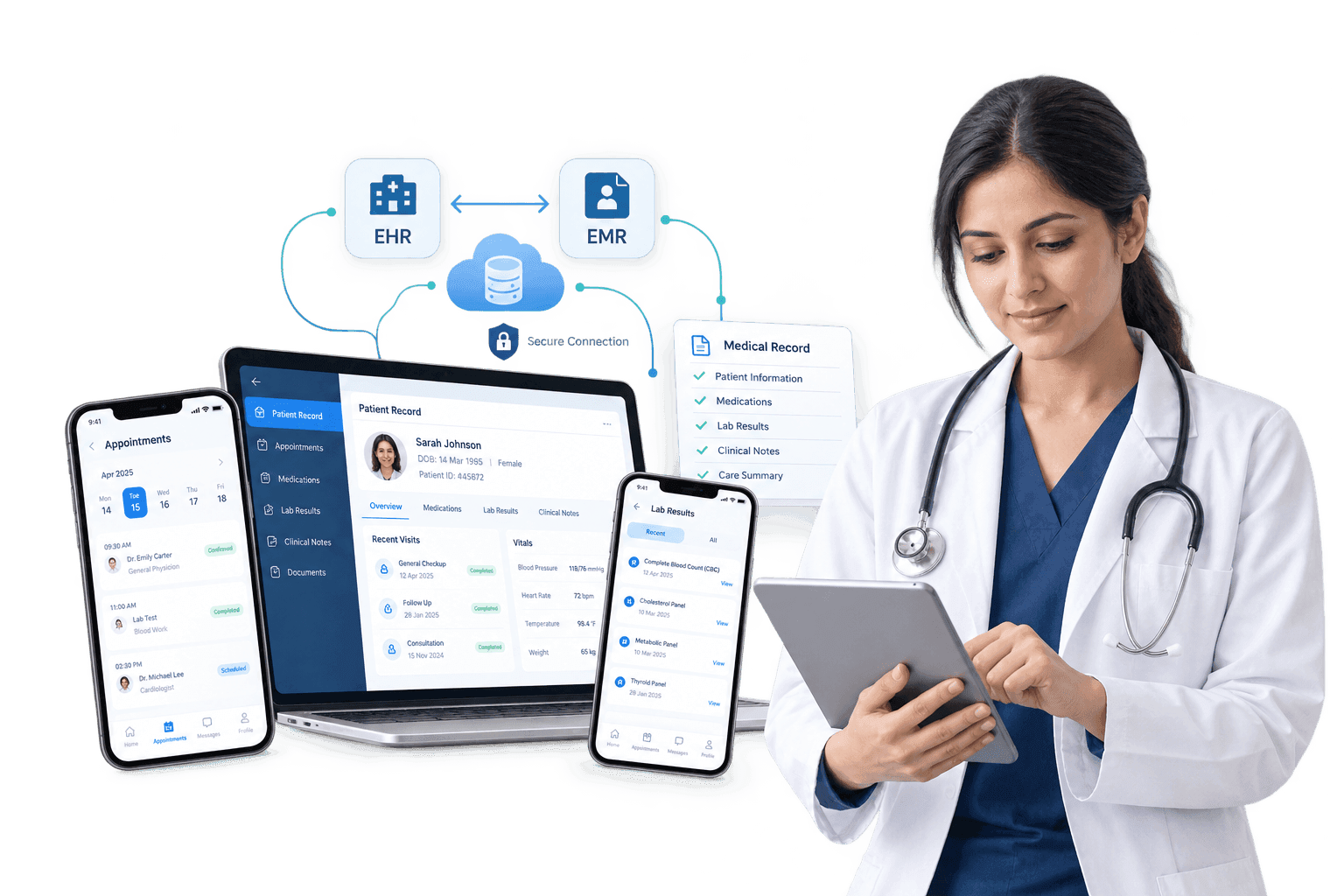
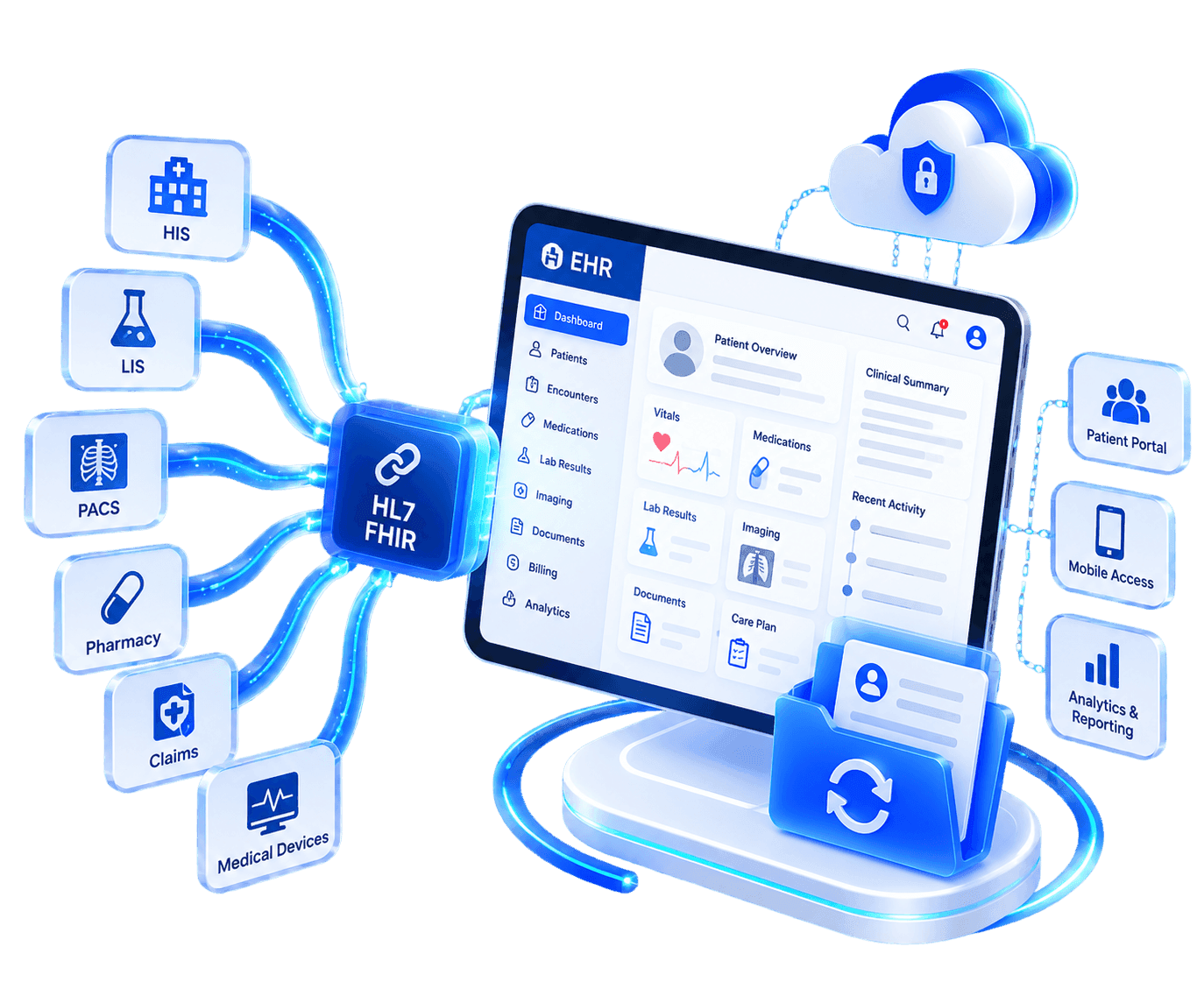
Isolated clinical databases and proprietary vendor silos prevent healthcare organizations from delivering seamless, coordinated patient care. At Junkies Coder, our EHR/EMR integration services bridge disparate clinical systems by engineering secure, high,throughput interoperability pipelines. We build bidirectional RESTful HL7 FHIR Release 4 and 5 APIs, SMART on FHIR application gateways, custom Mirth Connect (NextGen Connect) and Redox middleware brokers, and certified Surescripts e,prescribing connectors. Whether connecting an agile digital healthtech MVP to hospital EHRs like Epic, Cerner, and MEDITECH, or integrating regional laboratories and imaging centers across a multi,facility healthcare network, our certified digital health engineers eliminate information blocking while enforcing strict HIPAA, ONC (g)(10), and GDPR compliance.

HL7 FHIR & SMART on FHIR
ONC (g)(10) & 21st Century Cures Ready
Empowering awards and recognition to Drive Innovation and Success with
our unparalleled expertise and commitment to excellence.
Years of experience
Countries Served
Average cost P/H
Positive Feedbacks
Projects delivered
Experts & Engineers
CORE FEATURES
Our structured medical integration methodology takes your project from endpoint discovery and FHIR profiling to production certification and 24/7 SLA monitoring.
Interface Discovery & EHR Vendor API Endpoint Mapping
Data Model Architecture, FHIR Profiling & USCDI Design
Middleware Gateway Build (Mirth, Redox, AWS HealthLake)
Bidirectional System Testing & Message Transformation QA
ONC (g)(10) Inferno Certification, BAA & Security Audits
Production Cloud Cutover, Latency Logging & 24/7 SLA
A structured, milestone,driven delivery roadmap taking your custom EHR/EMR integration from initial API discovery to production certification and 24/7 SLA maintenance.
Mapping clinical workflows, EHR vendor APIs (Epic, Cerner, Athena), FHIR resource profiles, data schemas, and regulatory compliance standards (HIPAA, ONC, GDPR).
Configuring semantic dictionaries (SNOMED CT, LOINC, RxNorm) and designing bidirectional data transformation rules validated with sample clinical payloads.
Deploying scalable Mirth Connect, Redox, or AWS HealthLake message brokers, SMART on FHIR OAuth 2.0 authorization, and secure medical data pipelines.
Connecting laboratory analyzers via LOINC, PACS imaging via DICOMweb, Surescripts pharmacy directories, and automated ANSI ASC X12 EDI medical billing.
Conducting end,to,end security audits, automated Inferno test suite execution, third,party HIPAA reviews, and establishing 24/7 SLA interface monitoring.
Explore how Junkies Coder engineers secure, high,throughput healthcare interoperability pipelines that unify medical records and streamline clinical workflows.

Industry
Agro Logistics
Technology
Web / IoT / ERP
Location
India
Outcomes
50% Reduction
Vaishnodevi Agro Resources Pvt. Ltd needed a digital tracking system to replace manual agro-logistics processes in Radhanpur, India, covering truck entries, weighbridge, seed processing, lab reporting and dispatch management.
Whether you're looking to develop a digital solution from scratch, scale your current offerings, or fully modernize your system, we are here to help.
OUR EXPERTISE
From direct FHIR APIs and middleware message routing to real,time wearable telemetry and lab connectivity, we engineer robust healthcare data bridges.
Book a complimentary 30,minute healthcare architecture session with our senior digital health engineers to map your clinical data flows, FHIR integrations, and MVP delivery roadmap.

Deploy proven, modular integration components that reduce custom development time and eliminate hospital connectivity bottlenecks.
01
Standardized OAuth 2.0 app gateway allowing external digital health tools to run securely inside commercial EHR user interfaces with zero core codebase alterations.
02
Automated clinical rules engine evaluating patient data against medical guidelines in real time to trigger decision support cards during intake and prescribing.
03
High,throughput message broker translating legacy HL7 v2 messages (ADT, ORM, ORU) into standardized HL7 FHIR Release 4 JSON payloads in real time.
04
Automated bidirectional interface connecting hospital laboratory diagnostic hardware and pathology information systems with attending clinician charts.
05
High,performance browser,based medical imaging feed streaming CT, MRI, and X,ray studies directly from hospital PACS archives using WADO,RS protocols.
06
Certified electronic prescribing module with multi,factor cryptographic signing, real,time pharmacy lookups, and state PDMP database integration.
07
Instant clearinghouse integration checking patient co,pays, deductibles, and active insurance coverage prior to visits, paired with automated EDI 837 claim submission.
08
Probabilistic record linkage engine comparing demographic fields across disparate clinical systems to identify, merge, and deduplicate patient records.
09
Real,time API pipeline capturing ambient clinical dialogue, generating structured SOAP charts, and injecting documentation directly into EHR encounter records.
From hospital networks and research laboratories to medtech pioneers and digital health startups, our software engineering powers every tier of the modern healthcare ecosystem.
A disciplined, four,stage agile software engineering lifecycle designed to deliver compliant, scalable, and robust healthcare integration interfaces on schedule.
We analyze clinical data workflows, EHR vendor API capabilities, legacy database structures, and mandatory regulatory compliance frameworks (HIPAA, ONC, ABDM).
We craft USCDI,compliant data models, semantic terminology mappings (SNOMED CT, LOINC, RxNorm), and transformation rules for all clinical resources.
We build secure integration pipelines in 2 to 4 months ($25,000 to $60,000), implementing containerized Mirth/Redox brokers and direct RESTful FHIR connectors.
We scale the platform into an enterprise interoperability hub ($150,000 to $350,000+), enabling multi,system LIS/PACS/EDI synchronization and automated penetration testing.
Shalehin Modasia
Marketing DirectorENGAGEMENT MODELS
Choose the optimal collaboration framework tailored to your clinical product stage, internal engineering team, and healthtech budget.
A focused 2 to 4 month build ($25,000 to $60,000) connecting a specific EHR (Epic, Cerner, or Athenahealth) with your digital health tool via FHIR APIs.
Get a free consultationA dedicated cross,functional pod of senior digital health engineers (FHIR integrators, Mirth specialists, backend architects, medical QA) in India providing continuous roadmap delivery starting from $25/hr.
Get a free consultationComprehensive enterprise engineering ($150,000 to $350,000+) covering multi,facility HIE, laboratory LIS, PACS imaging, and automated EDI billing.
Get a free consultationReal stories from real partners who experienced clarity, accountability, and measurable business growth.
We engineer robust, future,ready digital healthcare architectures leveraging HL7 FHIR Release 4 and 5, SMART on FHIR, Mirth Connect, Redox, DICOMweb, Python, Node.js, AWS HealthLake, Azure Health Data Services, and zero,trust security.
Featured Technologies

HL7 FHIR R4 & R5
SMART on FHIR
CDS Hooks & USCDI

HL7 v2 ADT/ORM/ORU

NCPDP SCRIPT & Surescripts
Our healthcare development company enforces defense,in,depth security, automated Business Associate Agreements (BAAs), and end,to,end encryption across all digital clinical touchpoints.
We construct high,throughput, secure healthcare data highways that eliminate vendor lock,in, enable point,of,care intelligence, and satisfy global compliance mandates.
Normalize disparate unstructured clinical text, lab records, and diagnostic observations into AI,ready, standardized FHIR datasets for longitudinal health analytics.
Connect hospital networks, ambulatory clinics, and regional HIEs for frictionless cross,facility patient chart sharing and EHR,to,EHR data exchange.
Stream continuous patient vitals, diagnostic telemetry, and clinical events directly into EHR charting workstations with sub,second latency via Kafka.
Integrate continuous biometric feeds from remote patient monitoring devices and smart biosensors with automated clinical deterioration alerting.
Synchronize live virtual care video consultations, remote clinical charting, digital intake forms, and electronic prescriptions in real time.
Synchronize clinical documentation with automated ANSI ASC X12 EDI 837/835 claims engines to accelerate medical billing and real,time eligibility checks.
Execute zero,downtime data migration and continuous multi,database replication from legacy on,premise databases to cloud FHIR platforms.
Connect on,premise medical servers with certified cloud data lakes on AWS HealthLake and Azure Health Data Services with real,time event streaming.
Enforce granular patient consent preferences, purpose,of,use filters, role,based access control policies, and cryptographic PHI audit trails.
Capture ambient doctor,patient consultations passively, draft structured SOAP notes, and inject documentation directly into EHR encounter records.

EHR/EMR integration services are specialized healthcare engineering solutions that connect Electronic Health Record and Electronic Medical Record platforms with third,party clinical applications, diagnostic laboratories, medical imaging systems, pharmacy networks, and payer clearinghouses. These services leverage standardized interoperability protocols including HL7 FHIR Release 4 and 5 REST APIs, SMART on FHIR OAuth 2.0 authorization, legacy HL7 v2 (ADT, ORM, ORU) messaging, CDS Hooks, DICOMweb, and ANSI ASC X12 EDI standards to enable bidirectional, real,time patient data synchronization across healthcare ecosystems.
The top 3 Electronic Health Record (EHR) systems dominating enterprise healthcare are Epic Systems, Cerner (Oracle Health), and MEDITECH (alongside athenahealth in ambulatory care). We integrate with these platforms through both direct certified APIs (such as Epic App Orchard / Connection Hub and Cerner Code) and standardized HL7 FHIR REST endpoints. Our engineers deploy SMART on FHIR app wrappers and secure middleware bridges that read and write patient demographics, diagnostic lab orders, encounters, medications, and clinical observations without disrupting physician charting workflows.
In an integration architecture, an Electronic Medical Record (EMR) is primarily confined to single,practice clinical workflows, storing local charts, diagnosis notes, and department appointments. An Electronic Health Record (EHR) is engineered for broad interoperability across disparate health systems, laboratories, imaging centers, and state Health Information Exchanges (HIEs). EMR integration typically focuses on point,to,point clinic automation, whereas EHR integration requires enterprise Master Patient Index (MPI) matching, USCDI data profiling, and bidirectional FHIR exchange across external health entities.
The prominent EMR and clinic management platforms in India include e,Sushrut (NIC), Practo Ray, KareXpert, Docon, HealthPlix, MocDoc, MediXcel, Plus91, LiveHealth, and Clinicea. We build custom integration adapters that connect these EMR platforms directly to the Ayushman Bharat Digital Mission (ABDM) Gateway. Our integration engine verifies Ayushman Bharat Health Accounts (ABHA IDs), links longitudinal health records via the Unified Health Interface (UHI), and enforces Milestone 1, 2, and 3 FHIR compliance for secure, consent,governed clinical data exchange.
Custom EHR/EMR integration costs typically range from $25,000 to $60,000 for a focused single,endpoint integration connecting one EHR (such as Epic or Athenahealth) with a digital health tool via FHIR APIs within 2 to 4 months. A mid,complexity multi,system integration hub connecting an EHR with laboratory information systems (LIS), digital imaging PACS, and e,prescribing networks ranges from $60,000 to $150,000 over 4 to 8 months. Enterprise,grade Health Information Exchange (HIE) integrations supporting multi,hospital networks, automated EDI 837 billing, and Master Patient Index (MPI) deduplication range from $150,000 to $350,000+ depending on architectural scope.
A standard single,system EHR integration utilizing pre,built FHIR endpoints or SMART on FHIR wrappers typically takes 6 to 10 weeks from discovery to production sandbox testing. Multi,system integration projects involving legacy HL7 v2 message parsing, custom Mirth Connect middleware channels, and third,party laboratory LIS feeds generally require 3 to 6 months. Large,scale hospital network integrations with custom Master Patient Index matching and ONC (g)(10) compliance certification take 6 to 10 months of phased agile engineering.
Direct API integration connects your application straight to the EHR vendor RESTful FHIR endpoints or proprietary APIs (such as Epic FHIR or Athenahealth APIs), providing maximum performance and zero recurring third,party middleware license fees. Middleware platforms like Mirth Connect (NextGen Connect), Redox, or MuleSoft act as centralized integration brokers that translate, normalize, and route complex legacy HL7 v2 messages (ADT, ORM, ORU) into modern FHIR JSON payloads. We recommend direct FHIR APIs for modern greenfield apps and middleware brokers when connecting multiple legacy hospital subsystems.
To satisfy ONC 2015 Edition Cures Update criterion (g)(10) and comply with 21st Century Cures Act anti,information blocking mandates, we engineer standardized FHIR Release 4 application programming interfaces aligned with US Core Data for Interoperability (USCDI) standards. Our architecture implements SMART on FHIR OAuth 2.0 authorization, OpenID Connect authentication, TLS 1.3 encryption, and automated OpenMetrics API performance logging, validated through automated Inferno testing suites to guarantee unhindered patient access.
Master Patient Index (MPI) integration employs probabilistic record linkage algorithms (such as Fellegi,Sunter) alongside deterministic matching rules to compare patient identifiers (first name, last name, date of birth, national ID, phone number, and address) across disparate hospital databases. When discrepancies occur, the engine calculates a match confidence score, automatically merging verified records while flagging ambiguous cases for manual HIM supervisor review, ensuring a unified longitudinal patient chart.
We construct scalable biometric telemetry pipelines that connect FDA,cleared Bluetooth Low Energy (BLE) and cellular medical devices (blood pressure cuffs, glucometers, pulse oximeters, and continuous ECG monitors) to the EHR backend. Incoming continuous biometric telemetry is ingested through Apache Kafka message brokers, normalized into standard FHIR Observation resources with LOINC codes, and routed directly to attending clinician charting workstations with automated threshold alerts for abnormal vital readings.
We engineer secure API injection pipelines that connect ambient clinical voice scribing models (such as BioGPT, Med,PaLM, and Whisper Health) directly to EHR documentation modules. The integration passively captures doctor,patient dialogue, generates structured Subjective, Objective, Assessment, and Plan (SOAP) notes, suggests accurate ICD,10 and CPT billing codes, and injects the drafted chart directly into the attending physician EHR workstation via FHIR DocumentReference or Encounter APIs for one,click clinician review and signature.