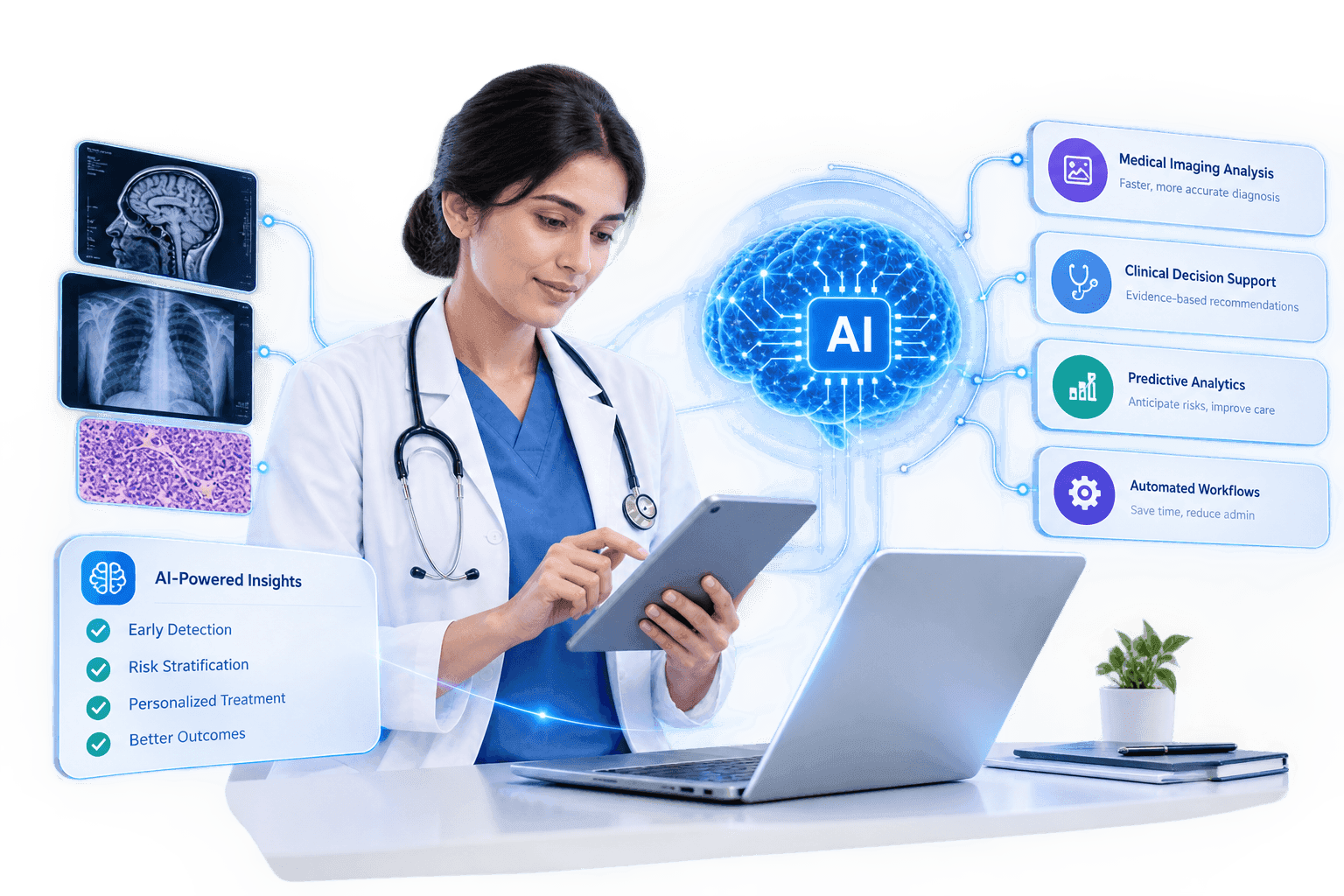
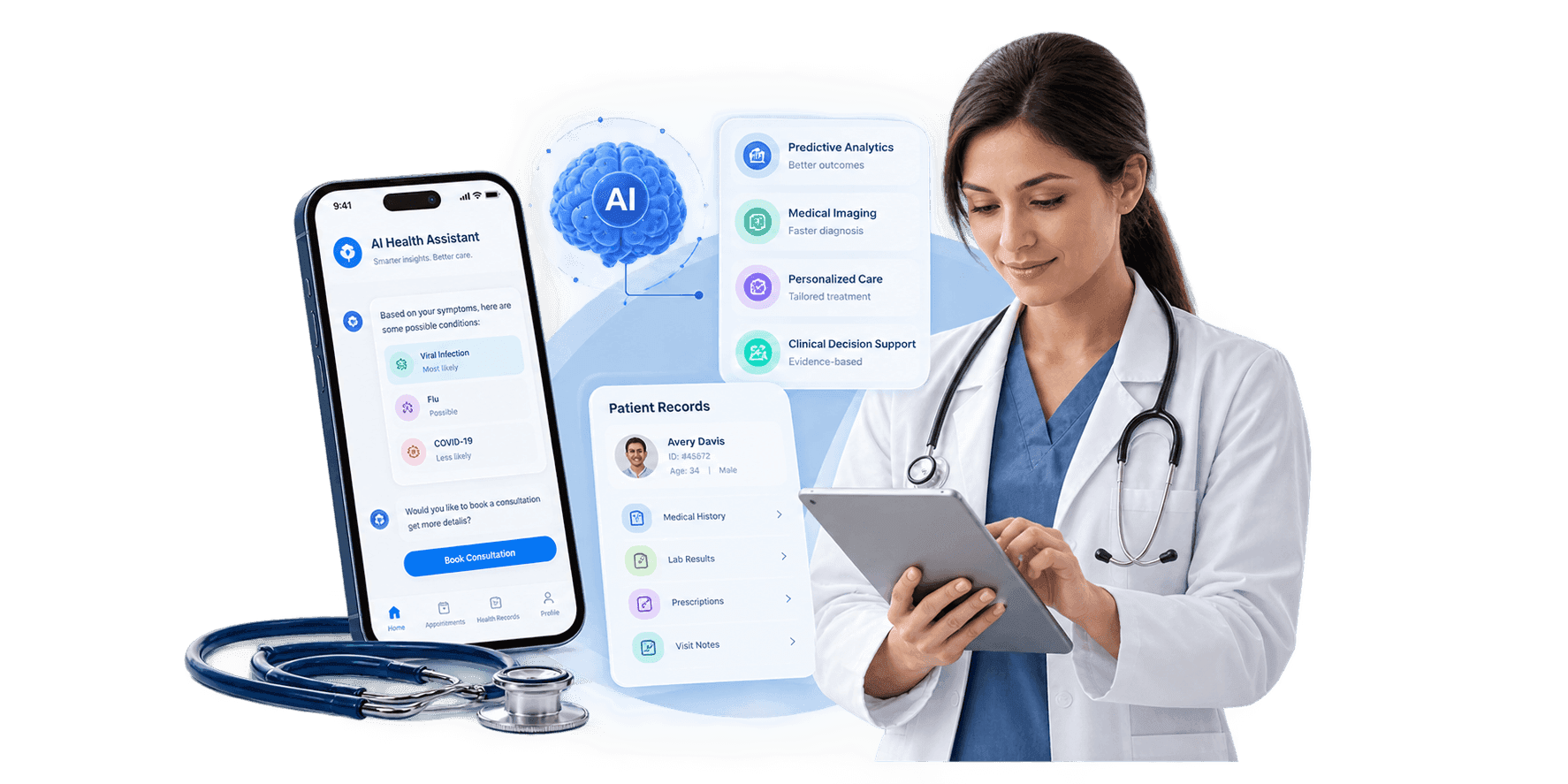
Healthcare AI development is moving beyond chatbots toward clinical copilots, agentic workflows, multimodal intelligence, and predictive care, making artificial intelligence an active layer across the entire healthcare ecosystem. At Junkies Coder, our custom healthcare AI development services engineer sovereign, domain,specific medical AI solutions tailored for clinical decision support, diagnostic precision, and administrative automation. Our machine learning engineers build scalable architectures powered by foundation biomedical LLMs (BioGPT, Med,PaLM), computer vision for DICOM imaging, ambient clinical voice scribes, and agentic multi,model workflows. Whether you are building an agile digital healthtech MVP or deploying enterprise clinical intelligence across a multi,facility hospital network, we deliver proprietary, HIPAA, FDA SaMD, and ISO 42001 compliant artificial intelligence platforms.

FDA SaMD & ISO 42001 Ready
Multimodal & Agentic Clinical AI
Empowering awards and recognition to Drive Innovation and Success with
our unparalleled expertise and commitment to excellence.
Years of experience
Countries Served
Average cost P/H
Positive Feedbacks
Projects delivered
Experts & Engineers
CORE FEATURES
Our structured medical AI development lifecycle takes your clinical models from algorithmic discovery and de,identification to FDA SaMD validation and 24/7 MLOps monitoring.
Clinical AI Discovery, Problem Formulation & Data Blueprinting
Medical Dataset Curation, Safe Harbor De,Identification & Labeling
Domain,Specific Model Architecture, Fine,Tuning & RAG Pipelines
HL7 FHIR Interoperability & Clinician Copilot UI Integration
FDA SaMD Validation, Algorithmic Bias Auditing & HIPAA BAA
Production Cloud Deployment, Triton Inference Scaling & 24/7 MLOps
A structured, milestone,driven delivery roadmap taking your custom healthcare AI software from initial algorithm discovery to clinical validation, FDA clearance, and production scaling.
Mapping clinical workflows, target outcomes, training data availability, FHIR schemas, and regulatory compliance requirements (HIPAA, FDA SaMD, ISO 42001, EU AI Act).
Executing automated PHI redaction, expert medical annotation, and benchmarking foundation models (Med,PaLM, BioGPT, MONAI) against clinical baseline performance.
Building scalable Triton inference microservices, vector retrieval databases, SMART on FHIR OAuth 2.0 authorization, and secure medical data pipelines.
Connecting hospital EHR backends via HL7 FHIR APIs, PACS imaging archives via DICOMweb, and embedding clinician copilot widgets directly inside doctor workstations.
Conducting prospective clinical accuracy studies, algorithmic fairness audits, third,party security penetration testing, and establishing 24/7 MLOps drift monitoring.
Explore how Junkies Coder engineers secure, high,precision healthcare AI platforms that streamline clinician documentation, improve diagnostic accuracy, and reduce hospital overhead.

Industry
Agro Logistics
Technology
Web / IoT / ERP
Location
India
Outcomes
50% Reduction
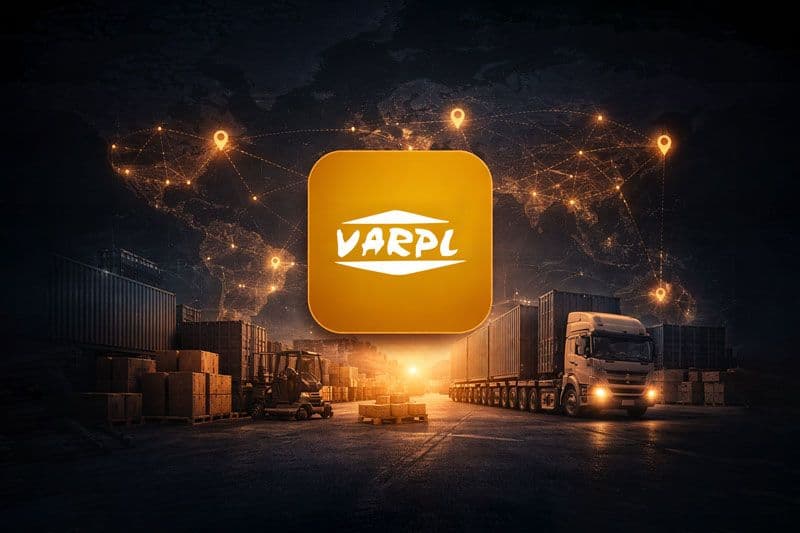
Vaishnodevi Agro Resources Pvt. Ltd needed a digital tracking system to replace manual agro-logistics processes in Radhanpur, India, covering truck entries, weighbridge, seed processing, lab reporting and dispatch management.
Whether you're looking to develop a digital solution from scratch, scale your current offerings, or fully modernize your system, we are here to help.
OUR EXPERTISE
From multimodal clinical copilots and automated medical imaging to agentic healthcare workflows and federated learning, we engineer sovereign, compliant medical AI.
Book a complimentary 30,minute healthcare architecture session with our senior biomedical AI engineers to map your model architectures, FHIR integrations, and MVP delivery roadmap.

Deploy battle,tested medical artificial intelligence modules that reduce custom engineering timelines and ensure seamless clinical integration.
01
Multi,modal foundation engine synthesizing unstructured clinical notes, DICOM radiological scans, ambient audio dialogue, and time,series telemetry into a unified patient representation.
02
Decentralized machine learning architecture training high,accuracy diagnostic models across disparate hospital networks without moving protected health information off,premises.
03
Transparent clinical explainability modules generating SHAP attribution values and Grad,CAM visual heatmaps, allowing physicians to inspect why the AI flagged a specific diagnosis.
04
Standardized containerized app embedding ambient documentation tools, predictive risk scores, and clinical order suggestions directly inside Epic and Cerner clinician workspaces.
05
High,throughput natural language redaction pipeline removing 18 HIPAA Safe Harbor identifiers from clinical narratives, audio recordings, and medical images with 99.8% precision.
06
Quantized, low,latency deep learning models optimized for point,of,care execution on edge medical hardware, ultrasound machines, and surgical workstations with zero cloud latency.
07
Dynamic in silico physiological simulation modeling patient cardiovascular responses, detecting continuous digital biomarkers, and forecasting therapeutic outcomes.
08
Enterprise MLOps dashboard continuously monitoring deployed clinical algorithms for concept drift, demographic bias, inference latency, and accuracy degradation.
09
High,accuracy multi,speaker medical speech recognition model supporting virtual nursing triage, clinical dictation, and hands,free clinician charting.
From radiology departments and oncology institutes to multi,hospital health systems and life sciences research, our healthcare AI platforms power specialized clinical intelligence.
A disciplined, four,stage agile engineering lifecycle designed to deliver clinically validated, scalable, and ethically governed healthcare AI platforms on schedule.
We define clinical problem statements, target diagnostic metrics (sensitivity, specificity, AUC), dataset access pathways, and regulatory governance frameworks (HIPAA, FDA SaMD, ISO 42001).
We curate and de,identify clinical datasets, engineer clinician,centric copilot interfaces (WCAG 2.1 AA), and design explainability dashboards validated by practicing medical professionals.
We build the core Healthcare AI Minimum Viable Product in 4 to 8 months ($50,000 to $150,000), implementing domain fine,tuning, RAG retrieval pipelines, and FHIR EHR connectors.
We scale the platform into an enterprise healthcare ecosystem ($450,000 to $1,500,000+), enabling federated learning, multi,agent workflow automation, and third,party compliance reviews.
Shalehin Modasia
Marketing DirectorENGAGEMENT MODELS
Choose the optimal collaboration framework tailored to your clinical product stage, internal AI research team, and healthtech budget.
A focused 4 to 8 month build ($50,000 to $150,000) delivering a specialized clinical NLP extractor, ambient voice documentation tool, or diagnostic imaging classifier to validate your healthtech product.
Get a free consultationA dedicated cross,functional pod of senior biomedical AI engineers (NLP architects, computer vision specialists, FHIR integrators, medical MLOps) in India starting from $25/hr.
Get a free consultationComprehensive enterprise engineering ($450,000 to $1,500,000+) covering multi,agent clinical automation, federated learning across hospital networks, and full FDA SaMD compliance.
Get a free consultationReal stories from real partners who experienced clarity, accountability, and measurable business growth.
We engineer robust, future,ready digital healthcare architectures leveraging PyTorch, TensorFlow Health, MONAI, Med,PaLM, BioGPT, LLaVA,Med, LangChain, CrewAI, DICOMweb, HL7 FHIR Release 4 and 5, AWS HealthLake, Azure Health Data Services, and zero,trust security.
Featured Technologies
BioGPT & Med-PaLM 2

ClinicalBERT & PubMedBERT
LLaVA-Med Multimodal

LangChain & CrewAI
Hugging Face Biomedical
Our healthcare development company enforces defense,in,depth security, automated Business Associate Agreements (BAAs), algorithmic bias mitigation, and end,to,end encryption across all digital clinical touchpoints.
We construct high,precision, secure healthcare artificial intelligence architectures that eliminate clinical burnout, accelerate diagnostic precision, and maintain ethical governance.
Domain,adapted foundation models synthesizing complex clinical discharge summaries, patient education letters, and multi,specialty treatment plans with zero hallucinations.
Context,aware clinical copilot interfaces embedded directly into EHR workflows assisting physicians with diagnostic checklists, lab interpretation, and rapid order entry.
Multi,agent architectures executing complex administrative chains including payer prior authorization, patient scheduling, clinical referral routing, and post,care outreach.
Biomedical transformer pipelines transforming unstructured clinical narratives, pathology reports, and radiology PDFs into structured, computable FHIR data.
Algorithms analyzing historical medical records to generate patient risk stratifications, care gap alerts, and personalized therapeutic recommendations at the point of care.
Continuous machine learning pipelines processing wearable IoT telemetry and FDA,cleared medical sensor data to detect early vital decompensation and heart failure flare,ups.
Conversational AI agents evaluating patient symptoms against clinical triage protocols, guiding individuals to appropriate care tiers, and answering medication FAQs.
Natural language processing engines extracting clinical documentation to automate medical coding (ICD,10, CPT, HCPCS), streamline prior authorizations, and accelerate revenue cycle workflows.
Intelligent platforms matching patient EHR cohorts to complex clinical trial eligibility criteria, optimizing trial design, and monitoring protocol adherence in real time.
Machine learning models accelerating molecular screening, drug candidate optimization, pharmacokinetic property prediction, and personalized genomic therapy design.

Healthcare AI development services build custom artificial intelligence, machine learning, and deep learning platforms engineered specifically for clinical, diagnostic, and administrative healthcare workflows. Core capabilities include generative AI clinical copilots, ambient voice scribing, computer vision for medical imaging (CT, MRI, X,ray, pathology), predictive patient risk analytics (sepsis, readmission, decompensation), natural language processing for unstructured EHR records, agentic clinical workflow automation, and automated medical coding. Every solution is engineered to comply with HIPAA, FDA Software as a Medical Device (SaMD) guidance, and ISO 42001 AI governance standards.
Generic AI models (such as base GPT or generic computer vision) lack clinical domain training, hallucinate medical terminology, cannot parse standardized medical ontologies (SNOMED CT, LOINC, RxNorm, ICD,10), and fail strict patient privacy and explainability mandates. In contrast, specialized Healthcare AI architectures are trained and fine,tuned on verified biomedical datasets (using models like BioGPT, Med,PaLM, ClinicalBERT, and MONAI), implement explainable AI techniques (such as SHAP values and Grad,CAM visual saliency maps), and integrate directly into clinical workflows via HL7 FHIR Release 4 and 5 APIs.
Agentic AI in healthcare moves beyond passive chatbots by deploying autonomous, goal,driven software agents capable of orchestrating multi,step clinical and operational workflows. For example, an agentic AI system can autonomously review a clinician order, retrieve relevant patient EHR history via FHIR APIs, verify payer prior authorization guidelines, compile necessary clinical documentation, submit the authorization request, and notify the attending care team upon approval, reducing administrative processing delays from days to seconds.
AI medical imaging utilizes deep convolutional neural networks (CNNs), vision transformers (ViTs), and foundation models (such as MONAI and LLaVA,Med) to analyze DICOM radiological scans, digital pathology whole,slide images (WSI), and ultrasound video streams. The AI segments anatomical structures, highlights suspicious micro,calcifications, nodules, or ischemic strokes, generates heatmaps using Grad,CAM, and drafts preliminary radiological findings for radiologist review, accelerating diagnostic turnaround and reducing missed findings.
Custom Healthcare AI software development costs typically range from $50,000 to $150,000 for a focused clinical AI MVP (such as a specialized clinical NLP extraction pipeline, ambient documentation assistant, or single,modality diagnostic imaging tool) within 4 to 8 months. A mid,complexity enterprise AI platform (combining clinical decision support, bidirectional EHR integration, predictive readmission models, and automated CPT/ICD,10 medical coding) ranges from $150,000 to $450,000 over 8 to 14 months. Enterprise,grade multimodal AI ecosystems (featuring multi,agent workflow automation, federated learning across hospital networks, and full FDA 510(k) SaMD regulatory validation) range from $450,000 to $1,500,000+ depending on architectural scope.
Developing a production,ready Healthcare AI solution typically requires 4 to 6 months for data curation, de,identification, model fine,tuning, and initial clinical sandbox validation. Expanding into an enterprise platform with bidirectional FHIR EHR integration, real,time inference pipelines, and clinician copilot UI widgets takes 8 to 12 months. Complex clinical AI systems requiring prospective multi,center clinical trials, FDA 510(k) De Novo clearance, and ISO 42001 certification generally require 12 to 18 months of phased engineering.
Leading global technology enterprises and specialized healthcare AI firms include Cognizant, OSP Labs, SevenCollab, ITrex Group, Andersen Lab, Digital Scientists, Softura, and SP Soft. While large system integrators focus on high,cost enterprise consulting with substantial overhead, partnering with Junkies Coder dedicated digital health AI pods in India starting from $25 to $50 per hour gives healthcare leaders 100% intellectual property ownership, direct access to elite biomedical AI engineers proficient in PyTorch, MONAI, Med,PaLM, and FHIR, and agile delivery timelines at 50% to 70% lower overall capital expenditure.
We enforce security by design and ethical AI governance across the entire machine learning lifecycle. All training datasets undergo automated Safe Harbor and Expert Determination PHI de,identification. The runtime architecture enforces TLS 1.3 in transit, AES,256 encryption at rest, role,based access control, and continuous data drift monitoring. We design algorithms in compliance with FDA Predetermined Change Control Plans (PCCP), Good Machine Learning Practice (GMLP), and ISO 42001 AI management system frameworks, maintaining immutable audit trails of every inference.
Federated Learning enables decentralized machine learning where AI models are trained across multiple hospital on,premise databases or cloud tenants without transferring raw patient health data (PHI) outside institutional firewalls. Only model weight updates and gradient parameters are encrypted and aggregated by a central coordinator using secure multi,party computation (SMPC) and differential privacy. This allows multi,hospital networks to build highly accurate, generalized diagnostic models while adhering strictly to HIPAA and GDPR privacy regulations.
Over 80% of healthcare data resides in unstructured clinical narratives, pathology reports, and discharge summaries. Our clinical NLP pipelines leverage domain,specific transformer models (BioGPT, ClinicalBERT, PubMedBERT) and retrieval,augmented generation (RAG) to parse free,text clinical notes, identify medical entities (diagnoses, symptoms, medications, dosages), map terms to standard medical ontologies (SNOMED CT, LOINC, RxNorm), and generate structured JSON outputs directly accessible by downstream clinical algorithms.
Our biomedical engineering stack includes PyTorch, TensorFlow Health, MONAI (Medical Open Network for AI), Hugging Face Transformers, LangChain, CrewAI, Python FastAPI, Triton Inference Server, NVIDIA Clara, DICOMweb, HL7 FHIR Release 4 and 5, AWS HealthLake, Azure Health Data Services, Google Cloud Vertex AI Healthcare, PostgreSQL pgvector, and HashiCorp Vault for cryptographic key management.