AI-generated code should not move directly from a chat window into a production repository. It should pass through a controlled workflow that connects the original business requirement to the prompt, repository context, agent session, branch, commit, tests, security checks, human review, release artifact, and production outcome.
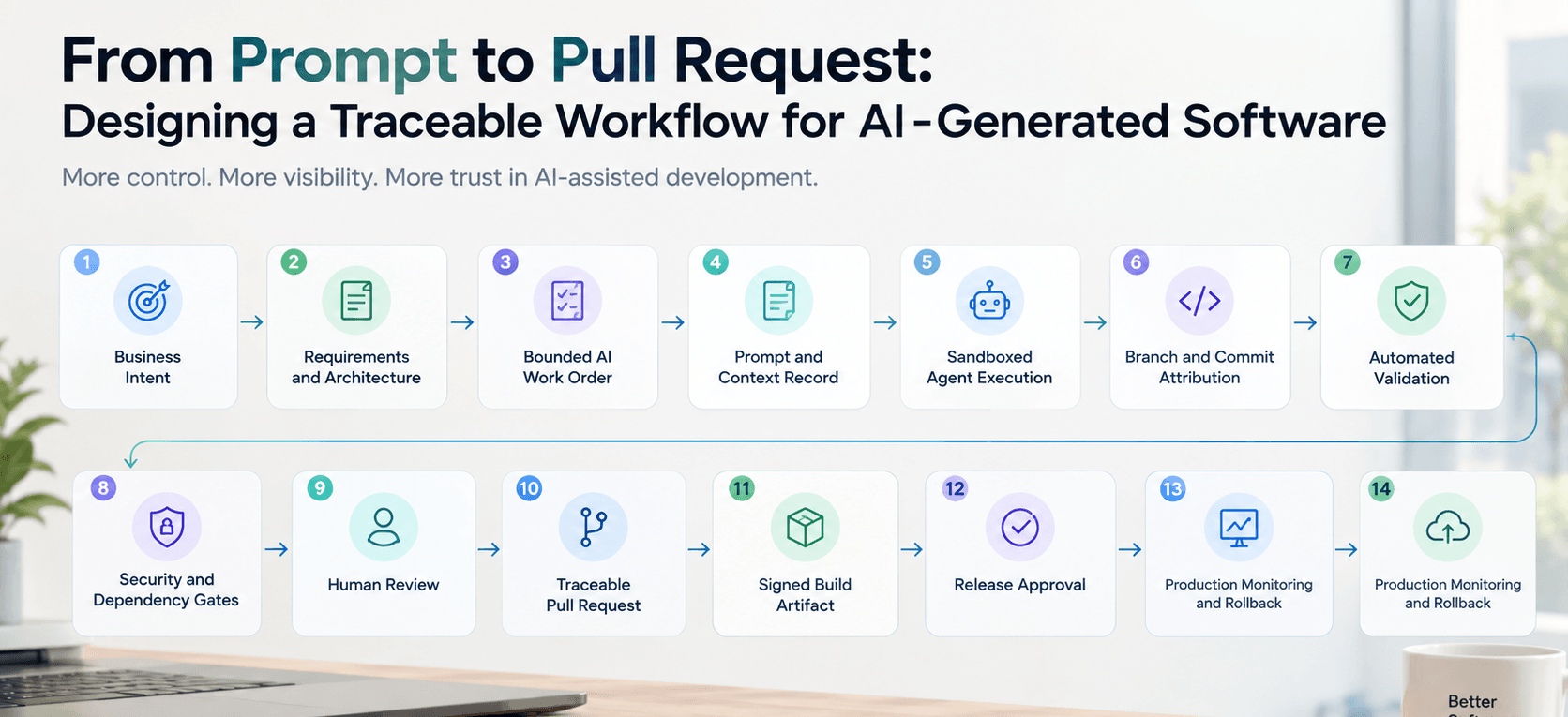
The objective is not to slow down AI-assisted development. It is to make every important change understandable, attributable, verifiable, reversible, and safe to operate.
- Controlled entry points: AI-generated code should enter a production repository through a controlled task and feature branch, not through direct edits to a protected branch.
- Unified traceability: Requirements, architecture, prompts, repository context, commits, tests, reviews, approvals, releases, and incidents should share a common task or work-package ID.
- Comprehensive provenance: A prompt alone is not sufficient provenance. Teams also need the model version, agent identity, repository revision, context sources, tool permissions, generated diff, validation results, and approval record.
- Sandboxed execution: AI agents should work in isolated environments with least-privilege access, restricted network permissions, protected secrets, and no direct production credentials.
- Independent validation gates: Automated tests, SAST, secret scanning, dependency analysis, license checks, and build validation should run independently of the agent.
- Mandatory human accountability: AI-generated code must receive qualified human review. The AI agent does not count as a reviewer, and the person who initiated generation should not be the sole approver for high-risk changes.
- Evidence-based PRs: A pull request should contain verifiable evidence, not merely an AI-written summary.
- Verified build provenance: The reviewed commit, built artifact, and deployed production version must be connected through reliable build provenance.
- Cross-repository coordination: Multi-repository changes require a shared work package so backend, mobile, infrastructure, schema, and documentation changes are reviewed together.
- Full-circle incident response: Rollback and incident records should link production behavior back to the release, artifact, PR, commit, requirement, and AI execution record.
From Software Factory to Pull Request
The emerging enterprise model is not simply “developer asks AI to write code.” It is a governed software factory that converts business intent into specifications, architecture decisions, bounded work orders, implementation, verification, release, and measurement.
Opsera describes this pattern as a flow from intent and specifications through design, build, verification, release, and operation, with governance and measurement across the lifecycle. Its software-factory model also emphasizes machine-readable requirements, architecture, security controls, work orders, and traceability back to the approved business objective.
AI-SDLC perspective similarly emphasizes context, orchestration, sandboxing, and auditability as the control layer required to make coding agents trustworthy in production.
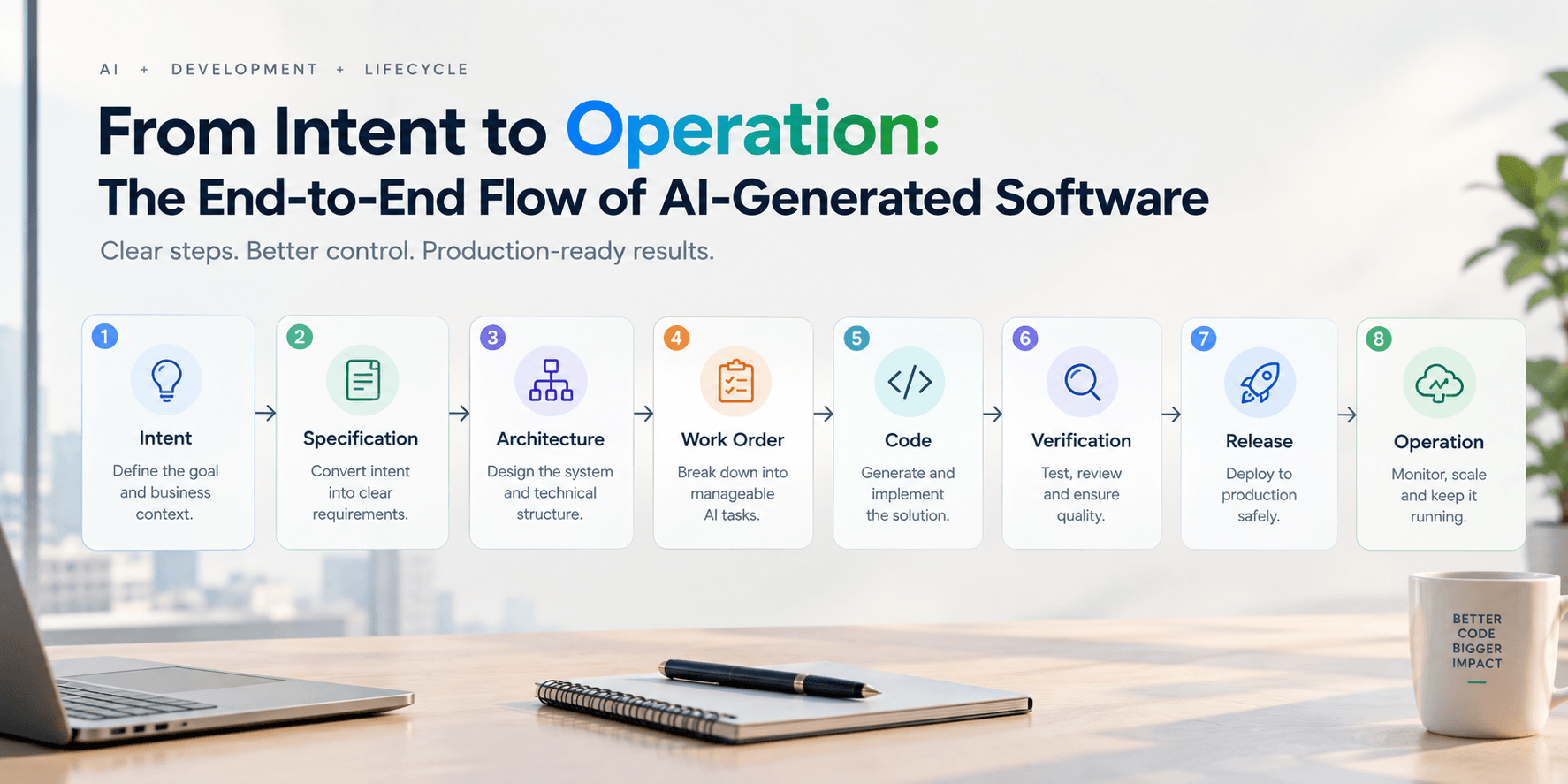
A pull request is therefore not the beginning of review. It is one evidence point inside a larger governed delivery system.
Why Traceability Matters
AI-assisted development adds new inputs to the software lifecycle. The final code may depend on:
- A business requirement
- A product specification
- An architecture decision
- A task or work order
- A user prompt
- A system prompt
- Repository files supplied as context
- Tool outputs
- Model and tool versions
- Generated tests
- CI feedback
- Automated repair attempts
- Human decisions during the session
A final diff does not reveal all of this.
Two pull requests may look similar while carrying very different levels of risk. One may come from a bounded task with explicit acceptance criteria, isolated execution, independent tests, and specialist review. The other may come from an unstructured prompt, broad repository access, incomplete testing, and no record of how the implementation was produced.
A traceable workflow answers five fundamental questions:
| Question | Evidence |
|---|---|
| What was requested? | Requirement, specification, acceptance criteria |
| What architecture should guide it? | Approved design, constraints, dependency map |
| What did the AI receive? | Prompt, model, context manifest, policies |
| What did the AI change? | Session record, branch, commits, diff |
| What verified and approved it? | Tests, scans, review, release record |
A software-factory approach treats requirements, architecture, generated code, pull requests, and validation as connected artifacts instead of separate documents.
The Traceability Model
A complete workflow connects six layers:
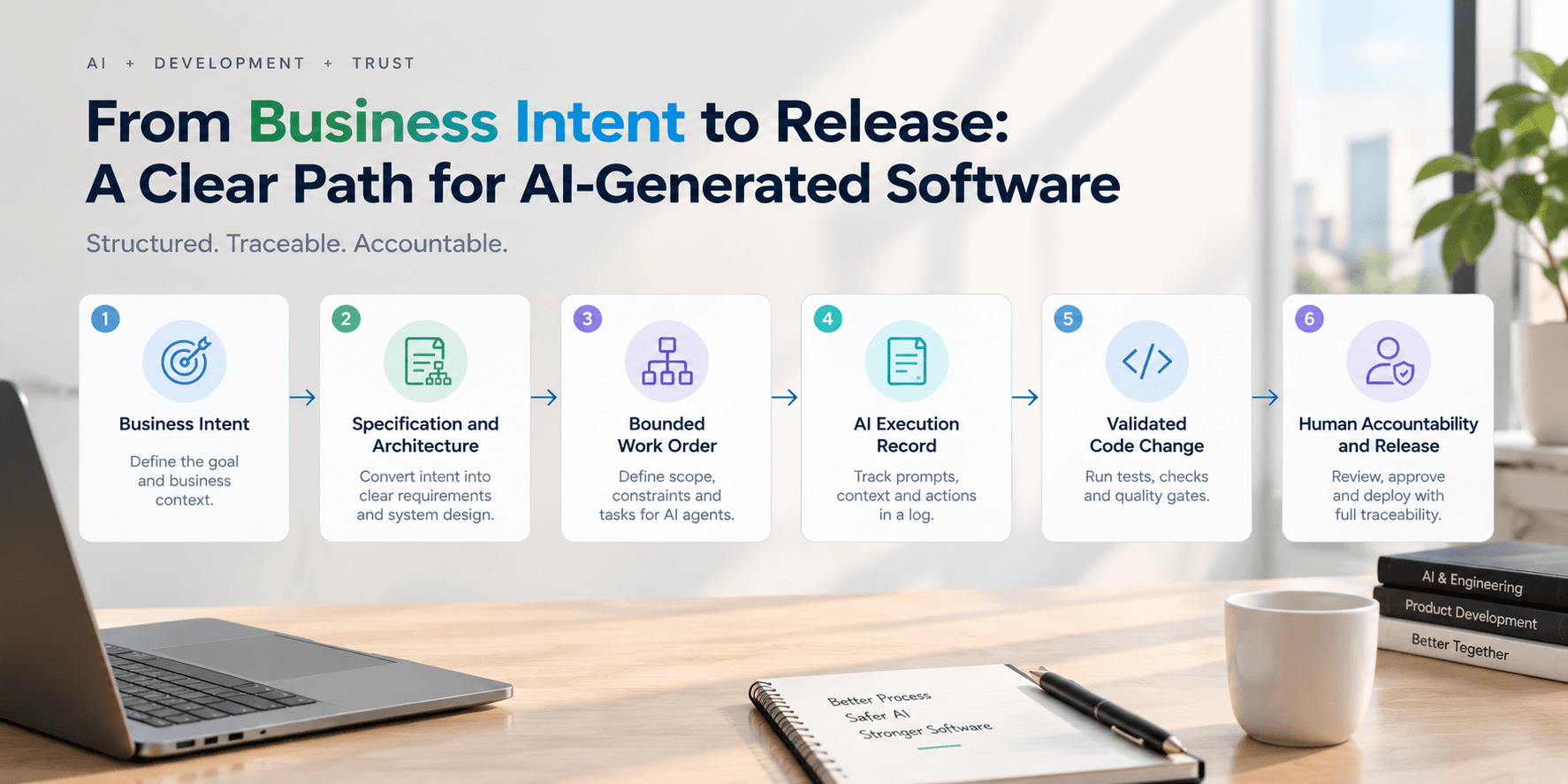
| Layer | Core Question | Required Evidence |
|---|---|---|
| Business intent | What problem are we solving? | Product requirement, user impact, business outcome |
| Specification | What behavior is required? | Functional and non-functional requirements |
| Architecture | What boundaries must be preserved? | Design decision, API contract, data model |
| Work order | What may change? | Scope, criteria, constraints, exclusions |
| AI execution | How was implementation produced? | Model, prompt, context, tools, session record |
| Validation | What proves it is acceptable? | Tests, scans, build, impact analysis |
| Accountability | Who accepted the risk? | Human review, release approval, owner |
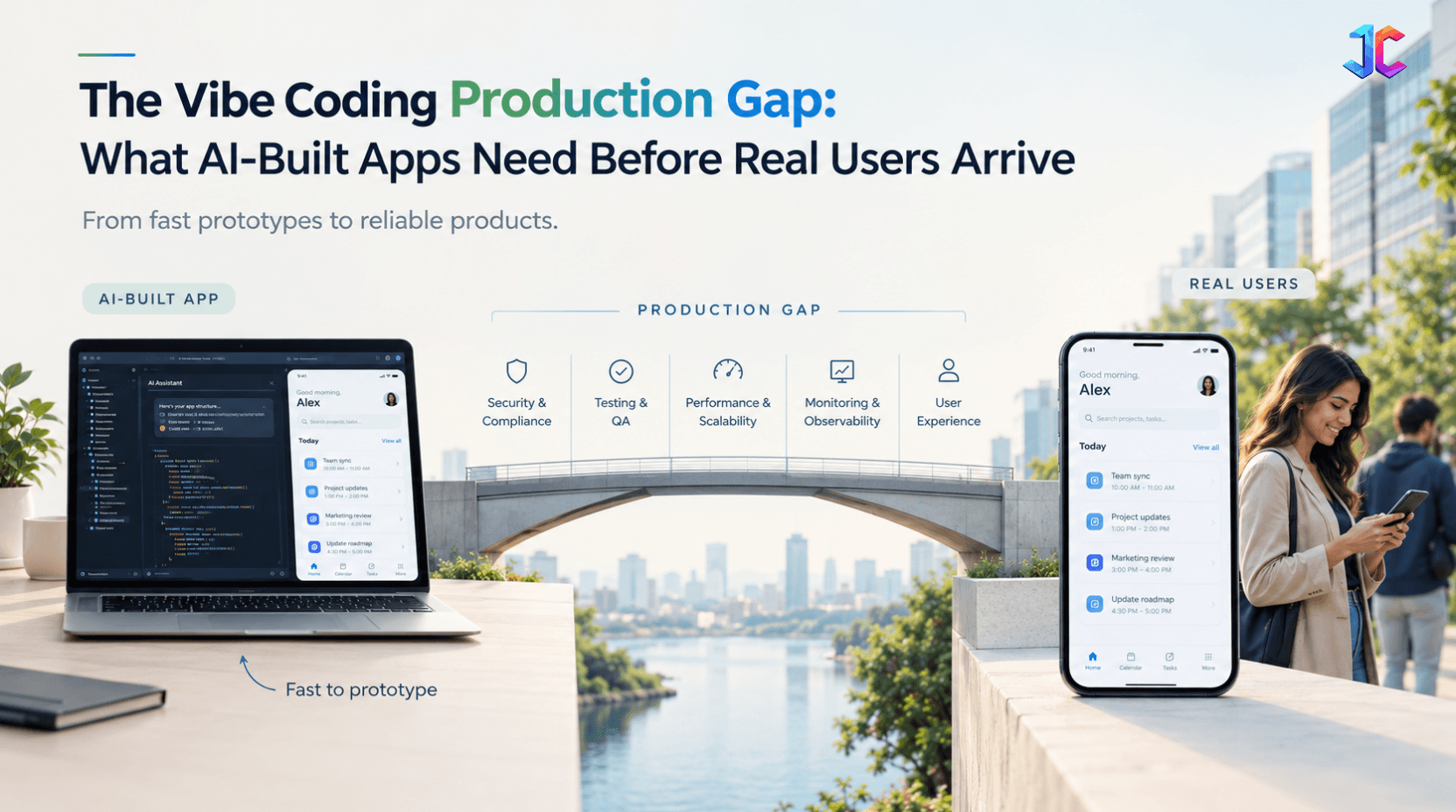
A prompt is not a requirement. A passing build is not proof that the requirement was correctly interpreted. A human approval is not meaningful if the reviewer cannot understand what the agent changed. This is the Vibe Coding Production Gap: the distance between generating working code quickly and having enough traceability, context, and validation to safely ship it to production.
Requirement Definition
The workflow should begin with a structured requirement, not with:
Build this feature and make it production-ready.
That instruction leaves behavior, constraints, failure conditions, architecture, and boundaries undefined.
A production-oriented requirement should include:
- Business outcome
- User or system affected
- Functional behavior
- Non-functional requirements
- Acceptance criteria
- Failure scenarios
- Security constraints
- Performance expectations
- Out-of-scope areas
- Required tests
- Risk classification
- Definition of done
- Required reviewers
Requirement Template
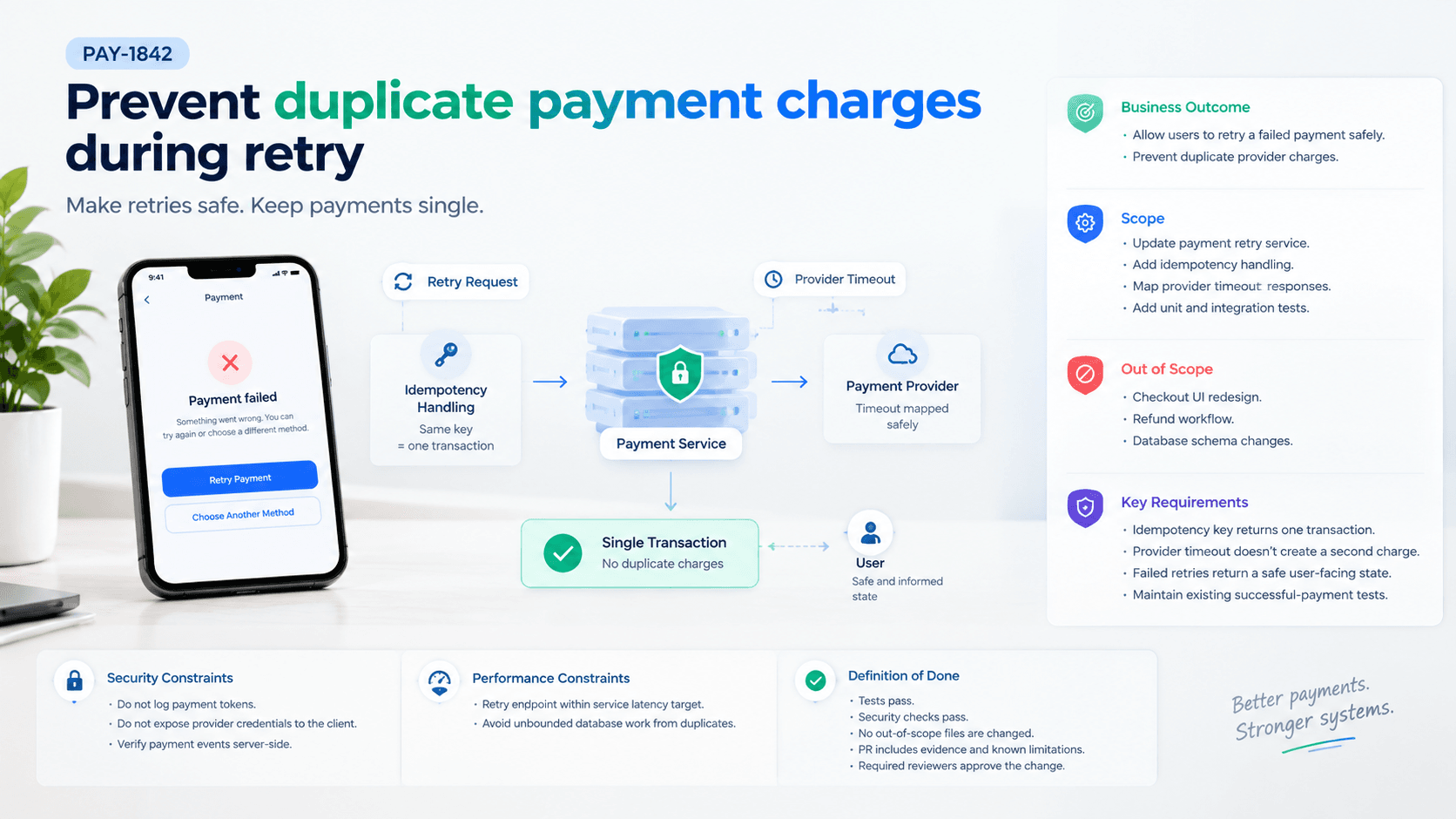
Risk Classification Tiers
Not every AI-assisted task needs the same level of control.
| Risk Level | Example | Required Control |
|---|---|---|
| Low | Documentation or isolated copy | Standard PR review |
| Moderate | UI behavior or internal tooling | Tests and human review |
| High | Business logic, APIs, shared libraries | Integration tests and security checks |
| Critical | Payments, identity, infrastructure, sensitive data | Isolated execution, specialist review, controlled release |
The risk tier should determine:
- Which model or tool may be used
- Which data may be supplied
- Whether prompt review is required
- Which scans must pass
- Which reviewers are mandatory
- Whether staged rollout is required
- Whether automatic merge is prohibited
Architecture Before Generation
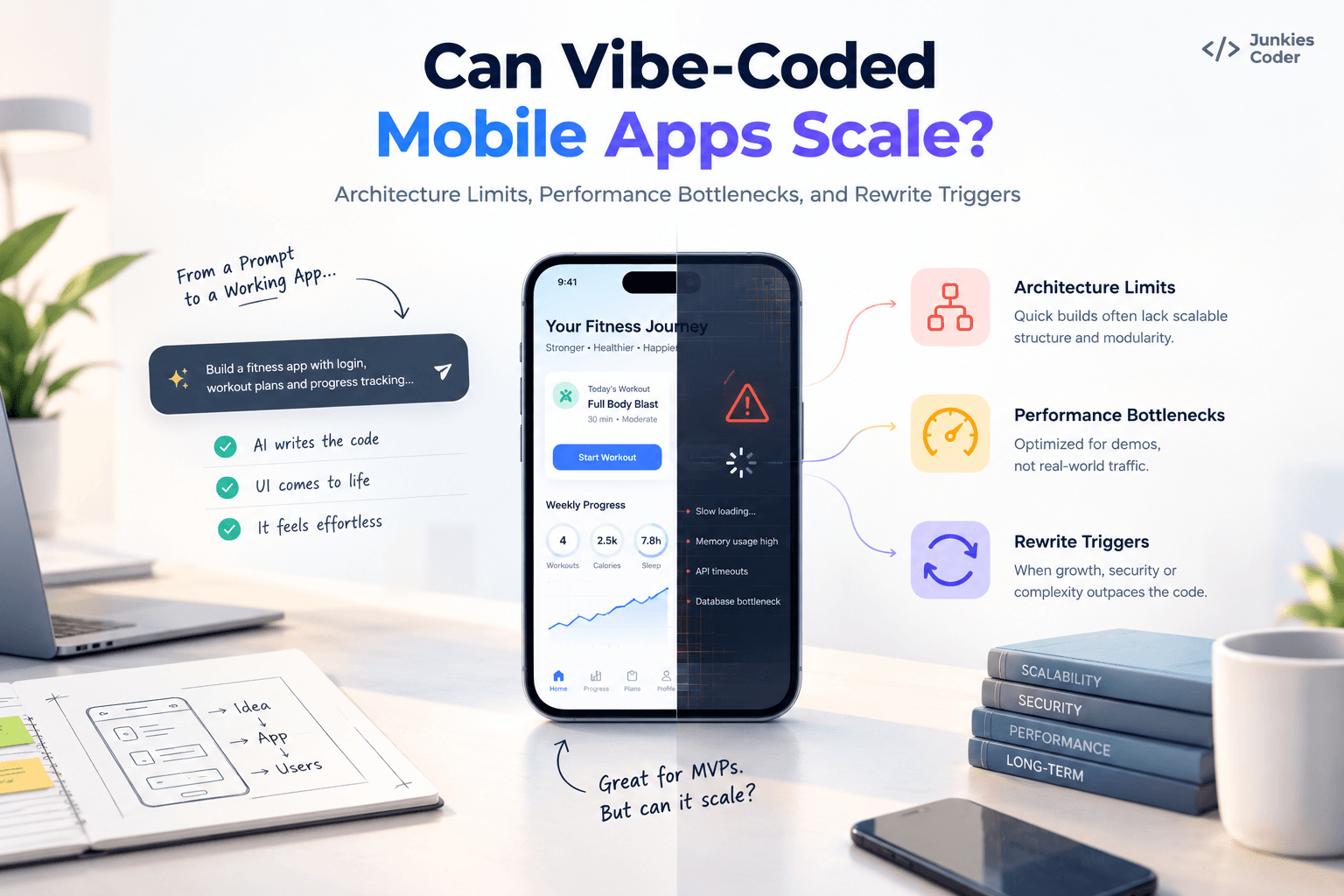
AI should not resolve major architecture decisions implicitly inside a coding prompt, especially as Vibe-Coded Mobile Apps Scale and architectural choices become harder to revisit once they reach production.
Before generation, define the relevant:
- Service boundary
- API contract
- Data model
- Authentication and authorization model
- Error-handling approach
- Event or queue behavior
- Migration strategy
- Performance constraints
- Observability requirements
- Rollback strategy
This does not mean every task requires a long architecture document. It means the agent should receive the architectural constraints that determine whether the implementation fits the system.
Architecture Record
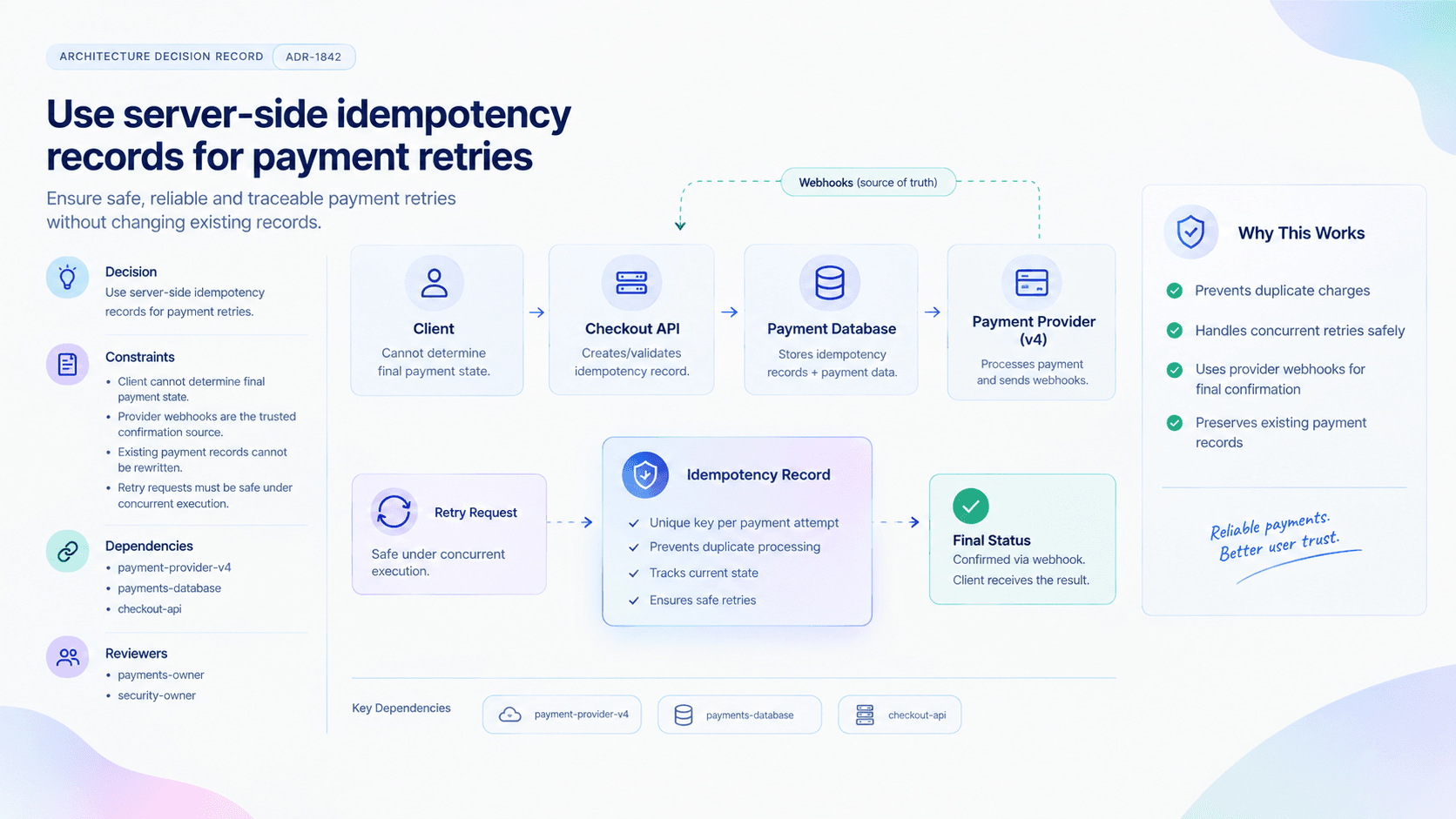
Architecture context reduces drift because the agent is not asked to invent a solution without knowing the system’s boundaries.
Bounded Work Orders
A work order converts an approved requirement into a small unit an agent can execute and a reviewer can verify.
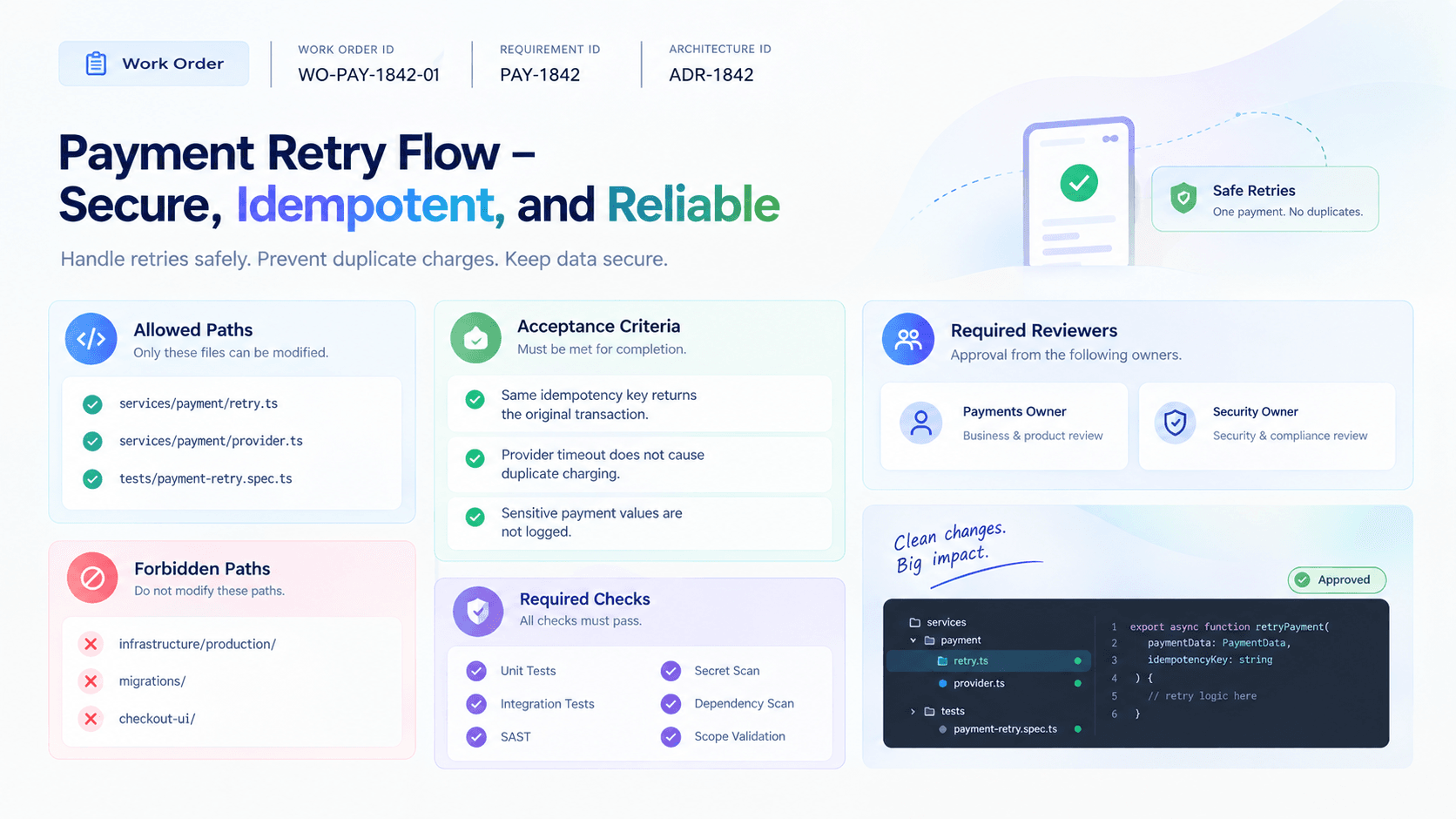
A bounded work order is stronger than a broad prompt because it defines what the agent may do, what it must prove, and what it must not touch.
Prompt and Context Recording
The prompt is part of the implementation history, but it is not the complete history.
Record:
- Requirement or issue ID
- Work-order ID
- User prompt
- Approved system prompt or template
- Model name and version
- Agent or IDE version
- Repository revision
- Branch
- Files supplied as context
- Architecture guidelines
- Security policies
- Dependency versions
- External documentation used
- Tool permissions
- Session ID
Context Manifest
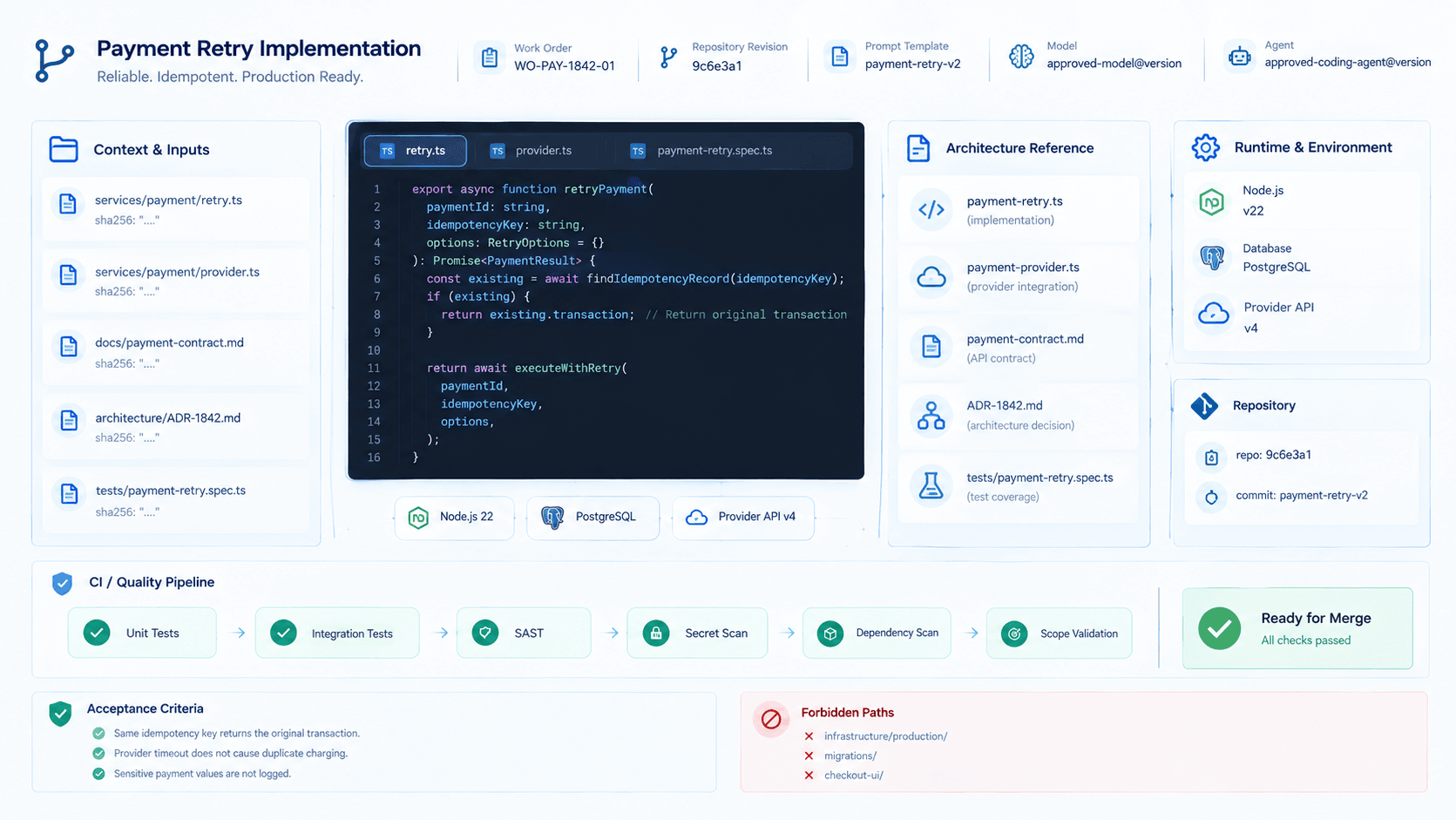
The context manifest matters because AI output can be correct relative to incomplete or outdated context and still be wrong for the current repository.
Version Prompts as Code
Prompt templates should be versioned like software:
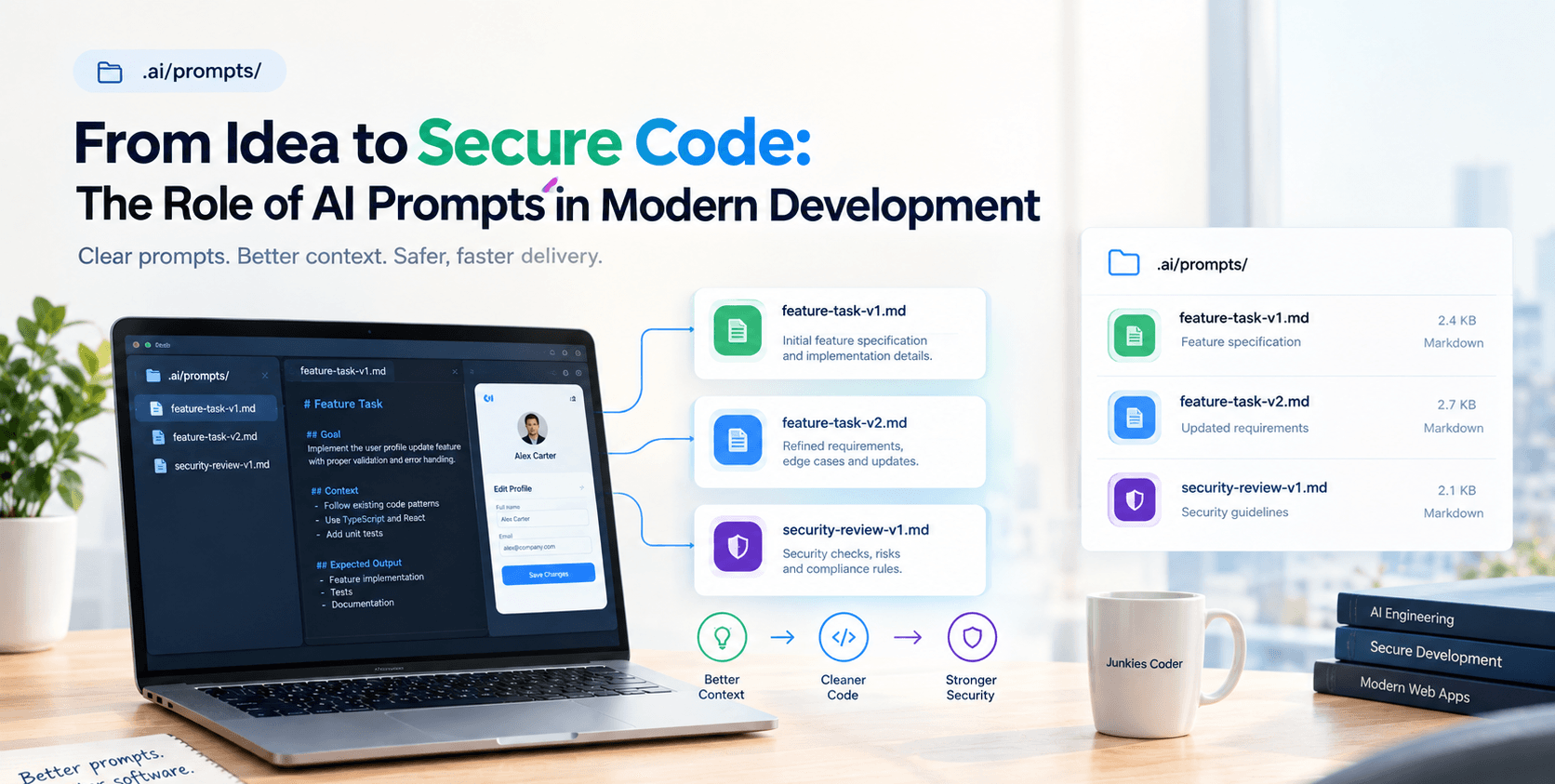
A prompt change can alter:
- Generated architecture
- Test behavior
- Dependency choices
- Error handling
- Security assumptions
- Scope interpretation
Treat important system prompts as controlled engineering configuration.
Protect Prompt Records
Prompts and execution logs may include:
- Proprietary architecture
- Internal URLs
- Customer data
- Security details
- Credentials accidentally pasted by a user
- Unreleased product information
Use redaction, access controls, encryption, retention limits, and secret scanning. Traceability should create evidence, not another data-exposure risk.
Prompt Review Before Generation
Most teams review code after generation. High-risk workflows should also review the instructions before the agent starts.
Prompt review is especially useful for:
- Authentication
- Payments
- Personal or health data
- Database migrations
- Infrastructure
- Public APIs
- Authorization
- Cryptography
- Compliance controls
- Shared libraries
- Production configuration
Prompt Review Checklist
| Question | Why It Matters |
|---|---|
| Is the desired behavior testable? | Prevents vague implementation |
| Are failure cases defined? | Avoids happy-path-only code |
| Is the scope bounded? | Limits unrelated edits |
| Are security constraints explicit? | Reduces unsafe shortcuts |
| Are existing patterns identified? | Prevents architecture drift |
| Is backward compatibility required? | Protects existing consumers |
| Is the migration strategy defined? | Prevents deployment inconsistency |
| Is human approval required before execution? | Controls high-impact work |
Prompt review does not guarantee good code. It ensures that the agent begins with a task that can be meaningfully evaluated.
AI-Generated Change Execution
The AI agent should operate inside a controlled environment rather than directly inside the production repository or protected branch.
Safe Execution Principles
- Use a task-specific feature branch.
- Provide only the required repository access.
- Use a disposable or isolated workspace.
- Keep production credentials unavailable.
- Restrict network access.
- Require approval for destructive commands.
- Prevent direct pushes to protected branches.
- Record files read and modified.
- Record commands executed.
- Preserve failed attempts and repair iterations.
- Generate a patch or commit for independent validation.
The agent should propose a change. It should not be the final authority that declares the change safe.
Agent Execution Record
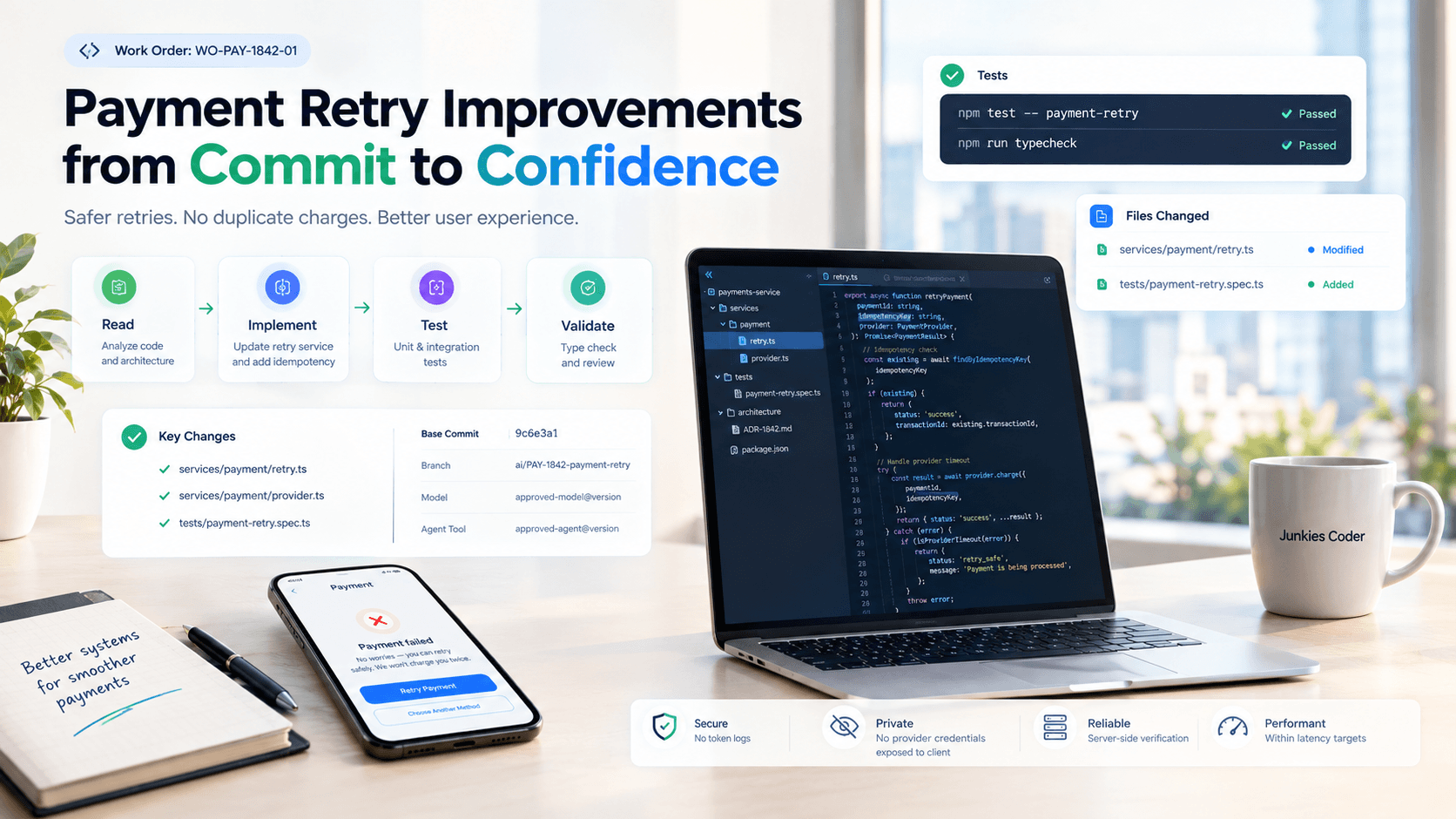
The record should distinguish:
- What the agent was told
- What the agent read
- What the agent changed
- What commands it executed
- What tools returned
- What a human decided
Agent Identity and Permission Lifecycle
A production workflow should treat an AI agent as a controlled software supply-chain participant, not as an anonymous coding utility.
Agent Identity Controls
- Give every agent or agent session a unique identity.
- Avoid shared service accounts.
- Scope access by repository, task, branch, and environment.
- Use short-lived credentials.
- Expire access when the task ends.
- Record the authorized human or service owner.
- Make permissions revocable.
- Review unused agents and integrations.
- Prohibit access to production credentials by default.
Risk-Based Permission Model
| Task | Default Access | Human Control |
|---|---|---|
| Documentation change | Read repository, write branch | Normal review |
| UI update | Limited source access | Functional review |
| Business logic | Relevant modules and tests | Code and test review |
| Database migration | Migration files in sandbox | Migration and rollback approval |
| Authentication change | Narrow security context | Security-aware review |
| Infrastructure change | No production access | Platform owner approval |
| Payment flow | Isolated test environment | Senior engineering review |
| Production deployment | No direct agent access | Human-controlled release |
Instructions inside a prompt are not a security boundary. Use operating-system permissions, network restrictions, secret managers, allowlisted commands, and protected environments.
AI Involvement Levels
“AI-assisted” is too broad to describe every change accurately.
| AI Involvement | Example | Recommended Record |
|---|---|---|
| Suggestion | Autocomplete or small completion | Tool metadata |
| Assisted | Developer accepted and edited generated logic | PR disclosure |
| Agent-generated | Agent created files and tests | Session and context record |
| Agent-modified | Agent changed existing production logic | Full provenance and review |
| Agent-operated | Agent ran migrations or deployment actions | Execution and approval logs |
Line-level attribution is not always reliable or necessary. The more important requirement is change-level provenance and accountability.
Every AI-assisted change should still have a human owner who understands and accepts responsibility for what is merged and shipped. OWASP’s secure-coding guidance recommends reviewing AI-generated changes and assigning human ownership to the result.
Branch and Commit Attribution
AI-generated work should be attributable through normal version-control structures.
Branch Naming
Use a consistent convention:
ai/-
Example: ai/PAY-1842-payment-retry
Commit Metadata
- PAY-1842: prevent duplicate payment retries
- AI-assisted: true
- AI-tool: approved-agent
- AI-model: approved-model@version
- AI-session: agent-2026-1842-009
- Work-order: WO-PAY-1842-01
Link the commit to:
- Requirement
- Architecture record
- Work order
- Branch
- Prompt record
- Context manifest
- Agent session
- Pull request
- CI validation
- Release artifact
Commit Signing
For higher-risk repositories, use signed commits or signed build provenance. This helps verify that the commit and artifact came through the expected workflow.
Keep three concepts separate:
- Attribution: What contributed to the change?
- Accountability: Which human owns the engineering decision?
- Verification: What evidence supports the change?
AI attribution does not replace human responsibility.
Automated Testing
Automated testing should run independently of the AI agent’s own claims.
Test the Requirement, Not Only the Implementation
For the payment example, tests should cover:
- First payment attempt
- Repeated request with the same idempotency key
- Different request with a new idempotency key
- Provider timeout
- Provider rejection
- Duplicate webhook
- Delayed webhook
- Database failure
- Safe logging behavior
- Existing successful payment behavior
AI-generated tests can improve coverage, but they may reproduce the same mistaken assumption as the generated code. Independent tests, regression suites, integration checks, and human review remain necessary.
Test Evidence
The PR should identify:
- Tests added
- Tests changed
- Requirement covered
- Failure cases tested
- Tests skipped
- Reason for skipped tests
- Test environment
- Build version
- Coverage changes
- Known untested behavior
A passing test suite proves only what the suite actually tests.
Security and Dependency Scanning
AI-generated code can introduce security issues through implementation, configuration, dependencies, logging, and permissions.
Run checks for:
- Hardcoded secrets
- Unsafe input handling
- Injection risks
- Broken authorization
- Sensitive data in logs
- Insecure cryptography
- Unsafe file access
- Dependency vulnerabilities
- License conflicts
- Suspicious package names
- Insecure infrastructure changes
- Container and configuration weaknesses
OWASP recommends that AI-generated code receive the same security review as human-written code and that security gates remain mandatory across design, implementation, review, testing, deployment, and monitoring.
Validation Layers
| Stage | Checks |
|---|---|
| Local or pre-commit | Formatting, linting, secret scanning |
| Pull request | SAST, dependency analysis, license checks, type checks |
| Build | Container and infrastructure scanning, SBOM generation |
| Pre-release | DAST, integration security tests, configuration validation |
| Production | Runtime monitoring, vulnerability alerts, incident detection |
Dependency Verification
AI agents may suggest or install packages without understanding registry risk. Verify:
- Package name
- Registry source
- Publisher identity
- Registration history
- Maintenance activity
- License
- Known vulnerabilities
- Transitive dependencies
- Package necessity
Do not allow an agent to install an unfamiliar dependency into a trusted build environment without review. AI coding agents are now considered an emerging software supply-chain node because they can select dependencies and execute build commands.
AI-BOM and SBOM
For enterprise environments, track:
- Source dependencies
- Runtime dependencies
- Container layers
- Build tools
- Model or agent versions
- Agent integrations
- Prompt template versions
- Relevant external services
Human Code Review
Human review should not be reduced to clicking “Approve” after CI passes.
Review Focus Areas
- Correctness: Does the implementation satisfy the requirement? Are edge cases handled? Are errors represented correctly? Does the code preserve existing behavior?
- Architecture: Does the change follow existing boundaries? Does it introduce unnecessary coupling? Does it create a new pattern without justification? Is the data flow understandable? Does it create future migration or maintenance risk?
- Security: Are authorization checks server-side? Are secrets protected? Is input validated? Are sensitive values excluded from logs? Are retries and external calls safe?
- Operations: Can the change be monitored? Is it reversible? Does it require a migration? Could it increase cost or latency? What happens if a dependency fails?
- Scope: Are unrelated files modified? Are new dependencies justified? Are configuration changes necessary? Has the agent performed an unrequested refactor?
Separation of Duties
For high-risk work:
- The AI agent cannot count as the reviewer.
- An automated review bot cannot replace the required human approver.
- The person who requested the AI generation should not be the sole reviewer.
- Security-sensitive changes should receive review from an appropriately qualified engineer.
The AI Security Verification Standard specifically recommends separation between the identity that requested AI generation and the reviewer who approves the result.
Change Impact and Blast-Radius Analysis
File count is not a reliable measure of risk. A one-line permission change may be more dangerous than a large documentation change.
Before merge, identify:
- Directly changed components
- Dependent services
- Public API consumers
- Database tables and migrations
- Shared libraries
- Permission boundaries
- Infrastructure resources
- External integrations
- Expected performance impact
- Rollback complexity
- Required reviewers
Impact Classification
| Impact | Example | Required Action |
|---|---|---|
| Local | One isolated component | Standard CI and review |
| Service-level | API or service behavior | Contract and integration testing |
| Cross-service | Shared event or API contract | Coordinated review and release |
| Data-level | Schema or migration | Migration and rollback planning |
| Platform-level | Infrastructure or permissions | Platform and security review |
| Business-critical | Payments or identity | Specialist review and controlled rollout |
A traceable workflow should flag changes that exceed the original task boundary or affect systems not named in the requirement.
Multi-Repository Coordination
Modern product changes often span multiple repositories:
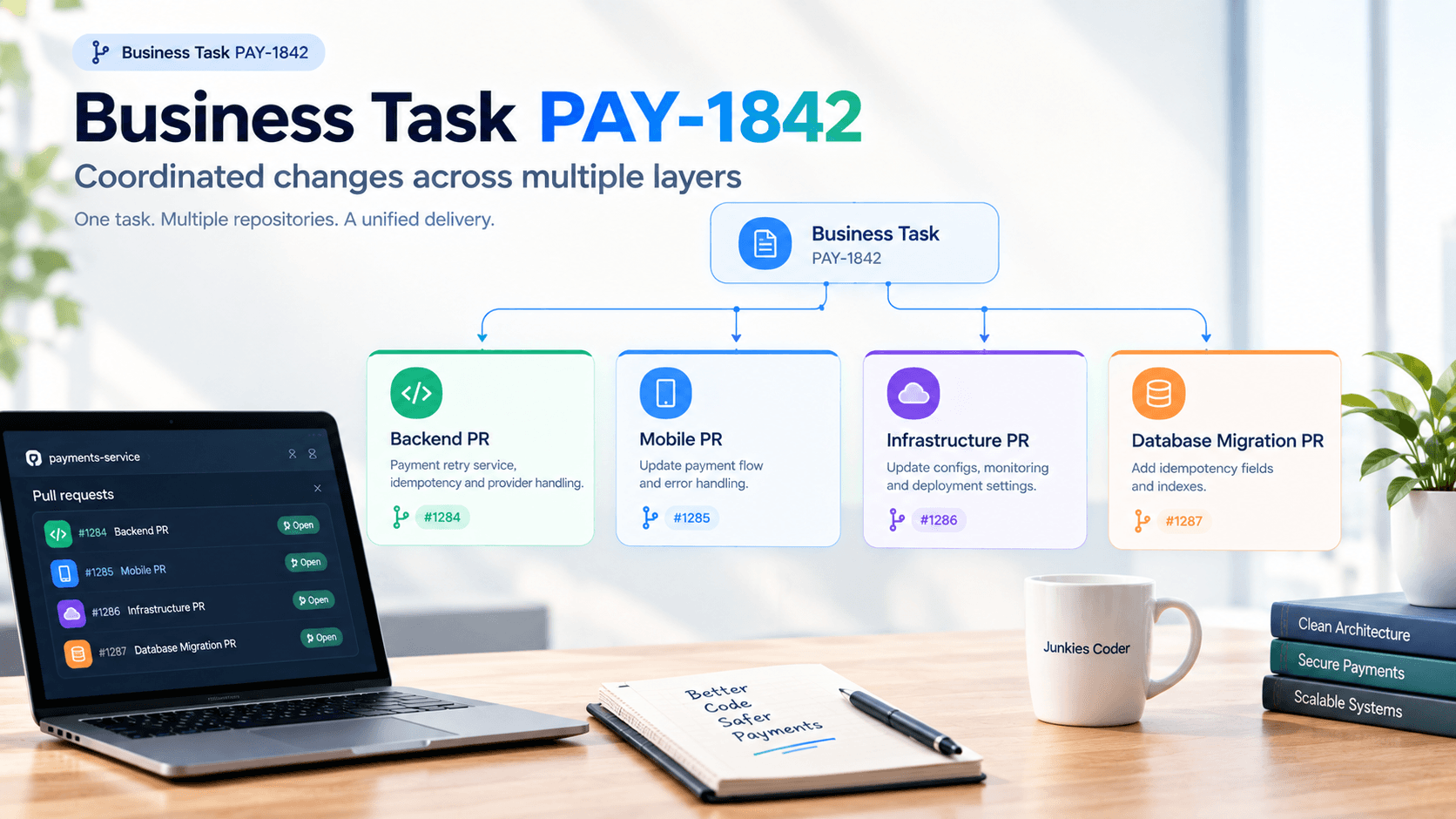
Use a shared work package or release identifier:
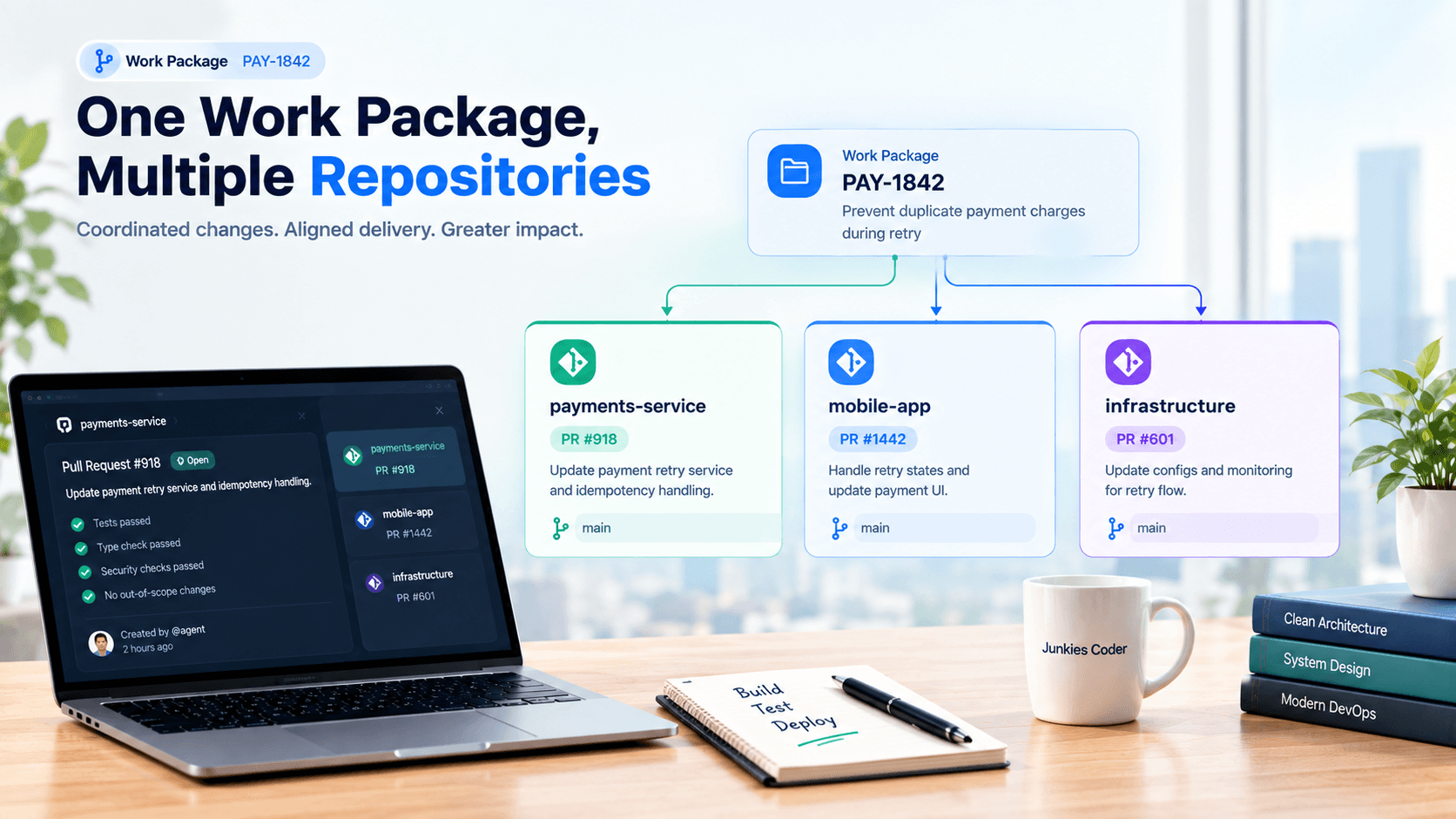
The release should not approve only one PR while missing a required companion change. Each repository can retain its own review process, but the release owner should see the complete change set and dependency order.
Pull-Request Evidence
The PR should help a reviewer make a decision without reconstructing the AI session manually.
Recommended PR Structure
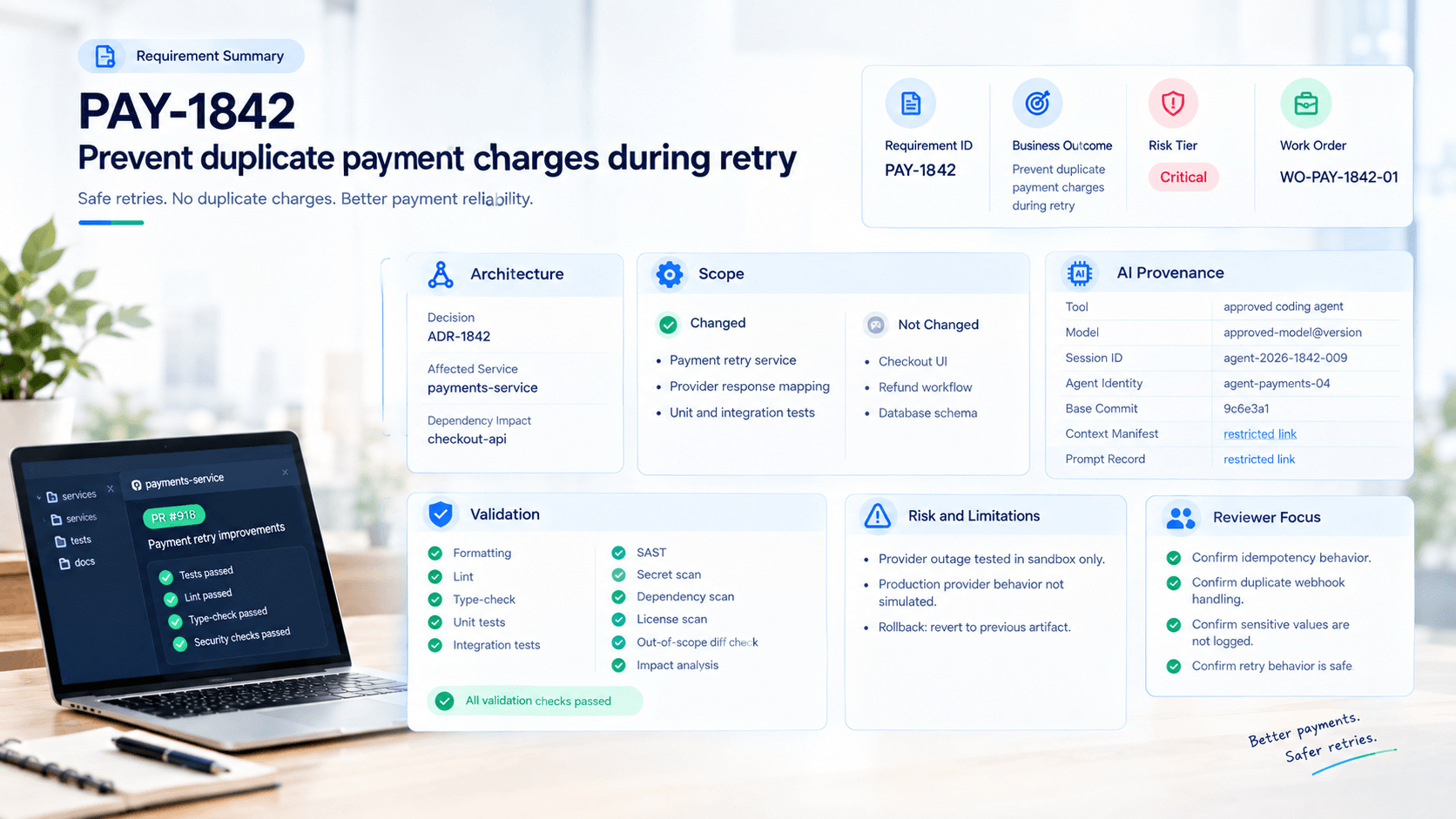
An AI-generated summary is useful for orientation, but it is not proof that the implementation works. The PR should link to actual CI runs, security reports, build artifacts, and approval records.
Build and Artifact Provenance
A reviewed source commit is not automatically the same as the software running in production.
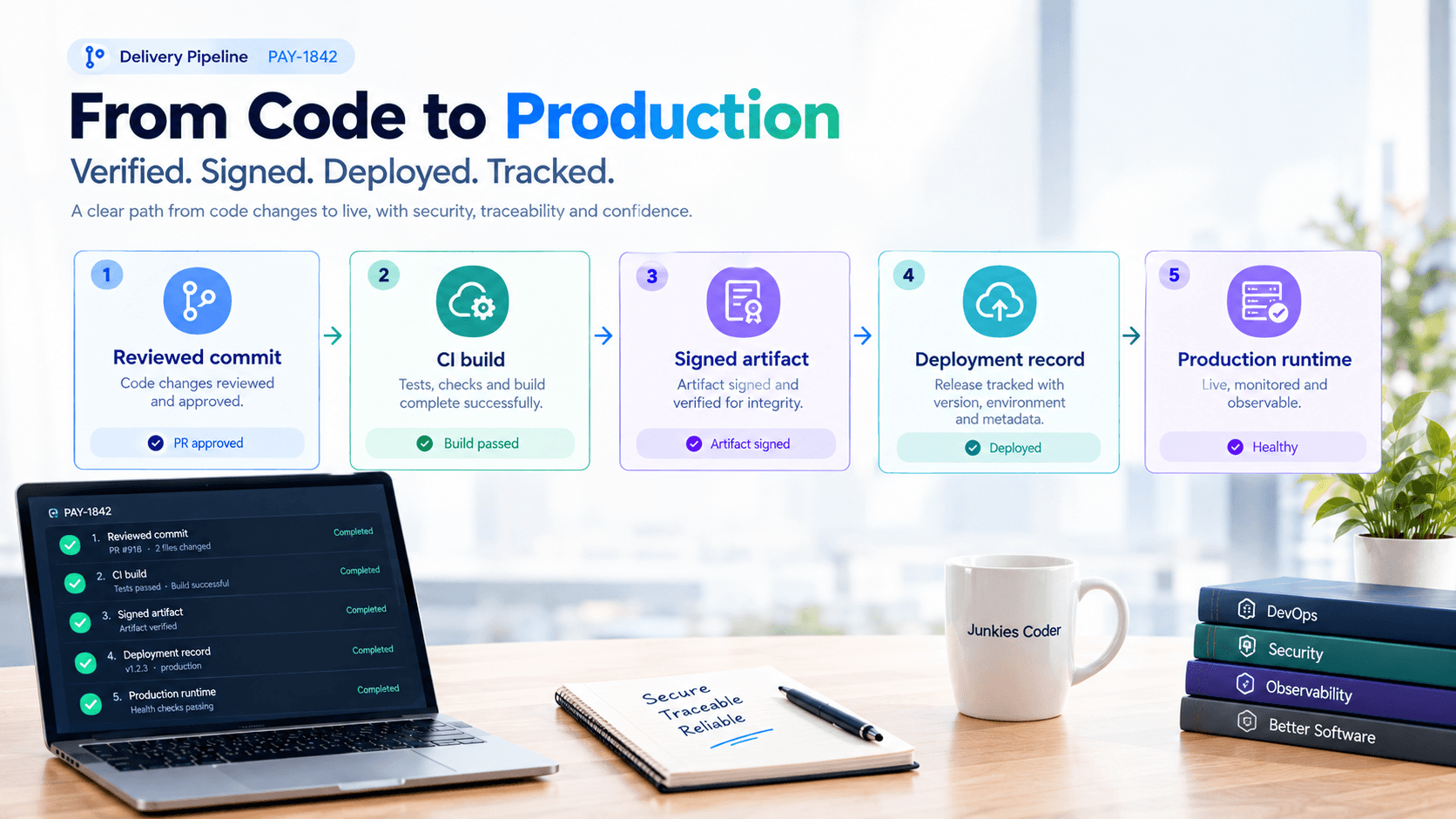
Before release, verify:
- The artifact was built from the approved commit.
- The build ran through the expected pipeline.
- The artifact digest is recorded.
- The deployed version matches the approved artifact.
- The SBOM belongs to the deployed artifact.
- The artifact was not rebuilt from unreviewed source.
- The rollback artifact is available.
- The build and deployment identities are recorded.
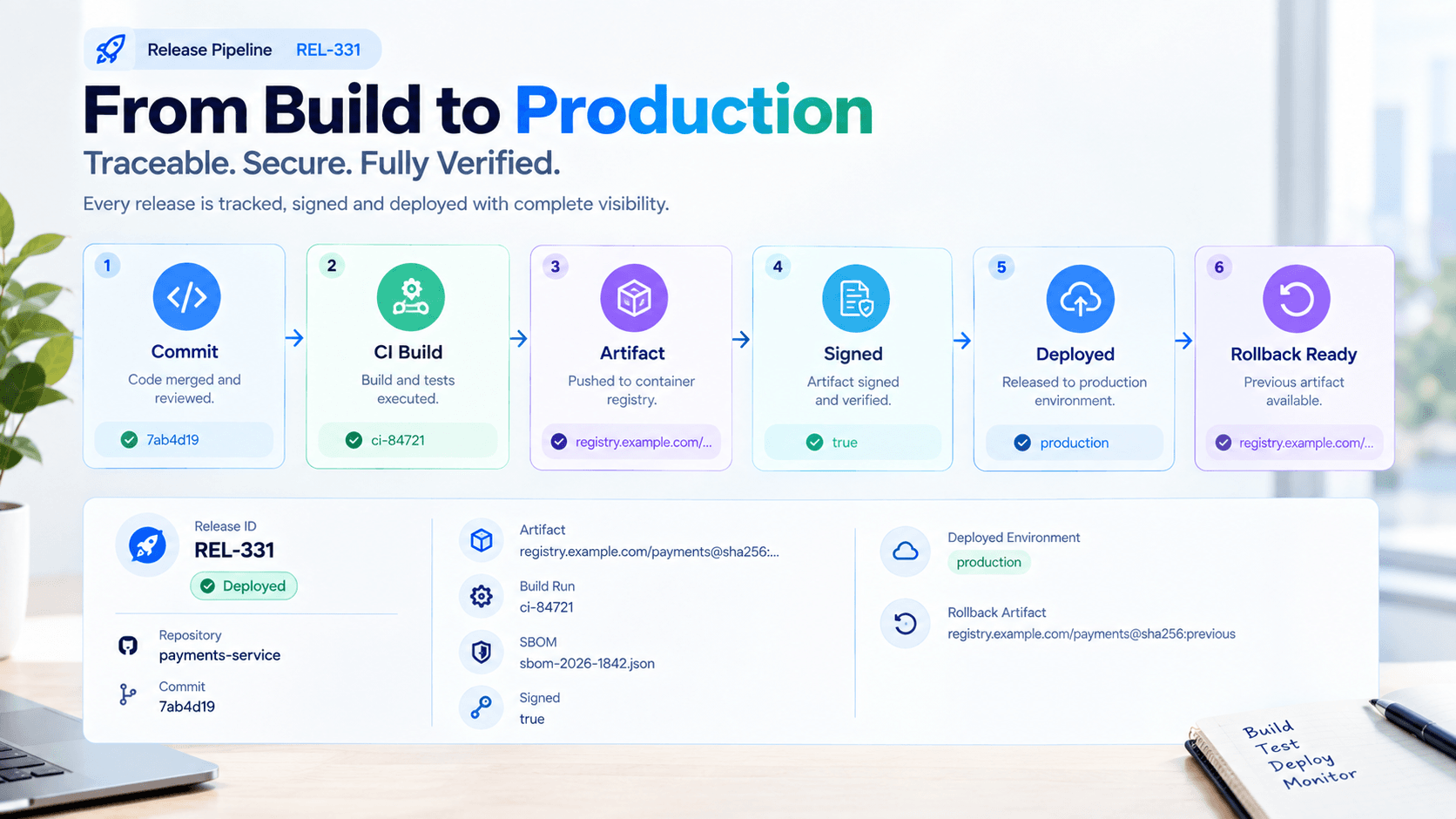
Artifact Record
This closes the gap between approved code and actual production software. Supply-chain provenance requires organizations to track and verify how source becomes a deployable artifact.
Release Approval
Approval should apply to the exact version that will be released.
Before production promotion, verify:
- The release commit matches the approved PR.
- The build was created from the reviewed source.
- Tests passed for that commit.
- Security scans passed.
- Required reviewers approved.
- Database migrations are available and reversible.
- Environment configuration is correct.
- Monitoring and alerts are ready.
- Rollback instructions exist.
- The release artifact is immutable or identifiable.
- Related repositories are included in the release plan.
Release Approval Matrix
| Change Type | Required Approval |
|---|---|
| Documentation or low-risk UI | Code owner |
| Business logic | Code owner and engineer |
| Public API | Service owner and API reviewer |
| Database migration | Service owner and database reviewer |
| Authentication or authorization | Security-aware reviewer |
| Payment workflow | Senior engineer and payments or security owner |
| Infrastructure | Platform owner |
| Production configuration | Operations or platform owner |
| Regulated data workflow | Engineering and compliance-approved reviewers |
The release approver should know exactly which commit, image, package, or artifact is being promoted.
Cost, Data Residency, and IP Governance
Enterprise AI workflows need controls beyond code correctness.
Cost Controls
Track:
- Model inference cost
- Agent runtime
- CI compute
- Repeated repair loops
- Context-window usage
- Cost per accepted PR
- Cost of failed or abandoned sessions
Set controls such as:
- Maximum autonomous iterations
- Budget limits per task
- Escalation after repeated failure
- Approved model tiers
- Limits on large repository scans
- Separate budgets for experimentation and production work
A workflow that produces more code but creates excessive review, rework, and compute costs may not improve engineering economics.
Data and IP Controls
Define:
- Which source code may be sent to external models
- Whether customer data must be removed
- Where prompts and logs are stored
- Whether providers retain inputs or outputs
- Which regional data-residency rules apply
- How proprietary algorithms are handled
- How generated dependencies are checked for license risk
- Which repositories may use external models
AI governance should include data handling, model provenance, tool access, and accountability, not only code review.
Model and Prompt Regression Testing
A model or system-prompt update can change generated output even when the task remains identical. Treat model and prompt changes as controlled workflow changes.
Regression Controls
- Version prompt templates.
- Record model and tool versions.
- Maintain representative task examples.
- Compare outputs across model versions.
- Test security-sensitive prompts.
- Review changes in agent permissions.
- Keep rollback capability for prompt and agent configuration.
- Re-run benchmark tasks after a major model update.
- Record quality, cost, latency, and failure differences.
Example Evaluation Set
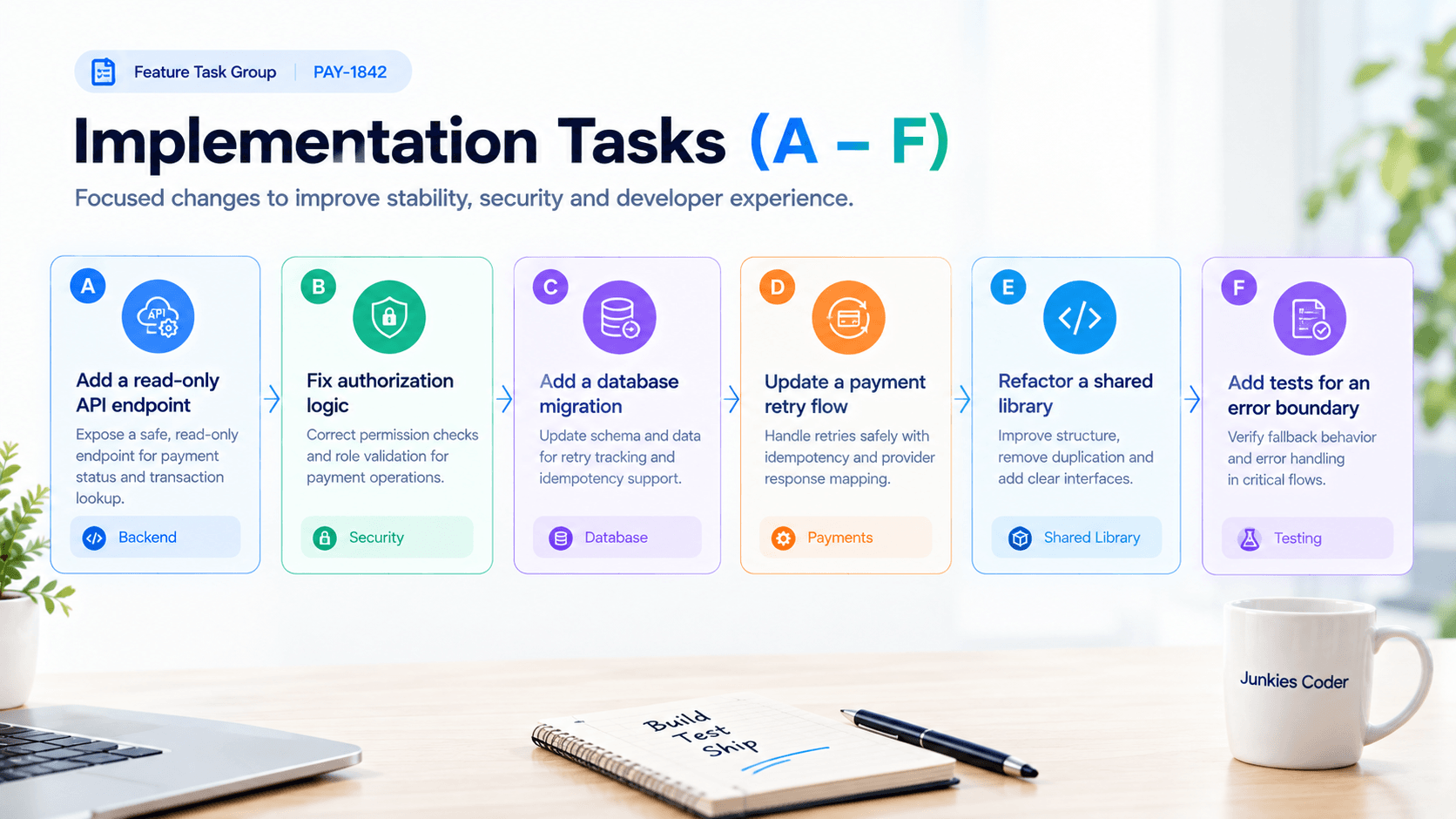
The organization does not need to freeze every model forever. It needs to know when a model or agent change alters the risk profile of its development workflow.
Rollback and Incident Traceability
Traceability becomes most valuable when something fails.
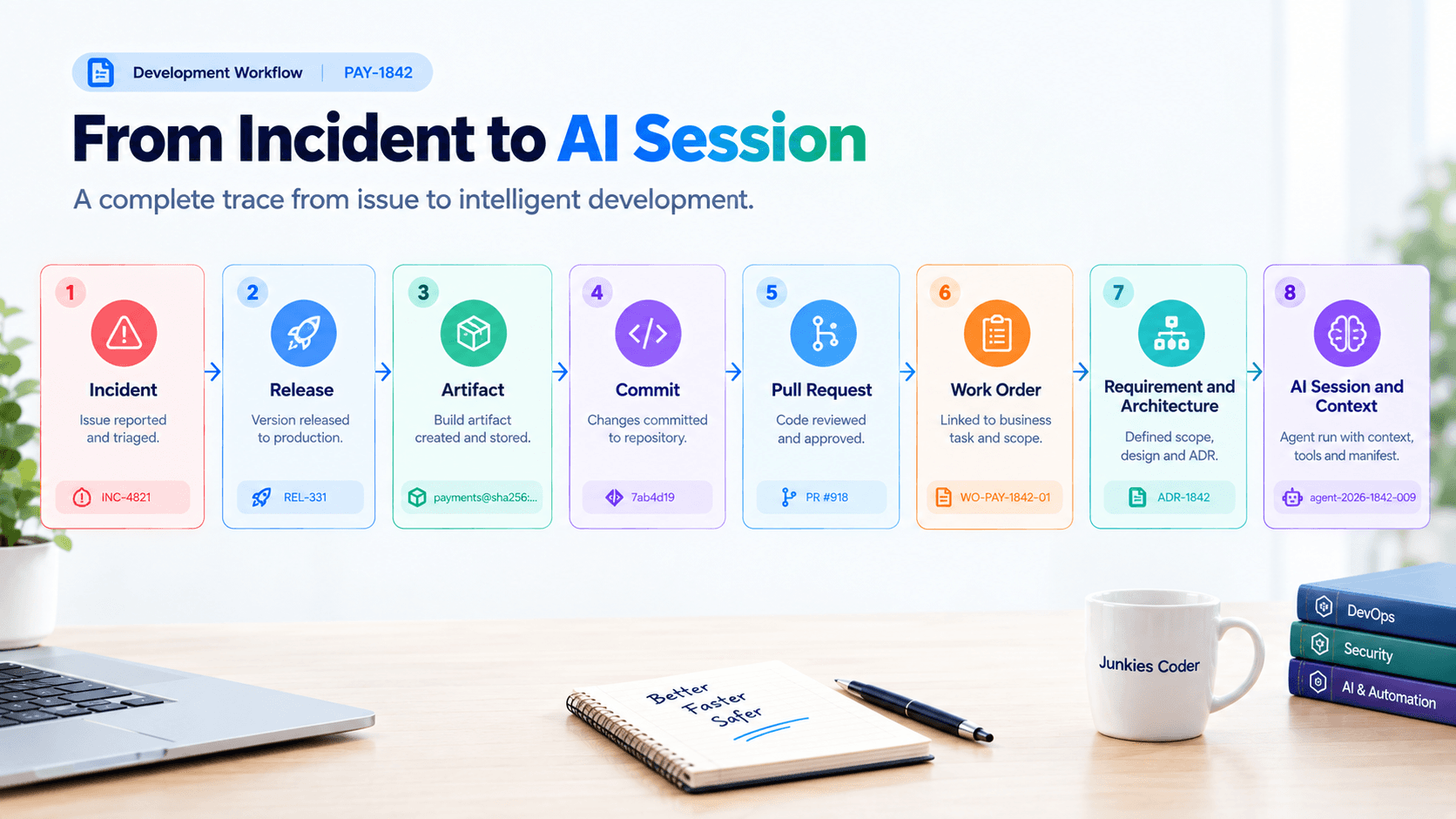
Incident Record
Include:
- Incident ID
- Affected release
- Deployed commit or artifact
- Related PR
- Work-order ID
- Requirement ID
- AI session ID
- Detection time
- Affected users or systems
- Symptoms
- Root cause
- Rollback or mitigation
- Tests that failed to detect the issue
- Corrective action
- Follow-up owner
Rollback Requirements
Every production release should have:
- A known previous-good version
- A tested rollback path
- Database migration strategy
- Feature flags where appropriate
- Release monitoring
- Clear ownership
- Incident communication process
Rollback is more complicated when a release changes both code and data. Database migrations should be backward-compatible where possible, and destructive changes should be separated from application deployment when practical.
Post-Incident Questions
- Was the requirement ambiguous?
- Did the AI receive outdated context?
- Did the agent modify files outside scope?
- Were tests insufficient?
- Did the reviewer miss a known risk?
- Did CI validate the wrong artifact?
- Was the release different from the approved commit?
- Was monitoring missing or too slow?
- Should the model, prompt, or permission policy be changed?
- Can the same failure be prevented through a workflow control?
The objective is not to blame the AI. It is to improve the system that allowed an unsafe change to move forward.
Post-Deployment Feedback Loop
The workflow should not end when the PR merges or the release completes.
Connect the deployed change to:
- Error-rate changes
- Latency changes
- Cost changes
- Conversion changes
- User complaints
- Support tickets
- Rollbacks
- Feature-flag outcomes
- Security alerts
- Dependency failures
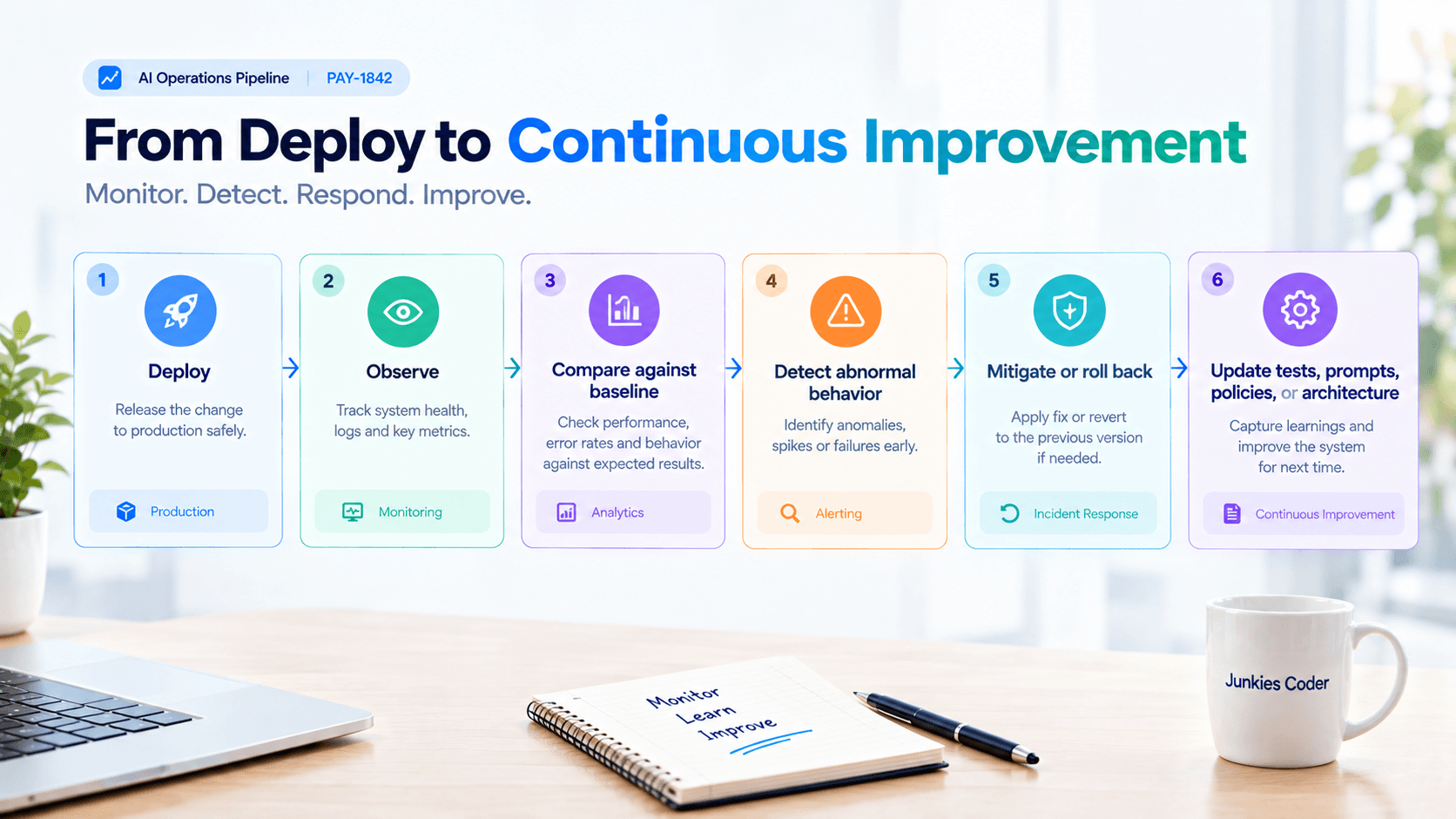
A production release is another validation layer. Software may pass static checks and still create unexpected latency, cost, reliability, or user-experience problems.
Governance and Separation of Duties
A mature AI-assisted SDLC separates:
- Requirement approval
- Architecture approval
- Prompt or work-order approval
- Agent execution
- Automated validation
- Human code review
- Release approval
- Production ownership
This does not mean every low-risk change requires six people. It means high-risk changes should not rely on one identity, one bot, or one automated check.
Recommended Governance Controls
- The agent cannot approve its own output.
- A review bot cannot replace a required human reviewer.
- The requester should not be the sole reviewer for critical changes.
- Security-sensitive changes require qualified review.
- Production deployment requires controlled promotion.
- Exceptions require documentation and an owner.
- Approvals should identify the exact commit or artifact.
- The deployed artifact should be traceable to the approved source.
OWASP guidance recommends covering the full secure software lifecycle, from design and implementation through review, testing, deployment, and post-deployment monitoring, with mandatory security gates whether or not AI was involved.
Metrics That Show Whether the Workflow Works
Traceability should be measured by engineering outcomes, not by the number of metadata fields stored.
| Metric | What It Shows |
|---|---|
| Requirement-to-PR linkage rate | Whether changes are attributable |
| Prompt-to-commit coverage | Whether AI-assisted work has provenance |
| Architecture-to-code traceability | Whether implementation follows approved design |
| First-pass CI success | Quality of task definition and implementation |
| Scope-drift rate | Agent boundary control |
| Rework per PR | Hidden requirement or design problems |
| Security findings per change | Effectiveness of security gates |
| Test-gap rate | Quality of behavioral validation |
| Review time | Whether PR evidence is understandable |
| Rollback frequency | Production risk |
| Post-release defect rate | Real-world effectiveness |
| Mean time to trace an incident | Operational value of provenance |
| Cost per accepted change | Economic efficiency |
| Model-change regression rate | Stability of the AI workflow |
Do not optimize for first-pass approval alone. A high approval rate is meaningless if production defects, security findings, or rollbacks increase.
Common Workflow Failures
- Recording prompts but not context: A prompt may be traceable while the files and policies supplied to the AI remain unknown. This makes it difficult to explain why the generated code took a particular direction.
- Running tests only inside the AI session: The agent can report that tests passed, but the repository should run those checks independently in a clean CI environment.
- Allowing direct production access: Agents should not receive production credentials or deployment authority simply because it is convenient.
- Treating a green build as complete verification: Build success does not prove authorization, business correctness, resilience, compatibility, or safe operational behavior.
- Creating oversized AI pull requests: Large, unrelated diffs are difficult to review and difficult to roll back. Bound the task and split changes by responsibility.
- Storing sensitive transcripts indefinitely: Prompt and execution records may contain proprietary or personal data. Retain only what is necessary and protect it appropriately.
- Using AI-generated summaries as evidence: A summary describes a change. It does not prove that the implementation works. Evidence must come from source inspection, independent tests, scans, approvals, and runtime signals.
- Failing to verify the production artifact: A reviewed commit is not enough if the release pipeline rebuilds from a different source revision or deploys an unverified image.
- Ignoring cross-repository dependencies: A backend PR may be approved while the required mobile, infrastructure, or schema change remains unreviewed. Use a shared work package and coordinated release record.
- Treating every AI task identically: Low-risk documentation changes and payment changes should not pass through identical approval paths. Governance should be proportional to impact.
Practical Adoption Roadmap
Do not attempt to create a perfect enterprise workflow in one release.
- Phase 1: Basic linkage — Require Requirement ID, AI-use disclosure, feature branch, test results, human reviewer, and protected main branch.
- Phase 2: Structured specifications — Add acceptance criteria, architecture context, out-of-scope rules, risk classification, required validation, and definition of done.
- Phase 3: Automated provenance — Capture model and tool version, repository revision, context manifest, session ID, changed files, commands, and CI results.
- Phase 4: Guarded execution — Introduce ephemeral runners, least-privilege access, network restrictions, secret redaction, approval for destructive actions, and zero production credentials.
- Phase 5: Artifact and release provenance — Connect commits to builds, builds to signed artifacts, artifacts to deployments, deployments to release approvals, and releases to rollback targets.
- Phase 6: Multi-repository and risk governance — Add shared work packages, blast-radius analysis, specialist reviewers, agent inventory, model and prompt regression testing, data residency, and IP controls.
- Phase 7: Outcome measurement — Track scope drift, defect rate, security findings, review time, rollbacks, post-release incidents, cost per accepted change, and time required to reconstruct provenance.
Automation should collect evidence in the background. Developers should not have to manually build an audit trail after every AI session.
Complete Traceability Record
A compact record can connect the full lifecycle:
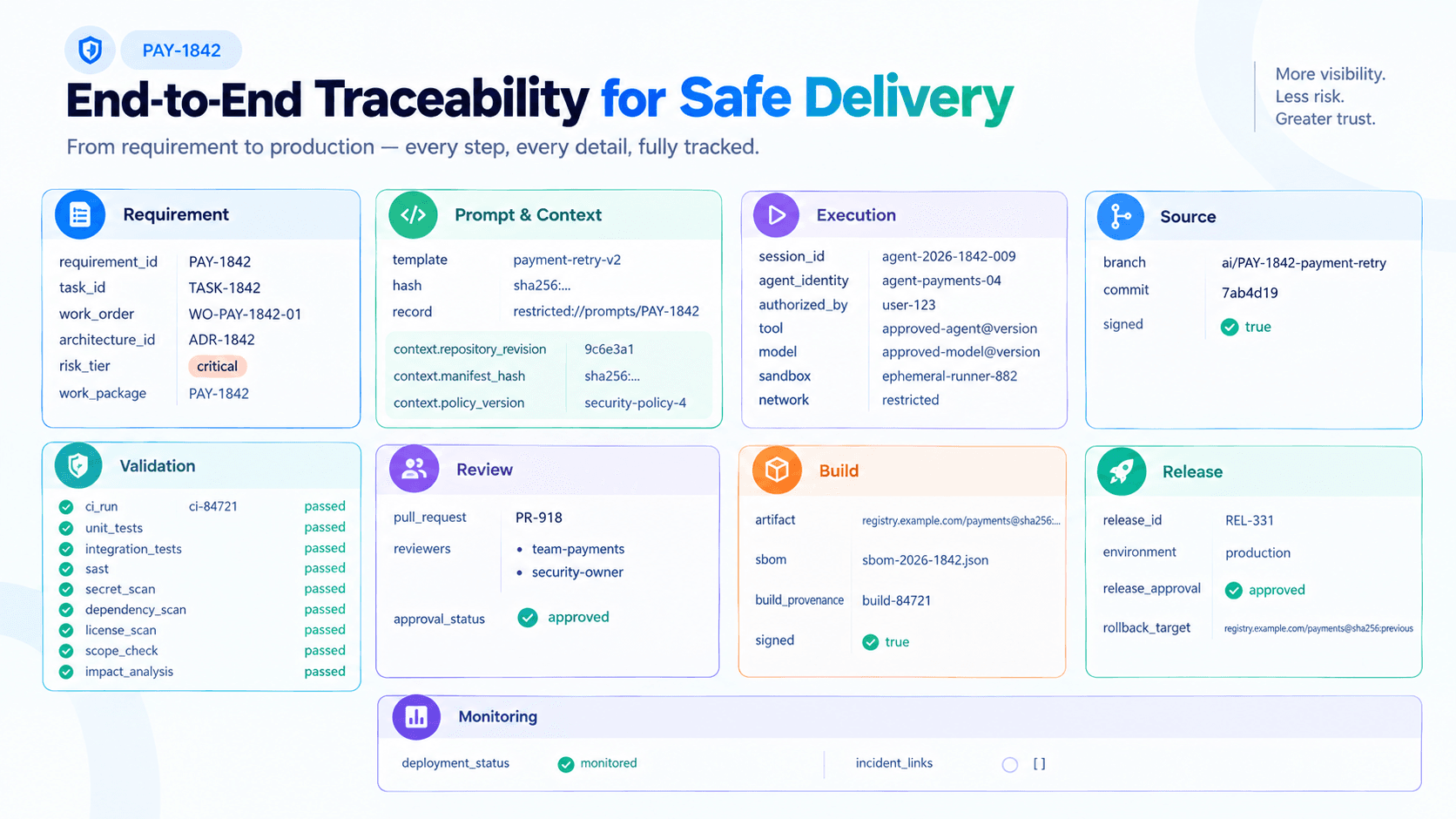
The exact format may differ by organization. The essential requirement is that every stage remains connected.
Frequently Asked Questions
What is the minimum traceability needed for AI-generated code?
At minimum, connect the AI-assisted change to a requirement or issue, feature branch, commit, pull request, validation results, and responsible human reviewer. For higher-risk changes, also record the architecture decision, model and tool version, repository revision, context manifest, execution session, security scans, release artifact, and rollback target.
Is the prompt-to-PR link enough for compliance?
Usually not. The link establishes origin, but compliance or enterprise assurance may also require evidence of access controls, testing, security review, approvals, release identity, and incident handling. Prompt history should be treated as one part of software provenance, not the complete compliance record.
Should the AI agent create the commit and pull request?
It may prepare a branch and draft PR in a controlled environment, but the organization should decide whether it can create commits, open PRs, or perform other repository actions. For high-risk changes, use separate permissions for code generation, validation, approval, merge, and deployment. An agent should not be able to approve its own work or bypass protected branch rules.
What if the AI changes files outside the requirement?
Block or flag the change until a human reviews the scope expansion. If the extra change is necessary, update the requirement and test plan. If it is unrelated, revert it or split it into a separate task. Untracked scope expansion is a major reason AI-generated pull requests become difficult to review.
Are AI-generated tests reliable enough for CI?
They can be valuable, but they should not be the only tests for the code they helped generate. Use existing regression tests, independently designed edge cases, integration tests, security checks, and human review. For high-risk behavior, require tests that originate from the requirement or acceptance criteria rather than only from the implementation.
How can teams protect secrets during AI-assisted development?
Use environment controls instead of relying only on prompt instructions:
- No production credentials in agent sandboxes
- Short-lived tokens
- Restricted network access
- Secret managers
- Protected sensitive files
- Output redaction
- Secret scanning
- Disposable runners
- Audit logs
The safest credential is one the agent never receives.
Who is responsible when AI-generated code causes a production incident?
The organization should assign responsibility to the human engineering owner and approval chain, not to the AI tool. The incident review should examine requirements, context, agent permissions, tests, review quality, release controls, monitoring, and whether the workflow made the risk visible.
What should a reviewer look for in an AI-generated pull request?
The reviewer should verify:
- The change satisfies the requirement.
- The architecture is respected.
- The scope is controlled.
- Failure cases are handled.
- Security and authorization are correct.
- Tests verify behavior.
- Dependencies are justified.
- The operational impact is understood.
- The release is reversible.
- Known limitations are documented.
Does traceability make AI development slower?
Poorly designed governance can create unnecessary friction. A well-designed workflow automates evidence collection and prevents repeated manual investigation. The objective is not to document every interaction for its own sake. It is to make risky changes easier to review, release, investigate, and roll back.
How should AI-generated code be identified in production?
Connect production artifacts to the commit, pull request, requirement, model and tool record, validation run, and approval record. Do not rely only on comments or commit labels. A structured SBOM, build provenance, release metadata, and version-control history provide stronger evidence.
What happens if the model or coding tool changes between releases?
Treat model and tool versions as part of the development environment. Record the versions used for each change and re-evaluate the workflow when a model, prompt template, agent capability, or permission policy changes materially. A model update can change coding style, dependency choices, test behavior, and risk patterns even when the task remains the same.
How should rollback connect to AI provenance?
The release record should identify the deployed artifact, source commit, pull request, originating requirement, AI session, and previous known-good version. If an incident occurs, the team should be able to move from the incident to the release and then back through the PR, commit, task, context, and validation evidence.
Can this workflow support autonomous coding agents?
Yes, but autonomy should be bounded by risk and permissions. Agents may independently inspect code, propose changes, run tests, and prepare pull requests. Production deployment, security-sensitive changes, destructive migrations, permission expansion, and high-impact releases should require explicit human approval and controlled promotion.
How should organizations handle AI-generated changes across multiple repositories?
Give all related pull requests a shared work-package ID and connect them to one release record. The release owner should verify that backend, frontend, mobile, infrastructure, schema, and documentation changes are reviewed in the correct order and that the deployed set is compatible.
What is build provenance, and why does it matter?
Build provenance explains how a reviewed source commit became the artifact deployed to production. Without it, a team may approve one commit while deploying a different rebuild, unverified image, or artifact with unexpected dependencies. Record the source commit, build run, artifact digest, SBOM, signature, deployment, and rollback target.
Should AI agent costs be monitored?
Yes. Track model usage, agent runtime, CI compute, repair attempts, and cost per accepted change. Cost monitoring helps identify workflows that generate excessive retries, scan unnecessarily large repositories, or create more review and rework than engineering value.
How can a company test whether a new model is safe for existing workflows?
Maintain a representative evaluation set of real engineering tasks and compare model outputs across versions. Measure correctness, security findings, scope drift, test quality, cost, latency, and rework. Do not enable a new model or autonomous mode across production repositories without a controlled evaluation.