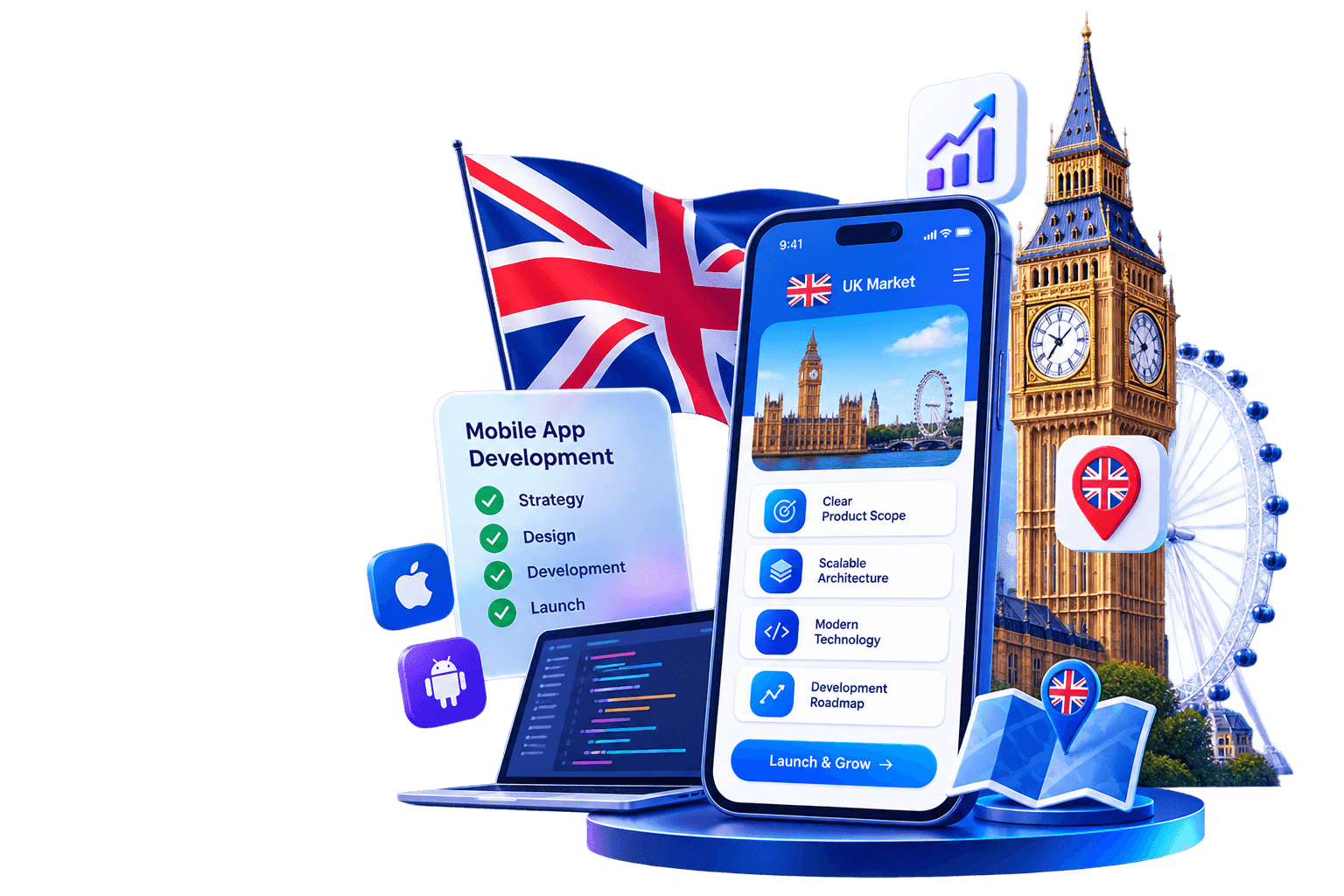
Junkies Coder develops mobile products for UK businesses that need a clear path from product idea to market launch and continued growth. The development approach connects product strategy, user experience, mobile engineering, backend systems, integrations, analytics, security, and post-launch optimisation. Whether the requirement is a startup MVP, subscription platform, customer application, enterprise workflow, or AI-powered product, the technology is planned around the business objective. The focus remains on building a product that customers can use, businesses can operate, and teams can continue improving after launch.

Enterprise-Grade Development
UK-Focused App Development
Empowering awards and recognition to Drive Innovation and Success with
our unparalleled expertise and commitment to excellence.
Years of experience
Countries Served
Average cost P/H
Positive Feedbacks
Projects delivered
Experts & Engineers
CORE FEATURES
An application needs a clear commercial purpose before development begins. The interface, technology, and roadmap must support how the business creates value, aligning customer behaviour, pricing, conversion, retention, and measurable outcomes.
A Clear Product Proposition
Frictionless Core Journeys
Business Model Alignment
Product Analytics
Personalised Experiences
Continuous Improvement
The product development journey connects commercial decisions with design and engineering milestones. Each stage produces an outcome to review before moving to the next, maintaining alignment with business objectives.
Define the business problem, target users, product proposition, competitive context, and success measures to establish why the product should exist and what outcome it needs to produce.
Study target users, existing behaviours, competitor experiences, and common points of friction, converting findings into user journeys, requirements, and product priorities.
Determine the minimum functionality required to deliver primary value, grouping features into first-release requirements and documenting dependencies, integrations, and acceptance criteria.
Create information architecture, user flows, wireframes, prototypes, interface systems, and accessibility considerations aligned with platform conventions and target user expectations.
Define mobile architecture, backend services, APIs, databases, authentication, integrations, cloud infrastructure, and deployment requirements evaluated against performance, security, and roadmap.
Develop mobile features, backend services, APIs, integrations, authentication, notifications, analytics, payment workflows, and supporting functionality in measurable product increments.
Test functionality across supported devices, operating-system versions, network conditions, APIs, performance, security, accessibility, usability, and regression requirements.
Prepare production infrastructure, application metadata, store assets, privacy information, analytics, monitoring, and release configuration for App Store and Google Play.
Analyse user behaviour, crashes, conversion, retention, performance, support issues, and feature adoption after launch to prioritise new releases according to measurable customer and business value.
A UK business approached us to build a scalable mobile solution. Within 12 weeks, we delivered a production-ready app that streamlined workflows and improved user experience.

Industry
Social Media
Technology
Swift - iOS
Location
Canada
Outcomes
iOS Music App
iQuQ App is a social music platform that transforms shared music experiences. Create party group, Every participant adds songs, casts votes and shapes live sessions through real time democratic playback.

Industry
Manufacturing
Platform
Corporate Website & E-Commerce
Location
Dammam, Saudi Arabia
Outcomes
Unified Digital Platform
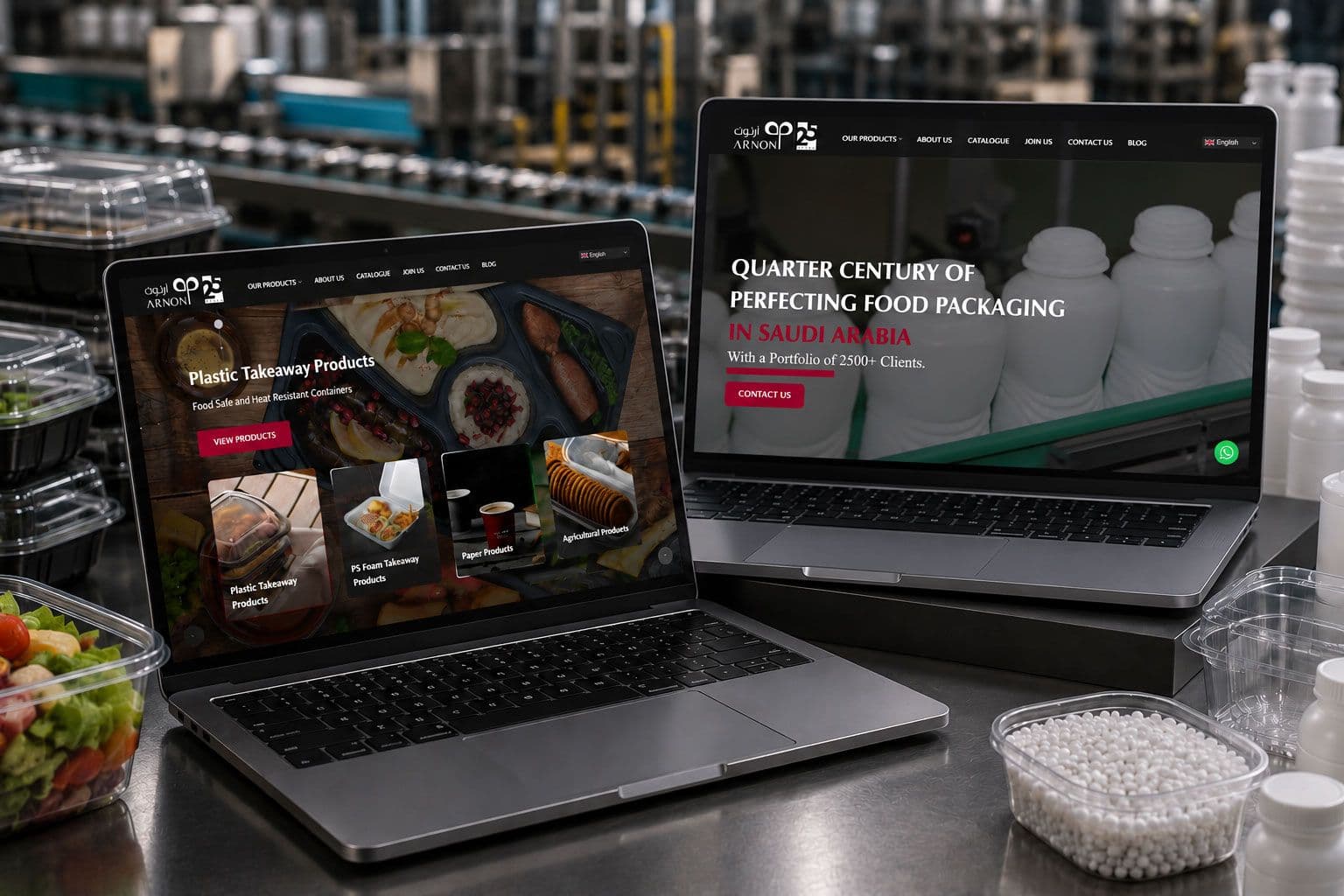
Arnon Plastic Industries needed a modern digital presence to match its scale as a 25-year manufacturing leader, and Junkies Coder delivered a corporate website with an integrated product catalogue, dual service-line navigation, and a dedicated e-commerce store, giving Arnon a unified platform across its food packaging and building insulation divisions.

Industry
Retail & E-Commerce
Platform
Android (Native)
Location
Saudi Arabia
Outcomes
Live on Google Play
aDawliah Electronic Appliances is one of Saudi Arabia's largest specialty retailers, stocking over 6,000 products across musical instruments, professional audio, and consumer electronics. Despite strong brand recognition, the company had no dedicated mobile channel. Junkies Coder designed and engineered a full-featured Android app, bringing their entire catalog to the Saudi mobile-first consumer.

Industry
Maternity & Nursing Fashion
Platform
Website + Multi-Language Storefront
Location
Denmark
Outcomes
Unified Brand Experience Across Markets
Carriwell needed a website that matched the comfort and trust behind its products, and Junkies Coder delivered a seamless, user-friendly platform with multi-language storefronts and a brand experience built around expecting and nursing mothers.

Industry
Social Media
Platform
Cross-Platform - Flutter & iOS
Location
Mumbai, India
Outcomes
Creator Economy
DeepStory wanted to solve the one problem every short video platform ignores. We built a gesture-first iOS and Android app where a single swipe delivers related content instantly, with no ads and no manual searching.

Industry
FashionTech & AI
Platform
Cross-Platform - iOS & Android
Location
Global
Outcomes
AI Virtual Try On
Doris is an intelligent fashion companion that eliminates wardrobe indecision. We engineered an AI powered platform that analyzes personal style, digitizes physical wardrobes, and provides high fidelity virtual try ons directly from any digital commerce website.

Industry
FinTech
Platform
Cross-Platform - Flutter & iOS
Location
Canada
Outcomes
Omni-Channel
Etmad Topup needed a centralized recharge system, and Junkies Coder delivered a Flutter-based omni-channel platform with a web admin panel and Node.js backend, enabling real-time transaction visibility and full operational control across Android, iOS, and web.

Industry
Gaming & Interactive Entertainment
Platform
Web App, React / Next.js
Location
Delaware, USA (Global)
Outcomes
AI-Driven Game Production
Game studios lose 8–12 hours weekly to pre-production coordination. Gamers Home fixes this with Arielle, an autonomous AI producer, paired with a vetted freelancer marketplace for every game development discipline. Junkies Coder built the complete platform in 12 months.

Industry
Artificial Intelligence
Platform
Web & Enterprise API
Location
New York, USA
Outcomes
Production Ready Runtime
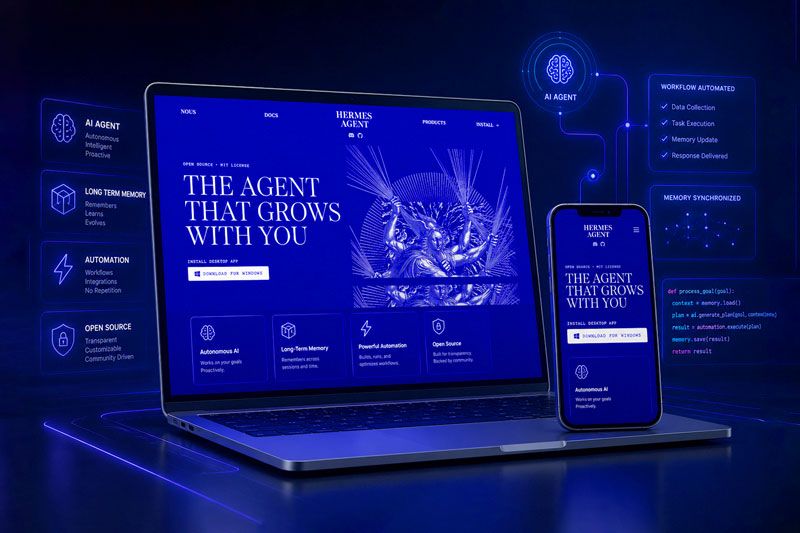
Nous Research developed the Hermes model family, featuring advanced agentic reasoning and complex function calling capabilities. Junkies Coder engineered the enterprise integration runtime and secure sandbox environment for Hermes, enabling businesses to deploy autonomous software agents within secure, production ready workflows.

Industry
Ecommerce
Platform
Cross-Platform - Flutter
Location
Bengaluru, India
Outcomes
Omni-channel Platform
Inspect & Buy App build by Junkies Coder - vision is to provide a seamless, personalized shopping experience that anticipates and fulfills the needs of customers while fostering trust and loyalty through product quality and exceptional services such as Wheelz, in-store shopping and online shopping.

Industry
Social & EdTech
Location
Nigeria
Architecture
Angular & Node.js
Platform
Web & Mobile PWA
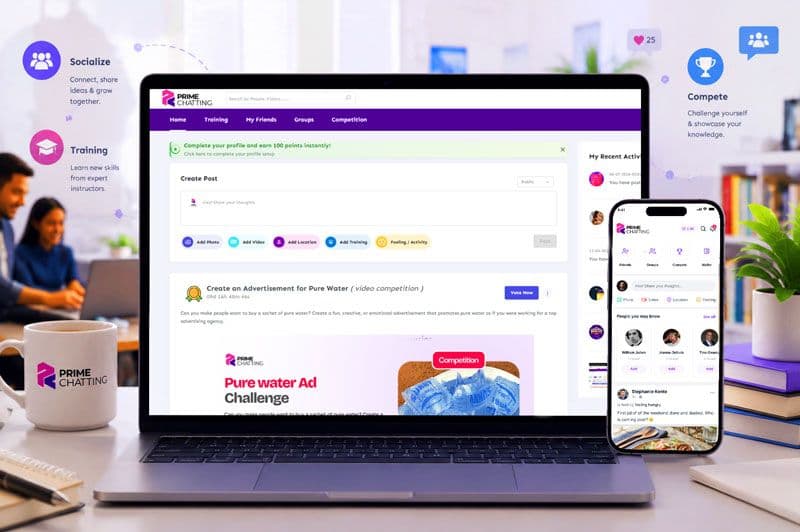
Junkies Coder engineered Prime Chatting, an enterprise social learning platform that connects educators, students, and content creators across global markets. By combining high frequency WebRTC live interactive video classrooms with automated activity based reward algorithms and gamified competition modules, Prime Chatting provides an all in one digital ecosystem where users learn skills, build communities, and participate in peer learning.
Whether you're looking to develop a digital solution from scratch, scale your current offerings, or fully modernize your system, we are here to help.
OUR EXPERTISE
UK customers expect fast digital experiences, mobile payments, and connected services. Junkies Coder plans mobile applications around target audience, business model, integrations, and product lifecycle.
A successful mobile product starts with a clear customer problem and a business objective that can be measured after launch. Plan your UK mobile application with the right product scope, architecture, technology, and development roadmap.

Mobile products combine application interfaces with intelligence, external services, real-time data, and connected devices to address real customer and operational problems.
01
Add conversational assistance for search, support, product navigation, recommendations, and information discovery connected to approved product data and business content.
02
Develop controlled AI workflows where an agent can interpret a request, retrieve information, and perform approved actions within defined permission and monitoring boundaries.
03
Combine keyword, structured, and semantic search across product catalogues, documents, knowledge bases, service directories, and enterprise data with contextual ranking.
04
Build financial experiences connecting with banking and financial-data infrastructure for account aggregation, financial visibility, transaction analysis, and affordability workflows.
05
Support live messaging, location updates, status changes, collaborative workflows, and alerts using WebSockets, push notifications, and event-driven backend services.
06
Use device-side machine learning for local intelligence providing benefits around fast response times, enhanced data privacy, offline use, and network independence.
07
Connect mobile applications with sensors, wearables, Bluetooth devices, and connected equipment to display telemetry, configure hardware, and support remote actions.
08
Combine analytics, behavioural data, experimentation, and machine learning to understand how customers use the application and inform continuous product improvements.
09
AI is becoming part of search, recommendations, support, content workflows, document processing, and task execution within applications. Rather than treating AI as an isolated chatbot, businesses can connect it with existing product functionality. This creates opportunities for more contextual and task-oriented mobile experiences. The right implementation depends on data availability, user needs, and measurable product value.
10
Mobile applications increasingly interact with location, camera, microphone, contacts, behavioural information, and third-party SDKs. The ICO recommends considering privacy and data protection from the design stage rather than treating it as a final compliance exercise. Architecture should therefore consider permissions, data minimisation, storage, processing, access, and retention. These decisions can influence both UX and backend implementation.
11
Mobile applications are increasingly being used by employees and operational teams, not only by customers. Field services, approvals, inspections, logistics, inventory, reporting, and communication can all move into mobile workflows. This makes mobile architecture closely connected to enterprise systems and operational data. The application becomes part of how the business operates rather than simply another customer channel.
12
Accessibility is becoming a more important part of mobile product quality and user experience. Design teams can incorporate accessible navigation, readable content, appropriate controls, assistive-technology support, and understandable interaction states. UK public-sector digital services have specific WCAG 2.2 AA requirements and accessibility statement obligations. Businesses serving broad audiences can also benefit from incorporating accessibility earlier in product development.
Mobile applications are becoming part of customer acquisition, service delivery, employee operations, and revenue generation across UK industries.
The product lifecycle continues after reaching the App Store and Google Play. Post-launch work is guided by evidence from real users, creating a continuous operating framework for deciding what to improve and why.
Track the product metrics that correspond to the business model and customer journey, including acquisition, activation, conversion, engagement, retention, transactions, feature usage, and support events.
Review behaviour patterns, customer feedback, support requests, usability problems, and technical performance to understand where users struggle and which features influence the intended outcome.
Rank potential improvements according to customer impact, business value, technical effort, urgency, and roadmap relevance so high-value opportunities receive development attention first.
Develop, test, deploy, and measure the selected improvement against the original product metric or hypothesis, creating a repeatable cycle for continuous product improvement.
Shalehin Modasia
Marketing DirectorENGAGEMENT MODELS
Different businesses need different delivery structures depending on product maturity, internal resources, scope clarity, and roadmap length.
A product team combining product management, design, engineering, QA, and technical leadership around a shared roadmap for continuous development based on analytics, feedback, and priorities.
Get in TouchOngoing mobile and backend engineering capacity for businesses with a longer-term product roadmap, expanding roles as the product moves through new releases and technical phases.
Get in TouchStructured for when requirements, deliverables, milestones, and acceptance criteria are sufficiently defined before development, divided into agreed stages for design, engineering, and launch.
Get in TouchSuited for products where requirements evolve during discovery and development, allowing scope to respond flexibly to user feedback, technical findings, and product experiments.
Get in TouchReal stories from real partners who experienced clarity, accountability, and measurable business growth.
The technology stack is selected around product requirements, team capability, integrations, performance expectations, and long-term maintenance across the complete product lifecycle.
Featured Technologies
OpenAi
Claude
Falcon
Gemini
Mistral
Grok
Meta
UK mobile products must embed UK GDPR data protection by design and default per the ICO, aligning with the Data (Use and Access) Act 2025, Data Protection Act 2018, PECR, secure authentication, payment rules, and accessibility standards.

Privacy Architecture (UK GDPR & DPA 2018)

Data (Use and Access) Act 2025
Secure Authentication & Access Controls

Payment Experiences (PCI-DSS & PSD2)
Accessibility (WCAG 2.2 AA)
ICO Children's Code (Age-Appropriate Design)

ISO/IEC 27001 Information Security
OWASP Mobile Application Security (MASVS)
Junkies Coder approaches mobile development as a product engineering engagement rather than limiting delivery to application interfaces. Product planning, UX, mobile engineering, backend systems, integrations, testing, analytics, and deployment can be coordinated across the same delivery programme. The approach can support businesses from early product validation through ongoing development. Technology and delivery decisions remain connected to the product roadmap.
Product objectives, customer journeys, commercial requirements, and technical dependencies are considered before implementation begins. This helps establish a practical MVP and a roadmap for future releases. The planning stage also identifies assumptions that require validation before development expands. The result is a clearer connection between business objectives and engineering scope.
Mobile applications can be supported by backend services, APIs, databases, cloud infrastructure, integrations, analytics, and operational tooling. This is important for products where the mobile interface depends on complex business systems. Engineering responsibilities can therefore extend beyond the application itself. The resulting architecture supports a complete digital product.
AI can be introduced into applications through intelligent search, recommendations, conversational assistance, document processing, prediction, and controlled task automation. AI opportunities are assessed according to user value, available data, technical feasibility, and business objectives. Where agents are required, action permissions and workflow boundaries can be defined as part of the architecture. This provides a practical path for incorporating AI into mobile products.
Authentication, permissions, APIs, storage, data handling, third-party integrations, and deployment are considered throughout development. Security requirements can be incorporated into architecture, implementation, testing, and operational monitoring. Privacy requirements are also considered according to the type of data and product context. This creates a more complete approach to application security.
The relationship with a mobile product does not end when it reaches the App Store or Google Play. Ongoing work can include monitoring, maintenance, OS updates, bug resolution, analytics, performance improvements, and new functionality. Product decisions can be guided by real customer behaviour and business performance. This supports continuous development as market requirements change.
Connect the product scope with pricing, revenue model, acquisition assumptions, operational costs, and expected customer value to align with the business case.
Organise product development into an initial release, post-launch improvements, growth capabilities, and longer-term opportunities as feedback emerges.
REST, GraphQL, WebSockets, event-driven services, and third-party APIs can connect the application with external systems. Integration architecture includes authentication, data mapping, error handling, retries, monitoring, and version management. The approach depends on the systems being connected and the required communication pattern. Well-defined interfaces also make future product expansion easier to manage.
AWS, Microsoft Azure, and Google Cloud can provide infrastructure for APIs, databases, storage, authentication, monitoring, processing, and deployment. Cloud architecture can be structured around the product's expected workload and operational requirements. Environment separation, backups, monitoring, access controls, and deployment processes can be incorporated into the infrastructure. This provides a managed foundation for production operations.

A mobile application may range from approximately £20,000 for a focused MVP to £300,000+ for a complex enterprise product. The final investment depends on platform coverage, features, backend architecture, integrations, design, testing, security, AI, and infrastructure. A product with fewer screens can still require substantial engineering if it involves complex business systems. A detailed scope and technical assessment are therefore required for a reliable estimate.
The timeline depends on the app's features, complexity, design, integrations, and testing requirements. A focused MVP may take a few months, while more complex business or enterprise applications can require longer development cycles.
A focused MVP is often a practical starting point for testing the product proposition before building extensive functionality. The first release should support the core customer journey and provide meaningful feedback through real usage. Later features can be prioritised according to market response, analytics, and commercial results. The architecture should still account for the product's expected direction.
The decision depends on target customers, product strategy, budget, launch objectives, and platform-specific functionality. Some businesses benefit from validating one platform before expanding to another. Others may require both platforms from the beginning because their audience or business model demands broad coverage. The decision should be made from market and product evidence rather than a default rule.
Yes. Flutter can be a practical choice for UK businesses that want to develop iOS and Android applications from a shared codebase. It can reduce duplicated development effort while supporting custom interfaces, integrations, and scalable mobile products.
The best technology stack depends on the app's functionality, performance requirements, target platforms, integrations, budget, and long-term roadmap. Options can include native iOS and Android technologies, Flutter, React Native, and backend technologies selected around the product's specific needs.
Depending on the product and data processing activities, considerations may include UK GDPR, the Data Protection Act 2018, PECR, and changes introduced through the Data (Use and Access) Act 2025. Sector-specific requirements may also apply depending on the service being provided. The exact obligations depend on what information the application collects, how it is processed, and the organisation's role. Privacy requirements should therefore be assessed during product planning.
Accessibility should be considered during product design, implementation, and quality assurance rather than being left until the final release. Testing can cover navigation, labels, contrast, touch interactions, screen readers, content structure, and other relevant accessibility requirements. UK public-sector services have specific obligations around WCAG 2.2 AA. The appropriate accessibility scope depends on the product, audience, and service context.
An existing web platform can often be extended with a dedicated mobile experience when the backend and APIs support the required workflows. The mobile application should still be designed around mobile usage rather than simply reproducing desktop screens. Authentication, data models, APIs, notifications, payments, and mobile-specific functionality should be assessed first. A technical audit can establish the most practical approach.
AI can be introduced into an existing application for search, recommendations, support, document processing, prediction, personalisation, or workflow automation. The best opportunity depends on the available data, current application architecture, customer journey, and business objective. AI features should also include appropriate evaluation, monitoring, access controls, and data handling. A focused AI capability can often be introduced without rebuilding the entire mobile product.