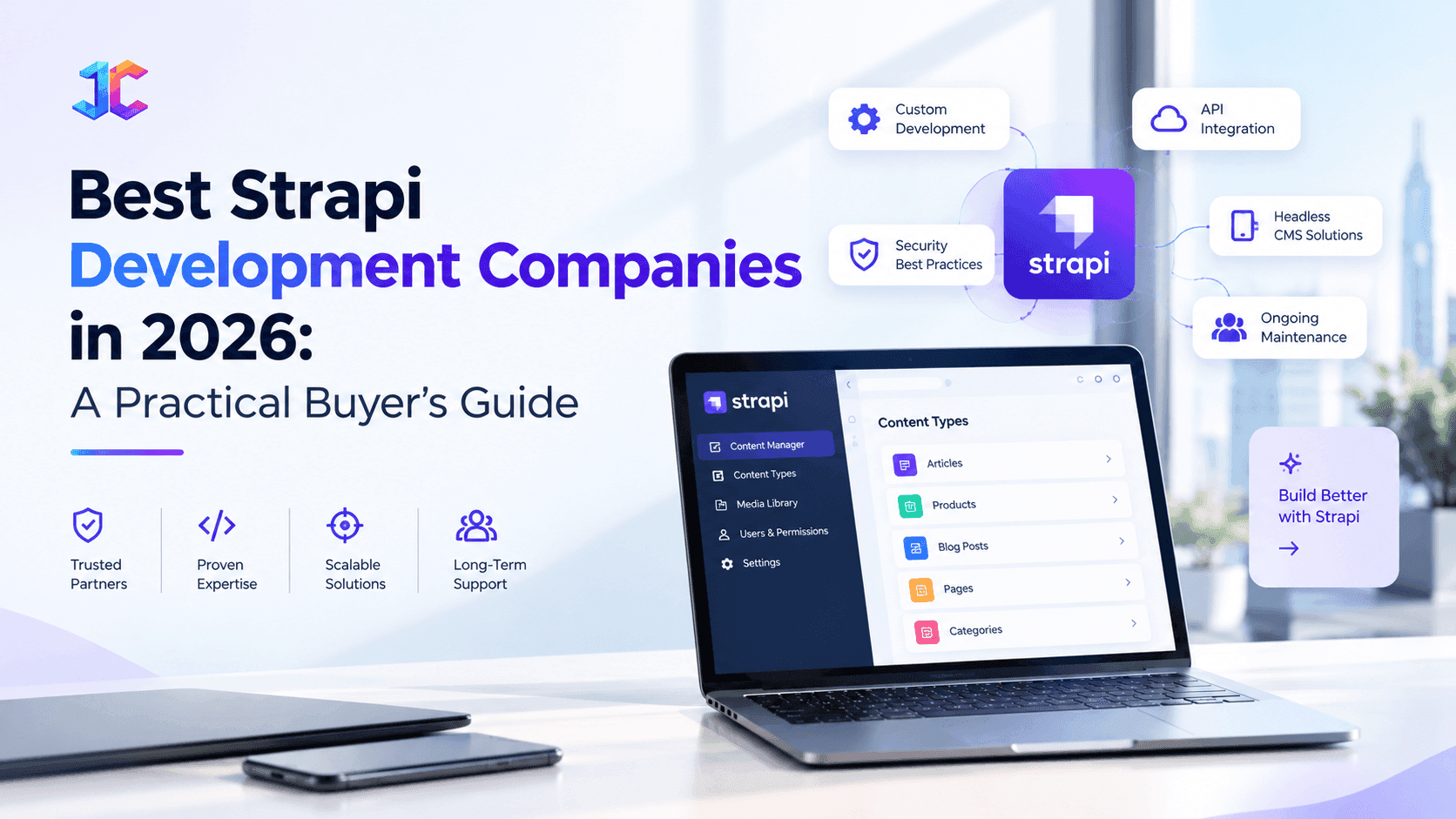
- The best Strapi development company depends on your budget, project complexity, business requirements, and preferred frontend framework, such as Next.js, React, or Astro.
- Leading Strapi agencies specialize in scalable, API-driven web applications, custom plugins, and composable commerce architectures.
- Headless architecture design: Implement self-hosted Strapi or Strapi Cloud with Node.js backends and PostgreSQL databases to support flexible, scalable content delivery.
- REST and GraphQL API development: Use Strapi’s Content-Type Builder to generate APIs and structure content for websites, mobile applications, portals, and other digital channels.
- Custom plugins and middleware: Extend Strapi’s admin panel, customize workflows, and implement business logic to meet specific operational requirements.
- CMS migration and upgrades: Migrate from legacy platforms, including WordPress and static websites, to modular headless CMS architectures while addressing content integrity, URL redirects, and SEO preservation.
- Frontend development and integration: Connect Strapi with Next.js, React, Vue.js, Astro, and other frontend technologies to build responsive, high-performance digital experiences.
- Cloud deployment and infrastructure: Choose between Strapi Cloud and self-hosted environments based on scalability, security, infrastructure control, and maintenance requirements.
- Enterprise-ready solutions: Look for agencies with experience in API integrations, performance optimization, multilingual content, legacy application connectivity, and ongoing platform maintenance.
- Industry-specific expertise: Evaluate providers based on their experience with relevant sectors, such as SaaS, healthcare, fintech, telecom, ecommerce, and enterprise digital platforms.
- Agency evaluation: Compare technical expertise, verified project portfolios, team capabilities, client references, pricing transparency, and post-launch support before making a decision.
Selecting the right Strapi development company is an architectural decision, not simply a search for the lowest hourly rate or largest team size. A successful headless implementation depends on a partner’s ability to translate complex content relationships, integration workflows, and business goals into a governed, scalable, API-first platform.
Strapi excels when structured content must power multiple digital touchpoints, such as websites, mobile applications, customer portals, and commerce channels, through clean REST or GraphQL APIs. An effective development partner must therefore demonstrate competencies across:
- Structured content modeling and normalization.
- Modern frontend engineering with Next.js, React, or Vue.
- API security, role-based access control (RBAC), and authentication.
- Enterprise CMS migration and data transformation.
- Cloud deployment, container orchestration, and ongoing maintenance.
This buyer’s guide evaluates leading Strapi development companies across delivery capabilities, architecture depth, migration experience, and enterprise readiness.
How We Evaluated These Strapi Companies
This guide uses practical buyer criteria rather than paid directory placements. Each agency was assessed qualitatively across eight core capabilities:
- Verified Strapi implementation experience: Demonstrated depth in configuring custom collection types, single types, components, dynamic zones, lifecycle hooks, and custom plugins.
- Relevant portfolio projects and case studies: Evidence of production environments delivering content reliably under real-world traffic and business constraints.
- Headless architecture and frontend expertise: Engineering proficiency with modern presentation layers including Next.js (App Router/Pages Router), React, Nuxt, and mobile SDKs.
- CMS migration and data integrity capabilities: Documented processes for auditing legacy schemas, executing automated ETL pipelines, preserving SEO equity, and mapping URL redirects.
- API security and integration experience: Implementation of token scoping, JWT authentication, rate limiting, and integrations with CRM, ERP, DAM, Algolia, and payment gateways.
- Enterprise readiness and maintainability: Adoption of CI/CD automation, environment separation (development, staging, production), code review standards, and scalable container deployment.
- Post-launch support and upgrade planning: Clear service level agreements (SLAs), monitoring, database backups, and structured upgrade paths (such as migrating from Strapi v4 to Strapi v5).
- Commercial transparency: Clarity regarding pricing models, deliverable scopes, communication channels, and technical documentation ownership.
Where verified third-party directory listings exist, such as the official Strapi Partner Directory, they are noted as independent verification signals.
Best Strapi Development Companies: Quick Comparison
| Company | Best For | Core Strengths | Verification Signal |
|---|---|---|---|
| Junkies Coder | CMS migration, legacy PHP/Laravel modernization, and Next.js builds | Strapi development, CMS migration blueprints, API-first architecture, SEO preservation | Documented enterprise migration and composable architecture practice |
| Weframe Tech | Startups and scale-ups needing conversion-focused headless sites | Next.js development, headless marketing platforms, CRO landing pages | Documented portfolio in health-tech and funded scale-ups |
| FocusReactive | Enterprises building scalable React and Next.js platforms | API-first architecture, structured content modeling, cloud infrastructure | Established modern JavaScript agency portfolio |
| Notum | SaaS businesses needing flexible headless digital products | Strapi, Next.js, React, Node.js integrations, performance engineering | Product engineering and web application portfolio |
| RaftLabs | Product teams wanting end-to-end Strapi and cloud delivery | Custom Strapi plugins, Next.js frontends, AWS and GCP cloud deployment | Published case studies in product-led digital platforms |
| Successive Digital | Large enterprises requiring broad digital transformation support | Enterprise technology services, multi-team delivery, digital experience platforms | Listed in official [Strapi Partner Ecosystem |
| QBurst | Enterprises needing custom software engineering alongside CMS delivery | Custom software engineering, enterprise integrations, consulting | Listed in official Strapi Partner Ecosystem |
| VirtusLab Group | Large organizations requiring high-capacity software engineering | 500+ engineers, enterprise platform programs, open-source engineering | 7+ years enterprise Strapi delivery in [Strapi Partner Ecosystem] |
| Liki Mobile Solutions | Businesses building mobile-first and ecommerce content platforms | REST/GraphQL delivery, mobile app backends, ecommerce integrations | Documented multi-device and headless commerce experience |
| Naturaily | Companies evaluating multiple headless CMS options before committing | Multi-CMS consulting (Strapi, Sanity, Payload, Storyblok), frontend builds | Multi-platform headless implementation portfolio |
1. Junkies Coder
Best for: Enterprises, funded startups, and growing product organizations that need Strapi implemented as part of a connected, scalable digital platform, particularly where CMS migration or legacy backend modernization is involved.
Why Junkies Coder Is Featured
Many Strapi projects are not greenfield implementations; they involve replacing inflexible WordPress instances, migrating legacy PHP backends, or decoupling monolithic architectures. Junkies Coder is distinguished by its ability to bridge content strategy, backend engineering, and frontend delivery into a unified operational model.
Rather than treating Strapi as an isolated CMS setup, Junkies Coder integrates content modeling with downstream API consumers:
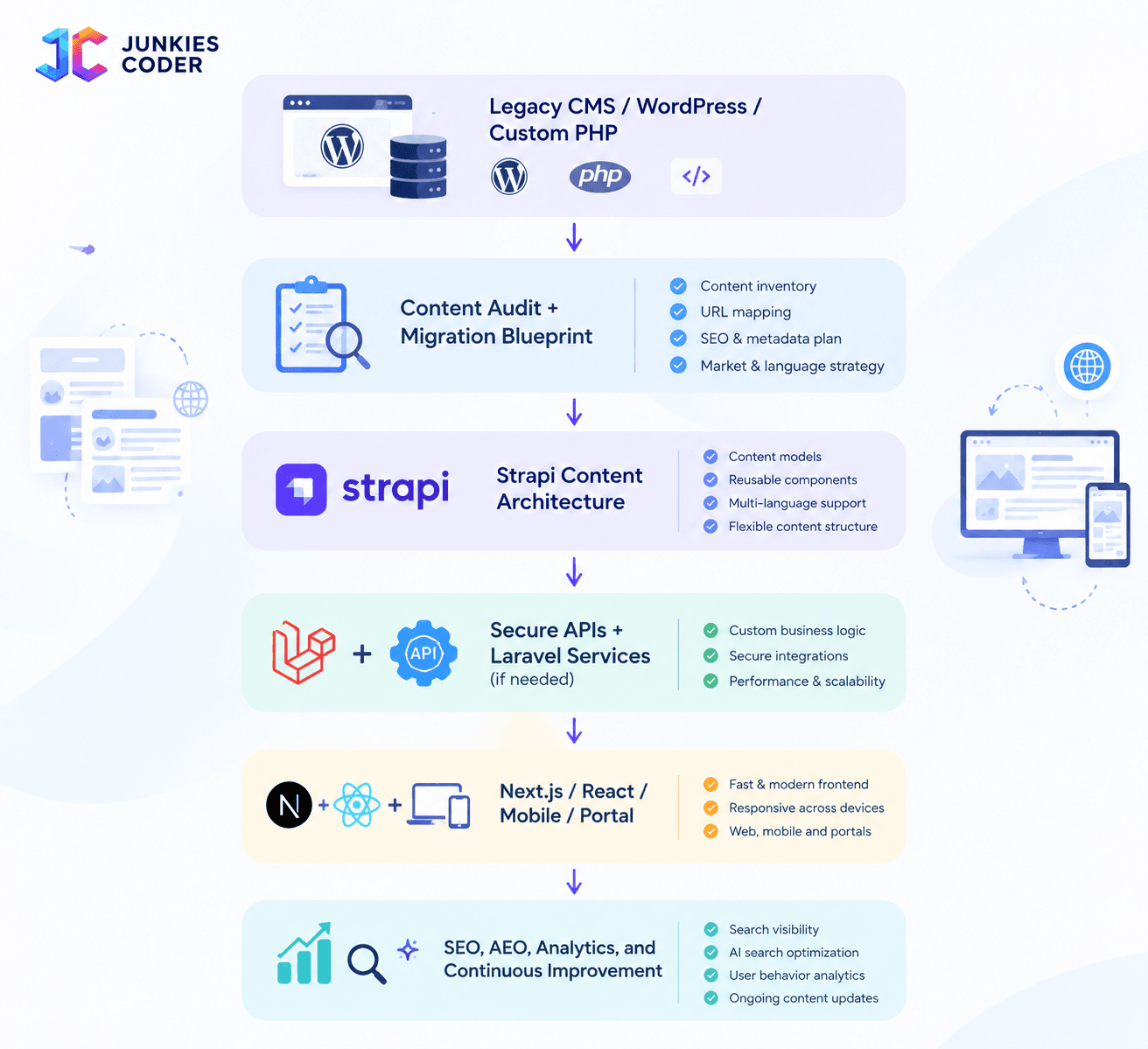
Core Capabilities
- Strapi Content Modeling: Designing normalized content types, reusable component libraries, dynamic zones, and role-based editorial workflows.
- Structured CMS Migration: Executing automated data pipelines to extract, transform, and load content from WordPress, Drupal, or custom databases into Strapi while preserving media assets, relationships, and metadata.
- PHP & Laravel Modernization: Decoupling transactional business logic (such as customer portals, payment workflows, and proprietary algorithms) into Laravel services while routing marketing and editorial content through Strapi.
- Next.js Frontend Architecture: Delivering high-performance, server-rendered (SSR), statically generated (SSG), or incrementally revalidated (ISR) user experiences optimized for Core Web Vitals and international SEO.
- SEO & AEO Preservation: Building URL redirect maps, canonical tags, automated XML sitemaps, and structured JSON-LD schema matching visible content for search engines and AI discovery systems.
Ideal Project Fit
- Migrating high-traffic WordPress or legacy PHP websites to Strapi + Next.js without organic traffic loss.
- Establishing an omnichannel content repository powering websites, mobile applications, and partner portals from a single CMS.
- Enterprises modernizing custom PHP or Laravel architectures while giving marketing teams independent publishing control.
2. Weframe Tech
Best for: Startups, scale-ups, and commerce-oriented businesses prioritizing high-converting headless frontends.
Weframe Tech specializes in building conversion-rate-optimized (CRO) digital experiences using Next.js and headless CMS backends. Their portfolio reflects significant work with healthcare, biotechnology, and technology scale-ups where fast page loads and custom marketing pages directly impact customer acquisition.
Strengths
- Strong focus on conversion-oriented design and rapid landing page creation.
- Proven delivery of Next.js frontends integrated with headless content backends.
- Agile, competitive delivery model well suited for venture-backed startups.
Considerations
Their core strength lies in frontend performance and conversion optimization. Organizations with deep legacy database migrations or intricate enterprise permission hierarchies should evaluate whether additional backend consulting is required.
3. FocusReactive
Best for: Enterprises and fast-growing organizations building scalable digital platforms with Strapi, Next.js, and React.
FocusReactive is an established modern JavaScript consultancy specializing in API-first content architectures for marketing websites, customer portals, and web applications. They focus on clean component design, structured content modeling, and reliable cloud deployments.
Strengths
- Advanced expertise in React, Next.js, and modern TypeScript ecosystems.
- Solid experience modeling structured content for multi-author editorial teams.
- Excellent technical collaboration for organizations that already possess internal frontend engineers.
Considerations
FocusReactive is primarily modern-JavaScript-oriented. If a project requires legacy PHP refactoring or database reverse-engineering, internal teams may need to manage those legacy backend aspects separately.
4. Notum
Best for: SaaS platforms and digital product teams requiring flexible, API-driven web applications.
Notum operates as a digital product development agency delivering custom headless solutions using Strapi, Next.js, React, and Node.js. Their engineering background makes them well suited for projects where Strapi powers application content alongside custom SaaS dashboards.
Strengths
- Strong product development orientation and clean code standards.
- Balanced capabilities across CMS backends, custom APIs, and frontend applications.
- Focus on building secure, maintainable digital products.
Considerations
Best suited when Strapi is integrated into a larger software product ecosystem. Organizations with high-volume publishing operations should establish detailed editorial workflow and approval governance during discovery.
5. RaftLabs
Best for: Product businesses seeking an accountable, end-to-end development team from architecture through cloud deployment.
RaftLabs is a software development firm offering end-to-end Strapi engineering, including custom plugin development, Node.js extensions, API-driven Next.js frontends, and cloud hosting deployments on AWS and Google Cloud Platform (GCP).
Strengths
- Full-lifecycle product execution from content architecture to DevOps.
- Experience writing custom Strapi plugins and backend extensions.
- Cloud deployment automation using containerized environments.
Considerations
A strong partner for product-led mid-market companies. Enterprises with strict compliance, SOC2 audits, or complex procurement processes should review deployment and security frameworks during technical discovery.
6. Successive Digital
Best for: Large enterprise organizations requiring Strapi within a comprehensive technology modernization initiative.
Successive Digital is an enterprise technology services company listed in the official [Strapi Partner Directory]. They provide digital experience consulting, enterprise web development, and cloud services for large multinational organizations.
Strengths
- Official Strapi partnership status with verified enterprise engagement experience.
- Large engineering capacity capable of managing multi-workstream digital transformations.
- Experience delivering integrated enterprise technology programs.
Considerations
Best suited for enterprises seeking a large technology vendor. Smaller organizations or startups with focused scopes may find an agile boutique agency more cost-effective.
7. QBurst
Best for: Businesses requiring custom software development alongside enterprise CMS implementations.
QBurst is a global product engineering and consulting firm with extensive experience across cloud platforms, mobile applications, data analytics, and custom software. They are listed in the official Strapi Partner Directory.
Strengths
- Broad technical capabilities spanning custom enterprise software and CMS backends.
- Established delivery presence across North America, Europe, and Asia-Pacific.
- Strong track record managing complex third-party system integrations.
Considerations
Because QBurst is a large, multi-disciplinary engineering provider, buyers should ensure that their allocated project team includes dedicated, experienced Strapi specialists.
8. VirtusLab Group
Best for: Global enterprises requiring substantial engineering capacity and open-source platform development.
VirtusLab Group is an enterprise software engineering company listed in the official [Strapi Partner Directory]. With over 500 engineers and more than seven years of experience delivering enterprise Strapi solutions, they cater to high-scale platform programs.
Strengths
- Extensive engineering depth and open-source platform expertise.
- Long-standing involvement in enterprise Strapi platform implementations.
- Robust engineering governance suitable for regulated, complex platform architectures.
Considerations
Designed for large-scale enterprise engagements with mature technical leadership and corresponding enterprise budgets.
9. Liki Mobile Solutions
Best for: Organizations building mobile-first applications, multi-device experiences, or headless commerce solutions.
Liki Mobile Solutions delivers headless CMS implementations with an emphasis on REST/GraphQL content delivery, mobile applications, and ecommerce platforms. Their architecture decouples content management from presentation layers across iOS, Android, and web.
Strengths
- Specialized experience delivering API content to native mobile applications.
- Practical experience with headless commerce architectures and catalog management.
- Comprehensive consulting covering project management and technical delivery.
Considerations
Ideal for projects where native mobile apps or commerce touchpoints are the primary consumers of the CMS.
10. Naturaily
Best for: Organizations that are still evaluating different headless CMS options before finalizing a platform.
Naturaily is a software agency working across multiple headless CMS platforms, including Strapi, Storyblok, Sanity, and Payload CMS. They provide technology-neutral audits, frontend development, and migration consulting.
Strengths
- Cross-platform perspective assisting teams during CMS selection phases.
- Capabilities covering content audits, frontend builds, and migration execution.
- Useful advisory for businesses weighing self-hosted versus SaaS headless models.
Considerations
A strong candidate when the CMS choice remains open. If your team has definitively selected Strapi, ensure that dedicated Strapi senior developers are assigned to lead the architecture.
Boutique vs. Enterprise Strapi Agency: Which Should You Choose?
Selecting the right partner model is just as important as choosing the specific agency:
| Factor | Boutique Strapi Agency | Enterprise Technology Agency |
|---|---|---|
| Team Structure | Small, specialized team of senior engineers | Large, multi-disciplinary teams across regions |
| Ideal Project Scope | Startups, scale-ups, and focused CMS migrations | Multi-year transformations, complex procurement programs |
| Direct Communication | Direct access to the lead architect and engineers | Account managers, project managers, delivery leads |
| Decision Velocity | Fast technical iterations and flexible workflows | Structured change-control and approval governance |
| Cost Structure | Lower overhead, specialized project billing | Higher overhead reflecting broader enterprise capacity |
| Specialization Depth | Deep focus on Strapi, Next.js, and decoupled architecture | Broad capabilities across cloud, data, and software |
| Risk Profile | Dependent on key senior personnel | Higher redundancy, standardized enterprise procedures |
| Best Choice When | You need speed, focused expertise, and senior guidance | You need multi-team capacity, security audits, and scale |
Indicative Strapi Development Costs (2026 Benchmarks)
Strapi development costs depend on content volume, frontend requirements, custom integrations, and data migration complexity. The following estimates reflect indicative 2026 market ranges in USD based on typical industry scopes:
| Project Scope | Indicative Cost Range (USD) | Scope Details & Assumptions |
|---|---|---|
| Basic Strapi Website | $10,000 – $25,000 | 5–10 structured content types, standard Next.js frontend, contact forms, basic SEO metadata. |
| Marketing Platform | $25,000 – $60,000 | 15–25 content types, reusable dynamic zone components, blog, case studies, Algolia search, CRM integration. |
| Multi-Channel Platform | $50,000 – $120,000 | Omnichannel content delivery to Next.js website and mobile apps, custom role permissions, localized content. |
| Enterprise CMS Migration | $20,000 – $75,000+ | Full audit, automated ETL scripts from WordPress/Drupal, URL mapping, 301 redirects, SEO preservation. |
| Enterprise Digital Platform | $80,000 – $200,000+ | Single Sign-On (SSO), advanced RBAC, complex third-party APIs (ERP/CRM), high-availability cloud deployment. |
| Legacy PHP/Laravel Modernization | $50,000 – $150,000+ | Decoupling business logic from legacy templates, building dedicated Laravel APIs, refactoring legacy databases. |
Pricing Models Explained
- Fixed-Price Projects: Best for clearly defined scopes with fully approved designs and stable specifications. Requires a discovery phase to establish boundaries.
- Time and Materials (Hourly): Typically ranges from $60 to $150+ per hour depending on agency tier, seniority, and geographic location. Provides flexibility for agile product iterations.
- Ongoing Support & Maintenance Retainers: Typically ranges from $2,000 to $10,000+ per month, covering version upgrades (minor and major), security patches, uptime monitoring, and editorial enhancements.
The Hidden Costs of Strapi Development
When budgeting for a headless CMS project, organizations must account for secondary and ongoing operational investments:
- Content Auditing, Cleanup, and Restructuring: Legacy WordPress or Drupal sites often harbor duplicate content, broken shortcodes, and orphaned media that must be cleaned before migration.
- Frontend Redesign and Component Development: A headless CMS requires a dedicated presentation layer (such as Next.js). Engineering accessible, responsive UI components represents a significant portion of the total budget.
- Third-Party Service Integrations: Costs for dedicated search engines (Algolia, Meilisearch), Digital Asset Management (Cloudinary, AWS S3), transactional email (SendGrid), and authentication providers.
- Cloud Infrastructure and Hosting: Ongoing hosting for Strapi (e.g., Strapi Cloud starting from standard tiers, or self-hosted AWS ECS/EKS, DigitalOcean, or GCP) plus CDN delivery (Cloudflare, AWS CloudFront) and frontend hosting (Vercel, AWS Amplify).
- Security Reviews and Compliance Audits: Penetration testing, role-based permission verification, vulnerability scanning, and regulatory compliance (GDPR, SOC2).
- Licensing Tiers: While the Strapi Community Edition is open source and free, the Strapi Enterprise Edition introduces commercial licensing costs for advanced features such as granular RBAC, SSO, and audit logs.
- Ongoing Maintenance and Major Version Upgrades: Headless platforms require regular dependency updates, Node.js runtime upgrades, and periodic major CMS framework migrations.
How Long Does a Strapi Project Take?
The delivery timeline for a Strapi project is governed by technical dependencies and organizational review cycles rather than page counts alone:
| Project Type | Indicative Timeline | Key Delivery Variables |
|---|---|---|
| Basic Strapi Website | 4–8 weeks | Design complexity, content volume, form requirements |
| Marketing Platform | 8–14 weeks | Reusable components, search integration, CRM sync, SEO validation |
| Multi-Channel Platform | 12–20 weeks | API architecture, multiple consumer frontends, role governance |
| CMS Migration (WordPress to Strapi) | 10–18 weeks | Content audit, data transformation, URL mapping, SEO continuity |
| Enterprise Platform | 16–30+ weeks | SSO integration, compliance audits, custom security reviews, multi-team QA |
| Legacy PHP Modernization + Strapi | 20–40+ weeks | Technical debt remediation, database schema refactoring, API extraction |
Key Factors Influencing Timelines
- Content Volume and Migration Complexity: Transforming unstructured HTML into modular JSON entities requires validation rules and automated reconciliation.
- Integration Dependencies: Third-party APIs (payment processors, identity systems, ERPs) often require external coordination and staging credentials.
- Custom Frontend Requirements: Building custom interactive features, localization switchers, and design-system components in Next.js.
- Review and Approval Cycles: Stakeholder sign-offs on content models, staging previews, security assessments, and cutover freezes.
- Technical Debt: Unraveling spaghetti code, hardcoded database queries, or outdated libraries in legacy PHP platforms.
Note: For projects involving PHP application modernization or Laravel refactoring, timelines should be estimated as independent workstreams alongside CMS delivery.
Red Flags: When a Strapi Agency Is Not the Right Fit
Watch for these warning signs during initial agency conversations:
- No Technical Discovery Phase: The agency offers fixed estimates without auditing your existing content model, data dependencies, or business goals.
- Absence of a Formal Migration Strategy: They cannot provide a concrete methodology for preserving URLs, 301 redirects, media files, and SEO rankings.
- Vague Security & Permission Responses: Inability to explain token scoping, API authentication, or role-based access control within Strapi.
- Lack of Modern Frontend Proficiency: The agency only builds the Strapi backend but lacks experienced Next.js, React, or TypeScript developers to deliver the user-facing application.
- No Upgrade and Maintenance Roadmap: No documented plan for managing Strapi updates, database migrations, or security patches after launch.
- Unclear Deliverable Ownership: Ambiguity regarding who owns the intellectual property, custom plugin source code, and cloud infrastructure configurations.
Strapi vs. WordPress: Architectural Trade-Offs
Choosing between Strapi and WordPress requires assessing content workflows, frontend flexibility, and development resources:
| Evaluation Factor | Strapi (Headless CMS) | WordPress (Conventional / Headless) |
|---|---|---|
| Architectural Model | Native decoupled, API-first content platform | Monolithic CMS by default; supports headless via REST API or WPGraphQL |
| Target User Base | Developer-led teams, product organizations, and multi-channel brands | Editorial teams, content publishers, and marketing departments |
| Content Delivery | Clean REST and GraphQL APIs powering web, mobile, portals, and IoT | HTML page generation natively; API endpoints available for decoupled frontends |
| Frontend Freedom | Total control over modern frameworks (Next.js, React, Vue, Nuxt) | Dependent on themes and page builders; high flexibility when run headlessly |
| Editorial Experience | Structured form fields; requires upfront modeling for custom page building | Highly familiar visual editor (Gutenberg) with immediate live preview |
| Internationalization | Native localized content support across fields and locales | Requires plugins (e.g., WPML, Polylang) or multisite configurations |
| Security Architecture | Scoped API tokens, JWT authentication, isolated frontend presentation | Requires vigilant management of WordPress core, plugins, themes, and hosting |
| Enterprise Features | Advanced RBAC, SSO, and audit logs available in Enterprise plans | Granular permissions and SSO require custom code or specialized plugins |
| Best Use Case | Multi-channel platforms, customer portals, custom web applications | Content-heavy publishing, blogs, rapid marketing websites |
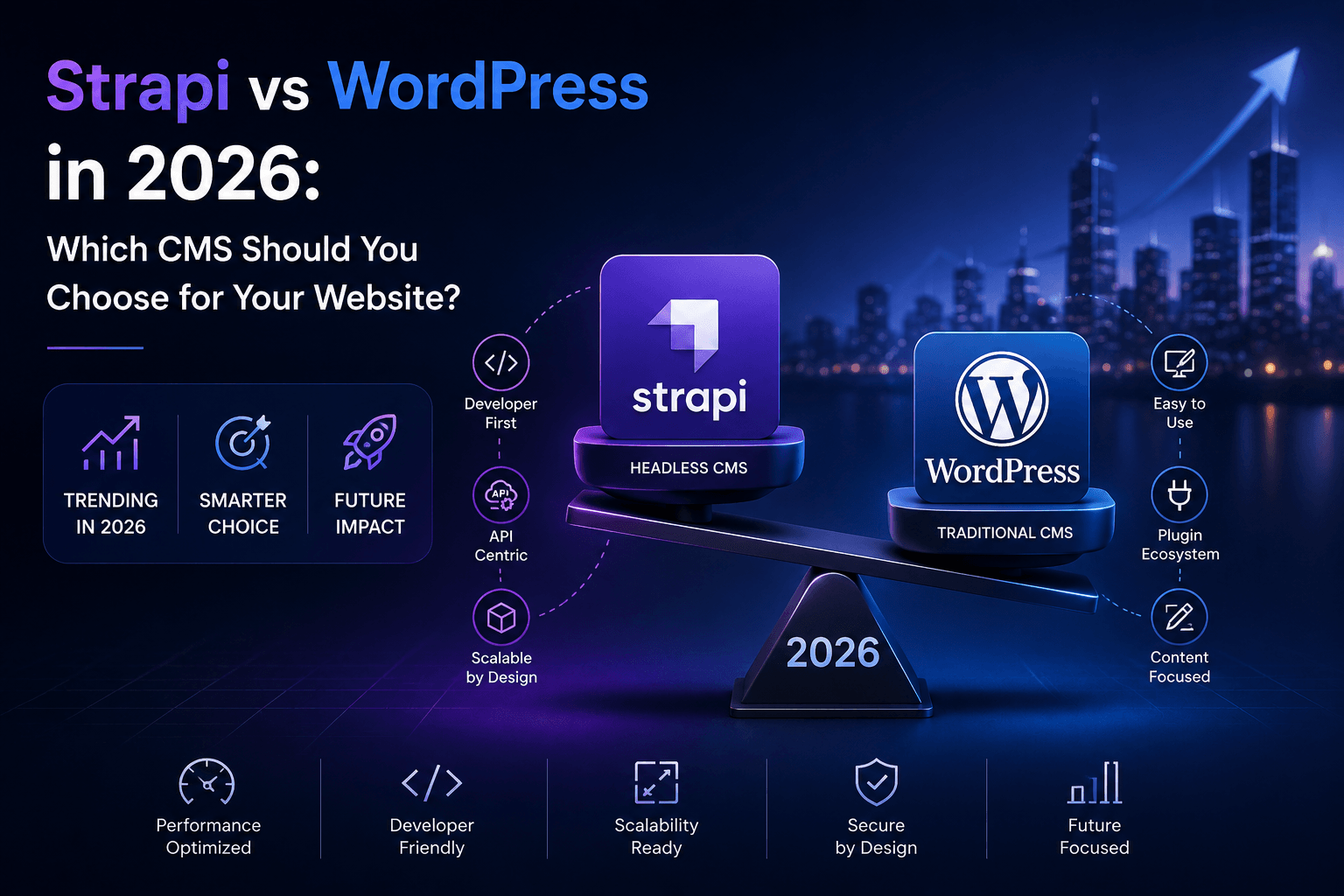
Summary: Strapi is the superior choice when an organization needs an API-first content core powering multiple frontends without presentation lock-in. WordPress remains practical when non-technical marketing teams prioritize familiar publishing tools, rapid theme-based deployment, and plugin ecosystem breadth.
What a Strong Strapi Development Partner Should Deliver
A qualified Strapi agency should provide comprehensive platform engineering across every stage:
| Delivery Phase | Core Deliverables & Technical Milestones |
|---|---|
| Discovery & Planning | User journeys, content inventory, technical dependency audit, and integration mapping. |
| Content Architecture | Normalized collection types, single types, reusable components, dynamic zones, and taxonomies. |
| API Engineering | REST and GraphQL endpoints, permission scoping, payload optimization, and OpenAPI documentation. |
| Frontend Development | Accessible Next.js or React UI components, server-side rendering, metadata control, and Core Web Vitals optimization. |
| CMS Migration | Automated extraction scripts, field transformations, media library migration, 301 redirect maps, and reconciliation QA. |
| Security & Governance | Role-based permission configuration, API token management, authentication integration, and security reviews. |
| DevOps & Cloud | CI/CD pipelines, containerized deployments (Docker/Kubernetes), automated backups, and environment staging. |
| Post-Launch Support | SLA-backed uptime monitoring, proactive Strapi version updates, and continuous platform enhancements. |
For organizations evaluating end-to-end migration services, reference our CMS migration services and headless CMS development company frameworks.
Questions to Ask Before Hiring a Strapi Agency
Before selecting a development partner, present these technical and operational questions:
- Can you demonstrate a relevant Strapi project currently operating in production?
- Who will be directly responsible for architecture decisions, schema design, and code reviews?
- How do you approach REST versus GraphQL API design in Strapi, and how do you prevent over-fetching?
- What is your documented process for validating content migration accuracy and relational data integrity?
- How will you preserve search engine visibility, URL parity, and 301 redirects during migration?
- How do you manage Strapi upgrades, breaking schema changes, and database migrations between major versions?
- How will you test API permissions, authentication flows, and secure file uploads?
- Who owns the custom plugin code, infrastructure configurations, and technical documentation upon completion?
- What is the rollback procedure if cutover validation fails during production deployment?
- What specific response times and services are included in your post-launch support agreement?
- How do you handle scope modifications, and what impact do they have on budget and delivery milestones?
- Can you integrate Strapi with existing backend systems, such as Laravel services, ERPs, CRMs, or custom APIs?
FAQs
Which is the best Strapi development company?
The right Strapi partner depends on project scope, technical stack, and organizational complexity. For businesses requiring end-to-end CMS migration, legacy PHP/Laravel modernization, and Next.js frontend builds alongside Strapi, Junkies Coder offers a dedicated migration blueprint. For conversion-focused marketing sites, Weframe Tech is a strong option. For enterprise React and Next.js applications, FocusReactive and Notum excel. For large-scale multi-team programs, VirtusLab Group and Successive Digital provide extensive engineering capacity.
How do I hire a Strapi developer or agency?
Begin by defining your content model, frontend requirements, third-party integrations, migration data scope, and security standards. Evaluate candidates against verified production case studies, API architecture expertise, Next.js or React skills, and clear post-launch maintenance terms rather than hourly rates alone.
Is Strapi better than WordPress?
Neither platform is universally superior. Strapi is purpose-built as an API-first, decoupled headless CMS for multi-channel apps, portals, and custom frontend architectures. WordPress provides a mature editorial interface, extensive plugin ecosystem, and rapid deployment for content-led marketing sites, and can also be configured headlessly via WPGraphQL or the REST API.
Can we migrate an existing WordPress site to Strapi?
Yes. An enterprise WordPress-to-Strapi migration requires auditing legacy content types and custom fields, restructuring data into normalized Strapi models, extracting media assets, mapping URLs to 301/308 redirects, rebuilding the frontend in Next.js, validating SEO parity, and testing deployment cutover.
Does Strapi support enterprise-scale applications?
Yes. Strapi provides role-based access control (RBAC), SSO integration (on Enterprise plans), JWT and API token management, custom controller hooks, audit logs, and horizontal container scalability, making it suitable for enterprise portals and high-traffic multi-channel platforms.
What is a headless CMS migration blueprint?
A headless CMS migration blueprint is an end-to-end operational roadmap covering content inventory, data normalization, entity relationship mapping, API contracts, URL redirects, canonical and hreflang controls, automated ETL scripts, frontend component templates, acceptance testing, and rollback procedures.
How long does a Strapi project take and what does it cost?
Indicative project timelines range from 4–8 weeks for a basic website ($10,000–$25,000) to 10–18 weeks for a CMS migration ($20,000–$75,000), and 16–30+ weeks for complex enterprise platforms ($80,000–$200,000+). Final budgets depend on content volume, custom integrations, frontend requirements, and legacy technical debt.
Final Recommendation
When selecting a Strapi development partner, evaluate how effectively each agency connects CMS architecture with your broader digital ecosystem:
- For comprehensive platform replatforming, CMS migration, and legacy PHP/Laravel modernization: Junkies Coder provides a proven engineering framework combining Strapi content modeling with Next.js frontend delivery.
- For conversion-driven marketing websites and commerce landing pages: Weframe Tech offers focused frontend performance and rapid iteration.
- For enterprise web applications and complex modern JavaScript architectures: FocusReactive and Notum deliver deep technical specialization.
- For high-capacity enterprise delivery across distributed engineering teams: VirtusLab Group and Successive Digital provide extensive scale.
The right decision is not determined by agency size alone. It is determined by finding the partner whose engineering methodology best aligns with your content lifecycle, security requirements, and long-term digital growth goals.