- A Noon-like marketplace is a multi-vendor commerce platform, not a single eCommerce application.
- The core systems are customer shopping, seller management, catalogue, inventory, checkout, order orchestration, fulfilment, delivery, returns and settlement.
- A focused MVP should begin with one category, one geography, one fulfilment model and a controlled seller group.
- AI is most valuable when it improves catalogue quality, search, demand planning, support, fraud controls or delivery prediction.
- Hyperlocal commerce requires live inventory, zone-level delivery promises and local fulfilment economics.
- The most difficult technical problem is keeping product, inventory, payment, order and delivery states consistent.
- A marketplace should measure contribution margin, repeat orders, return rate and fulfilment quality, not only downloads and GMV.
- Enterprise success depends on reliable operations, seller trust and post-launch product improvement.
Building a Noon-like marketplace in 2026 can cost approximately US$40,000–100,000 for a focused MVP, US$120,000–300,000 for a production multi-vendor platform, and US$600,000–1.5 million+ for a regional enterprise marketplace. The final budget depends on catalogue complexity, seller workflows, inventory, payments, logistics, returns, AI, security and the number of markets.
The important distinction is that a Noon-like product is not simply a shopping app. It is a coordinated commerce system connecting customers, sellers, payment providers, warehouses, delivery partners, and marketplace operations. Public Noon materials show how a mature regional marketplace combines broad product categories, multiple payment options, delivery services, and returns. For businesses looking to build a similar ecosystem, partnering with a mobile app development company in UAE can help bring together these different components into one reliable and user-friendly platform.
This guide explains what “Noon-like” means, what an MVP should include, how the architecture should be structured, which AI capabilities are practical in 2026, how much each development layer may cost and what ongoing operating expenses to plan for.
What Is a Noon-Like Marketplace?
A “Noon-like marketplace” does not mean an exact clone of Noon’s interface, brand, catalogue or proprietary technology.
It means a multi-sided commerce platform that may include:
- Customer app and web storefront.
- Multiple sellers or merchants.
- Seller onboarding and management.
- Product catalogue and search.
- Inventory and warehouse coordination.
- Payments and refunds.
- Order management.
- Delivery and fulfilment.
- Returns and disputes.
- Seller commissions and settlements.
- Admin, analytics and trust controls.
The objective is to reproduce the business capabilities required by a regional marketplace, not to copy another company’s internal systems.
How the Marketplace Works
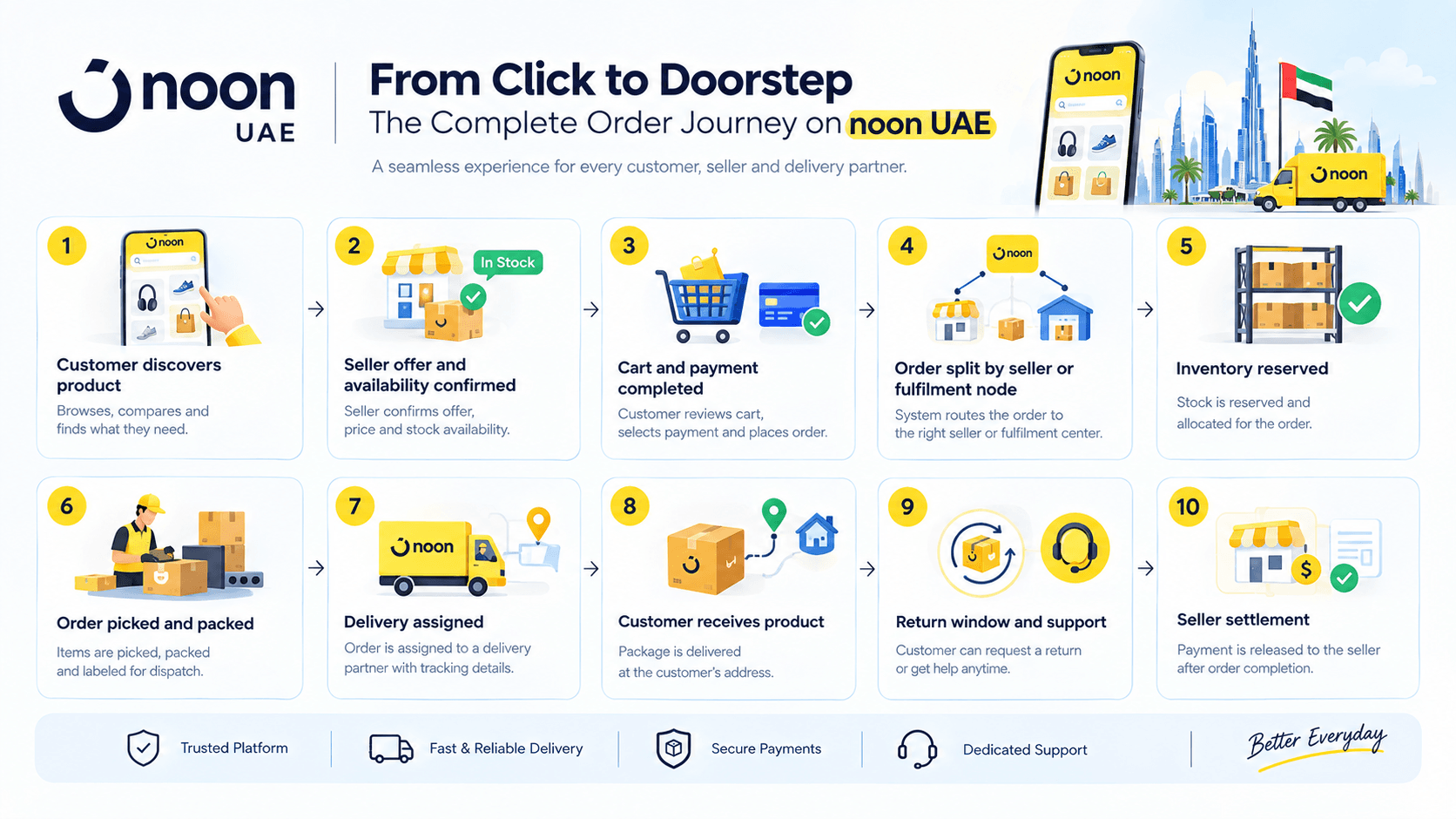
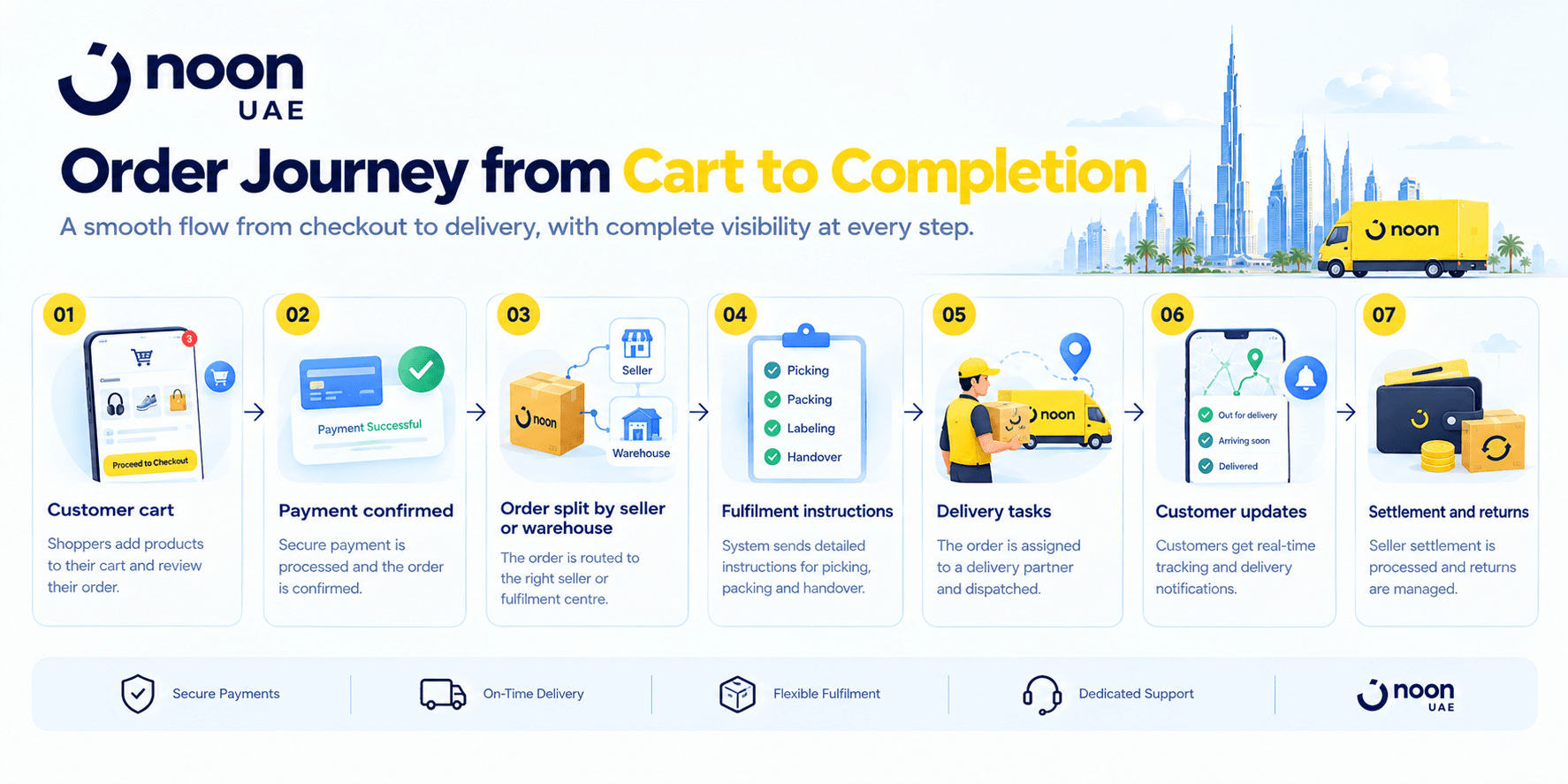
A single cart may produce several fulfilment orders. Each seller may have different inventory, delivery speed, return terms and settlement rules. That is why the platform needs an order-orchestration layer rather than a simple “order placed” status.
Marketplace Business Models
| Model | How it works | Suitable starting point |
|---|---|---|
| Single-vendor store | One company owns products and fulfilment | Brand or retailer |
| Third-party marketplace | Independent sellers list and fulfil products | Established seller network |
| Managed marketplace | Platform controls content and service standards | Quality-sensitive categories |
| Seller-fulfilled marketplace | Sellers store and ship products | Long-tail catalogue |
| Hybrid fulfilment | Platform fulfils selected items and sellers fulfil others | Regional scaling |
| Hyperlocal marketplace | Nearby stores serve defined delivery zones | Grocery and local retail |
| B2B marketplace | Businesses buy from approved suppliers | Procurement and wholesale |
Choose the business model before finalising the technical architecture because it affects seller permissions, inventory ownership, delivery responsibility, returns, commissions and settlement.
Core Product Surfaces
Customer app and web
The customer experience may include:
- Registration and guest browsing.
- Arabic and English content.
- Search and filters.
- Product comparison.
- Product details.
- Wishlist.
- Cart.
- Checkout.
- Payment options.
- Delivery selection.
- Order tracking.
- Returns.
- Reviews.
- Support.
The customer should see the total cost, seller identity, delivery promise and return terms before purchase.
Seller portal
The seller portal may provide:
- Business onboarding.
- Product listing.
- Bulk SKU upload.
- Product variants.
- Inventory updates.
- Pricing.
- Promotions.
- Order processing.
- Return responses.
- Settlement statements.
- Sales analytics.
- Team permissions.
Delivery and operations app
A delivery application may support:
- Task assignment.
- Pickup confirmation.
- Route planning.
- Customer contact.
- Proof of delivery.
- Failed-delivery reason.
- Return pickup.
- Offline mode.
- Driver performance.
Admin panel
The admin platform may manage:
- Seller approval.
- Catalogue moderation.
- Commission rules.
- Orders and exceptions.
- Refunds.
- Promotions.
- Customer support.
- Fraud alerts.
- Settlement review.
- Marketplace analytics.
Catalogue and Inventory Architecture
Catalogue and inventory should be separate domains.
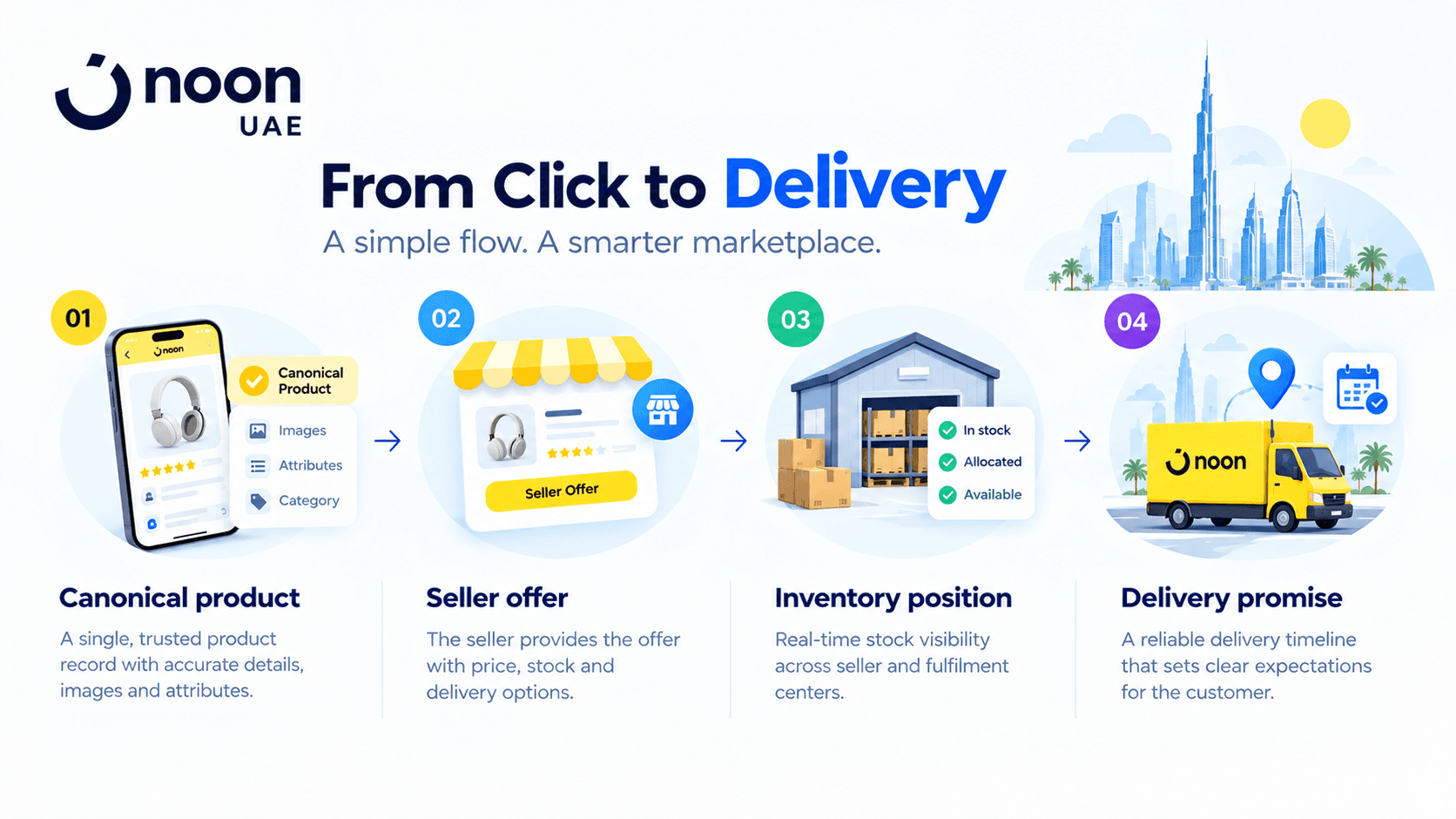
Catalogue data
A structured catalogue should manage:
- Product identity.
- Category.
- Brand.
- Variants.
- Size and colour.
- Dimensions.
- Compatibility.
- Warranty.
- Images.
- Language versions.
- Safety or regulatory information.
Inventory states
Inventory may move through:
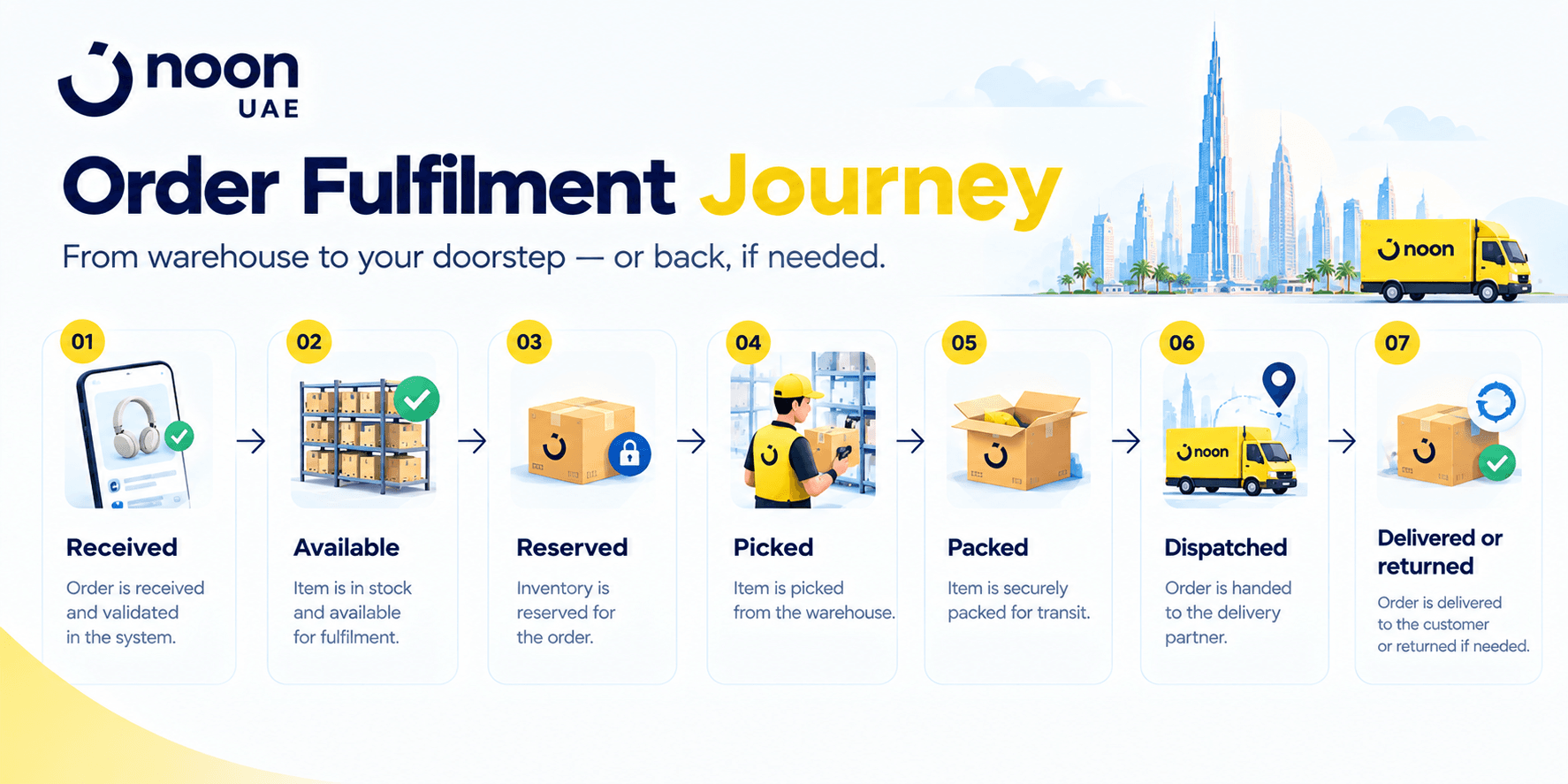
Inventory must be tracked by seller, warehouse, store, fulfilment centre and condition. A single “stock count” is not enough for a marketplace with multiple locations and fulfilment models.
AI Tools for Catalogue Intelligence
Catalogue intelligence is one of the most practical AI opportunities for a marketplace because seller-submitted product data is often incomplete, inconsistent or duplicated.
AI tool categories
| Catalogue problem | AI category or example |
|---|---|
| Product description generation | LLMs such as GPT, Claude or Gemini |
| Product image analysis | Vision-language models |
| Text extraction from invoices or labels | OCR tools such as Google Document AI, AWS Textract or Azure Document Intelligence |
| Similar-product discovery | Embeddings and vector search |
| Duplicate listing detection | Embedding similarity and entity matching |
| Product translation | Machine translation with human review |
| Category prediction | Classification models |
| Content moderation | Text and image safety models |
| Search enrichment | Query expansion and semantic embeddings |
| Demand prediction | Time-series forecasting models |
| Review analysis | Sentiment and topic-classification models |
Recommended catalogue workflow
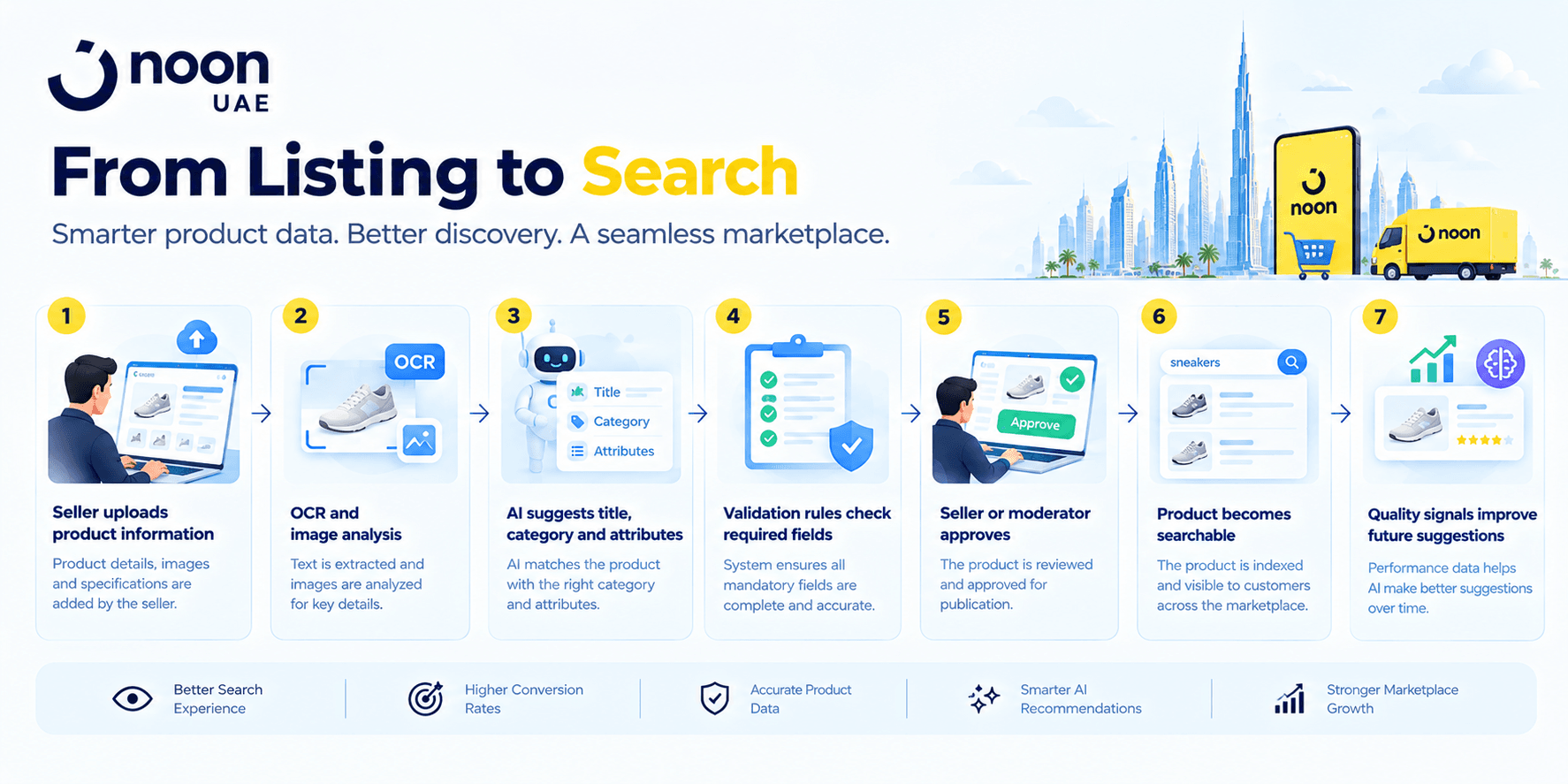
AI should not invent certifications, ingredients, warranties, medical claims or technical specifications. Those details should come from verified seller data or approved sources.
Search and Product Discovery
A large catalogue requires more than keyword search.
A modern discovery system may combine:
- Keyword matching.
- Semantic search.
- Product attributes.
- User intent.
- Price range.
- Local availability.
- Delivery promise.
- Seller quality.
- Review confidence.
- Purchase history.
- Sponsored-placement rules.
For example, a customer might search: “A lightweight laptop for university under AED 2,500, available this week.”
The system should interpret:
- Product category.
- Budget.
- Use case.
- Weight preference.
- Location.
- Delivery deadline.
Sponsored results should be labelled clearly so paid placement does not become hidden ranking manipulation.
Order, Payment and Settlement
The platform should separate:
- Customer payment.
- Seller receivable.
- Platform commission.
- Delivery charge.
- Promotional funding.
- Refund.
- Chargeback.
- Settlement adjustment.
Order orchestration
Seller settlement
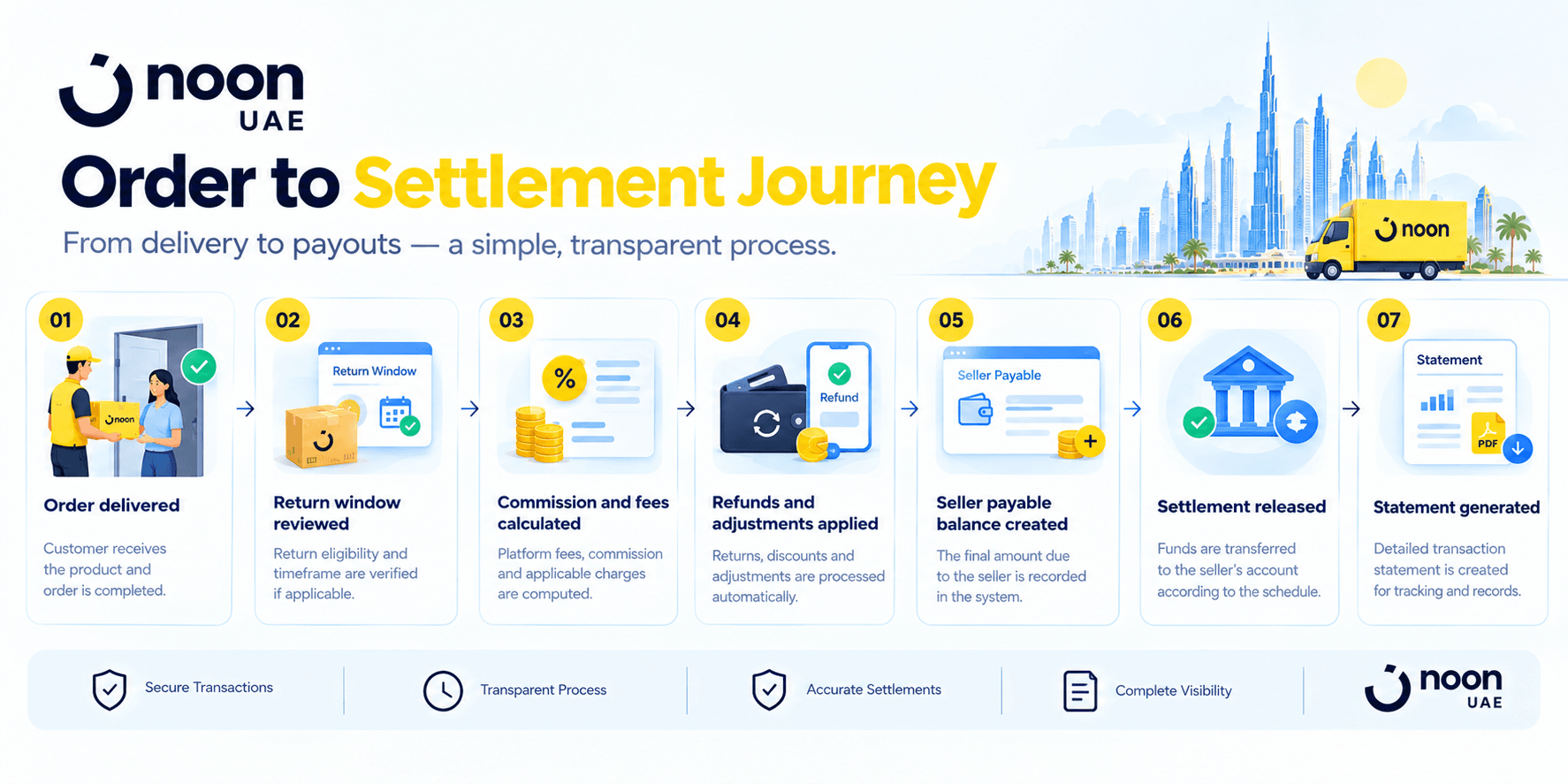
A seller dashboard should show gross sales, fees, returns, chargebacks, pending settlement, released settlement and bank references. Noon’s seller and payment documentation demonstrates why statements, returns and settlement schedules are core marketplace operations rather than optional reporting features.
Returns as Reverse Commerce
Returns create a second operational journey:
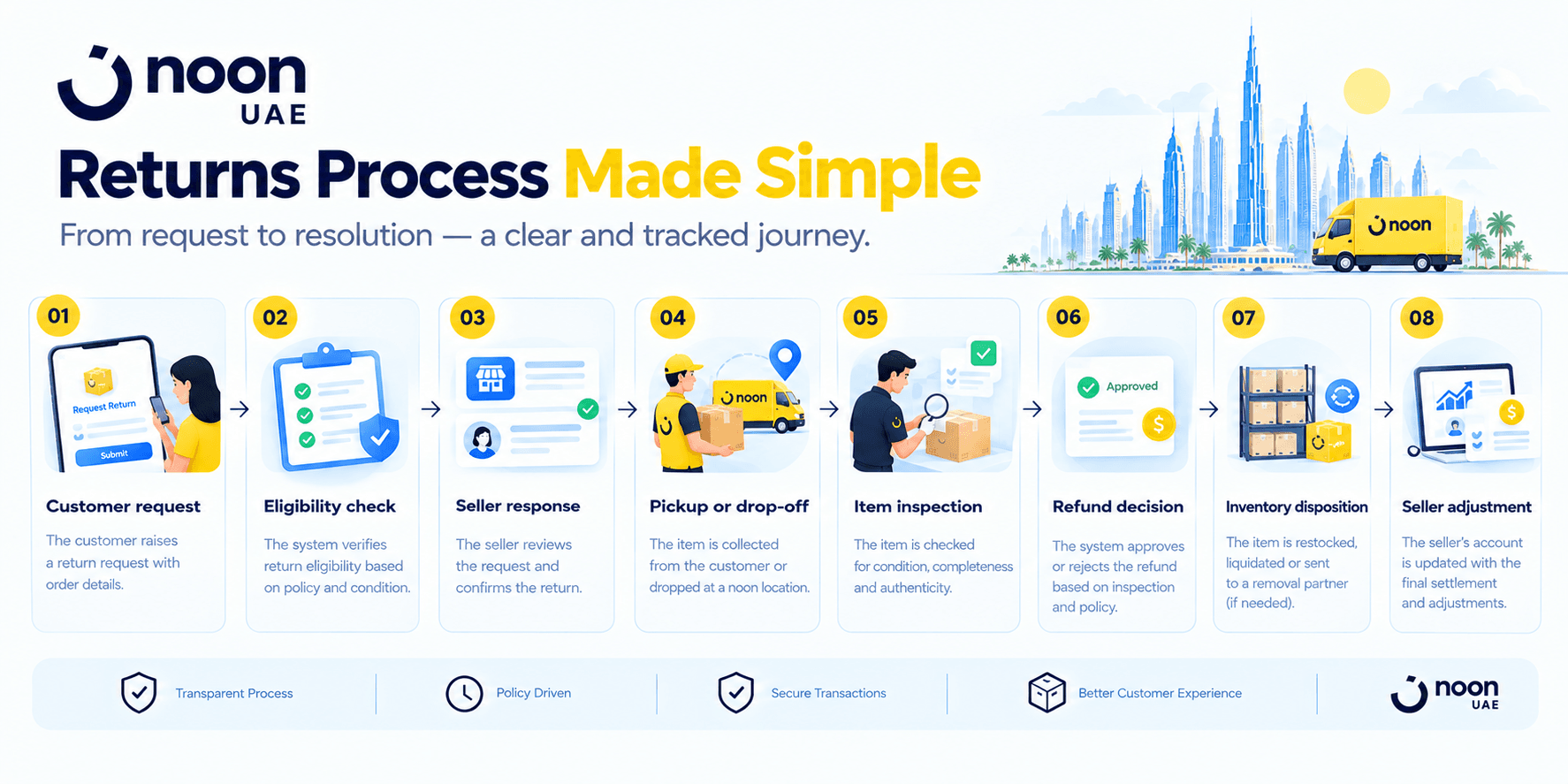
A returned item may be:
- Resalable.
- Open-box.
- Damaged.
- Warranty-related.
- Counterfeit.
- Sent for refurbishment.
- Removed from sale.
A marketplace should define different workflows for wrong items, damaged products, missing items, late deliveries, warranty claims and change-of-mind returns. Public Noon policies show that return eligibility and refund timing can vary by product and payment method.
Hyperlocal Commerce in 2026
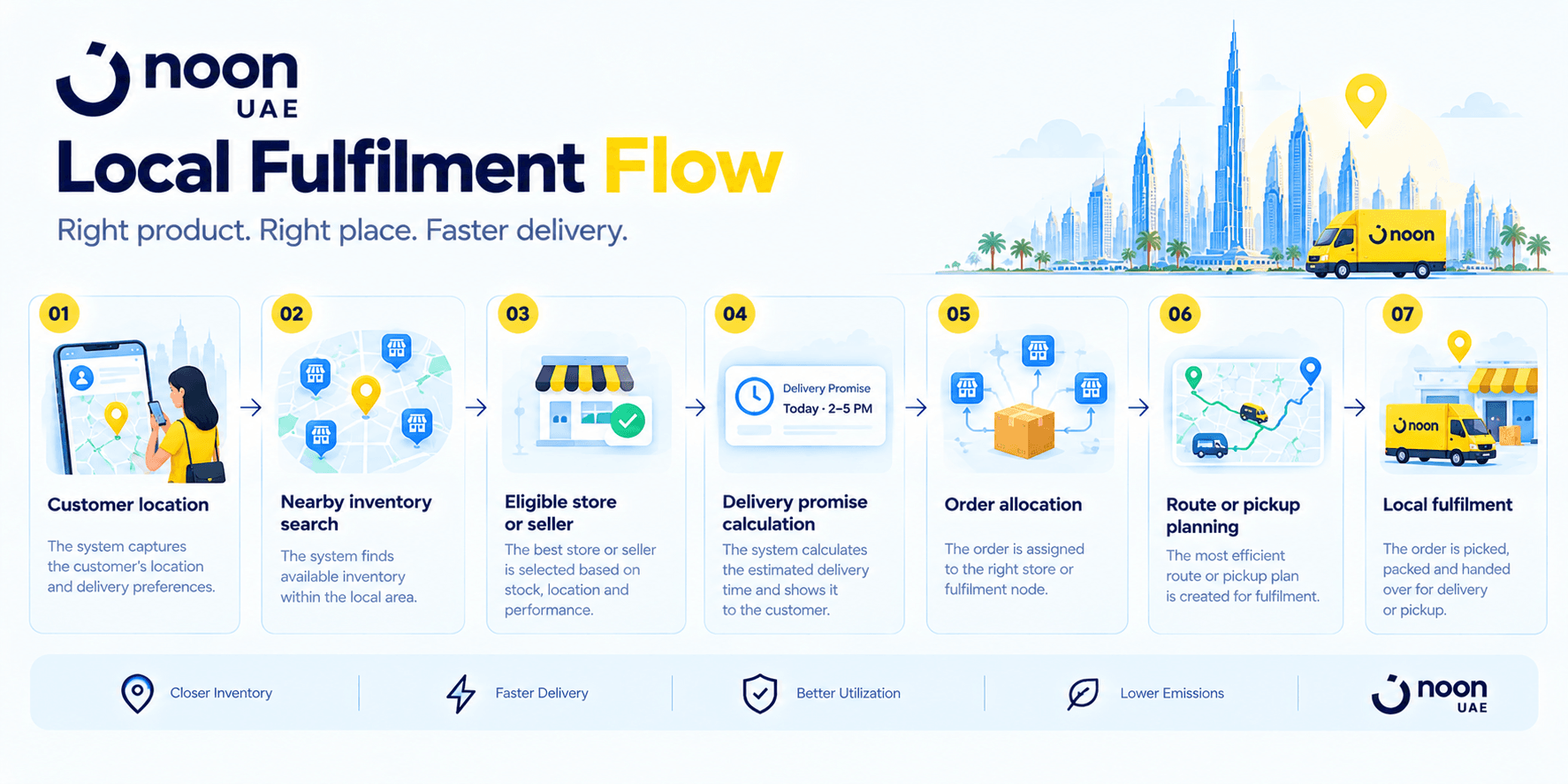
Hyperlocal commerce is not simply “fast delivery.” It is a zone-level operating model that matches nearby demand with live inventory and delivery capacity.
Hyperlocal inputs
- Customer location.
- Store distance.
- Available inventory.
- Preparation time.
- Driver capacity.
- Traffic.
- Weather.
- Cut-off time.
- Basket value.
- Delivery cost.
- Service radius.
Hyperlocal flow
Future impact
Hyperlocal platforms will increasingly use:
- Store-as-warehouse models.
- Micro-fulfilment centres.
- Pickup lockers.
- Click-and-collect.
- Local delivery slots.
- Route batching.
- Electric delivery fleets.
- Neighbourhood-level offers.
- Predictive stock placement.
The platform should not promise the fastest possible delivery in every case. It should promise a delivery window that reflects actual inventory, staff, traffic and capacity.
AI for Marketplace Operations
Demand forecasting
AI can estimate demand by:
- Location.
- Season.
- Promotion.
- Product category.
- Seller.
- Lead time.
- Stock-out history.
Delivery prediction
Models can estimate:
- Delay probability.
- Best fulfilment node.
- Route risk.
- Customer absence.
- Delivery-slot availability.
- Cost of fulfilment.
Seller-quality monitoring
AI can detect patterns in:
- Cancellations.
- Returns.
- Complaints.
- Review manipulation.
- Inventory inaccuracies.
- Unusual pricing.
- Fulfilment delays.
Customer support
AI can assist with:
- Order status.
- Delivery updates.
- Return-policy guidance.
- Invoice retrieval.
- Product comparison.
- Seller-support routing.
It should not invent delivery dates, refund decisions or warranty outcomes.
AI Agent Commerce
AI agents may eventually search, compare and prepare purchases for customers.
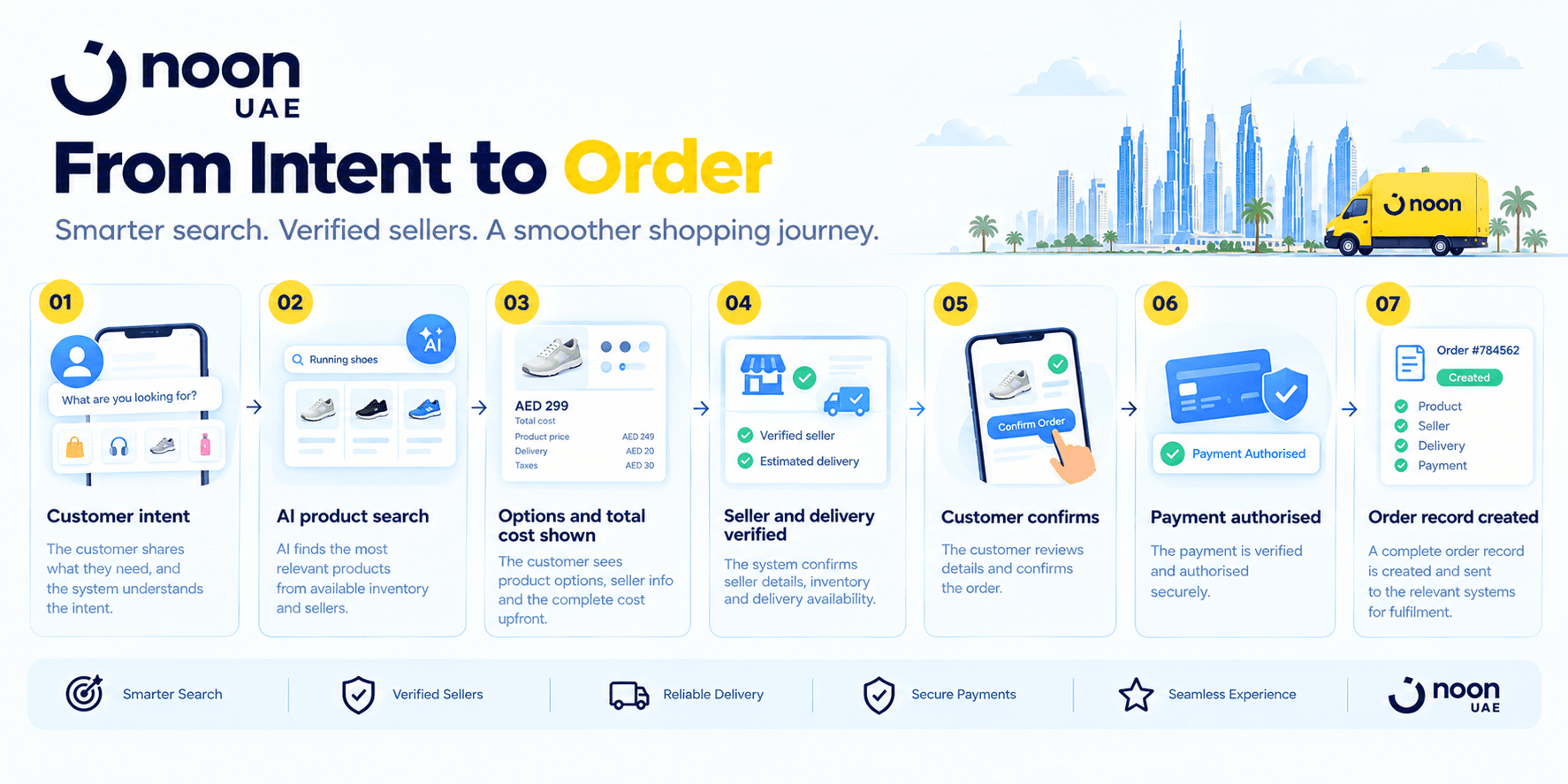
A marketplace should require:
- Agent authentication.
- Customer permission.
- Spending limits.
- Seller verification.
- Total-cost disclosure.
- Explicit confirmation.
- Fraud monitoring.
- Transaction audit history.
- Cancellation and recovery process.
An AI agent should assist shopping, not silently create a purchase or payment obligation.
Event-Driven Marketplace Architecture
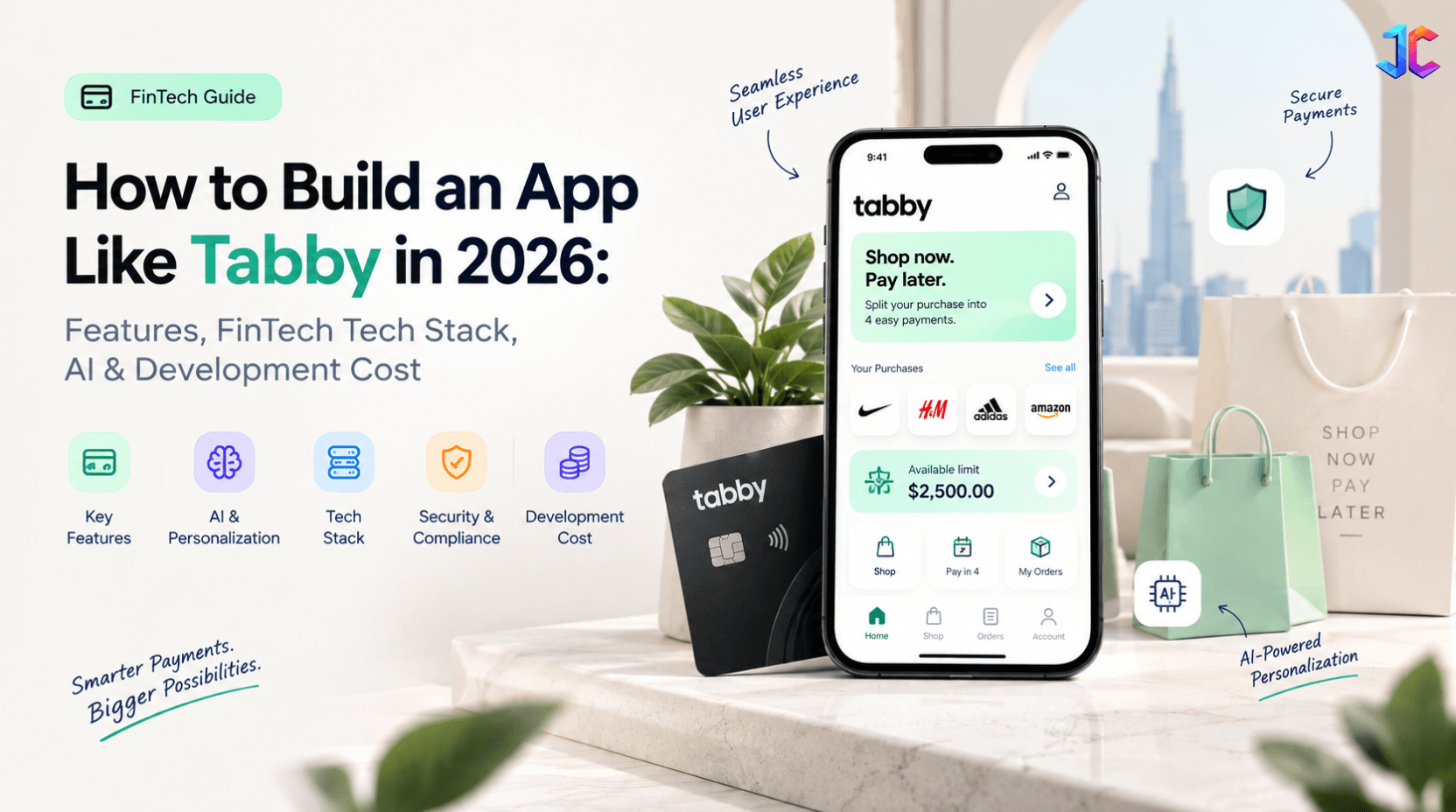
A marketplace benefits from event-driven workflows because orders, payments, inventory, delivery, and returns change independently. This approach is also relevant when exploring how to build an app like Tabby, where payment events, customer transactions, order updates, and repayment processes need to work together without creating unnecessary dependencies between services.
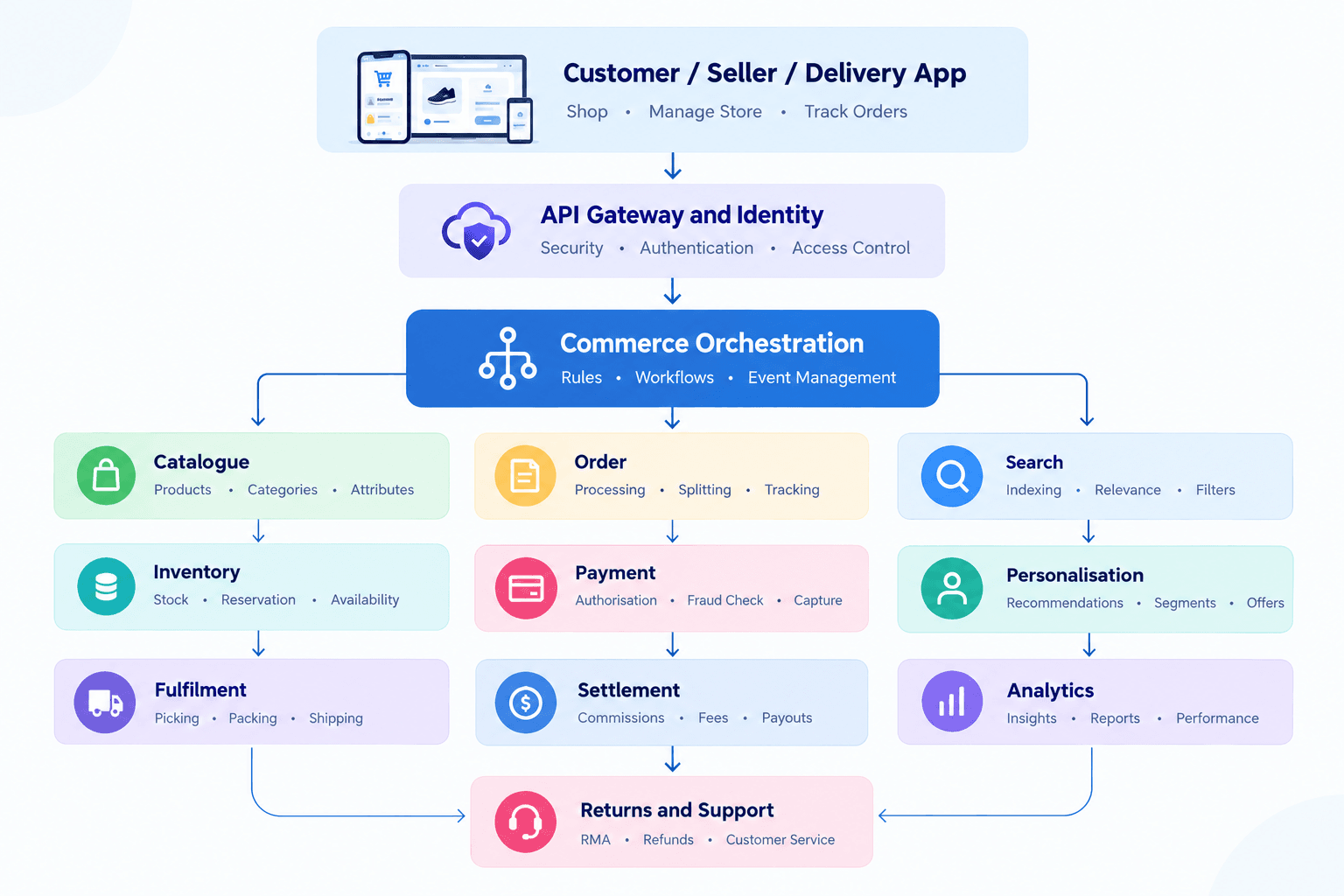
Example events
ProductCreatedInventoryReservedOrderPlacedPaymentAuthorizedSellerConfirmedShipmentCreatedDeliveryCompletedReturnRequestedRefundIssuedSellerSettlementCreated
Every event should include:
- Unique event ID.
- Order or entity reference.
- Event timestamp.
- Source service.
- Version.
- Retry status.
- Processing result.
This supports delayed events, retries, auditability and independent service scaling.
Marketplace Trust and Authenticity
Trust should be treated as infrastructure.
Useful controls include:
- Seller identity verification.
- Brand-authorisation records.
- Product-serial validation.
- Purchase-verified reviews.
- Review-abuse detection.
- Image similarity checks.
- Counterfeit reporting.
- Dispute evidence.
- Chain-of-custody records.
- Customer protection policies.
A larger catalogue is not automatically a stronger marketplace. Customers need confidence in the product, seller, price, delivery promise, and return process. Building these trust-focused features into the platform is an important part of creating a reliable marketplace, which is where an experienced mobile app development company in Dubai can help turn these requirements into a smooth customer experience.
Recommended MVP Scope
A focused MVP should prove the marketplace loop:
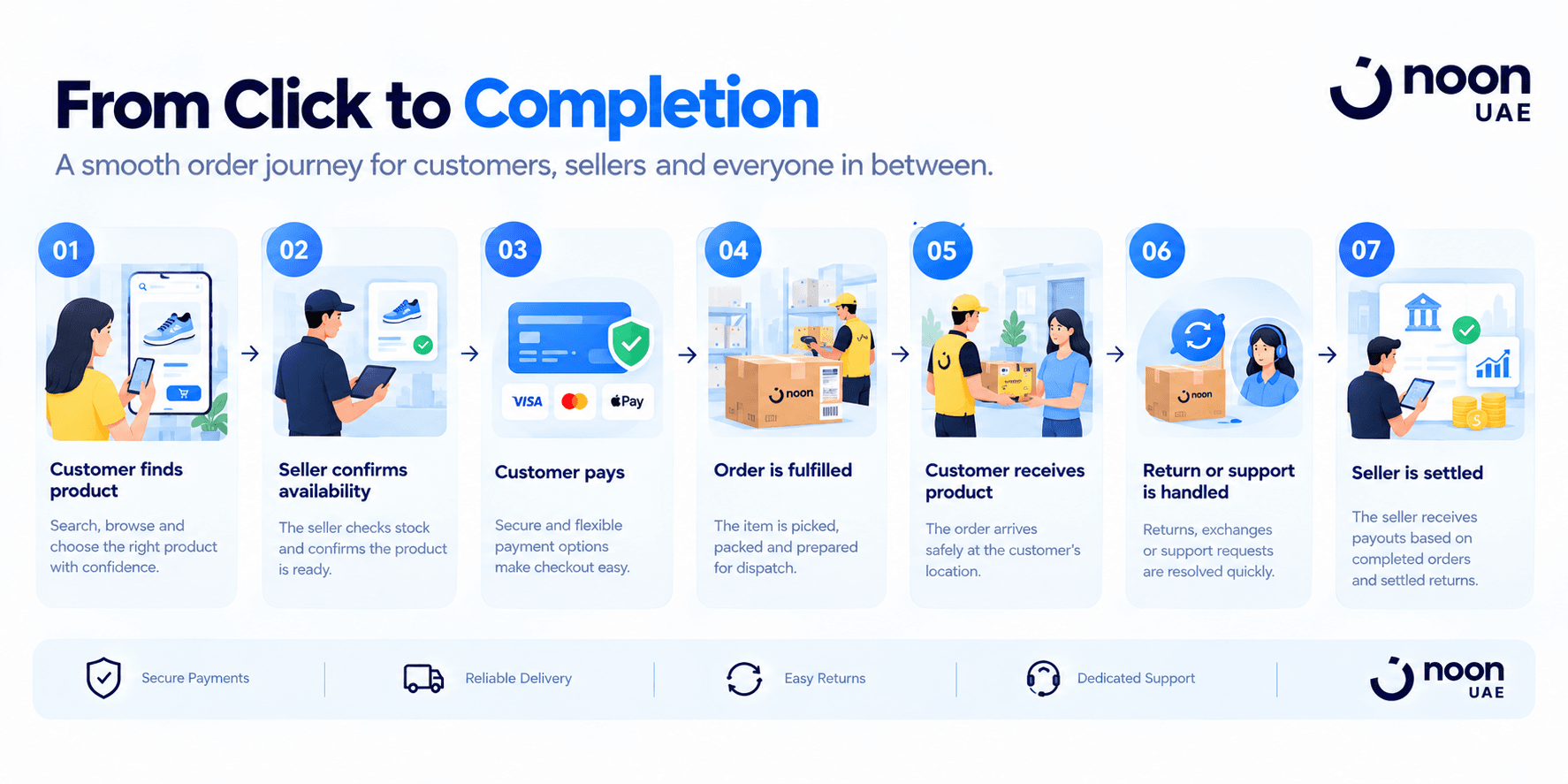
Include in the MVP
- One customer app or responsive web experience.
- One seller portal.
- One admin console.
- One product category.
- Limited seller onboarding.
- Catalogue and search.
- Product pages.
- Cart and checkout.
- One or two payment methods.
- Basic order tracking.
- Seller fulfilment status.
- Return request.
- Customer support.
- Seller settlement report.
- Basic analytics.
- Audit logs.
Defer initially
- Full regional catalogue.
- Multi-warehouse network.
- Same-hour delivery.
- AI shopping agent.
- AR product visualisation.
- Dynamic pricing.
- Cross-border operations.
- Complex loyalty wallet.
- Multiple seller-financing products.
Technology Stack
| Layer | Suitable options |
|---|---|
| Mobile | Flutter, React Native, Swift or Kotlin |
| Web storefront | Next.js, React or another SEO-friendly framework |
| Seller portal | React or comparable web framework |
| Backend | Java, Go, Node.js, Kotlin or Python |
| Transaction database | PostgreSQL |
| Search | OpenSearch, Elasticsearch or managed search |
| Catalogue | Product-information service with versioned attributes |
| Inventory | Real-time inventory service |
| Cache | Redis |
| Events | Kafka, managed queues or event streaming |
| Payments | Regional gateway, wallet and payment APIs |
| Delivery | Mapping, routing and logistics APIs |
| AI | Python services, vector search and model serving |
| Cloud | AWS, Azure or Google Cloud |
| Analytics | Event warehouse, dashboards and experimentation tools |
| Security | KMS/HSM, secrets management, MFA and monitoring |
Development Team
A marketplace team may include:
- Product manager.
- Marketplace business analyst.
- UI/UX designer.
- Mobile developers.
- Web developers.
- Backend developers.
- Search or catalogue engineer.
- Payments engineer.
- Logistics integration engineer.
- QA and automation engineer.
- DevOps or cloud engineer.
- Data or AI engineer, if required.
- Security specialist.
- Seller-operations team.
- Customer-support team.
The team should be sized according to operating complexity, not only the number of app screens.
Development Timeline
| Stage | Approximate timeline |
|---|---|
| Discovery and product definition | 2–4 weeks |
| UX, data model and architecture | 3–6 weeks |
| Focused MVP development | 4–8 months |
| Production multi-vendor marketplace | 8–14 months |
| Logistics-enabled regional platform | 10–18 months |
| Multi-country enterprise marketplace | 12+ months |
Third-party onboarding, payment certification, seller recruitment, logistics partnerships and regulatory reviews can extend the calendar independently of engineering.
Cost to Build a Noon-Like Marketplace
A Noon-like marketplace may include customer mobile and web, seller tools, admin operations, delivery workflows, search, inventory, payments, returns and analytics.
| Product stage | Typical scope | Indicative cost |
|---|---|---|
| Discovery and prototype | Product model, UX and architecture | US$15,000–40,000 |
| Focused marketplace MVP | One category, limited sellers and checkout | US$40,000–100,000 |
| Multi-vendor production platform | Seller, inventory, payment, order and return systems | US$120,000–300,000 |
| Logistics-enabled marketplace | Routing, tracking, delivery and settlement | US$250,000–600,000+ |
| Regional enterprise marketplace | Multi-country, AI, multi-warehouse and high availability | US$600,000–1.5 million+ |
These are planning estimates for software development, not fixed quotations. Public Noon-like app estimates vary because some cover only a customer application, while others include multi-vendor operations, logistics, AI, and administration. For a retail e-commerce platform, the final development scope and budget will depend on the features, integrations, number of user roles, and level of marketplace functionality required.
Practical Cost Breakdown
| Development area | What it covers | Indicative share |
|---|---|---|
| Discovery and product strategy | Research, workflows, scope and architecture | 5–10% |
| UI/UX design | Customer, seller, delivery and admin experiences | 8–12% |
| Customer app and web | Browse, search, cart, checkout and orders | 15–22% |
| Seller panel | Listings, inventory, fulfilment and settlements | 10–15% |
| Admin panel | Moderation, users, disputes and configuration | 6–10% |
| Backend and APIs | Commerce logic, accounts, orders and permissions | 18–25% |
| Payment integration | Gateways, wallets, refunds and webhooks | 4–8% |
| Logistics | Delivery, routes, tracking and proof of delivery | 8–15% |
| AI and data | Search, catalogue, forecasting and support | 5–15% |
| QA and security | Functional, load, security and recovery testing | 8–12% |
| Cloud and deployment | Environments, observability and release setup | 3–7% |
These percentages are planning ranges, not a mathematical pricing formula. The allocation changes substantially by marketplace model.
Costs outside development
Budget separately for:
- Payment-provider fees.
- Maps and routing APIs.
- SMS and OTP.
- Search infrastructure.
- AI APIs or model hosting.
- Cloud usage.
- Security audits.
- Seller onboarding.
- Customer support.
- Delivery operations.
- Warehouse and inventory costs.
- Marketing.
- Returns and refunds.
- Insurance and legal services.
Monthly Operating Costs
Development is the initial investment. A marketplace also needs recurring operating capacity.
| Cost area | Typical driver |
|---|---|
| Cloud infrastructure | Traffic, storage, images and event volume |
| SMS and OTP | Login, verification and notifications |
| Maps and routing | Geocoding, tracking and route requests |
| Payment gateway | Transaction value and payment method |
| Search | Query volume and index size |
| AI services | Catalogue processing, search and support usage |
| Monitoring | Logs, metrics, traces and retention |
| Customer support | Order volume, returns and disputes |
| Seller operations | Verification, catalogue and quality review |
| Maintenance | Updates, bug fixes and security patches |
| Delivery operations | Drivers, partners, vehicles and fulfilment |
| Returns | Reverse logistics, inspection and refunds |
A reasonable launch budget should include a maintenance and operations reserve rather than treating development as the entire cost of ownership.
Monetization Models
A marketplace may earn through:
- Commission on completed orders.
- Seller subscription plans.
- Sponsored listings.
- Marketplace advertising.
- Fulfilment fees.
- Delivery charges.
- Premium customer memberships.
- Affiliate revenue.
- Seller analytics.
- B2B marketplace services.
Separate platform revenue from money collected on behalf of sellers. That distinction affects accounting, settlement and profitability.
Marketplace Metrics and Unit Economics
GMV is not profit.
A useful contribution calculation is:
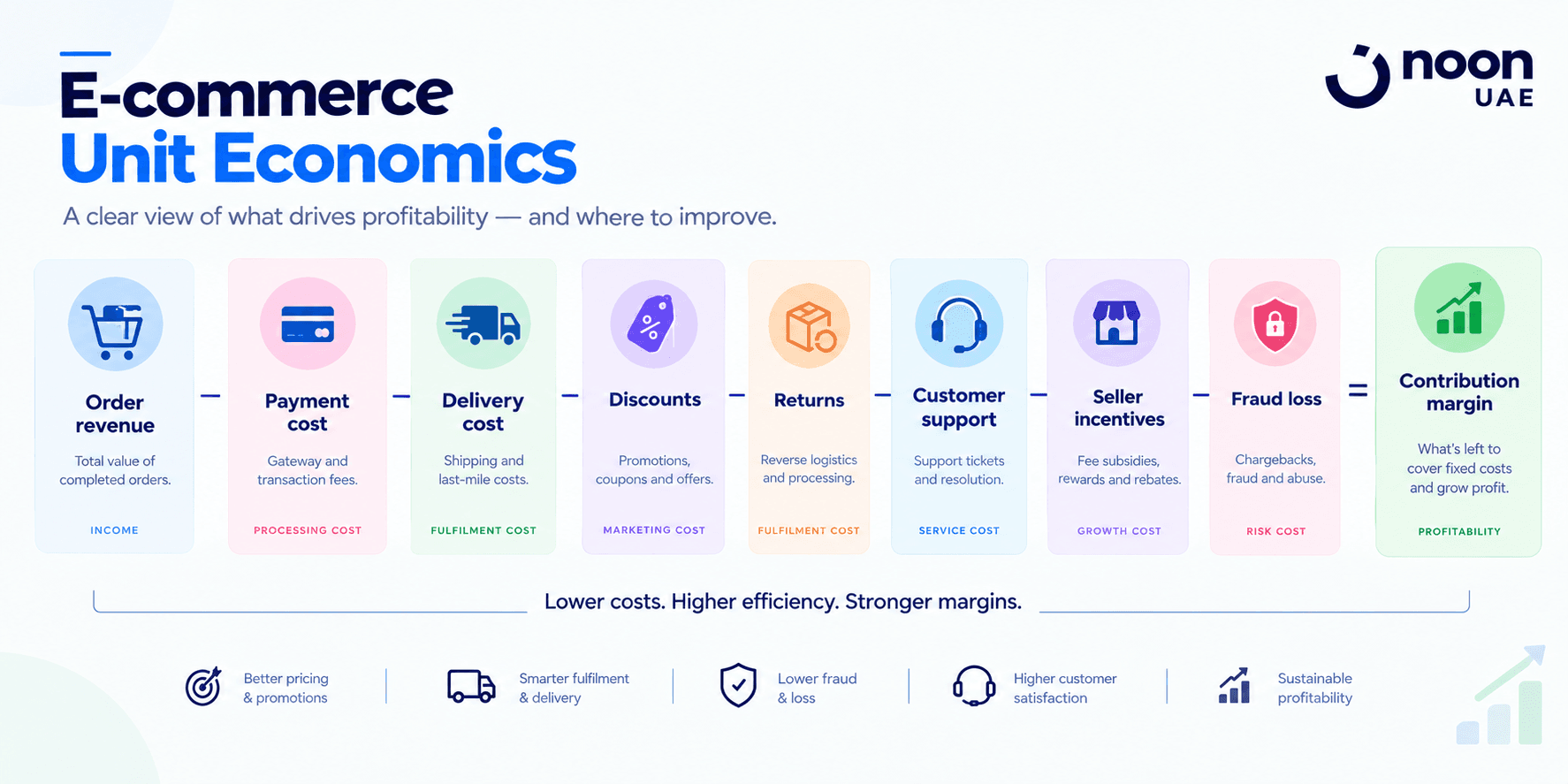
Track performance by:
- Order.
- Seller.
- Product category.
- Customer segment.
- Delivery zone.
- Fulfilment model.
- Promotion.
- Payment method.
Core metrics
- Monthly active customers.
- Repeat purchase rate.
- Search-to-cart conversion.
- Cart-to-order conversion.
- Average order value.
- Seller fulfilment rate.
- Cancellation rate.
- Return rate.
- Delivery success rate.
- Customer-support contacts.
- Seller retention.
- Contribution margin.
What Is a Marketplace With 10,000 Users Worth?
Downloads do not determine marketplace value.
A more useful view considers:
- Monthly active users.
- Repeat orders.
- GMV.
- Net revenue.
- Contribution margin.
- Seller retention.
- Customer acquisition cost.
- Fulfilment cost.
- Return rate.
- Organic demand.
- Catalogue quality.
- Technology debt.
A marketplace with 10,000 inactive downloads may be worth less than one with 2,000 repeat customers and healthy seller economics.
Scaling Roadmap
Stage 1: Validate
- One category.
- One geography.
- Limited sellers.
- One fulfilment model.
- Basic payments.
- Manual exception handling.
Stage 2: Improve
- Better search.
- Seller self-service.
- Real-time inventory.
- Automated refunds.
- Delivery-partner integration.
- Funnel analytics.
- Catalogue-quality tools.
Stage 3: Scale
- Multiple categories.
- Multiple fulfilment nodes.
- Hyperlocal delivery.
- Demand forecasting.
- Seller-quality scoring.
- Personalisation.
- Retail media.
Stage 4: Regionalise
- Multiple countries.
- Multi-currency.
- Regional payment methods.
- Cross-border sellers.
- Local returns.
- Country-specific policies.
- Distributed operations.
Future of AI and Agentic Commerce
- Intent-driven shopping: Customers will increasingly search through text, voice and images instead of fixed categories.
- Predictive fulfilment: Marketplaces will estimate demand, stock-outs, delivery delays, return probability and the best fulfilment node.
- AI-assisted sellers: Sellers will use AI for product content, translations, image improvement, demand planning and support.
- Reverse-commerce intelligence: Returns, repairs, refurbishment, resale and liquidation will become part of the product lifecycle.
- Margin-aware personalisation: The most relevant product will not always be the product with the largest discount. Future ranking may balance customer intent, seller economics, delivery cost, return probability and inventory.
- Composable payments: Cards, wallets, account-to-account payments, BNPL and business payment terms will be connected through an orchestration layer.
- Trust as infrastructure: Verified sellers, authentic products, transparent reviews, accurate delivery promises and traceable returns will become core marketplace capabilities.
- Hyperlocal commerce: Store-as-warehouse models, micro-fulfilment, pickup points, delivery batching, electric fleets and neighbourhood-level offers will shape local commerce.
Marketplace Maturity Comparison
| Capability | Focused MVP | Growth marketplace | Enterprise platform |
|---|---|---|---|
| Catalogue | Curated products | Seller-managed catalogue | Structured and AI-assisted |
| Sellers | Limited and manually approved | Self-serve with verification | Continuous seller-quality scoring |
| Inventory | Seller updates | Real-time integrations | Multi-warehouse availability |
| Search | Keyword and filters | Semantic search | Personalised, visual and voice discovery |
| Fulfilment | Seller or one delivery partner | Multiple partners | Predictive multi-node orchestration |
| Returns | Manual request flow | Customer self-service | Reverse-logistics intelligence |
| Payments | One or two methods | Multiple gateways | Regional orchestration |
| Promotions | Manual discounts | Campaign tools | Personalised, margin-aware offers |
| AI | Basic catalogue or support | Recommendations and forecasting | Agents, fraud and operations AI |
| Analytics | Orders and revenue | Funnel and seller metrics | Contribution and experimentation |
| Trust | Seller verification | Review and dispute controls | Authenticity and provenance systems |
FAQs
How much does it cost to build an app like Noon?
A focused marketplace MVP may cost approximately US$40,000–100,000. A multi-vendor production platform may cost US$120,000–300,000, while logistics-enabled and regional enterprise systems can exceed US$600,000.
What is the Noon clone app development cost?
A basic Noon-like clone with one customer experience, limited seller tools and basic checkout may cost around US$40,000–100,000. A genuine multi-vendor marketplace with inventory, delivery, returns, settlement and AI requires a much larger budget.
How much does marketplace app development cost?
Marketplace app development cost depends on the number of user roles, seller workflows, catalogue complexity, inventory, payment methods, delivery, returns, security and regional integrations. A production marketplace generally costs considerably more than a single-vendor shopping app.
How long does it take to build a Noon-like app?
A focused MVP may take around four to eight months. A production multi-vendor platform may require eight to fourteen months, while a regional marketplace with logistics, AI and multiple fulfilment models can take longer.
What are the core features of a Noon-like marketplace?
Core capabilities include customer shopping, seller onboarding, catalogue management, search, inventory, checkout, payments, order orchestration, delivery status, returns, support, seller settlement and administration.
Do I need separate customer, seller and admin apps?
They do not always need to be separate mobile applications, but they need separate interfaces, permissions and workflows. A customer app, seller portal, delivery application and admin console are common structures.
Should I build a marketplace or a single-vendor store first?
Start with a single-vendor or managed marketplace when you need to validate customer demand and fulfilment. Choose a third-party marketplace when seller supply is available and you can manage catalogue quality, disputes and settlements.
Should the MVP include AI?
Use AI in the MVP only when it solves a measurable problem, such as catalogue enrichment, semantic search or support classification. Delay advanced recommendation and agent systems until reliable product and transaction data exists.
Which AI tools improve catalogue intelligence?
Useful categories include LLMs for descriptions and support, vision models for images, OCR for invoices and labels, embeddings for semantic search, recommendation models for personalisation, classification models for categorisation and forecasting models for demand prediction.
How much does it cost to build an app through AI?
AI can reduce effort for prototyping, content creation, test generation and selected workflows. A production marketplace still requires architecture, integrations, security, QA, deployment and maintenance, so AI-assisted development does not eliminate enterprise costs.
How much is an app with 10,000 users worth?
There is no reliable value based only on user count. Active customers, repeat orders, GMV, net revenue, retention, seller quality, contribution margin and technology health matter more than downloads.
How much does it cost to develop an app?
A basic consumer shopping app can cost tens of thousands of dollars. A marketplace with seller tools, inventory, payments, logistics and returns may cost hundreds of thousands.
How much can an app with 1,000 downloads make?
Downloads do not guarantee revenue. A marketplace can earn through commissions, sponsored listings, seller subscriptions, affiliate revenue, delivery fees and premium services, but meaningful income requires active buyers and completed orders.
What is hyperlocal commerce?
Hyperlocal commerce connects customers with nearby sellers, stores or fulfilment points using local inventory, delivery capacity, distance and time-based availability.
How does a marketplace manage inventory?
It tracks available, reserved, picked, dispatched, returned and damaged inventory by seller, warehouse or store. Controlled inventory events help reduce overselling.
How can AI improve marketplace operations?
AI can support search, catalogue creation, demand forecasting, seller-quality monitoring, fraud detection, delivery prediction, return classification and customer support.
Can an AI agent buy products for a customer?
Potentially, but it requires authentication, spending limits, customer permission, seller verification, total-cost disclosure, explicit confirmation and an audit trail.
Conclusion
Building an app like Noon in 2026 means building a commerce operating system, not copying an eCommerce interface.
The practical route is to:
- Choose one category and geography.
- Select a clear seller and fulfilment model.
- Build catalogue, inventory and order accuracy before advanced personalisation.
- Treat payments, returns and settlements as core systems.
- Use AI for measurable improvements in discovery, catalogue quality, operations and trust.
- Test hyperlocal delivery assumptions before promising speed.
- Pilot with selected sellers and a controlled service area.
- Measure repeat orders, fulfilment quality, returns and contribution margin.
- Expand only after the marketplace loop works reliably.
A sustainable Noon-like marketplace is not defined by its number of listings or downloads. It is defined by how reliably customers find the right products, how effectively sellers manage supply, how accurately the platform fulfils orders and how transparently it handles payments, returns and disputes.