Retrieval Augmented Generation (RAG) has moved from experimentation to production critical infrastructure. Organizations are no longer asking whether they should use RAG, but rather which RAG architecture, at what cost, with which guardrails, will actually work in production. This comprehensive guide covers architecture patterns, cost considerations, feature checklists, and implementation steps based on documented industry engineering practices.
What Is RAG and Why It Matters
RAG connects a large language model (LLM) to your internal documents so it answers from your actual knowledge base rather than static training data. It retrieves relevant passages at query time, passes them as context to the LLM, and cites the source.
LLMs do not know your internal policies, product specifications, or compliance documents. RAG addresses this by retrieving relevant information from your knowledge base at query time and grounding answers in your actual data.
RAG is a common architecture for enterprise AI assistants, internal search engines, support bots, and compliance tools because it:
- Reduces hallucinations compared to vanilla LLMs by grounding answers in retrieved context
- Keeps knowledge fresh without retraining models
- Enables source citations and audit trails
- Can lower total cost versus frequent fine tuning when knowledge changes regularly
Core Production RAG Architecture
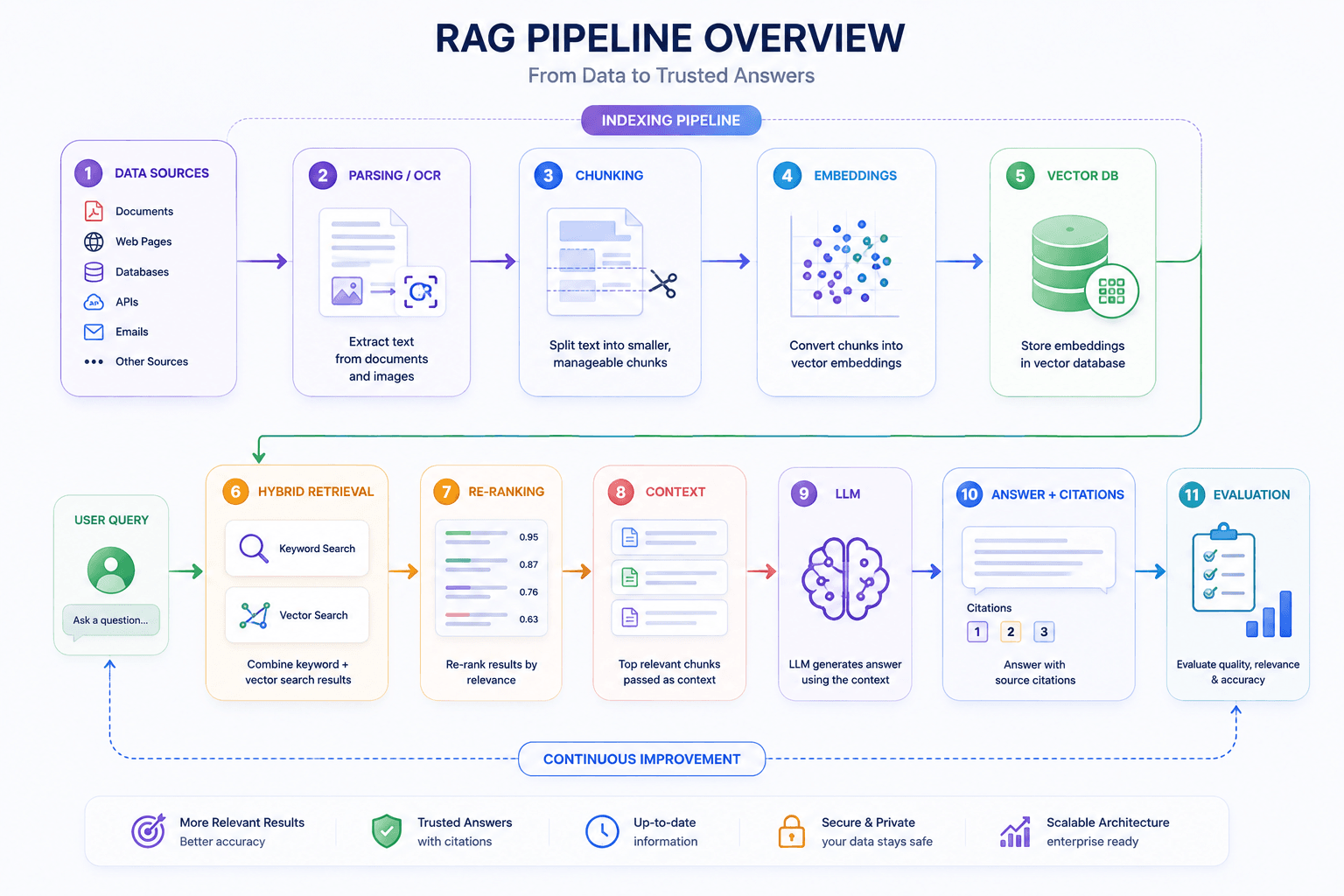
A production RAG system has two operational phases: ingestion (preparing your data) and retrieval plus generation (answering user questions).
1. Ingestion Pipeline
The ingestion workflow prepares enterprise documents for semantic retrieval:
- Document Parsing: Extract text from PDFs, Word documents, Confluence wikis, emails, support tickets, and APIs. Tables, nested headers, and images with embedded text require special handling.
- Semantic Chunking: Split documents into smaller pieces. Production systems typically use semantic chunking with appropriate token windows (typically 256 to 512 tokens) and overlap between chunks to preserve context.
- Vector Embedding: Convert each chunk into a vector using models like OpenAI text embedding 3 large, Cohere Embed v4, or open source alternatives.
- Vector Storage: Store vectors in a vector database such as Pinecone, Weaviate, Qdrant, Milvus, or pgvector with metadata including source, date, owner, and authorization permissions.
2. Retrieval and Generation Pipeline
When a user submits a query, the system executes real time contextual processing:
- Query Embedding: The question is converted into a vector using the identical embedding model.
- Semantic and Keyword Search: The vector database performs hybrid search combining vector semantic similarity and BM25 keyword matching, returning top K chunks.
- Reranking: A cross encoder reranker rescores the retrieved chunks for exact relevance.
- Context Assembly: The top chunks are assembled into a context window alongside the user query.
- LLM Generation: The LLM generates a response grounded in the retrieved context, with instructions to cite sources and explicitly state "I don't know" when context is insufficient.
- Citation and Logging: The system maps response claims back to source documents and logs retrieval and generation metrics for auditability.
For organizations building production RAG pipelines, our specialized RAG Development Services provide end to end architecture engineering and vector database integration.
RAG Architectures: Which One to Choose
Four main RAG patterns are deployed in production systems:
| RAG Type | How It Retrieves | Best For | Trade-offs |
|---|---|---|---|
| Naive RAG | Single retrieve and generate pass over a vector store | FAQ bots, small document sets | Struggles with complex multi hop queries |
| Advanced RAG | Hybrid retrieval (vector + keyword), reranking, query rewriting | Mid scale enterprise search, support assistants | More engineering required, significantly higher precision |
| Agentic RAG | Agent plans, routes, and iterates retrieval across sources | Multi step questions, tool use, agent memory | Higher latency and cost, greater build complexity |
| GraphRAG | Retrieves over a knowledge graph of linked entities | Connected data, multi hop reasoning, thematic queries | Higher build complexity, exceptional for relational data |
Selection Guidance for Enterprises
- Start with Advanced RAG for most enterprise knowledge management use cases.
- Use Agentic RAG for complex multi step workflows and research agents.
- Consider GraphRAG when relationships between entities carry primary business meaning.
- Reserve Naive RAG for simple well scoped applications.
Production systems often combine these approaches depending on query complexity, data structure, and operational requirements.
RAG vs Fine Tuning: Comparison and Decision Framework
| Dimension | RAG | Fine Tuning | RAG + Fine Tuning |
|---|---|---|---|
| Primary Purpose | Ground responses in specific data | Change model behavior, style, or format | Facts via RAG, behavior via fine tuning |
| Data Freshness | Reflects updated data when knowledge base is reindexed | Stale until retrained (hours to weeks) | Real time knowledge with stable model behavior |
| Cost to Update | Low (re-embed new documents) | High (GPU retraining runs) | Moderate overall update cost |
| Hallucination Control | Strong (cites source documents) | Moderate (can still fabricate details) | Maximum control over facts and output formatting |
| Best For | Document Q&A, support, compliance | Tone, formatting, domain specific reasoning | Production enterprise AI products |
| Build Cost (MVP) | $8,000 – $50,000 | $20,000 – $80,000 | $40,000 – $100,000 |
| Time to Production | 3 – 16 weeks | 6 – 12 weeks | 8 – 14 weeks |
Use RAG when your data changes frequently, users require citations, or you work with proprietary data. Use fine tuning when you need a specific output format, tone, or classification behavior. In production, many systems use both: RAG for knowledge, fine tuning for behavior.
RAG Cost Breakdown: Build and Run
Costs vary by scale, data volume, and architecture. The ranges below represent indicative estimates based on enterprise deployments.
Build Costs by Tier
| Tier | System Scope | Cost Range (USD) | Development Timeline |
|---|---|---|---|
| MVP | Naive RAG, single data source, under 10K documents | $8,000 – $50,000 | 3 – 6 weeks |
| Standard | Hybrid retrieval, multiple sources, reranking, evaluation | $30,000 – $75,000 | 6 – 10 weeks |
| Enterprise | Agentic RAG, GraphRAG, multimodal, compliance guardrails | $75,000 – $200,000+ | 10 – 20 weeks |
Data cleaning and preprocessing typically consume a significant portion of total project cost. This surprises most teams, but data quality is the single biggest factor in system precision.
Monthly Operating Costs (Unoptimized vs Optimized)
| Scale Tier | Monthly Query Volume | Monthly Cost (Unoptimized) | Monthly Cost (Optimized) |
|---|---|---|---|
| Startup | 10,000 | $130 – $190 | $80 – $120 |
| Growth | 100,000 | $800 – $1,500 | $400 – $800 |
| Enterprise | 1,000,000+ | $8,000 – $19,000 | $4,500 – $10,000 |
Where the Budget Goes
- Embedding Generation: Varies by model provider and token volume.
- Vector Database Hosting: $70 to $500 per month depending on index scale and provider.
- LLM Inference: The largest variable expense, scaling directly with query volume.
- Reranking Services: Commercial rerankers charge per query; open source models require compute hosting.
- Infrastructure: Compute nodes, networking, observability, and security monitoring.
Cost Optimization Tactics
- Semantic Caching: Cache responses for semantically similar queries to reduce LLM API calls.
- Smart Model Routing: Direct simple queries to lightweight models while reserving frontier models for complex tasks.
- Self Hosted Embeddings: Open source embedding models eliminate per token API fees.
- Open Source Rerankers: Self hosting cross encoders eliminates commercial per query fees.
Teams building mobile applications with integrated AI features can consult our AI Application Development experts for optimized client side deployments.
Essential Features for a Production RAG System
A production ready RAG platform must include:
- Hybrid Retrieval: Combining dense vector search with sparse keyword search and cross encoder reranking.
- Document Level Access Control: Filtering retrieved chunks based on user role and session permissions.
- Retrieval Observability: Logging retrieval precision, recall, and latency alongside generation quality scores.
- Multi Channel Support: Delivering answers via Web, Slack, Teams, WhatsApp, and internal portals from a single knowledge base.
- Automatic Re-indexing: Re-embedding updated documents automatically on a schedule or via change detection webhooks.
- Source Citations: Attaching direct links and metadata to every generated answer.
- System Guardrails: Instructing the model to decline queries when context is insufficient, paired with confidence scoring.
When RAG Is Not the Right Tool
RAG is ideal for knowledge intensive applications, but it is not a universal solution. RAG is not recommended when:
- Required information resides in a transactional SQL database requiring mathematical aggregation
- Answers require deterministic calculations or exact financial logic
- The workflow depends on real time operational API state
- The knowledge base is extremely small and static
- The task requires structured business actions rather than document retrieval
In these scenarios, enterprise architectures combine RAG with SQL generation, API calling, business rules, or agentic workflow tools.
Decision Framework
| Use Case | Recommended Approach |
|---|---|
| Answer questions from internal documents | RAG |
| Deterministic calculations or aggregations | SQL / Database API |
| Real time operational data | API / Tool Calling |
| Change model behavior or output format | Fine Tuning |
| Simple keyword search over documents | Traditional Search |
| Complex multi step research tasks | Agentic RAG |
| Highly relational connected data | GraphRAG |
RAG Evaluation: Start With a Test Dataset
Before modifying chunking, retrieval, reranking, or prompt templates, create a representative test dataset of real user questions with expected answers and source document references.
A comprehensive test dataset includes:
- Questions actual users ask in production
- Expected ground truth answers and target source documents
- Edge cases (ambiguous phrasing, multi hop queries, permission boundaries)
- Negative examples (questions the system should decline to answer)
Key Evaluation Metrics
| Metric | What It Measures |
|---|---|
| Retrieval Precision@K | Percentage of top K retrieved chunks that are relevant |
| Recall@K | Percentage of all relevant chunks appearing in top K |
| MRR (Mean Reciprocal Rank) | Position rank of the first relevant result |
| Faithfulness | Extent to which generated answer sticks to retrieved context |
| Answer Relevance | How accurately the answer addresses the user query |
| Citation Accuracy | Verification that every claim traces back to a source |
| Latency | Time elapsed from query submission to response stream |
| Cost per Query | Combined expense of embedding, retrieval, and LLM inference |
Baseline vs Improved Pipeline Workflow
- Baseline: Measure current retrieval precision, answer faithfulness, and latency using the test dataset.
- Change: Apply a target improvement, such as adding hybrid search or reranking.
- Re-evaluate: Run the identical test dataset through the updated pipeline.
- Decision: If Precision@10 improves by 10% or more with acceptable latency, deploy the change.
Production RAG Tech Stack (2026)
| Architectural Layer | Recommended Technology Options |
|---|---|
| Document Processing | Apache Tika, Unstructured, custom parsing scripts |
| Embedding Models | OpenAI text embedding 3 large, Cohere Embed v4, open source models |
| Vector Databases | Pinecone, Weaviate, Qdrant, Milvus, pgvector |
| Retrieval & Reranking | Hybrid search (Vector + BM25), Cohere Rerank, cross encoders |
| LLM Engine | Hosted APIs (GPT 4o, Claude 3.5 Sonnet) or self hosted (Llama 3, Mixtral) |
| Orchestration | LlamaIndex, LangChain, LangGraph |
| Observability & Evaluation | LangSmith, Arize Phoenix, RAGAS framework |
Real World Query Execution Example
When an employee submits the query: "What is our parental leave policy for employees in India?"
- Query Embedding: The question is converted into a vector representation.
- Hybrid Retrieval: The system executes combined vector and BM25 search across the policy index.
- Permission Filtering: Access control filters exclude documents the user lacks authorization to view.
- Reranking: Candidate chunks are rescored by a cross encoder for exact semantic alignment.
- Context Assembly: Top verified policy passages are injected into the LLM system prompt.
- Generation: The LLM streams a clear answer grounded strictly in the retrieved policy text.
- Citation: The UI attaches verifiable links pointing to the specific HR policy sections.
Security and Permissions in Enterprise RAG
A secure enterprise RAG implementation must:
- Integrate with enterprise Identity Providers (SSO, SAML, OIDC)
- Enforce document level and field level Role Based Access Control (RBAC)
- Log all retrieval, generation, and user access events for compliance audit trails
- Encrypt data both in transit and at rest using enterprise key management
- Apply automated PII redaction and masking prior to context injection
- Guard against prompt injection attacks embedded within untrusted documents
- Isolate tenant data in multi-tenant SaaS environments
Data Privacy Note: Proprietary data remains within your controlled infrastructure when using self hosted databases. When using hosted LLM APIs, retrieved context is transmitted to the API provider. Organizations requiring absolute privacy can self host both embedding models and LLMs within a private cloud network boundary.
Common RAG Failure Scenarios and Mitigations
| Failure Mode | What Happens | Engineering Mitigation |
|---|---|---|
| Answer Not in Knowledge Base | System cannot find relevant context | Instruct LLM to decline and state "Insufficient information" |
| Irrelevant Retrieval | System pulls unrelated document chunks | Refine chunking size, add reranking, implement query rewriting |
| Contradictory Documents | Documents contain conflicting policy versions | Surface both sources and flag for editorial human review |
| Outdated Documents | System retrieves old document revisions | Implement document version tracking and deprecation tags |
| Permission Violation | User views context from restricted files | Enforce permission aware filtering at the vector retrieval layer |
Practical Architecture Implementations
Small Company Architecture Stack
- Vector Database: PostgreSQL + pgvector
- Embedding Model: Open source (such as bge small en)
- Reranker: Open source cross encoder
- LLM: Hosted API (GPT 4o or Claude)
- Orchestration: LlamaIndex or LangChain
Enterprise Architecture Stack
- Vector Database: Pinecone, Weaviate, or Qdrant
- Embedding Model: OpenAI text embedding 3 large or Cohere Embed v4
- Reranker: Commercial Cohere Rerank or self hosted cross encoder
- LLM: Hosted enterprise API or self hosted Llama 3 / Mixtral
- Orchestration: LangGraph for multi agent workflows
- Security: SSO, RBAC enforcement, automated audit logging, VPC deployment
Enterprise RAG Checklist
- Security: SSO integration, end to end encryption, comprehensive audit logging
- Access Control: Document level and field level permissions enforced at query time
- Data Freshness: Automated re-indexing pipelines responding to source updates
- Citations: Verifiable source links attached to every generated claim
- Evaluation: Standardized test dataset tracking retrieval and faithfulness metrics
- Monitoring: Observability dashboards for latency, token costs, and precision
- Cost Control: Semantic caching, model routing, and self hosted embeddings
- Scalability: Horizontal scaling for vector databases and retrieval endpoints
- Compliance: PII masking, data retention controls, tenant isolation
Where Enterprise RAG Is Heading
Enterprise RAG engineering is evolving across four key frontiers:
- Multimodal Retrieval: Processing diagrams, technical schematics, tables, scanned contracts, and audio alongside text.
- Real Time Hybrid Retrieval: Blending indexed vector stores with live database APIs and transactional streams.
- Agentic RAG Workflows: RAG operating as a specialized tool invoked by autonomous AI agents during multi step workflows.
- Rigorous Continuous Evaluation: Moving from subjective outputs to automated regression testing with RAGAS and Arize.
Conclusion
RAG is no longer an experimental demo technique. It is enterprise software infrastructure for accurate, up to date, and auditable AI. The difference between a simple RAG demo and a production product lies in rigorous evaluation, access control governance, and continuous observability. Build your data pipeline right, measure precision from day one, and plan for ongoing optimization.
For many enterprise knowledge-search use cases, RAG can provide a maintainable way to connect changing organizational information to generative AI without retraining the underlying model. But it must be built as an architecture and governance project, not just an AI chatbot project.
Frequently Asked Questions
What is RAG in simple terms?
RAG (Retrieval Augmented Generation) connects an AI model directly to your proprietary data so it looks up real information before answering. Instead of relying on what the model memorized during training, RAG searches your documents and knowledge base in real time to generate accurate, grounded responses.
How is RAG different from fine tuning?
RAG retrieves external data at query time without modifying model parameters, while fine tuning bakes knowledge into model weights through additional training. RAG is superior for frequently changing data where source citations are required. Fine tuning is ideal for modifying output tone, formatting, or domain reasoning. In production, many enterprise systems combine both approaches.
What databases work best for RAG?
Managed vector databases like Pinecone streamline infrastructure operations, while databases like Qdrant, Milvus, and pgvector provide greater control, custom deployment options, and cost flexibility. The optimal choice depends on your data volume, security requirements, and cloud infrastructure preferences.
How much does a production RAG system cost to build?
Development costs range from $8,000 to $50,000 for a basic single source MVP built over 3 to 6 weeks. A production grade system with hybrid retrieval, reranking, and evaluation pipelines ranges from $30,000 to $75,000 over 6 to 10 weeks. Enterprise platforms featuring Agentic RAG, GraphRAG, and strict security compliance can exceed $200,000. Monthly operating costs range from $80 to $190 for startups up to $4,500 to $10,000+ for enterprise scale.
Can RAG work with private company data?
Yes. Proprietary data remains within your controlled infrastructure. Documents are embedded and stored in your vector database, and only relevant passages are transmitted as context for specific queries. For maximum data privacy, organizations can self host both embedding models and LLMs within a private cloud network boundary.
What is Agentic RAG?
Agentic RAG puts autonomous AI agents in charge of multi step retrieval workflows instead of running a single retrieve and generate pass. The agent decomposes complex questions into sub-queries, routes them across diverse data stores, evaluates candidate retrieval quality, and iterates until sufficient context is gathered.
What is GraphRAG?
GraphRAG builds a knowledge graph from enterprise documents by extracting entities and their relationships, then leverages the graph structure for retrieval. It is particularly effective for complex thematic queries, healthcare records, financial portfolios, and highly relational domain data.
How do you measure RAG accuracy?
Accuracy is evaluated across three core dimensions: retrieval quality (Precision@K, Recall@K, MRR), generation faithfulness (sticking to retrieved context without hallucinations), and end to end answer correctness (citation accuracy and task success). Frameworks like RAGAS, LangSmith, and Arize Phoenix provide automated benchmarking test suites.
Does RAG eliminate AI hallucinations completely?
No. RAG significantly reduces hallucinations by grounding answers in context, but does not eliminate them entirely. Hallucinations can occur if retrieved context is ambiguous or incomplete. Production RAG systems require system guardrails, confidence scoring, citation verification, and fallback responses when context is insufficient.
What frameworks are best for building RAG systems?
LangChain and LlamaIndex are the primary frameworks for building RAG applications. LangChain provides broad flexibility and an ecosystem including LangGraph for agentic workflows and LangSmith for observability. LlamaIndex offers optimized abstractions tailored specifically for data ingestion and retrieval pipelines.