- A DEWA-inspired utility app should bring together account management, billing, payments, smart-meter data, service requests, sustainability, EV charging, and AI assistance in one connected experience.
- The next generation of utility platforms will move beyond answering customer questions toward securely preparing and executing approved service workflows.
- Agentic AI is already influencing UAE utility services. In September 2026, DEWA reported that 16 of its 21 services had adopted agentic AI, demonstrating a shift toward AI-driven service execution. Building such capabilities requires permission-based tools, policy controls, human approvals, transaction limits, audit trails, and rollback mechanisms.
- The most complex engineering challenges often lie beyond the mobile interface, particularly in legacy-system integration, smart-meter connectivity, identity management, payments, cybersecurity, and operational governance.
- A realistic enterprise development budget can range from USD 150,000 to USD 400,000+, depending on integration complexity, IoT requirements, AI capabilities, compliance, and deployment scale.
- Large public-sector or multi-utility implementations may exceed USD 700,000 and require approximately 18–36 months, depending on scope and implementation requirements.
- Choosing a mobile app development company in the UAE requires evaluating enterprise integration expertise, security practices, and long-term operational capabilities, not just design quality or development speed.
- The broader opportunity is to build an AI-native utility operating layer that connects customers, field teams, infrastructure assets, payments, and enterprise service systems through secure, coordinated workflows.
Building an app like the DEWA Smart App in 2026 means creating more than a digital billing portal. It requires a secure, AI-enabled utility platform that connects customer accounts, smart meters, payments, field operations, sustainability services, EV charging, and enterprise systems.
The most important market shift is the move from conversational AI to agentic utility services. In September 2026, DEWA reported that 16 of its 21 services had been transformed into agentic-AI-powered services, representing 76% of its service portfolio. This makes agentic service execution a current UAE utility trend rather than a distant future concept.
Important: This article explains how to build an original DEWA-inspired platform. It does not suggest copying DEWA’s branding, proprietary design, internal systems, or protected assets.
Why This Topic Is Important in the UAE
The UAE is moving from AI pilots toward AI-enabled public services and infrastructure. Dubai’s AI blueprint focuses on accelerating AI adoption, improving government services, and supporting the emirate’s position as a global technology and innovation hub.
DEWA’s recent agentic-AI transformation provides a practical example of this direction. The reported shift covers service workflows rather than merely adding a chatbot to a website or mobile app.
For technology companies, this creates a stronger opportunity than building a standard utility application. The demand is moving toward platforms that can:
- Understand customer intent.
- Retrieve verified account information.
- Coordinate several backend systems.
- Prepare service actions.
- Obtain approvals.
- Execute authorized workflows.
- Verify outcomes.
- Escalate exceptions.
What a DEWA-Inspired App Should Solve
A successful product should solve three connected problems:
Customer problem
Customers want to:
- Understand their bills.
- Pay quickly.
- Monitor consumption.
- Receive early warnings.
- Report problems.
- Track service requests.
- Manage multiple properties.
- Reduce utility costs.
Utility-operations problem
Utility teams need to:
- Reduce repetitive service work.
- Detect anomalies earlier.
- Prioritize field cases.
- Reconcile payments.
- Improve customer communication.
- Manage assets and infrastructure.
- Use operational data more effectively.
Business problem
The organization needs to:
- Reduce support cost.
- Improve service completion time.
- Increase digital adoption.
- Control AI and cloud expenditure.
- Improve customer satisfaction.
- Support sustainability targets.
- Create a scalable technology foundation.
A strong app connects all three. If it focuses only on customer screens, it becomes a front-end project rather than a digital utility platform.
Core Product Modules
1. Customer and identity management
The identity layer should support:
- Secure registration and login.
- Multi-factor authentication.
- Biometric login where appropriate.
- Digital-identity integration.
- Account linking.
- Premise verification.
- Tenant and owner relationships.
- Multiple properties.
- Delegated access for facility teams.
- Role-based access for business accounts.
The identity system should be connected to utility accounts and premises rather than operating as a separate consumer profile.
2. Utility account lifecycle
The platform should support the customer from connection to closure:
- New connection.
- Move-in.
- Move-out.
- Account transfer.
- Premise linking.
- Service reconnection.
- Security-deposit status.
- Account closure.
- Final billing.
- Document submission.
- Service-history access.
These workflows often require integration with customer-information systems, billing platforms, identity providers, document management, payment services, and field operations.
3. Billing and payment management
Important capabilities include:
- Current bill display.
- Bill breakdown.
- Payment history.
- Downloadable invoices.
- Payment receipts.
- Auto-pay.
- Payment reminders.
- Installment requests.
- Refund tracking.
- Failed-payment handling.
- Corporate payment approvals.
- Payment-dispute initiation.
The design should make the amount, due date, payment status, and account identifier immediately understandable.
Payment security should use tokenization and compliant payment providers. The application should avoid storing raw card details unless the organization has the appropriate controls and certifications.
4. Consumption intelligence
Consumption functionality should go beyond basic graphs.
Useful features include:
- Hourly, daily, weekly, and monthly usage.
- Electricity and water trends.
- Previous-period comparison.
- Property-level comparison.
- Weather-adjusted analysis.
- Peak-demand identification.
- Estimated upcoming bill.
- Usage-change explanations.
- Efficiency recommendations.
- Carbon-impact estimates.
A high-quality product answers three questions:
- What changed?
- Why did it change?
- What can the customer do next?
5. Leak and anomaly detection
Anomaly detection can identify:
- Continuous water flow.
- Sudden electricity spikes.
- Usage during an away period.
- Unexpected consumption after a tenant change.
- Meter-reading gaps.
- Abnormal night-time demand.
- Consumption inconsistent with historical behaviour.
The app should communicate confidence and urgency clearly. A possible leak, a confirmed leak, and a network incident should not appear as the same type of notification.
6. Away mode
Away mode allows users to define when a property is vacant.
The platform can then:
- Establish a reduced usage baseline.
- Detect unexpected consumption.
- Send push notifications.
- Request user confirmation.
- Recommend property inspection.
- Prepare a service request.
- Connect to approved remote controls where available.
Remote shutoff should not be treated as a simple convenience feature. It requires authorization, safety checks, failure handling, and an audit trail.
7. Service requests and field operations
Customers may need to:
- Report outages.
- Report leaks.
- Request meter testing.
- Upload images.
- Submit documents.
- Schedule visits.
- Track technician arrival.
- Reschedule appointments.
- View service history.
- Confirm job completion.
The utility backend should connect the request to:
- Work-order management.
- GIS.
- Asset information.
- Technician availability.
- Inventory.
- Escalation rules.
- Customer communications.
8. EV charging services
An EV module may provide:
- Charging-station discovery.
- Availability information.
- Navigation.
- QR-code scanning.
- Session start and stop.
- Charging history.
- Digital receipts.
- Fleet accounts.
- Station issue reporting.
- Pricing visibility.
The charging module should use live station and session APIs. A static map adds little value.
9. Sustainability services
A future-ready utility app can provide:
- Water-efficiency recommendations.
- Electricity-saving suggestions.
- Carbon-impact estimates.
- Solar-generation monitoring.
- Net-metering information.
- EV charging insights.
- Building sustainability reports.
- Progress toward energy targets.
For commercial users, sustainability reporting can become an enterprise feature rather than only a consumer dashboard.
Agentic AI: The Main 2026 Differentiator
Chatbot versus agent
A chatbot mainly responds to a user’s message. An agentic system can:
- Understand an objective.
- Retrieve authorized data.
- Plan a sequence of steps.
- Use approved tools.
- Ask for missing information.
- Request approval.
- Execute an authorized action.
- Verify the result.
- Update the customer.
- Escalate exceptions.
This distinction matters because utility actions can affect money, services, property, safety, and infrastructure.
High-value utility agents
Bill-explanation agent
This agent can explain:
- Current charges.
- Usage changes.
- Tariff components.
- Estimated versus final amounts.
- Payment status.
- Previous-period differences.
It should use verified billing data and cite the relevant account or tariff source internally.
Bill-forecasting agent
The agent can estimate the next bill using:
- Current consumption.
- Historical readings.
- Seasonal patterns.
- Tariffs.
- Weather.
- Account changes.
- Solar or EV activity.
The result must be labelled as a forecast. It should not present a prediction as a final invoice.
Consumption-anomaly agent
This agent investigates unusual patterns and may:
- Compare current usage with historical baselines.
- Check away-mode settings.
- Consider weather and occupancy information.
- Ask the user targeted questions.
- Recommend an inspection.
- Prepare a service request.
Connection-activation agent
A controlled activation workflow may:
- Verify identity.
- Validate the premise.
- Check required documents.
- Calculate charges.
- Prepare the activation request.
- Initiate payment.
- Track completion.
- Notify the customer.
This is a multi-system workflow, not simply a chatbot response.
Payment-reconciliation agent
This agent can identify:
- Delayed payment confirmations.
- Duplicate transactions.
- Unmatched payment references.
- Failed payment callbacks.
- Receipt-generation issues.
It should create an exception for human review rather than silently modifying financial records.
Field-triage agent
A field agent can classify cases by:
- Safety risk.
- Customer impact.
- Asset criticality.
- Location.
- Duplicate reports.
- Required technician capability.
- Expected restoration time.
Critical infrastructure decisions should remain human-supervised.
Sustainability agent
This agent can turn raw usage data into specific recommendations based on:
- Property type.
- Historical usage.
- Weather.
- Tariff structure.
- Solar generation.
- EV usage.
- Occupancy patterns.
Agentic workflow governance
An agent should not receive unrestricted access to utility systems.
Every agent needs:
- A defined purpose.
- Approved tools.
- Data-access boundaries.
- Role permissions.
- Transaction limits.
- Approval thresholds.
- Human escalation rules.
- Audit logging.
- Prompt and policy versioning.
- Emergency suspension.
- Rollback procedures.
Controlled action model
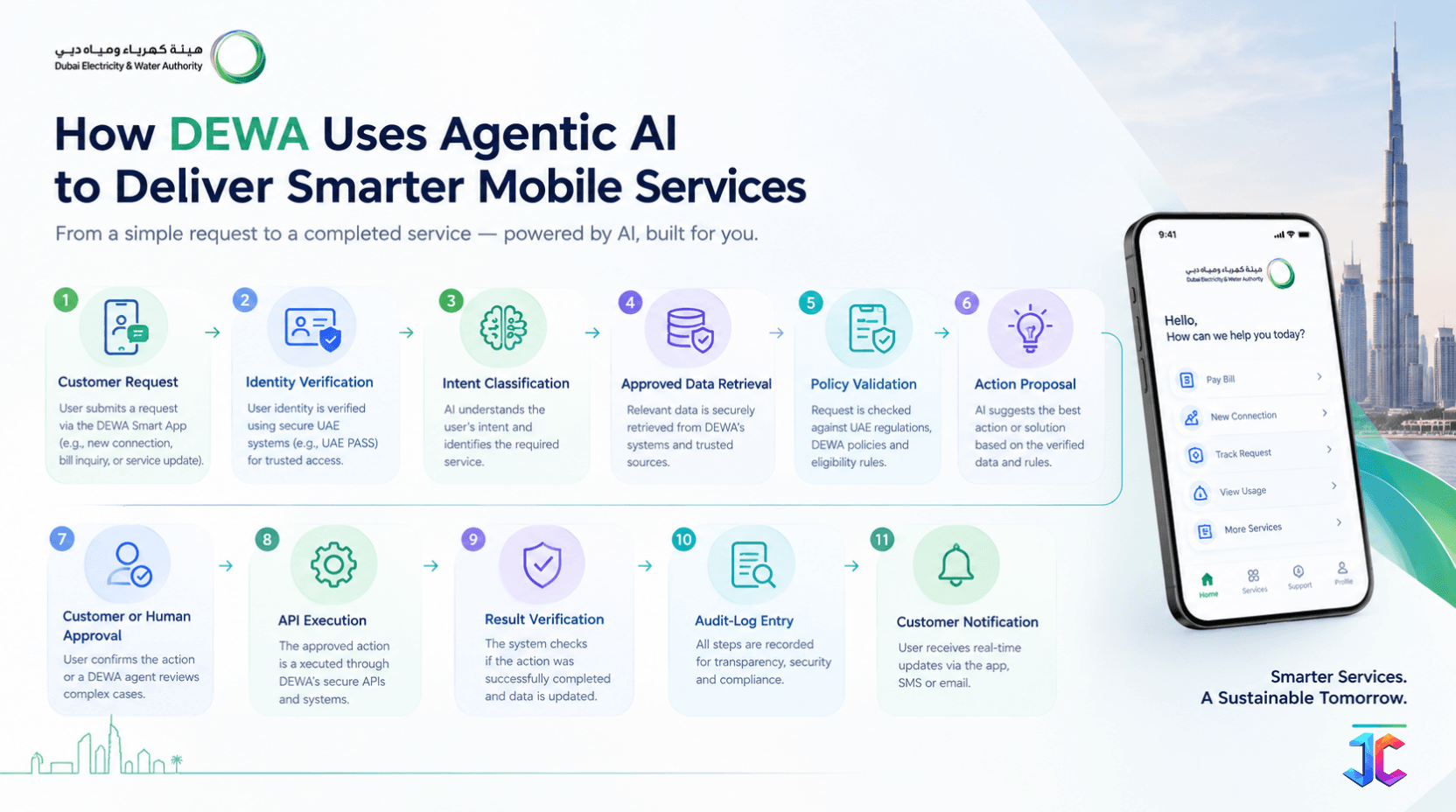
This structure separates the AI model from the systems that perform real-world actions.
Recommended System Architecture
Data and integration layer
The platform may connect with:
- Customer-information systems.
- Billing and revenue-management systems.
- Smart electricity meters.
- Smart water meters.
- Payment gateways.
- Digital identity providers.
- GIS and outage systems.
- Field-service platforms.
- EV charging networks.
- Building-management systems.
- Weather services.
- Solar and battery systems.
IoT and telemetry layer
Meter data may arrive through:
- NB-IoT.
- LTE-M.
- LoRaWAN.
- Cellular networks.
- RF mesh.
- Utility-specific protocols.
The ingestion layer should authenticate devices, validate readings, detect duplicates, manage retries, and separate real-time events from batch imports.
Stream-processing layer
Use stream processing to:
- Normalize meter readings.
- Detect missing data.
- Calculate rolling windows.
- Trigger anomaly detection.
- Publish events.
- Store raw and processed data.
- Replay failed events.
Data layer
Use separate storage for separate workloads:
- PostgreSQL or SQL Server: Accounts, billing, payments, workflows, and permissions.
- TimescaleDB or InfluxDB: Interval meter readings.
- Redis: Sessions, caching, rate limits, and temporary state.
- Object storage: Invoices, documents, images, reports, and audit exports.
- Search and vector storage: Utility knowledge and retrieval.
- Data warehouse: Historical analytics and forecasting.
Application layer
Mobile and web clients should connect through secure APIs managed by an API gateway.
Important components include:
- REST or GraphQL APIs.
- OAuth 2.0.
- OpenID Connect.
- Short-lived tokens.
- Multi-factor authentication.
- Rate limiting.
- API versioning.
- Request validation.
- Service-to-service authorization.
- Push notifications.
- Event-driven workflows.
AI and analytics layer
The AI layer may include:
- Large language models.
- Small task-specific models.
- Retrieval-augmented generation.
- Tool-calling services.
- Workflow orchestration.
- Anomaly-detection models.
- Forecasting models.
- Document understanding.
- Image classification.
- Evaluation pipelines.
- Policy guardrails.
Technology Stack
| Layer | Suitable technologies | Purpose |
|---|---|---|
| Mobile | Flutter, React Native, Swift, Kotlin | Cross-platform and native app delivery |
| Web | React, Angular, Vue | Customer and operations portals |
| Backend | Java Spring Boot, .NET, Node.js, Go | Transactional services and integrations |
| API management | Apigee, Kong, AWS API Gateway, Azure API Management | Routing, throttling, access control |
| Identity | OAuth 2.0, OpenID Connect, enterprise IAM | Authentication and authorization |
| Streaming | Apache Kafka, Azure Event Hubs, AWS MSK, Apache Flink | Meter and event processing |
| Transactions | PostgreSQL, SQL Server, Oracle | Billing, accounts, payments, workflows |
| Time series | TimescaleDB, InfluxDB | Consumption readings |
| Cache | Redis | Fast access and temporary state |
| AI orchestration | LangGraph or custom workflow services | Stateful agent execution |
| Models | Managed APIs or approved open-weight models | Language, reasoning, extraction |
| ML | Python, PyTorch, scikit-learn | Forecasting and anomaly detection |
| Retrieval | OpenSearch, Elasticsearch, vector database | Approved knowledge search |
| Cloud | AWS, Microsoft Azure, or approved regional cloud | Deployment and resilience |
| Security | Vault, cloud KMS, SIEM, WAF | Secrets, encryption, monitoring |
The final technology selection should depend on existing utility systems, data-residency needs, internal capabilities, procurement standards, and expected scale.
Security and Compliance
A utility platform handles sensitive account, identity, payment, consumption, and infrastructure data.
Identity protection
Implement:
- Multi-factor authentication.
- Role-based access.
- Privileged-access management.
- Device and session monitoring.
- Step-up authentication.
- Separate customer and operator roles.
- Delegated business access.
- Session expiry and revocation.
Data protection
Use:
- Encryption in transit and at rest.
- Key-management services.
- Tokenized payment information.
- Field-level protection.
- Data minimization.
- Retention controls.
- Deletion workflows.
- Controlled exports.
- Tenant isolation.
API and application security
Include:
- Secure coding standards.
- Input validation.
- API authorization.
- Rate limiting.
- Bot protection.
- Dependency scanning.
- Secret rotation.
- Vulnerability management.
- Centralized security monitoring.
AI security
Protect against:
- Prompt injection.
- Tool hijacking.
- Data exfiltration.
- Retrieval poisoning.
- Unauthorized actions.
- Excessive permissions.
- Malicious documents.
- Hallucinated transactions.
- Cross-tenant data exposure.
High-impact operations should require structured inputs, allowlisted tools, validation rules, confirmation, and complete logging.
Development Cost
The phrase “app like DEWA” can refer to very different products. A billing application, a smart-meter platform, and a public multi-utility ecosystem do not have the same scope or cost.
Indicative cost ranges
| Scope | Estimated cost | Timeline |
|---|---|---|
| Customer utility MVP | USD 80,000–150,000 | 4–7 months |
| Smart utility platform | USD 150,000–300,000 | 7–12 months |
| Enterprise utility ecosystem | USD 300,000–700,000+ | 12–24+ months |
| Public-sector multi-utility platform | USD 700,000–1.5 million+ | 18–36+ months |
For a UAE or Dubai deployment, cost may increase because of:
- Local product management.
- Arabic and English support.
- Utility integrations.
- Smart-meter access.
- Security assessments.
- Data-residency requirements.
- Payment compliance.
- Field-service systems.
- Government procurement.
- High availability.
- Ongoing support.
Cost by workstream
| Workstream | Indicative range |
|---|---|
| Discovery and architecture | USD 15,000–40,000 |
| UX, accessibility, and design system | USD 20,000–60,000 |
| Mobile and web development | USD 45,000–130,000 |
| Billing, payment, identity, and utility integrations | USD 40,000–150,000 |
| IoT and consumption analytics | USD 40,000–150,000 |
| Agentic AI and retrieval | USD 35,000–150,000 |
| Security and penetration testing | USD 25,000–100,000 |
| QA and performance testing | USD 20,000–80,000 |
| Deployment, monitoring, and documentation | USD 15,000–60,000 |
The largest cost drivers are normally integration complexity, data availability, security, smart-meter architecture, agent governance, and operational workflows.
Ongoing costs
Budget separately for:
- Cloud infrastructure.
- AI model usage.
- IoT ingestion.
- Storage.
- Monitoring.
- Security tools.
- Payment fees.
- Notifications.
- Customer support.
- Human review.
- Penetration testing.
- Model evaluation.
- Disaster recovery.
- Application maintenance.
Development Roadmap
Phase 1: Product discovery
Define:
- Target users.
- Launch geography.
- Utility services.
- Existing systems.
- Smart-meter availability.
- Payment providers.
- Identity requirements.
- AI use cases.
- Security obligations.
- Success metrics.
Phase 2: Architecture and feasibility
Prepare:
- System architecture.
- Data-flow diagrams.
- API contracts.
- Integration plan.
- Agent-permission model.
- Data-retention policy.
- Threat model.
- Operating-cost estimate.
- Disaster-recovery design.
Phase 3: Customer MVP
Launch with:
- Secure login.
- Account linking.
- Bill viewing.
- Payments.
- Consumption summaries.
- Notifications.
- Service requests.
- Support search.
- Basic administration.
Phase 4: Smart utility layer
Add:
- Interval meter data.
- Leak detection.
- Anomaly alerts.
- Bill forecasting.
- Away mode.
- Sustainability recommendations.
- Field-service tracking.
- EV charging.
Phase 5: Controlled agents
Introduce:
- Bill-explanation agents.
- Customer-support agents.
- Anomaly-investigation agents.
- Service-request preparation.
- Payment-reconciliation support.
- Field triage.
Begin with read-only and recommendation workflows before enabling approved actions.
Phase 6: Enterprise scale
Add:
- Multi-utility support.
- Digital-twin operations.
- Model routing.
- Regional deployment.
- Enterprise analytics.
- Advanced FinOps.
- Continuous security testing.
- AI evaluation.
- Human escalation centres.
How to Choose a Mobile App Development Company in Dubai or UAE
A mobile app development company in Dubai may be suitable for the application layer, but a complete utility platform requires enterprise capabilities.
Evaluate whether the partner understands:
- Utility and billing integrations.
- Smart-meter data.
- IoT architecture.
- Payment security.
- Digital identity.
- Arabic and English UX.
- Cloud and data residency.
- AI governance.
- API security.
- Penetration testing.
- Field-service workflows.
- Accessibility.
- Post-launch operations.
Request:
- An enterprise case study.
- A reference architecture.
- A sample smart-meter data flow.
- A security threat model.
- A detailed cost model.
- An agent-permission design.
- A support and SLA proposal.
- Source-code ownership terms.
- Data-export and migration terms.
- Model-provider migration planning.
A low quote is not necessarily a low-cost solution if it excludes integration, security, evaluation, monitoring, or maintenance.
Business Models
Utility and municipal licensing
License the platform to electricity, water, district-cooling, or municipal organizations through implementation fees and annual contracts.
Property-management SaaS
Charge based on buildings, units, meters, administrator seats, or monitored assets.
Energy-management subscriptions
Offer forecasting, anomaly alerts, advanced reports, and optimization features through paid plans.
Enterprise integration services
Charge for custom APIs, private deployment, reporting, data connectors, and support.
EV and fleet services
Generate revenue through charging management, fleet tools, station management, or enterprise mobility integrations where permitted.
Future Impact
Utility apps will become service engines
The main product will no longer be the dashboard. The dashboard will become the interface to a broader service engine that understands accounts, assets, payments, usage, and operational workflows.
AI agents will coordinate departments
A customer request may involve identity, billing, payments, field operations, customer support, and communications. Agents can coordinate the workflow while humans handle exceptions and sensitive decisions.
Smart-meter data will become operational intelligence
Meter data will support more than customer charts. It will help identify equipment problems, improve demand planning, prioritize inspections, and support sustainability programmes.
Utility and building platforms will converge
Residential and commercial utility applications will increasingly connect with:
- Building-management systems.
- Solar generation.
- Battery storage.
- EV chargers.
- Facility-management tools.
- Occupancy data.
- Indoor-environment systems.
Trust will become a competitive advantage
Customers and enterprise buyers will expect to know:
- What the AI is doing.
- What data it is using.
- Why it made a recommendation.
- Which actions require approval.
- How to correct an error.
- How to delete or export data.
- When a human is involved.
What Should Not Be Automated First
Avoid starting with high-risk automation such as:
- Automatic service disconnection.
- Unverified payment changes.
- Remote water or electricity shutoff.
- Contract or tariff modifications.
- High-impact field dispatch.
- Sensitive identity decisions.
- Unsupervised account closure.
Begin with low-risk, high-value capabilities:
- Bill explanations.
- Service-status updates.
- Consumption alerts.
- Knowledge search.
- Document collection.
- Service-request preparation.
- Payment-status explanations.
- Human-support handoff.
FAQs for Decision-Makers
What is the strongest MVP for a DEWA-inspired app?
The strongest MVP usually includes secure identity, account linking, bill viewing, payment processing, consumption summaries, notifications, service requests, and a searchable support experience. Add smart-meter intelligence only when reliable data access is confirmed.
Should agentic AI be included in the MVP?
Include agentic AI in a controlled way. Begin with bill explanations, knowledge retrieval, anomaly alerts, and service-request preparation. Avoid unrestricted transaction execution until the organization has permission controls, evaluation, audit logging, and human escalation.
What is the most difficult integration?
The most difficult integration is usually not the mobile application. It is connecting legacy customer-information, billing, payment, smart-meter, field-service, GIS, and identity systems while maintaining consistent data, security, and transaction status.
How can a utility app reduce operational cost?
It can reduce repetitive support work, improve payment reconciliation, identify abnormal consumption earlier, reduce duplicate service requests, prioritize field work, and provide customers with self-service explanations. The reduction depends on integration quality and adoption, not simply app downloads.
How should success be measured?
Use operational and customer metrics together:
- Digital-service completion rate.
- Average service-resolution time.
- Payment-success rate.
- Support deflection.
- Anomaly-detection precision.
- False-alert rate.
- Customer satisfaction.
- AI escalation rate.
- Cost per digital transaction.
- Cloud and model cost per active user.
- Field-dispatch efficiency.
- Utility-loss reduction.
How can businesses avoid AI vendor lock-in?
Keep prompts, character or agent definitions, evaluation datasets, tool schemas, memories, analytics, and user data in portable formats. Use an orchestration layer that allows approved model providers to be changed without rebuilding the entire product.
Is this platform useful for private property developers?
Yes. A private version can connect building management, tenant services, utility consumption, maintenance requests, EV charging, access systems, and sustainability reporting. It should be positioned as a smart-building or energy-management platform rather than a public utility replacement.
What should an agency include in its proposal?
The proposal should include product scope, system architecture, integration assumptions, security model, AI-agent permissions, cost estimates, operating costs, testing, ownership, support, migration, and acceptance criteria. A feature list and development timeline alone are not sufficient.
Conclusion
Building an app like the DEWA Smart App in 2026 requires an enterprise utility strategy rather than a standard mobile-app project.
The strongest product will combine:
- Secure identity.
- Account and billing management.
- Smart-meter intelligence.
- Payments.
- Service workflows.
- Field operations.
- EV charging.
- Sustainability.
- Agentic AI.
- Governance and auditability.
The most valuable future capability is not an AI chatbot that gives faster answers. It is a governed service layer that can understand customer objectives, coordinate approved systems, execute routine workflows, verify outcomes, and involve human teams when risk or complexity increases.
For businesses searching for a mobile app development company in Dubai, the right partner should demonstrate utility integration, enterprise architecture, AI governance, cybersecurity, bilingual experience, cloud resilience, and post-launch operations. That combination is what turns a utility app into a scalable smart-city platform.