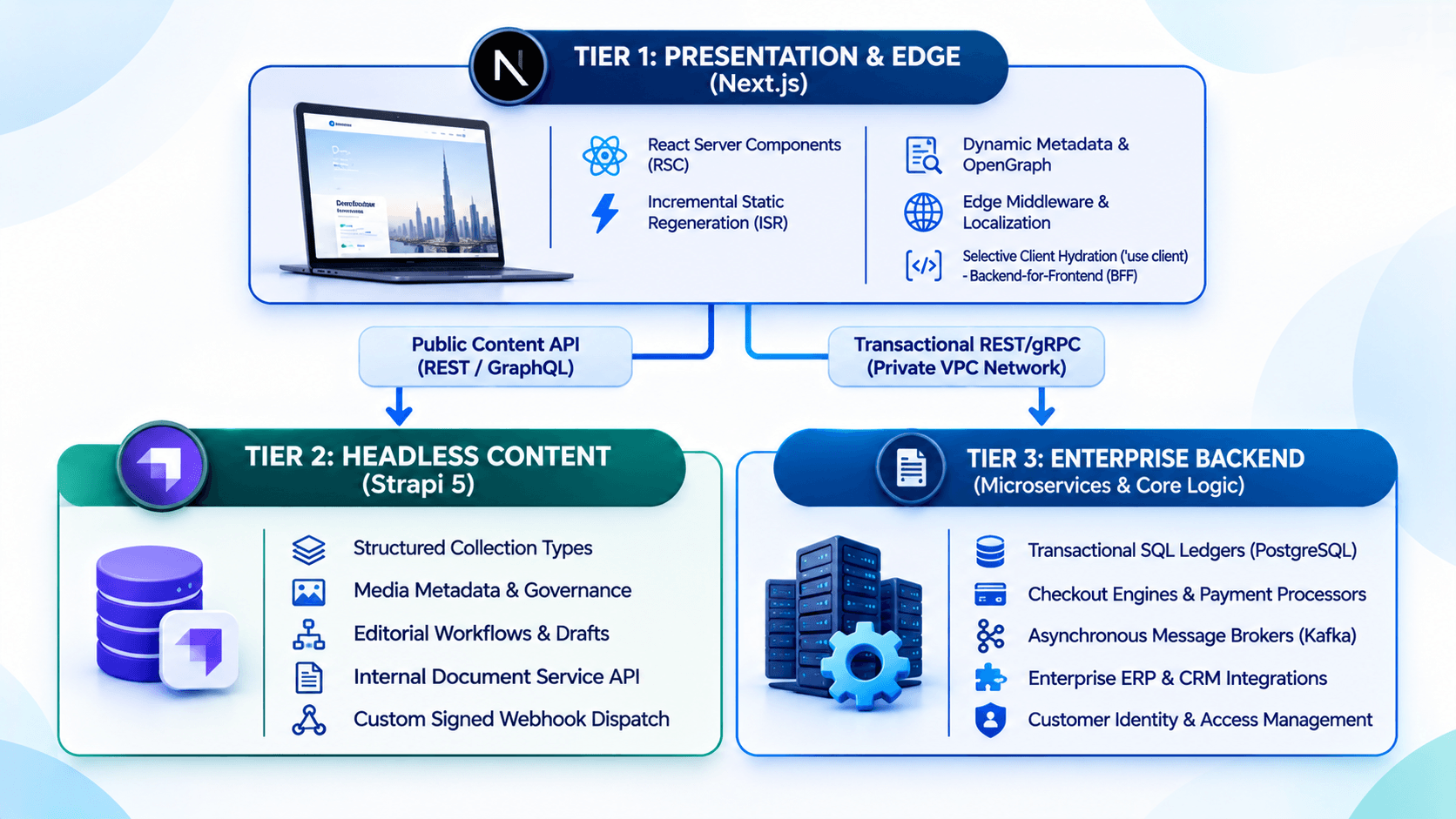
- Three-Tier Architectural Separation: Modernizing monolithic legacy PHP requires establishing clear operational boundaries between the presentation edge (Next.js), the headless content engine (Strapi 5), and core transactional services (Enterprise Backend).
- API Distinctions: Downstream frontends consume content exclusively through Strapi's HTTP REST and GraphQL Content APIs, whereas Strapi's internal Document Service API is reserved for server-side lifecycle logic, custom plugins, and automated ETL loader scripts.
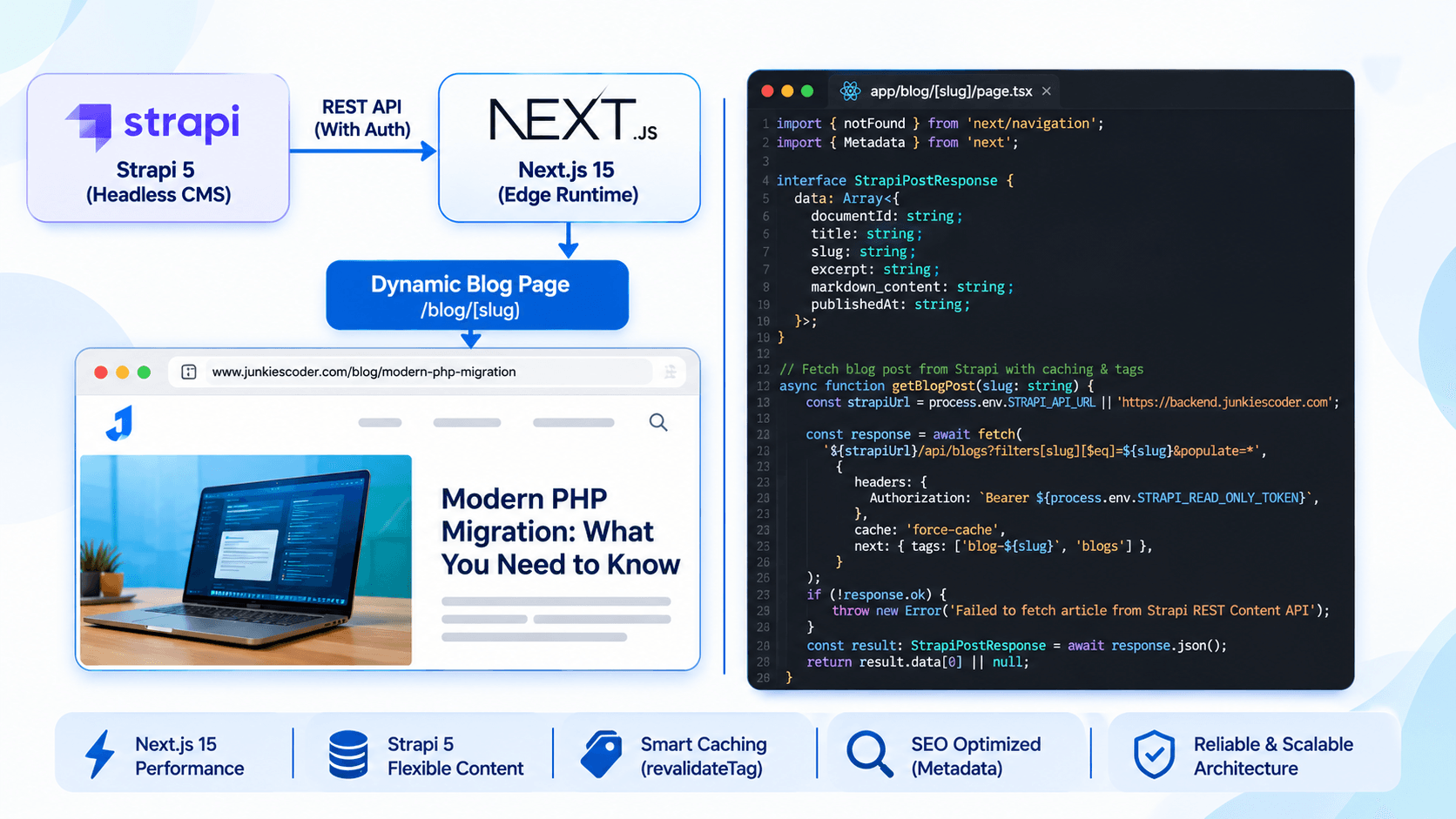
- Next.js 15 Cache Orchestration: In Next.js 15, fetch requests are un-cached by default. High-performance marketing routes must explicitly define tag-based caching parameters (
cache: 'force-cache',next: { tags: [...] }), paired with on-demand cache purges viarevalidateTag. - Cryptographic Webhook Security with Replay Protection: Secure cache invalidation requires custom Strapi HMAC signing paired with timestamp validation in Next.js to eliminate replay attacks, using constant-time buffer comparisons (
crypto.timingSafeEqual). - Selective Client Hydration: React Server Components execute exclusively on the server to keep static content outside the browser bundle, while interactive UI elements selectively hydrate using Client Components (
'use client').
Quick Answer
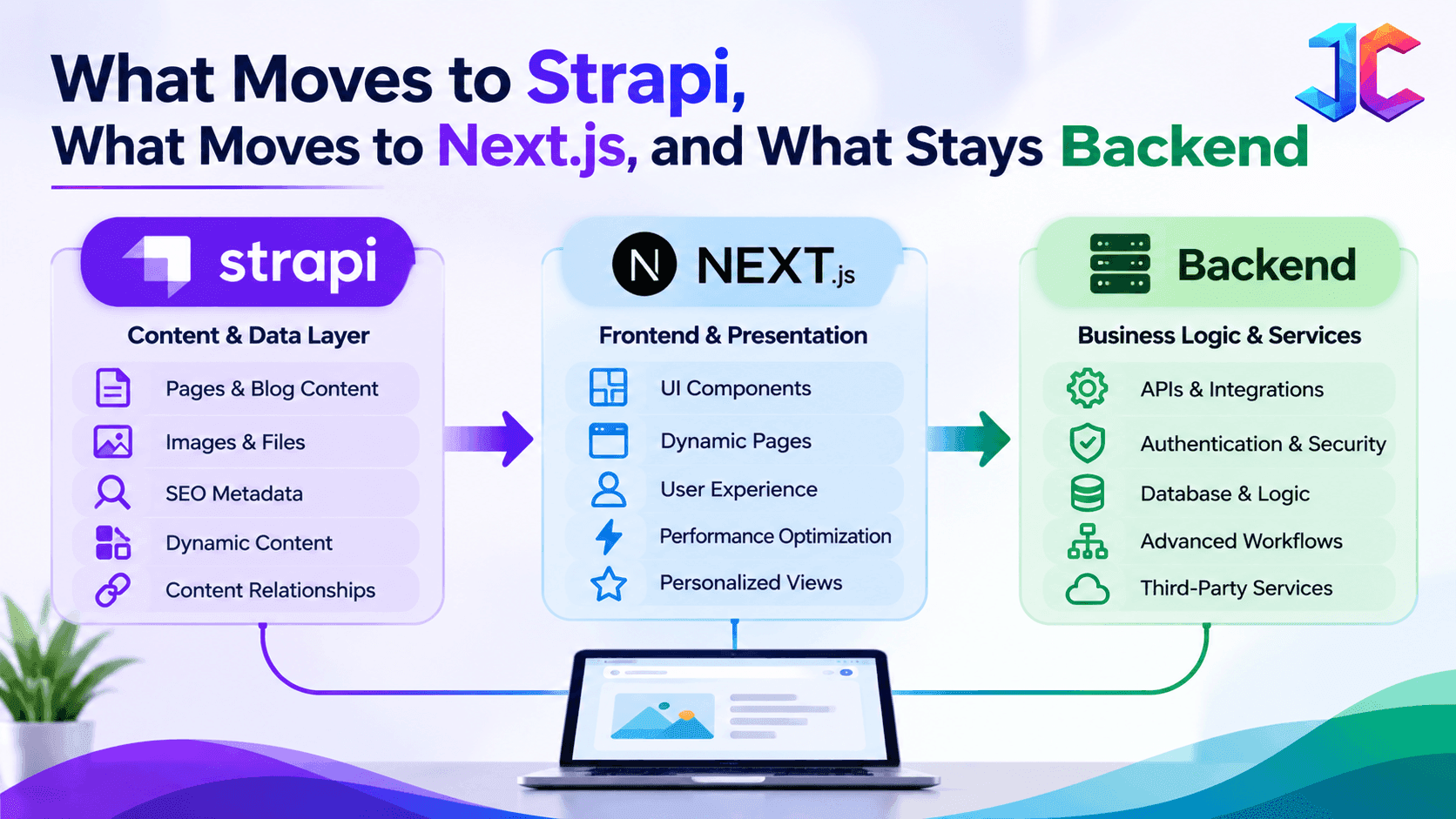
What moves to Strapi, what moves to Next.js, and what stays in the enterprise backend? In a production decoupled architecture, Strapi manages editorial content modeling, media asset governance, localization, and structured REST and GraphQL Content APIs. Next.js handles HTML rendering, React Server Components (RSC), selective client hydration, edge routing, Core Web Vitals, dynamic SEO metadata, and Backend-for-Frontend (BFF) data orchestration. High-concurrency ACID transactions, checkout processing, background worker queues, ERP integrations, customer identity providers, and sensitive data vaults remain in dedicated enterprise backend microservices.
Decoupling legacy monolithic systems through legacy PHP application modernization is frequently misunderstood as a simple two-piece frontend and backend split. Engineering leaders quickly discover that treating a headless CMS as an all-purpose replacement for legacy PHP backend code creates architectural fragility, database locking, and operational gridlock.
When planning a comprehensive PHP application migration, a successful enterprise deployment demands a disciplined three-tier decoupled topology. By establishing clear system boundaries, engineering organizations eliminate cross-tier dependencies, reduce attack surfaces, and enable content creators and software developers to operate at peak velocity.
The Architectural Pitfalls of Naive Headless Decoupling
When development teams migrate away from monolithic PHP codebases, they frequently make the mistake of shifting legacy technical debt into the wrong layer.
1. The Overloaded CMS Trap
In this scenario, teams attempt to force all legacy backend logic into Strapi. Developers add dozens of custom controllers, database lifecycle hooks, and third-party integrations to manage user checkout states, payment processing webhooks, inventory recalculations, and transactional PDF receipts.
Consequently, Strapi's database connections become overwhelmed by row locks and heavy write queries. Editorial staff experience severe latency while drafting content, and deploying a minor marketing update risks bringing down revenue-critical sales workflows. During an enterprise-wide PHP migration, attempting to force transactional business logic into content collection types is the leading cause of headless CMS project failures.
2. The Fat Frontend Trap
In this opposite scenario, teams use Next.js Route Handlers and Server Actions to execute heavy business calculations, direct database mutations, and third-party API orchestrations.
This anti-pattern drastically inflates serverless bundle sizes, triggers cold-start latency spikes, increases cloud hosting bills, and scatters enterprise business logic across frontend files. Organizations that previously relied on routine PHP upgrade services often reach an architectural ceiling where upgrading PHP versions fails to resolve underlying database concurrency limits. For organizations evaluating platform overhaul options, our legacy PHP modernization guide provides the overarching decision matrix for determining whether to upgrade, refactor, or migrate.
What Moves to Strapi: The Content and Editorial Engine
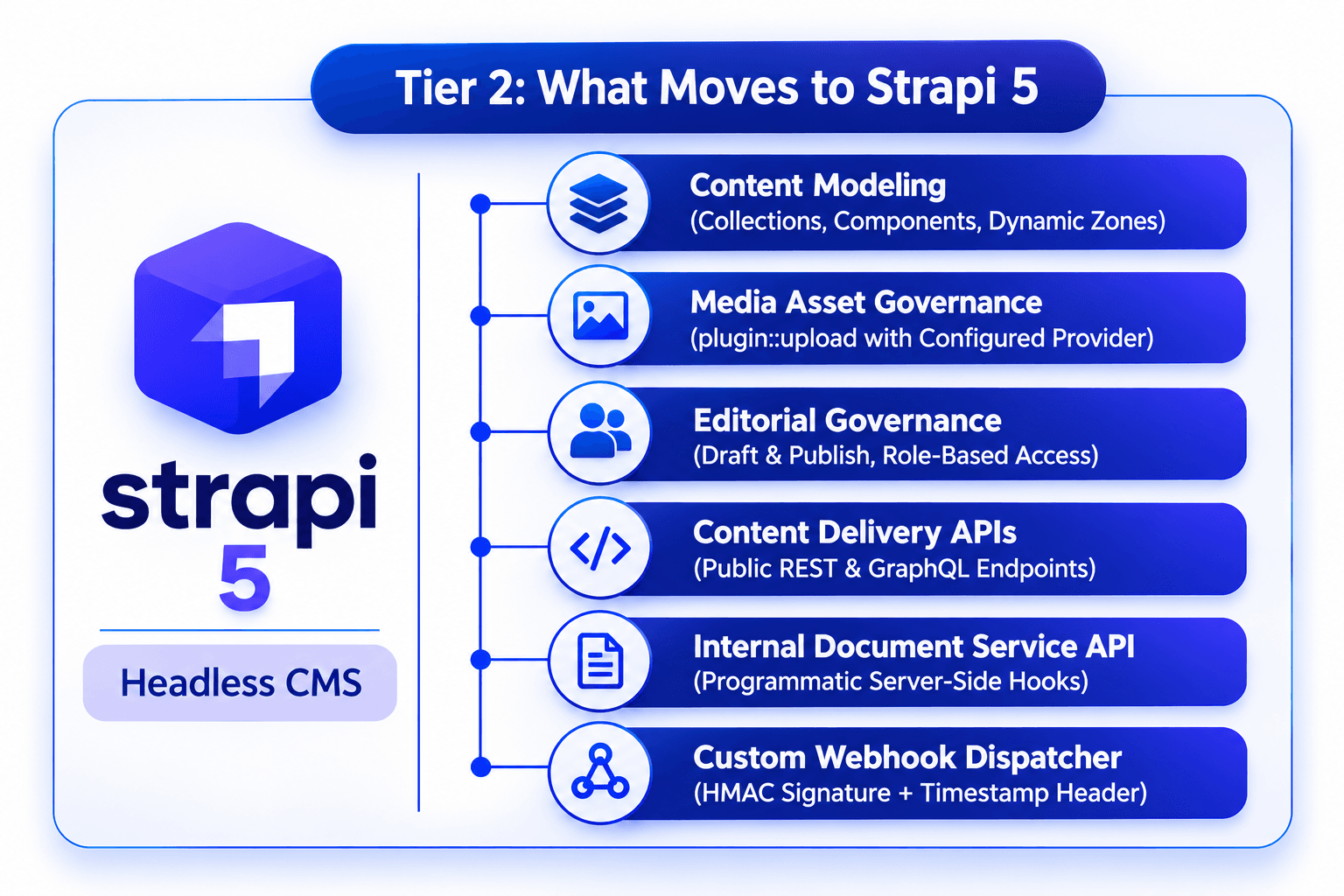
Strapi acts as the centralized source of truth for all structured, presentation-agnostic editorial content.
1. Structured Content Modeling and Layout Components
All marketing copy, landing pages, knowledge bases, team directories, and blog posts reside inside Strapi. Content is modeled as typed Collection Types, Single Types, and modular Dynamic Zones rather than unstructured HTML blobs. For granular field transformation mappings, review our guide on mapping legacy content types, relationships, and media to Strapi.
2. Media Asset Governance and Upload Providers
Images, documents, whitepapers, and brand assets are indexed and governed by Strapi's upload plugin (plugin::upload). However, automated cloud storage offloading (to Amazon S3, Google Cloud Storage, or Cloudinary) and automated responsive derivative generation (thumbnail, medium, large, AVIF/WebP) depend entirely on configuring an appropriate upload provider plugin (such as @strapi/provider-upload-aws-s3). In a default local setup, files remain stored on local disk without external CDN delivery.
3. Editorial Governance, Staging, and Internationalization
Strapi provides the administrative dashboard where copywriters, editors, and marketing leaders collaborate. Native draft-and-publish stages, role-based access control (RBAC), and localized translation forks allow marketing teams to publish campaigns independently without triggering developer deployments. Our specialized CMS migration services ensure legacy editorial permissions and taxonomy hierarchies map cleanly to Strapi's governance model.
4. API Boundaries: Document Service vs. REST Content API
A vital architectural distinction in Strapi 5 is the difference between its two primary API interfaces:
- Internal Document Service API: This is Strapi's server-side programmatic interface, accessible exclusively within the Strapi Node.js runtime (e.g., inside custom services, controllers, lifecycle hooks, and cron jobs via
strapi.documents('api::model.model')). It operates directly on the database layer with built-in draft, publish, and localization support. - External REST and GraphQL Content APIs: These are the HTTP endpoints exposed to downstream applications like Next.js. They handle client authentication, field filtering, population parameters, and payload serialization over network boundaries.
5. Webhook Dispatch Architecture: Built-In vs. Custom HMAC Signing
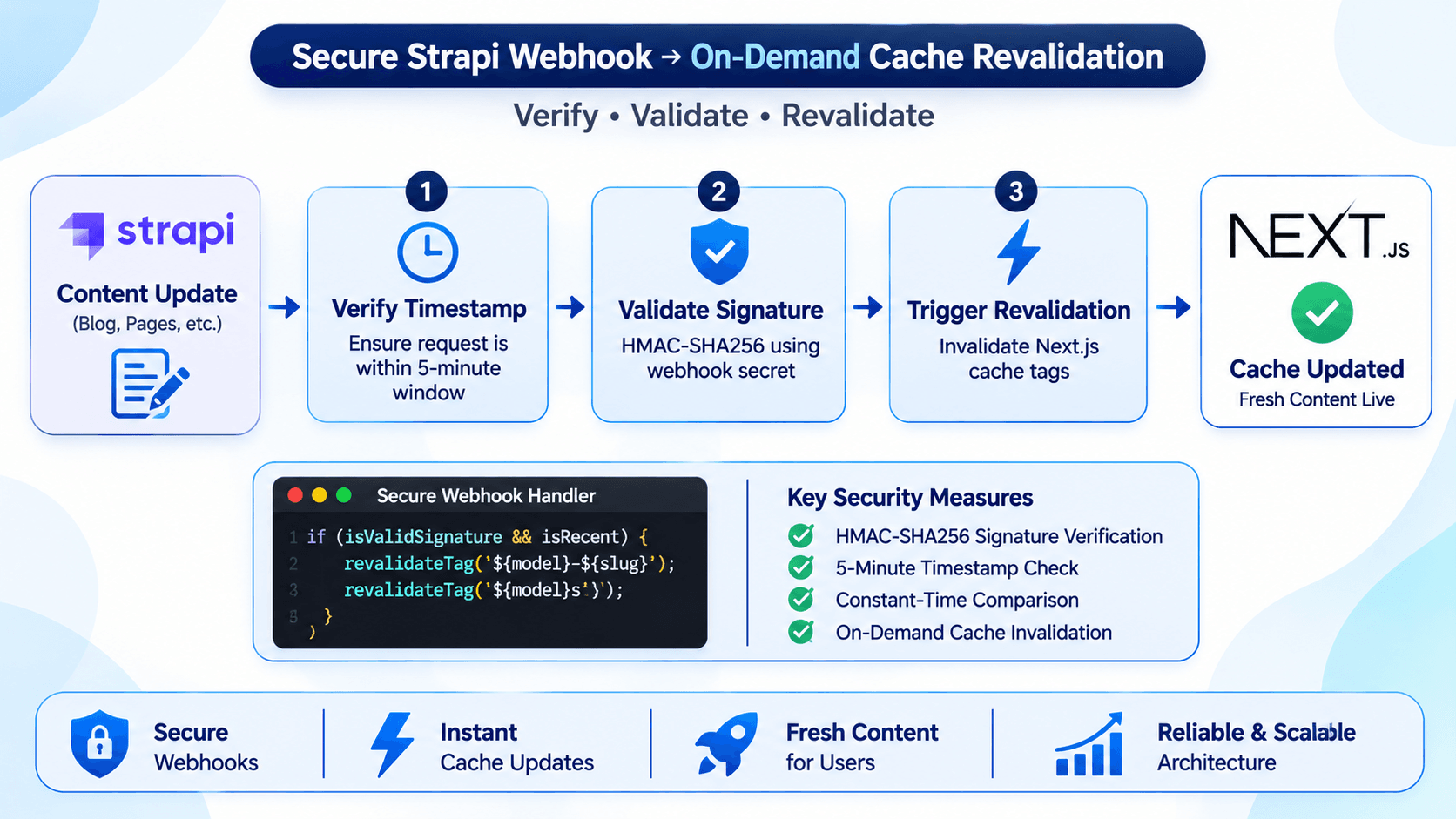
In Strapi 5, default webhooks deliver JSON payloads to target URLs and allow configuring custom static headers. However, generating cryptographic HMAC-SHA256 request signatures with timestamp headers is not an automated native feature. Implementing signature validation requires adding a custom webhook dispatcher service or lifecycle subscriber in Strapi that calculates an HMAC digest over the payload and timestamp before sending the HTTP POST request to Next.js.
What Moves to Next.js: The Edge Presentation and BFF Layer
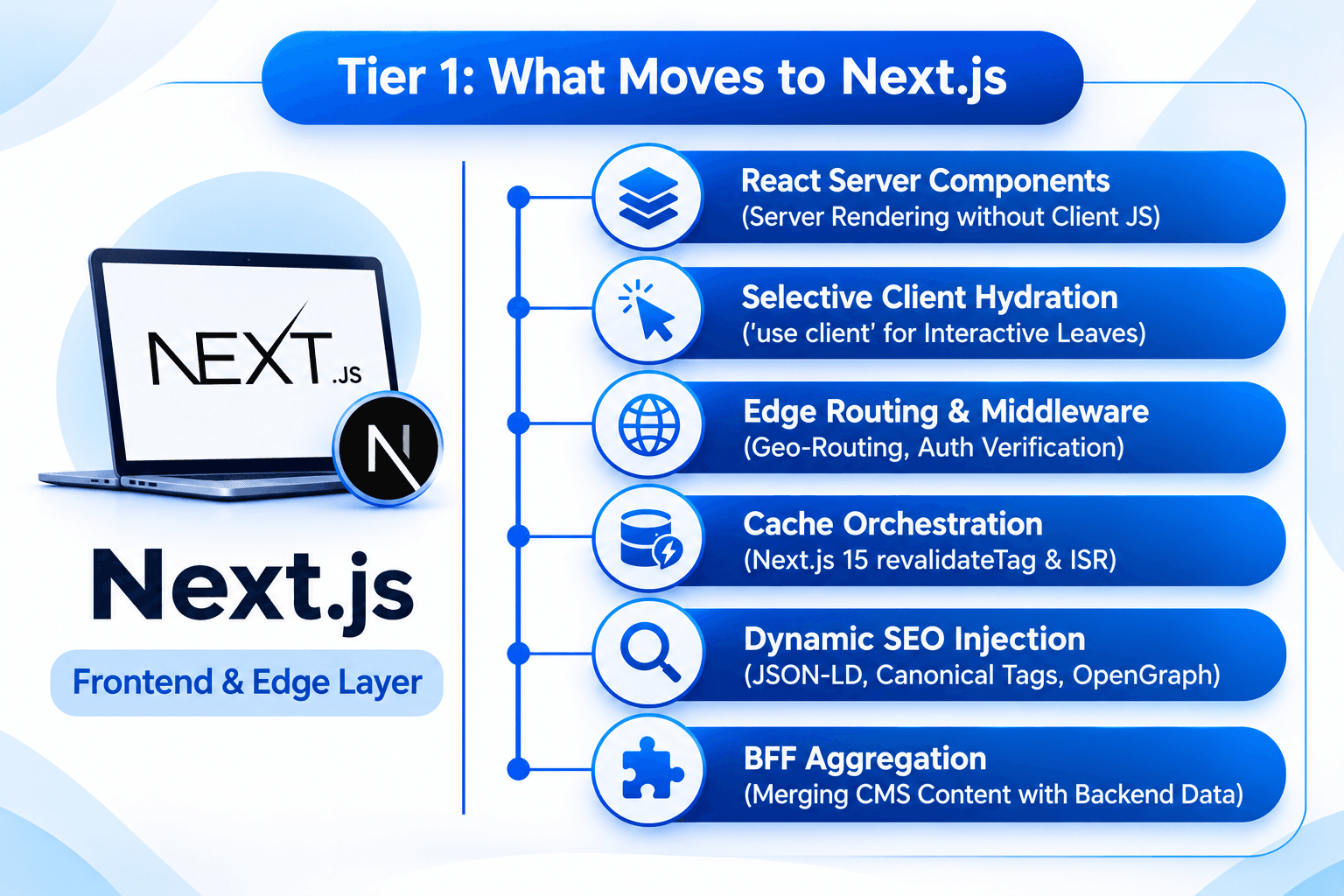
Next.js functions as the presentation tier and edge orchestration powerhouse, compiling structured content into high-performance user interfaces.
1. React Server Components and Selective Client Hydration
Next.js leverages React Server Components (RSC) to execute data fetching and component rendering exclusively on the server for content-heavy sections. These components do not ship their JavaScript runtime to the browser, significantly reducing the initial client JavaScript bundle.
When interactive elements are required (such as search filters, interactive menus, or lead capture forms), developers selectively mark specific leaf components with 'use client'. These Client Components hydrate in the browser, while parent server components remain lightweight HTML, striking an optimal balance between client speed and rich interactivity.
2. Cache Tag Orchestration and On-Demand Invalidation
Next.js 15 introduces refined caching semantics. Instead of relying on full-site rebuilds, Next.js caches page segments using explicit tag identifiers. When Strapi broadcasts an update, Next.js purges only the relevant cache tags via revalidateTag, delivering rapid edge cache response times and significantly reducing origin server load across global CDN points of presence.
3. Dynamic SEO and Core Web Vitals Optimization
Dynamic OpenGraph cards, language alternate tags, sitemaps, and structured JSON-LD schemas are generated server-side in Next.js. By taking full ownership of page rendering, Next.js maximizes First Contentful Paint (FCP) and Cumulative Layout Shift (CLS) scores. For deep-dive organic search retention strategies, see our guide on how to migrate a website without losing URLs or organic traffic.
4. Backend-for-Frontend (BFF) Composition
When a single page view requires both marketing content from Strapi (such as hero copy) and live data from core services (such as real-time inventory or localized pricing), Next.js executes both requests concurrently inside private cloud networks, stitching the data before streaming HTML to the browser.
What Stays Backend: Core Enterprise Microservices and Transactional Logic
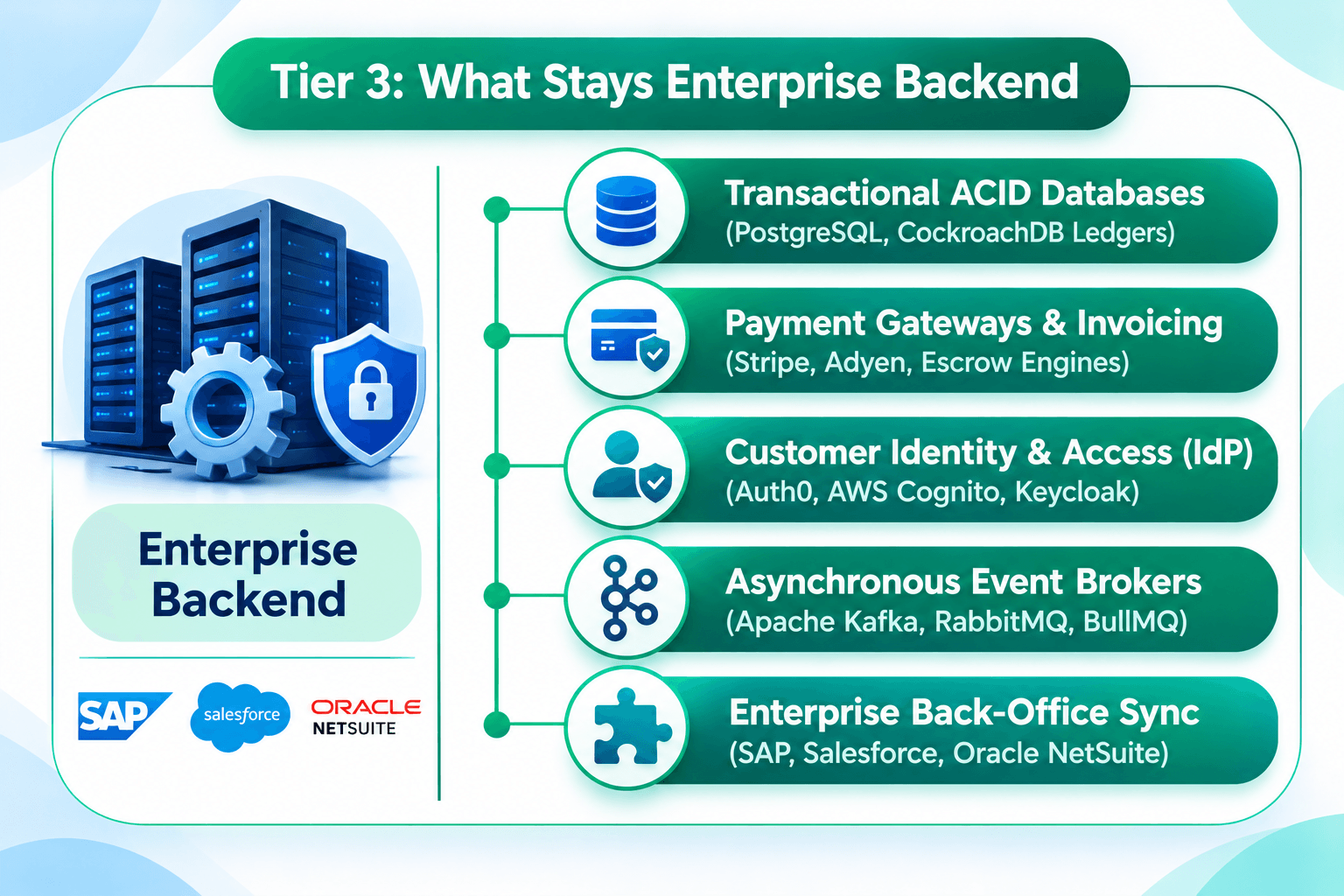
Core business operations, stateful ledgers, and sensitive data transactions must remain isolated inside dedicated enterprise backend services built with Node.js, Go, Python, or robust frameworks like Laravel or Symfony.
1. ACID-Compliant Transactional Workloads
Financial ledger transactions, order booking pipelines, and inventory reservations require strict ACID properties, row-level locks, and multi-table transactions. Dedicated microservices backed by PostgreSQL ensure high-throughput purchasing flows continue smoothly regardless of marketing campaign traffic surges.
2. Customer Authentication and Identity Management
While Strapi manages internal credentials for marketing authors via its admin panel, customer identity belongs in external Identity Providers (IdPs) like Auth0, AWS Cognito, or Keycloak. Next.js validates session tokens via encrypted HTTP-only cookies, passing authenticated claims to enterprise backend services.
3. Asynchronous Job Queues and Event Streaming
Long-running jobs like generating monthly billing invoices, processing data exports, transcoding video uploads, and dispatching webhook notifications must run on distributed message brokers like Apache Kafka, RabbitMQ, or Redis BullMQ to avoid thread exhaustion on web tiers.
4. Enterprise ERP and CRM Connectors
Integrations with back-office platforms like SAP, Salesforce, or NetSuite belong in dedicated backend adapters. These services maintain persistent database connections, handle rate limits, and enforce strict payload validation away from edge access points. Organizations modernizing complex architectures can evaluate our Laravel migration services for refactoring monolithic backends into composable, microservice-ready architectures.
The Enterprise Responsibility Matrix
This matrix provides engineering teams with an unambiguous division of architectural ownership.
| Architectural Dimension | Next.js (Edge / BFF) | Strapi 5 (Headless CMS) | Enterprise Backend (Microservices) | Architectural Justification |
|---|---|---|---|---|
| HTML UI Rendering | Primary Owner | Non-Existent | Non-Existent | Next.js compiles React Server Components into optimized HTML at the edge. |
| Content Schemas & Modeling | Consumes via API | Primary Owner | Non-Existent | Strapi provides the UI builder, schema definitions, and content models. |
| Media File Management | Edge Image Resizing | Primary Owner | Non-Existent | Strapi stores asset metadata; Next.js optimizes formats (AVIF/WebP) on demand. |
| Cache Tag Invalidation | Primary Owner | Webhook Dispatcher | Non-Existent | Next.js invalidates cache tags via revalidateTag upon receiving signed webhooks. |
| Search Engine Optimization | Primary Owner | Consumed SEO Fields | Non-Existent | Next.js injects dynamic metadata, OpenGraph tags, and JSON-LD schemas. |
| Editorial Workflows | Non-Existent | Primary Owner | Non-Existent | Strapi manages drafting, previewing, internationalization, and publishing. |
| Customer Identity & SSO | Session Cookies | Non-Existent | Primary Owner | External IdP verifies credentials; backend services authorize data access. |
| Admin Editorial Access | Non-Existent | Primary Owner | Non-Existent | Strapi native RBAC restricts which internal users can modify content fields. |
| Transactional Checkout | View & API Client | Non-Existent | Primary Owner | Order creation, payment authorization, and inventory deduction require ACID databases. |
| BFF Data Aggregation | Primary Owner | Non-Existent | Non-Existent | Next.js Server Components query Strapi and microservices concurrently. |
| Background Job Queues | Non-Existent | Non-Existent | Primary Owner | Kafka or BullMQ workers execute asynchronous tasks without blocking web requests. |
| Enterprise ERP Integration | Non-Existent | Non-Existent | Primary Owner | Enterprise synchronization scripts operate safely behind private VPC firewalls. |
| Layered Rate Limiting | Edge Middleware | Token Throttling | API Gateway (Kong/AWS) | Defense-in-depth protection mitigates volumetric DDoS and credential attacks. |
| Audit & Compliance Logs | Access Logs | Content Revisions | Financial Audit Trails | Strapi tracks content changes; backend services audit financial and security events. |
Database Migration Strategy: Splitting Monolithic Schemas
Transitioning an enterprise PHP monolith requires dividing a single relational database into two distinct data stores: editorial content in Strapi, and transactional data in core microservices.
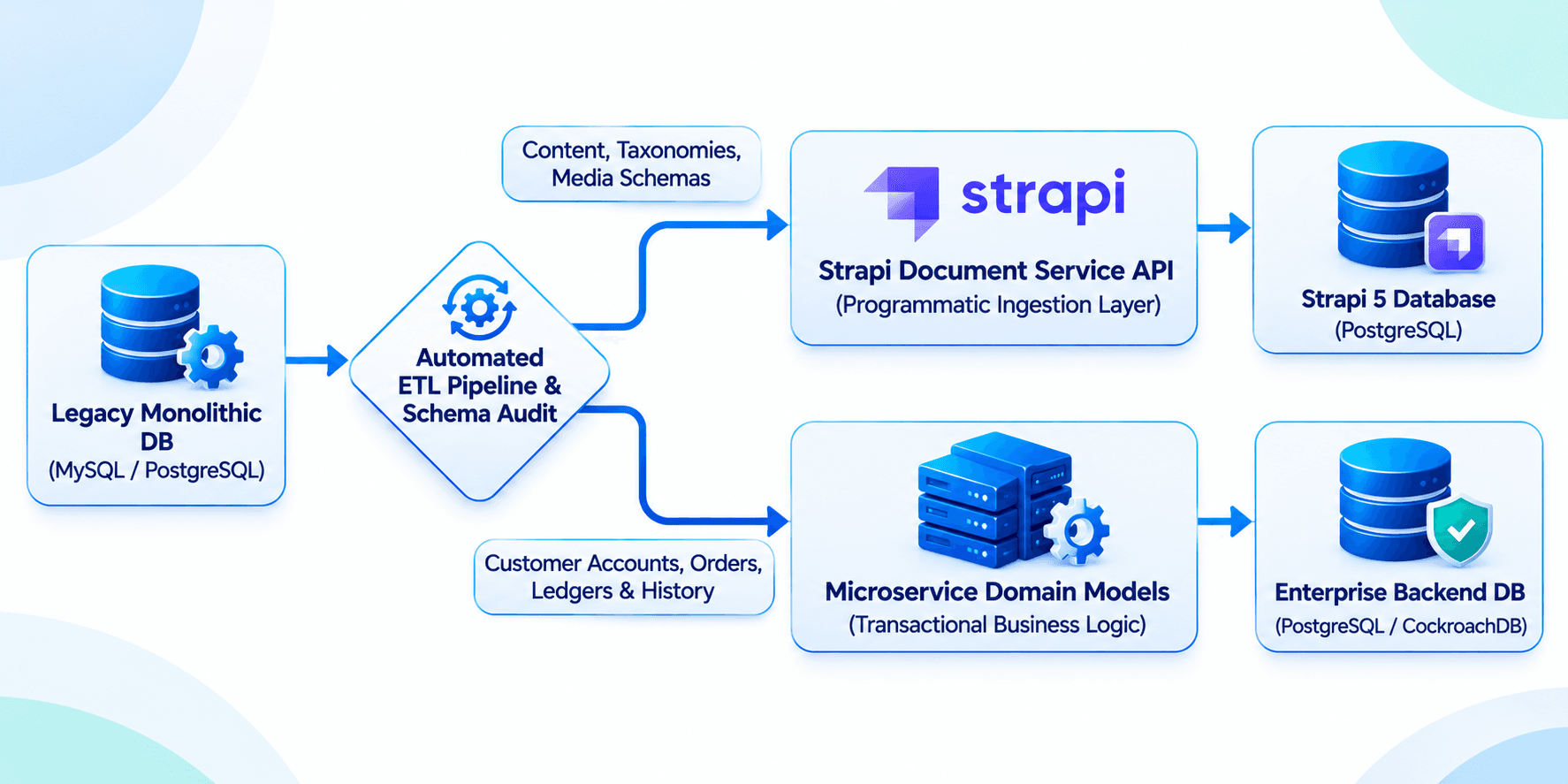
1. Schema Classification and Ingestion Sequencing
Before writing migration scripts, architects must categorize every legacy database table into one of two operational domains:
- Content Domain: Articles, taxonomies, categories, landing page layouts, digital media attachments, and navigational structures. These are extracted by ETL loader scripts and passed through the Strapi Document Service API, which validates data types, handles relations, and writes normalized rows into Strapi's PostgreSQL database.
- Transactional Domain: Customer accounts, hashed passwords, billing histories, order items, active cart sessions, and audit logs. These are migrated directly into transactional microservice databases. When transitioning from a monolithic Laravel or PHP framework, planning a structured Laravel database migration ensures that customer ledgers and relational foreign keys remain intact while marketing entities transition to Strapi.
2. Dual-Write Architecture and Change Data Capture (CDC)
To prevent data desynchronization during gradual migration, implement a Change Data Capture (CDC) pipeline using tools like Debezium or PostgreSQL logical replication. While the legacy application is still accepting live customer orders, changes to product descriptions or editorial copy are replicated directly to Strapi's staging environment, ensuring data parity without imposing database locking on the production monolith.
3. Preserving Relational Integrity Across Independent Systems
When a content record references a transactional entity (for example, a blog post mentioning a specific product SKU), avoid creating database-level foreign key constraints across the two independent databases. Instead, store the immutable external reference identifier (such as product_sku or service_code) as a string attribute inside the Strapi model. Next.js then uses this identifier at runtime to query the transactional service for real-time pricing and availability.
4. Evaluating Modernization Investment and Resource Allocation
Understanding overall PHP migration cost requires evaluating engineering hours across schema extraction, ETL script development, API contract testing, and cloud infrastructure setup. Investing in clean system boundaries upfront significantly reduces ongoing maintenance overhead and hosting expenses.
Common Migration Challenges and Architectural Mitigations
Modernizing enterprise architectures introduces specific distributed systems challenges that require proactive architectural controls.
1. Data Consistency Across Edge Caches
In a decoupled stack, content updates can suffer from propagation delay between Strapi, the Next.js presentation server, and the edge CDN. To solve this, enforce tag-based cache revalidation rather than time-based polling (TTL). When an editor clicks publish, Strapi's webhook invalidates the specific collection tag instantly, ensuring visitors receive updated content on the next page view.
2. API Contract Evolution and Versioning
As frontend and content teams scale independently, uncoordinated schema modifications can break production frontends. Mitigate this by treating Strapi API responses as strict contracts. Use TypeScript generation tools (such as OpenAPI TypeScript codegen) to synchronize Strapi component schemas with Next.js interface definitions during build time, catching type mismatches in continuous integration.
3. Session Management and Cross-Domain Authentication
Monolithic PHP systems typically rely on server-side session stores using PHPSESSID cookies. In a decoupled architecture, the user browser communicates with Next.js, while API requests route to backend microservices. Mitigate cross-origin cookie challenges by configuring Next.js as a reverse proxy or Backend-for-Frontend (BFF), maintaining encrypted HTTP-only session cookies on the primary domain and exchanging scoped JWT tokens with backend APIs over private networks.
4. Zero-Downtime Cutover and Rollback Preparation
A hard cutover where DNS is switched overnight introduces extreme business risk. Implement the Strangler Fig Pattern using an edge reverse proxy (such as Cloudflare or AWS CloudFront). Route low-risk marketing traffic to Next.js and Strapi first, while keeping sensitive checkout paths pointed to the existing PHP application until stability is verified.
Testing and Quality Assurance for Decoupled Systems
A multi-tier architecture demands comprehensive testing across unit, integration, and performance layers.
1. API Contract and Schema Testing
Implement automated contract testing using tools like Pact to verify that changes to Strapi Collection Types do not break Next.js data fetching assumptions. Run schema validation suites in CI/CD pipelines before any CMS content model changes are deployed to staging.
2. End-to-End Rendering Verification
Utilize Playwright or Cypress to run automated smoke tests against Next.js production builds. Tests should verify that React Server Components hydrate properly, dynamic metadata matches SEO specifications, and interactive client components respond correctly.
3. Load Testing Edge Cache vs. CMS Origin
Simulate peak user concurrency using tools like k6 or Artillery. Benchmarking should validate that 95 percent of marketing page views hit the Next.js edge cache without forwarding requests to Strapi, ensuring that backend origins remain protected during massive traffic spikes.
4. Data Reconciliation Audits
After running automated ETL scripts, execute automated reconciliation checks comparing legacy source table row counts, primary keys, and foreign relations against imported Strapi documents. Every discrepancy must be logged and resolved before finalizing production DNS cutover.
Phased Deployment Strategy and Production Monitoring
Deploying a decoupled enterprise stack requires a structured release strategy combined with continuous telemetry.
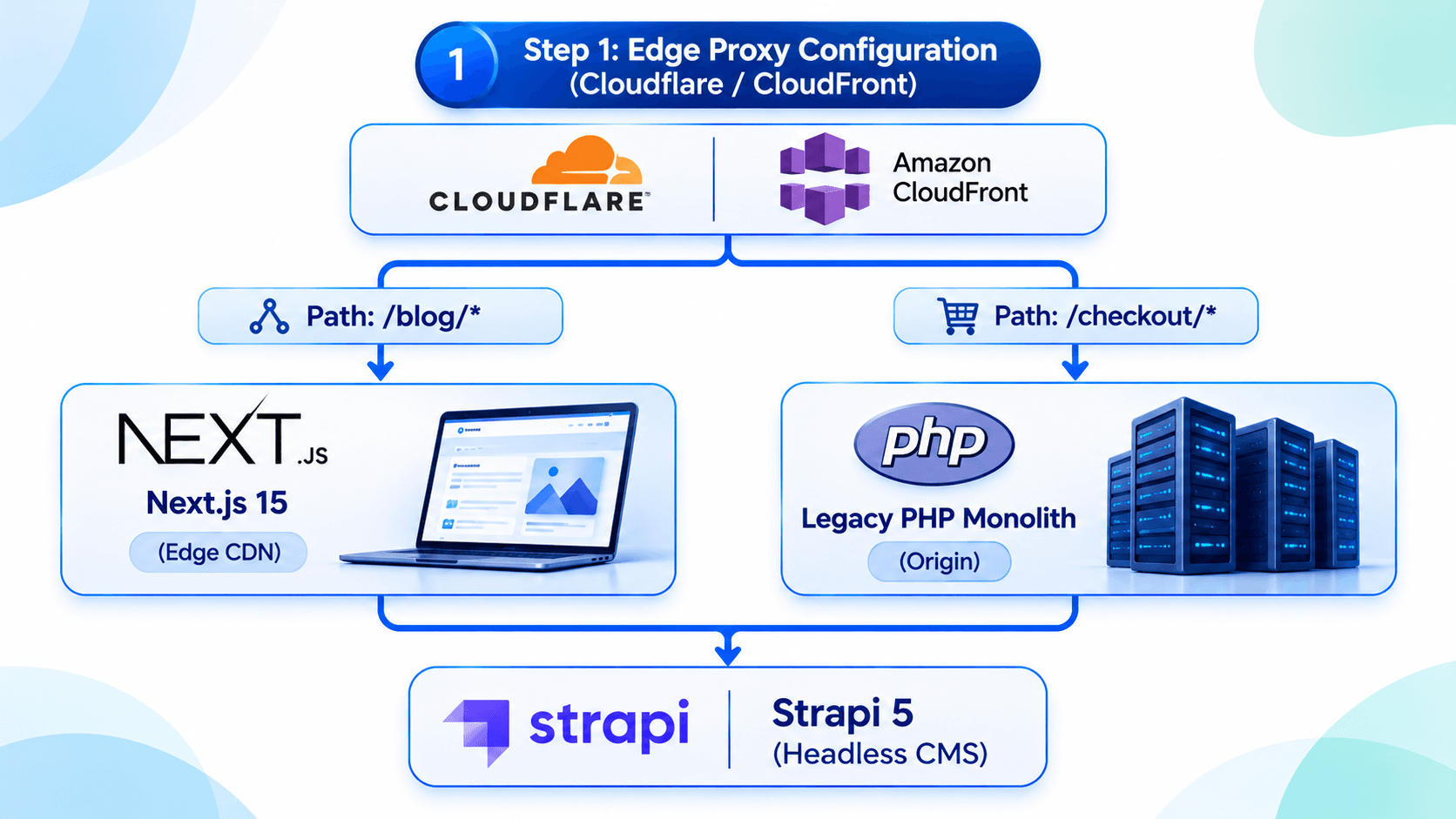
1. The Strangler Fig Edge Routing Strategy
Configure an edge routing layer to split traffic dynamically based on URL patterns:
- Route 1 (
/blog/*,/about,/services/*): Directed to Next.js edge CDN, backed by Strapi. - Route 2 (
/account/*,/checkout/*,/cart/*): Directed to the legacy PHP application until microservices are validated. This allows organizations to realize immediate Core Web Vitals and SEO gains on marketing pages while isolating transactional logic during development.
2. Instant Rollback Mechanisms
If critical defects emerge post-deployment, rolling back must not require redeploying software. Configure edge proxies with instant origin failover rules. If Next.js error rates exceed 1 percent over a five-minute window, traffic can be rerouted back to the legacy monolith within seconds via edge routing rules.
3. Distributed Telemetry and APM
Instrument all three tiers using OpenTelemetry standards integrated with observability platforms like Datadog, New Relic, or Grafana. Distributed trace IDs passed in request headers allow engineers to trace a user request from the Next.js edge layer through the BFF, into Strapi, and back to core database queries.
Security Architecture: Protecting the Decoupled Stack
Decoupling your application eliminates monolithic attack surfaces, provided security controls are enforced across every tier.
1. Least-Privilege API Token Scoping
Strapi allows administrators to generate granular API tokens. Never configure Next.js with full-access administrative tokens. Create read-only API tokens scoped strictly to published documents for public rendering, reserving write-access tokens for authenticated private serverless functions.
2. Centralized Secrets Management
Avoid committing API secrets or database credentials into source repositories or scattered .env files. Utilize centralized secret managers such as AWS Secrets Manager or HashiCorp Vault. In production, inject secrets directly into containerized runtimes during startup.
3. Multi-Layer Rate Limiting
Enforce rate limiting across two defensive perimeters:
- Edge Layer: Next.js edge middleware or Cloudflare WAF applies IP-based rate limiting to protect public routes against scraping and volumetric floods.
- Service Layer: Internal API Gateways (such as Kong or AWS API Gateway) enforce token-bucket rate limiting on Strapi and core microservices, preventing misconfigured frontend scripts from exhausting database connection pools.
4. Sensitive Data Boundaries
Enforce architectural policies preventing sensitive customer data from entering the CMS. Personally Identifiable Information (PII), credit card numbers, health records, and customer passwords must be stored exclusively in PCI-DSS or HIPAA-compliant backend databases, keeping the headless CMS clean and compliant.
Implementation Guide: Next.js 15 Caching and Cryptographic Webhooks
Connecting Next.js 15 App Router to Strapi requires modern data-fetching patterns and robust webhook security.
1. Fetching Structured Content with Next.js 15 Tag-Based Caching
2. Cryptographic HMAC Signature Verification with Replay Attack Protection
For teams looking for complete repository scaffolding, our PHP to Strapi and Next.js migration blueprint provides complete repository structure examples and deployment scripts. If you are assessing modernizing options across your engineering organization, our legacy PHP modernization guide details the evaluation matrix for planning refactoring budgets.
FAQs
What is the difference between Strapi's Document Service API and its REST API?
Strapi's Document Service API is an internal server-side TypeScript interface accessible within the Strapi Node.js application for custom controllers, lifecycle hooks, and ETL migration scripts. The REST and GraphQL Content APIs are external HTTP interfaces consumed by downstream clients like Next.js over network connections, enforcing token authentication and population rules.
How does Next.js 15 handle fetch caching compared to Next.js 14?
In Next.js 14, fetch requests were cached statically by default. In Next.js 15, fetch requests default to no-store (uncached) to align with standard web specifications. When building high-traffic marketing pages, developers must explicitly pass { cache: 'force-cache', next: { tags: [...] } } to enable static edge caching and tag-based on-demand invalidation.
How do we protect CMS revalidation webhooks from replay attacks?
Protecting against replay attacks requires sending a timestamp header (x-strapi-timestamp) alongside the payload and including that timestamp in the HMAC signature string (${timestamp}.${rawBody}). The receiving Next.js route handler asserts that the timestamp falls within a five-minute tolerance window before comparing signatures, preventing captured requests from being replayed maliciously.
Why is custom implementation required for Strapi HMAC webhook signing?
Strapi 5 provides native webhook dispatching with custom header support, but does not calculate dynamic cryptographic HMAC signatures on request payloads out of the box. Teams must implement a custom lifecycle subscriber or webhook middleware service in Strapi to compute the SHA-256 digest and append signature headers prior to dispatch.
Why should transactional database tables not be stored directly inside Strapi?
Strapi is engineered as a content management system optimized for editorial workflows, document versioning, and read-heavy queries. Placing high-frequency transactional data like user checkouts or billing ledgers inside Strapi causes table locking, degrades admin panel responsiveness for marketing teams, and creates a single point of failure between marketing updates and customer revenue generation.
Can Next.js Server Actions replace a traditional backend API entirely?
Next.js Server Actions are exceptional for handling simple mutations, user session updates, and lightweight form submissions. However, they should not replace dedicated backend microservices for complex business logic, distributed transactions, long-running batch workers, or enterprise integrations like ERP synchronization because serverless execution environments have strict execution time limits and memory constraints.
Where should user authentication and customer profiles live in this architecture?
Administrative authentication for content creators lives inside Strapi using native Role-Based Access Control (RBAC). Customer and user authentication belongs in an external Identity Provider (IdP) like Auth0, AWS Cognito, or Okta. Next.js manages customer sessions via secure HTTP-only cookies, passing authenticated tokens to core backend microservices for data access.
What happens if the Strapi CMS backend experiences temporary downtime?
Because Next.js caches rendered pages and static content at the edge using Incremental Static Regeneration (ISR), public marketing pages remain fully operational and fast even if the Strapi CMS undergoes maintenance. Only cache-miss requests or fresh revalidation webhooks will await Strapi availability, ensuring high availability for end visitors.
Modernize Your Enterprise Architecture with Junkies Coder
Transitioning an enterprise website or application from a monolithic legacy system into a resilient three-tier headless architecture requires seasoned engineering governance.
Junkies Coder specializes in architecting high-performance digital ecosystems. From auditing complex monolithic databases to building scalable Strapi 5 schemas and high-speed Next.js frontends, our solutions ensure optimal security, high Core Web Vitals, and effortless developer velocity.
Explore our legacy application modernization services or speak with our solutions architects to evaluate your modernization roadmap.