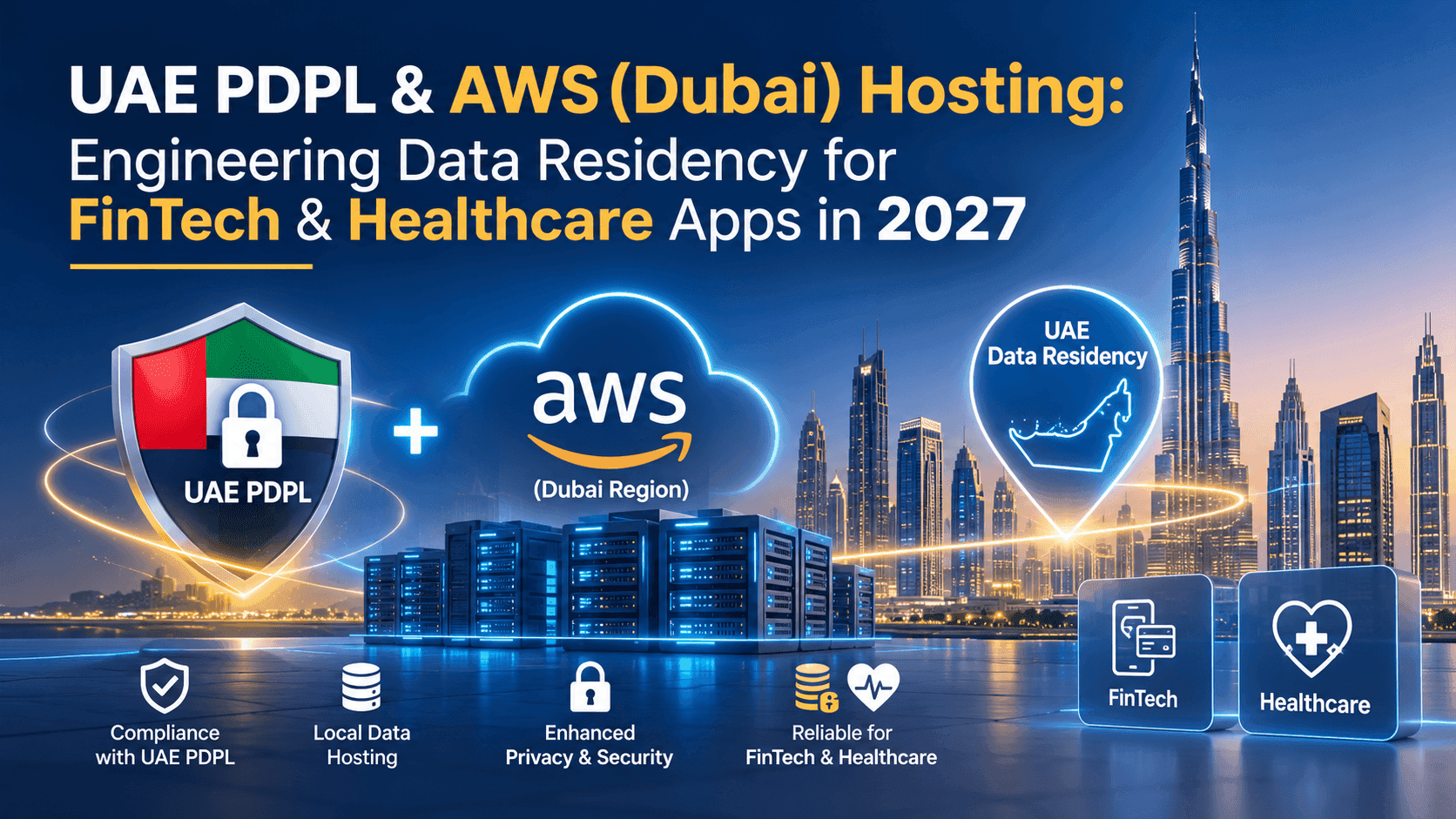
- AWS Dubai Is a Starting Point, Not a Compliance Guarantee: Hosting in the AWS Middle East (UAE) Region (
me-central-1) supports UAE data residency, but complete compliance depends on data processing, access, backups, integrations, and applicable regulations. - Federal PDPL Is Not a Blanket Data-Localisation Law: Federal Decree-Law No. 45 of 2021 establishes personal data protection and cross-border transfer requirements. DIFC, ADGM, and regulated sectors have additional frameworks.
- FinTech Applications Must Address CBUAE Requirements: Evaluate customer confidentiality, Master System of Record, cloud outsourcing, regulatory approvals, and financial data access restrictions.
- Healthcare Data Requires Stricter Localisation Controls: Assess Federal Law No. 2 of 2019 and applicable DHA, DoH, or other Health Authority requirements. Clinical records, copies, and external processing must follow the applicable rules.
- Enforce AWS Region Locking: Use AWS Organizations Service Control Policies (SCPs) to restrict unapproved regional deployments and prevent developers from creating regulated workloads outside approved UAE infrastructure.
- Keep Backups and Disaster Recovery Within Approved Boundaries: Review database snapshots, S3 replication, log shipping, backup vaults, and failover destinations. Prefer Multi-AZ resilience within
me-central-1where appropriate. - Separate Regulated Data Environments: Isolate healthcare, financial, and general application data using dedicated AWS accounts, databases, storage buckets, and access policies.
- Implement Customer-Managed Encryption: Use AWS KMS, restrictive key policies, TLS encryption, key-access auditing, and separation of administrative responsibilities.
- Control External AI and Third-Party APIs: Analytics, APM, crash reporting, support platforms, and external LLM endpoints can introduce cross-border data flows. Redact, tokenise, or keep sensitive processing within approved environments.
- Restrict Offshore Administrative Access: Implement least-privilege IAM, MFA, just-in-time access, AWS Systems Manager Session Manager, and auditable emergency-access procedures.
- Strengthen FinTech Transaction Security: Separate core ledgers from marketing data, implement payment tokenisation, webhook verification, idempotency, and transaction audit trails.
- Protect Healthcare Interoperability: Use controlled HL7 FHIR integrations, patient-level authorisation, consent management, and detailed clinical-record access auditing.
- Prepare for AI-Specific Security Threats: Protect RAG pipelines against prompt injection, data poisoning, sensitive output leakage, and excessive AI-agent permissions.
- Adopt Confidential Computing Where Justified: Evaluate AWS Nitro Enclaves and hardware-backed isolation for sensitive data-processing workloads.
- Prepare for Post-Quantum Cryptography: Inventory cryptographic dependencies and build crypto-agility into systems handling long-lived financial and healthcare information.
- Secure the Software Supply Chain: Generate SBOMs, scan dependencies, verify build provenance, sign release artefacts, and audit third-party mobile SDKs.
- Plan for Digital Sovereignty: Assess cloud concentration risk, provider dependencies, portability, UAE recovery capabilities, and cloud exit arrangements.
- Automate Continuous Compliance: Integrate AWS configuration checks, regional restrictions, backup validation, security monitoring, and residency testing into CI/CD pipelines.
- Bottom Line: UAE data residency in 2027 requires more than AWS Dubai hosting. It requires control over where data is stored, processed, accessed, transferred, backed up, and deleted throughout the application's lifecycle.
Introduction: AWS Dubai Hosting Is Not the Same as UAE Data Residency Compliance
Choosing AWS Dubai hosting is an infrastructure decision. Engineering a UAE data-resident application is a much broader architectural responsibility.
A FinTech application can store its primary database in the AWS Middle East (UAE) Region while sending customer identifiers to an overseas fraud-detection API. A healthcare application can keep patient records in Dubai but transmit clinical notes to an external AI model for document summarisation. A mobile application can use UAE-based infrastructure while its crash-reporting SDK collects device identifiers and sends diagnostic information to another country.
In each scenario, the primary database remains in the UAE, but the overall data-processing architecture introduces additional privacy, transfer and regulatory considerations.
This distinction matters when building regulated digital products in the UAE.
Federal Decree-Law No. 45 of 2021, commonly known as the UAE Personal Data Protection Law (PDPL), establishes requirements for personal data processing and cross-border transfers. However, certain categories of information, including health information and banking or credit data regulated under separate legislation, require a more specific legal assessment. DIFC and ADGM also operate their own data protection frameworks.
For healthcare applications, Federal Law No. 2 of 2019 concerning the use of Information and Communication Technology (ICT) in Health Fields introduces specific restrictions on storing and processing health information outside the UAE.
For financial institutions, Central Bank of the UAE (CBUAE) outsourcing and cloud computing requirements introduce additional controls over confidential customer data, cloud arrangements, regulatory access and operational resilience.
The engineering challenge is therefore not simply choosing a UAE cloud region. It is ensuring that every component involved in collecting, transmitting, processing, storing, accessing and deleting information operates within an approved data-governance framework.
This guide explains how to design that architecture for 2027, including AWS infrastructure, mobile application integrations, AI workloads, confidential computing, digital sovereignty, software supply-chain security, sector-specific requirements and continuous residency validation.
TL;DR: What UAE Businesses Should Know
- AWS Dubai can support data residency by hosting workloads in the AWS Middle East (UAE) Region.
- Hosting in AWS Dubai does not automatically make an application PDPL compliant.
- FinTech and healthcare apps face sector-specific requirements beyond general privacy rules.
- Third-party SDKs, analytics tools, support platforms and AI providers can create cross-border data flows.
- AI prompts containing personal data may become a cross-border transfer if processed outside the UAE.
- Compliance requires a data-flow map, access controls, encryption, vendor governance and operational monitoring.
- AWS provides infrastructure and regional hosting options, but the business remains responsible for application security, data governance, access controls and legal compliance.
1. Residency, Localisation and PDPL Compliance: Which Rules Apply?
The first architecture decision should be regulatory classification, not database selection.
Different businesses can process similar information under different regulatory requirements depending on their licensing, activities, data categories and operating jurisdiction.
Federal PDPL: The General Personal Data Framework
Federal Decree-Law No. 45 of 2021 applies to relevant controllers and processors operating in mainland UAE and, within its territorial scope, organisations outside the UAE processing personal data of individuals in the UAE.
It establishes obligations concerning:
- Lawful and transparent personal data processing.
- Purpose limitation and data minimisation.
- Data accuracy and security.
- Data subject rights.
- Controller and processor responsibilities.
- Records of processing activities.
- Data protection impact assessments in applicable circumstances.
- International transfers under Articles 22 and 23.
The PDPL does not create a universal requirement that every commercial database must physically remain in the UAE.
Its cross-border transfer provisions establish conditions under which personal data may be transferred outside the country, including mechanisms involving adequate protection and specified safeguards or circumstances.
This distinction matters for businesses using overseas development teams, cloud services and international SaaS providers.
2027 regulatory consideration: Verify the latest implementing regulations, decisions and regulator guidance before deployment. Do not assume that anticipated regulatory requirements are already binding.
Official reference: https://aws.amazon.com/compliance/uae_data_privacy/
The 2027 UAE Regulatory Stack
Compliance depends on mapping each dataset to its governing law, as sectoral rules override general federal privacy provisions.
| Regulatory Regime | Target Sector / Jurisdiction | Localization & Transfer Mandate |
|---|---|---|
| UAE PDPL (Federal Decree-Law No. 45 of 2021) | Onshore UAE and commercial free zones (DMCC, JAFZA, DAFZA) | Does not mandate local storage, but restricts cross-border transfers unless adequacy, contractual clauses, or explicit consent requirements are satisfied. Full enforcement aligns with the 1 January 2027 compliance milestone. |
| CBUAE Outsourcing & Payment Rules | Mainland banks, Payment Service Providers (PSPs), and FinTechs | Strict Localization: Consumer, payment, and transaction data must remain inside the UAE. Offshoring material workloads requires prior Central Bank non-objection. |
| Federal Health Data Law (Law No. 2 of 2019) and DHA/DoH | All UAE health entities, including free zones (e.g., DHCC) | Strict Localization: Health data generated in the UAE cannot leave the country without a joint resolution. Records must be retained locally for at least 25 years. |
| DIFC & ADGM Data Laws | Financial free zones (regulated by DFSA and FSRA) | Exempt from federal PDPL and governed by independent regimes (DIFC Law No. 5 of 2020 / ADGM Regulations 2021), allowing risk-based international transfers. |
DIFC and ADGM: Separate Data Protection Frameworks
Companies operating in the Dubai International Financial Centre (DIFC) or Abu Dhabi Global Market (ADGM) should not automatically apply the federal PDPL as their only privacy framework.
Relevant frameworks include:
- DIFC Data Protection Law No. 5 of 2020.
- ADGM Data Protection Regulations 2021, as amended.
- A financial technology company incorporated in DIFC may need to assess DIFC data protection rules, Dubai Financial Services Authority requirements and applicable outsourcing contracts.
An ADGM-based business may need to consider the ADGM data protection framework and Financial Services Regulatory Authority requirements.
The cloud architecture should follow the actual regulatory and contractual obligations of the operating entity rather than assuming that a Dubai-based server satisfies every requirement.
Healthcare: Federal Law No. 2 of 2019
Healthcare applications require a more specific assessment.
Federal Law No. 2 of 2019 regulates the use of ICT in the UAE healthcare sector, including relevant free zones.
Article 13 restricts storing, processing, generating or transforming health data outside the UAE when it relates to healthcare services provided inside the UAE, subject to the applicable Health Authority decision and legal framework.
This means an overseas AI API, clinical analytics service or outsourced medical-record processing provider cannot simply be approved because the original database is located in Dubai.
The relevant Health Authority requirements, implementing decisions, exceptions and approvals must be checked before external processing is introduced.
Official reference: https://u.ae/en/about-the-uae/digital-uae/whole-of-government-approach/digital-health/ict-in-the-health-sector
FinTech: CBUAE Outsourcing and Cloud Requirements
Financial institutions must assess requirements applicable to their specific licence and activities.
For banks, the CBUAE Outsourcing Regulation establishes controls over confidential information, outsourcing providers, subcontracting, regulatory access and contractual arrangements.
The bank-specific requirements concerning the Master System of Record and customer confidential data are particularly important when designing cloud architecture.
For example, the CBUAE Outsourcing Regulation for Banks requires the Master System of Record, including Confidential Data, to be continuously maintained and stored within the UAE, subject to the provisions and exceptions in the Regulation.
Other regulated financial institutions may be subject to different requirements under the relevant CBUAE or financial-services regulator framework.
Do not automatically apply bank-specific rules to every payment startup, digital wallet, lending application or technology provider.
Official references:
https://rulebook.centralbank.ae/en/rulebook/outsourcing-regulation-banks https://rulebook.centralbank.ae/en/rulebook/cloud-computing
Cloud Hosting Options: AWS Dubai vs Alternatives
AWS Dubai is a strong option for many UAE FinTech and healthcare applications, but it is not the only architecture choice. The right option depends on regulatory requirements, existing systems, security needs and operational capacity.
| Hosting option | Best for | Benefits | Watch-outs |
|---|---|---|---|
| AWS Dubai | AWS-native FinTech and healthcare applications | UAE Region availability, mature managed services, strong ecosystem | Shared responsibility remains with the business |
| Azure UAE | Microsoft-centric enterprises | Strong integration with Microsoft tools and enterprise systems | Same residency and compliance responsibilities apply |
| On-premise | Highly regulated or sovereign workloads | Maximum infrastructure control | Higher cost, slower delivery and operational burden |
| Multi-cloud | Large enterprises with specific platform needs | Flexibility and resilience | More complexity and greater data-flow risk |
| Private cloud | Organisations needing controlled environments | More control over infrastructure | Requires strong internal security and operations capability |
Do not choose a cloud provider based only on hosting location. Review where every third-party service processes data, who can access it and whether cross-border transfers are necessary.
2. The Hidden Data Residency Problem: Your Application Has More Than One Data Plane
A conventional cloud deployment diagram often shows a mobile application, API server and database. A production application has considerably more processing components.
Consider a healthcare application deployed in AWS Dubai:
- A patient submits medical information through the mobile application.
- The API stores the information in an AWS UAE database.
- An analytics SDK records the patient's activity.
- A crash-reporting platform captures request metadata.
- A support platform receives a diagnostic ticket.
- An AI service processes a medical document.
- A developer accesses production logs from another country.
- The database remains in the UAE, but several other systems interact with the same information.
A useful architecture review must distinguish between four dimensions:
| Dimension | What engineering teams must establish |
|---|---|
| Data at rest | Where databases, files, backups and indexes are stored |
| Data in transit | Which countries and external services receive information |
| Data processing | Where APIs, analytics, AI models and other services process data |
| Administrative access | Who can access production data, from which locations and under what permissions |
A UAE database location does not independently establish that every processing operation is compliant.
Control plane versus data plane
Cloud infrastructure also introduces a distinction between application data and operational metadata.
The application data plane includes customer records, payment transactions, patient documents and business information.
The operational layer includes deployment metadata, audit records, monitoring events, support diagnostics and administrative activity.
These categories can have different storage and processing characteristics.
For example, an engineering team may configure a UAE-hosted database while using a globally operated monitoring service. Before approving the architecture, determine what information that monitoring service receives, where it processes the information and whether its configuration satisfies applicable requirements.
Engineering requirement: Maintain a service dependency register that records each AWS service, external integration, processing location, data category and operational owner.
3. AWS Dubai Reference Architecture for Regulated Mobile Applications
The AWS Middle East (UAE) Region provides an infrastructure foundation for applications that need UAE-based cloud resources.
However, service availability, feature availability, global dependencies and service-specific data-handling behaviour must be verified individually.
A reference architecture should separate application workloads, regulated data stores, administrative access and external integrations.
Proposed architecture
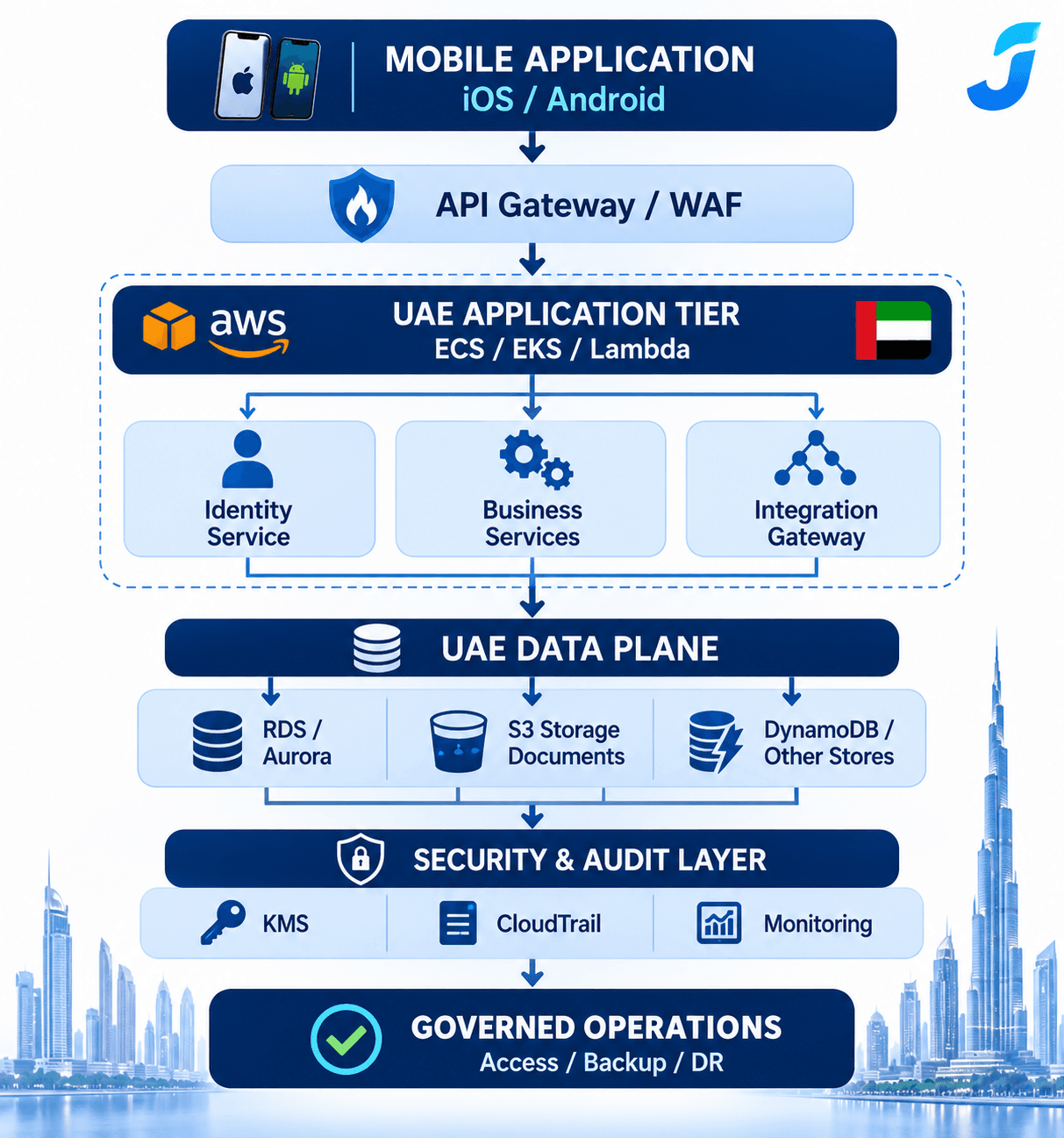
This is a logical reference architecture, not a guarantee that every listed service or capability is available in the UAE Region.
AWS services to evaluate
| Architecture requirement | AWS services |
|---|---|
| API protection | AWS WAF, API Gateway |
| Application compute | ECS, EKS, EC2, Lambda |
| Relational data | Amazon RDS, Aurora |
| Object storage | Amazon S3 |
| NoSQL workloads | DynamoDB |
| Encryption | AWS KMS, CloudHSM |
| Secrets management | AWS Secrets Manager |
| Infrastructure auditing | CloudTrail, AWS Config |
| Threat detection | GuardDuty, Security Hub |
| Monitoring | CloudWatch |
| Backup management | AWS Backup |
Before selecting a service, verify its availability and required features in the Middle East (UAE) Region.
Do not assume that all AWS services, global endpoints or optional features operate exclusively within the selected Region.
Regional deployment guardrails
A production deployment should enforce location constraints through infrastructure policy rather than developer instructions alone.
Recommended controls include:
- AWS Organizations service control policies for approved Regions.
- IAM restrictions on infrastructure creation.
- Terraform or CloudFormation policy validation.
- Automated checks for cross-region replication.
- Approved backup destinations.
- Deployment approval for services with global dependencies.
- Continuous configuration monitoring. A regional deployment policy should prevent unapproved resources from being introduced into production.
If a developer attempts to create a database or backup resource in an unapproved Region, the deployment pipeline should reject the change before production infrastructure is provisioned.
Who Is Responsible for Compliance? (RACI Matrix)
AWS provides cloud infrastructure, but compliance is a shared responsibility. The business, development partner and cloud provider each play a different role.
| Responsibility | Business | Development partner | Cloud provider |
|---|---|---|---|
| Legal compliance and regulatory advice | Owner | Advisor | Platform controls |
| Data classification | Owner | Implementer | — |
| Consent and privacy notices | Owner | Implementer | — |
| Encryption and key management | Owner | Implementer | Tooling and controls |
| Application security | Owner | Implementer | — |
| Identity and access management | Owner | Implementer | Platform controls |
| Incident response | Owner | Support | Platform alerts |
| Backup and recovery | Owner | Implementer | Infrastructure availability |
| Vendor due diligence | Owner | Advisor | — |
| Audit and monitoring | Owner | Implementer | Platform telemetry |
A mobile app development company in Dubai should implement technical controls and advise on architecture. It should not be treated as the sole owner of legal compliance.
4. Encryption, Confidential Computing and Data-in-Use Protection
Traditional cloud security focuses on protecting data at rest and in transit.
However, applications also need to consider what happens while sensitive information is actively being processed.
For a FinTech application, this may involve fraud-risk calculations using transaction information. For healthcare, it may involve processing clinical documents or patient records.
Confidential computing introduces hardware-backed trusted execution environments (TEEs) designed to help protect data during processing.
What confidential computing changes
A conventional encrypted database protects stored information. TLS protects information moving between systems. Neither control independently protects data while an authorised application process is using it.
A confidential computing architecture can introduce an additional isolation boundary around selected workloads.
Technology to evaluate includes:
- AWS Nitro Enclaves for isolated processing environments.
- Hardware-backed trusted execution environments.
- Attestation-based workload verification.
- Restricted key release policies.
- Separation between infrastructure administration and sensitive processing.
Example: Sensitive financial document processing
Consider a FinTech application that extracts information from financial documents.
A possible controlled workflow is:
- The document enters UAE-hosted object storage.
- The application classifies its sensitivity.
- A restricted processing workload receives the document.
- An isolated environment performs the sensitive operation.
- Encryption keys are released only after required verification.
- The output is returned to the approved application workflow.
- Processing metadata is logged without exposing the original document.
- Confidential computing does not automatically establish PDPL compliance or data residency. It does not remove the need to review service location, key management, access policies and third-party processing.
It should be evaluated as an additional protection layer where the threat model justifies it.
5. AWS Encryption, Identity and Administrative Access: Protecting the Actual Data Boundary
Encryption is necessary, but enterprise-grade data residency requires control over who can decrypt information and under which circumstances.
Customer-managed encryption keys
Use AWS KMS or an appropriate customer-managed key strategy for sensitive workloads.
Define:
- Key administrators separately from data administrators.
- Key usage permissions through restricted IAM policies.
- Rotation and recovery procedures.
- Logging of key-management activity.
- Separation between production and non-production environments.
- Backup encryption and key recovery processes. Where the risk model requires stronger key isolation, evaluate CloudHSM and other suitable key-management arrangements.
A customer-managed key does not automatically establish data residency. Its location, access permissions, recovery mechanisms and supporting services must also be assessed.
Zero Trust and UAE digital identity
A successful login should not automatically provide unrestricted access to all application resources.
Zero Trust architecture evaluates identity, device context, workload permissions and resource access continuously.
For UAE mobile applications, relevant considerations include:
- UAE PASS integration where appropriate.
- Federated identity and secure authentication.
- Multi-factor authentication.
- Device and session risk assessment.
- Workload identity for service-to-service communication.
- Short-lived credentials.
- Context-aware authorisation.
- Privileged access monitoring. UAE PASS can support digital identity and authentication journeys, but it should not be treated as a replacement for application-level authorisation.
A user authenticated through UAE PASS must still receive only the permissions appropriate to their role and the requested operation.
Privileged access architecture
Production database access should not depend on shared developer credentials or unrestricted administrator accounts.
Implement:
- Federated identity and MFA.
- Role-based access control.
- Short-lived credentials.
- Just-in-time production access.
- Session recording where appropriate.
- Separate production and development accounts.
- Periodic access recertification.
- Logged emergency-access procedures. For an overseas engineering team, establish whether remote access to personal or regulated information creates a cross-border disclosure or processing issue under the applicable framework.
Where practical, developers should troubleshoot using masked data, synthetic datasets and restricted diagnostic tools instead of unrestricted production records.
6. FinTech Apps: Engineering Around the Master System of Record
For a regulated banking application, the most important architectural question is not simply where the mobile app runs.
It is where the authoritative financial records are maintained and how confidential customer information moves between systems.
Separate the financial system of record from operational workloads
A practical architecture should distinguish:
Core financial records
Customer account information.
Authoritative transaction records.
Account balances.
Financial reconciliation records.
Confidential customer information.
Supporting application workloads
Mobile application sessions.
Notification preferences.
Product analytics.
Marketing consent.
Customer support metadata.
Non-sensitive application configuration. This separation reduces the risk that a marketing or analytics integration becomes an uncontrolled channel for financial information.
For banks subject to applicable CBUAE outsourcing requirements, the Master System of Record and customer confidential data must be addressed according to the relevant UAE storage and access requirements.
Payment data architecture
Payment processing should be designed around the actual role of the application and its payment provider.
Use:
- Tokenisation where supported.
- Secure payment-provider integrations.
- Webhook signature verification.
- Idempotency controls.
- Immutable transaction audit events.
- Reconciliation workflows.
- Restricted access to payment credentials. Avoid collecting or storing raw payment credentials unless the business model and compliance scope specifically require it.
FinTech AI: Separate Fraud Intelligence From Unrestricted Customer Data
AI can support fraud detection, document processing, transaction classification and customer-service automation.
However, sending complete customer transaction histories to an external model is rarely a sensible default.
Instead, design a controlled inference pipeline:
- Extract the minimum features required for the use case.
- Remove direct customer identifiers where possible.
- Tokenise sensitive fields.
- Evaluate the model provider's processing location.
- Restrict prompt and output retention.
- Record model decisions and relevant supporting evidence.
- Require appropriate human review for consequential decisions. For regulated financial institutions, assess the applicable outsourcing and regulatory approval requirements before introducing external AI processing.
7. Healthcare Apps: Clinical Data Needs a Separate Processing Boundary
Healthcare architecture requires stronger separation between clinical information and ordinary application activity.
A patient-facing mobile application may contain several different data domains:
| Domain | Examples |
|---|---|
| Patient identity | Name, Emirates ID, contact details |
| Clinical records | Diagnoses, prescriptions, laboratory results |
| Appointments | Booking history, clinician schedules |
| Billing | Invoices and payment status |
| Analytics | Aggregated product usage |
| Support | Technical complaints and service requests |
These domains should not automatically share the same access permissions or processing destinations.
Clinical data access and separation
A production healthcare application should implement:
- Separate patient and clinical data access policies.
- Clinician-specific permissions.
- Patient authentication.
- Access logging for medical records.
- Emergency access with documented justification.
- Restricted administrative access.
- Retention rules aligned with applicable healthcare requirements.
- Controlled exports and integrations. A support representative may need access to appointment status but should not automatically receive access to a patient's complete clinical history.
Healthcare interoperability: FHIR and secure clinical data exchange
Healthcare applications rarely operate independently.
They may exchange information with:
- Hospital information systems.
- Electronic medical record platforms.
- Laboratory information systems.
- Pharmacy platforms.
- Insurance providers. - Telemedicine systems.
- Health information exchange networks. HL7 FHIR (Fast Healthcare Interoperability Resources) provides a standard for exchanging healthcare information through structured resources and APIs.
However, adopting FHIR does not automatically make an integration secure or compliant.
An enterprise healthcare architecture should consider:
- Patient identity matching: Ensure that information is linked to the correct patient across participating systems.
- Consent propagation: Make sure the permissions governing a record are considered when information is requested by another system.
- API authorisation: Apply resource-level access restrictions to clinical information.
- Auditability: Record which system or authorised user accessed a medical resource and when.
- Data minimisation: Exchange only the clinical information required for the specific workflow.
- Interoperability boundaries: Review the location and regulatory status of every external hospital, laboratory, insurer or clinical integration.
This becomes particularly important when patient information is exchanged across multiple healthcare organisations.
Health information and external processing
Federal Law No. 2 of 2019 makes external processing a particularly important design consideration.
Consider a medical document summarisation feature.
The application stores a patient's report in an AWS UAE S3 bucket. The backend extracts the text and forwards it to an external AI provider.
Although the original document remains in Dubai, the clinical information is now being processed elsewhere.
Before implementing this workflow, determine:
- Whether the processing relates to healthcare services provided in the UAE.
- Whether applicable health-data localisation requirements apply.
- Whether a specific legal exception or Health Authority approval covers the processing.
- Whether required patient consent and other conditions apply.
- Whether a UAE-based processing alternative is available. For clinical workflows, a UAE-hosted processing environment may be preferable where it satisfies the required technical and regulatory conditions.
UAE Sector Regulators to Assess
PDPL is not the only framework a FinTech or healthcare app may need to consider. The applicable requirements depend on the business activity, jurisdiction, customer type and data being processed.
| Sector | Authorities and frameworks to assess |
|---|---|
| FinTech | Central Bank of the UAE (CBUAE), DFSA for DIFC entities, payment partners and outsourcing requirements |
| Healthcare | Dubai Health Authority (DHA), Department of Health Abu Dhabi where relevant, clinical governance and health-data requirements |
| Real estate | Dubai Land Department, Real Estate Regulatory Agency (RERA) and Department of Economy and Tourism |
| Insurance | CBUAE, DFSA for DIFC entities and insurance-specific requirements |
| Virtual assets | Virtual Assets Regulatory Authority (VARA) in Dubai |
This table is a starting point, not legal advice. The applicable regulator and approval process depend on the product’s activity, jurisdiction and data-processing model.
8. AI, Sensitive Data and Access Control: RAG & Agentic Residency in 2027
AI architecture introduces more data destinations than conventional application architecture.
The problem is not limited to sending a prompt to a large language model.
Modern AI applications can include document extraction, embedding generation, vector search, model inference, agent tools, external APIs and observability platforms.
Each component can introduce a different processing location.
The complete AI data lifecycle
A production retrieval-augmented generation (RAG) system may follow this workflow:
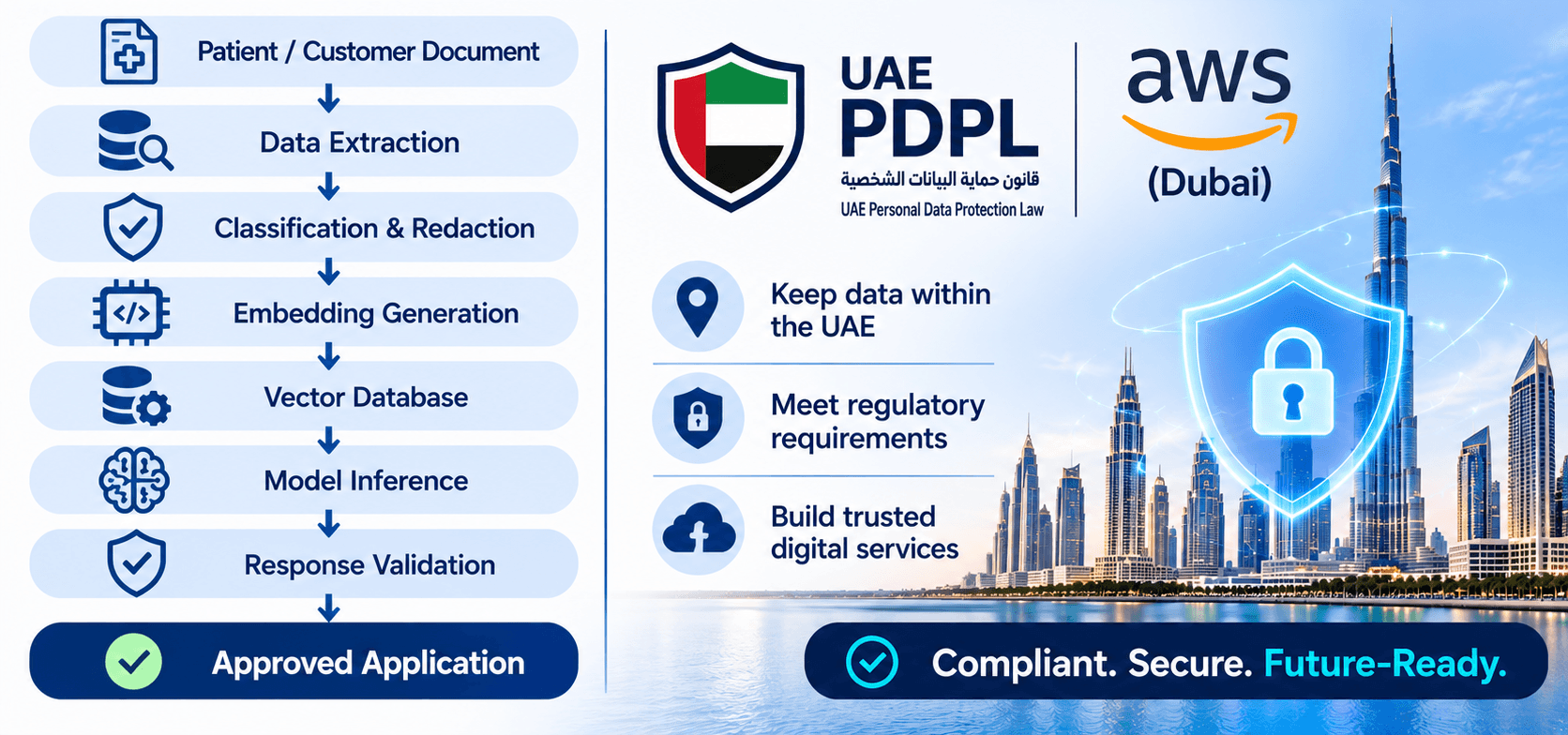
For each stage, document:
- Processing location.
- Storage location.
- Data classification.
- Model provider.
- Subprocessors.
- Prompt and response retention.
- Access permissions.
- Deletion requirements. A common mistake is keeping the original documents in UAE object storage while sending their extracted text or embeddings to an external service without reviewing the transfer.
AI model security: Prompt injection, data poisoning and model leakage
Data residency alone does not protect an AI application from attacks against its models and processing pipeline.
A healthcare RAG system, for example, might retrieve a maliciously modified document that attempts to instruct the model to reveal other patient information.
A FinTech AI assistant might receive a prompt designed to expose internal transaction information or misuse an authorised integration.
Important threats include:
- Prompt injection: Malicious instructions embedded in user input or retrieved documents.
- RAG data poisoning: Manipulated documents or knowledge-base content that influences model responses.
- Sensitive output leakage: The model reveals information that the requesting user is not authorised to access.
- Model supply-chain risk: Compromised model packages, dependencies or third-party AI components.
- Excessive agent permissions: An AI agent performs actions beyond the intended business workflow.
- Model and prompt logging exposure: Sensitive information is retained in debugging and observability systems.
Engineering controls should include:
- Retrieval-level authorisation.
- Document provenance checks.
- Input and output validation.
- Tool allowlists.
- Restricted agent permissions.
- Sensitive-field filtering.
- Adversarial testing.
- Human approval for consequential actions.
- AI-specific incident monitoring. For healthcare and financial applications, model output must not become an unrestricted source of clinical or financial authority.
UAE National Cyber Security Policy for Artificial Intelligence
The UAE's National Cyber Security Policy for Artificial Intelligence provides a relevant national reference for organisations developing or deploying AI systems.
It addresses AI governance, infrastructure and application security, algorithm protection, operational safety, adversarial attacks, monitoring and incident response.
These themes should influence AI architecture reviews, particularly when AI is used in sensitive or business-critical workflows.
A practical implementation should maintain:
- An inventory of AI models and services.
- Model ownership and approved use cases.
- Training and retrieval data controls.
- Model access restrictions.
- AI threat assessments.
- Vulnerability and change management.
- Monitoring and incident response.
- Human oversight for critical decisions. Official reference: https://u.ae/en/about-the-uae/strategies-initiatives-and-awards/policies/cyber-activities/The-National-Cyber-Security-Policy-for-Artificial-Intelligence
Cloud AI versus on-premises AI
The decision should be based on workload classification, processing requirements, model availability and operating cost.
| Approach | Potential advantage | Main engineering consideration |
|---|---|---|
| UAE-region cloud AI | Managed infrastructure and scalable inference | Verify actual in-region processing and dependencies |
| On-premises AI | Direct control over model infrastructure | GPU capacity, patching, operations and maintenance |
| Hybrid AI | Different processing paths for different data classes | Reliable routing and policy enforcement |
| Private model deployment | Greater control over model execution | Infrastructure, security and lifecycle management |
A UAE-hosted AI application is not automatically a UAE-processed AI application.
Model inference, embedding generation, telemetry and external tool calls must be assessed separately.
Agentic AI requires additional controls
As applications adopt autonomous agents, the residency problem becomes more complex.
An agent might retrieve a customer document, call an external API, write to a CRM and generate a support ticket.
The model itself may not be the only component handling sensitive information.
Implement:
- Tool allowlists.
- Data-classification-aware routing.
- Restricted agent permissions.
- Human approval for sensitive actions.
- Prompt and tool-call logging with redaction.
- Limits on external data retrieval.
- Controlled memory and conversation retention. For 2027, AI governance should be treated as part of application architecture from the beginning, not as a feature added after deployment.
9. Post-Quantum Cryptography: Preparing Long-Lived Financial and Healthcare Data
Post-quantum cryptography (PQC) is an important future-readiness consideration for organisations that manage sensitive information with long confidentiality requirements.
The concern is often described as "harvest now, decrypt later": an attacker collects encrypted information today and attempts to decrypt it in the future if sufficiently capable quantum computers become available.
For healthcare and financial organisations, some information may remain sensitive for many years.
This makes cryptographic migration planning relevant even when a quantum-capable attack is not currently practical.
What should engineering teams prepare?
Start with a cryptographic inventory covering:
- TLS configurations.
- Public-key certificates.
- Key exchange mechanisms.
- Digital signatures.
- API authentication.
- Mobile application communication.
- Database and backup encryption.
- Third-party cryptographic dependencies. Then identify systems that depend on algorithms expected to require migration.
Build crypto-agility into the architecture
Crypto-agility means designing systems so cryptographic algorithms and configurations can be changed without rebuilding the entire application.
Practical steps include:
- Maintain an inventory of cryptographic dependencies.
- Identify long-lived sensitive information.
- Track vendor support for approved post-quantum standards.
- Design replaceable cryptographic interfaces.
- Test protocol and certificate compatibility.
- Plan staged migration for critical systems.
- Review third-party providers and mobile SDK dependencies.
NIST published its post-quantum cryptography standards in 2024 and its transition roadmap, NIST IR 8547, in October 2026.
This makes 2027 a sensible time to begin cryptographic discovery and migration planning for long-lived sensitive systems.
It does not mean every UAE mobile application must immediately replace all existing encryption algorithms.
Official reference: https://csrc.nist.gov/pubs/ir/8547/final
10. UAE Digital Sovereignty and Cloud Concentration Risk
Hosting in the UAE and maintaining control over digital infrastructure are related but different objectives.
Digital sovereignty concerns the ability to govern, access, protect and maintain control over critical digital assets and dependencies.
A company may deploy its primary workload in AWS Dubai while relying on external identity services, global SaaS providers, overseas support teams and proprietary application dependencies.
This creates a broader operational dependency than the location of the primary database suggests.
What happens if a critical cloud dependency becomes unavailable?
Consider a regulated financial application that depends on:
- A single cloud provider.
- One identity service.
- One external payment gateway.
- One AI inference provider.
- One overseas monitoring platform. Even if the primary AWS Region remains operational, the application may become unavailable when one of these external services fails.
The business should identify which dependencies are critical and which can be replaced.
Multi-cloud versus hybrid cloud
| Architecture | Appropriate use case | Main trade-off |
|---|---|---|
| Single-region cloud | Controlled workload with manageable dependency risk | Regional concentration |
| Multi-region cloud | High availability where approved | Replication and regulatory complexity |
| Multi-cloud | Selected critical workloads requiring provider flexibility | Operational complexity and inconsistent services |
| Hybrid cloud | Workloads requiring private infrastructure integration | Network and operational management |
| Private infrastructure | Specialised control requirements | Capital, capacity and maintenance |
Multi-cloud should not be adopted simply because it sounds more resilient.
It introduces additional identity systems, monitoring platforms, networking arrangements and data-transfer paths.
For regulated workloads, an architecture with a tested recovery strategy and clear provider exit plan may be more effective than an unnecessarily complicated multi-cloud deployment.
UAE National Cloud Security Policy
The UAE National Cloud Security Policy provides a national reference for cloud security governance, privacy, protection of cloud resources and incident response.
Engineering teams should use it alongside applicable sector-specific regulations and organisational security standards when evaluating cloud service providers and operating models.
Official reference: https://uaelegislation.gov.ae/en/policy/details/lsy-s-lotny-llamn-lsh-by
11. Software Supply-Chain Security: SBOM, SDKs and Build Provenance
A mobile application is not built entirely from code written by its development team.
It may contain hundreds of dependencies, including:
- Open-source libraries.
- Payment SDKs.
- Analytics packages.
- Authentication components.
- Third-party APIs.
- Container images.
- AI model dependencies.
- Build and deployment tools. A vulnerability or compromised dependency can affect the security of the entire application.
For a FinTech or healthcare application, supply-chain security should be part of the residency and compliance assessment because third-party components may also introduce unexpected data collection and external processing.
What is an SBOM?
A Software Bill of Materials (SBOM) is a structured inventory of software components and dependencies used in an application.
It helps engineering and security teams identify:
- Which components are included in a release.
- Which versions are deployed.
- Whether known vulnerabilities affect the application.
- Which dependencies need replacement.
- Whether a compromised library is present.
- Which external components require security review.
Build a software supply-chain control process
A production-ready mobile application pipeline should include:
- Dependency inventory: Generate an SBOM for application releases and important backend components.
- Dependency scanning: Identify vulnerable and outdated packages.
- Build provenance: Record where application artifacts were built and which source revisions were used.
- Artifact signing: Verify the integrity and origin of release artifacts.
- Secret scanning: Prevent credentials and keys from entering source control.
- SDK privacy review: Verify the information collected by mobile libraries.
- AI component review: Assess model packages, plugins and external AI dependencies.
- Release verification: Ensure production releases originate from approved pipelines.
The objective is not to remove every third-party dependency. It is to understand, monitor and control the components that enter the production environment.
12. Third-Party Services and Cross-Border Data Flows: Mobile SDK Risks Outside AWS
A mobile app development company in UAE should audit the complete mobile application dependency chain before approving a production release.
Native mobile applications frequently depend on services that operate independently of the primary backend.
Examples include:
| Integration | Residency review |
|---|---|
| Firebase Analytics | Event fields, identifiers and processing location |
| Crashlytics | Stack traces, device identifiers and captured request information |
| Customer support SDKs | Ticket content and agent access |
| Push notifications | Payload content and notification metadata |
| Payment gateways | Transaction information and webhook processing |
| Maps and location APIs | Location collection and retention |
| Email and SMS | Message content and delivery logs |
| AI APIs | Prompt processing, model location and retention |
These are examples to audit, not a statement that every named provider necessarily transfers data outside the UAE.
Build a third-party data dependency register
For every SDK and external service, record:
- What information does it receive?
- Is the information personal, sensitive or regulated?
- Where is it stored?
- Where is it processed?
- Which subprocessors are involved?
- Can the collected information be minimised?
- What contractual safeguards apply?
- How can data be deleted or exported?
- Who is authorised to access it? A vendor's security certification alone does not answer all these questions.
Review the data-processing agreement, subprocessor list, breach-notification terms, retention policy and exit procedures.
13. Data Residency Testing: Prove That the Architecture Matches the Design
A data-flow diagram describes intended behaviour. Production testing should establish whether the application actually behaves that way.
For enterprise applications, residency validation should become part of the software delivery lifecycle.
Automated residency controls
| Control | Implementation approach |
|---|---|
| Region restrictions | AWS Organizations SCPs and IAM policies |
| Infrastructure validation | Terraform and CloudFormation policy checks |
| Storage audits | S3, database and backup inventory |
| Replication monitoring | Configuration and event monitoring |
| External API review | Integration inventory and endpoint testing |
| Access validation | CloudTrail and privileged access reviews |
| Sensitive log detection | Redaction and DLP scanning |
| Configuration drift | AWS Config and automated remediation |
CI/CD residency validation
A production deployment pipeline should include an architecture-policy stage.
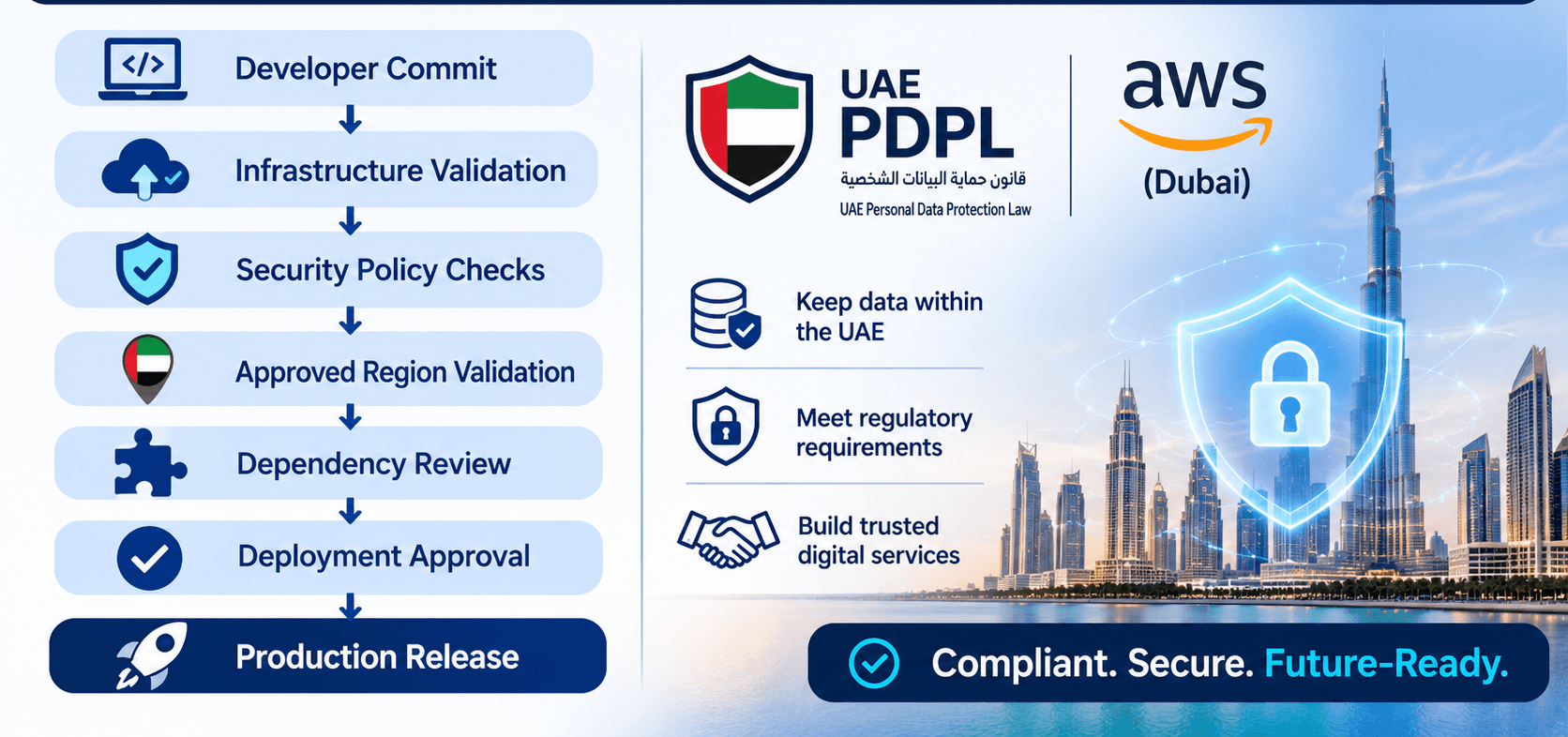
If a deployment introduces an unapproved storage location, replication destination or external processing dependency, the pipeline should flag the change before release.
Maintain evidence of:
- Approved infrastructure configurations.
- Data-flow reviews.
- Vendor approvals.
- Access reviews.
- Security test results.
- Backup restoration tests.
- Remediation activities. The objective is continuous evidence generation rather than preparing a collection of screenshots immediately before an audit.
14. Disaster Recovery Without Breaking UAE Data Residency
Traditional cloud disaster recovery often uses replication to another geographic Region.
For regulated workloads, this introduces a difficult trade-off between availability and data-location requirements.
Consider a healthcare application whose primary deployment operates in AWS Dubai. If the Region becomes unavailable, an automatic failover to another country could introduce an unapproved external processing or storage arrangement.
The disaster recovery design must therefore be approved before production deployment.
Residency-aware disaster recovery strategy
Consider:
- UAE-based backup storage where required.
- Encrypted and access-controlled backup vaults.
- Immutable backups where appropriate.
- Defined Recovery Point Objectives (RPO).
- Defined Recovery Time Objectives (RTO).
- Regular restoration and integrity tests.
- Encryption-key recovery procedures.
- Documented regional outage procedures.
- Approved failover destinations. For financial institutions, align recovery planning with applicable CBUAE outsourcing and business continuity requirements.
For healthcare systems, assess the applicable health-data rules and any approval needed for external processing.
A backup that has never been restored is not a proven recovery strategy.
15. Data Breach Forensics and Regulatory Incident Readiness
A data breach involving a regulated mobile application rarely affects only one infrastructure component.
An incident might originate from a compromised mobile SDK, an exposed API credential, an administrator account or a third-party AI service.
The response team must understand which information was accessed, where it went and which organisations or subprocessors were involved.
Build an evidence-ready incident response architecture
Maintain:
- Centralised infrastructure audit logs.
- Authentication and privileged-access events.
- API request metadata with sensitive fields redacted.
- Database access records.
- Deployment and configuration-change histories.
- Third-party integration inventories.
- AI tool-call and model activity records where appropriate.
- Incident timelines and evidence preservation procedures.
Questions to answer during an incident
- Which data categories were affected?
- Which customers or patients may be involved?
- Was the information accessed, copied or transmitted?
- Which infrastructure and external services were involved?
- Did the incident introduce a cross-border disclosure?
- Which contractual and regulatory notification requirements apply?
- What containment and recovery actions are required?
- Incident notification obligations and deadlines must be determined under the applicable legal and sector-specific framework.
Do not assume that one notification deadline applies to every UAE organisation.
For AI-enabled systems, include model and agent activity in the investigation. A compromised agent may access information through authorised tools even when the underlying database has not been directly breached.
16. Data Retention, Deletion and Cloud Exit: Design the Entire Lifecycle
Data residency should not end when a record is saved to a database.
A regulated application needs to control what happens throughout the information lifecycle.
A customer deletion request, for example, may affect:
- Primary database records.
- S3 object versions.
- Search indexes.
- Analytics systems.
- Application logs.
- AI prompt histories.
- Customer support records.
- Third-party processors.
- Backups and snapshots. Deletion must be implemented in accordance with applicable retention obligations. Financial and healthcare records may be subject to mandatory retention requirements, so not every record can necessarily be erased immediately.
Design a data lifecycle policy
Each data category should have:
- A defined collection purpose.
- An approved storage location.
- A retention period.
- An authorised access group.
- A deletion or archival procedure.
- A documented legal retention exception, where applicable.
Cloud exit planning
A regulated business should also know how it will leave its cloud provider or replace a critical service.
A practical cloud exit plan includes:
- Complete data export procedures.
- Database portability assessment.
- Encryption-key ownership and recovery.
- Backup migration and restoration.
- Third-party contract termination.
- Subprocessor data deletion.
- Evidence of data return or destruction.
- Business continuity during migration. For regulated financial institutions, applicable CBUAE outsourcing requirements make data access, termination arrangements and provider transition particularly important.
17. AWS Dubai vs Hybrid Cloud vs Private Infrastructure: Which Architecture Should UAE Businesses Choose in 2027?
The right architecture depends on data classification, regulatory requirements, workload performance, operational capability and business continuity objectives.
A single deployment model will not suit every FinTech or healthcare product.
| Business scenario | Architecture to evaluate | Main consideration |
|---|---|---|
| Standard FinTech application | AWS UAE Region | Data classification and regulator requirements |
| Regulated banking workload | Approved UAE cloud architecture | Master System of Record and outsourcing obligations |
| Healthcare clinical platform | UAE-hosted controlled architecture | Health-data localisation |
| AI document processing | In-region AI or private deployment | Inference location and data handling |
| High-availability financial platform | UAE redundancy and approved DR | Recovery and regulatory constraints |
| Enterprise multi-provider environment | Hybrid or multi-cloud | Portability and concentration risk |
When AWS UAE Region makes sense
AWS UAE can be a strong option when the required services are available, the workload is appropriately classified and the architecture can meet the applicable regulatory and operational requirements.
When private infrastructure deserves consideration
Private infrastructure may be appropriate when specific workloads require dedicated processing controls, specialised hardware or integration with existing enterprise systems.
However, private infrastructure introduces additional responsibilities for patching, capacity, monitoring, physical security and disaster recovery.
When hybrid architecture makes sense
Hybrid architecture can support organisations that need a combination of cloud scalability and private infrastructure.
The important requirement is to establish explicit data boundaries between environments and prevent uncontrolled replication or integration.
Architecture selection should follow regulatory classification and workload requirements, not marketing claims about which hosting model is automatically more compliant.
18. What a Mobile App Development Company in UAE Should Deliver Before Go-Live
Selecting a mobile app development company in Dubai should involve more than comparing framework expertise, delivery timelines and development costs.
For a FinTech or healthcare application, the development partner should understand how product decisions affect the application's regulatory and technical architecture.
Before development begins, request the following deliverables.
Architecture and compliance deliverables
| Deliverable | What it should contain |
|---|---|
| Data inventory | Every personal and regulated data field |
| Data-flow diagram | Collection, transmission, storage and processing paths |
| Regulatory mapping | Applicable federal, free-zone and sector requirements |
| AWS architecture | Regional infrastructure and service dependencies |
| Vendor register | SDKs, APIs and external processors |
| IAM matrix | Roles, permissions and privileged access |
| AI processing assessment | Model location, prompts, embeddings and retention |
| Security threat model | Application, AI and infrastructure attack scenarios |
| SBOM | Software dependencies and component inventory |
| Backup and DR plan | Recovery design and approved destinations |
| Retention schedule | Data deletion and legal retention rules |
| Go-live evidence pack | Testing, approvals and configuration evidence |
Questions to ask a development partner
Before signing a software development agreement, ask:
- Can you map every third-party SDK used by the mobile application?
- Can you demonstrate how AWS deployment regions are restricted?
- How do you prevent personal information from entering crash logs?
- How are production database permissions granted and revoked?
- Can the application support UAE-based AI processing where required?
- How are backups, exports and disaster recovery controlled?
- Can you generate an SBOM for production releases?
- How do you assess AI model and software supply-chain risks?
- What happens to customer information when the development contract ends? A capable development partner should be able to explain the technical implementation and its limitations without promising legal compliance on behalf of the client.
For additional context, see our related guide: How Do UAE Data Residency and Data Protection Laws Affect Software Vendor Selection?.
19. UAE PDPL and AWS Dubai Production Go-Live Checklist for 2027
Use this checklist as an engineering acceptance framework. Regulatory and legal sign-off must remain separate from technical testing.
Regulatory readiness
- Applicable UAE regulatory framework identified.
- Federal PDPL applicability assessed.
- DIFC or ADGM requirements reviewed, where applicable.
- Healthcare or financial-sector requirements assessed.
- Cross-border transfer mechanisms documented.
- Data-processing agreements reviewed.
- Regulatory approvals obtained where required.
AWS architecture
- Approved AWS UAE Region deployment documented.
- Regional service availability verified.
- Infrastructure deployment restrictions configured.
- Production and non-production environments separated.
- Database and object storage locations verified.
- Replication destinations reviewed.
- Backup locations approved.
- Network and API boundaries documented.
Security and identity
- MFA enabled for privileged accounts.
- Least-privilege IAM policies implemented.
- Root credentials restricted.
- Secrets managed centrally.
- Encryption enabled in transit and at rest.
- Key access logged and restricted.
- Production access reviewed periodically.
- Security monitoring and alerts enabled.
- Zero Trust access controls reviewed.
- Confidential computing assessed where justified.
Mobile application and supply chain
- Analytics SDKs reviewed.
- Crash-reporting data redacted.
- Push notification payloads reviewed.
- Deep-link authentication tested.
- Sensitive data excluded from application logs.
- Third-party API destinations approved.
- SBOM generated for production releases.
- Critical dependency vulnerabilities reviewed.
- Release artifacts and build provenance verified.
- Arabic and English journeys tested.
AI readiness
- AI use cases classified.
- Model processing locations confirmed.
- Embedding and vector storage locations reviewed.
- Prompts and outputs protected.
- External model retention reviewed.
- Agent tools and permissions restricted.
- Adversarial AI testing performed.
- Human review defined for consequential decisions.
- AI monitoring and audit evidence enabled.
Future-readiness
- Cryptographic inventory created.
- Post-quantum migration requirements assessed.
- Cloud concentration risks documented.
- Critical provider dependencies identified.
- Cloud exit strategy documented.
- FHIR and clinical integrations reviewed where applicable.
Operations and lifecycle
- Data retention schedule approved.
- Deletion and export workflows tested.
- Backup restoration demonstrated.
- RPO and RTO documented.
- Incident response procedures established.
- Vendor register completed.
- Data breach evidence procedures tested.
- Production architecture evidence retained.
20. What Will Change in UAE Data Residency Engineering Beyond 2027?
Data residency is becoming an application architecture requirement rather than a standalone hosting preference.
Several developments deserve particular attention.
1. AI inference location will become an architecture-selection criterion
As AI becomes part of banking, insurance, healthcare and customer-service applications, organisations will increasingly need to assess where inference happens, not just where model data is stored.
The availability of UAE-based inference options may influence the selection of cloud platforms, model providers and private AI deployments.
2. Confidential computing will support more sensitive processing workloads
Hardware-backed isolation and attestation may become increasingly relevant for selected workloads involving confidential financial or healthcare information.
Adoption will depend on service availability, performance, cost and the actual threat model.
3. Post-quantum migration planning will enter enterprise security roadmaps
Long-lived sensitive records create a reason to evaluate cryptographic dependencies before quantum-resistant migration becomes urgent.
Cryptographic inventory and crypto-agility are sensible starting points.
4. Software vendors will face deeper operational scrutiny
Enterprise customers will increasingly evaluate development partners based on their ability to demonstrate data access controls, subcontractor governance, secure development practices, dependency management and production environment separation.
A software development agreement will need to address operational access and data handling, not just source-code ownership and delivery timelines.
5. Continuous compliance evidence will matter more than static documentation
Infrastructure changes continuously. New SDKs, AI integrations, database replicas and monitoring services can change the data-processing architecture after launch.
Automated policy checks, configuration monitoring and auditable deployment pipelines provide a stronger foundation than a one-time compliance assessment.
6. Digital sovereignty will influence enterprise cloud procurement
Organisations with critical workloads will increasingly assess provider concentration, operational dependencies, portability, local recovery capabilities and exit arrangements.
These are engineering trends to plan for, not predictions that a particular new legal obligation will automatically become effective in 2027.
Frequently Asked Questions
Should a UAE FinTech app use AWS Dubai or on-premise hosting?
AWS Dubai can support data residency for many FinTech workloads, but the right choice depends on regulatory expectations, existing systems and operational capacity. On-premise hosting may suit organisations needing maximum infrastructure control, while AWS Dubai offers a more scalable managed-cloud approach.
Does hosting in AWS Dubai remove the need for a privacy review?
No. AWS Dubai can support data residency, but it does not remove the need for a privacy review. The business must still assess data collection, consent, retention, third-party processors, cross-border transfers and sector-specific requirements.
Does AWS Dubai guarantee UAE PDPL compliance?
No. AWS Dubai provides infrastructure that can support UAE data residency. The business remains responsible for lawful processing, data classification, access management, encryption, retention, third-party integrations and applicable regulatory requirements.
Does the UAE PDPL require all application data to stay in the UAE?
No. The federal PDPL does not impose a blanket localisation requirement on all ordinary commercial personal data. Cross-border transfers are regulated under Articles 22 and 23, while sector-specific requirements may impose stricter restrictions.
Can a healthcare app store patient records in AWS Dubai?
A UAE-hosted architecture can support healthcare data requirements, but the application must also assess Federal Law No. 2 of 2019, its implementing framework, applicable Health Authority requirements and the location of all processing operations.
Can a FinTech application use overseas development teams?
Potentially, depending on the data involved, regulatory framework, outsourcing arrangements, access permissions and applicable cross-border transfer requirements. Overseas access should be assessed before production access is granted.
Does a UAE-hosted database prevent cross-border data transfers?
No. External APIs, analytics platforms, support systems, AI endpoints, remote administrative access and backup services may introduce additional data-processing or transfer activities.
Can AI process patient information outside the UAE?
Not automatically. Health data relating to healthcare services provided in the UAE is subject to specific localisation restrictions and applicable exceptions or approvals. Obtain a sector-specific legal assessment before implementing overseas AI processing.
What is confidential computing and why does it matter for UAE applications?
Confidential computing uses hardware-backed isolation to help protect data while it is being processed. It can provide an additional security boundary for sensitive workloads, but it does not independently establish legal compliance or data residency.
Should UAE FinTech companies prepare for post-quantum cryptography?
Organisations managing long-lived sensitive information should begin by inventorying cryptographic dependencies and evaluating migration readiness. This is a future-readiness recommendation rather than a blanket UAE legal requirement.
Is multi-cloud more compliant than AWS Dubai?
No. Multi-cloud can improve provider flexibility in selected scenarios, but it also introduces additional data flows, identity systems, operational complexity and vendor dependencies. Compliance depends on the actual architecture and applicable rules.
What should a mobile app development company in Dubai provide for a regulated project?
A development partner should provide a documented architecture, data-flow map, integration register, access-control design, security implementation, testing evidence, software dependency inventory and deployment documentation. Legal and regulatory approval should be obtained from appropriately qualified advisers.
What should businesses evaluate before choosing AWS Dubai hosting?
Evaluate regulatory applicability, AWS service availability, data classification, cross-border dependencies, encryption, access controls, backup requirements, AI processing, disaster recovery and cloud exit arrangements before selecting the final deployment architecture.
Conclusion: Build Data Residency Into the Application, Not Just the Cloud Deployment
AWS Dubai is an important infrastructure option for organisations building regulated digital products in the UAE. However, selecting the UAE Region is only the starting point.
A genuinely residency-aware application must control the entire data lifecycle: mobile collection, API transmission, database storage, AI inference, analytics, third-party integrations, administrative access, backup, disaster recovery and eventual deletion.
For FinTech applications, that means understanding the applicable financial regulator's outsourcing requirements and protecting authoritative customer and transaction records.
For healthcare applications, it means engineering around health-data localisation, clinical information access, interoperability and restrictions on external processing.
For AI-enabled applications in 2027, it means evaluating every stage of the model pipeline, protecting against adversarial threats and controlling how autonomous agents interact with sensitive information.
For enterprise cloud environments, it also means preparing for confidential computing, post-quantum cryptography, software supply-chain threats and provider concentration risk.
A capable mobile app development company in UAE should start with a data-flow map, regulatory assessment, security threat model and infrastructure design before selecting the technology stack.
At Codenicely Studio, the engineering objective should be to build applications where data location, access, processing, security and lifecycle controls are considered from the first architecture decision, not added as a compliance exercise before launch.
Planning a FinTech or healthcare mobile application for the UAE market? Start with an architecture assessment that identifies your data categories, AWS deployment requirements, external integrations, AI processing requirements and sector-specific dependencies before development begins.